COAL MICROLITHOTYPES AND
THEIR USAGE IN INTERPRETING
DEPOSITIONAL ENVIRONMENT
BY
OLATINPO, OLUSEGUN AYOBAMI
14/68ET003
OUTLINE
Introduction
Coal Microlithotypes
Microlithotype Analysis
Significance of Coal Microlithotypes for
Interpreting Depositional Environment
Summary and Conclusion
7/11/2015 OLUSEGUN OLATINPO (2015) 2
Introduction
• Coal is described as an organic sedimentary rock
usually found in layers with other sedimentary
rocks such as shale, limestone and sandstone
• It is a combustible rock
• The major chemical elements in coal are: carbon,
hydrogen, oxygen, nitrogen, and sulphur
7/11/2015 OLUSEGUN OLATINPO (2015) 3
CONTD
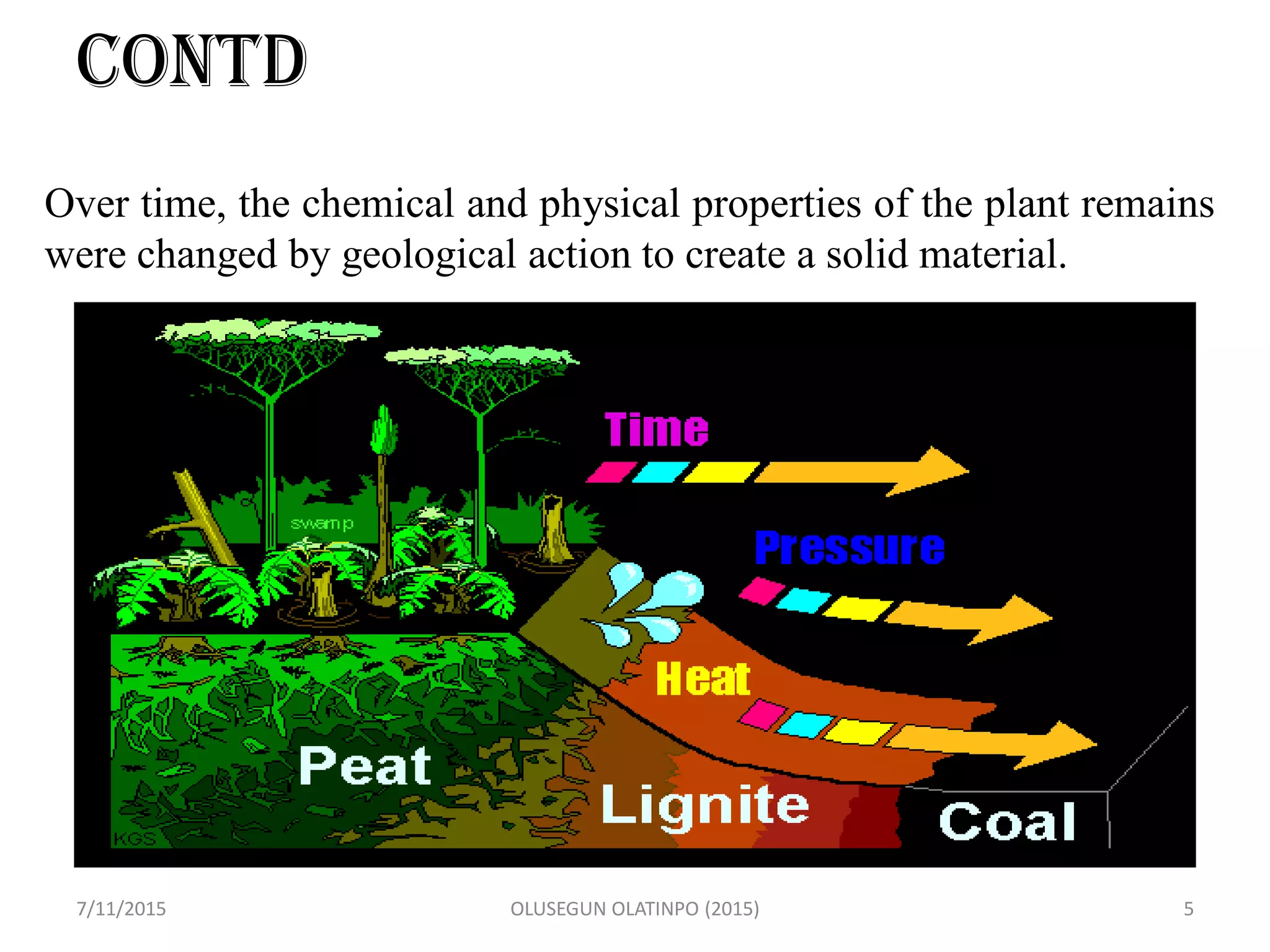
The process of coal formation from organic
compounds includes two distinct phases:
1. Biochemical phase
plant material – peat – lignite
2. Geochemical phase
lignite – bituminous coal – anthracite
7/11/2015 OLUSEGUN OLATINPO (2015) 4
CONTD
7/11/2015 OLUSEGUN OLATINPO (2015) 5
Over time, the chemical and physical properties of the plant remains
were changed by geological action to create a solid material.
COAL MICROLITHOTYPES
 Microlithotype was developed to permit the designation of rock
types within coal that are at a microscopic scale and their definition
is based on maceral percentages.
 Microlithotypes are natural associations of macerals in coals at
microscopic level.
 In addition to the maceral content, 20–60% (vol.) of silicate or
carbonate minerals or 5–20% (vol.) sulfide minerals redefines
themicrolithotype as a carbominerite.
 All macerals have a suffix "-inite" and microlithotypes have the
suffix "-ite".
7/11/2015 OLUSEGUN OLATINPO (2015) 6
CONTD
Macerals are the basic and relatively homogenous
organo-petrographic entities of coal which by their
chemical composition and physical characteristics
determine its properties and utilization.
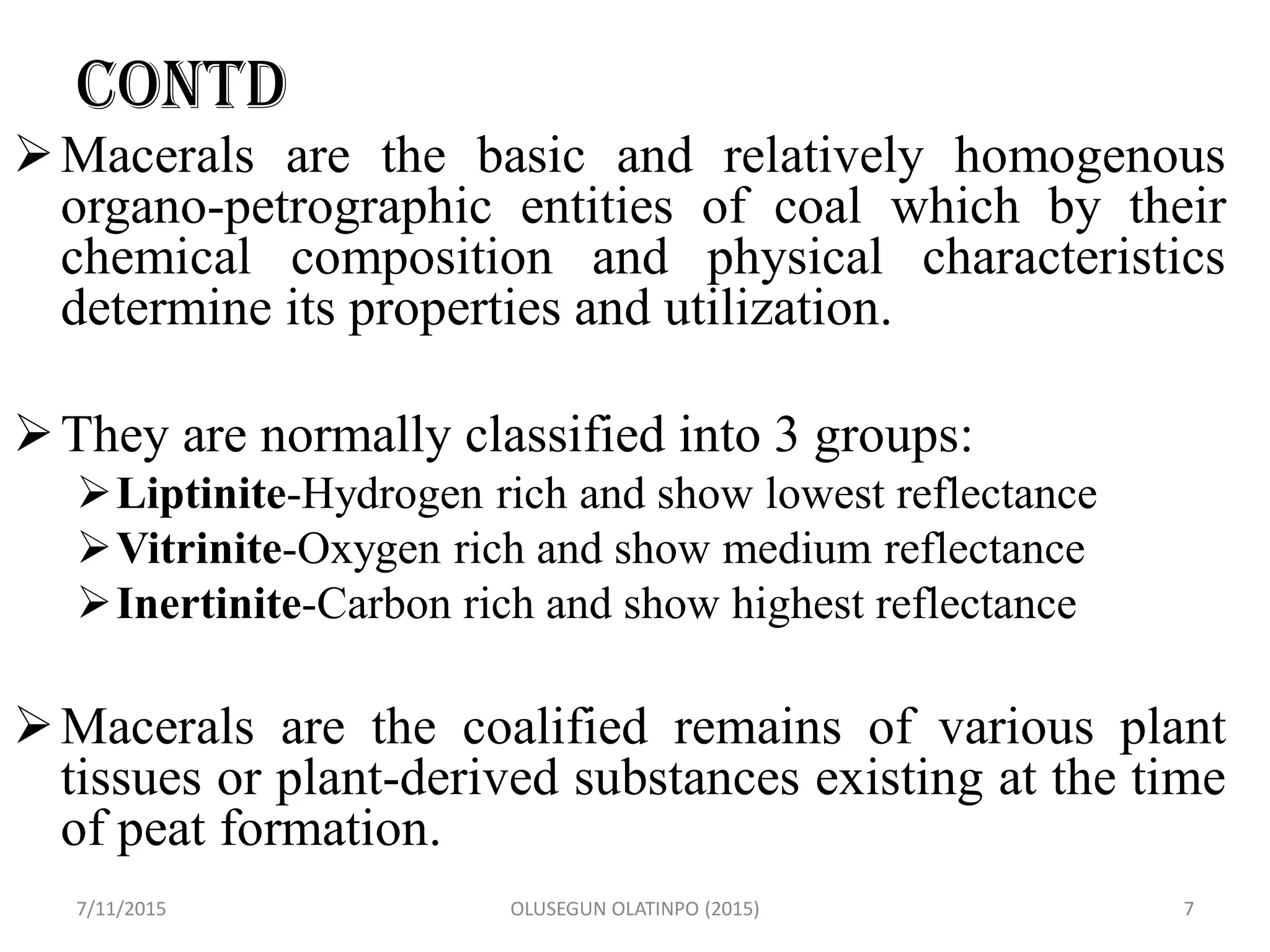
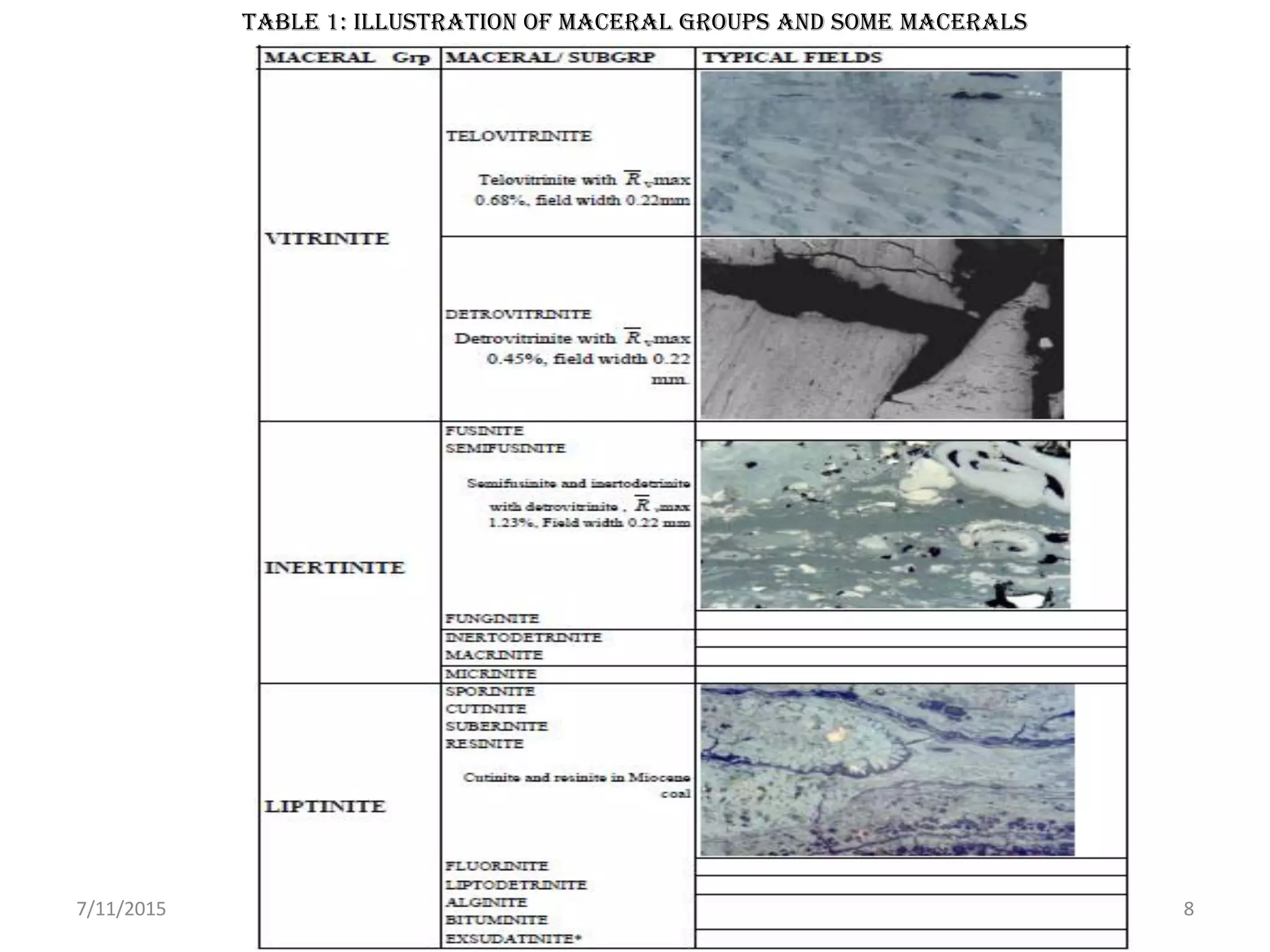
They are normally classified into 3 groups:
Liptinite-Hydrogen rich and show lowest reflectance
Vitrinite-Oxygen rich and show medium reflectance
Inertinite-Carbon rich and show highest reflectance
Macerals are the coalified remains of various plant
tissues or plant-derived substances existing at the time
of peat formation.
7/11/2015 OLUSEGUN OLATINPO (2015) 7
TABLE 1: ILLUSTRATION OF MACERAL GROUPS AND SOME MACERALS
7/11/2015 OLUSEGUN OLATINPO (2015) 8
CONTD
 The formation of macerals from plant remains during the early
stages of peat accumulation depends on th:
 type of plant community,
 climatic and
 ecological controls, and
 conditions of the depositional environment
 In polished sections under the microscope using incident light,
macerals are identified on the basis of their optical properties.
 Thus, layers of a particular maceral group greater than 0.05 mm
in thickness and consisting of greater than 95% of a particular
maceral are termed after the maceral group e.g vitrinite maceral
group forms vitrite microlithotype.
7/11/2015 OLUSEGUN OLATINPO (2015) 9
CONTD
Microlithtypes are classified into three groups based on
number macerals they contain :
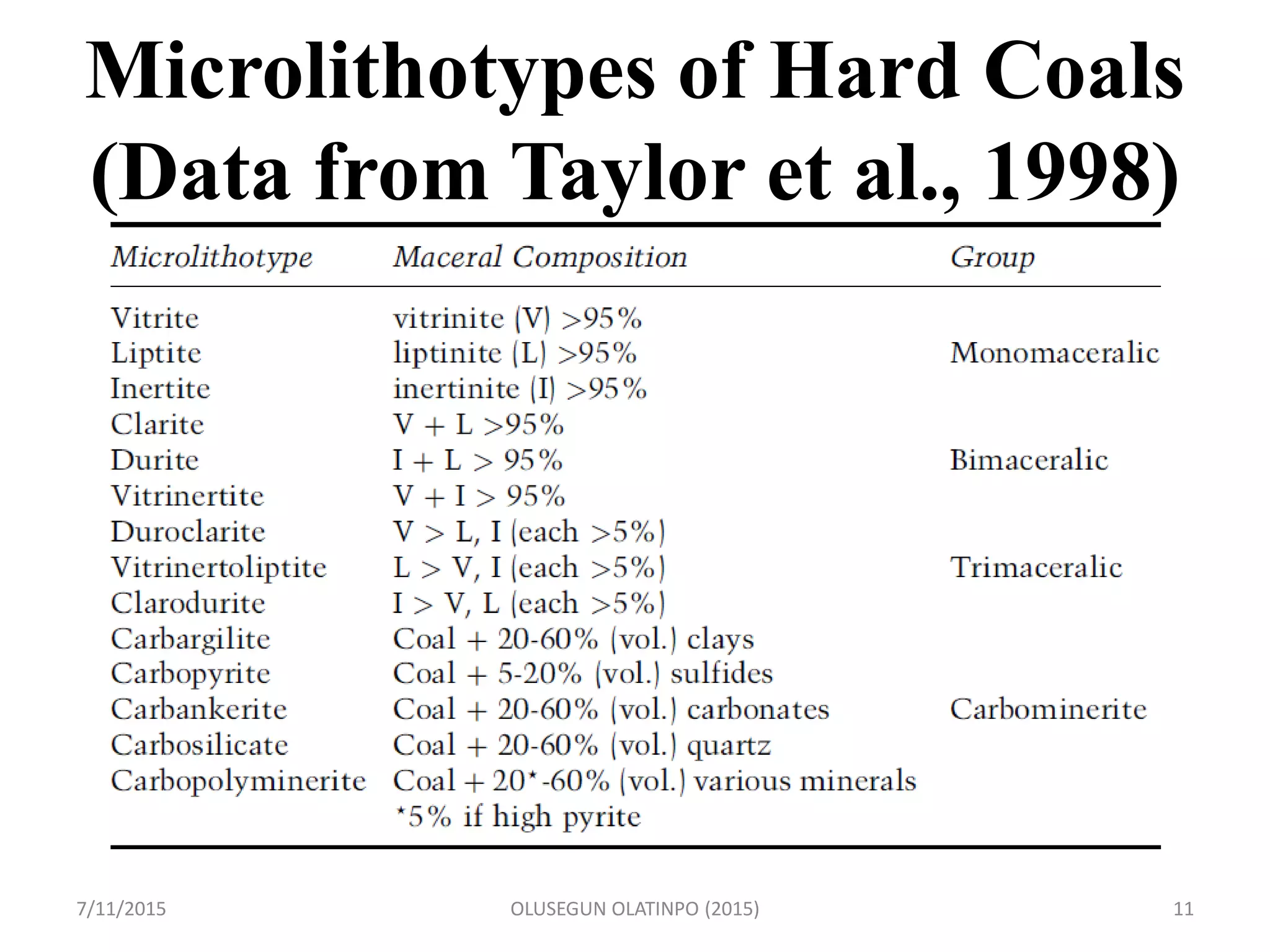
Monomaceral- type consist of one maceral group
examples are vitrite (over 95% vitrinite) and inertite
(over 95% inertinite)
Bimaceral- consist of 2 maceral groups examples are
clarite, durite and vitrinertite.
Trimaceral-consist of 3 maceral groups examples are
duroclarite, clarodurite and vitrinertoliptite.
7/11/2015 OLUSEGUN OLATINPO (2015) 10
Microlithotypes of Hard Coals
(Data from Taylor et al., 1998)
7/11/2015 OLUSEGUN OLATINPO (2015) 11
CONTD
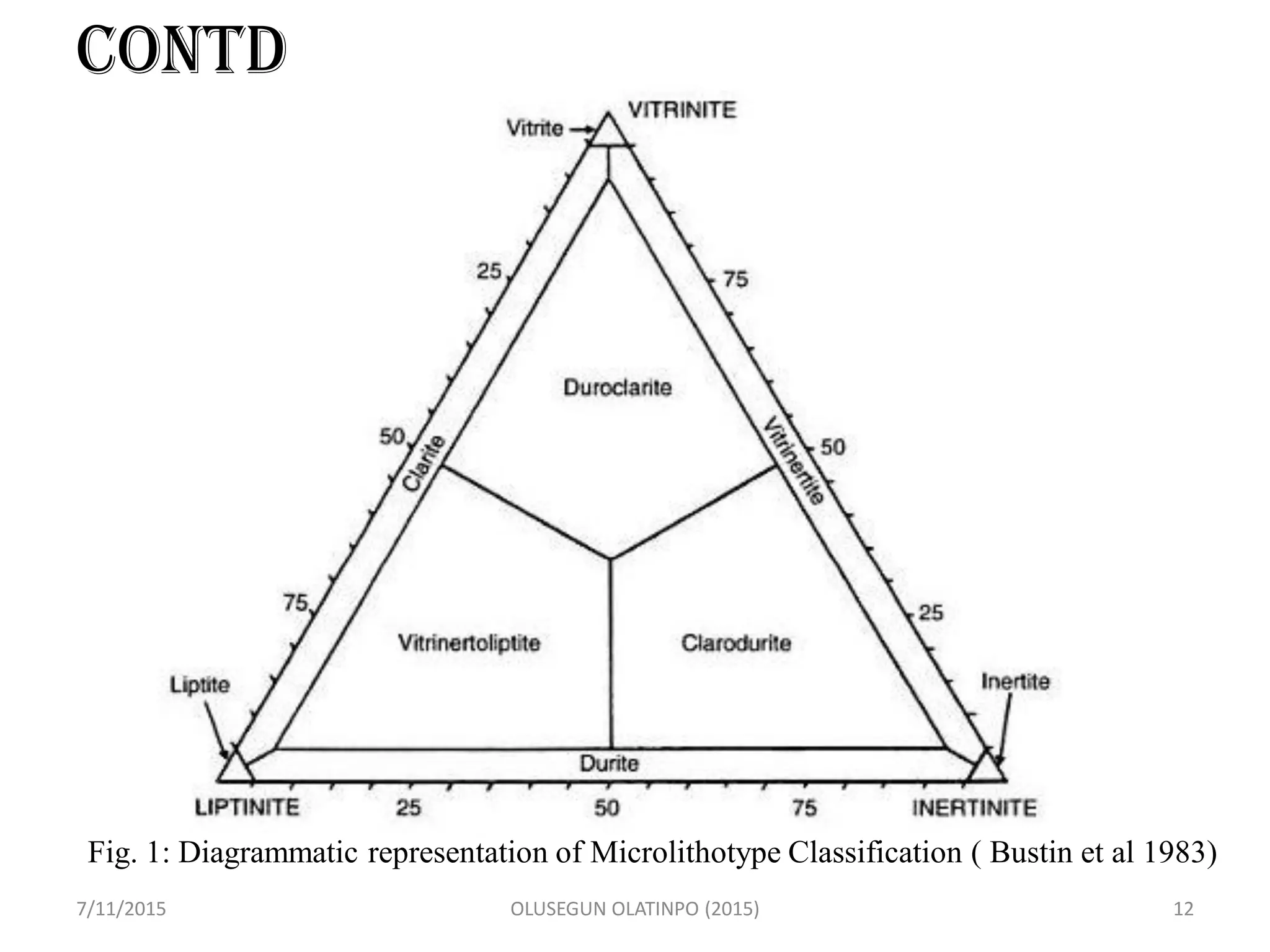
7/11/2015 OLUSEGUN OLATINPO (2015) 12
Fig. 1: Diagrammatic representation of Microlithotype Classification ( Bustin et al 1983)
CONTD
 The chemical properties of microlithotypes are very similar to those of the
predominating macerals
 Their physical properties, however, are related not only to those of the
macerals but also to the combined effect of the association.
 The microhardness of bi- and trimaceralic microlithotypes is always
higher than that of monomaceralic associations.
 The density of the microlithotypes varies with rank, maceral composition,
and size, as well as the form and quantity of associated minerals.
 The degree of heterogeneity in a microlithotype is also important in its
technological behavior, particularly in carbonization, combustion, and
gasification
7/11/2015 OLUSEGUN OLATINPO (2015) 13
CONTD
G
7/11/2015 OLUSEGUN OLATINPO (2015) 14
The maceral, mineral, and microlithotype
composition of a coal seam may change over
short distances both vertically and laterally, in
response to the conditions existing during the
formation of the original peat swamps. These
changes can be quantified by petrographic
assessment of the microlithotypes in relevant
coal samples.
MICROLITHOTYPE ANALYSIS
 It is used to determine the relative proportions of the various microlithotypes and
coal-mineral associations
 Although microlithotype analysis is carried out in a similar manner to maceral
analysis, a suitable 20-point reticule must be placed in one of the oculars of the
microscope as a substitute for the micrometer or cross-hairs.
 Two conventions (ICCP, 1963) must be observed:
 The minimum bandwidth of the association to be measured must be 50microns,
and
 Macerals present in the association in amounts smaller than 5% should be
disregarded (the 5% rule).
 Each observation on a 20-intersection reticule is regarded as one point in the
analysis, and each intersection on the reticule represents 5% of the total number of
intersections (20), providing guidance in use of the 5% rule.
 For a complete microlithotype analysis, at least 500 points should be measured, and
the results should be expressed as volume percentages. Microlithotype analysis is
less accurate than maceral analysis.
7/11/2015 OLUSEGUN OLATINPO (2015) 15
Significance of Coal Microlithotypes for
Interpreting Depositional Environment
 Maceral data needs to be considered in the light of different swamp
types and resulting coal microlithotypes in Teichmuller (1962), the coal
facies diagrams of Diessel (1986).
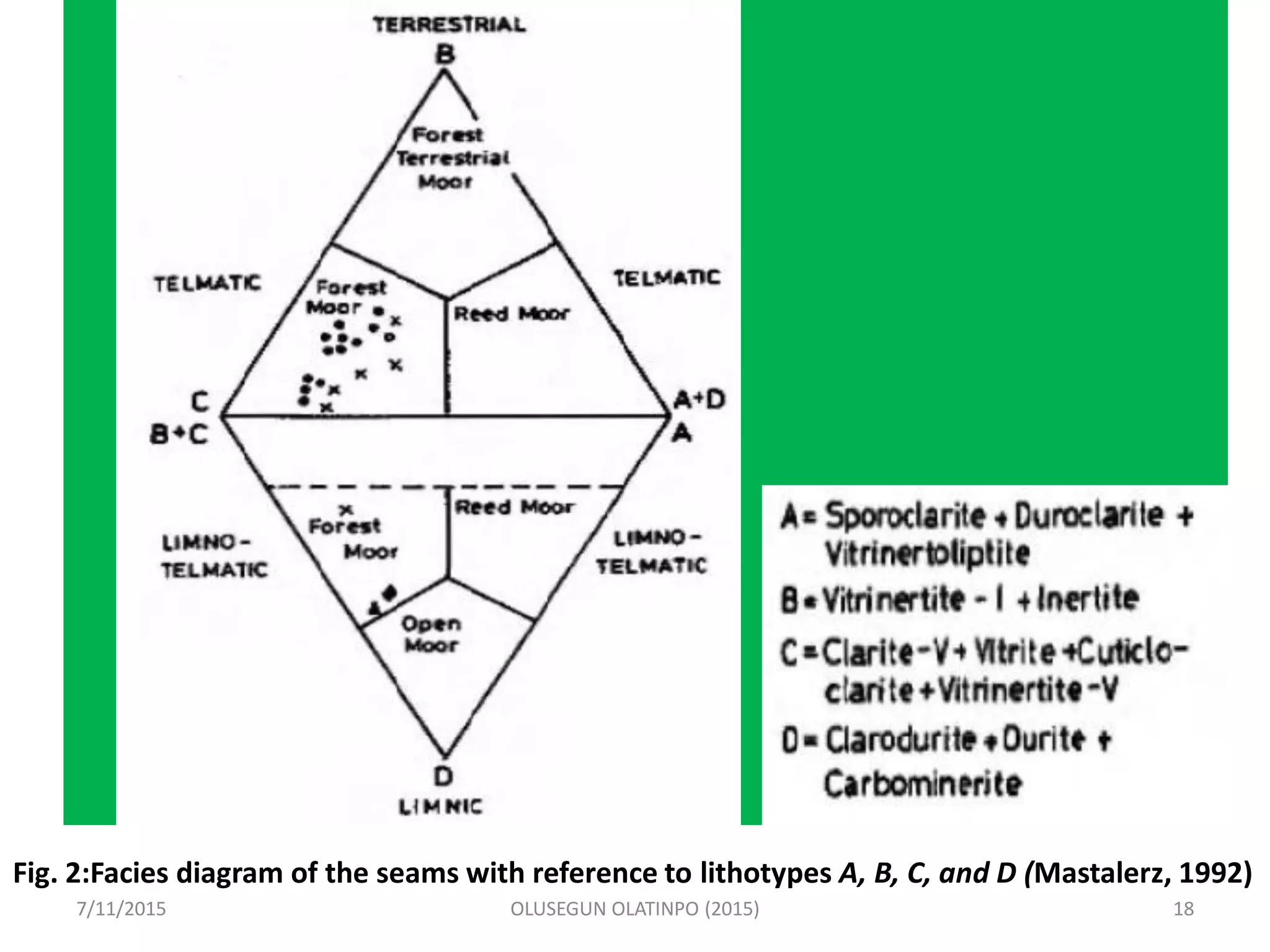
 The swamp and moor types described by Teichmuller (1962) indicate
that characteristic plants occur in each swamp type and plant remains
can be identified petrographically by maceral and microlithotype
analysis.
 Three swamp types illustrated on this basis include
 Forest swamp
 Reed swamp
 Open water swamp
7/11/2015 OLUSEGUN OLATINPO (2015) 16
CONTD
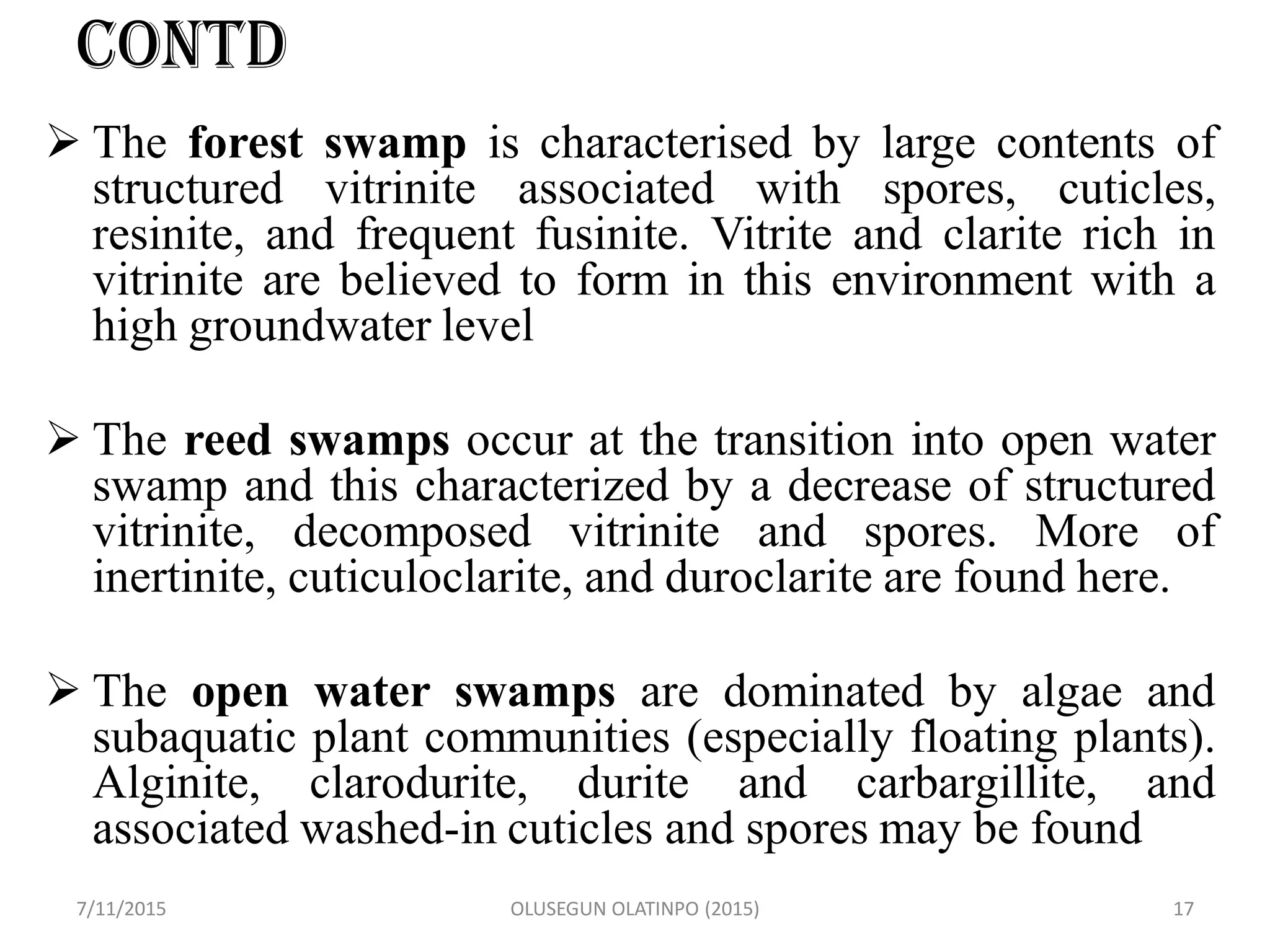
 The forest swamp is characterised by large contents of
structured vitrinite associated with spores, cuticles,
resinite, and frequent fusinite. Vitrite and clarite rich in
vitrinite are believed to form in this environment with a
high groundwater level
 The reed swamps occur at the transition into open water
swamp and this characterized by a decrease of structured
vitrinite, decomposed vitrinite and spores. More of
inertinite, cuticuloclarite, and duroclarite are found here.
 The open water swamps are dominated by algae and
subaquatic plant communities (especially floating plants).
Alginite, clarodurite, durite and carbargillite, and
associated washed-in cuticles and spores may be found
7/11/2015 OLUSEGUN OLATINPO (2015) 17
h
7/11/2015 OLUSEGUN OLATINPO (2015) 18
Fig. 2:Facies diagram of the seams with reference to lithotypes A, B, C, and D (Mastalerz, 1992)
CONTD
7/11/2015 OLUSEGUN OLATINPO (2015) 19
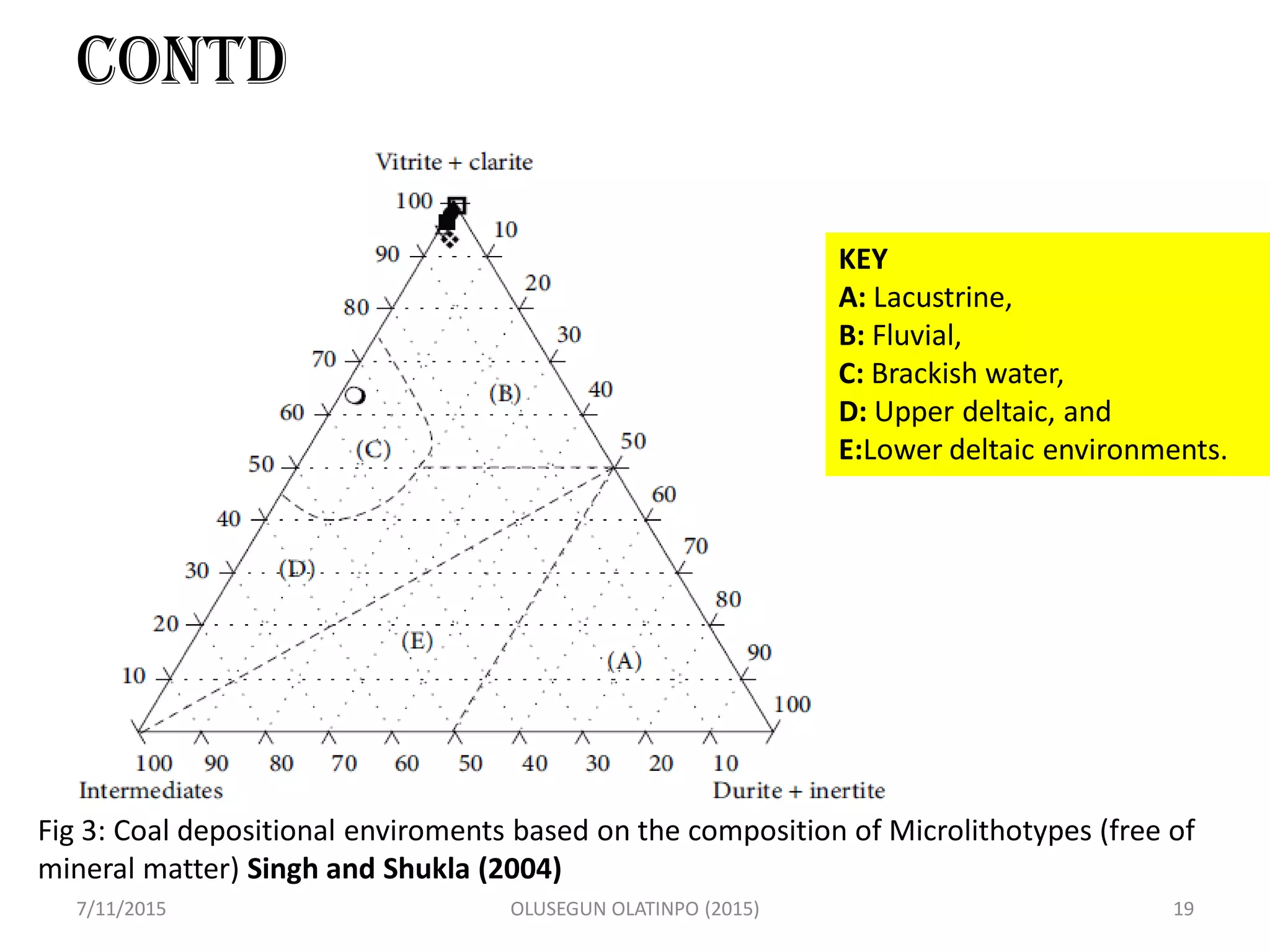
Fig 3: Coal depositional enviroments based on the composition of Microlithotypes (free of
mineral matter) Singh and Shukla (2004)
KEY
A: Lacustrine,
B: Fluvial,
C: Brackish water,
D: Upper deltaic, and
E:Lower deltaic environments.
SUMMARY AND CONCLUSION
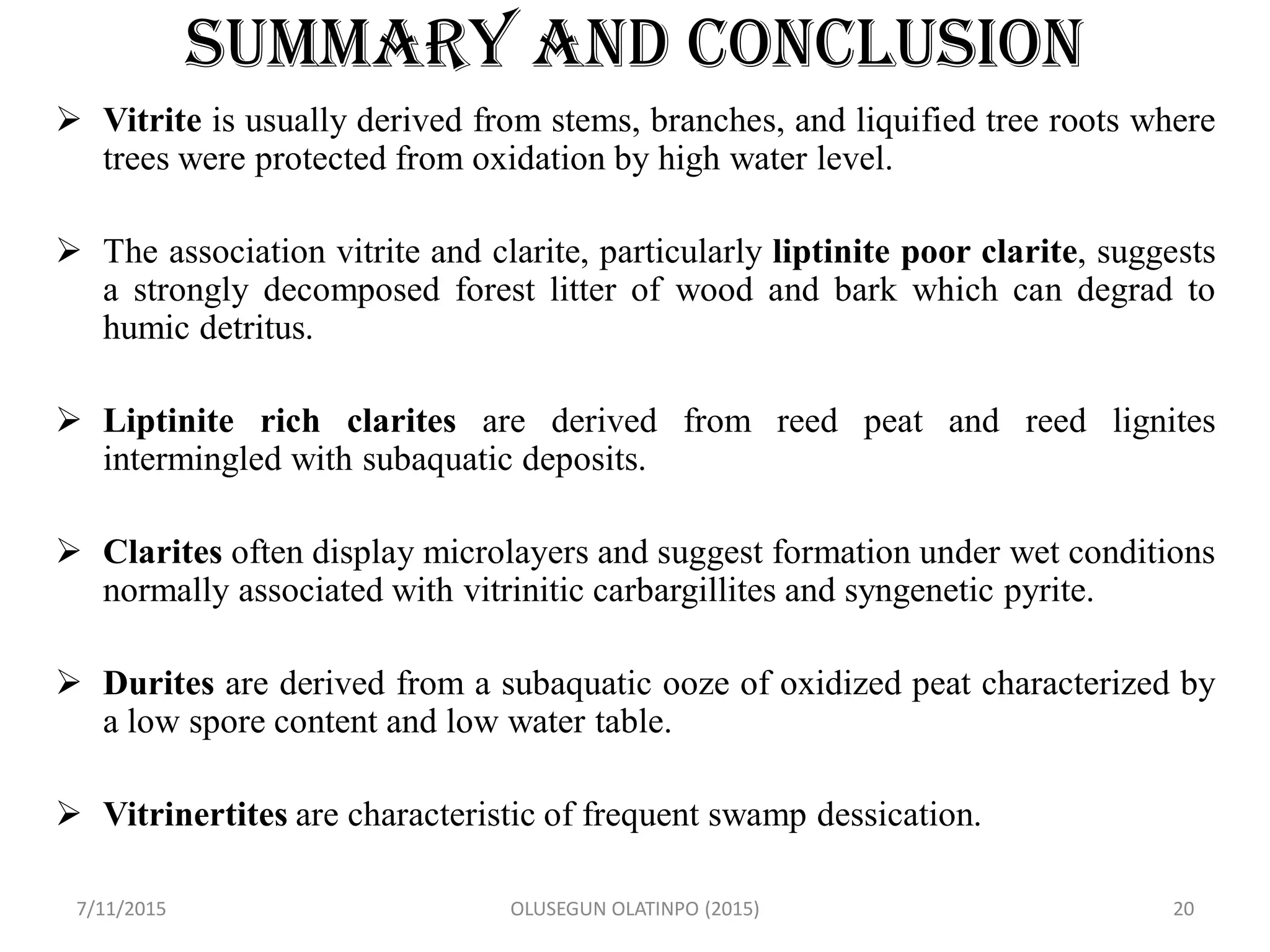
 Vitrite is usually derived from stems, branches, and liquified tree roots where
trees were protected from oxidation by high water level.
 The association vitrite and clarite, particularly liptinite poor clarite, suggests
a strongly decomposed forest litter of wood and bark which can degrad to
humic detritus.
 Liptinite rich clarites are derived from reed peat and reed lignites
intermingled with subaquatic deposits.
 Clarites often display microlayers and suggest formation under wet conditions
normally associated with vitrinitic carbargillites and syngenetic pyrite.
 Durites are derived from a subaquatic ooze of oxidized peat characterized by
a low spore content and low water table.
 Vitrinertites are characteristic of frequent swamp dessication.
7/11/2015 OLUSEGUN OLATINPO (2015) 20
SUMMARY AND CONCLUSION
For geological research on coal basins and for an
evaluation of coal seam quality it is important to
know the quantitative composition of a coal in
terms of the macerals (and minerals in some
cases) or maceral groups and microlithotype.
This is because differences in maceral
composition may indicate differences in chemical
composition and consequently differences in the
technological properties of a coal like
liquefaction, carbonization, and combustion.
7/11/2015 OLUSEGUN OLATINPO (2015) 21
THANK
YOU
FOR
ATTENTION
7/11/2015 OLUSEGUN OLATINPO (2015) 22
G
7/11/2015 OLUSEGUN OLATINPO (2015) 23
QUESTIONS
AND
COMMENTS

COAL MICROLITHOTYPES AND THEIR USAGE IN INTERPRETING DEPOSITION ENVIRONMENT

  • 1.
    COAL MICROLITHOTYPES AND THEIRUSAGE IN INTERPRETING DEPOSITIONAL ENVIRONMENT BY OLATINPO, OLUSEGUN AYOBAMI 14/68ET003
  • 2.
    OUTLINE Introduction Coal Microlithotypes Microlithotype Analysis Significanceof Coal Microlithotypes for Interpreting Depositional Environment Summary and Conclusion 7/11/2015 OLUSEGUN OLATINPO (2015) 2
  • 3.
    Introduction • Coal isdescribed as an organic sedimentary rock usually found in layers with other sedimentary rocks such as shale, limestone and sandstone • It is a combustible rock • The major chemical elements in coal are: carbon, hydrogen, oxygen, nitrogen, and sulphur 7/11/2015 OLUSEGUN OLATINPO (2015) 3
  • 4.
    CONTD The process ofcoal formation from organic compounds includes two distinct phases: 1. Biochemical phase plant material – peat – lignite 2. Geochemical phase lignite – bituminous coal – anthracite 7/11/2015 OLUSEGUN OLATINPO (2015) 4
  • 5.
    CONTD 7/11/2015 OLUSEGUN OLATINPO(2015) 5 Over time, the chemical and physical properties of the plant remains were changed by geological action to create a solid material.
  • 6.
    COAL MICROLITHOTYPES  Microlithotypewas developed to permit the designation of rock types within coal that are at a microscopic scale and their definition is based on maceral percentages.  Microlithotypes are natural associations of macerals in coals at microscopic level.  In addition to the maceral content, 20–60% (vol.) of silicate or carbonate minerals or 5–20% (vol.) sulfide minerals redefines themicrolithotype as a carbominerite.  All macerals have a suffix "-inite" and microlithotypes have the suffix "-ite". 7/11/2015 OLUSEGUN OLATINPO (2015) 6
  • 7.
    CONTD Macerals are thebasic and relatively homogenous organo-petrographic entities of coal which by their chemical composition and physical characteristics determine its properties and utilization. They are normally classified into 3 groups: Liptinite-Hydrogen rich and show lowest reflectance Vitrinite-Oxygen rich and show medium reflectance Inertinite-Carbon rich and show highest reflectance Macerals are the coalified remains of various plant tissues or plant-derived substances existing at the time of peat formation. 7/11/2015 OLUSEGUN OLATINPO (2015) 7
  • 8.
    TABLE 1: ILLUSTRATIONOF MACERAL GROUPS AND SOME MACERALS 7/11/2015 OLUSEGUN OLATINPO (2015) 8
  • 9.
    CONTD  The formationof macerals from plant remains during the early stages of peat accumulation depends on th:  type of plant community,  climatic and  ecological controls, and  conditions of the depositional environment  In polished sections under the microscope using incident light, macerals are identified on the basis of their optical properties.  Thus, layers of a particular maceral group greater than 0.05 mm in thickness and consisting of greater than 95% of a particular maceral are termed after the maceral group e.g vitrinite maceral group forms vitrite microlithotype. 7/11/2015 OLUSEGUN OLATINPO (2015) 9
  • 10.
    CONTD Microlithtypes are classifiedinto three groups based on number macerals they contain : Monomaceral- type consist of one maceral group examples are vitrite (over 95% vitrinite) and inertite (over 95% inertinite) Bimaceral- consist of 2 maceral groups examples are clarite, durite and vitrinertite. Trimaceral-consist of 3 maceral groups examples are duroclarite, clarodurite and vitrinertoliptite. 7/11/2015 OLUSEGUN OLATINPO (2015) 10
  • 11.
    Microlithotypes of HardCoals (Data from Taylor et al., 1998) 7/11/2015 OLUSEGUN OLATINPO (2015) 11
  • 12.
    CONTD 7/11/2015 OLUSEGUN OLATINPO(2015) 12 Fig. 1: Diagrammatic representation of Microlithotype Classification ( Bustin et al 1983)
  • 13.
    CONTD  The chemicalproperties of microlithotypes are very similar to those of the predominating macerals  Their physical properties, however, are related not only to those of the macerals but also to the combined effect of the association.  The microhardness of bi- and trimaceralic microlithotypes is always higher than that of monomaceralic associations.  The density of the microlithotypes varies with rank, maceral composition, and size, as well as the form and quantity of associated minerals.  The degree of heterogeneity in a microlithotype is also important in its technological behavior, particularly in carbonization, combustion, and gasification 7/11/2015 OLUSEGUN OLATINPO (2015) 13
  • 14.
    CONTD G 7/11/2015 OLUSEGUN OLATINPO(2015) 14 The maceral, mineral, and microlithotype composition of a coal seam may change over short distances both vertically and laterally, in response to the conditions existing during the formation of the original peat swamps. These changes can be quantified by petrographic assessment of the microlithotypes in relevant coal samples.
  • 15.
    MICROLITHOTYPE ANALYSIS  Itis used to determine the relative proportions of the various microlithotypes and coal-mineral associations  Although microlithotype analysis is carried out in a similar manner to maceral analysis, a suitable 20-point reticule must be placed in one of the oculars of the microscope as a substitute for the micrometer or cross-hairs.  Two conventions (ICCP, 1963) must be observed:  The minimum bandwidth of the association to be measured must be 50microns, and  Macerals present in the association in amounts smaller than 5% should be disregarded (the 5% rule).  Each observation on a 20-intersection reticule is regarded as one point in the analysis, and each intersection on the reticule represents 5% of the total number of intersections (20), providing guidance in use of the 5% rule.  For a complete microlithotype analysis, at least 500 points should be measured, and the results should be expressed as volume percentages. Microlithotype analysis is less accurate than maceral analysis. 7/11/2015 OLUSEGUN OLATINPO (2015) 15
  • 16.
    Significance of CoalMicrolithotypes for Interpreting Depositional Environment  Maceral data needs to be considered in the light of different swamp types and resulting coal microlithotypes in Teichmuller (1962), the coal facies diagrams of Diessel (1986).  The swamp and moor types described by Teichmuller (1962) indicate that characteristic plants occur in each swamp type and plant remains can be identified petrographically by maceral and microlithotype analysis.  Three swamp types illustrated on this basis include  Forest swamp  Reed swamp  Open water swamp 7/11/2015 OLUSEGUN OLATINPO (2015) 16
  • 17.
    CONTD  The forestswamp is characterised by large contents of structured vitrinite associated with spores, cuticles, resinite, and frequent fusinite. Vitrite and clarite rich in vitrinite are believed to form in this environment with a high groundwater level  The reed swamps occur at the transition into open water swamp and this characterized by a decrease of structured vitrinite, decomposed vitrinite and spores. More of inertinite, cuticuloclarite, and duroclarite are found here.  The open water swamps are dominated by algae and subaquatic plant communities (especially floating plants). Alginite, clarodurite, durite and carbargillite, and associated washed-in cuticles and spores may be found 7/11/2015 OLUSEGUN OLATINPO (2015) 17
  • 18.
    h 7/11/2015 OLUSEGUN OLATINPO(2015) 18 Fig. 2:Facies diagram of the seams with reference to lithotypes A, B, C, and D (Mastalerz, 1992)
  • 19.
    CONTD 7/11/2015 OLUSEGUN OLATINPO(2015) 19 Fig 3: Coal depositional enviroments based on the composition of Microlithotypes (free of mineral matter) Singh and Shukla (2004) KEY A: Lacustrine, B: Fluvial, C: Brackish water, D: Upper deltaic, and E:Lower deltaic environments.
  • 20.
    SUMMARY AND CONCLUSION Vitrite is usually derived from stems, branches, and liquified tree roots where trees were protected from oxidation by high water level.  The association vitrite and clarite, particularly liptinite poor clarite, suggests a strongly decomposed forest litter of wood and bark which can degrad to humic detritus.  Liptinite rich clarites are derived from reed peat and reed lignites intermingled with subaquatic deposits.  Clarites often display microlayers and suggest formation under wet conditions normally associated with vitrinitic carbargillites and syngenetic pyrite.  Durites are derived from a subaquatic ooze of oxidized peat characterized by a low spore content and low water table.  Vitrinertites are characteristic of frequent swamp dessication. 7/11/2015 OLUSEGUN OLATINPO (2015) 20
  • 21.
    SUMMARY AND CONCLUSION Forgeological research on coal basins and for an evaluation of coal seam quality it is important to know the quantitative composition of a coal in terms of the macerals (and minerals in some cases) or maceral groups and microlithotype. This is because differences in maceral composition may indicate differences in chemical composition and consequently differences in the technological properties of a coal like liquefaction, carbonization, and combustion. 7/11/2015 OLUSEGUN OLATINPO (2015) 21
  • 22.
  • 23.
    G 7/11/2015 OLUSEGUN OLATINPO(2015) 23 QUESTIONS AND COMMENTS