Unsymmetrical
Fault
Ismile Hossain
1403EEE00052
Department of Electrical & Electronic Engineering
Conte
nts
Unsymmetrical Fault
Causes of Unsymmetrical Fault
Effects of Faults
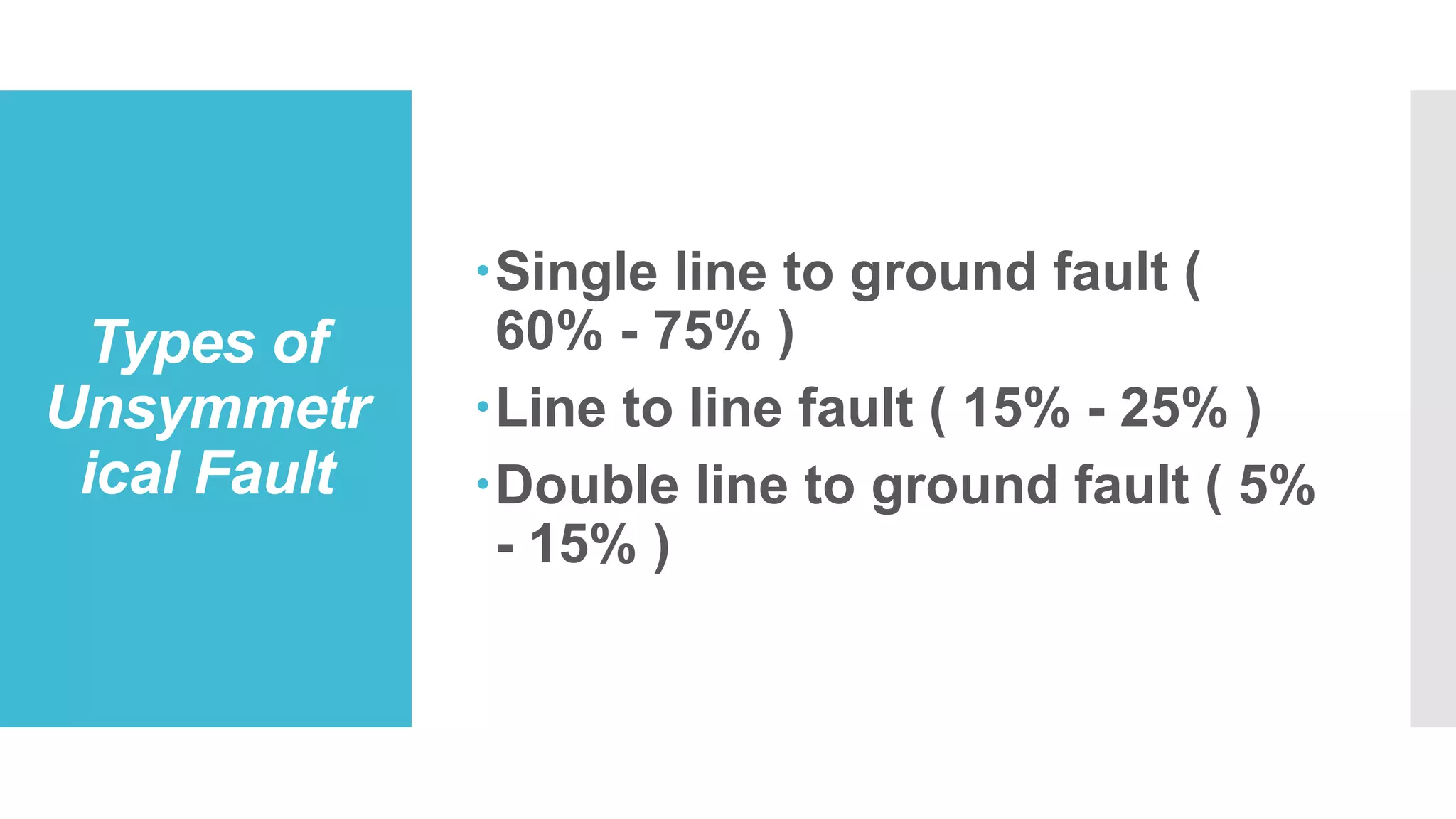
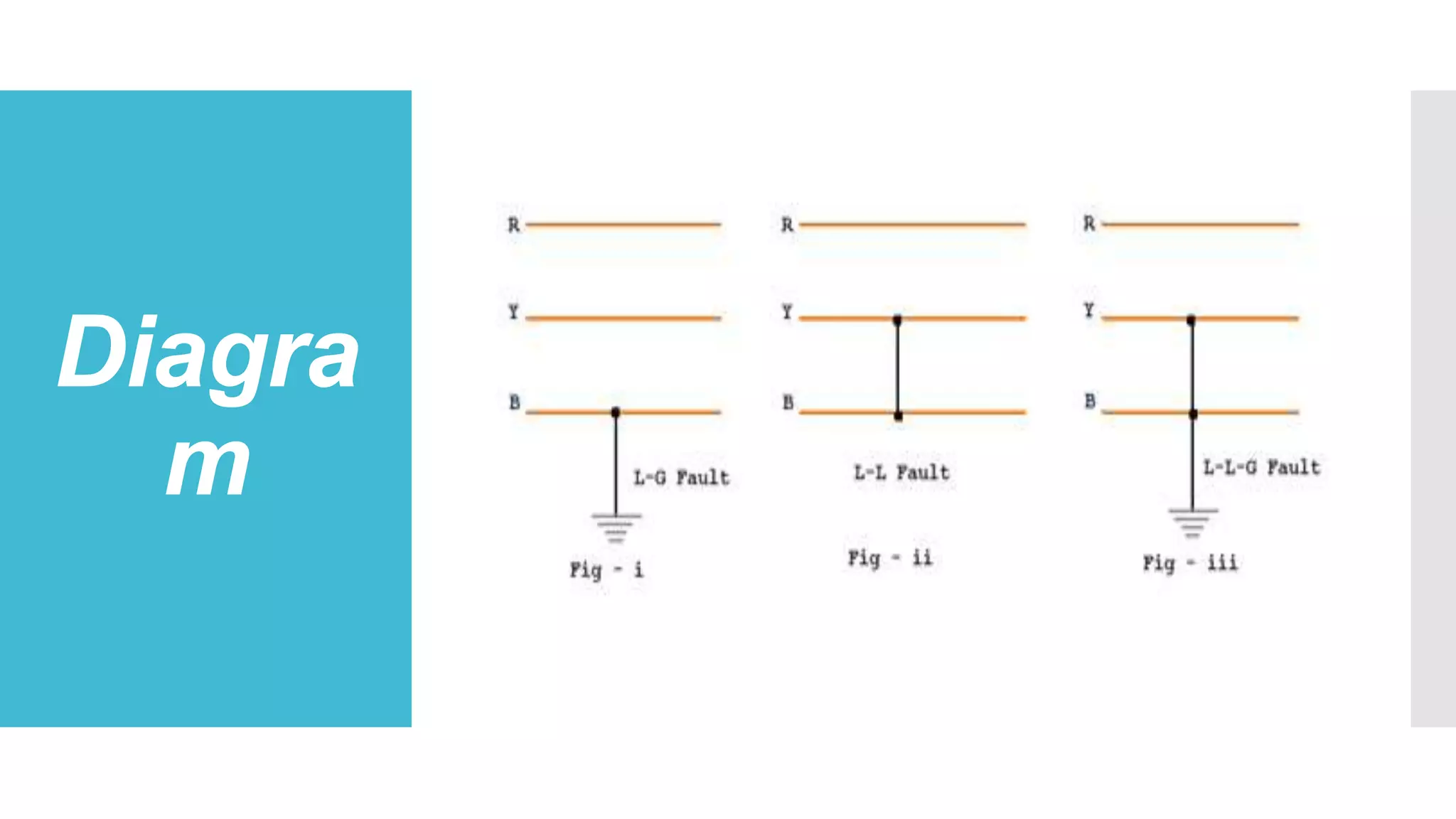
Types of Unsymmetrical Fault
Symmetrical Components
Fortescue’s Theorem
Analysis Unsymmetrical faults by
Bus Impedance Matrix
Fault Limiting Devices
Unsymmetr
ical Fault
The faults which give rise to
unsymmetrical current ( i.e.
unequal line currents with
unequal displacement ) are
called Unsymmetrical Fault.
It makes system unbalanced.
Unsymmetri
cal Fault
 Most of the faults that occur on power
systems are unsymmetrical faults, which
may consist of unsymmetrical short circuits,
unsymmetrical faults through impedances
or open conductor.
 One or two open conductors result in
unsymmetrical faults, through either the
breaking of one or two conductors or the
achon of fuses and other devices that may
not open the three phase simultaneously.
Causes of
Unsymmetr
ical Fault
Falling of tree on line.
Wind and Ice loading on
Transmission Line.
Vehicle colliding with
supporting structures.
Birds shorting on lines.
Insulation Failure.
Effects
of
Faults
 Over Current Flow: When fault occurs it creates a
very low impedance path for the current flow.
 Danger to operating personnel: Fault occurrence
can also cause shocks to individuals.
 Loss of equipment: Heavy current due to short
circuit faults result in the components being burnt
completely which leads to improper working of
equipment or device.
 Disturbs interconnected active circuits: Fault only
affect the location at which they occur but also
disturbs the active interconnected circuits to the
faulted line.
 Electrical Fires: Short circuit causes flashovers &
sparks due to the ionization of air between two
conducting paths which further leads to fire.
Types of
Unsymmetr
ical Fault
Single line to ground fault (
60% - 75% )
Line to line fault ( 15% - 25% )
Double line to ground fault ( 5%
- 15% )
Diagra
m
Symmetri
cal
Compone
nts
 For unbalanced system, power system
analysis can’t be analyzed using per
phase as in Load flow analysis or
Symmetrical fault; Symmetrical
components need to be used.
 Symmetrical component allow
unbalanced phase quantities such as
current & voltages to be replaced by
three separate balanced symmetrical
components.
Fortesc
ue’s
Theore
m
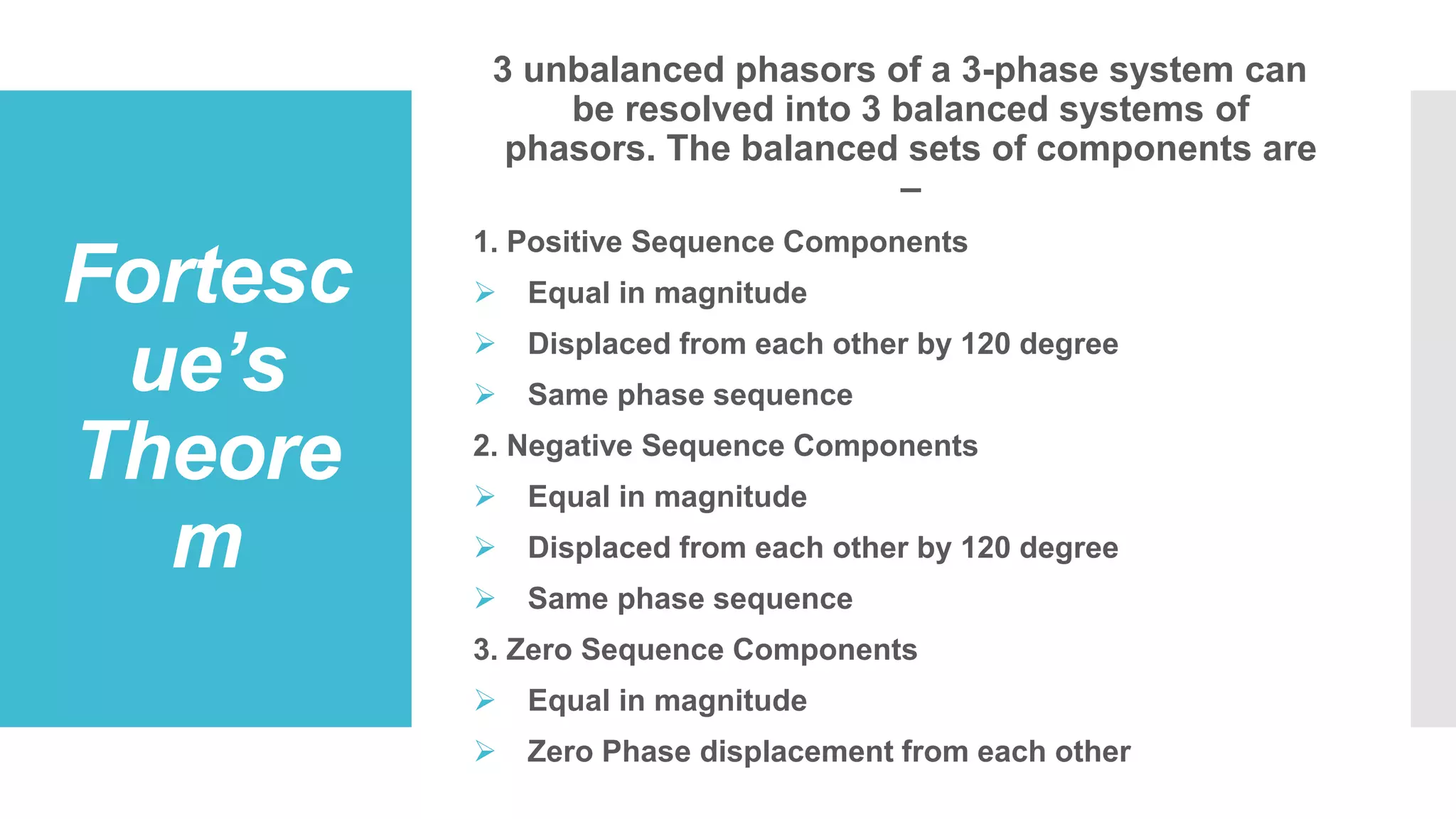
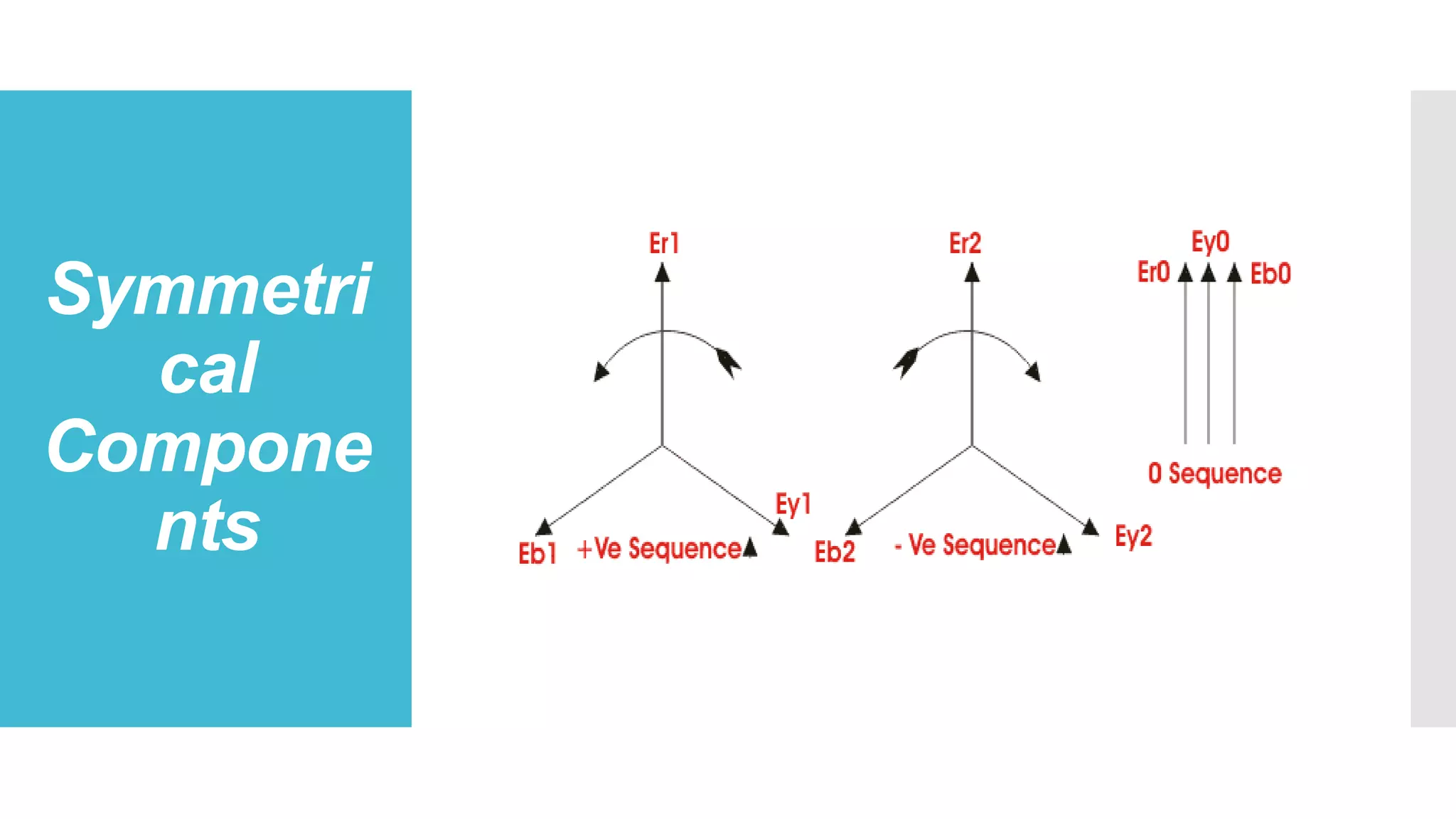
3 unbalanced phasors of a 3-phase system can
be resolved into 3 balanced systems of
phasors. The balanced sets of components are
–
1. Positive Sequence Components
 Equal in magnitude
 Displaced from each other by 120 degree
 Same phase sequence
2. Negative Sequence Components
 Equal in magnitude
 Displaced from each other by 120 degree
 Same phase sequence
3. Zero Sequence Components
 Equal in magnitude
 Zero Phase displacement from each other
Symmetri
cal
Compone
nts
Analysis
Unsymmetri
cal faults by
Bus
Impedance
Matrix
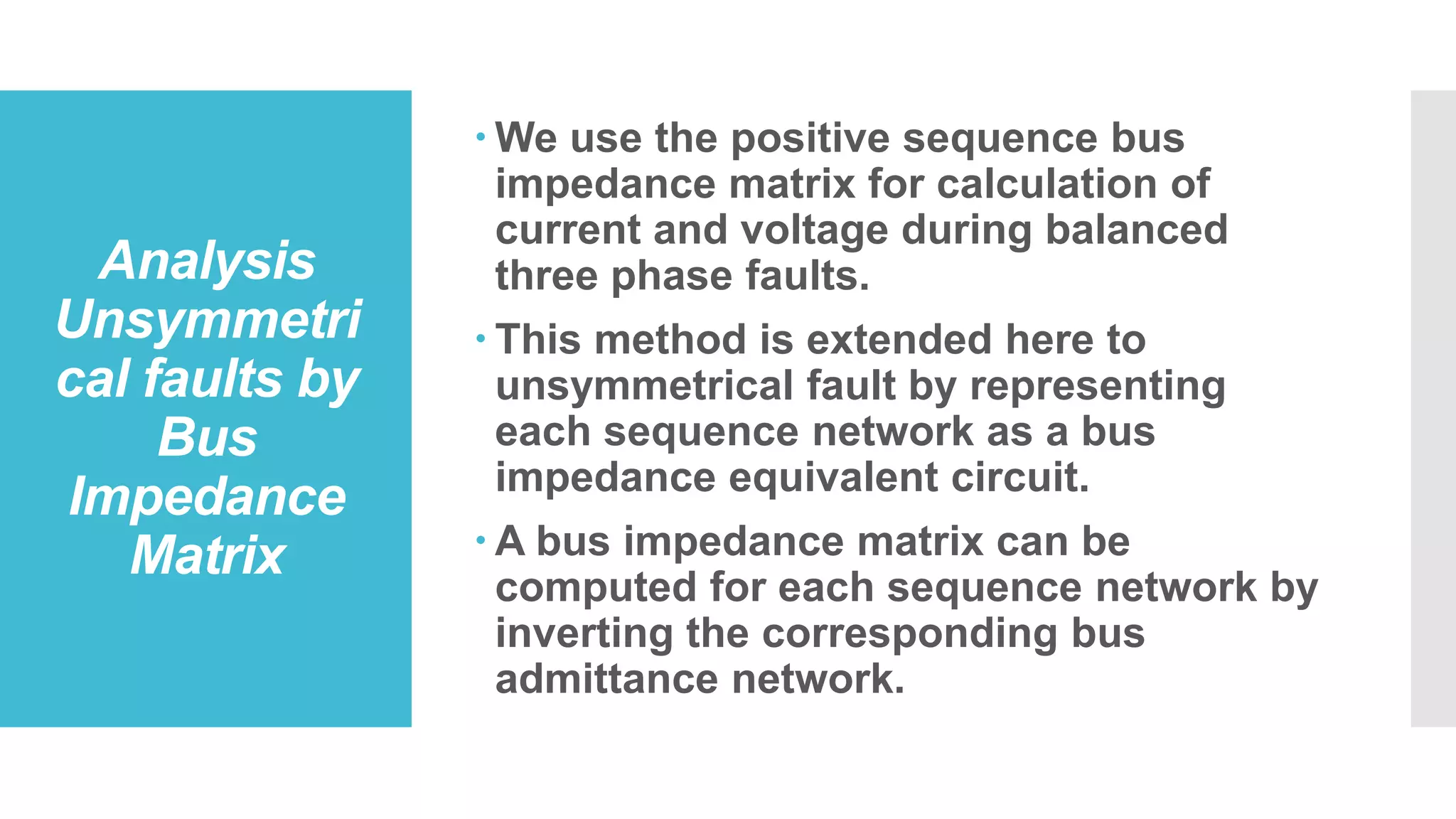
 We use the positive sequence bus
impedance matrix for calculation of
current and voltage during balanced
three phase faults.
 This method is extended here to
unsymmetrical fault by representing
each sequence network as a bus
impedance equivalent circuit.
 A bus impedance matrix can be
computed for each sequence network by
inverting the corresponding bus
admittance network.
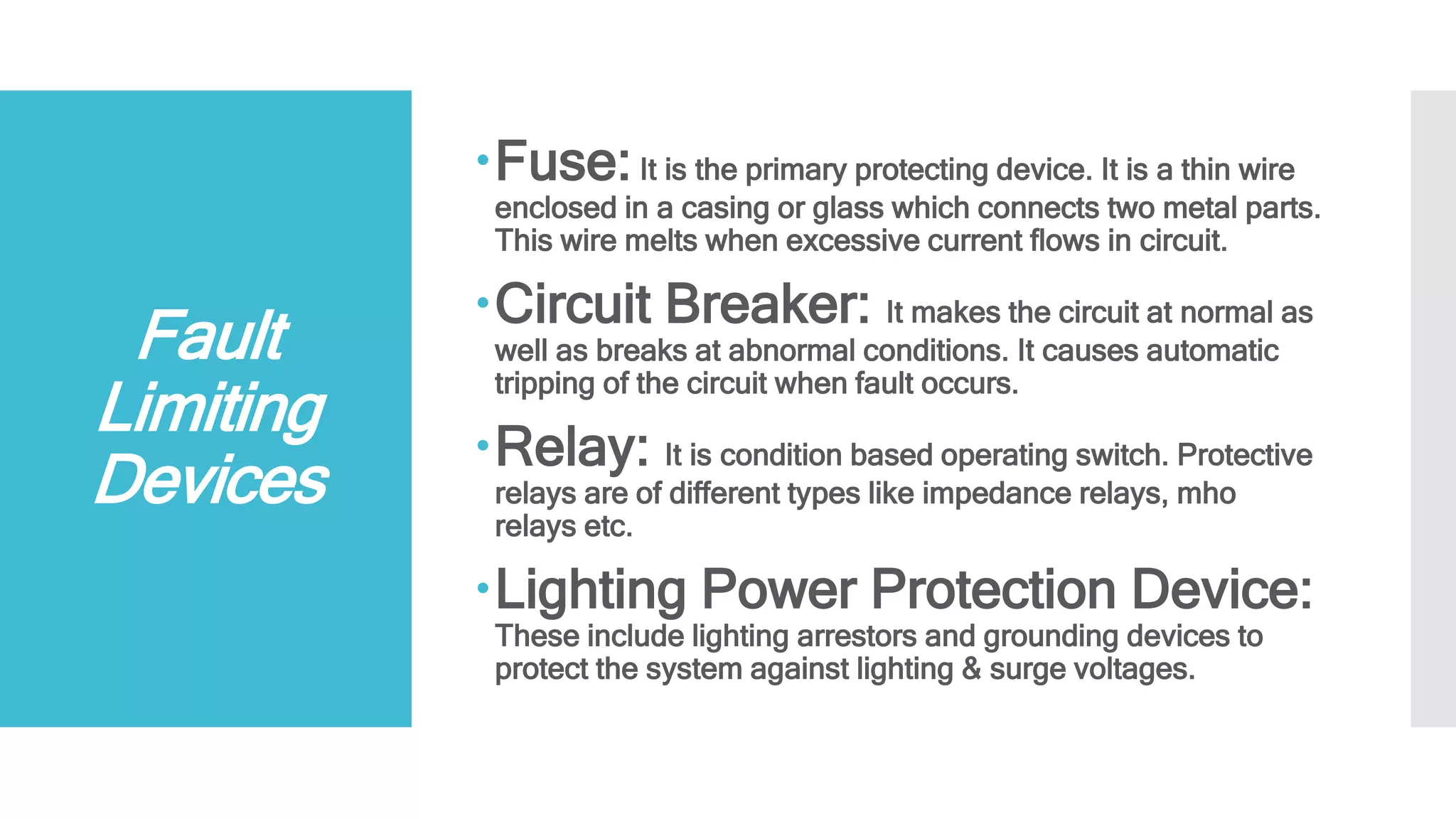
Fault
Limiting
Devices
Fuse:It is the primary protecting device. It is a thin wire
enclosed in a casing or glass which connects two metal parts.
This wire melts when excessive current flows in circuit.
Circuit Breaker: It makes the circuit at normal as
well as breaks at abnormal conditions. It causes automatic
tripping of the circuit when fault occurs.
Relay: It is condition based operating switch. Protective
relays are of different types like impedance relays, mho
relays etc.
Lighting Power Protection Device:
These include lighting arrestors and grounding devices to
protect the system against lighting & surge voltages.
The
End

Unsymmetrical fault

  • 1.
  • 2.
    Conte nts Unsymmetrical Fault Causes ofUnsymmetrical Fault Effects of Faults Types of Unsymmetrical Fault Symmetrical Components Fortescue’s Theorem Analysis Unsymmetrical faults by Bus Impedance Matrix Fault Limiting Devices
  • 3.
    Unsymmetr ical Fault The faultswhich give rise to unsymmetrical current ( i.e. unequal line currents with unequal displacement ) are called Unsymmetrical Fault. It makes system unbalanced.
  • 4.
    Unsymmetri cal Fault  Mostof the faults that occur on power systems are unsymmetrical faults, which may consist of unsymmetrical short circuits, unsymmetrical faults through impedances or open conductor.  One or two open conductors result in unsymmetrical faults, through either the breaking of one or two conductors or the achon of fuses and other devices that may not open the three phase simultaneously.
  • 5.
    Causes of Unsymmetr ical Fault Fallingof tree on line. Wind and Ice loading on Transmission Line. Vehicle colliding with supporting structures. Birds shorting on lines. Insulation Failure.
  • 6.
    Effects of Faults  Over CurrentFlow: When fault occurs it creates a very low impedance path for the current flow.  Danger to operating personnel: Fault occurrence can also cause shocks to individuals.  Loss of equipment: Heavy current due to short circuit faults result in the components being burnt completely which leads to improper working of equipment or device.  Disturbs interconnected active circuits: Fault only affect the location at which they occur but also disturbs the active interconnected circuits to the faulted line.  Electrical Fires: Short circuit causes flashovers & sparks due to the ionization of air between two conducting paths which further leads to fire.
  • 7.
    Types of Unsymmetr ical Fault Singleline to ground fault ( 60% - 75% ) Line to line fault ( 15% - 25% ) Double line to ground fault ( 5% - 15% )
  • 8.
  • 9.
    Symmetri cal Compone nts  For unbalancedsystem, power system analysis can’t be analyzed using per phase as in Load flow analysis or Symmetrical fault; Symmetrical components need to be used.  Symmetrical component allow unbalanced phase quantities such as current & voltages to be replaced by three separate balanced symmetrical components.
  • 10.
    Fortesc ue’s Theore m 3 unbalanced phasorsof a 3-phase system can be resolved into 3 balanced systems of phasors. The balanced sets of components are – 1. Positive Sequence Components  Equal in magnitude  Displaced from each other by 120 degree  Same phase sequence 2. Negative Sequence Components  Equal in magnitude  Displaced from each other by 120 degree  Same phase sequence 3. Zero Sequence Components  Equal in magnitude  Zero Phase displacement from each other
  • 11.
  • 12.
    Analysis Unsymmetri cal faults by Bus Impedance Matrix We use the positive sequence bus impedance matrix for calculation of current and voltage during balanced three phase faults.  This method is extended here to unsymmetrical fault by representing each sequence network as a bus impedance equivalent circuit.  A bus impedance matrix can be computed for each sequence network by inverting the corresponding bus admittance network.
  • 13.
    Fault Limiting Devices Fuse:It is theprimary protecting device. It is a thin wire enclosed in a casing or glass which connects two metal parts. This wire melts when excessive current flows in circuit. Circuit Breaker: It makes the circuit at normal as well as breaks at abnormal conditions. It causes automatic tripping of the circuit when fault occurs. Relay: It is condition based operating switch. Protective relays are of different types like impedance relays, mho relays etc. Lighting Power Protection Device: These include lighting arrestors and grounding devices to protect the system against lighting & surge voltages.
  • 14.