SIGNAL
            FILTERING

                                           HADJI Isma
                                       HAFNAOUI Imane

June 2012      University of M’Hamed Bouguara - IGEE
OUTILINES
   Introduction
   Electronic filters
   1D Signal Filtering
   The Butterworth filter
   The Wiener filter
   Conclusion
Introduction
   Most of the signals we deal with in real life get
    corrupteed in some way or another by some
    unwanted signals.

   For the purpose of signal processing and
    analysis, it is imperative to get rid of these
    interferences, or at least reduce their effects.

   This is achieved through applying Signal
    Filtering techniques.
Electronic Filters
   A Filter is an electronic circuit that removes /
    attenuates, from a signal, some unwanted
    component or feature.
   Filter Application
     Eliminate background noise
     Radio tuning to a specific frequency

     Direct particular frequencies to different speakers

     Modify digital images

     Remove specific frequencies in data analysis
Filter Characteristics
   To understand the basics of filtering, it is first
    necessary to learn some important terms used to
    define filter characteristics.
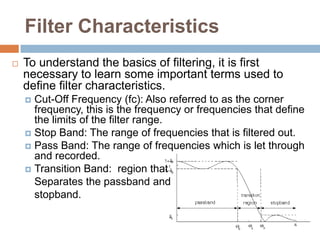
     Cut-Off Frequency (fc): Also referred to as the corner
      frequency, this is the frequency or frequencies that define
      the limits of the filter range.
     Stop Band: The range of frequencies that is filtered out.
     Pass Band: The range of frequencies which is let through
      and recorded.
     Transition Band: region that
      Separates the passband and
      stopband.
Types of Filters
   Electronic filters can be:
     passive or active
     analog or digital
     high-pass, low-pass, bandpass, band-reject or all-
      pass.
     discrete-time (sampled) or continuous-time
     Linear or non-linear
     infinite impulse response (IIR type) or finite impulse
      response (FIR type)

   Most commercial filters use analog technology. In
    other words, these instruments porcess signals
    (speech or music) in a continuous (analog) pattern
    as they exist in the environment.
1D Filtering
   1 D signals can be voltage or current recordings, ecg
    or eeg signals or else audio signals.
    Speech signal is one of the most important signals in
    multimedia applications.
   Speech signals degrade due to the presence of noise
    and therefore noise reduction is an important field of
    speech processing.
   We will examine audio filtering in the sense of specific
    frequency suppression and extraction.
    There are many different types of filters available for
    the construction of filters. We will specifically use the
    Butterworth filter and the wiener filter and compare
    their action
Butterworth Filter
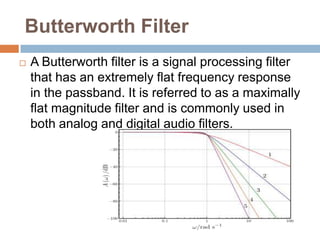
   A Butterworth filter is a signal processing filter
    that has an extremely flat frequency response
    in the passband. It is referred to as a maximally
    flat magnitude filter and is commonly used in
    both analog and digital audio filters.
Butterworth Filter
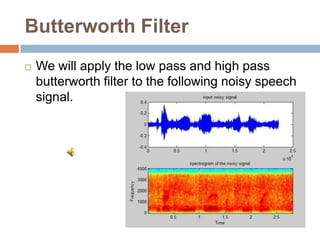
   We will apply the low pass and high pass
    butterworth filter to the following noisy speech
    signal.
Butterworth Filter
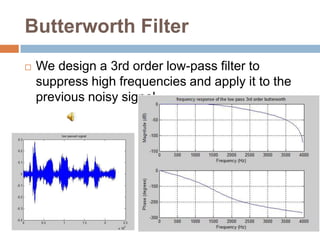
   We design a 3rd order low-pass filter to
    suppress high frequencies and apply it to the
    previous noisy signal
Butterworth Filter
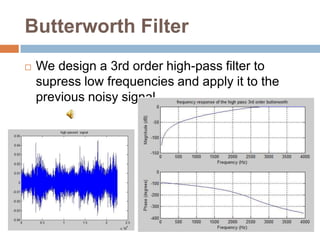
   We design a 3rd order high-pass filter to
    supress low frequencies and apply it to the
    previous noisy signal
Wiener Filter
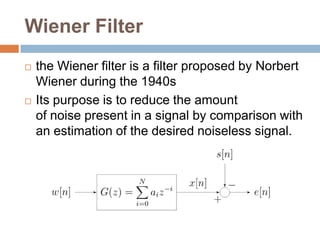
   the Wiener filter is a filter proposed by Norbert
    Wiener during the 1940s
   Its purpose is to reduce the amount
    of noise present in a signal by comparison with
    an estimation of the desired noiseless signal.
Wiener Filter
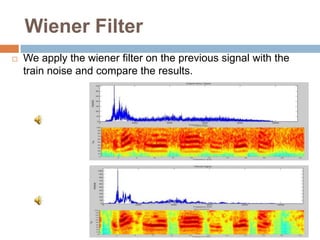
   We apply the wiener filter on the previous signal with the
    train noise and compare the results.
Wiener Filter
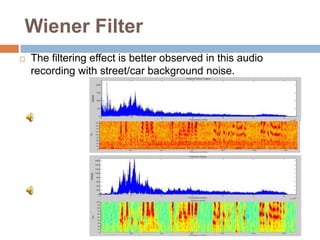
   The filtering effect is better observed in this audio
    recording with street/car background noise.
Conclusion
   In this presentation, the concept of signal
    filtering was presented where the importance
    of filters in signal processing was brought to
    the forefront.

   The butterworth and Wiener Filters were
    tested on filtering samples of 1D noisy signals.

   Where Butterworth was able to filter the noise
    to a certain degree, Wiener is observed to
    have a better noise reduction.
THANK YOU

Signal Filtering

  • 1.
    SIGNAL FILTERING HADJI Isma HAFNAOUI Imane June 2012 University of M’Hamed Bouguara - IGEE
  • 2.
    OUTILINES  Introduction  Electronic filters  1D Signal Filtering  The Butterworth filter  The Wiener filter  Conclusion
  • 3.
    Introduction  Most of the signals we deal with in real life get corrupteed in some way or another by some unwanted signals.  For the purpose of signal processing and analysis, it is imperative to get rid of these interferences, or at least reduce their effects.  This is achieved through applying Signal Filtering techniques.
  • 4.
    Electronic Filters  A Filter is an electronic circuit that removes / attenuates, from a signal, some unwanted component or feature.  Filter Application  Eliminate background noise  Radio tuning to a specific frequency  Direct particular frequencies to different speakers  Modify digital images  Remove specific frequencies in data analysis
  • 5.
    Filter Characteristics  To understand the basics of filtering, it is first necessary to learn some important terms used to define filter characteristics.  Cut-Off Frequency (fc): Also referred to as the corner frequency, this is the frequency or frequencies that define the limits of the filter range.  Stop Band: The range of frequencies that is filtered out.  Pass Band: The range of frequencies which is let through and recorded.  Transition Band: region that Separates the passband and stopband.
  • 6.
    Types of Filters  Electronic filters can be:  passive or active  analog or digital  high-pass, low-pass, bandpass, band-reject or all- pass.  discrete-time (sampled) or continuous-time  Linear or non-linear  infinite impulse response (IIR type) or finite impulse response (FIR type)  Most commercial filters use analog technology. In other words, these instruments porcess signals (speech or music) in a continuous (analog) pattern as they exist in the environment.
  • 7.
    1D Filtering  1 D signals can be voltage or current recordings, ecg or eeg signals or else audio signals.  Speech signal is one of the most important signals in multimedia applications.  Speech signals degrade due to the presence of noise and therefore noise reduction is an important field of speech processing.  We will examine audio filtering in the sense of specific frequency suppression and extraction.  There are many different types of filters available for the construction of filters. We will specifically use the Butterworth filter and the wiener filter and compare their action
  • 8.
    Butterworth Filter  A Butterworth filter is a signal processing filter that has an extremely flat frequency response in the passband. It is referred to as a maximally flat magnitude filter and is commonly used in both analog and digital audio filters.
  • 9.
    Butterworth Filter  We will apply the low pass and high pass butterworth filter to the following noisy speech signal.
  • 10.
    Butterworth Filter  We design a 3rd order low-pass filter to suppress high frequencies and apply it to the previous noisy signal
  • 11.
    Butterworth Filter  We design a 3rd order high-pass filter to supress low frequencies and apply it to the previous noisy signal
  • 12.
    Wiener Filter  the Wiener filter is a filter proposed by Norbert Wiener during the 1940s  Its purpose is to reduce the amount of noise present in a signal by comparison with an estimation of the desired noiseless signal.
  • 13.
    Wiener Filter  We apply the wiener filter on the previous signal with the train noise and compare the results.
  • 14.
    Wiener Filter  The filtering effect is better observed in this audio recording with street/car background noise.
  • 15.
    Conclusion  In this presentation, the concept of signal filtering was presented where the importance of filters in signal processing was brought to the forefront.  The butterworth and Wiener Filters were tested on filtering samples of 1D noisy signals.  Where Butterworth was able to filter the noise to a certain degree, Wiener is observed to have a better noise reduction.
  • 16.