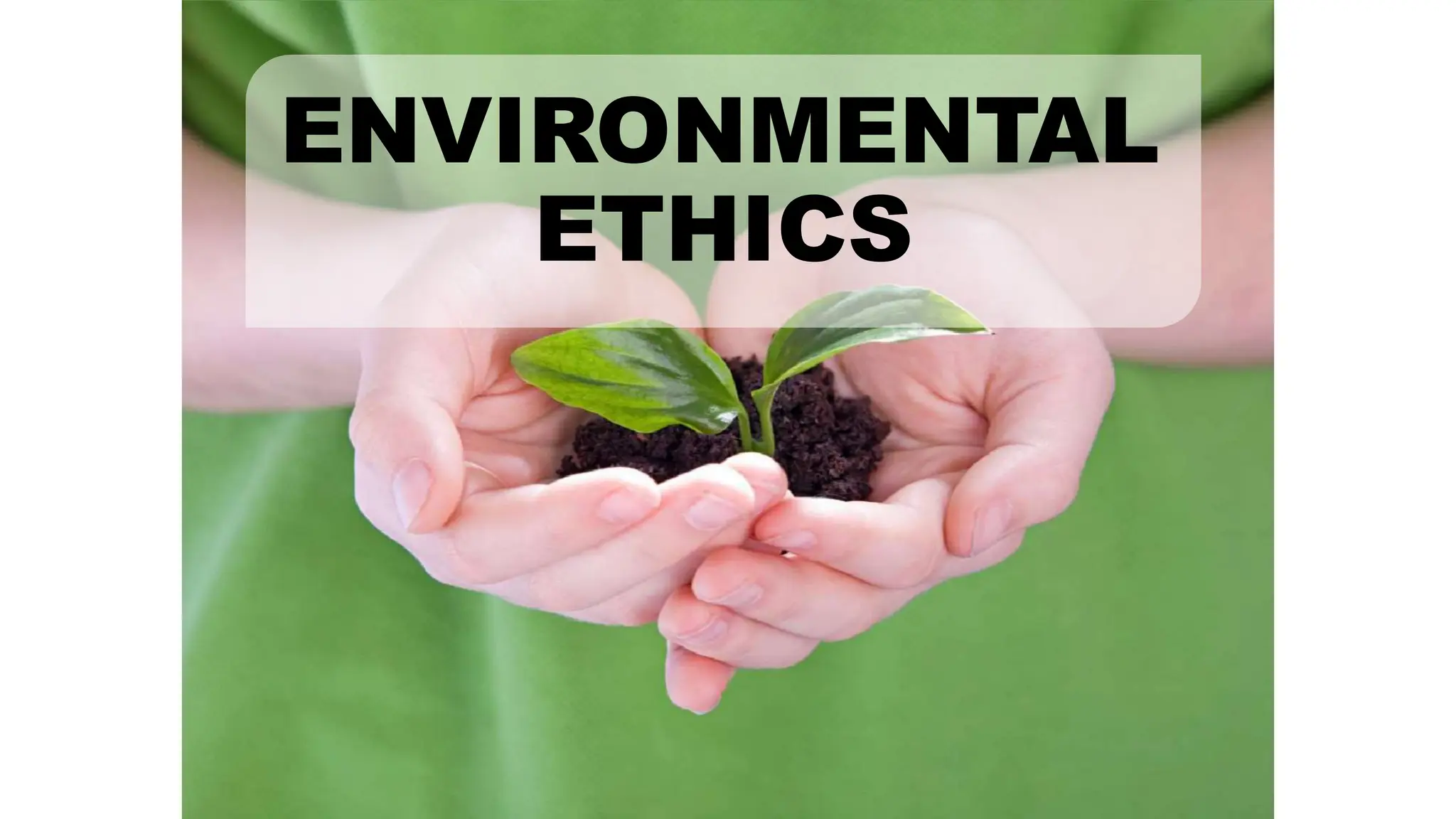
ENVIRONMENTAL
ETHICS
ENVIRONMENT
• 'Environment' defined under the
Environmental Protection Act, 1986,
The living and nonliving things that surround a
living thing make up its environment.
'Environment' includes Water, air and land and
the inter-relationship which exists among and
between, water, air, land, and human beings,
other living creatures, plants, microorganisms
and property.
Environmental issues at global level
• Depletion of natural resources
• Water pollution
• Air pollution
• Ground water pollution
• Toxic chemicals & soil pollution
• Ozone layer depletion
• Global warming
• Sea level rise
• Loss of bio-diversity
• Extinction of wildlife and loss of natural habitat
• Nuclear wastes and radiation issues
Environmental Ethics
............ What is the solution for these
issues?
Environmental Ethics
⚫Ethics = the study of good and bad, right and wrong
⚫Ethical standards = criteria that help differentiate
right from wrong
⚫Environmental ethics = the study of ethical
questions regarding human interactions with the
environment
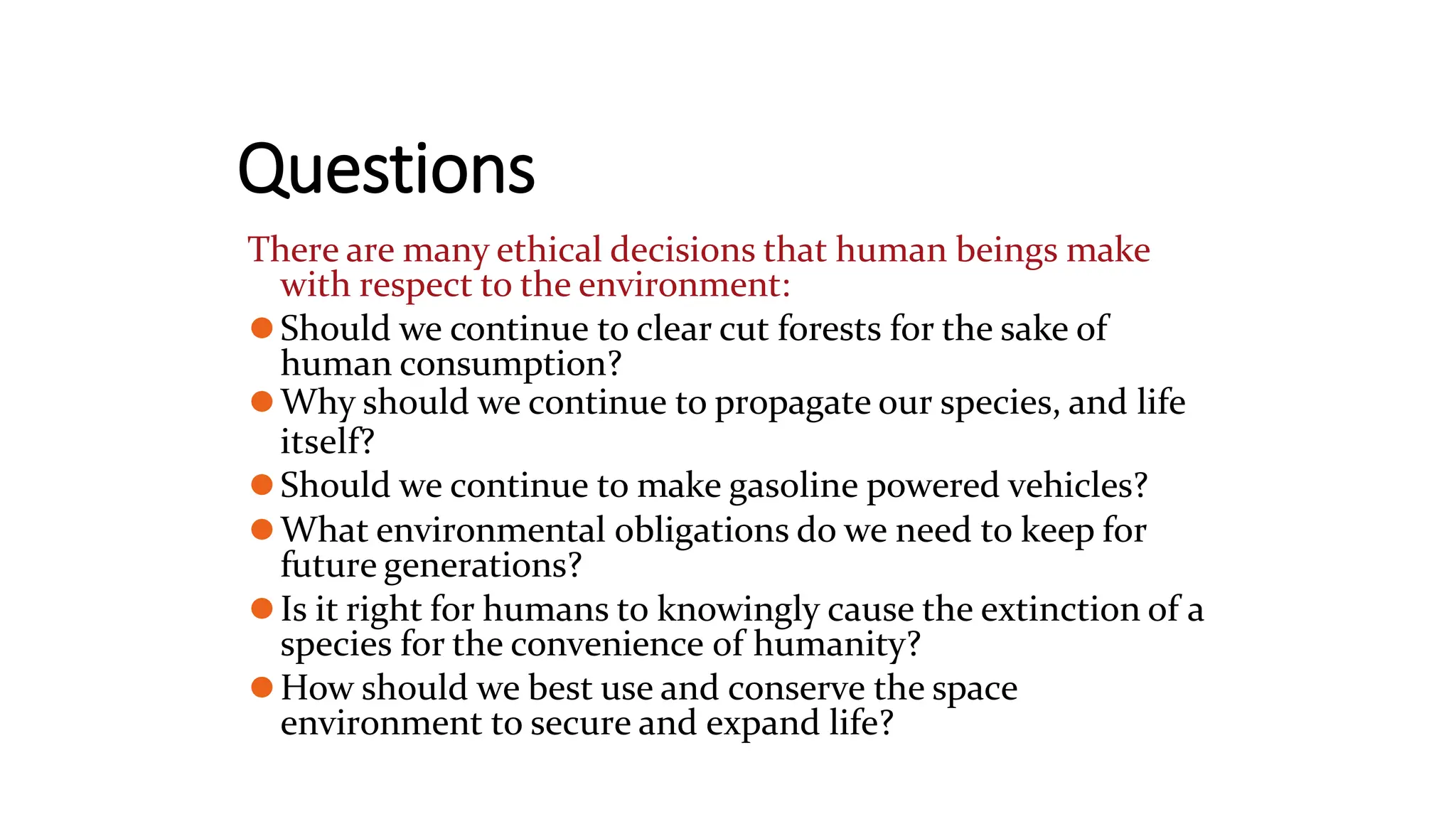
Questions
There are many ethical decisions that human beings make
with respect to the environment:
⚫Should we continue to clear cut forests for the sake of
human consumption?
⚫Why should we continue to propagate our species, and life
itself?
⚫Should we continue to make gasoline powered vehicles?
⚫What environmental obligations do we need to keep for
future generations?
⚫Is it right for humans to knowingly cause the extinction of a
species for the convenience of humanity?
⚫How should we best use and conserve the space
environment to secure and expand life?
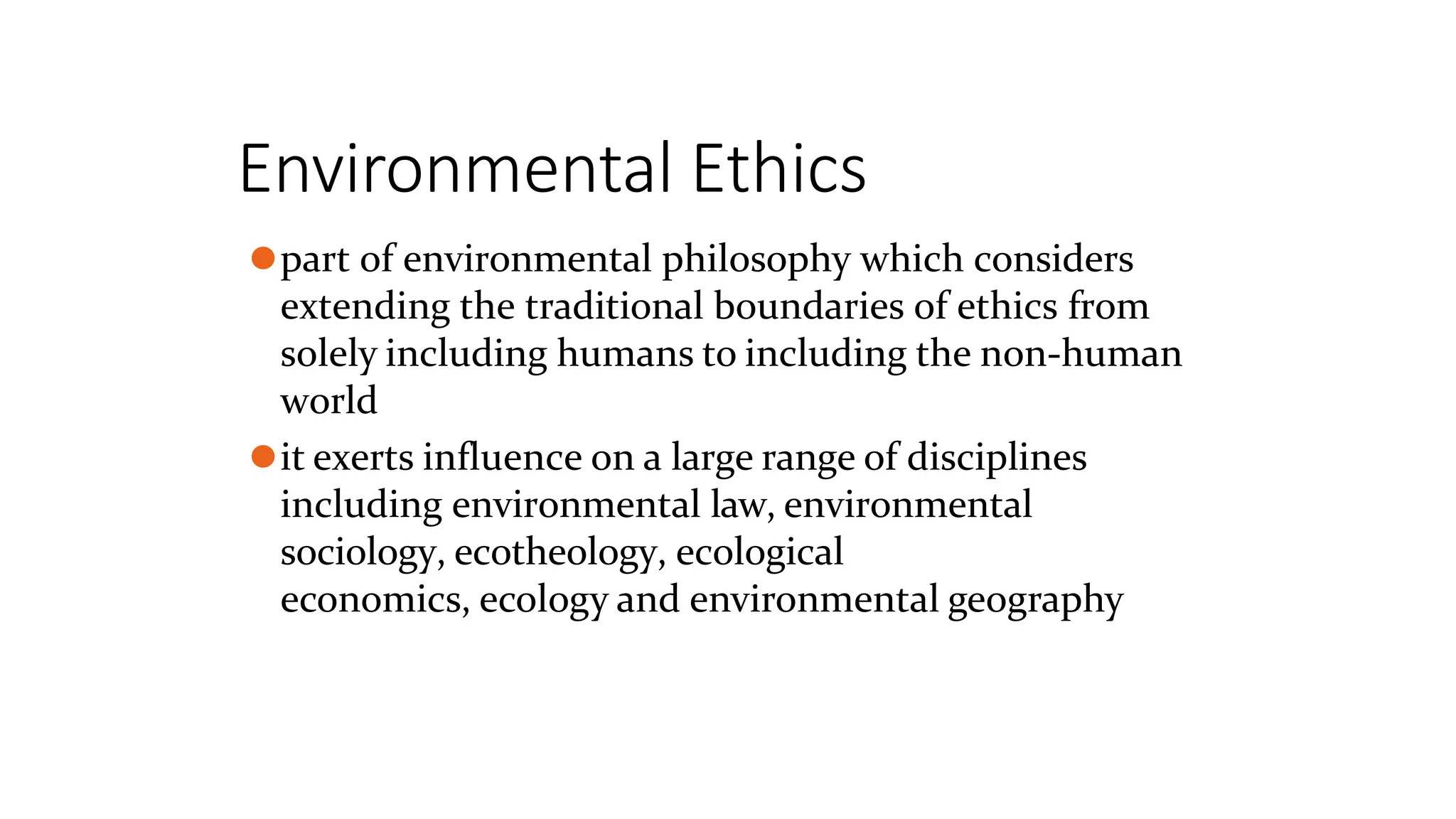
Environmental Ethics
⚫part of environmental philosophy which considers
extending the traditional boundaries of ethics from
solely including humans to including the non-human
world
⚫it exerts influence on a large range of disciplines
including environmental law, environmental
sociology, ecotheology, ecological
economics, ecology and environmental geography
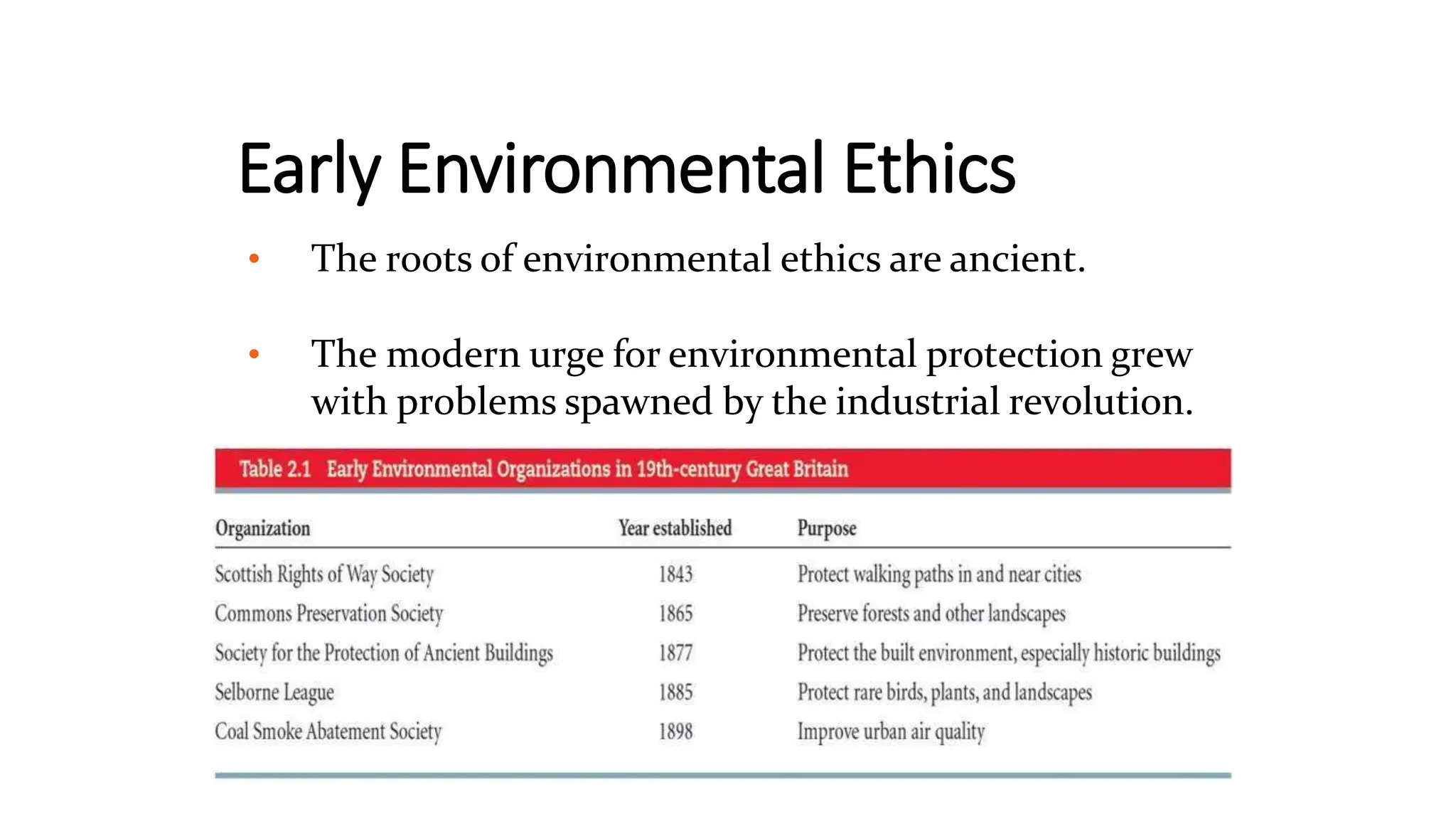
Early Environmental Ethics
• The roots of environmental ethics are ancient.
• The modern urge for environmental protection grew
with problems spawned by the industrial revolution.
Marshall's
categories
Three general ethical approaches have emerged over the last 40 years:
Libertarian Extension,
The Ecologic Extension,
Conservation Ethics.
Libertarian extension
10
Marshall's libertarian extension echoes a civil liberty
approach (i.e. a commitment to extending equal rights to all
members of a community). In environmentalism, the
community is generally thought to consist of non-humans as well as
humans.
Given ethical worth purely on the basis that they exist
Ecologic extension
• Alan Marshall's category of ecologic extension places emphasis not on
human rights but on the recognition of the fundamental interdependence
of all biological (and some abiological) entities and their essential diversity.
• This theory that the planet earth alters its geo-physiological structure over time in
order to ensure the continuation of an equilibrium of evolving organic and inorganic
matter. The planet is characterized as a unified, holistic entity with independent
ethical value, compared to which the human race is of no particular significance in
the long run.
11
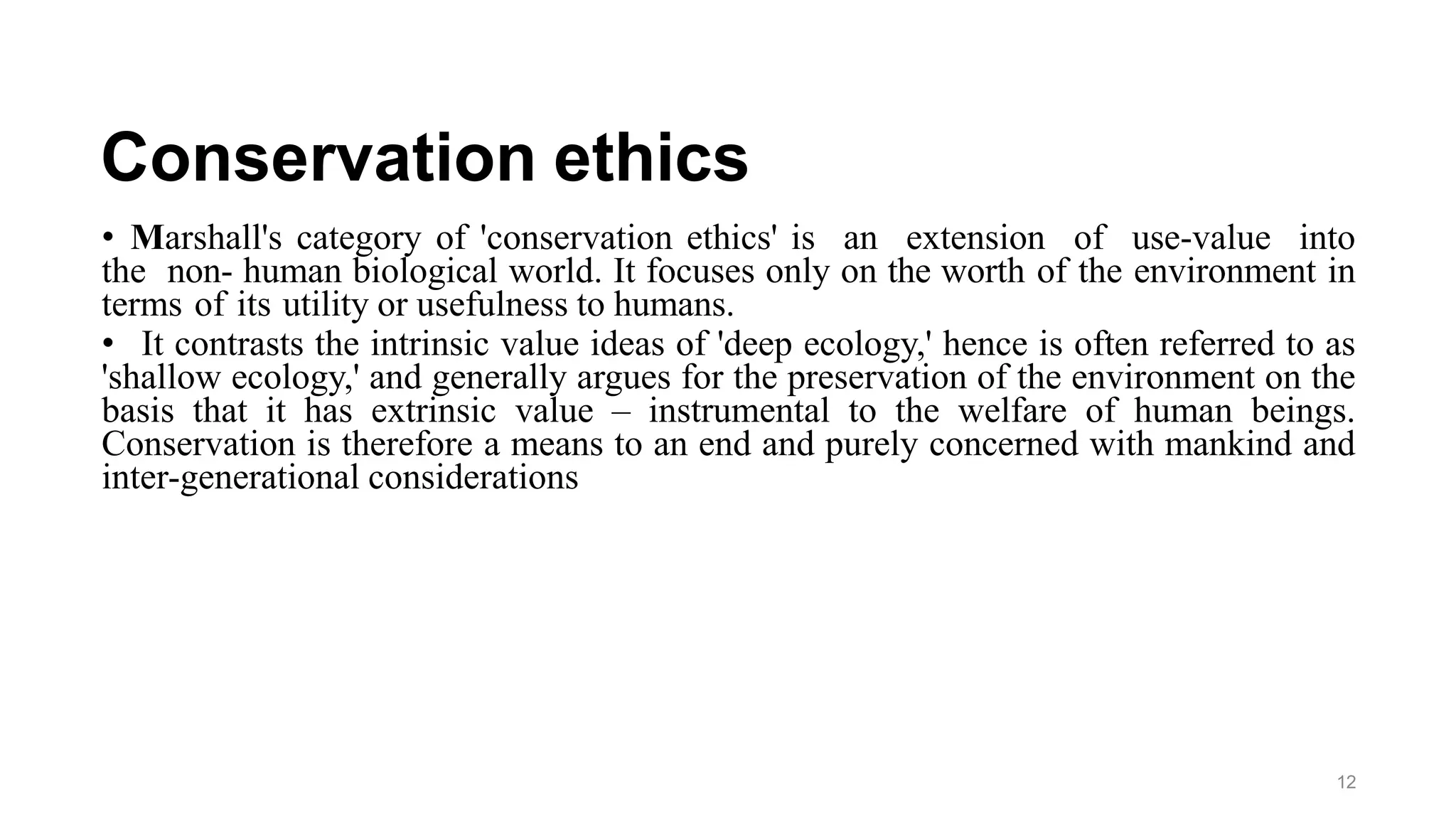
Conservation ethics
• Marshall's category of 'conservation ethics' is an extension of use-value into
the non- human biological world. It focuses only on the worth of the environment in
terms of its utility or usefulness to humans.
• It contrasts the intrinsic value ideas of 'deep ecology,' hence is often referred to as
'shallow ecology,' and generally argues for the preservation of the environment on the
basis that it has extrinsic value – instrumental to the welfare of human beings.
Conservation is therefore a means to an end and purely concerned with mankind and
inter-generational considerations
12
Environmental Ethics and its Core Principles
Environmental ethics is a branch of philosophy concerned with the moral obligations humans have towards the
environment. At its core, it seeks to address questions about our relationship with nature and the ethical
principles that should guide our actions. Here are some core principles of environmental ethics:
Intrinsic Value: Recognizing the inherent worth of all living beings and natural systems, irrespective of their
utility to humans.
Interconnectedness: Understanding that all life forms and ecosystems are interconnected, and human
actions can have far-reaching consequences on the environment.
Stewardship: Embracing the responsibility to care for and protect the environment for present and future
generations.
Sustainability: Striving to meet the needs of the present without compromising the ability of future
generations to meet their own needs.
Environmental ethics theories
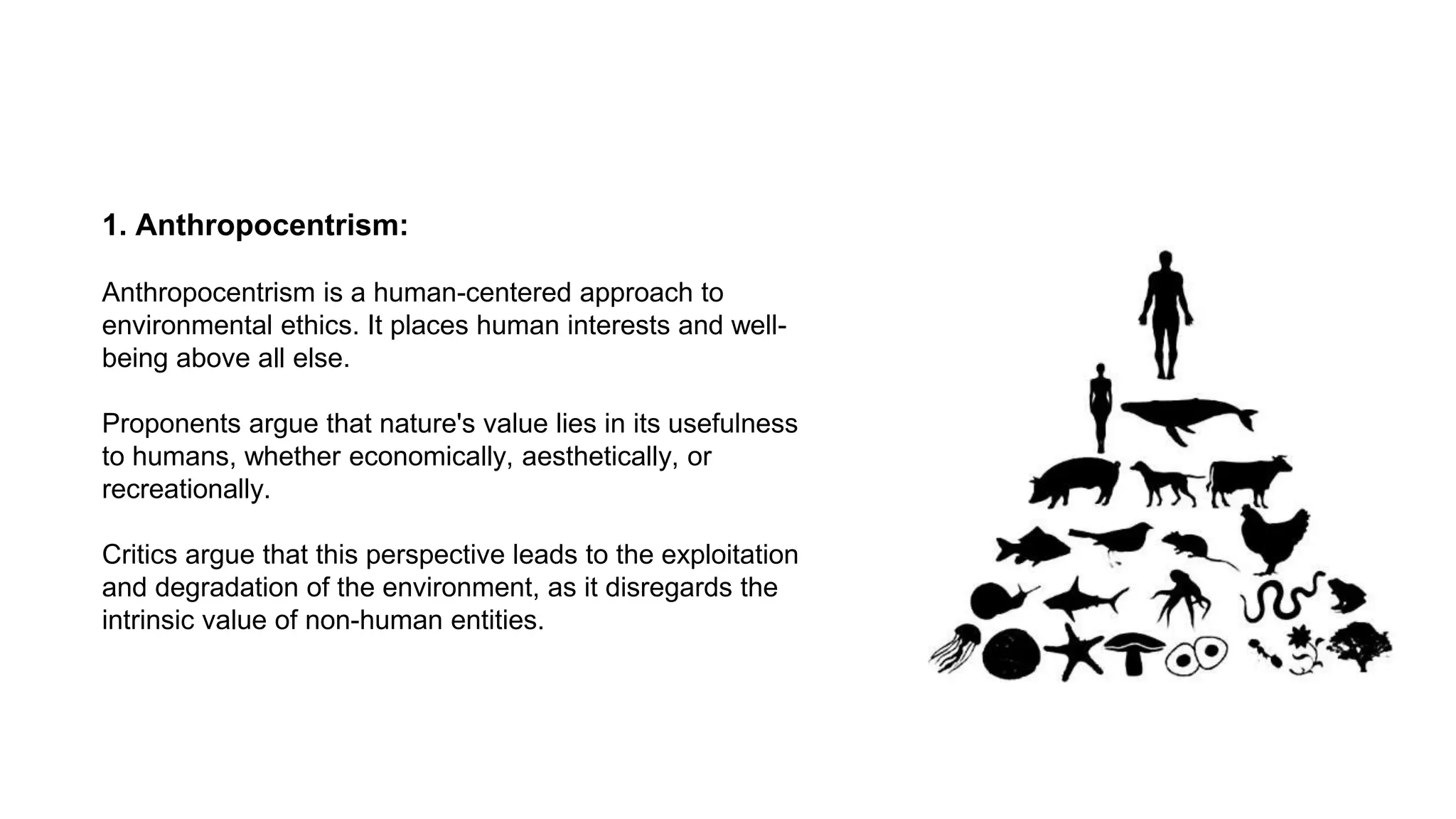
1. Anthropocentrism:
Anthropocentrism is a human-centered approach to
environmental ethics. It places human interests and well-
being above all else.
Proponents argue that nature's value lies in its usefulness
to humans, whether economically, aesthetically, or
recreationally.
Critics argue that this perspective leads to the exploitation
and degradation of the environment, as it disregards the
intrinsic value of non-human entities.
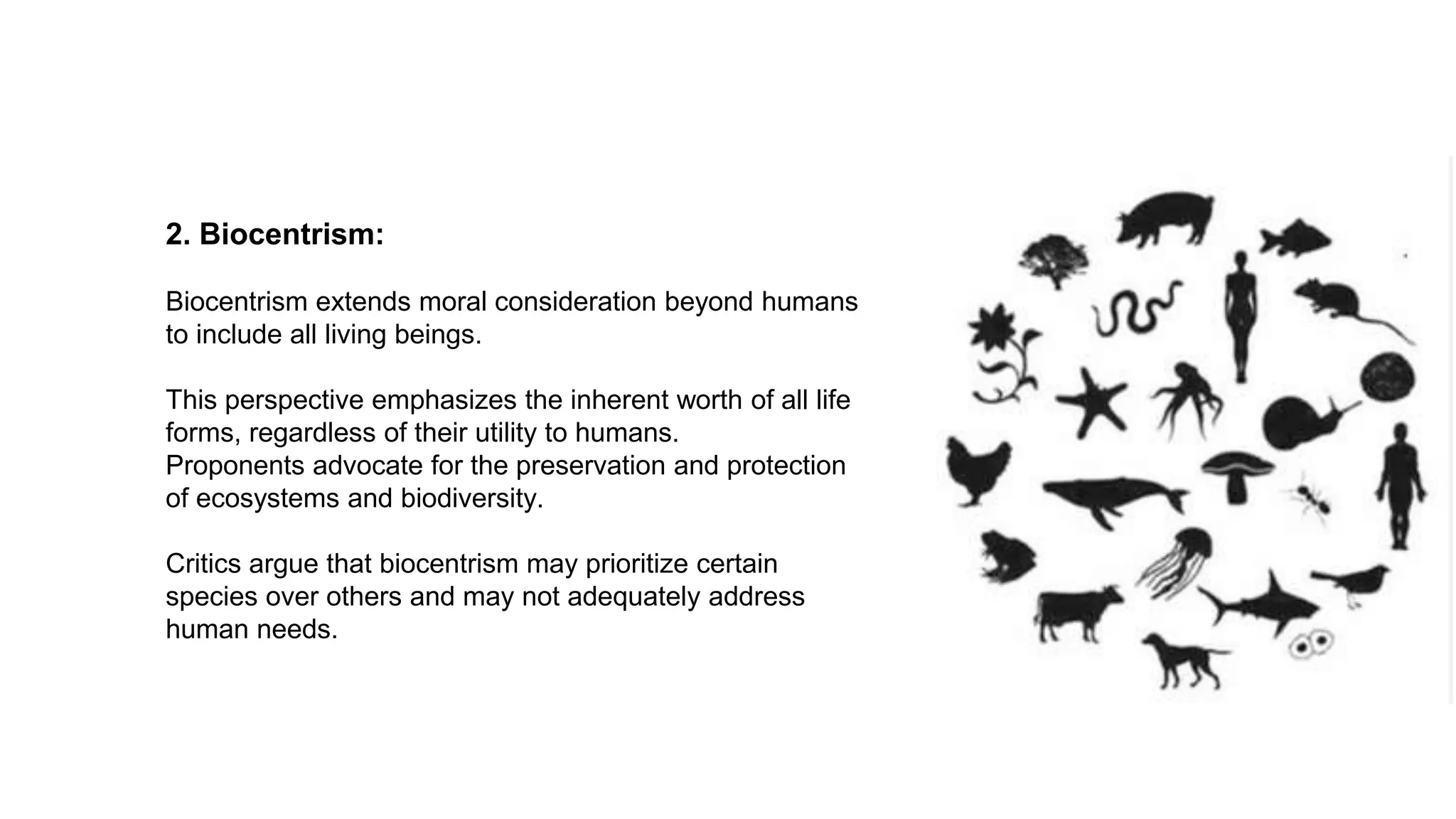
2. Biocentrism:
Biocentrism extends moral consideration beyond humans
to include all living beings.
This perspective emphasizes the inherent worth of all life
forms, regardless of their utility to humans.
Proponents advocate for the preservation and protection
of ecosystems and biodiversity.
Critics argue that biocentrism may prioritize certain
species over others and may not adequately address
human needs.
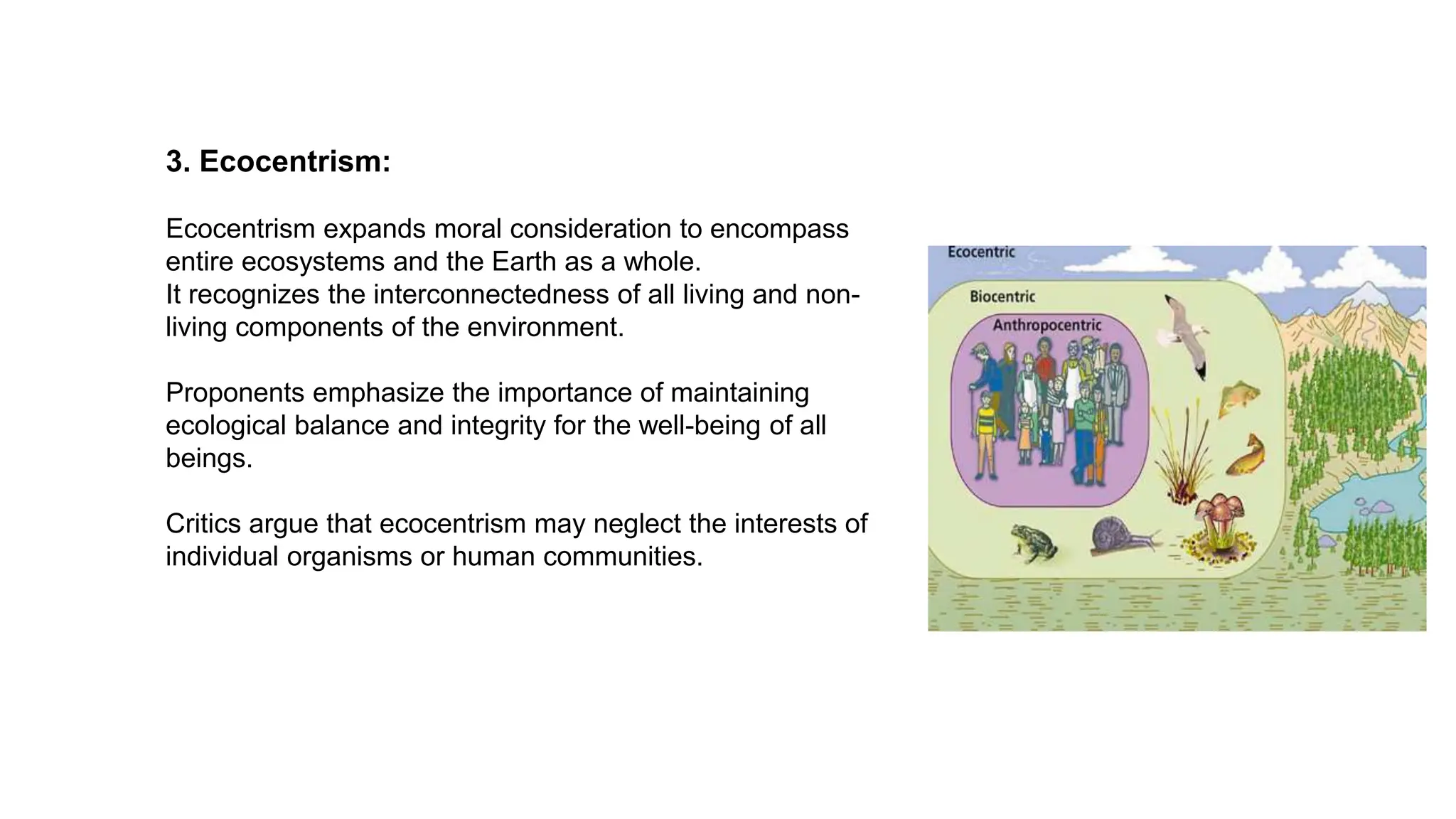
3. Ecocentrism:
Ecocentrism expands moral consideration to encompass
entire ecosystems and the Earth as a whole.
It recognizes the interconnectedness of all living and non-
living components of the environment.
Proponents emphasize the importance of maintaining
ecological balance and integrity for the well-being of all
beings.
Critics argue that ecocentrism may neglect the interests of
individual organisms or human communities.
4. Deep Ecology:
Deep ecology goes beyond superficial environmental concerns to address fundamental questions about
humanity's place in the natural world.
Deep Ecology is an environmental philosophy that recognises and advocates for the inherent value of all
living beings, regardless of their usefulness to humans. It asserts that the natural world has an intrinsic
value that is separate from any value that humans may assign to it, and that human interference in
nature can have negative consequences for both the environment and for human well-being. It is based
on the idea that human beings are an integral part of the natural world and should coexist with other
species in a sustainable wayProponents argue for a reduction in human population, consumption, and
technology to achieve ecological sustainability.
Critics argue that deep ecology may be impractical and unrealistic in addressing pressing environmental
challenges.
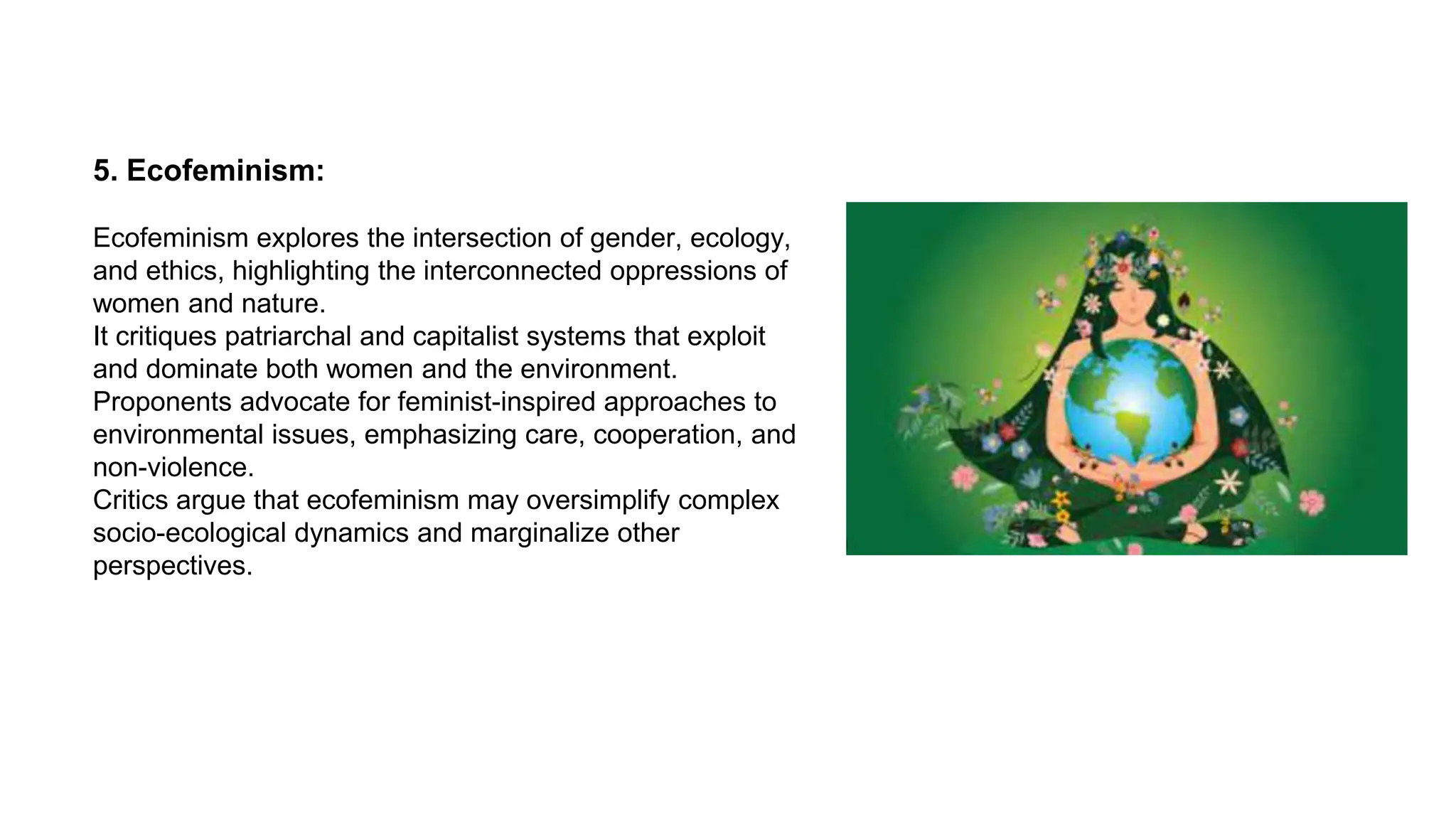
5. Ecofeminism:
Ecofeminism explores the intersection of gender, ecology,
and ethics, highlighting the interconnected oppressions of
women and nature.
It critiques patriarchal and capitalist systems that exploit
and dominate both women and the environment.
Proponents advocate for feminist-inspired approaches to
environmental issues, emphasizing care, cooperation, and
non-violence.
Critics argue that ecofeminism may oversimplify complex
socio-ecological dynamics and marginalize other
perspectives.
In conclusion, environmental ethics offers diverse
perspectives on our moral responsibilities towards the
environment. Whether anthropocentric, biocentric,
ecocentric, deep ecological, or ecofeminist, each theory
contributes to our understanding of how we should
interact with the natural world. As we confront
environmental challenges, it's essential to critically engage
with these theories and strive towards ethical practices
that promote the well-being of all beings and the integrity
of ecosystems. Thank you for joining me in this
exploration of environmental ethics.
Human Responsibility towards the Environment
Humans have a profound impact on the environment, and with that impact comes a
responsibility to ensure the well-being of the planet and its inhabitants. This
responsibility encompasses several aspects:
1.Conservation: Preserving biodiversity, protecting ecosystems, and minimizing
habitat destruction through sustainable land management practices.
2.Pollution Control: Reducing pollution and minimizing our ecological footprint
through responsible waste management, emissions reduction, and conservation of
resources.
3.Climate Action: Mitigating climate change by transitioning to renewable energy
sources, promoting energy efficiency, and advocating for policies that reduce
greenhouse gas emissions.
4.Environmental Justice: Ensuring equitable distribution of environmental
benefits and burdens, and addressing environmental injustices that
disproportionately affect marginalized communities.
Sustainable Practices and their Importance
Environmental ethics provides a framework for understanding our moral responsibilities towards
the environment and guiding our actions towards sustainability and justice. By embracing
principles such as intrinsic value, interconnectedness, stewardship, and sustainability, we can
work towards a more harmonious relationship with nature and a healthier planet for all.
Sustainability lies at the heart of environmental ethics, aiming to maintain ecological balance
while meeting the needs of current and future generations. Here are some sustainable practices
and their importance:
1.Renewable Energy: Transitioning from fossil fuels to renewable sources such as solar, wind,
and hydroelectric power reduces greenhouse gas emissions and mitigates climate change.
2.Resource Conservation: Conserving water, energy, and natural resources through efficient
use and recycling helps minimize environmental degradation and reduce pressure on
ecosystems.
3.Sustainable Agriculture: Embracing practices such as organic farming, agroforestry, and
crop rotation promotes soil health, biodiversity, and food security while minimizing
environmental harm.
4.Green Transportation: Encouraging public transportation, carpooling, cycling, and walking
reduces air pollution, congestion, and greenhouse gas emissions associated with traditional
transportation modes.

environmental ethics approaches and theories.pptx

  • 1.
  • 2.
    ENVIRONMENT • 'Environment' definedunder the Environmental Protection Act, 1986, The living and nonliving things that surround a living thing make up its environment. 'Environment' includes Water, air and land and the inter-relationship which exists among and between, water, air, land, and human beings, other living creatures, plants, microorganisms and property.
  • 3.
    Environmental issues atglobal level • Depletion of natural resources • Water pollution • Air pollution • Ground water pollution • Toxic chemicals & soil pollution • Ozone layer depletion • Global warming • Sea level rise • Loss of bio-diversity • Extinction of wildlife and loss of natural habitat • Nuclear wastes and radiation issues
  • 4.
    Environmental Ethics ............ Whatis the solution for these issues?
  • 5.
    Environmental Ethics ⚫Ethics =the study of good and bad, right and wrong ⚫Ethical standards = criteria that help differentiate right from wrong ⚫Environmental ethics = the study of ethical questions regarding human interactions with the environment
  • 6.
    Questions There are manyethical decisions that human beings make with respect to the environment: ⚫Should we continue to clear cut forests for the sake of human consumption? ⚫Why should we continue to propagate our species, and life itself? ⚫Should we continue to make gasoline powered vehicles? ⚫What environmental obligations do we need to keep for future generations? ⚫Is it right for humans to knowingly cause the extinction of a species for the convenience of humanity? ⚫How should we best use and conserve the space environment to secure and expand life?
  • 7.
    Environmental Ethics ⚫part ofenvironmental philosophy which considers extending the traditional boundaries of ethics from solely including humans to including the non-human world ⚫it exerts influence on a large range of disciplines including environmental law, environmental sociology, ecotheology, ecological economics, ecology and environmental geography
  • 8.
    Early Environmental Ethics •The roots of environmental ethics are ancient. • The modern urge for environmental protection grew with problems spawned by the industrial revolution.
  • 9.
    Marshall's categories Three general ethicalapproaches have emerged over the last 40 years: Libertarian Extension, The Ecologic Extension, Conservation Ethics.
  • 10.
    Libertarian extension 10 Marshall's libertarianextension echoes a civil liberty approach (i.e. a commitment to extending equal rights to all members of a community). In environmentalism, the community is generally thought to consist of non-humans as well as humans. Given ethical worth purely on the basis that they exist
  • 11.
    Ecologic extension • AlanMarshall's category of ecologic extension places emphasis not on human rights but on the recognition of the fundamental interdependence of all biological (and some abiological) entities and their essential diversity. • This theory that the planet earth alters its geo-physiological structure over time in order to ensure the continuation of an equilibrium of evolving organic and inorganic matter. The planet is characterized as a unified, holistic entity with independent ethical value, compared to which the human race is of no particular significance in the long run. 11
  • 12.
    Conservation ethics • Marshall'scategory of 'conservation ethics' is an extension of use-value into the non- human biological world. It focuses only on the worth of the environment in terms of its utility or usefulness to humans. • It contrasts the intrinsic value ideas of 'deep ecology,' hence is often referred to as 'shallow ecology,' and generally argues for the preservation of the environment on the basis that it has extrinsic value – instrumental to the welfare of human beings. Conservation is therefore a means to an end and purely concerned with mankind and inter-generational considerations 12
  • 13.
    Environmental Ethics andits Core Principles Environmental ethics is a branch of philosophy concerned with the moral obligations humans have towards the environment. At its core, it seeks to address questions about our relationship with nature and the ethical principles that should guide our actions. Here are some core principles of environmental ethics: Intrinsic Value: Recognizing the inherent worth of all living beings and natural systems, irrespective of their utility to humans. Interconnectedness: Understanding that all life forms and ecosystems are interconnected, and human actions can have far-reaching consequences on the environment. Stewardship: Embracing the responsibility to care for and protect the environment for present and future generations. Sustainability: Striving to meet the needs of the present without compromising the ability of future generations to meet their own needs.
  • 14.
  • 15.
    1. Anthropocentrism: Anthropocentrism isa human-centered approach to environmental ethics. It places human interests and well- being above all else. Proponents argue that nature's value lies in its usefulness to humans, whether economically, aesthetically, or recreationally. Critics argue that this perspective leads to the exploitation and degradation of the environment, as it disregards the intrinsic value of non-human entities.
  • 16.
    2. Biocentrism: Biocentrism extendsmoral consideration beyond humans to include all living beings. This perspective emphasizes the inherent worth of all life forms, regardless of their utility to humans. Proponents advocate for the preservation and protection of ecosystems and biodiversity. Critics argue that biocentrism may prioritize certain species over others and may not adequately address human needs.
  • 17.
    3. Ecocentrism: Ecocentrism expandsmoral consideration to encompass entire ecosystems and the Earth as a whole. It recognizes the interconnectedness of all living and non- living components of the environment. Proponents emphasize the importance of maintaining ecological balance and integrity for the well-being of all beings. Critics argue that ecocentrism may neglect the interests of individual organisms or human communities.
  • 18.
    4. Deep Ecology: Deepecology goes beyond superficial environmental concerns to address fundamental questions about humanity's place in the natural world. Deep Ecology is an environmental philosophy that recognises and advocates for the inherent value of all living beings, regardless of their usefulness to humans. It asserts that the natural world has an intrinsic value that is separate from any value that humans may assign to it, and that human interference in nature can have negative consequences for both the environment and for human well-being. It is based on the idea that human beings are an integral part of the natural world and should coexist with other species in a sustainable wayProponents argue for a reduction in human population, consumption, and technology to achieve ecological sustainability. Critics argue that deep ecology may be impractical and unrealistic in addressing pressing environmental challenges.
  • 19.
    5. Ecofeminism: Ecofeminism exploresthe intersection of gender, ecology, and ethics, highlighting the interconnected oppressions of women and nature. It critiques patriarchal and capitalist systems that exploit and dominate both women and the environment. Proponents advocate for feminist-inspired approaches to environmental issues, emphasizing care, cooperation, and non-violence. Critics argue that ecofeminism may oversimplify complex socio-ecological dynamics and marginalize other perspectives.
  • 21.
    In conclusion, environmentalethics offers diverse perspectives on our moral responsibilities towards the environment. Whether anthropocentric, biocentric, ecocentric, deep ecological, or ecofeminist, each theory contributes to our understanding of how we should interact with the natural world. As we confront environmental challenges, it's essential to critically engage with these theories and strive towards ethical practices that promote the well-being of all beings and the integrity of ecosystems. Thank you for joining me in this exploration of environmental ethics.
  • 22.
    Human Responsibility towardsthe Environment Humans have a profound impact on the environment, and with that impact comes a responsibility to ensure the well-being of the planet and its inhabitants. This responsibility encompasses several aspects: 1.Conservation: Preserving biodiversity, protecting ecosystems, and minimizing habitat destruction through sustainable land management practices. 2.Pollution Control: Reducing pollution and minimizing our ecological footprint through responsible waste management, emissions reduction, and conservation of resources. 3.Climate Action: Mitigating climate change by transitioning to renewable energy sources, promoting energy efficiency, and advocating for policies that reduce greenhouse gas emissions. 4.Environmental Justice: Ensuring equitable distribution of environmental benefits and burdens, and addressing environmental injustices that disproportionately affect marginalized communities.
  • 23.
    Sustainable Practices andtheir Importance Environmental ethics provides a framework for understanding our moral responsibilities towards the environment and guiding our actions towards sustainability and justice. By embracing principles such as intrinsic value, interconnectedness, stewardship, and sustainability, we can work towards a more harmonious relationship with nature and a healthier planet for all. Sustainability lies at the heart of environmental ethics, aiming to maintain ecological balance while meeting the needs of current and future generations. Here are some sustainable practices and their importance: 1.Renewable Energy: Transitioning from fossil fuels to renewable sources such as solar, wind, and hydroelectric power reduces greenhouse gas emissions and mitigates climate change. 2.Resource Conservation: Conserving water, energy, and natural resources through efficient use and recycling helps minimize environmental degradation and reduce pressure on ecosystems. 3.Sustainable Agriculture: Embracing practices such as organic farming, agroforestry, and crop rotation promotes soil health, biodiversity, and food security while minimizing environmental harm. 4.Green Transportation: Encouraging public transportation, carpooling, cycling, and walking reduces air pollution, congestion, and greenhouse gas emissions associated with traditional transportation modes.