Basic Life Support & Automated External Defibrillation Course
OBJECTIVES At the end of this course participants should be able to demonstrate: How to assess the collapsed victim. How to perform chest compression and rescue breathing. How to operate an automated external defibrillator safely. How to place an unconscious breathing victim in the recovery position.
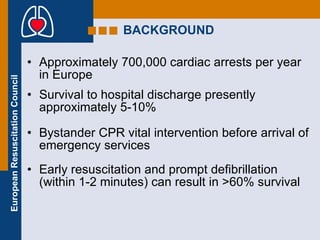
BACKGROUND Approximately 700,000 cardiac arrests per year in Europe Survival to hospital discharge presently approximately 5-10% Bystander CPR vital intervention before arrival of emergency services Early resuscitation and prompt defibrillation (within 1-2 minutes) can result in >60% survival
CHAIN OF SURVIVAL
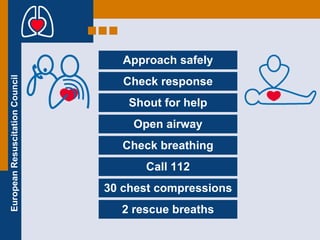
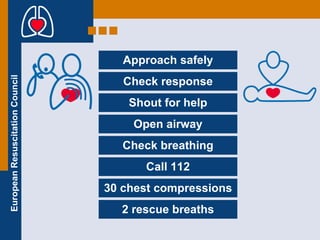
Approach safely Check response Shout for help Open airway Check breathing Call 112 30 chest compressions 2 rescue breaths
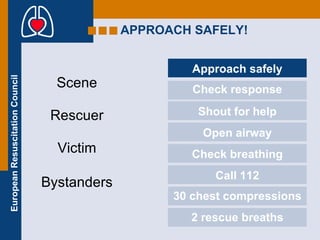
APPROACH SAFELY! Scene Rescuer Victim Bystanders Approach safely Check response Shout for help Open airway Check breathing Call 112 30 chest compressions 2 rescue breaths
CHECK RESPONSE Approach safely Check response Shout for help Open airway Check breathing Call 112 30 chest compressions 2 rescue breaths
CHECK RESPONSE Shake shoulders gently Ask “Are you all right?” If he responds Leave as you find him. Find out what is wrong. Reassess regularly.
SHOUT FOR HELP Approach safely Check response Shout for help Open airway Check breathing Call 112 30 chest compressions 2 rescue breaths
OPEN AIRWAY Approach safely Check response Shout for help Open airway Check breathing Call 112 30 chest compressions 2 rescue breaths
CHECK BREATHING Approach safely Check response Shout for help Open airway Check breathing Call 112 30 chest compressions 2 rescue breaths
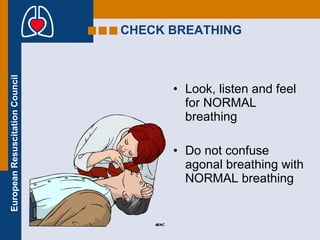
CHECK BREATHING Look, listen and feel for NORMAL breathing Do not confuse agonal breathing with NORMAL breathing
AGONAL BREATHING Occurs shortly after the heart stops  in up to 40% of cardiac arrests Described as barely, heavy, noisy or gasping breathing Recognise as a sign of cardiac arrest
Approach safely Check response Shout for help Open airway Check breathing Call 112 30 chest compressions 2 rescue breaths
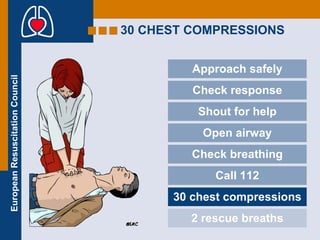
30 CHEST COMPRESSIONS Approach safely Check response Shout for help Open airway Check breathing Call 112 30 chest compressions 2 rescue breaths
CHEST COMPRESSIONS Place the heel of one hand in the centre of the chest Place other hand on top  Interlock fingers Compress the chest Rate 100 min -1 Depth 4-5 cm Equal compression : relaxation When possible change CPR operator every 2 min
RESCUE BREATHS Approach safely Check response Shout for help Open airway Check breathing Call 112 30 chest compressions 2 rescue breaths
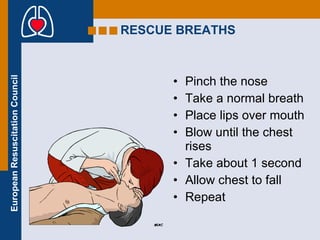
RESCUE BREATHS Pinch the nose Take a normal breath Place lips over mouth Blow until the chest rises Take about 1 second Allow chest to fall Repeat
CONTINUE CPR   30 2
Approach safely Check response Shout for help Open airway Check breathing Call 112 30 chest compressions 2 rescue breaths
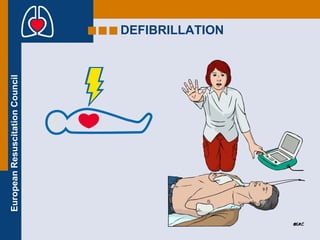
DEFIBRILLATION
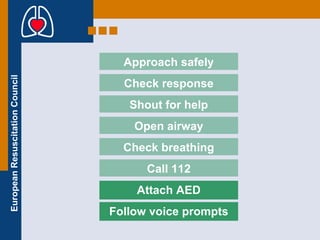
Call 112 Approach safely Check response Shout for help Open airway Check breathing Attach AED Follow voice prompts
SWITCH ON AED Some AEDs will automatically switch themselves on when the lid is opened
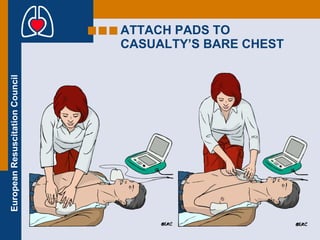
ATTACH PADS TO CASUALTY’S BARE CHEST
ANALYSING RHYTHM  DO NOT TOUCH VICTIM
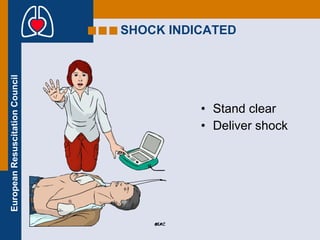
SHOCK INDICATED Stand clear Deliver shock
SHOCK DELIVERED FOLLOW AED INSTRUCTIONS   30   2
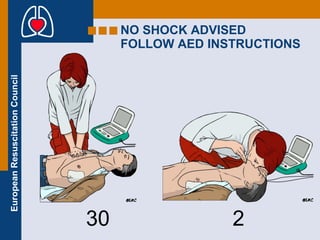
NO SHOCK ADVISED FOLLOW AED INSTRUCTIONS   30   2
IF VICTIM STARTS TO BREATHE NORMALLY PLACE IN RECOVERY POSITION
 
CPR IN CHILDREN Adult CPR techniques can be used on children Compressions 1/3 of the depth of the chest
AED IN CHILDREN Age > 8 years use adult AED Age 1-8 years use paediatric pads / settings if available (otherwise use adult mode) Age < 1 year use only if manufacturer instructions indicate it is safe
ANY QUESTIONS?
Approach safely Check response Shout for help Open airway Check breathing Call 112 30 chest compressions 2 rescue breaths Approach safely Check response Shout for help Open airway Check breathing Call 112 Attach AED Follow voice prompts

Basic Life Support & Automated External Defibrillation Course

  • 1.
    Basic Life Support& Automated External Defibrillation Course
  • 2.
    OBJECTIVES At theend of this course participants should be able to demonstrate: How to assess the collapsed victim. How to perform chest compression and rescue breathing. How to operate an automated external defibrillator safely. How to place an unconscious breathing victim in the recovery position.
  • 3.
    BACKGROUND Approximately 700,000cardiac arrests per year in Europe Survival to hospital discharge presently approximately 5-10% Bystander CPR vital intervention before arrival of emergency services Early resuscitation and prompt defibrillation (within 1-2 minutes) can result in >60% survival
  • 4.
  • 5.
    Approach safely Checkresponse Shout for help Open airway Check breathing Call 112 30 chest compressions 2 rescue breaths
  • 6.
    APPROACH SAFELY! SceneRescuer Victim Bystanders Approach safely Check response Shout for help Open airway Check breathing Call 112 30 chest compressions 2 rescue breaths
  • 7.
    CHECK RESPONSE Approachsafely Check response Shout for help Open airway Check breathing Call 112 30 chest compressions 2 rescue breaths
  • 8.
    CHECK RESPONSE Shakeshoulders gently Ask “Are you all right?” If he responds Leave as you find him. Find out what is wrong. Reassess regularly.
  • 9.
    SHOUT FOR HELPApproach safely Check response Shout for help Open airway Check breathing Call 112 30 chest compressions 2 rescue breaths
  • 10.
    OPEN AIRWAY Approachsafely Check response Shout for help Open airway Check breathing Call 112 30 chest compressions 2 rescue breaths
  • 11.
    CHECK BREATHING Approachsafely Check response Shout for help Open airway Check breathing Call 112 30 chest compressions 2 rescue breaths
  • 12.
    CHECK BREATHING Look,listen and feel for NORMAL breathing Do not confuse agonal breathing with NORMAL breathing
  • 13.
    AGONAL BREATHING Occursshortly after the heart stops in up to 40% of cardiac arrests Described as barely, heavy, noisy or gasping breathing Recognise as a sign of cardiac arrest
  • 14.
    Approach safely Checkresponse Shout for help Open airway Check breathing Call 112 30 chest compressions 2 rescue breaths
  • 15.
    30 CHEST COMPRESSIONSApproach safely Check response Shout for help Open airway Check breathing Call 112 30 chest compressions 2 rescue breaths
  • 16.
    CHEST COMPRESSIONS Placethe heel of one hand in the centre of the chest Place other hand on top Interlock fingers Compress the chest Rate 100 min -1 Depth 4-5 cm Equal compression : relaxation When possible change CPR operator every 2 min
  • 17.
    RESCUE BREATHS Approachsafely Check response Shout for help Open airway Check breathing Call 112 30 chest compressions 2 rescue breaths
  • 18.
    RESCUE BREATHS Pinchthe nose Take a normal breath Place lips over mouth Blow until the chest rises Take about 1 second Allow chest to fall Repeat
  • 19.
  • 20.
    Approach safely Checkresponse Shout for help Open airway Check breathing Call 112 30 chest compressions 2 rescue breaths
  • 21.
  • 22.
    Call 112 Approachsafely Check response Shout for help Open airway Check breathing Attach AED Follow voice prompts
  • 23.
    SWITCH ON AEDSome AEDs will automatically switch themselves on when the lid is opened
  • 24.
    ATTACH PADS TOCASUALTY’S BARE CHEST
  • 25.
    ANALYSING RHYTHM DO NOT TOUCH VICTIM
  • 26.
    SHOCK INDICATED Standclear Deliver shock
  • 27.
    SHOCK DELIVERED FOLLOWAED INSTRUCTIONS 30 2
  • 28.
    NO SHOCK ADVISEDFOLLOW AED INSTRUCTIONS 30 2
  • 29.
    IF VICTIM STARTSTO BREATHE NORMALLY PLACE IN RECOVERY POSITION
  • 30.
  • 31.
    CPR IN CHILDRENAdult CPR techniques can be used on children Compressions 1/3 of the depth of the chest
  • 32.
    AED IN CHILDRENAge > 8 years use adult AED Age 1-8 years use paediatric pads / settings if available (otherwise use adult mode) Age < 1 year use only if manufacturer instructions indicate it is safe
  • 33.
  • 34.
    Approach safely Checkresponse Shout for help Open airway Check breathing Call 112 30 chest compressions 2 rescue breaths Approach safely Check response Shout for help Open airway Check breathing Call 112 Attach AED Follow voice prompts