Automated External Defibrillation Mita Patel Blaine Burris Jeffrey Laws Trey McCurry HRD 860 November 30 th  2009
Objectives AED instruction classes provide students to knowledge and practice to deal with emergency situations. Using mannequins, students will be able to learn  the correct procedure and technique to give CPR and use AED.  In a clinical setting, students will be able to demonstrate proper technique, procedure and usage of an AED when faced with an emergency situation.
Would you know what to do? An woman suddenly collapses while running laps.  She is lying on the ground and does not appear to be moving.  You recognize the emergency and perform an initial assessment.  You determine that she is unconscious, not moving  or breathing and has no pulse. The facility has an automated external defibrillator (AED).  How would you respond? Would you know what to do?
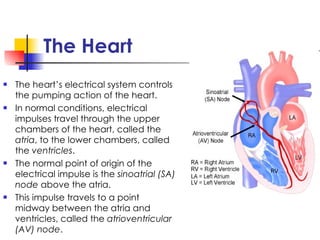
The Heart The heart’s electrical system controls the pumping action of the heart. In normal conditions, electrical impulses travel through the upper chambers of the heart, called the  atria , to the lower chambers, called the  ventricles . The normal point of origin of the electrical impulse is the  sinoatrial (SA) node  above the atria. This impulse travels to a point midway between the atria and ventricles, called the  atrioventricular (AV) node .
When the heart STOPS! There are 2 types of disruption that can occur to the heart;  ventricular fibrillation ( V-fib )  and  ventricular tachycardia ( V-tach ). V-fib  is a state of totally disorganized electrical activity in the heart.  The heart is thus incapable of pumping blood resulting in no pulse. V-tach  is a very rapid contraction of the ventricles.  Even though there is electrical activity, the rate is so fast that the heart is unable to pump blood properly, again resulting in no movement, breathing or and no pulse.
Defibrillation  V-fib and V-tach rhythms can be corrected with early defibrillation. Delivering an electrical shock with an AED disrupts the electrical activity long enough to allow the heart to spontaneously develop an effective rhythm on its own. If V-fib or V-tach are not disrupted, all electrical activity will cease, called  asystole , which cannot be corrected by defibrillation. With the quick and efficient use of an AED you can save lives.
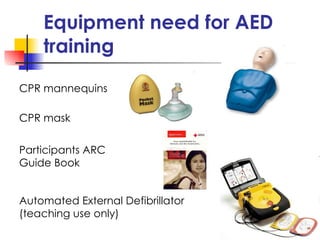
Equipment need for AED training CPR mannequins CPR mask Automated External Defibrillator  (teaching use only) Participants ARC Guide Book
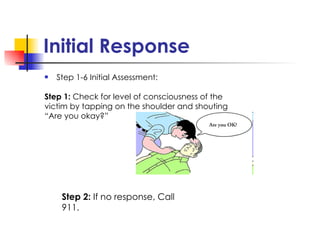
Initial Response Step 1-6 Initial Assessment: Step 1:  Check for level of consciousness of the  victim by tapping on the shoulder and shouting  “ Are you okay?” Step 2:  If no response, Call 911.
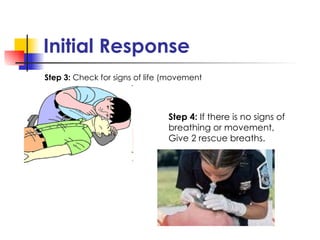
Initial Response Step 3:  Check for signs of life (movement  and breathing) Step 4:  If there is no signs of breathing or movement, Give 2 rescue breaths.
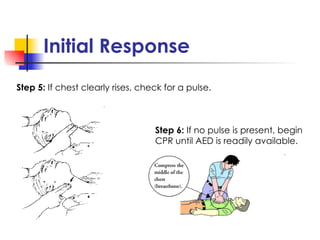
Initial Response Step 5:  If chest clearly rises, check for a pulse. Step 6:  If no pulse is present, begin CPR until AED is readily available.
Cardiac Arrest Once an initial assessment has been performed and CPR has been initiated because there is no pulse, breathing or movement.  An AED should be used once is it ready for use.
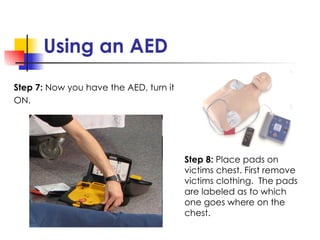
Using an AED Step 7:  Now you have the AED, turn it ON. Step 8:  Place pads on victims chest. First remove victims clothing.  The pads are labeled as to which one goes where on the chest.
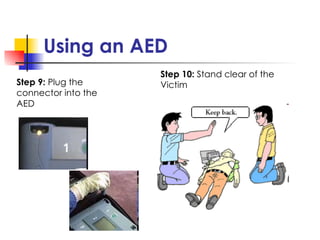
Using an AED Step 9:  Plug the connector into the  AED Step 10:  Stand clear of the Victim
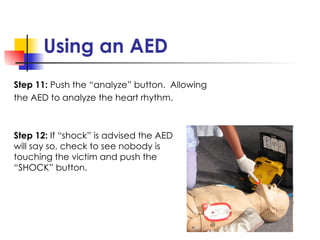
Using an AED Step 11:  Push the “analyze” button.  Allowing  the AED to analyze the heart rhythm. Step 12:  If “shock” is advised the AED will say so, check to see nobody is touching the victim and push the “SHOCK” button.
Student Evaluation Each student after the lecture portion will be tested in two ways: A demonstration of proper techniques Students will be expected to go through each of the steps as though in a real emergency situation. Using the CPR mannequin they will demonstrate the correct way to administer rescue breathing and placement of AED pads. An online based test over the proper usage of an AED after the practical testing

Automated External Defibrillator

  • 1.
    Automated External DefibrillationMita Patel Blaine Burris Jeffrey Laws Trey McCurry HRD 860 November 30 th 2009
  • 2.
    Objectives AED instructionclasses provide students to knowledge and practice to deal with emergency situations. Using mannequins, students will be able to learn the correct procedure and technique to give CPR and use AED. In a clinical setting, students will be able to demonstrate proper technique, procedure and usage of an AED when faced with an emergency situation.
  • 3.
    Would you knowwhat to do? An woman suddenly collapses while running laps. She is lying on the ground and does not appear to be moving. You recognize the emergency and perform an initial assessment. You determine that she is unconscious, not moving or breathing and has no pulse. The facility has an automated external defibrillator (AED). How would you respond? Would you know what to do?
  • 4.
    The Heart Theheart’s electrical system controls the pumping action of the heart. In normal conditions, electrical impulses travel through the upper chambers of the heart, called the atria , to the lower chambers, called the ventricles . The normal point of origin of the electrical impulse is the sinoatrial (SA) node above the atria. This impulse travels to a point midway between the atria and ventricles, called the atrioventricular (AV) node .
  • 5.
    When the heartSTOPS! There are 2 types of disruption that can occur to the heart; ventricular fibrillation ( V-fib ) and ventricular tachycardia ( V-tach ). V-fib is a state of totally disorganized electrical activity in the heart. The heart is thus incapable of pumping blood resulting in no pulse. V-tach is a very rapid contraction of the ventricles. Even though there is electrical activity, the rate is so fast that the heart is unable to pump blood properly, again resulting in no movement, breathing or and no pulse.
  • 6.
    Defibrillation V-fiband V-tach rhythms can be corrected with early defibrillation. Delivering an electrical shock with an AED disrupts the electrical activity long enough to allow the heart to spontaneously develop an effective rhythm on its own. If V-fib or V-tach are not disrupted, all electrical activity will cease, called asystole , which cannot be corrected by defibrillation. With the quick and efficient use of an AED you can save lives.
  • 7.
    Equipment need forAED training CPR mannequins CPR mask Automated External Defibrillator (teaching use only) Participants ARC Guide Book
  • 8.
    Initial Response Step1-6 Initial Assessment: Step 1: Check for level of consciousness of the victim by tapping on the shoulder and shouting “ Are you okay?” Step 2: If no response, Call 911.
  • 9.
    Initial Response Step3: Check for signs of life (movement and breathing) Step 4: If there is no signs of breathing or movement, Give 2 rescue breaths.
  • 10.
    Initial Response Step5: If chest clearly rises, check for a pulse. Step 6: If no pulse is present, begin CPR until AED is readily available.
  • 11.
    Cardiac Arrest Oncean initial assessment has been performed and CPR has been initiated because there is no pulse, breathing or movement. An AED should be used once is it ready for use.
  • 12.
    Using an AEDStep 7: Now you have the AED, turn it ON. Step 8: Place pads on victims chest. First remove victims clothing. The pads are labeled as to which one goes where on the chest.
  • 13.
    Using an AEDStep 9: Plug the connector into the AED Step 10: Stand clear of the Victim
  • 14.
    Using an AEDStep 11: Push the “analyze” button. Allowing the AED to analyze the heart rhythm. Step 12: If “shock” is advised the AED will say so, check to see nobody is touching the victim and push the “SHOCK” button.
  • 15.
    Student Evaluation Eachstudent after the lecture portion will be tested in two ways: A demonstration of proper techniques Students will be expected to go through each of the steps as though in a real emergency situation. Using the CPR mannequin they will demonstrate the correct way to administer rescue breathing and placement of AED pads. An online based test over the proper usage of an AED after the practical testing