Chapter 6
Automated External Defibrillation
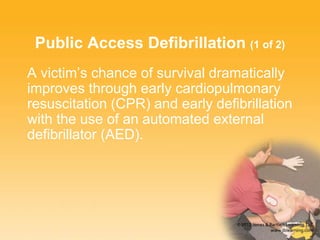
Public Access Defibrillation (1 of 2)
A victim’s chance of survival dramatically
improves through early cardiopulmonary
resuscitation (CPR) and early defibrillation
with the use of an automated external
defibrillator (AED).
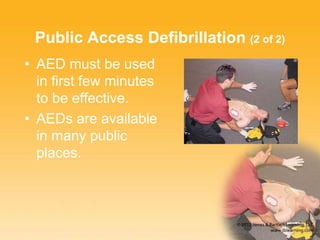
Public Access Defibrillation (2 of 2)
• AED must be used
in first few minutes
to be effective.
• AEDs are available
in many public
places.
How the Heart Works
• An organ with four
hollow chambers
• Two chambers on the
right; two chambers on
the left
• Electrical system
• Contracts approximately
every second
• Needs an abundant
supply of oxygen
When Normal Electrical Activity Is
Interrupted (1 of 2)
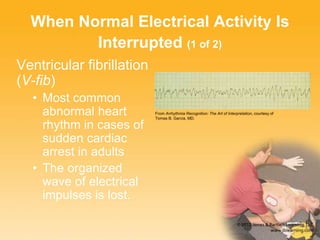
Ventricular fibrillation
(V-fib)
• Most common
abnormal heart
rhythm in cases of
sudden cardiac
arrest in adults
• The organized
wave of electrical
impulses is lost.
From Arrhythmia Recognition: The Art of Interpretation, courtesy of
Tomas B. Garcia, MD.
When Normal Electrical Activity Is
Interrupted (2 of 2)
• Ventricular
tachycardia
(V-tach)
• Heart beats too
fast to pump
blood.
From Arrhythmia Recognition: The Art of Interpretation, courtesy of
Tomas B. Garcia, MD.
Care for Cardiac Arrest
• Time is crucial.
• CPR is the initial
care.
About AEDs (1 of 3)
Electronic device that:
• analyzes the heart rhythm.
• delivers an electric shock if necessary.
• corrects one of the abnormal electrical
disturbances.
About AEDs (2 of 3)
• Attaches to
victim’s chest
• Built-in rhythm
analysis system
• Records victim’s
heart rhythm,
shock data, and
other information
About AEDs (3 of 3)
Common elements:
• On/off mechanism
• Cable and pads (electrodes)
• Analysis capability
• Defibrillation capability
• Prompts
• Battery-operation capability
Using an AED (1 of 4)
• Only use if the
victim is
unresponsive and
not breathing.
• Power on the
AED.
Using an AED (2 of 4)
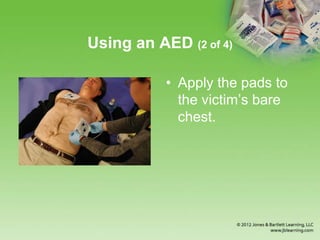
• Apply the pads to
the victim’s bare
chest.
Using an AED (3 of 4)
• Stand clear.
• Allow the device
to analyze the
heart rhythm.
• If advised, press
the shock button.
Using an AED (4 of 4)
• Perform CPR.
• Follow the device
prompts.
Special Considerations (1 of 3)
• Water
• Remove victim from water.
• Dry victim’s chest.
• Children
• May have special pediatric
pads
LIFEPAK® 1000 Defibrillator (AED) courtesy of Physio-Control. Used
with permission of Physio-Control, Inc., and according to the Material
Release Form provided by Physio-Control.
Special Considerations (2 of 3)
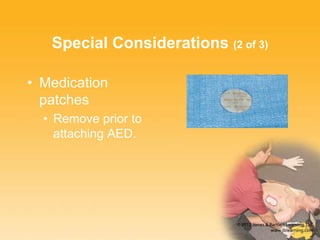
• Medication
patches
• Remove prior to
attaching AED.
Special Considerations (3 of 3)
Implanted devices
• Pacemakers
• Defibrillators
• Avoid placing
electrode pads over
devices.
• Allow the unit to stop
before using the
AED.
AED Maintenance
AEDs should be
inspected
periodically to ensure
proper working
condition and to
ensure that proper
supplies are
available.
AED Supplies
Supplies included:
• Two sets of electrode pads
• Extra battery
• Razor
• Hand towel
Supplies to consider:
• Breathing device
• Exam gloves
AED Manufacturers
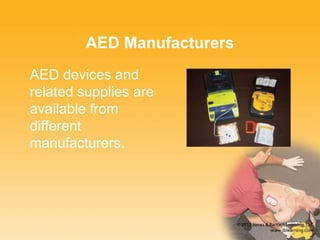
AED devices and
related supplies are
available from
different
manufacturers.

Chapter 6 Automated External Defibrillation

  • 1.
  • 2.
    Public Access Defibrillation(1 of 2) A victim’s chance of survival dramatically improves through early cardiopulmonary resuscitation (CPR) and early defibrillation with the use of an automated external defibrillator (AED).
  • 3.
    Public Access Defibrillation(2 of 2) • AED must be used in first few minutes to be effective. • AEDs are available in many public places.
  • 4.
    How the HeartWorks • An organ with four hollow chambers • Two chambers on the right; two chambers on the left • Electrical system • Contracts approximately every second • Needs an abundant supply of oxygen
  • 5.
    When Normal ElectricalActivity Is Interrupted (1 of 2) Ventricular fibrillation (V-fib) • Most common abnormal heart rhythm in cases of sudden cardiac arrest in adults • The organized wave of electrical impulses is lost. From Arrhythmia Recognition: The Art of Interpretation, courtesy of Tomas B. Garcia, MD.
  • 6.
    When Normal ElectricalActivity Is Interrupted (2 of 2) • Ventricular tachycardia (V-tach) • Heart beats too fast to pump blood. From Arrhythmia Recognition: The Art of Interpretation, courtesy of Tomas B. Garcia, MD.
  • 7.
    Care for CardiacArrest • Time is crucial. • CPR is the initial care.
  • 8.
    About AEDs (1of 3) Electronic device that: • analyzes the heart rhythm. • delivers an electric shock if necessary. • corrects one of the abnormal electrical disturbances.
  • 9.
    About AEDs (2of 3) • Attaches to victim’s chest • Built-in rhythm analysis system • Records victim’s heart rhythm, shock data, and other information
  • 10.
    About AEDs (3of 3) Common elements: • On/off mechanism • Cable and pads (electrodes) • Analysis capability • Defibrillation capability • Prompts • Battery-operation capability
  • 11.
    Using an AED(1 of 4) • Only use if the victim is unresponsive and not breathing. • Power on the AED.
  • 12.
    Using an AED(2 of 4) • Apply the pads to the victim’s bare chest.
  • 13.
    Using an AED(3 of 4) • Stand clear. • Allow the device to analyze the heart rhythm. • If advised, press the shock button.
  • 14.
    Using an AED(4 of 4) • Perform CPR. • Follow the device prompts.
  • 15.
    Special Considerations (1of 3) • Water • Remove victim from water. • Dry victim’s chest. • Children • May have special pediatric pads LIFEPAK® 1000 Defibrillator (AED) courtesy of Physio-Control. Used with permission of Physio-Control, Inc., and according to the Material Release Form provided by Physio-Control.
  • 16.
    Special Considerations (2of 3) • Medication patches • Remove prior to attaching AED.
  • 17.
    Special Considerations (3of 3) Implanted devices • Pacemakers • Defibrillators • Avoid placing electrode pads over devices. • Allow the unit to stop before using the AED.
  • 18.
    AED Maintenance AEDs shouldbe inspected periodically to ensure proper working condition and to ensure that proper supplies are available.
  • 19.
    AED Supplies Supplies included: •Two sets of electrode pads • Extra battery • Razor • Hand towel Supplies to consider: • Breathing device • Exam gloves
  • 20.
    AED Manufacturers AED devicesand related supplies are available from different manufacturers.

Editor's Notes

  • #9 End punc
  • #11 Initial cap on list items
  • #20 Initial cap on list items