Chapter

8
 Covalent Bonding
Section 8.1
                               Molecular Compounds

OBJECTIVES:
• Distinguish between the melting points and boiling points of molecular compounds
  and ionic compounds.
• Describe the information provided by a molecular formula.

Bonds are…

     Forces that hold groups of atoms together and make them function as a unit. Two
      types:

    1) Ionic bonds – transfer of electrons (gained or lost; makes formula unit)
    2) Covalent bonds – ________________________ of electrons. The resulting
       particle is called a ___________________________________

Covalent Bonds

•   The word covalent is a combination of the prefix co- (from Latin com, meaning
    “with” or “together”), and the verb valere, meaning “to be strong”.
•   Two electrons shared together have the strength to hold two atoms together in a bond.

Molecules

•   Many elements found in nature are in the form of molecules:
•   a ______________________________________________________________ joined
    together by covalent bonds.
•   For example, air contains oxygen molecules, consisting of two oxygen atoms joined
    covalently
•   Called a “_______________________________________________________” (O2)

How does H2 form?
(diatomic hydrogen molecule)

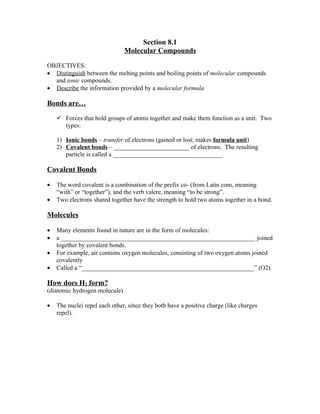
•   The nuclei repel each other, since they both have a positive charge (like charges
    repel).
+                                                             +

                                              +                       +
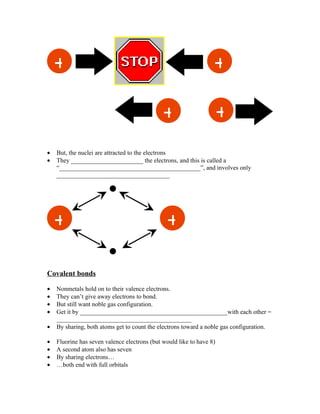
•   But, the nuclei are attracted to the electrons
•   They _______________________ the electrons, and this is called a
    “_____________________________________________”, and involves only
    ____________________________________


    +                                          +

Covalent bonds

•   Nonmetals hold on to their valence electrons.
•   They can’t give away electrons to bond.
•   But still want noble gas configuration.
•   Get it by _______________________________________________with each other =
    ___________________________________________
•   By sharing, both atoms get to count the electrons toward a noble gas configuration.

•   Fluorine has seven valence electrons (but would like to have 8)
•   A second atom also has seven
•   By sharing electrons…
•   …both end with full orbitals
Molecular Compounds

•   Compounds that are bonded covalently (like in water, or carbon dioxide) are called
    ________________________________________________
•   Molecular compounds tend to have relatively __________________________
    melting and boiling points than ionic compounds – this is not as strong a bond as
    ionic

•   Thus, molecular compounds tend to be _____________________________________
    at room temperature
           • Ionic compounds were solids
•   A molecular compound have a ___________________________________________
           o Shows how many atoms of each element a molecule contains

•   The formula for water is written as H2O
•   The ___________________________________ behind hydrogen means there are 2
    atoms of hydrogen; if there is only one atom, the subscript 1 is omitted
•   Molecular formulas do not tell any information about the structure (the arrangement
    of the various atoms).
Section 8.2
                     The Nature of Covalent Bonding
OBJECTIVES:
  • Describe how electrons are shared to form covalent bonds, and identify
     exceptions to the octet rule.
  • Demonstrate how electron dot structures represent shared electrons.
  • Describe how atoms form double or triple covalent bonds.
  • Distinguish between a covalent bond and a coordinate covalent bond, and
     describe how the strength of a covalent bond is related to its bond dissociation
     energy.
  • Describe how oxygen atoms are bonded in ozone.

A Single Covalent Bond is...

   •   A sharing of two valence electrons.
   •   Only _____________________________ and ____________________________
   •   Different from an ionic bond because they actually form molecules.
   •   Two specific atoms are joined.
   •   In an ionic solid, you can’t tell which atom the electrons moved from or to

How to show the formation…

   •   It’s like a jigsaw puzzle.
   •   You put the pieces together to end up with the right formula.
   •   Carbon is a special example - can it really share 4 electrons: 1s22s22p2?
            o Yes, due to electron promotion!
   •   Another example: lets show how water is formed with covalent bonds, by using
       an electron dot diagram

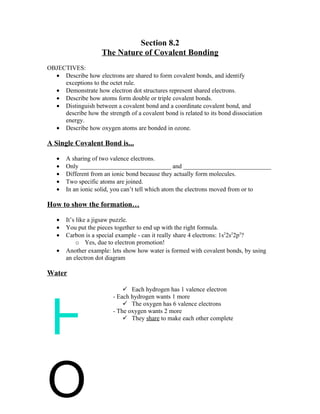
Water

                               Each hydrogen has 1 valence electron


H
                          - Each hydrogen wants 1 more
                               The oxygen has 6 valence electrons
                          - The oxygen wants 2 more
                               They share to make each other complete


O
•   Put the pieces together
    •   The first hydrogen is happy
    •   The oxygen still needs one more
    •   So, a second hydrogen attaches
    •   Every atom has full energy levels


Multiple Bonds

    •   Sometimes atoms share more than one pair of valence electrons.
    •   A ____________________________________________ is when atoms share
        two pairs of electrons (4 total)
    •   A ____________________________________________ is when atoms share
        three pairs of electrons (6 total)
    •   Table 8.1, p.222 - Know these 7 elements as _____________________________:


Dot diagram for Carbon dioxide

•   CO2 - Carbon is central atom ( more metallic )
•   Carbon has 4 valence electrons
•   Wants 4 more
•   Oxygen has 6 valence electrons
•   Wants 2 more


C
O
Carbon dioxide

    •    Attaching 1 oxygen leaves the oxygen 1 short, and the carbon 3 short


    •    Attaching the second oxygen leaves both of the oxygen 1 short, and the carbon 2
         short


•   The only solution is to share more
•   Requires two double bonds
•   Each atom can count all the electrons in the bond


    How to draw them?

        Use these guidelines:
    1)   Add up all the valence electrons.
    2)   Count up the total number of electrons to make all atoms happy.
    3)   Subtract; then Divide by 2
    4)   Tells you how many bonds to draw
    5)   Fill in the rest of the valence electrons to fill atoms up.
Example


  •   NH3, which is ammonia
  •   N – central atom; has 5 valence electrons, wants 8
  •   H - has 1 (x3) valence electrons, wants 2 (x3)
  •   NH3 has 5+3 = _______
  •   NH3 wants 8+6 = 14
  •   (14-8)/2= ___________________
  •   4 atoms with _________ bonds

  •   Draw in the bonds; start with singles
  •   All 8 electrons are accounted for
  •   Everything is full – done with this one


Example: HCN

  •   HCN: C is central atom
  •   N - has _____ valence electrons, wants _____
  •   C - has _____ valence electrons, wants _____
  •   H - has _____ valence electron, wants _____
  •   HCN has _____+_____+_____ = _____
  •   HCN wants _____+_____+_____=_____
  •   (_____-_____)/2= _____ bonds
  •   3 atoms with _____ bonds – this will require multiple bonds - not to H however

HCN

  •   Put single bond between each atom
  •   Need to add 2 more bonds
  •   Must go between C and N (Hydrogen is full)
•   Uses 8 electrons – need 2 more to equal the 10 it has


  •   Must go on the N to fill its octet


Another way of indicating bonds

  •   Often use a line to indicate a bond
  •   Called a ________________________________________________
  •   Each line is ________ valence electrons


Other Structural Examples


A Coordinate Covalent Bond...

  •   When one atom donates both electrons in a covalent bond.
  •   Carbon monoxide (CO) is a good example:
Coordinate covalent bond

   •   Most polyatomic cations and anions contain covalent and coordinate covalent
       bonds
   •   Table 16.2, p.445
   •   Sample Problem 16.2, p.446
   •   The ammonium ion (NH41+) can be shown as another example

Bond Dissociation Energies...

   •   _________________________________________________________________
       _________________________________________________________________
       __
   •   High dissociation energy usually means the chemical is relatively
       _________________________________, because it takes a lot of energy to break
       it down.
Resonance is...

   •   When ____________________________________ valid dot diagram is possible.
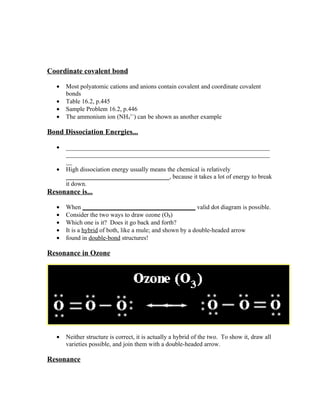
   •   Consider the two ways to draw ozone (O3)
   •   Which one is it? Does it go back and forth?
   •   It is a hybrid of both, like a mule; and shown by a double-headed arrow
   •   found in double-bond structures!

Resonance in Ozone


   •   Neither structure is correct, it is actually a hybrid of the two. To show it, draw all
       varieties possible, and join them with a double-headed arrow.

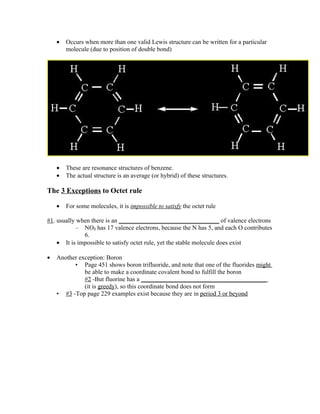
Resonance
•   Occurs when more than one valid Lewis structure can be written for a particular
        molecule (due to position of double bond)


    •   These are resonance structures of benzene.
    •   The actual structure is an average (or hybrid) of these structures.

The 3 Exceptions to Octet rule

    •   For some molecules, it is impossible to satisfy the octet rule

#1. usually when there is an ________________________________ of valence electrons
           – NO2 has 17 valence electrons, because the N has 5, and each O contributes
              6.
    • It is impossible to satisfy octet rule, yet the stable molecule does exist

•   Another exception: Boron
          • Page 451 shows boron trifluoride, and note that one of the fluorides might
              be able to make a coordinate covalent bond to fulfill the boron
              #2 -But fluorine has a ________________________________________
              (it is greedy), so this coordinate bond does not form
    • #3 -Top page 229 examples exist because they are in period 3 or beyond

Chemistry - Chp 8 - Covalent Bonding - Notes

  • 1.
  • 2.
    Section 8.1 Molecular Compounds OBJECTIVES: • Distinguish between the melting points and boiling points of molecular compounds and ionic compounds. • Describe the information provided by a molecular formula. Bonds are…  Forces that hold groups of atoms together and make them function as a unit. Two types: 1) Ionic bonds – transfer of electrons (gained or lost; makes formula unit) 2) Covalent bonds – ________________________ of electrons. The resulting particle is called a ___________________________________ Covalent Bonds • The word covalent is a combination of the prefix co- (from Latin com, meaning “with” or “together”), and the verb valere, meaning “to be strong”. • Two electrons shared together have the strength to hold two atoms together in a bond. Molecules • Many elements found in nature are in the form of molecules: • a ______________________________________________________________ joined together by covalent bonds. • For example, air contains oxygen molecules, consisting of two oxygen atoms joined covalently • Called a “_______________________________________________________” (O2) How does H2 form? (diatomic hydrogen molecule) • The nuclei repel each other, since they both have a positive charge (like charges repel).
  • 3.
    + + + + • But, the nuclei are attracted to the electrons • They _______________________ the electrons, and this is called a “_____________________________________________”, and involves only ____________________________________ + + Covalent bonds • Nonmetals hold on to their valence electrons. • They can’t give away electrons to bond. • But still want noble gas configuration. • Get it by _______________________________________________with each other = ___________________________________________ • By sharing, both atoms get to count the electrons toward a noble gas configuration. • Fluorine has seven valence electrons (but would like to have 8) • A second atom also has seven • By sharing electrons… • …both end with full orbitals
  • 4.
    Molecular Compounds • Compounds that are bonded covalently (like in water, or carbon dioxide) are called ________________________________________________ • Molecular compounds tend to have relatively __________________________ melting and boiling points than ionic compounds – this is not as strong a bond as ionic • Thus, molecular compounds tend to be _____________________________________ at room temperature • Ionic compounds were solids • A molecular compound have a ___________________________________________ o Shows how many atoms of each element a molecule contains • The formula for water is written as H2O • The ___________________________________ behind hydrogen means there are 2 atoms of hydrogen; if there is only one atom, the subscript 1 is omitted • Molecular formulas do not tell any information about the structure (the arrangement of the various atoms).
  • 5.
    Section 8.2 The Nature of Covalent Bonding OBJECTIVES: • Describe how electrons are shared to form covalent bonds, and identify exceptions to the octet rule. • Demonstrate how electron dot structures represent shared electrons. • Describe how atoms form double or triple covalent bonds. • Distinguish between a covalent bond and a coordinate covalent bond, and describe how the strength of a covalent bond is related to its bond dissociation energy. • Describe how oxygen atoms are bonded in ozone. A Single Covalent Bond is... • A sharing of two valence electrons. • Only _____________________________ and ____________________________ • Different from an ionic bond because they actually form molecules. • Two specific atoms are joined. • In an ionic solid, you can’t tell which atom the electrons moved from or to How to show the formation… • It’s like a jigsaw puzzle. • You put the pieces together to end up with the right formula. • Carbon is a special example - can it really share 4 electrons: 1s22s22p2? o Yes, due to electron promotion! • Another example: lets show how water is formed with covalent bonds, by using an electron dot diagram Water  Each hydrogen has 1 valence electron H - Each hydrogen wants 1 more  The oxygen has 6 valence electrons - The oxygen wants 2 more  They share to make each other complete O
  • 6.
    Put the pieces together • The first hydrogen is happy • The oxygen still needs one more • So, a second hydrogen attaches • Every atom has full energy levels Multiple Bonds • Sometimes atoms share more than one pair of valence electrons. • A ____________________________________________ is when atoms share two pairs of electrons (4 total) • A ____________________________________________ is when atoms share three pairs of electrons (6 total) • Table 8.1, p.222 - Know these 7 elements as _____________________________: Dot diagram for Carbon dioxide • CO2 - Carbon is central atom ( more metallic ) • Carbon has 4 valence electrons • Wants 4 more • Oxygen has 6 valence electrons • Wants 2 more C O
  • 7.
    Carbon dioxide • Attaching 1 oxygen leaves the oxygen 1 short, and the carbon 3 short • Attaching the second oxygen leaves both of the oxygen 1 short, and the carbon 2 short • The only solution is to share more • Requires two double bonds • Each atom can count all the electrons in the bond How to draw them?  Use these guidelines: 1) Add up all the valence electrons. 2) Count up the total number of electrons to make all atoms happy. 3) Subtract; then Divide by 2 4) Tells you how many bonds to draw 5) Fill in the rest of the valence electrons to fill atoms up.
  • 8.
    Example • NH3, which is ammonia • N – central atom; has 5 valence electrons, wants 8 • H - has 1 (x3) valence electrons, wants 2 (x3) • NH3 has 5+3 = _______ • NH3 wants 8+6 = 14 • (14-8)/2= ___________________ • 4 atoms with _________ bonds • Draw in the bonds; start with singles • All 8 electrons are accounted for • Everything is full – done with this one Example: HCN • HCN: C is central atom • N - has _____ valence electrons, wants _____ • C - has _____ valence electrons, wants _____ • H - has _____ valence electron, wants _____ • HCN has _____+_____+_____ = _____ • HCN wants _____+_____+_____=_____ • (_____-_____)/2= _____ bonds • 3 atoms with _____ bonds – this will require multiple bonds - not to H however HCN • Put single bond between each atom • Need to add 2 more bonds • Must go between C and N (Hydrogen is full)
  • 9.
    Uses 8 electrons – need 2 more to equal the 10 it has • Must go on the N to fill its octet Another way of indicating bonds • Often use a line to indicate a bond • Called a ________________________________________________ • Each line is ________ valence electrons Other Structural Examples A Coordinate Covalent Bond... • When one atom donates both electrons in a covalent bond. • Carbon monoxide (CO) is a good example:
  • 10.
    Coordinate covalent bond • Most polyatomic cations and anions contain covalent and coordinate covalent bonds • Table 16.2, p.445 • Sample Problem 16.2, p.446 • The ammonium ion (NH41+) can be shown as another example Bond Dissociation Energies... • _________________________________________________________________ _________________________________________________________________ __ • High dissociation energy usually means the chemical is relatively _________________________________, because it takes a lot of energy to break it down. Resonance is... • When ____________________________________ valid dot diagram is possible. • Consider the two ways to draw ozone (O3) • Which one is it? Does it go back and forth? • It is a hybrid of both, like a mule; and shown by a double-headed arrow • found in double-bond structures! Resonance in Ozone • Neither structure is correct, it is actually a hybrid of the two. To show it, draw all varieties possible, and join them with a double-headed arrow. Resonance
  • 11.
    Occurs when more than one valid Lewis structure can be written for a particular molecule (due to position of double bond) • These are resonance structures of benzene. • The actual structure is an average (or hybrid) of these structures. The 3 Exceptions to Octet rule • For some molecules, it is impossible to satisfy the octet rule #1. usually when there is an ________________________________ of valence electrons – NO2 has 17 valence electrons, because the N has 5, and each O contributes 6. • It is impossible to satisfy octet rule, yet the stable molecule does exist • Another exception: Boron • Page 451 shows boron trifluoride, and note that one of the fluorides might be able to make a coordinate covalent bond to fulfill the boron #2 -But fluorine has a ________________________________________ (it is greedy), so this coordinate bond does not form • #3 -Top page 229 examples exist because they are in period 3 or beyond