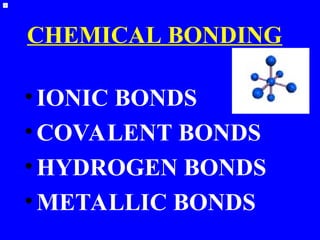
CHEMICAL BONDING
•IONIC BONDS
•COVALENT BONDS
•HYDROGEN BONDS
•METALLIC BONDS
IONIC BONDING
When an atom of a nonmetal
takes one or more electrons
from an atom of a metal
so both atoms end up with
eight valence electrons
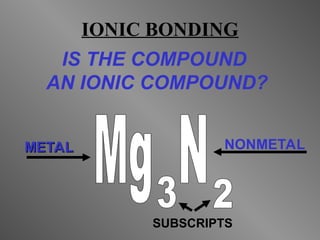
IONIC BONDING
IS THE COMPOUND
AN IONIC COMPOUND?
METAL
METAL NONMETAL
SUBSCRIPTS
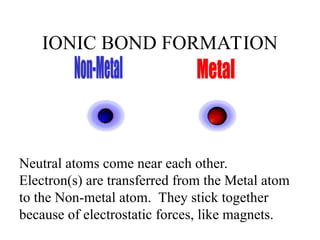
IONIC BOND FORMATION
Neutral atoms come near each other.
Electron(s) are transferred from the Metal atom
to the Non-metal atom. They stick together
because of electrostatic forces, like magnets.
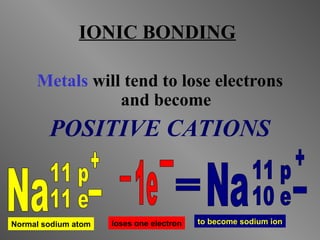
IONIC BONDING
Metals will tend to lose electrons
and become
POSITIVE CATIONS
Normal sodium atom loses one electron to become sodium ion
IONIC BONDING
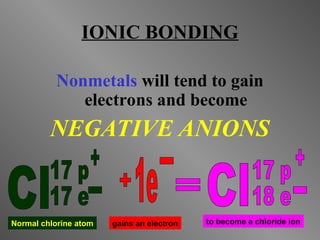
Nonmetals will tend to gain
electrons and become
NEGATIVE ANIONS
Normal chlorine atom gains an electron to become a chloride ion
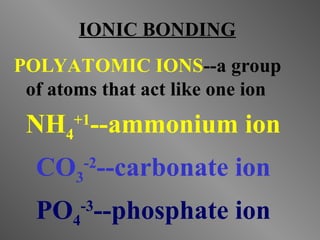
POLYATOMIC IONS--a group
of atoms that act like one ion
NH4
+1
--ammonium ion
CO3
-2
--carbonate ion
PO4
-3
--phosphate ion
IONIC BONDING
IONIC BONDING
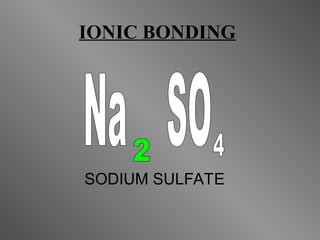
SODIUM SULFATE
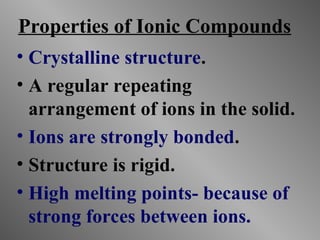
Properties of Ionic Compounds
• Crystalline structure.
• A regular repeating
arrangement of ions in the solid.
• Ions are strongly bonded.
• Structure is rigid.
• High melting points- because of
strong forces between ions.
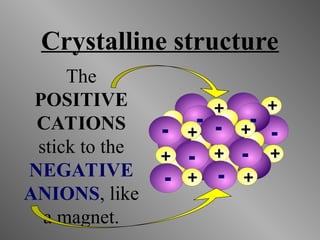
Crystalline structure
+
+
+ +
+
+
+
+
+
-
-
-
-
- -
-
-
-
The
POSITIVE
CATIONS
stick to the
NEGATIVE
ANIONS, like
a magnet.
Do they Conduct?
• Conducting electricity is allowing
charges to move.
• In a solid, the ions are locked in place.
• Ionic solids are insulators.
• When melted, the ions can move
around.
• Melted ionic compounds conduct.
• First get them to 800ºC.
• Dissolved in water they conduct.
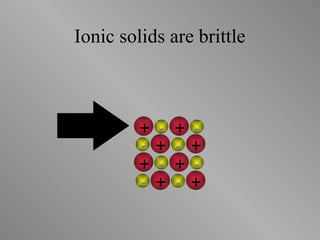
Ionic solids are brittle
+ - + -
+
- +
-
+ - + -
+
- +
-
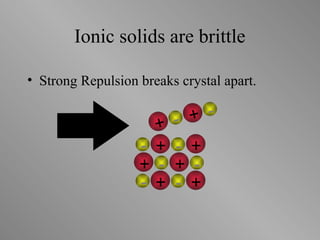
Ionic solids are brittle
+ - + -
+
- +
-
+ - + -
+
- +
-
• Strong Repulsion breaks crystal apart.
COVALENT BONDING
When an atom of one
nonmetal
shares one or more
electrons
with an atom of another
nonmetal so both atoms
end up with
eight valence electrons
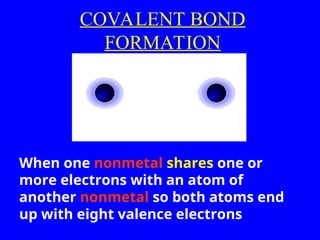
COVALENT BOND
FORMATION
When one nonmetal shares one or
more electrons with an atom of
another nonmetal so both atoms end
up with eight valence electrons
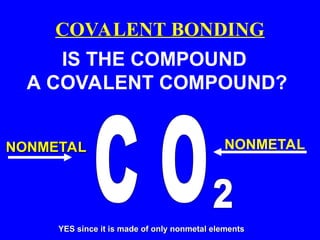
COVALENT BONDING
IS THE COMPOUND
A COVALENT COMPOUND?
NONMETAL
NONMETAL NONMETAL
YES since it is made of only nonmetal elements
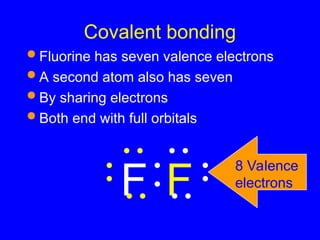
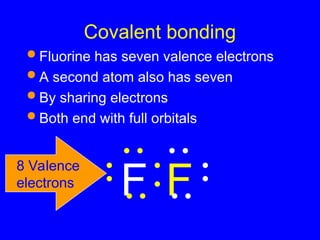
Covalent bonding
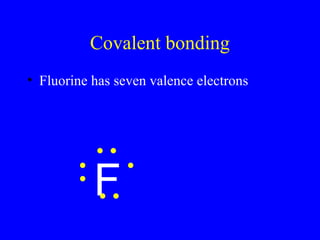
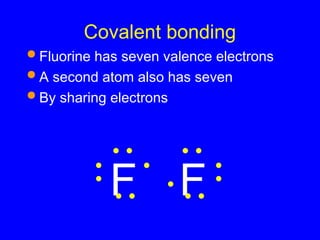
• Fluorine has seven valence electrons
F
Covalent bonding
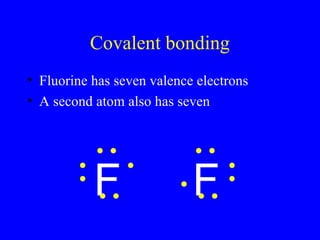
• Fluorine has seven valence electrons
• A second atom also has seven
F F
Covalent bonding
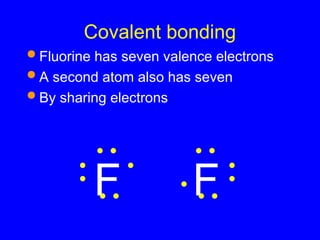
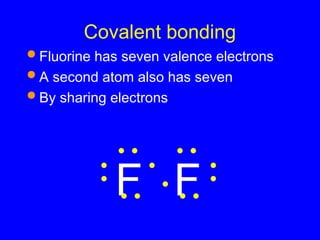
 Fluorine has seven valence electrons
 A second atom also has seven
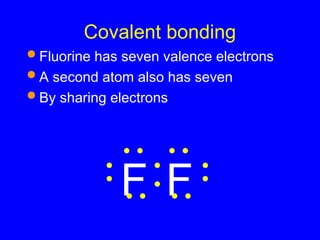
 By sharing electrons
F F
Covalent bonding
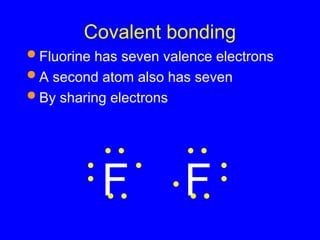
 Fluorine has seven valence electrons
 A second atom also has seven
 By sharing electrons
F F
Covalent bonding
 Fluorine has seven valence electrons
 A second atom also has seven
 By sharing electrons
F F
Covalent bonding
 Fluorine has seven valence electrons
 A second atom also has seven
 By sharing electrons
F F
Covalent bonding
 Fluorine has seven valence electrons
 A second atom also has seven
 By sharing electrons
F F
Covalent bonding
 Fluorine has seven valence electrons
 A second atom also has seven
 By sharing electrons
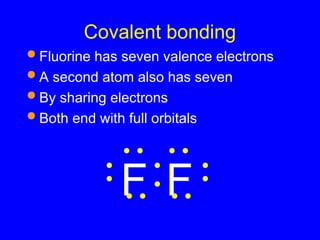
 Both end with full orbitals
F F
Covalent bonding
 Fluorine has seven valence electrons
 A second atom also has seven
 By sharing electrons
 Both end with full orbitals
F F
8 Valence
electrons
Covalent bonding
 Fluorine has seven valence electrons
 A second atom also has seven
 By sharing electrons
 Both end with full orbitals
F F
8 Valence
electrons
Single Covalent Bond
• A sharing of two valence electrons.
• Only nonmetals and Hydrogen.
• Different from an ionic bond because they
actually form molecules.
• Two specific atoms are joined.
• In an ionic solid you can’t tell which atom
the electrons moved from or to.
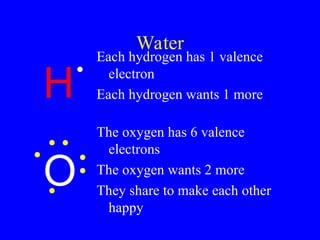
Water
H
O
Each hydrogen has 1 valence
electron
Each hydrogen wants 1 more
The oxygen has 6 valence
electrons
The oxygen wants 2 more
They share to make each other
happy
Water
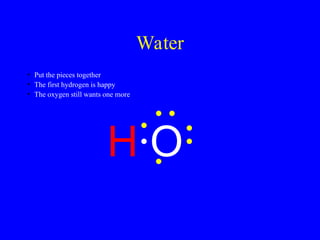
• Put the pieces together
• The first hydrogen is happy
• The oxygen still wants one more
H O
Water
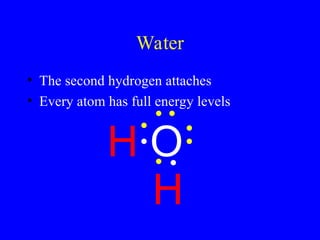
• The second hydrogen attaches
• Every atom has full energy levels
H O
H
Carbon dioxide
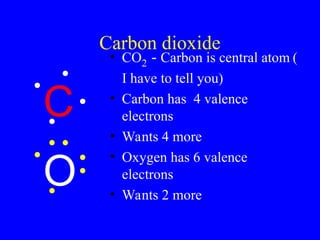
• CO2 - Carbon is central atom (
I have to tell you)
• Carbon has 4 valence
electrons
• Wants 4 more
• Oxygen has 6 valence
electrons
• Wants 2 more
O
C
Carbon dioxide
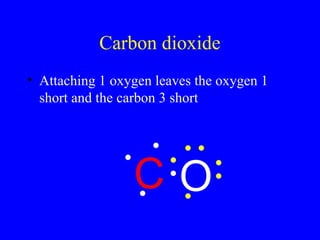
• Attaching 1 oxygen leaves the oxygen 1
short and the carbon 3 short
O
C
Carbon dioxide
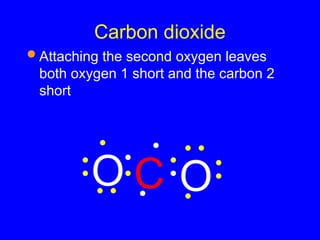
 Attaching the second oxygen leaves
both oxygen 1 short and the carbon 2
short
O
C
O
Carbon dioxide
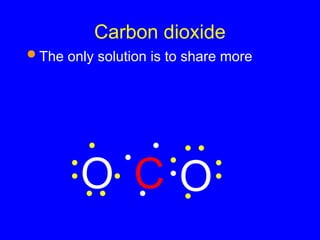
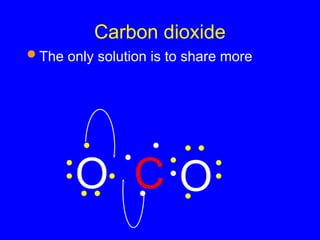
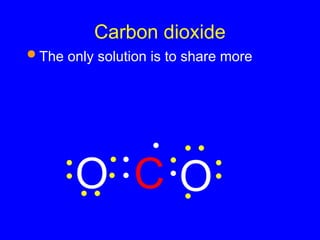
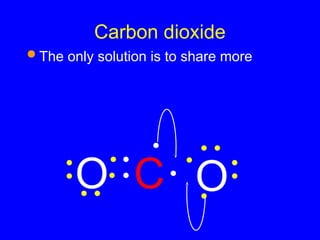
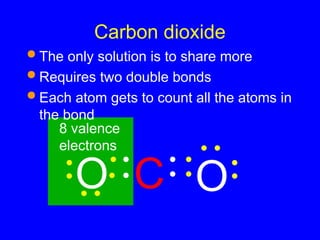
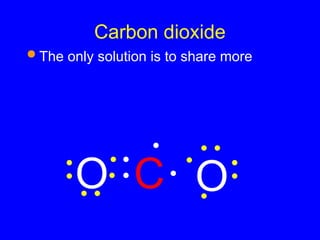
 The only solution is to share more
O
C
O
Carbon dioxide
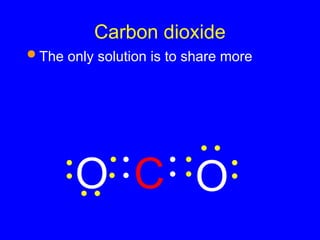
 The only solution is to share more
O
C
O
Carbon dioxide
 The only solution is to share more
O
C
O
Carbon dioxide
 The only solution is to share more
O
C
O
Carbon dioxide
 The only solution is to share more
O
C
O
Carbon dioxide
 The only solution is to share more
O
C
O
Carbon dioxide
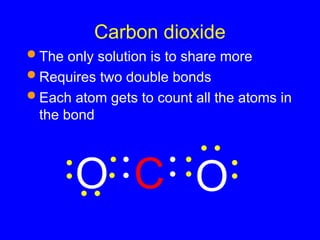
 The only solution is to share more
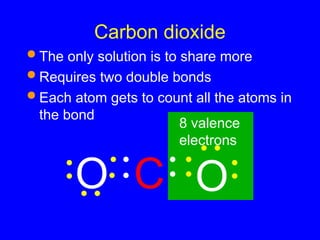
 Requires two double bonds
 Each atom gets to count all the atoms in
the bond
O
C
O
Carbon dioxide
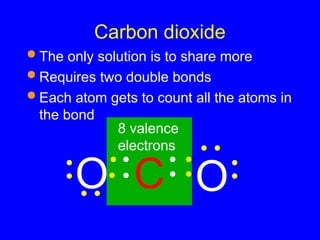
 The only solution is to share more
 Requires two double bonds
 Each atom gets to count all the atoms in
the bond
O
C
O
8 valence
electrons
Carbon dioxide
 The only solution is to share more
 Requires two double bonds
 Each atom gets to count all the atoms in
the bond
O
C
O
8 valence
electrons
Carbon dioxide
 The only solution is to share more
 Requires two double bonds
 Each atom gets to count all the atoms in
the bond
O
C
O
8 valence
electrons
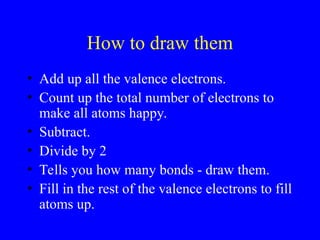
How to draw them
• Add up all the valence electrons.
• Count up the total number of electrons to
make all atoms happy.
• Subtract.
• Divide by 2
• Tells you how many bonds - draw them.
• Fill in the rest of the valence electrons to fill
atoms up.
Examples
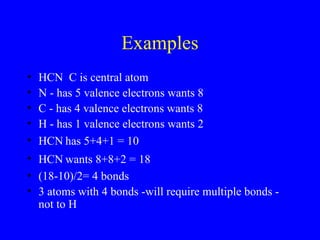
• HCN C is central atom
• N - has 5 valence electrons wants 8
• C - has 4 valence electrons wants 8
• H - has 1 valence electrons wants 2
• HCN has 5+4+1 = 10
• HCN wants 8+8+2 = 18
• (18-10)/2= 4 bonds
• 3 atoms with 4 bonds -will require multiple bonds -
not to H
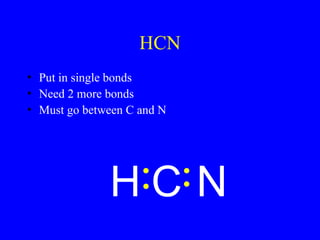
HCN
• Put in single bonds
• Need 2 more bonds
• Must go between C and N
N
H C
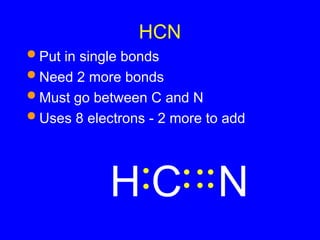
HCN
 Put in single bonds
 Need 2 more bonds
 Must go between C and N
 Uses 8 electrons - 2 more to add
N
H C
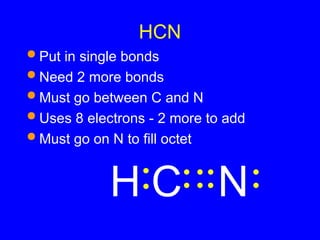
HCN
 Put in single bonds
 Need 2 more bonds
 Must go between C and N
 Uses 8 electrons - 2 more to add
 Must go on N to fill octet
N
H C
Polar Bonds
• When the atoms in a bond are the same, the
electrons are shared equally.
• This is a nonpolar covalent bond.
• When two different atoms are connected,
the atoms may not be shared equally.
• This is a polar covalent bond.
• How do we measure how strong the atoms
pull on electrons?
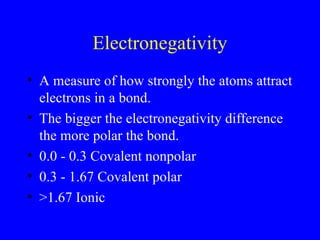
Electronegativity
• A measure of how strongly the atoms attract
electrons in a bond.
• The bigger the electronegativity difference
the more polar the bond.
• 0.0 - 0.3 Covalent nonpolar
• 0.3 - 1.67 Covalent polar
• >1.67 Ionic
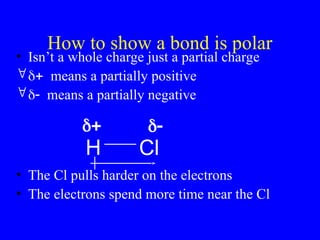
How to show a bond is polar
• Isn’t a whole charge just a partial charge
means a partially positive
means a partially negative
• The Cl pulls harder on the electrons
• The electrons spend more time near the Cl
H Cl
 
Polar Molecules
Molecules with ends
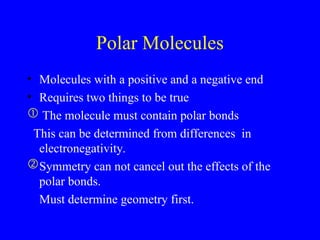
Polar Molecules
• Molecules with a positive and a negative end
• Requires two things to be true
 The molecule must contain polar bonds
This can be determined from differences in
electronegativity.
Symmetry can not cancel out the effects of the
polar bonds.
 Must determine geometry first.
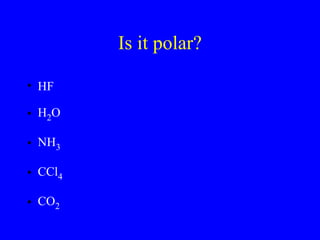
Is it polar?
• HF
• H2O
• NH3
• CCl4
• CO2
Intermolecular Forces
What holds molecules to each other
Intermolecular Forces
• They are what make solid and liquid molecular
compounds possible.
• The weakest are called van der Waal’s forces -
there are two kinds
• Dispersion forces
• Dipole Interactions
– depend on the number of electrons
– more electrons stronger forces
– Bigger molecules
Dipole interactions
• Depend on the number of electrons
• More electrons stronger forces
• Bigger molecules more electrons
•Fluorine is a gas
•Bromine is a liquid
•Iodine is a solid
Dipole interactions
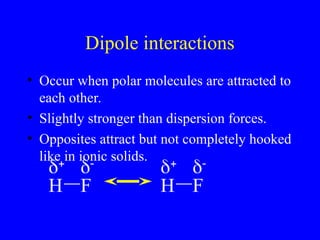
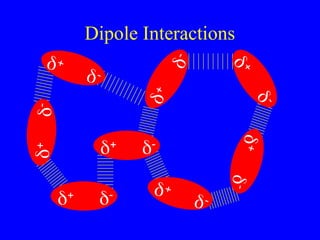
• Occur when polar molecules are attracted to
each other.
• Slightly stronger than dispersion forces.
• Opposites attract but not completely hooked
like in ionic solids.
Dipole interactions
• Occur when polar molecules are attracted to
each other.
• Slightly stronger than dispersion forces.
• Opposites attract but not completely hooked
like in ionic solids.
H F


H F


Dipole Interactions
























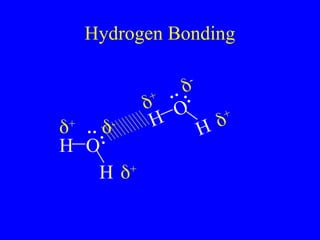
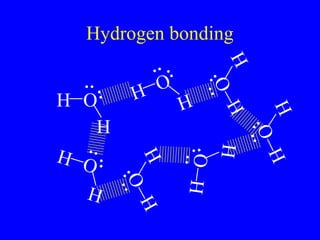
Hydrogen bonding
• Are the attractive force caused by hydrogen
bonded to F, O, or N.
• F, O, and N are very electronegative so it is
a very strong dipole.
• The hydrogen partially share with the lone
pair in the molecule next to it.
• The strongest of the intermolecular forces.
Hydrogen Bonding
H
H
O
+
-
+
H H
O
+
-
+
Hydrogen bonding
H
H
O H
H
O
H
H
O
H
H
O
H
H
O
H
H
O
H
H
O
MOLECULAR
SHAPES
OF
COVALENT
COMPOUNDS
VSepR tHEORY
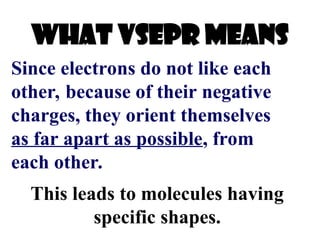
What Vsepr means
Since electrons do not like each
other, because of their negative
charges, they orient themselves
as far apart as possible, from
each other.
This leads to molecules having
specific shapes.
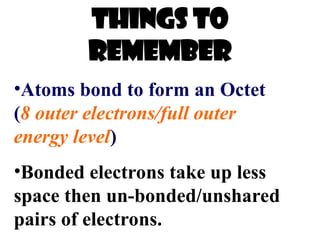
Things to
remember
•Atoms bond to form an Octet
(8 outer electrons/full outer
energy level)
•Bonded electrons take up less
space then un-bonded/unshared
pairs of electrons.
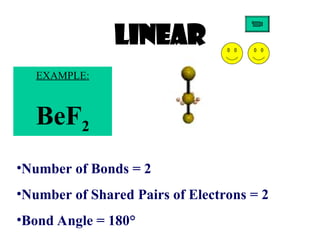
Linear
•Number of Bonds = 2
•Number of Shared Pairs of Electrons = 2
•Bond Angle = 180°
EXAMPLE:
BeF2
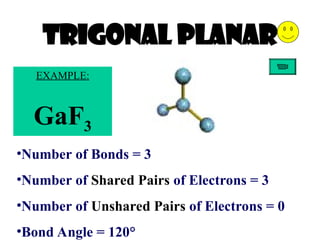
Trigonal Planar
•Number of Bonds = 3
•Number of Shared Pairs of Electrons = 3
•Number of Unshared Pairs of Electrons = 0
•Bond Angle = 120°
EXAMPLE:
GaF3
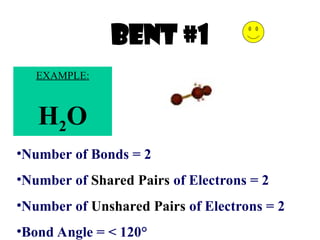
Bent #1
•Number of Bonds = 2
•Number of Shared Pairs of Electrons = 2
•Number of Unshared Pairs of Electrons = 2
•Bond Angle = < 120°
EXAMPLE:
H2O
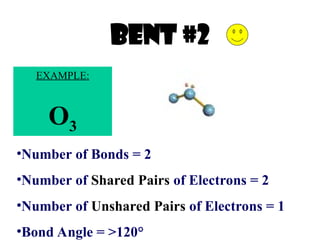
Bent #2
•Number of Bonds = 2
•Number of Shared Pairs of Electrons = 2
•Number of Unshared Pairs of Electrons = 1
•Bond Angle = >120°
EXAMPLE:
O3
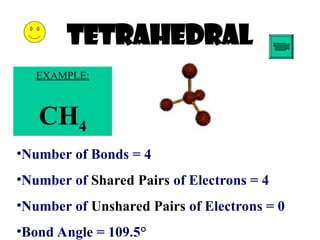
Tetrahedral
•Number of Bonds = 4
•Number of Shared Pairs of Electrons = 4
•Number of Unshared Pairs of Electrons = 0
•Bond Angle = 109.5°
EXAMPLE:
CH4
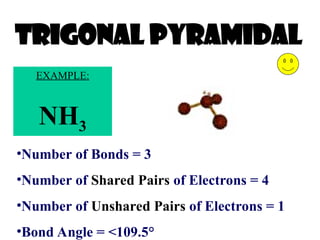
Trigonal Pyramidal
•Number of Bonds = 3
•Number of Shared Pairs of Electrons = 4
•Number of Unshared Pairs of Electrons = 1
•Bond Angle = <109.5°
EXAMPLE:
NH3
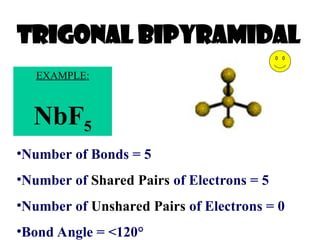
Trigonal bIPyramidal
•Number of Bonds = 5
•Number of Shared Pairs of Electrons = 5
•Number of Unshared Pairs of Electrons = 0
•Bond Angle = <120°
EXAMPLE:
NbF5
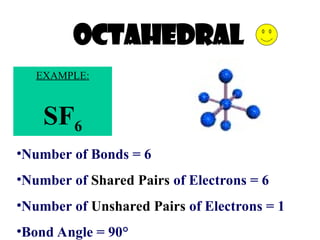
OCTAHEDRAL
•Number of Bonds = 6
•Number of Shared Pairs of Electrons = 6
•Number of Unshared Pairs of Electrons = 1
•Bond Angle = 90°
EXAMPLE:
SF6
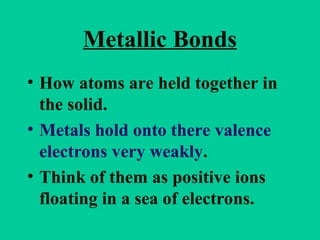
Metallic Bonds
• How atoms are held together in
the solid.
• Metals hold onto there valence
electrons very weakly.
• Think of them as positive ions
floating in a sea of electrons.
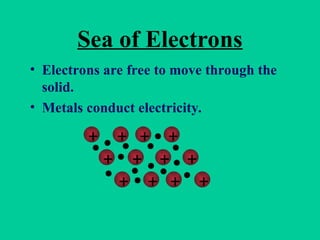
Sea of Electrons
+ + + +
+ + + +
+ + + +
• Electrons are free to move through the
solid.
• Metals conduct electricity.
Metals are Malleable
• Hammered into shape
(bend).
• Ductile - drawn into
wires.
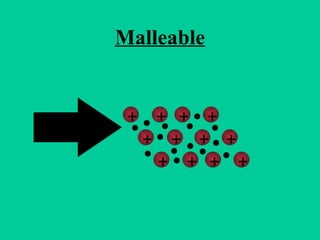
Malleable
+ + + +
+ + + +
+ + + +
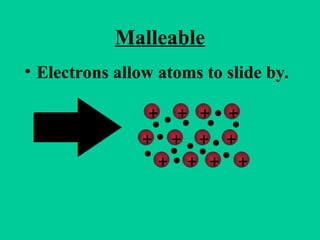
Malleable
+ + + +
+ + + +
+ + + +
• Electrons allow atoms to slide by.
CHEMICAL BONDING In Physics For Engineering Students

CHEMICAL BONDING In Physics For Engineering Students

  • 1.
    CHEMICAL BONDING •IONIC BONDS •COVALENTBONDS •HYDROGEN BONDS •METALLIC BONDS
  • 3.
    IONIC BONDING When anatom of a nonmetal takes one or more electrons from an atom of a metal so both atoms end up with eight valence electrons
  • 4.
    IONIC BONDING IS THECOMPOUND AN IONIC COMPOUND? METAL METAL NONMETAL SUBSCRIPTS
  • 5.
    IONIC BOND FORMATION Neutralatoms come near each other. Electron(s) are transferred from the Metal atom to the Non-metal atom. They stick together because of electrostatic forces, like magnets.
  • 6.
    IONIC BONDING Metals willtend to lose electrons and become POSITIVE CATIONS Normal sodium atom loses one electron to become sodium ion
  • 7.
    IONIC BONDING Nonmetals willtend to gain electrons and become NEGATIVE ANIONS Normal chlorine atom gains an electron to become a chloride ion
  • 8.
    POLYATOMIC IONS--a group ofatoms that act like one ion NH4 +1 --ammonium ion CO3 -2 --carbonate ion PO4 -3 --phosphate ion IONIC BONDING
  • 9.
  • 10.
    Properties of IonicCompounds • Crystalline structure. • A regular repeating arrangement of ions in the solid. • Ions are strongly bonded. • Structure is rigid. • High melting points- because of strong forces between ions.
  • 11.
    Crystalline structure + + + + + + + + + - - - - -- - - - The POSITIVE CATIONS stick to the NEGATIVE ANIONS, like a magnet.
  • 12.
    Do they Conduct? •Conducting electricity is allowing charges to move. • In a solid, the ions are locked in place. • Ionic solids are insulators. • When melted, the ions can move around. • Melted ionic compounds conduct. • First get them to 800ºC. • Dissolved in water they conduct.
  • 13.
    Ionic solids arebrittle + - + - + - + - + - + - + - + -
  • 14.
    Ionic solids arebrittle + - + - + - + - + - + - + - + - • Strong Repulsion breaks crystal apart.
  • 16.
    COVALENT BONDING When anatom of one nonmetal shares one or more electrons with an atom of another nonmetal so both atoms end up with eight valence electrons
  • 17.
    COVALENT BOND FORMATION When onenonmetal shares one or more electrons with an atom of another nonmetal so both atoms end up with eight valence electrons
  • 18.
    COVALENT BONDING IS THECOMPOUND A COVALENT COMPOUND? NONMETAL NONMETAL NONMETAL YES since it is made of only nonmetal elements YES since it is made of only nonmetal elements
  • 19.
    Covalent bonding • Fluorinehas seven valence electrons F
  • 20.
    Covalent bonding • Fluorinehas seven valence electrons • A second atom also has seven F F
  • 21.
    Covalent bonding  Fluorinehas seven valence electrons  A second atom also has seven  By sharing electrons F F
  • 22.
    Covalent bonding  Fluorinehas seven valence electrons  A second atom also has seven  By sharing electrons F F
  • 23.
    Covalent bonding  Fluorinehas seven valence electrons  A second atom also has seven  By sharing electrons F F
  • 24.
    Covalent bonding  Fluorinehas seven valence electrons  A second atom also has seven  By sharing electrons F F
  • 25.
    Covalent bonding  Fluorinehas seven valence electrons  A second atom also has seven  By sharing electrons F F
  • 26.
    Covalent bonding  Fluorinehas seven valence electrons  A second atom also has seven  By sharing electrons  Both end with full orbitals F F
  • 27.
    Covalent bonding  Fluorinehas seven valence electrons  A second atom also has seven  By sharing electrons  Both end with full orbitals F F 8 Valence electrons
  • 28.
    Covalent bonding  Fluorinehas seven valence electrons  A second atom also has seven  By sharing electrons  Both end with full orbitals F F 8 Valence electrons
  • 29.
    Single Covalent Bond •A sharing of two valence electrons. • Only nonmetals and Hydrogen. • Different from an ionic bond because they actually form molecules. • Two specific atoms are joined. • In an ionic solid you can’t tell which atom the electrons moved from or to.
  • 30.
    Water H O Each hydrogen has1 valence electron Each hydrogen wants 1 more The oxygen has 6 valence electrons The oxygen wants 2 more They share to make each other happy
  • 31.
    Water • Put thepieces together • The first hydrogen is happy • The oxygen still wants one more H O
  • 32.
    Water • The secondhydrogen attaches • Every atom has full energy levels H O H
  • 33.
    Carbon dioxide • CO2- Carbon is central atom ( I have to tell you) • Carbon has 4 valence electrons • Wants 4 more • Oxygen has 6 valence electrons • Wants 2 more O C
  • 34.
    Carbon dioxide • Attaching1 oxygen leaves the oxygen 1 short and the carbon 3 short O C
  • 35.
    Carbon dioxide  Attachingthe second oxygen leaves both oxygen 1 short and the carbon 2 short O C O
  • 36.
    Carbon dioxide  Theonly solution is to share more O C O
  • 37.
    Carbon dioxide  Theonly solution is to share more O C O
  • 38.
    Carbon dioxide  Theonly solution is to share more O C O
  • 39.
    Carbon dioxide  Theonly solution is to share more O C O
  • 40.
    Carbon dioxide  Theonly solution is to share more O C O
  • 41.
    Carbon dioxide  Theonly solution is to share more O C O
  • 42.
    Carbon dioxide  Theonly solution is to share more  Requires two double bonds  Each atom gets to count all the atoms in the bond O C O
  • 43.
    Carbon dioxide  Theonly solution is to share more  Requires two double bonds  Each atom gets to count all the atoms in the bond O C O 8 valence electrons
  • 44.
    Carbon dioxide  Theonly solution is to share more  Requires two double bonds  Each atom gets to count all the atoms in the bond O C O 8 valence electrons
  • 45.
    Carbon dioxide  Theonly solution is to share more  Requires two double bonds  Each atom gets to count all the atoms in the bond O C O 8 valence electrons
  • 46.
    How to drawthem • Add up all the valence electrons. • Count up the total number of electrons to make all atoms happy. • Subtract. • Divide by 2 • Tells you how many bonds - draw them. • Fill in the rest of the valence electrons to fill atoms up.
  • 47.
    Examples • HCN Cis central atom • N - has 5 valence electrons wants 8 • C - has 4 valence electrons wants 8 • H - has 1 valence electrons wants 2 • HCN has 5+4+1 = 10 • HCN wants 8+8+2 = 18 • (18-10)/2= 4 bonds • 3 atoms with 4 bonds -will require multiple bonds - not to H
  • 48.
    HCN • Put insingle bonds • Need 2 more bonds • Must go between C and N N H C
  • 49.
    HCN  Put insingle bonds  Need 2 more bonds  Must go between C and N  Uses 8 electrons - 2 more to add N H C
  • 50.
    HCN  Put insingle bonds  Need 2 more bonds  Must go between C and N  Uses 8 electrons - 2 more to add  Must go on N to fill octet N H C
  • 51.
    Polar Bonds • Whenthe atoms in a bond are the same, the electrons are shared equally. • This is a nonpolar covalent bond. • When two different atoms are connected, the atoms may not be shared equally. • This is a polar covalent bond. • How do we measure how strong the atoms pull on electrons?
  • 52.
    Electronegativity • A measureof how strongly the atoms attract electrons in a bond. • The bigger the electronegativity difference the more polar the bond. • 0.0 - 0.3 Covalent nonpolar • 0.3 - 1.67 Covalent polar • >1.67 Ionic
  • 53.
    How to showa bond is polar • Isn’t a whole charge just a partial charge means a partially positive means a partially negative • The Cl pulls harder on the electrons • The electrons spend more time near the Cl H Cl  
  • 54.
  • 55.
    Polar Molecules • Moleculeswith a positive and a negative end • Requires two things to be true  The molecule must contain polar bonds This can be determined from differences in electronegativity. Symmetry can not cancel out the effects of the polar bonds.  Must determine geometry first.
  • 56.
    Is it polar? •HF • H2O • NH3 • CCl4 • CO2
  • 57.
    Intermolecular Forces What holdsmolecules to each other
  • 58.
    Intermolecular Forces • Theyare what make solid and liquid molecular compounds possible. • The weakest are called van der Waal’s forces - there are two kinds • Dispersion forces • Dipole Interactions – depend on the number of electrons – more electrons stronger forces – Bigger molecules
  • 59.
    Dipole interactions • Dependon the number of electrons • More electrons stronger forces • Bigger molecules more electrons •Fluorine is a gas •Bromine is a liquid •Iodine is a solid
  • 60.
    Dipole interactions • Occurwhen polar molecules are attracted to each other. • Slightly stronger than dispersion forces. • Opposites attract but not completely hooked like in ionic solids.
  • 61.
    Dipole interactions • Occurwhen polar molecules are attracted to each other. • Slightly stronger than dispersion forces. • Opposites attract but not completely hooked like in ionic solids. H F   H F  
  • 62.
  • 63.
    Hydrogen bonding • Arethe attractive force caused by hydrogen bonded to F, O, or N. • F, O, and N are very electronegative so it is a very strong dipole. • The hydrogen partially share with the lone pair in the molecule next to it. • The strongest of the intermolecular forces.
  • 64.
  • 65.
  • 66.
  • 67.
  • 68.
    What Vsepr means Sinceelectrons do not like each other, because of their negative charges, they orient themselves as far apart as possible, from each other. This leads to molecules having specific shapes.
  • 69.
    Things to remember •Atoms bondto form an Octet (8 outer electrons/full outer energy level) •Bonded electrons take up less space then un-bonded/unshared pairs of electrons.
  • 71.
    Linear •Number of Bonds= 2 •Number of Shared Pairs of Electrons = 2 •Bond Angle = 180° EXAMPLE: BeF2
  • 72.
    Trigonal Planar •Number ofBonds = 3 •Number of Shared Pairs of Electrons = 3 •Number of Unshared Pairs of Electrons = 0 •Bond Angle = 120° EXAMPLE: GaF3
  • 73.
    Bent #1 •Number ofBonds = 2 •Number of Shared Pairs of Electrons = 2 •Number of Unshared Pairs of Electrons = 2 •Bond Angle = < 120° EXAMPLE: H2O
  • 74.
    Bent #2 •Number ofBonds = 2 •Number of Shared Pairs of Electrons = 2 •Number of Unshared Pairs of Electrons = 1 •Bond Angle = >120° EXAMPLE: O3
  • 75.
    Tetrahedral •Number of Bonds= 4 •Number of Shared Pairs of Electrons = 4 •Number of Unshared Pairs of Electrons = 0 •Bond Angle = 109.5° EXAMPLE: CH4
  • 76.
    Trigonal Pyramidal •Number ofBonds = 3 •Number of Shared Pairs of Electrons = 4 •Number of Unshared Pairs of Electrons = 1 •Bond Angle = <109.5° EXAMPLE: NH3
  • 77.
    Trigonal bIPyramidal •Number ofBonds = 5 •Number of Shared Pairs of Electrons = 5 •Number of Unshared Pairs of Electrons = 0 •Bond Angle = <120° EXAMPLE: NbF5
  • 78.
    OCTAHEDRAL •Number of Bonds= 6 •Number of Shared Pairs of Electrons = 6 •Number of Unshared Pairs of Electrons = 1 •Bond Angle = 90° EXAMPLE: SF6
  • 79.
    Metallic Bonds • Howatoms are held together in the solid. • Metals hold onto there valence electrons very weakly. • Think of them as positive ions floating in a sea of electrons.
  • 80.
    Sea of Electrons ++ + + + + + + + + + + • Electrons are free to move through the solid. • Metals conduct electricity.
  • 81.
    Metals are Malleable •Hammered into shape (bend). • Ductile - drawn into wires.
  • 82.
    Malleable + + ++ + + + + + + + +
  • 83.
    Malleable + + ++ + + + + + + + + • Electrons allow atoms to slide by.