KS3 Chemistry

7H Solutions
1 of 32
20

© Boardworks Ltd 2004
2005
Contents

7H Solutions
Introducing solutions
Separating mixtures
Chromatography
More about solubility
Summary activities
1 of 32
20
2

© Boardworks Ltd 2004
2005
Mixtures and solutions
A mixture is two or more substances that are mixed together
but not chemically joined.
A solution is a special type of mixture that is made when
a solid dissolves and mixes a liquid.
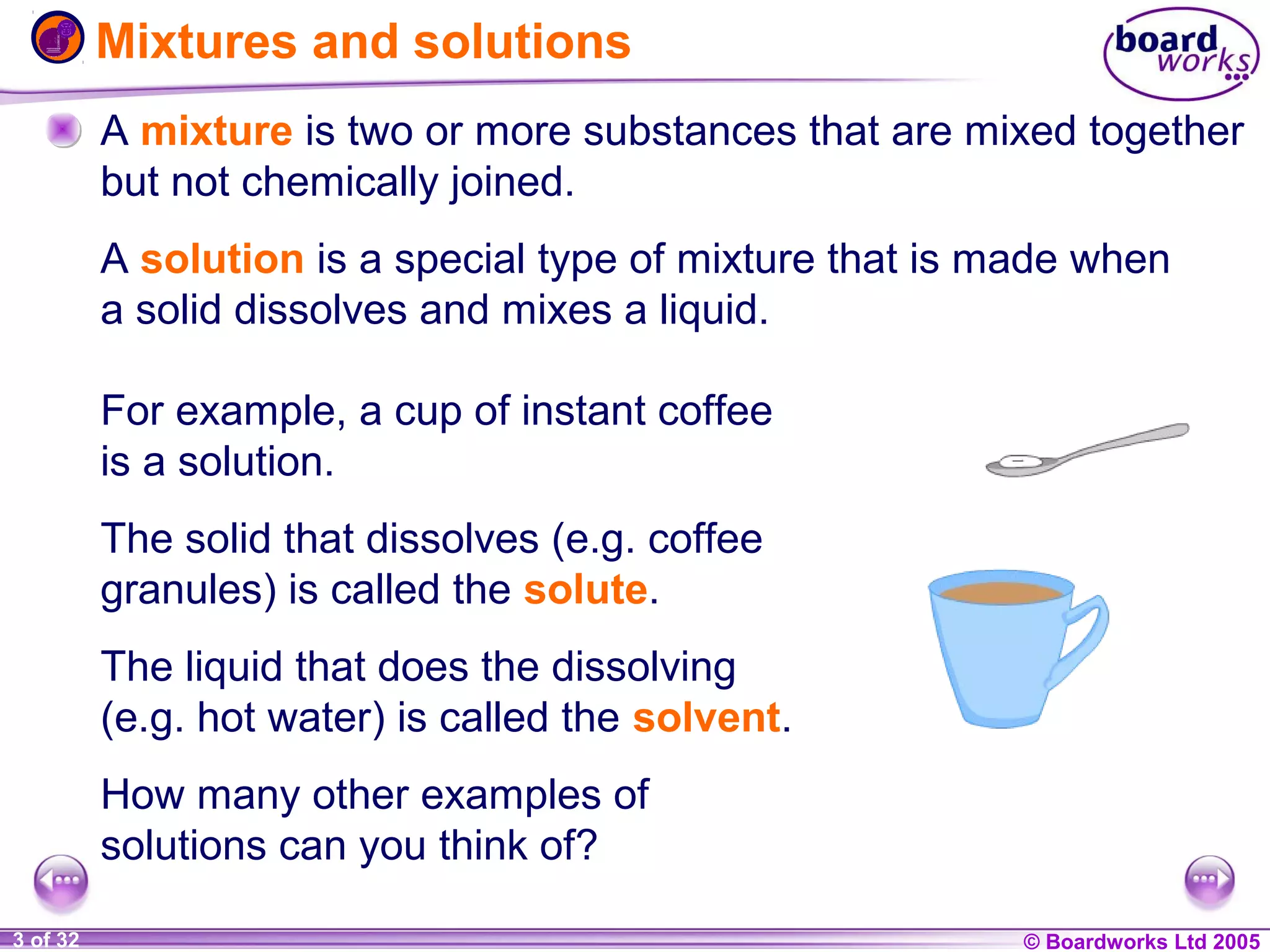
For example, a cup of instant coffee
is a solution.
The solid that dissolves (e.g. coffee
granules) is called the solute.
The liquid that does the dissolving
(e.g. hot water) is called the solvent.
How many other examples of
solutions can you think of?
1 of 32
20
3

© Boardworks Ltd 2004
2005
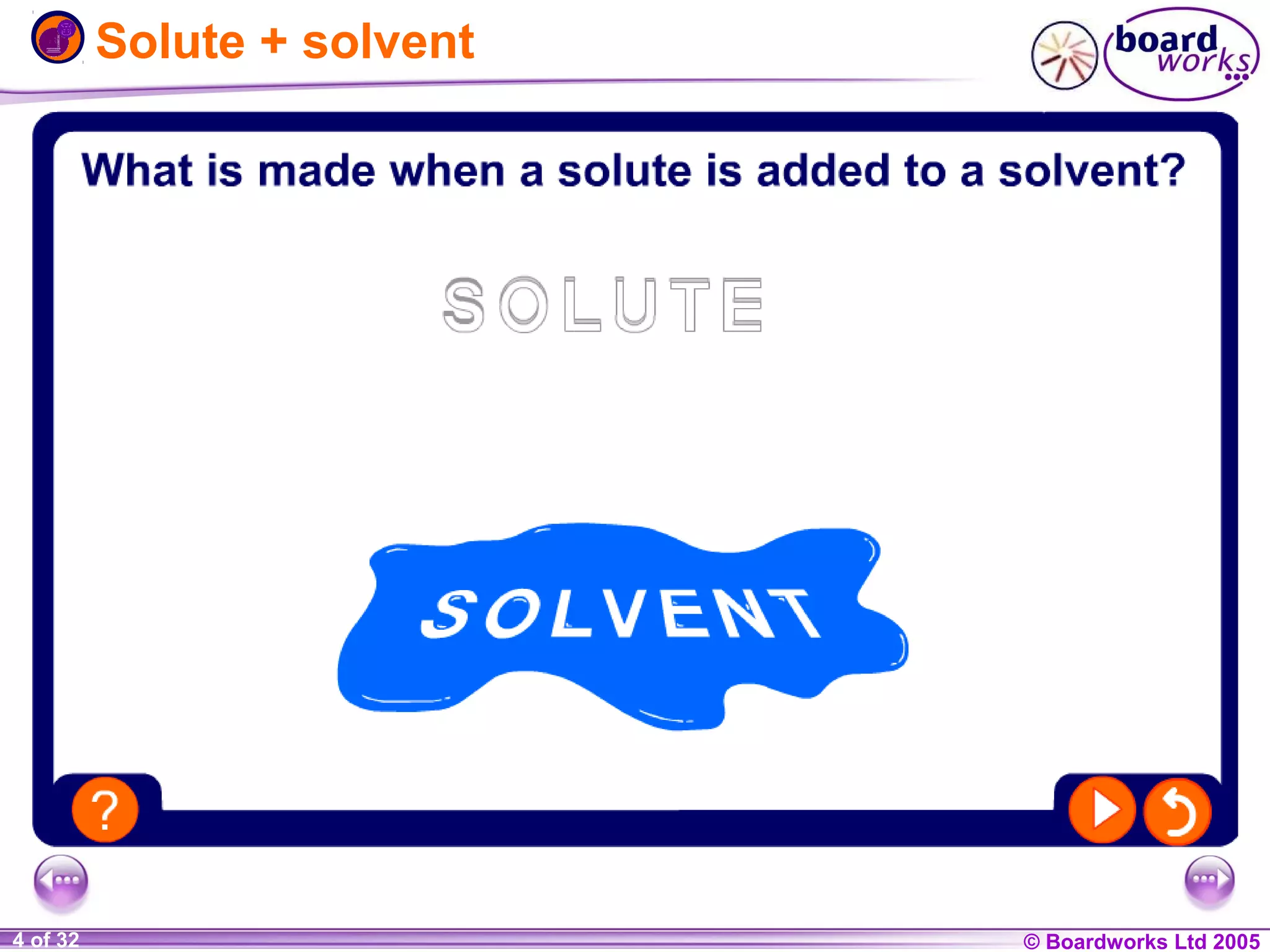
Solute + solvent

1 of 32
20
4

© Boardworks Ltd 2004
2005
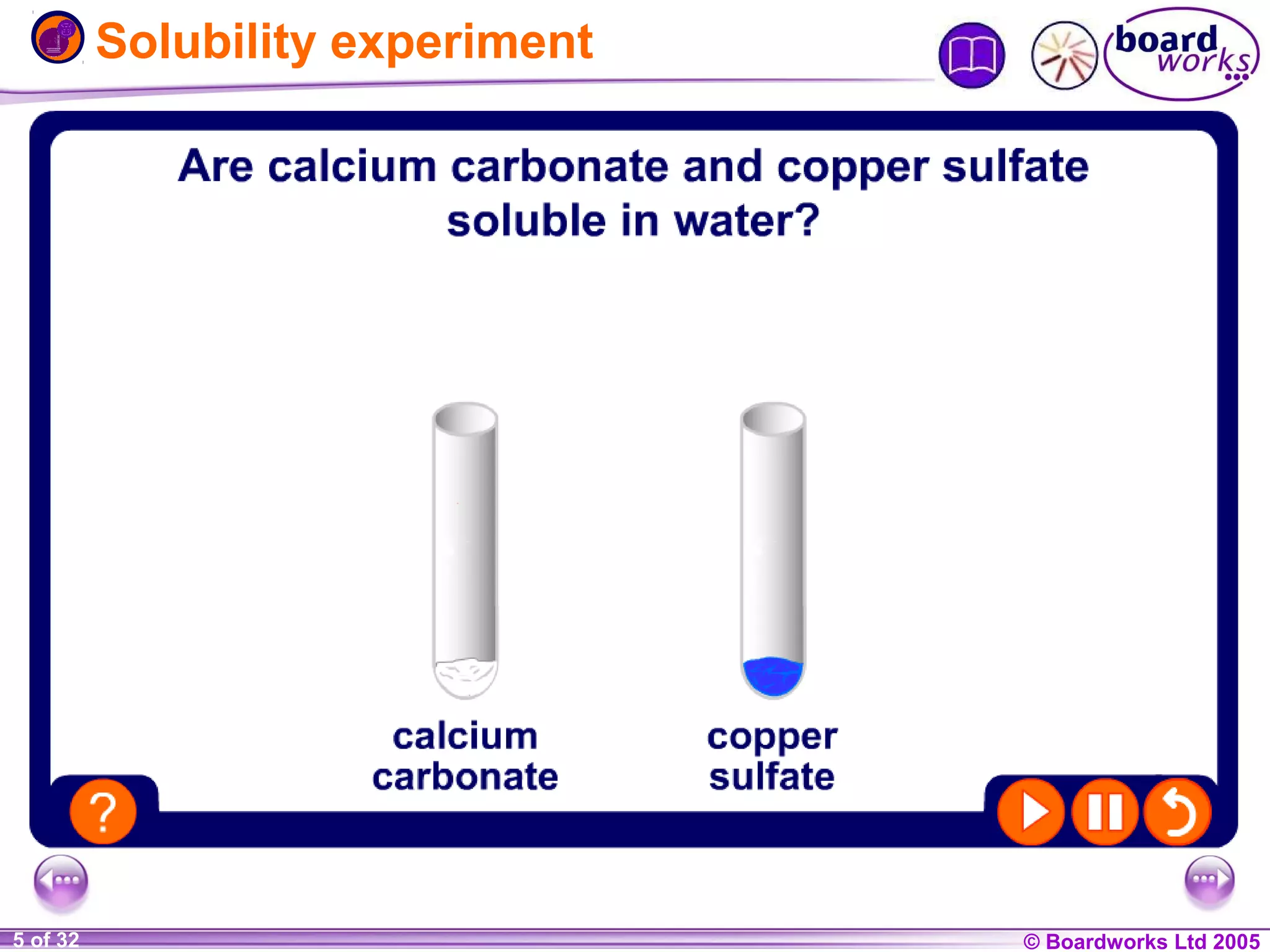
Solubility experiment

1 of 32
20
5

© Boardworks Ltd 2004
2005
Contents

7H Solutions
Introducing solutions
Separating mixtures
Chromatography
More about solubility
Summary activities
1 of 32
20
6

© Boardworks Ltd 2004
2005
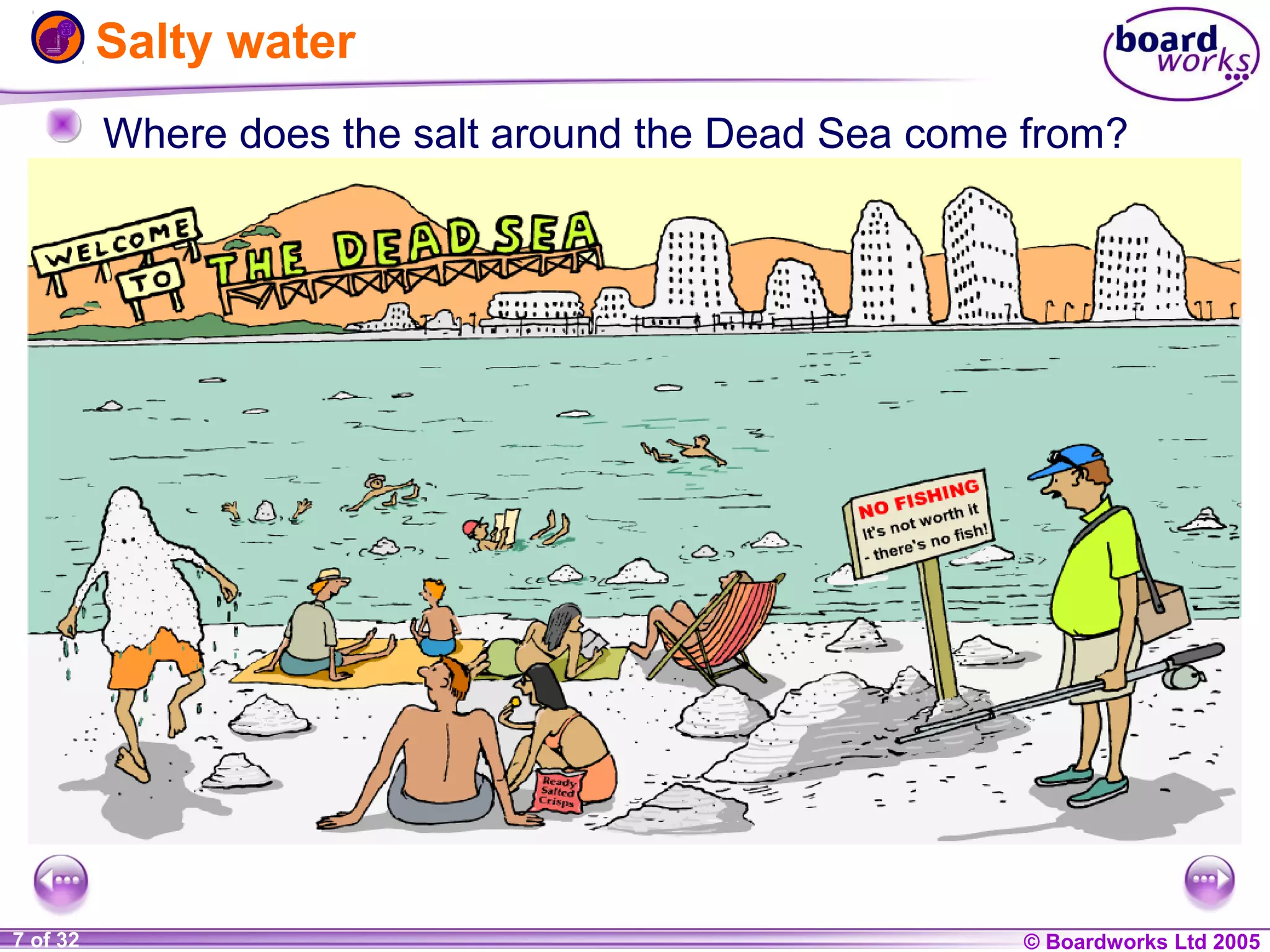
Salty water
Where does the salt around the Dead Sea come from?

1 of 32
20
7

© Boardworks Ltd 2004
2005
Separating mixtures
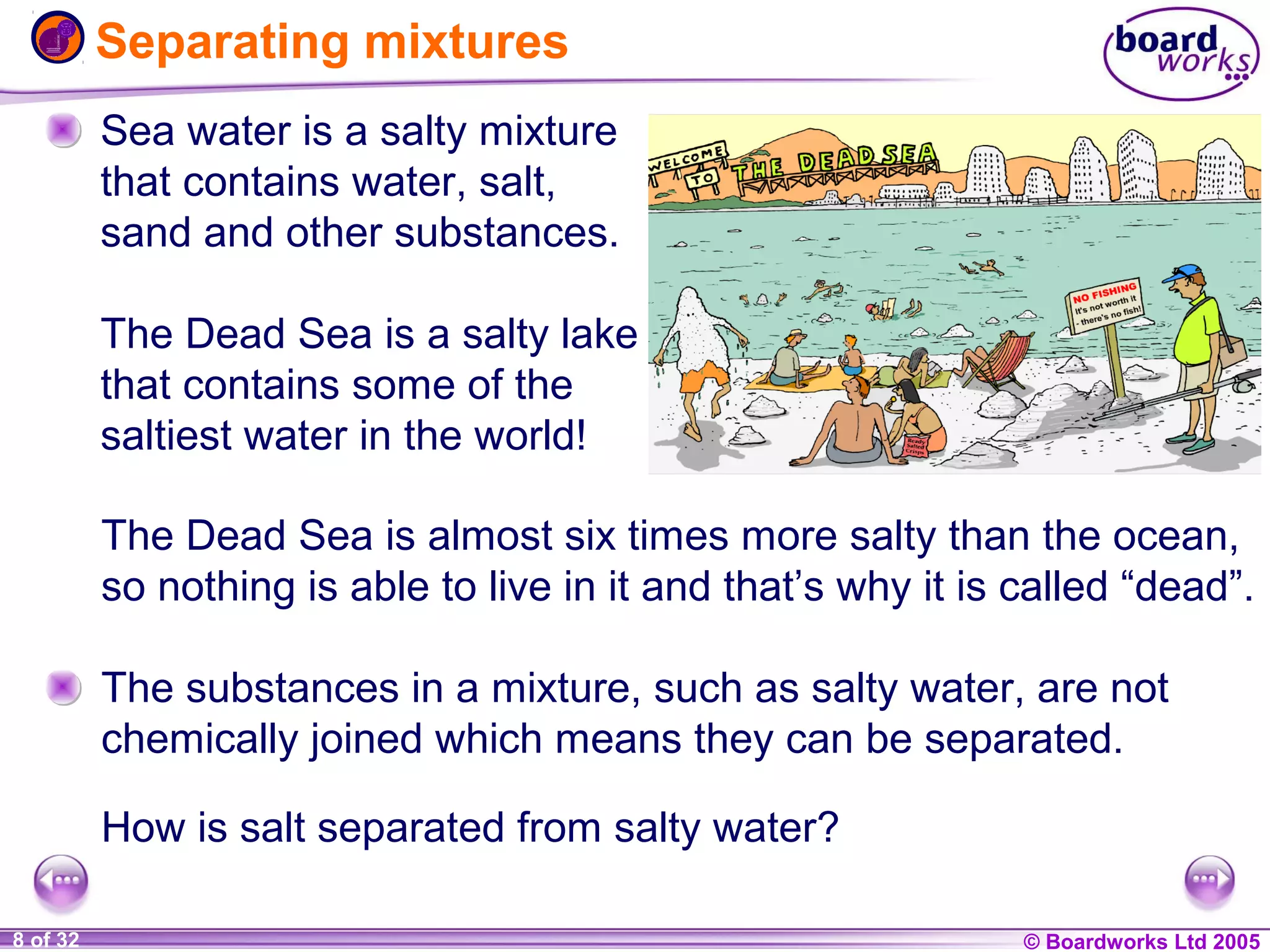
Sea water is a salty mixture
that contains water, salt,
sand and other substances.
The Dead Sea is a salty lake
that contains some of the
saltiest water in the world!
The Dead Sea is almost six times more salty than the ocean,
so nothing is able to live in it and that’s why it is called “dead”.
The substances in a mixture, such as salty water, are not
chemically joined which means they can be separated.
How is salt separated from salty water?
1 of 32
20
8

© Boardworks Ltd 2004
2005
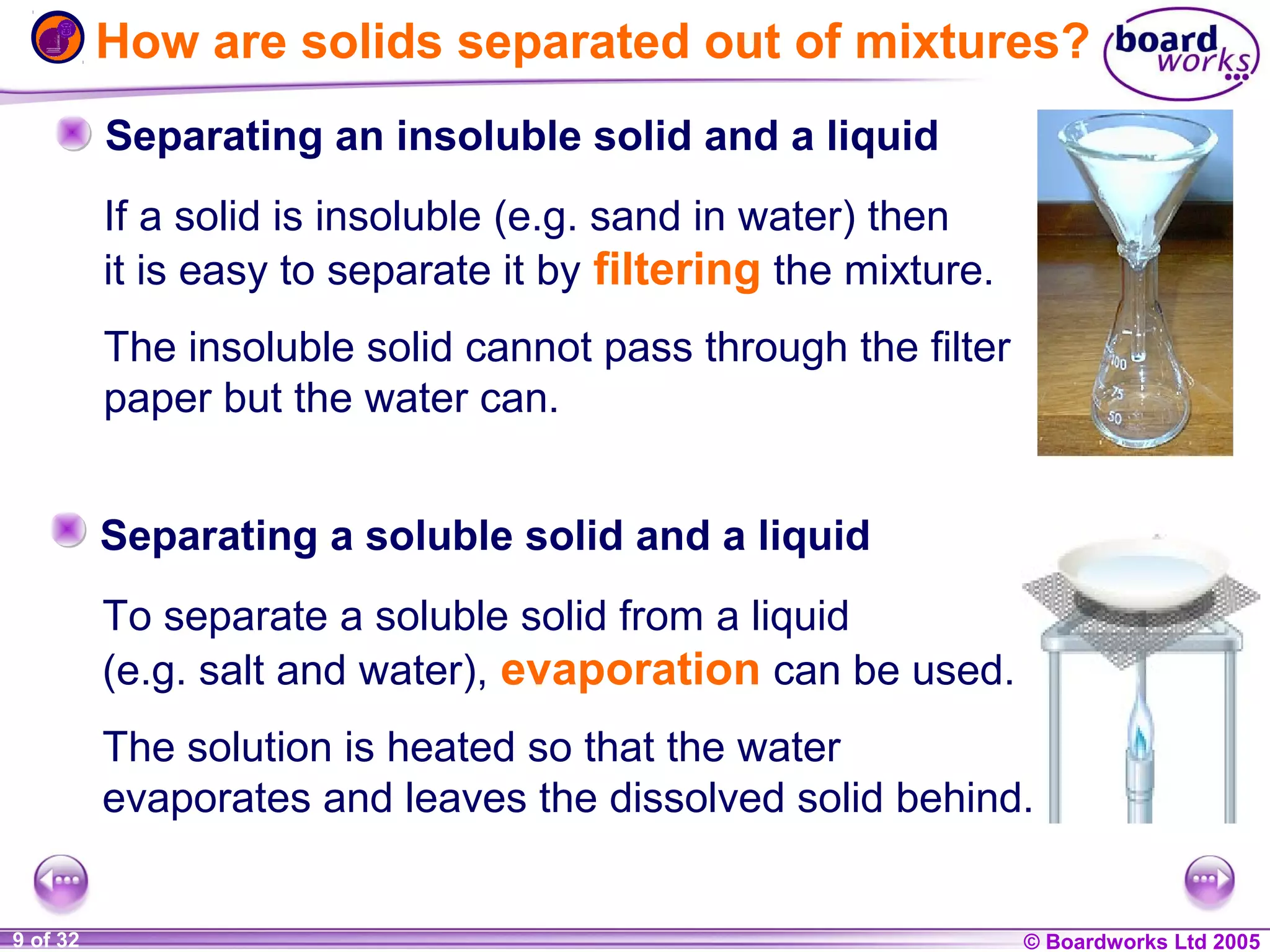
How are solids separated out of mixtures?
Separating an insoluble solid and a liquid
If a solid is insoluble (e.g. sand in water) then
it is easy to separate it by filtering the mixture.
The insoluble solid cannot pass through the filter
paper but the water can.
Separating a soluble solid and a liquid
To separate a soluble solid from a liquid
(e.g. salt and water), evaporation can be used.
The solution is heated so that the water
evaporates and leaves the dissolved solid behind.
1 of 32
20
9

© Boardworks Ltd 2004
2005
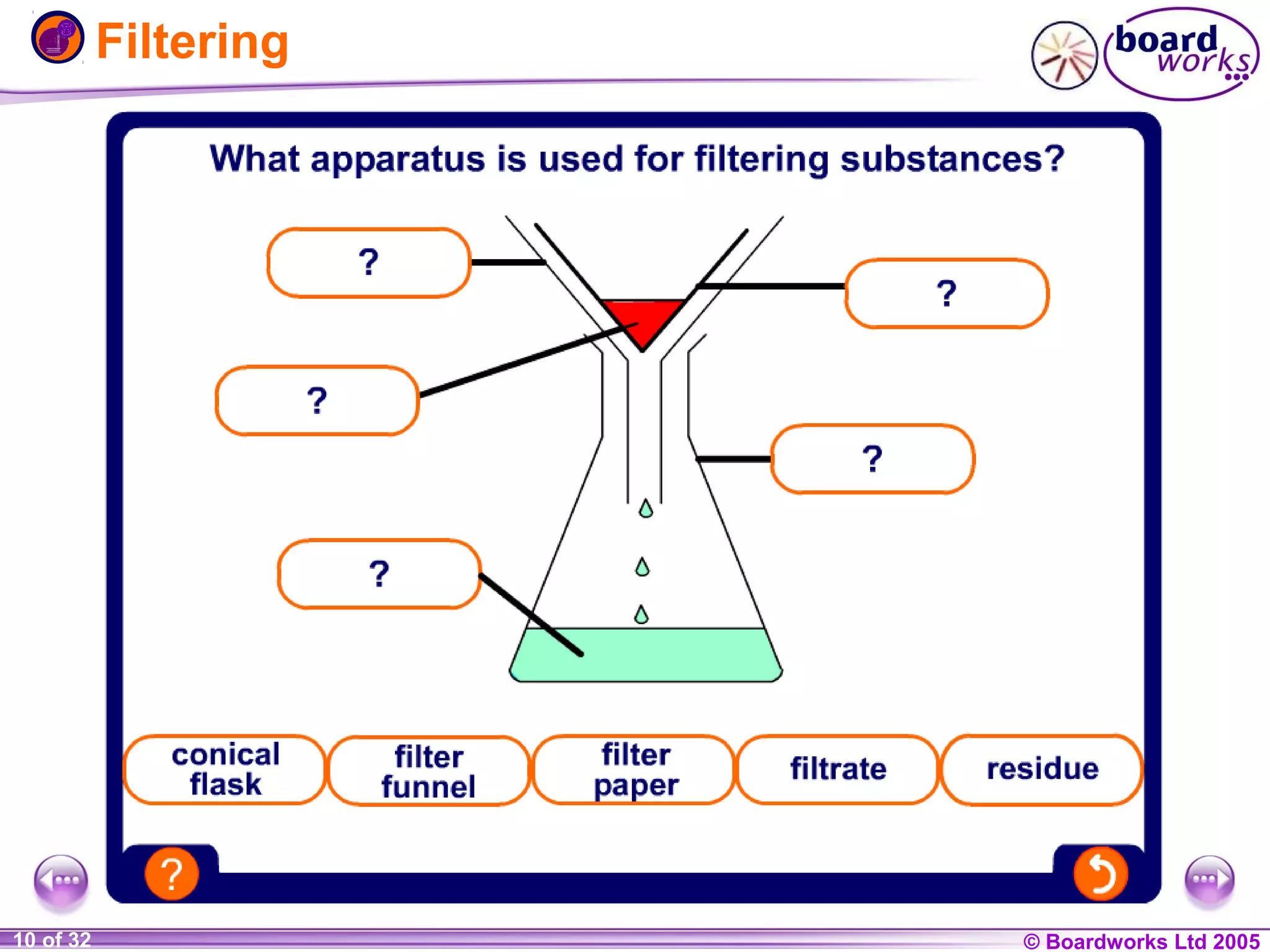
Filtering

1 of 20
10 of 32

© Boardworks Ltd 2004
2005
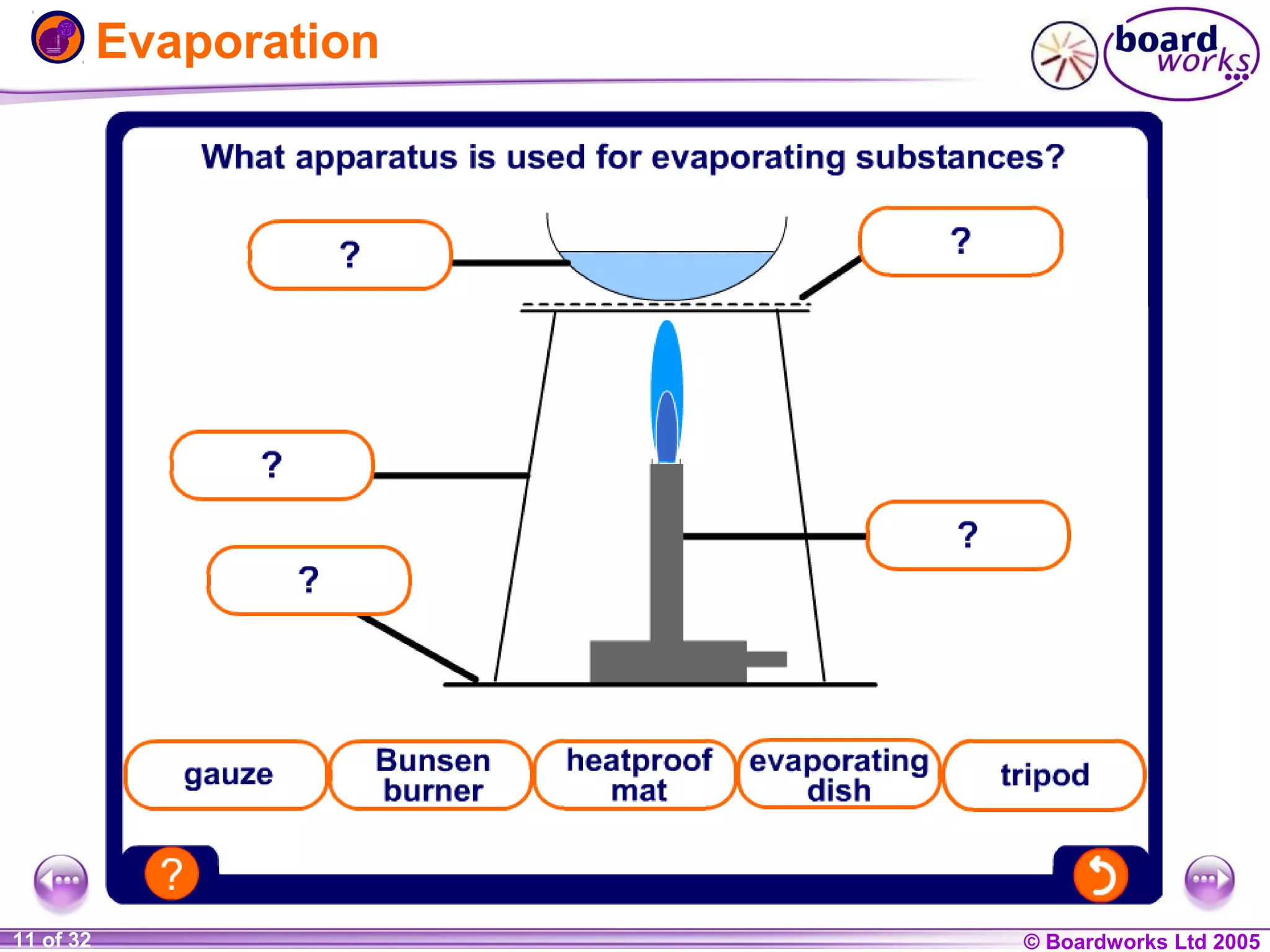
Evaporation

1 of 20
11 of 32

© Boardworks Ltd 2004
2005
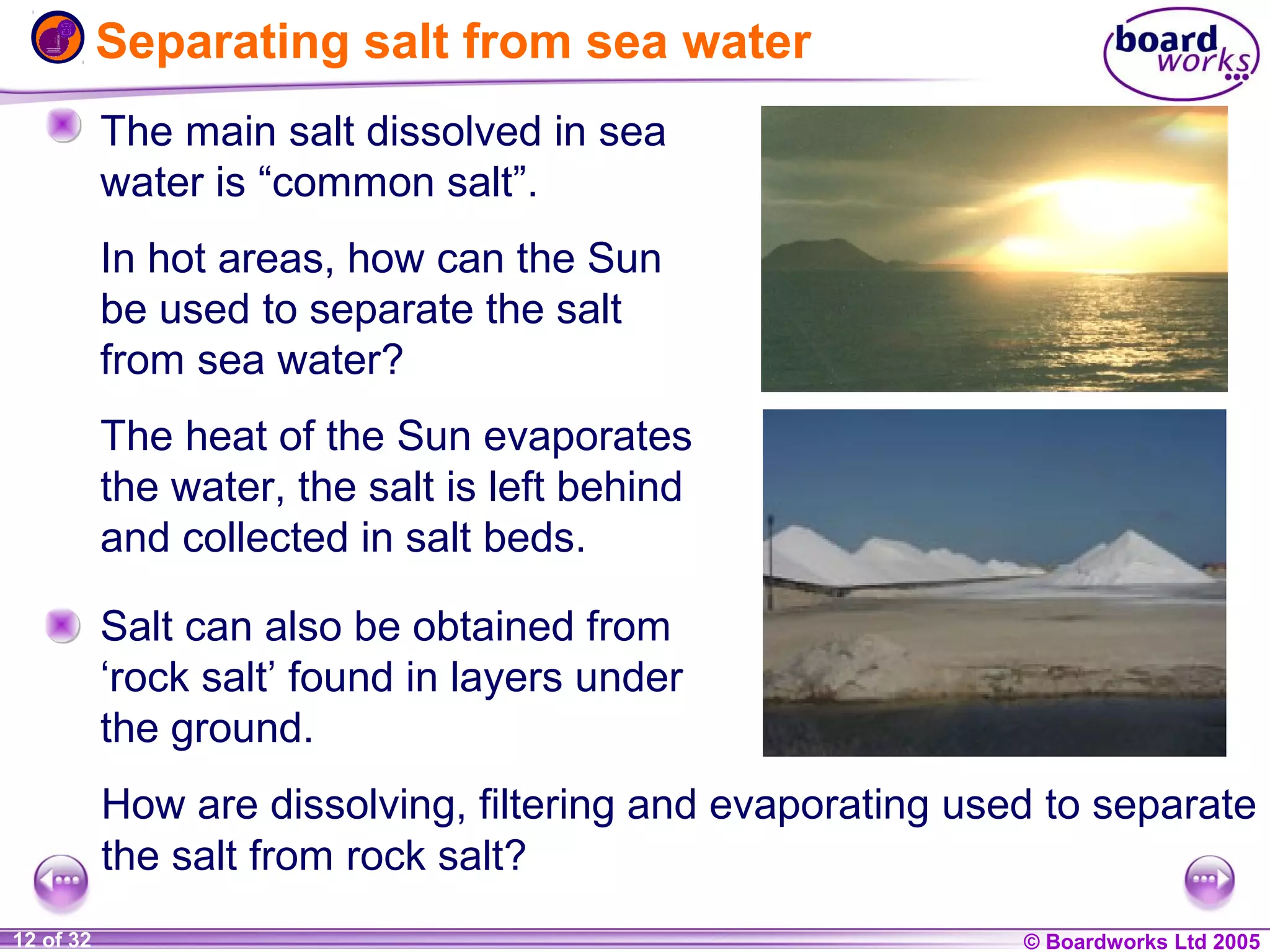
Separating salt from sea water
The main salt dissolved in sea
water is “common salt”.
In hot areas, how can the Sun
be used to separate the salt
from sea water?
The heat of the Sun evaporates
the water, the salt is left behind
and collected in salt beds.
Salt can also be obtained from
‘rock salt’ found in layers under
the ground.
How are dissolving, filtering and evaporating used to separate
the salt from rock salt?
1 of 20
12 of 32

© Boardworks Ltd 2004
2005
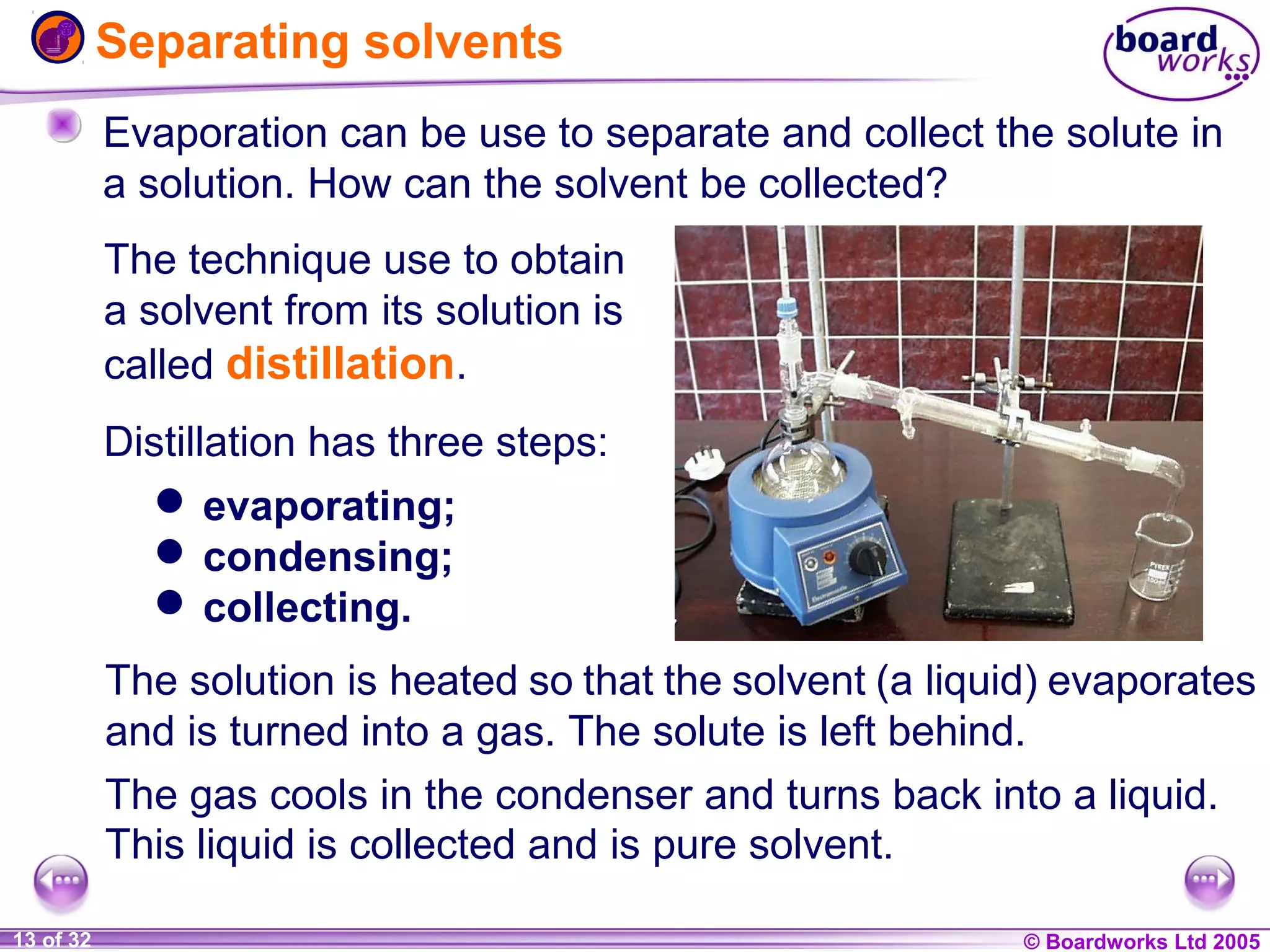
Separating solvents
Evaporation can be use to separate and collect the solute in
a solution. How can the solvent be collected?
The technique use to obtain
a solvent from its solution is
called distillation.
Distillation has three steps:
 evaporating;
 condensing;
 collecting.
The solution is heated so that the solvent (a liquid) evaporates
and is turned into a gas. The solute is left behind.
The gas cools in the condenser and turns back into a liquid.
This liquid is collected and is pure solvent.
1 of 20
13 of 32

© Boardworks Ltd 2004
2005
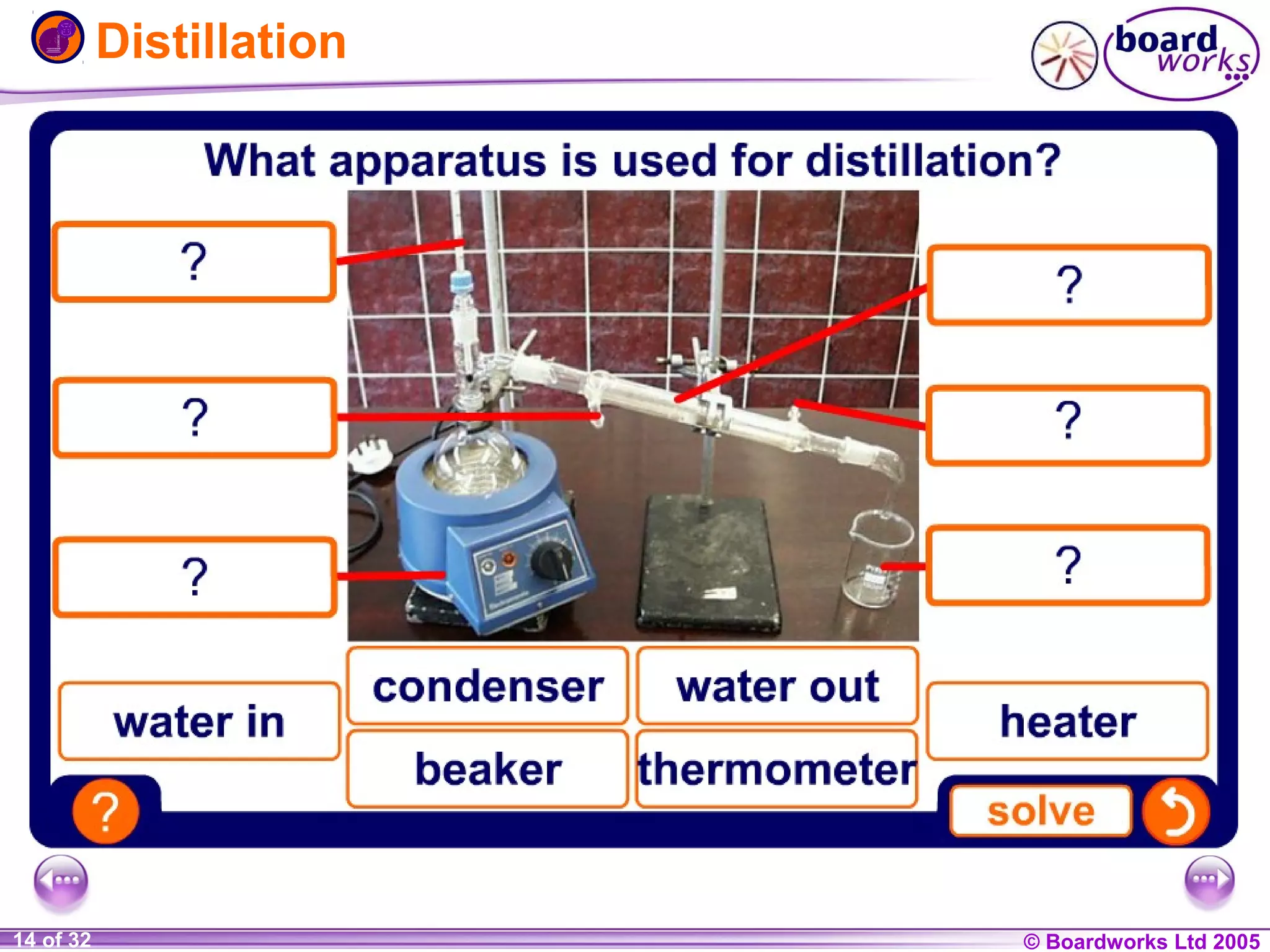
Distillation

1 of 20
14 of 32

© Boardworks Ltd 2004
2005
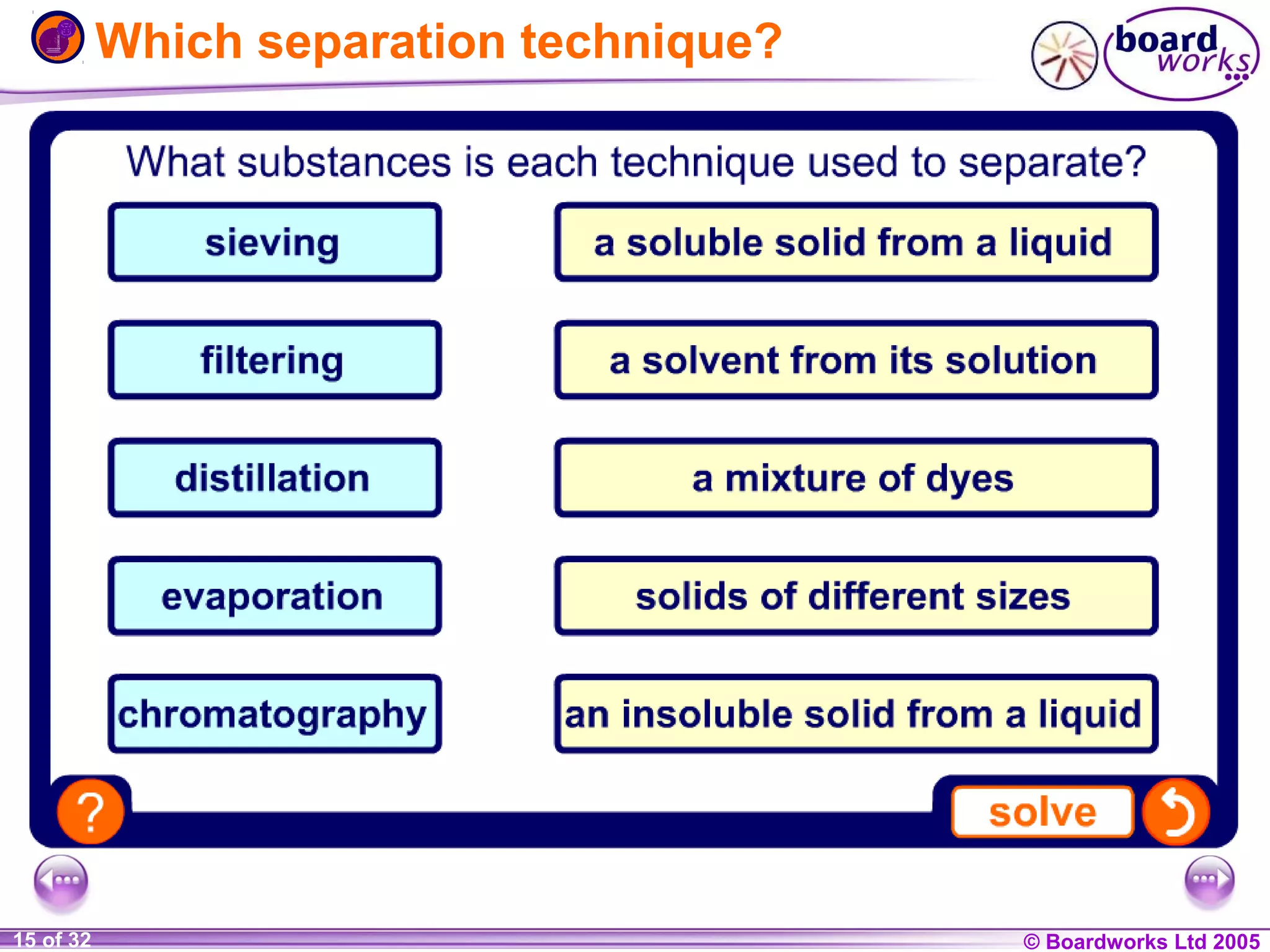
Which separation technique?

1 of 20
15 of 32

© Boardworks Ltd 2004
2005
Contents

7H Solutions
Introducing solutions
Separating mixtures
Chromatography
More about solubility
Summary activities
1 of 20
16 of 32

© Boardworks Ltd 2004
2005
What is chromatography?
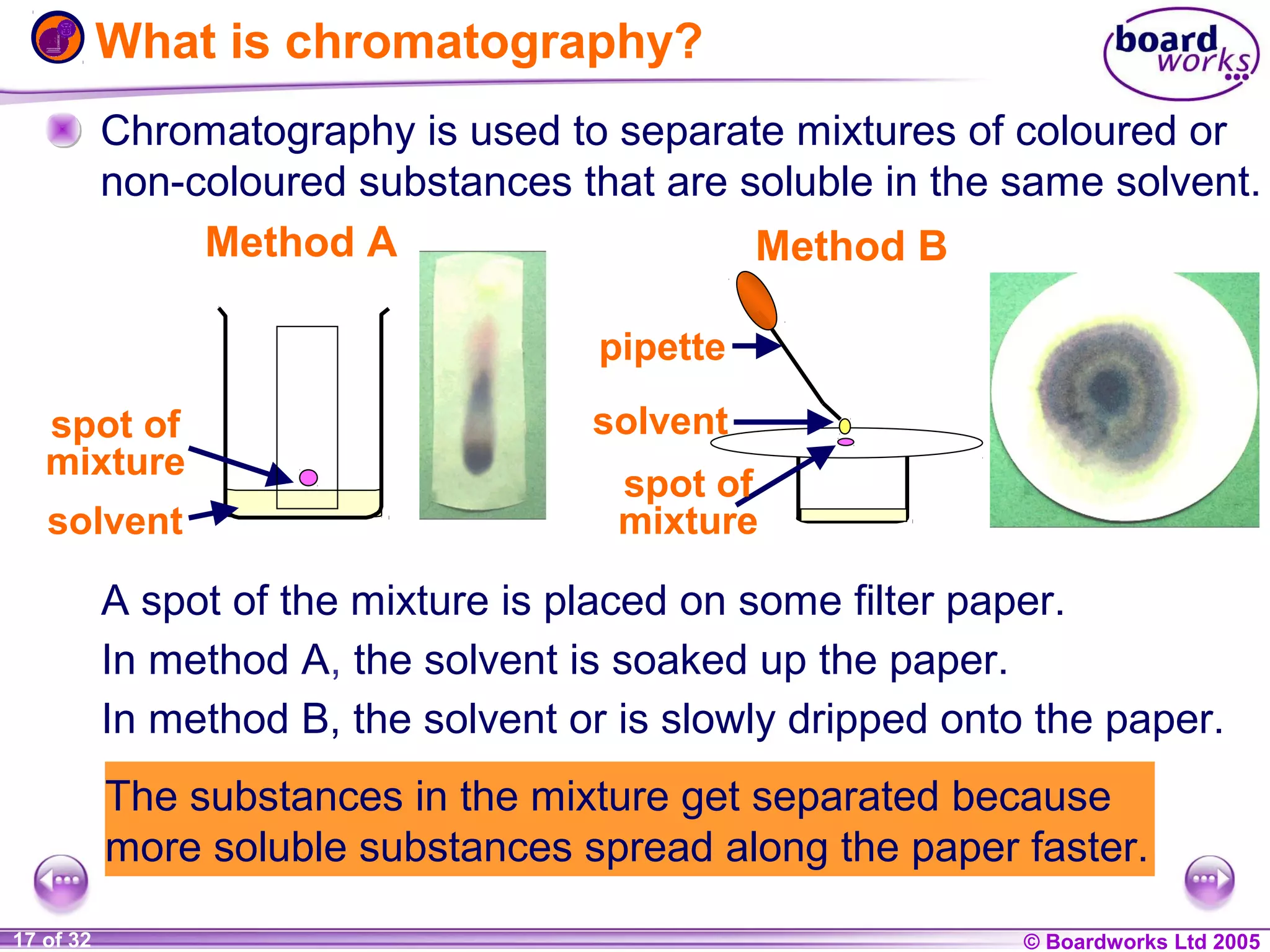
Chromatography is used to separate mixtures of coloured or
non-coloured substances that are soluble in the same solvent.
Method A
Method B
pipette
spot of
mixture
solvent

solvent
spot of
mixture

A spot of the mixture is placed on some filter paper.
In method A, the solvent is soaked up the paper.
In method B, the solvent or is slowly dripped onto the paper.
The substances in the mixture get separated because
more soluble substances spread along the paper faster.
1 of 20
17 of 32

© Boardworks Ltd 2004
2005
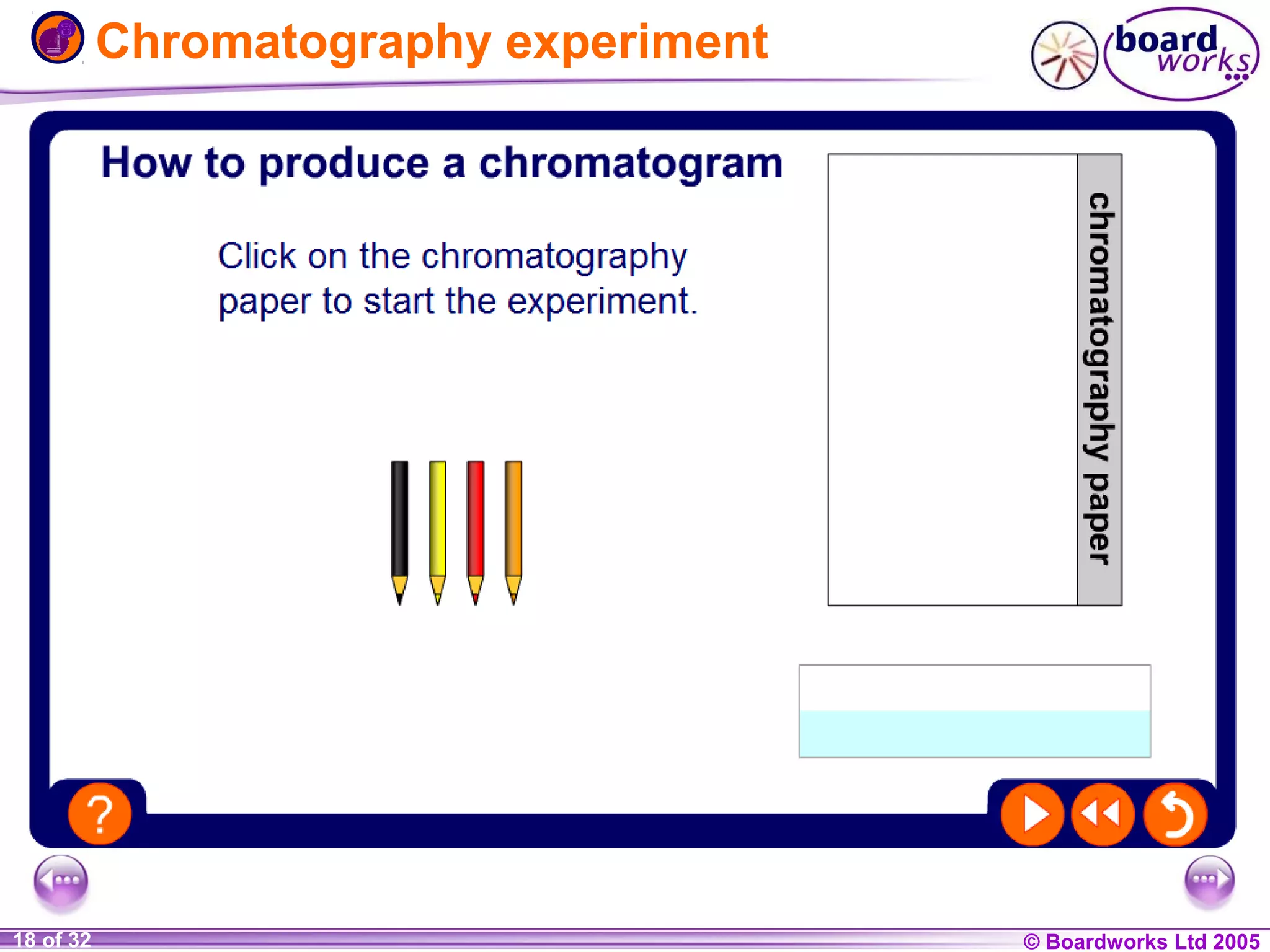
Chromatography experiment

1 of 20
18 of 32

© Boardworks Ltd 2004
2005
Identifying dyes in a mixture
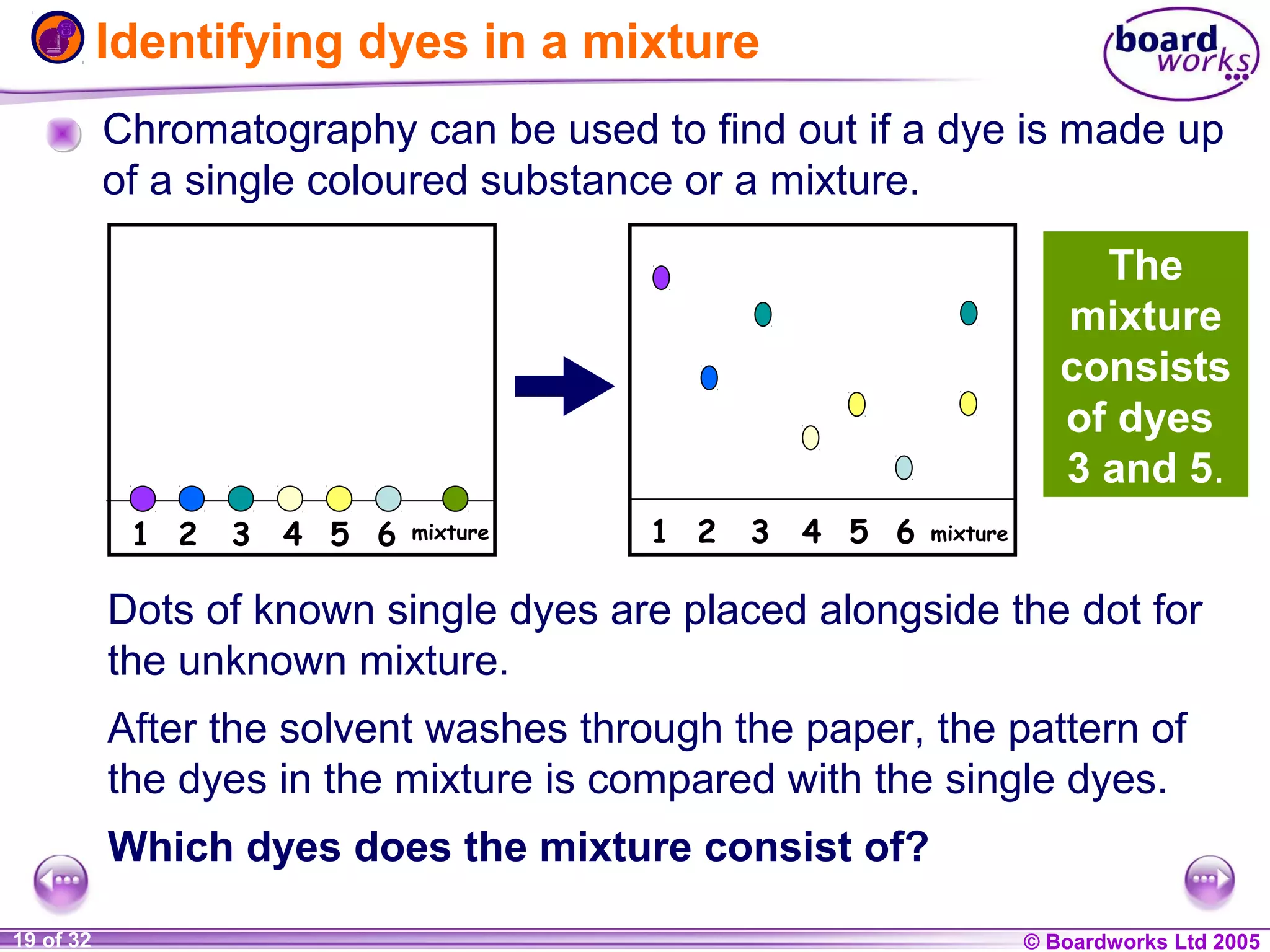
Chromatography can be used to find out if a dye is made up
of a single coloured substance or a mixture.
The
mixture
consists
of dyes
3 and 5.
1 2

3

4 5 6

mixture

1 2

3

4 5 6

mixture

Dots of known single dyes are placed alongside the dot for
the unknown mixture.
After the solvent washes through the paper, the pattern of
the dyes in the mixture is compared with the single dyes.
Which dyes does the mixture consist of?
1 of 20
19 of 32

© Boardworks Ltd 2004
2005
Identifying dyes in a mixture
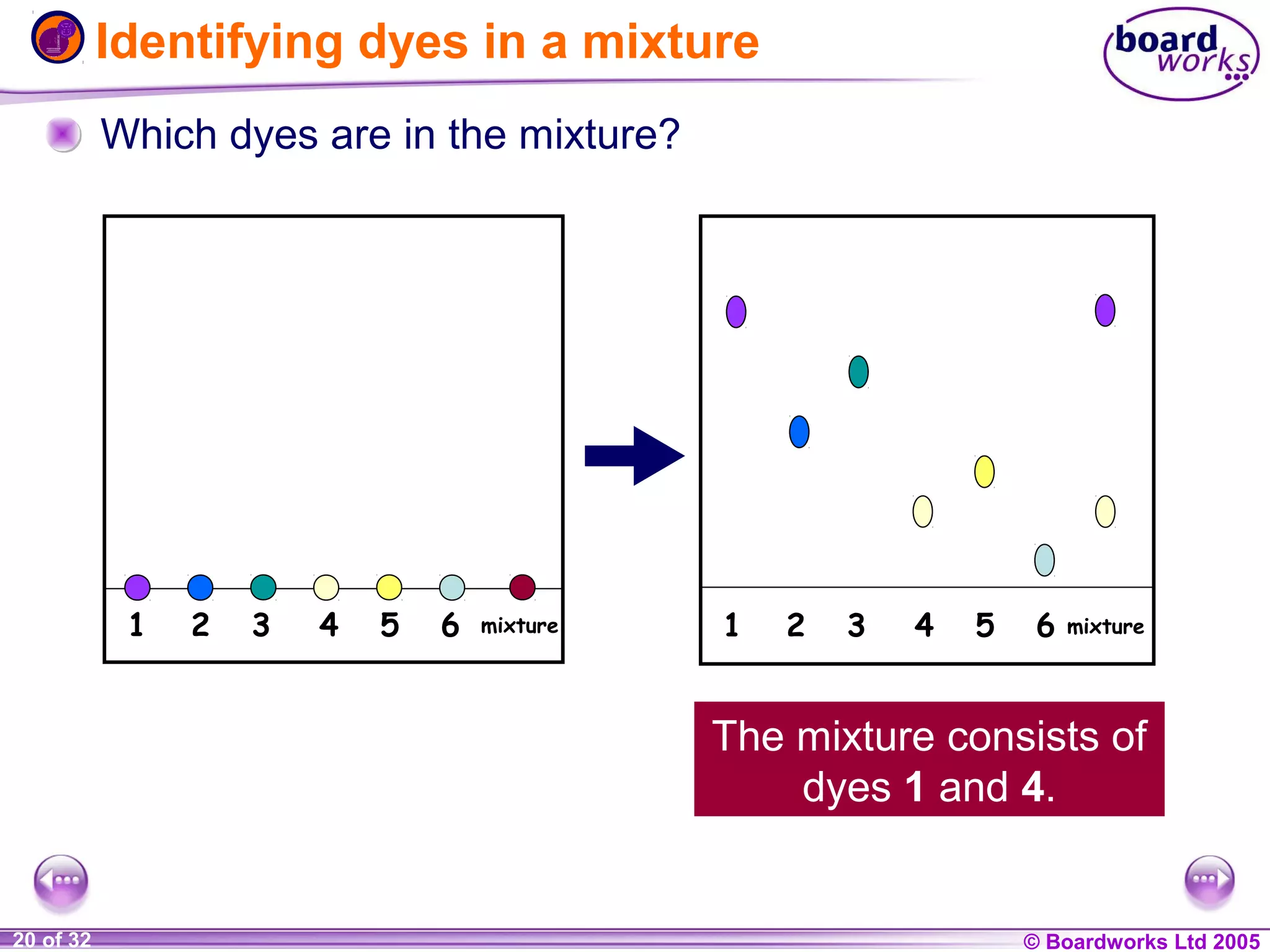
Which dyes are in the mixture?

1

2

3

4

5

6

mixture

1

2

3

4

5

6

mixture

The mixture consists of
dyes 1 and 4.

1 of 20
20 of 32

© Boardworks Ltd 2004
2005
Contents

7H Solutions
Introducing solutions
Separating mixtures
Chromatography
More about solubility
Summary activities
1 of 20
21 of 32

© Boardworks Ltd 2004
2005
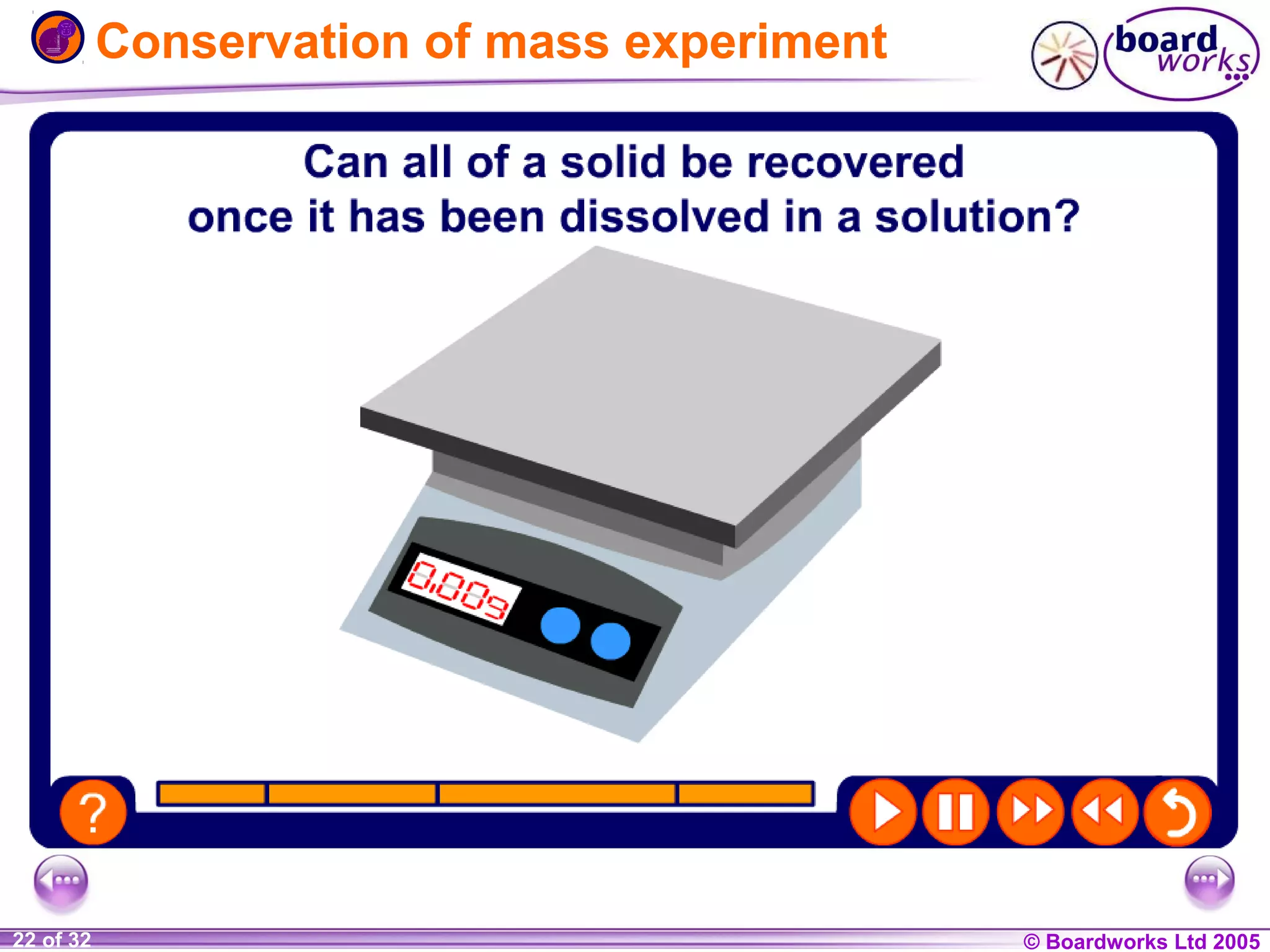
Conservation of mass experiment

1 of 20
22 of 32

© Boardworks Ltd 2004
2005
Conservation of mass
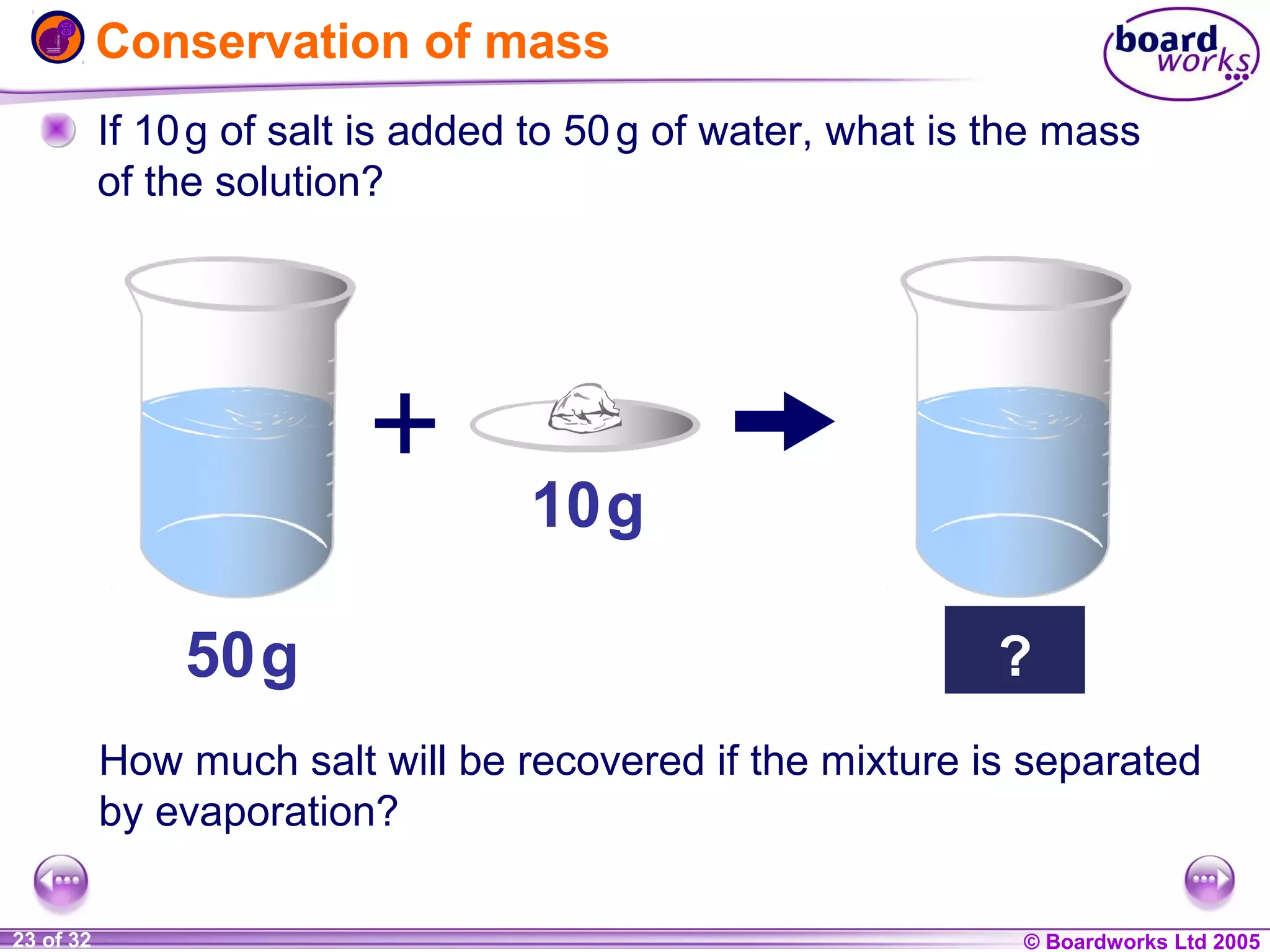
If 10 g of salt is added to 50 g of water, what is the mass
of the solution?

10 g
50 g

?
60 g

How much salt will be recovered if the mixture is separated
by evaporation?
1 of 20
23 of 32

© Boardworks Ltd 2004
2005
Conservation of mass – extension
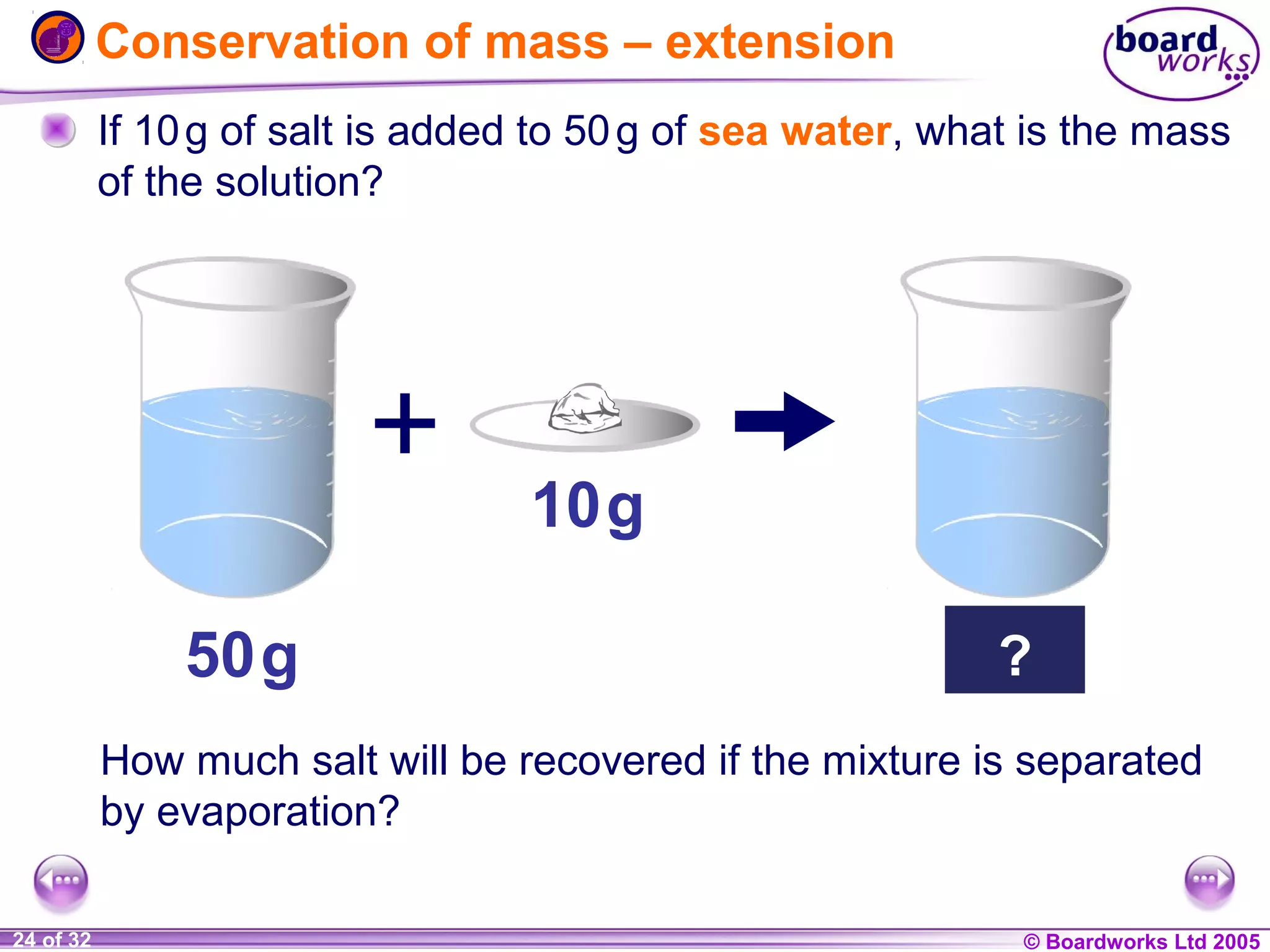
If 10 g of salt is added to 50 g of sea water, what is the mass
of the solution?

10 g
50 g

?
60 g

How much salt will be recovered if the mixture is separated
by evaporation?
1 of 20
24 of 32

© Boardworks Ltd 2004
2005
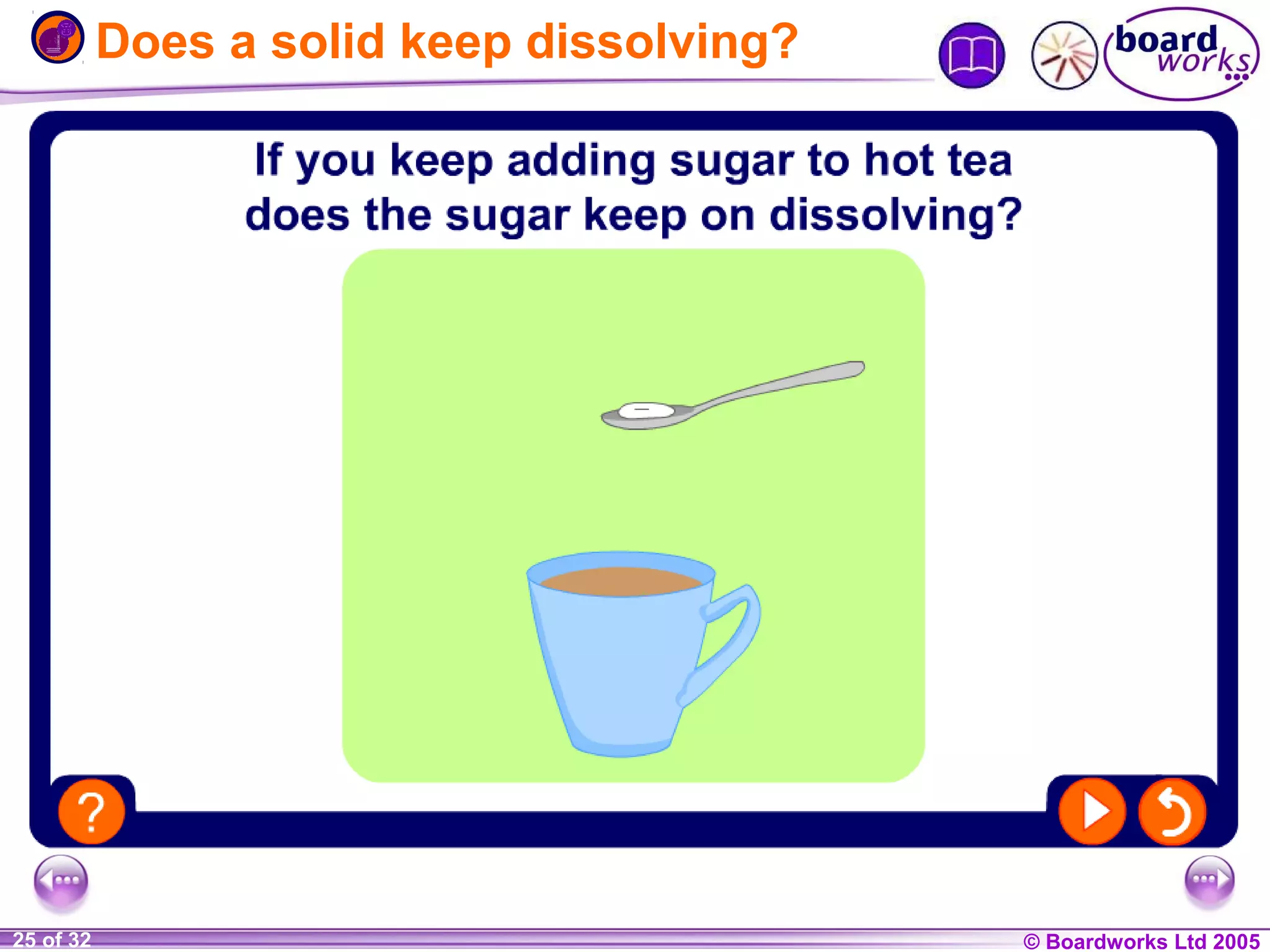
Does a solid keep dissolving?

1 of 20
25 of 32

© Boardworks Ltd 2004
2005
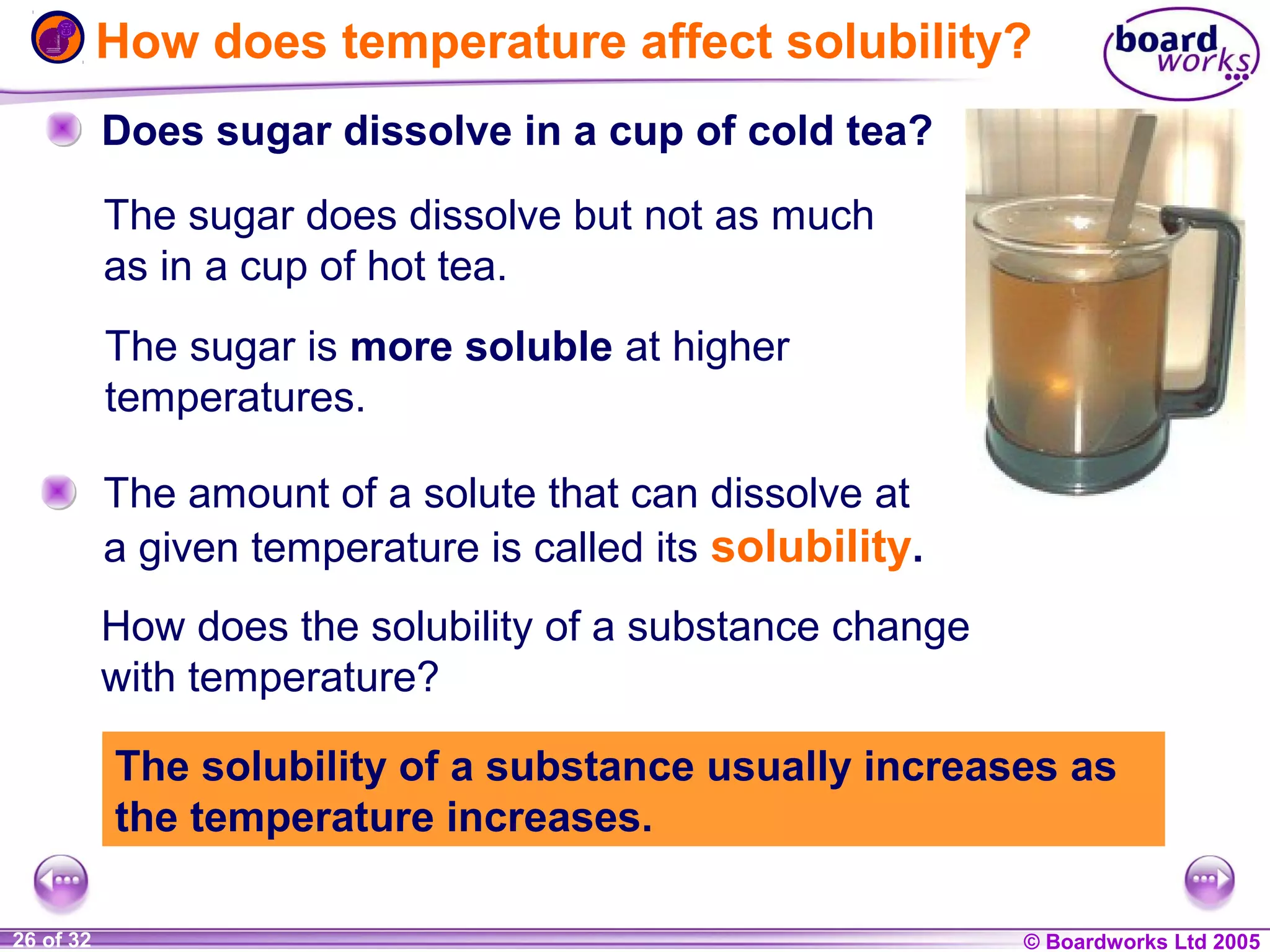
How does temperature affect solubility?
Does sugar dissolve in a cup of cold tea?
The sugar does dissolve but not as much
as in a cup of hot tea.
The sugar is more soluble at higher
temperatures.
The amount of a solute that can dissolve at
a given temperature is called its solubility.
How does the solubility of a substance change
with temperature?
The solubility of a substance usually increases as
the temperature increases.
1 of 20
26 of 32

© Boardworks Ltd 2004
2005
Contents

7H Solutions
Introducing solutions
Separating mixtures
Chromatography
More about solubility
Summary activities
1 of 20
27 of 32

© Boardworks Ltd 2004
2005
Glossary
dissolving – The mixing of a solid with a liquid to make a
solution.

mixture – Two or more substances that are mixed together
but are not chemically joined.

saturated – A solution containing the maximum amount of
solute that it can hold.

soluble – A substance that can dissolve in a solvent.
solubility – A measure of how much solute can dissolve in
a solvent at a given temperature.

solute – Solid that dissolves in a solvent to make a solution.
solution – Mixture made when a solute dissolves in a solvent.
solvent – Liquid in which a solid dissolves to make a solution.
1 of 20
28 of 32

© Boardworks Ltd 2004
2005
Anagrams

1 of 20
29 of 32

© Boardworks Ltd 2004
2005
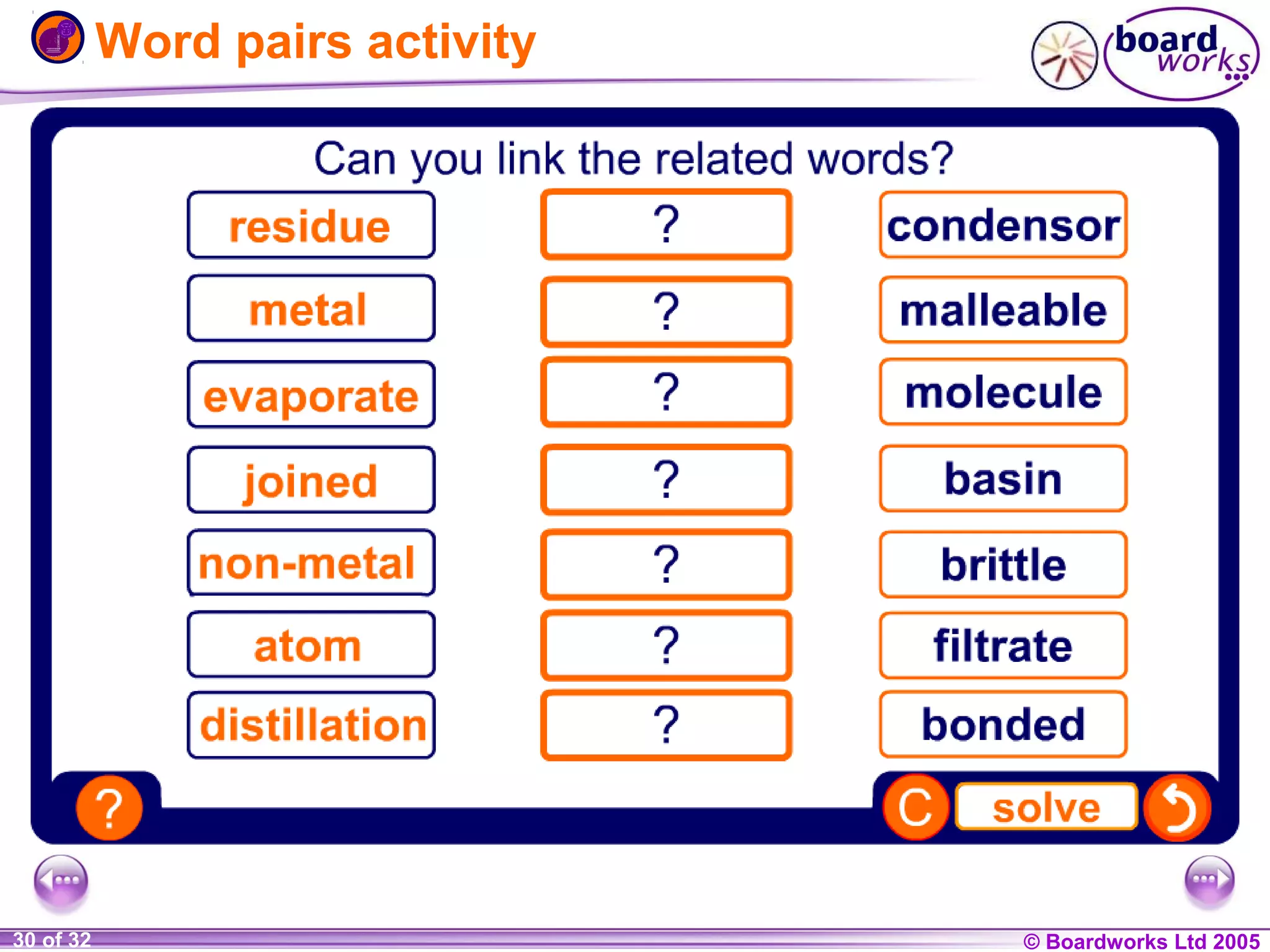
Word pairs activity

1 of 20
30 of 32

© Boardworks Ltd 2004
2005
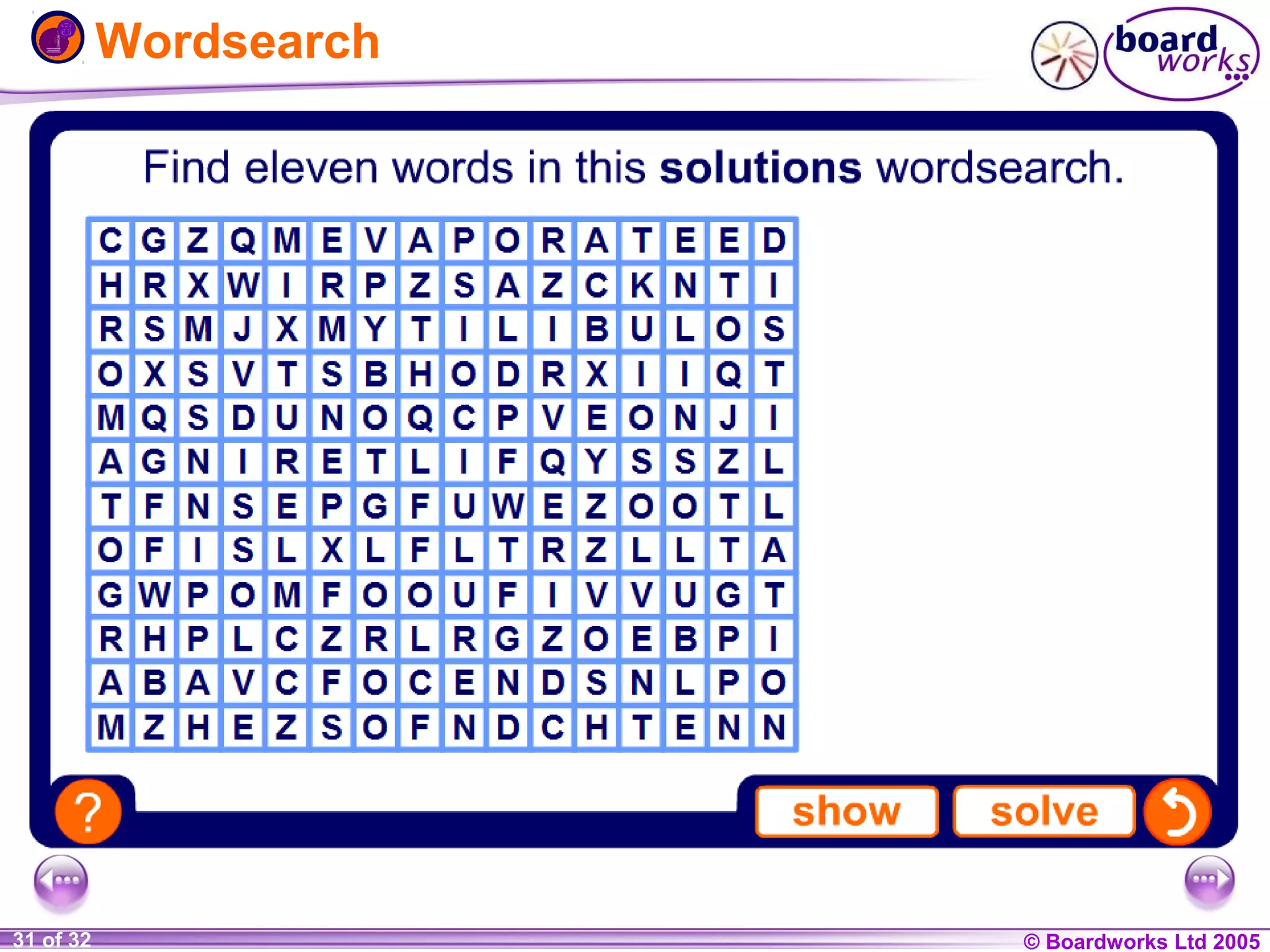
Wordsearch

1 of 20
31 of 32

© Boardworks Ltd 2004
2005
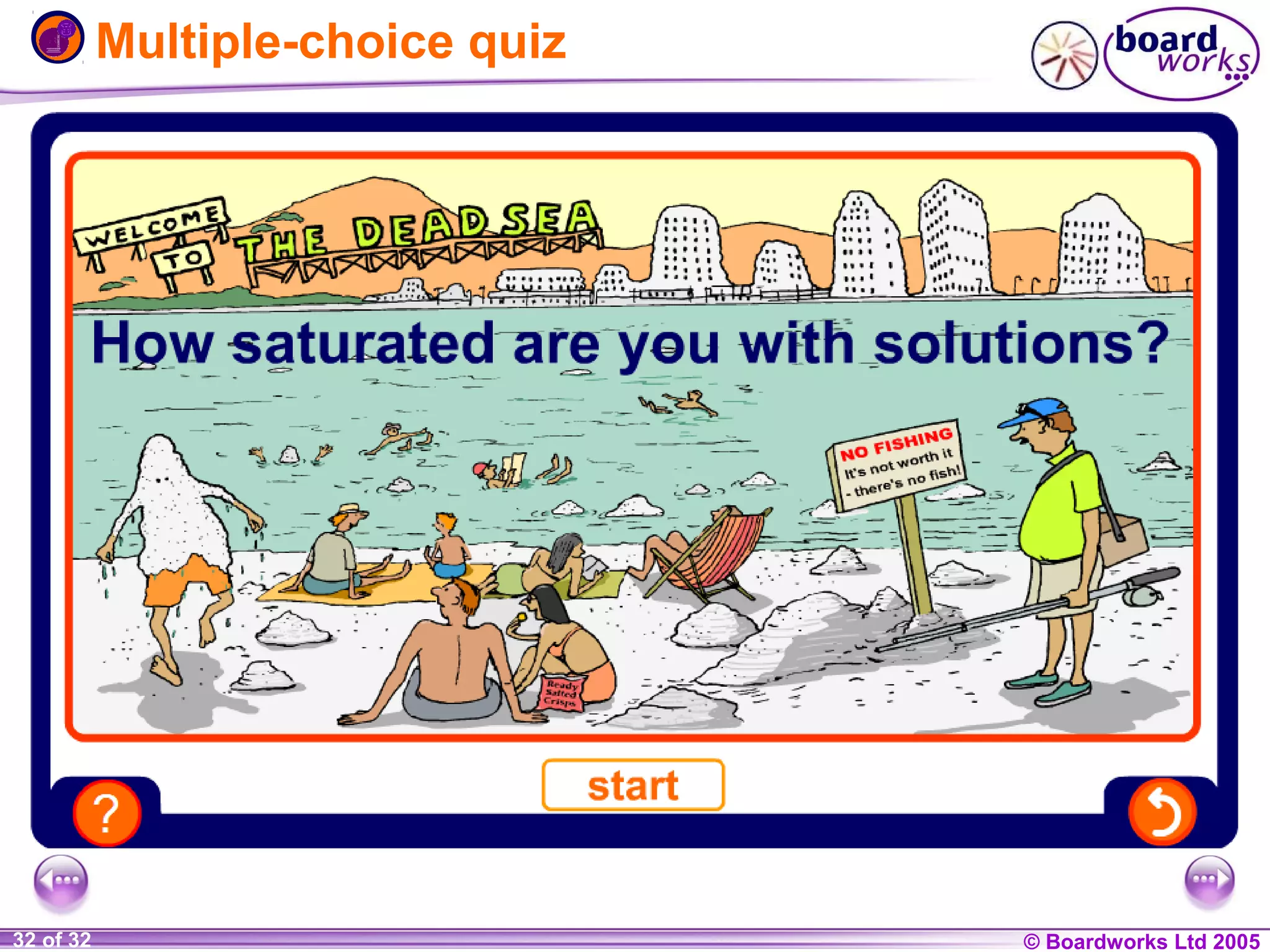
Multiple-choice quiz

1 of 20
32 of 32

© Boardworks Ltd 2004
2005

7 h solutions (boardworks)

  • 1.
    KS3 Chemistry 7H Solutions 1of 32 20 © Boardworks Ltd 2004 2005
  • 2.
    Contents 7H Solutions Introducing solutions Separatingmixtures Chromatography More about solubility Summary activities 1 of 32 20 2 © Boardworks Ltd 2004 2005
  • 3.
    Mixtures and solutions Amixture is two or more substances that are mixed together but not chemically joined. A solution is a special type of mixture that is made when a solid dissolves and mixes a liquid. For example, a cup of instant coffee is a solution. The solid that dissolves (e.g. coffee granules) is called the solute. The liquid that does the dissolving (e.g. hot water) is called the solvent. How many other examples of solutions can you think of? 1 of 32 20 3 © Boardworks Ltd 2004 2005
  • 4.
    Solute + solvent 1of 32 20 4 © Boardworks Ltd 2004 2005
  • 5.
    Solubility experiment 1 of32 20 5 © Boardworks Ltd 2004 2005
  • 6.
    Contents 7H Solutions Introducing solutions Separatingmixtures Chromatography More about solubility Summary activities 1 of 32 20 6 © Boardworks Ltd 2004 2005
  • 7.
    Salty water Where doesthe salt around the Dead Sea come from? 1 of 32 20 7 © Boardworks Ltd 2004 2005
  • 8.
    Separating mixtures Sea wateris a salty mixture that contains water, salt, sand and other substances. The Dead Sea is a salty lake that contains some of the saltiest water in the world! The Dead Sea is almost six times more salty than the ocean, so nothing is able to live in it and that’s why it is called “dead”. The substances in a mixture, such as salty water, are not chemically joined which means they can be separated. How is salt separated from salty water? 1 of 32 20 8 © Boardworks Ltd 2004 2005
  • 9.
    How are solidsseparated out of mixtures? Separating an insoluble solid and a liquid If a solid is insoluble (e.g. sand in water) then it is easy to separate it by filtering the mixture. The insoluble solid cannot pass through the filter paper but the water can. Separating a soluble solid and a liquid To separate a soluble solid from a liquid (e.g. salt and water), evaporation can be used. The solution is heated so that the water evaporates and leaves the dissolved solid behind. 1 of 32 20 9 © Boardworks Ltd 2004 2005
  • 10.
    Filtering 1 of 20 10of 32 © Boardworks Ltd 2004 2005
  • 11.
    Evaporation 1 of 20 11of 32 © Boardworks Ltd 2004 2005
  • 12.
    Separating salt fromsea water The main salt dissolved in sea water is “common salt”. In hot areas, how can the Sun be used to separate the salt from sea water? The heat of the Sun evaporates the water, the salt is left behind and collected in salt beds. Salt can also be obtained from ‘rock salt’ found in layers under the ground. How are dissolving, filtering and evaporating used to separate the salt from rock salt? 1 of 20 12 of 32 © Boardworks Ltd 2004 2005
  • 13.
    Separating solvents Evaporation canbe use to separate and collect the solute in a solution. How can the solvent be collected? The technique use to obtain a solvent from its solution is called distillation. Distillation has three steps:  evaporating;  condensing;  collecting. The solution is heated so that the solvent (a liquid) evaporates and is turned into a gas. The solute is left behind. The gas cools in the condenser and turns back into a liquid. This liquid is collected and is pure solvent. 1 of 20 13 of 32 © Boardworks Ltd 2004 2005
  • 14.
    Distillation 1 of 20 14of 32 © Boardworks Ltd 2004 2005
  • 15.
    Which separation technique? 1of 20 15 of 32 © Boardworks Ltd 2004 2005
  • 16.
    Contents 7H Solutions Introducing solutions Separatingmixtures Chromatography More about solubility Summary activities 1 of 20 16 of 32 © Boardworks Ltd 2004 2005
  • 17.
    What is chromatography? Chromatographyis used to separate mixtures of coloured or non-coloured substances that are soluble in the same solvent. Method A Method B pipette spot of mixture solvent solvent spot of mixture A spot of the mixture is placed on some filter paper. In method A, the solvent is soaked up the paper. In method B, the solvent or is slowly dripped onto the paper. The substances in the mixture get separated because more soluble substances spread along the paper faster. 1 of 20 17 of 32 © Boardworks Ltd 2004 2005
  • 18.
    Chromatography experiment 1 of20 18 of 32 © Boardworks Ltd 2004 2005
  • 19.
    Identifying dyes ina mixture Chromatography can be used to find out if a dye is made up of a single coloured substance or a mixture. The mixture consists of dyes 3 and 5. 1 2 3 4 5 6 mixture 1 2 3 4 5 6 mixture Dots of known single dyes are placed alongside the dot for the unknown mixture. After the solvent washes through the paper, the pattern of the dyes in the mixture is compared with the single dyes. Which dyes does the mixture consist of? 1 of 20 19 of 32 © Boardworks Ltd 2004 2005
  • 20.
    Identifying dyes ina mixture Which dyes are in the mixture? 1 2 3 4 5 6 mixture 1 2 3 4 5 6 mixture The mixture consists of dyes 1 and 4. 1 of 20 20 of 32 © Boardworks Ltd 2004 2005
  • 21.
    Contents 7H Solutions Introducing solutions Separatingmixtures Chromatography More about solubility Summary activities 1 of 20 21 of 32 © Boardworks Ltd 2004 2005
  • 22.
    Conservation of massexperiment 1 of 20 22 of 32 © Boardworks Ltd 2004 2005
  • 23.
    Conservation of mass If10 g of salt is added to 50 g of water, what is the mass of the solution? 10 g 50 g ? 60 g How much salt will be recovered if the mixture is separated by evaporation? 1 of 20 23 of 32 © Boardworks Ltd 2004 2005
  • 24.
    Conservation of mass– extension If 10 g of salt is added to 50 g of sea water, what is the mass of the solution? 10 g 50 g ? 60 g How much salt will be recovered if the mixture is separated by evaporation? 1 of 20 24 of 32 © Boardworks Ltd 2004 2005
  • 25.
    Does a solidkeep dissolving? 1 of 20 25 of 32 © Boardworks Ltd 2004 2005
  • 26.
    How does temperatureaffect solubility? Does sugar dissolve in a cup of cold tea? The sugar does dissolve but not as much as in a cup of hot tea. The sugar is more soluble at higher temperatures. The amount of a solute that can dissolve at a given temperature is called its solubility. How does the solubility of a substance change with temperature? The solubility of a substance usually increases as the temperature increases. 1 of 20 26 of 32 © Boardworks Ltd 2004 2005
  • 27.
    Contents 7H Solutions Introducing solutions Separatingmixtures Chromatography More about solubility Summary activities 1 of 20 27 of 32 © Boardworks Ltd 2004 2005
  • 28.
    Glossary dissolving – Themixing of a solid with a liquid to make a solution. mixture – Two or more substances that are mixed together but are not chemically joined. saturated – A solution containing the maximum amount of solute that it can hold. soluble – A substance that can dissolve in a solvent. solubility – A measure of how much solute can dissolve in a solvent at a given temperature. solute – Solid that dissolves in a solvent to make a solution. solution – Mixture made when a solute dissolves in a solvent. solvent – Liquid in which a solid dissolves to make a solution. 1 of 20 28 of 32 © Boardworks Ltd 2004 2005
  • 29.
    Anagrams 1 of 20 29of 32 © Boardworks Ltd 2004 2005
  • 30.
    Word pairs activity 1of 20 30 of 32 © Boardworks Ltd 2004 2005
  • 31.
    Wordsearch 1 of 20 31of 32 © Boardworks Ltd 2004 2005
  • 32.
    Multiple-choice quiz 1 of20 32 of 32 © Boardworks Ltd 2004 2005

Editor's Notes

  • #6 Points to note are that: when a solute dissolves, mass is conserved. when a solute dissolves, the solute and solvent particles intermingle. increasing the temperature increases the rate of dissolving.
  • #26 Points to note are that: when a solid is added to a liquid, eventually no more will dissolve; different masses of different solids dissolve in the same volume of a particular solvent. that solids can dissolve in liquids other than water.