MYCOPLASMA
MUSKAN
M.SC MICROBIOLOGY
HISTORY OF MYOPLASMA
 The name of mycoplasma from the Greek mykes (fungus) and plasma (formed), was
proposed in 1950s replace that the term plural pneumonia like PPLO .
 The generic name of mycoplasma was given by KNOWAK in 1929 due to their fungus
like resembless.
 This organism were firstly observed Louis pasture in 18 centuries , when he studying the
causative agent of BOVINI PLURAL PNEUMONIA.
 Its was believed that causal agent of PPLO( plural pneumonia like organism).
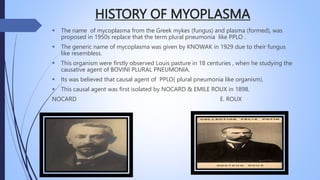
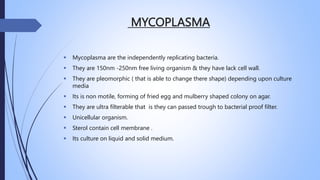
 This causal agent was first isolated by NOCARD & EMILE ROUX in 1898.
NOCARD E. ROUX
MYCOPLASMA
 Mycoplasma are the independently replicating bacteria.
 They are 150nm -250nm free living organism & they have lack cell wall.
 They are pleomorphic ( that is able to change there shape) depending upon culture
media
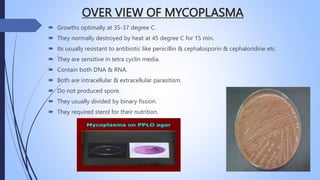
 Its is non motile, forming of fried egg and mulberry shaped colony on agar.
 They are ultra filterable that is they can passed trough to bacterial proof filter.
 Unicellular organism.
 Sterol contain cell membrane .
 Its culture on liquid and solid medium.
OVER VIEW OF MYCOPLASMA
 Growths optimally at 35-37 degree C.
 They normally destroyed by heat at 45 degree C for 15 min.
 Its usually resistant to antibiotic like penicillin & cephalosporin & cephaloridine etc.
 They are sensitive in tetra cyclin media.
 Contain both DNA & RNA.
 Both are intracellular & extracellular parasitism.
 Do not produced spore.
 They usually divided by binary fission.
 They required sterol for their nutrition.
Habitat and habitat
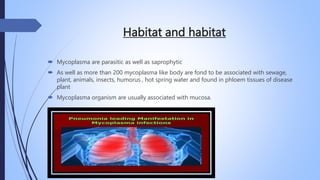
 Mycoplasma are parasitic as well as saprophytic
 As well as more than 200 mycoplasma like body are fond to be associated with sewage,
plant, animals, insects, humorus , hot spring water and found in phloem tissues of disease
plant
 Mycoplasma organism are usually associated with mucosa.
CELL STRUCTURE
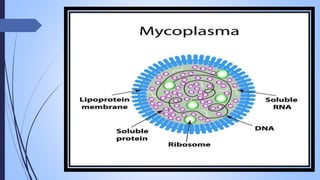
 In mycoplasma cells are small that is 150- 250nm.
 They have rigid cell wall is absent.
 Cell are surrounded by triple layer lipoprotinatious unit membrane that is 10nm thick cell membrane.
 This cell membrane contain sterol.
 Unit membrane encloses the cytoplasm, with in the cytoplasm RNA , DNA & Ribosome are +nt.
 Ribosome are 14nm & diameter & 72 S- type .
 DNA (double stranded helix) & it can be distinguish from bacterial DNA from low GC contain.
 In some species from some polar body protrude out from one or other end of the cell BLEV. This BLEV is
consider the site of attachment during infection.
 The surface antigen +nt in mycoplasma are made up of glycoprotein & lipid:-
 They are 17 species of mycoplasma have been isolated from human, but 4 species are clinically significance for
infection.
 These species are M. homnis, M. genitalivium.

SPREAD OF MYCOPLASMA INFECTION
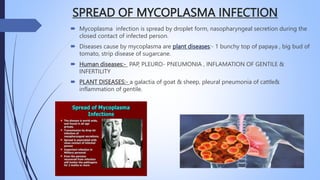
 Mycoplasma infection is spread by droplet form, nasopharyngeal secretion during the
closed contact of infected person.
 Diseases cause by mycoplasma are plant diseases:- 1 bunchy top of papaya , big bud of
tomato, strip disease of sugarcane.
 Human diseases:- PAP, PLEURO- PNEUMONIA , INFLAMATION OF GENTILE &
INFERTILITY
 PLANT DISEASES:- a galactia of goat & sheep, pleural pneumonia of cattle&
inflammation of gentile.
DIAGNOSIS OF MYCOPLASMA INFECTION
 Majorities of mycoplasma infection are diagnosed with serological test such as COLD
AGGLUTINATION TEST , STREPTOCOCCAL MG TEST, IMMUNOFLORESENCE ,
HEAM AGGULITINATION , INHIBITION TEST, CFT.
THANK YOU

MYCOPLASMA.pptx

  • 1.
  • 2.
    HISTORY OF MYOPLASMA The name of mycoplasma from the Greek mykes (fungus) and plasma (formed), was proposed in 1950s replace that the term plural pneumonia like PPLO .  The generic name of mycoplasma was given by KNOWAK in 1929 due to their fungus like resembless.  This organism were firstly observed Louis pasture in 18 centuries , when he studying the causative agent of BOVINI PLURAL PNEUMONIA.  Its was believed that causal agent of PPLO( plural pneumonia like organism).  This causal agent was first isolated by NOCARD & EMILE ROUX in 1898. NOCARD E. ROUX
  • 3.
    MYCOPLASMA  Mycoplasma arethe independently replicating bacteria.  They are 150nm -250nm free living organism & they have lack cell wall.  They are pleomorphic ( that is able to change there shape) depending upon culture media  Its is non motile, forming of fried egg and mulberry shaped colony on agar.  They are ultra filterable that is they can passed trough to bacterial proof filter.  Unicellular organism.  Sterol contain cell membrane .  Its culture on liquid and solid medium.
  • 4.
    OVER VIEW OFMYCOPLASMA  Growths optimally at 35-37 degree C.  They normally destroyed by heat at 45 degree C for 15 min.  Its usually resistant to antibiotic like penicillin & cephalosporin & cephaloridine etc.  They are sensitive in tetra cyclin media.  Contain both DNA & RNA.  Both are intracellular & extracellular parasitism.  Do not produced spore.  They usually divided by binary fission.  They required sterol for their nutrition.
  • 5.
    Habitat and habitat Mycoplasma are parasitic as well as saprophytic  As well as more than 200 mycoplasma like body are fond to be associated with sewage, plant, animals, insects, humorus , hot spring water and found in phloem tissues of disease plant  Mycoplasma organism are usually associated with mucosa.
  • 6.
    CELL STRUCTURE  Inmycoplasma cells are small that is 150- 250nm.  They have rigid cell wall is absent.  Cell are surrounded by triple layer lipoprotinatious unit membrane that is 10nm thick cell membrane.  This cell membrane contain sterol.  Unit membrane encloses the cytoplasm, with in the cytoplasm RNA , DNA & Ribosome are +nt.  Ribosome are 14nm & diameter & 72 S- type .  DNA (double stranded helix) & it can be distinguish from bacterial DNA from low GC contain.  In some species from some polar body protrude out from one or other end of the cell BLEV. This BLEV is consider the site of attachment during infection.  The surface antigen +nt in mycoplasma are made up of glycoprotein & lipid:-  They are 17 species of mycoplasma have been isolated from human, but 4 species are clinically significance for infection.  These species are M. homnis, M. genitalivium. 
  • 8.
    SPREAD OF MYCOPLASMAINFECTION  Mycoplasma infection is spread by droplet form, nasopharyngeal secretion during the closed contact of infected person.  Diseases cause by mycoplasma are plant diseases:- 1 bunchy top of papaya , big bud of tomato, strip disease of sugarcane.  Human diseases:- PAP, PLEURO- PNEUMONIA , INFLAMATION OF GENTILE & INFERTILITY  PLANT DISEASES:- a galactia of goat & sheep, pleural pneumonia of cattle& inflammation of gentile.
  • 9.
    DIAGNOSIS OF MYCOPLASMAINFECTION  Majorities of mycoplasma infection are diagnosed with serological test such as COLD AGGLUTINATION TEST , STREPTOCOCCAL MG TEST, IMMUNOFLORESENCE , HEAM AGGULITINATION , INHIBITION TEST, CFT.
  • 10.