Project Management
Professional (PMP)
Exam Preparation
(Based on Guide to PMBOK 6th Edition)
www.ADVConsultants.comwww.advconsultants.com 1
Start Teaching Today!
Purchase the Entire Slide Deck
• The PMP/CAPM
Instructor slides are
based on the PMBOK
6th edition.
• Total of 489 teaching
Slides
• Covers the entire
PMBOK 6th Edition
including Agile
Methodology
• Each chapter comes
with a set of
questions for students
to review in class
• Make it yours today:
– www.advconsultants.com/prod
uct/pmp-capm-instructor-
slides/
www.advconsultants.com
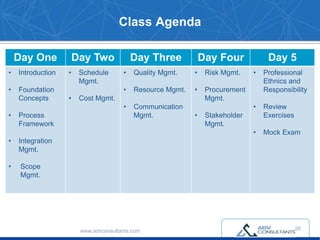
2
Project Management Professional (PMP)
Project Management Institute
www.pmi.org
Project Management Institute
Established in 1969 and headquartered outside
Philadelphia, Pennsylvania USA, the Project Management
Institute (PMI) is the world’s leading for project
management professional association with 500,082
Project Management Professionals (PMP).
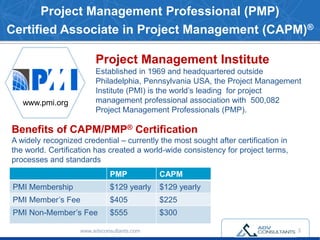
Benefits of CAPM/PMP® Certification
A widely recognized credential – currently the most sought after certification in
the world. Certification has created a world-wide consistency for project terms,
processes and standards
PMP CAPM
PMI Membership $129 yearly $129 yearly
PMI Member’s Fee $405 $225
PMI Non-Member’s Fee $555 $300
Certified Associate in Project Management (CAPM)®
www.advconsultants.com 3
Is it worth to be
PMP/CAPM Certified?
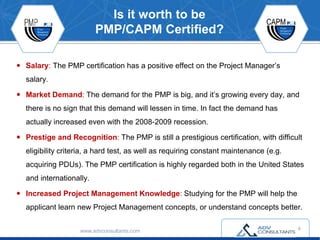
 Salary: The PMP certification has a positive effect on the Project Manager’s
salary.
 Market Demand: The demand for the PMP is big, and it’s growing every day, and
there is no sign that this demand will lessen in time. In fact the demand has
actually increased even with the 2008-2009 recession.
 Prestige and Recognition: The PMP is still a prestigious certification, with difficult
eligibility criteria, a hard test, as well as requiring constant maintenance (e.g.
acquiring PDUs). The PMP certification is highly regarded both in the United States
and internationally.
 Increased Project Management Knowledge: Studying for the PMP will help the
applicant learn new Project Management concepts, or understand concepts better.
www.advconsultants.com 4
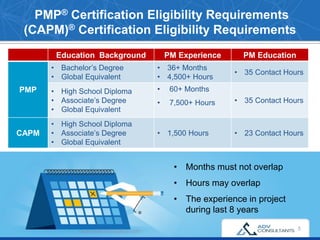
PMP® Certification Eligibility Requirements
(CAPM)® Certification Eligibility Requirements
• Months must not overlap
• Hours may overlap
• The experience in project
during last 8 years
Education Background PM Experience PM Education
PMP
• Bachelor’s Degree
• Global Equivalent
• 36+ Months
• 4,500+ Hours
• 35 Contact Hours
• High School Diploma
• Associate’s Degree
• Global Equivalent
• 60+ Months
• 7,500+ Hours • 35 Contact Hours
CAPM
• High School Diploma
• Associate’s Degree
• Global Equivalent
• 1,500 Hours • 23 Contact Hours
5
www.advconsultants.com
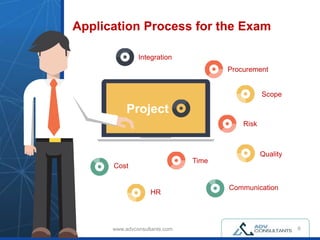
Application Process for the Exam
6
Project
Time
Cost
Procurement
Risk
Communication
Integration
Scope
Quality
HR
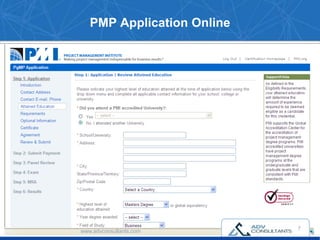
PMP Application Online
7
www.advconsultants.com
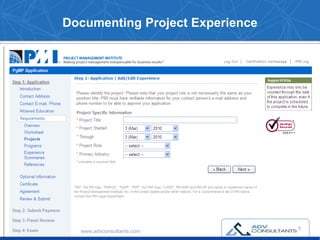
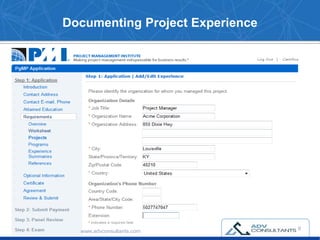
Documenting Project Experience
8
www.advconsultants.com
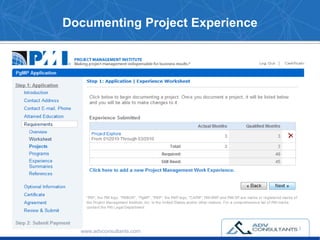
Documenting Project Experience
9
www.advconsultants.com
Documenting Project Experience
10
www.advconsultants.com
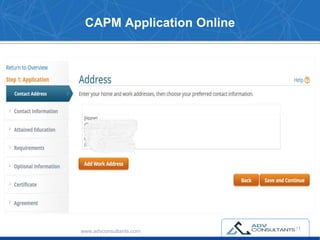
CAPM Application Online
11
www.advconsultants.com
Application Picked For Audit
• PMI holds the right to ‘Audit’ candidates application.
• The process is generally applied randomly & only after candidate has paid for
the examination
• PMI sends back the details of 4500Hrs of experience back to candidate and asks
for formal verification of each project by the concerned contact person. (detailed
and very simple step by step procedure will be informed by the PMI through mail)
• Candidate should submit all the projects data duly signed (hard copy) by the
contact person back to PMI
• Upon satisfactory submission PMI will send the confirmation letter to the candidate
to schedule the exam.
www.advconsultants.com 12
www.advconsultants.com
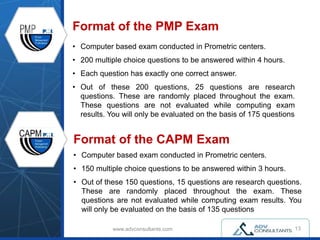
Format of the PMP Exam
• Computer based exam conducted in Prometric centers.
• 200 multiple choice questions to be answered within 4 hours.
• Each question has exactly one correct answer.
• Out of these 200 questions, 25 questions are research
questions. These are randomly placed throughout the exam.
These questions are not evaluated while computing exam
results. You will only be evaluated on the basis of 175 questions
13
Format of the CAPM Exam
• Computer based exam conducted in Prometric centers.
• 150 multiple choice questions to be answered within 3 hours.
• Out of these 150 questions, 15 questions are research questions.
These are randomly placed throughout the exam. These
questions are not evaluated while computing exam results. You
will only be evaluated on the basis of 135 questions
Format of the PMP/CAPM Exam
• On clicking the final submission button, the
system will compute the results immediately
and provide you with the Pass or Fail
message. Do not forget to collect the result-
sheet from the Examination center
invigilator/coordinator.
• To pass the PMP examination, you must
answer a minimum of 106 of the 200 scored
questions correctly.
• To pass the CAMP examination, you must
answer a minimum of 106 of the 150 scored
questions correctly.
www.advconsultants.com 14
www.advconsultants.com
Format of the PMP Exam
• There is no negative marking in the
exam. Unanswered questions are
treated as wrong questions.
• After clearing the exam, you will
receive the PMP certificate by mail
within 2 months.
15
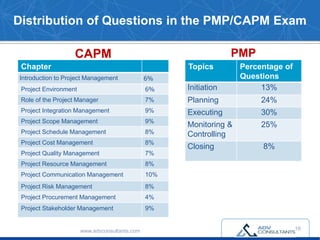
Distribution of Questions in the PMP/CAPM Exam
Topics Percentage of
Questions
Initiation 13%
Planning 24%
Executing 30%
Monitoring &
Controlling
25%
Closing 8%
Chapter
Introduction to Project Management 6%
Project Environment 6%
Role of the Project Manager 7%
Project Integration Management 9%
Project Scope Management 9%
Project Schedule Management 8%
Project Cost Management 8%
Project Quality Management 7%
Project Resource Management 8%
Project Communication Management 10%
Project Risk Management 8%
Project Procurement Management 4%
Project Stakeholder Management 9%
CAPM PMP
www.advconsultants.com 16
PMP Question Types
www.advconsultants.com
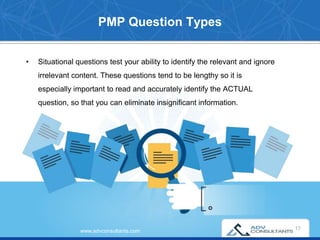
• Situational questions test your ability to identify the relevant and ignore
irrelevant content. These questions tend to be lengthy so it is
especially important to read and accurately identify the ACTUAL
question, so that you can eliminate insignificant information.
17
PMP Question Types
• Formula-based questions are more than just “solving for the median” or
calculating earned value. There are about 49 PMP formulas that you must
know backwards and forwards, ranging from simple averages to
Probability and Depreciation. You must know both the formula and how to
perform the calculation in order to get the answer right.
www.advconsultants.com 18
PMP Question Types
• Knowledge-based questions require you to know facts — most often from
the PMBOK Guide. These questions also occasionally ask which processes
belong to which Knowledge Area, or which Inputs, Tools & Techniques or
Outputs go with which process. Sometimes you are asked to identify an
example chart or graph, such as recognizing a RACI or Pareto chart.
19
www.advconsultants.com
PMP Question Types
Interpretational questions may also test
your ability to deduce a situation or
condition. For example: “If your project
has an SPI and a CPI both greater than
1, how well is your project performing?”
Specific Technique questions will contain
a tool or technique like a network
diagram and ask you to provide an
element that’s inherent in that diagram
such as forward pass or backward pass.
www.advconsultants.com 20
21
Answer the questions from
PMI’s perspective, not from
your real –world experiences
21
www.advconsultants.com
Tricks for the PMP Exam
• Bring the authorization letter from PMI to the test site
• Bring snacks, you can not eat in the test room, but
you can out of the room.
• The exam will not be adapted according to you, 200
Q’s will be selected in the beginning and it will not be
changed
• You can mark questions in order to return to it back
• Most of the questions are situational
• You can re-take the exam for 2 times only.
www.advconsultants.com 22
Seven Steps in the Journey towards PMP
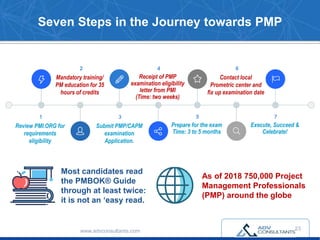
Mandatory training/
PM education for 35
hours of credits
2
Receipt of PMP
examination eligibility
letter from PMI
(Time: two weeks)
4
Contact local
Prometric center and
fix up examination date
6
Review PMI.ORG for
requirements
eligibility
1
Submit PMP/CAPM
examination
Application.
3
Prepare for the exam
Time: 3 to 5 months
5
Execute, Succeed &
Celebrate!
7
Most candidates read
the PMBOK® Guide
through at least twice:
it is not an ‘easy read.
As of 2018 750,000 Project
Management Professionals
(PMP) around the globe
www.advconsultants.com 23
Instructors
• Instructor Name
Instructor Email
www.advconsultants.com 24
www.advconsultants.com
Class Logistics
25
• Session Schedule
• Session Dates (5/19, 5/20, 5/26,
5/27 & 6/2)
• Start/Stop Times (9 am – 5 pm)
• Homework
• Breaks
• Facilities
• Classroom Etiquette
Class Agenda
Day One Day Two Day Three Day Four Day 5
• Introduction
• Foundation
Concepts
• Process
Framework
• Integration
Mgmt.
• Scope
Mgmt.
• Schedule
Mgmt.
• Cost Mgmt.
• Quality Mgmt.
• Resource Mgmt.
• Communication
Mgmt.
• Risk Mgmt.
• Procurement
Mgmt.
• Stakeholder
Mgmt.
• Professional
Ethnics and
Responsibility
• Review
Exercises
• Mock Exam
www.advconsultants.com 26
www.advconsultants.com
Class Goal
• PASS on FIRST TRY!
• P – Pare down the bulk of focus on the critical pieces
• A – Analyze key concepts
• S – Structure the concepts to understand
• S –Study the material and practice questions
27
Class Members Introductions
• Name
• Background
• What do you plan to do with your
PMP® / CAPM certification?
www.advconsultants.com 28
www.advconsultants.com
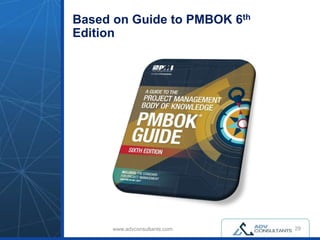
Based on Guide to PMBOK 6th
Edition
29
Chapter One
Introduction
www.IntellectualPoint.comwww.advconsultants.com 30
What is a Project ?
31
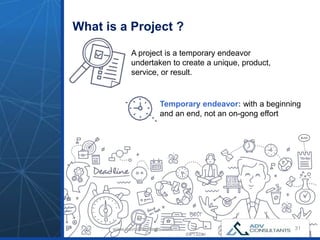
A project is a temporary endeavor
undertaken to create a unique, product,
service, or result.
Temporary endeavor: with a beginning
and an end, not an on-gong effort
31www.advconsultants.com
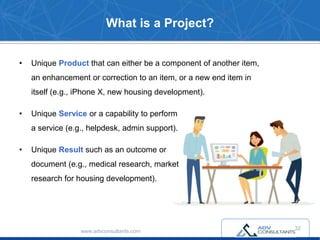
• Unique Product that can either be a component of another item,
an enhancement or correction to an item, or a new end item in
itself (e.g., iPhone X, new housing development).
• Unique Service or a capability to perform
a service (e.g., helpdesk, admin support).
• Unique Result such as an outcome or
document (e.g., medical research, market
research for housing development).
www.advconsultants.com
What is a Project?
32
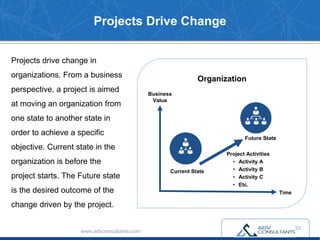
Projects Drive Change
Projects drive change in
organizations. From a business
perspective, a project is aimed
at moving an organization from
one state to another state in
order to achieve a specific
objective. Current state in the
organization is before the
project starts. The Future state
is the desired outcome of the
change driven by the project.
www.advconsultants.com
Organization
Business
Value
Time
Current State
Future State
Project Activities
• Activity A
• Activity B
• Activity C
• Etc.
33
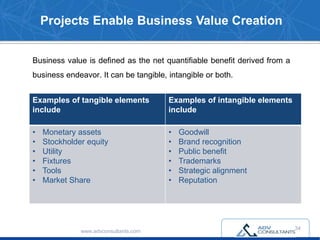
Projects Enable Business Value Creation
Business value is defined as the net quantifiable benefit derived from a
business endeavor. It can be tangible, intangible or both.
www.advconsultants.com
Examples of tangible elements
include
Examples of intangible elements
include
• Monetary assets
• Stockholder equity
• Utility
• Fixtures
• Tools
• Market Share
• Goodwill
• Brand recognition
• Public benefit
• Trademarks
• Strategic alignment
• Reputation
34
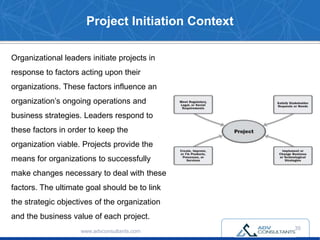
Project Initiation Context
www.advconsultants.com
Organizational leaders initiate projects in
response to factors acting upon their
organizations. These factors influence an
organization’s ongoing operations and
business strategies. Leaders respond to
these factors in order to keep the
organization viable. Projects provide the
means for organizations to successfully
make changes necessary to deal with these
factors. The ultimate goal should be to link
the strategic objectives of the organization
and the business value of each project.
35
Why are Projects Initiated
• An electronics firm authorizes a new project to
develop a faster, cheaper, and smaller laptop based
on advances in computer memory and electronics
technology.
• A car company authorizes a project to build more fuel
efficient cars in response to gasoline shortage.
• A public company authorizes a project to create a new
service for electric car sharing to reduce pollution.
www.advconsultants.com
36
What is Project Management
www.advconsultants.com
• Project Management is defined as the application of knowledge,
skills, tools, and techniques to project activities to meet the project
requirements.
• Project management is accomplished through the appropriate
application and integration of the project management processes
identified for the project.
• Project management enables organizations to execute projects
effectively and efficiently.
37
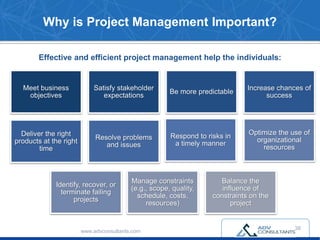
Why is Project Management Important?
www.advconsultants.com
Meet business
objectives
Satisfy stakeholder
expectations
Be more predictable
Increase chances of
success
Deliver the right
products at the right
time
Resolve problems
and issues
Respond to risks in
a timely manner
Optimize the use of
organizational
resources
Identify, recover, or
terminate failing
projects
Manage constraints
(e.g., scope, quality,
schedule, costs,
resources)
Balance the
influence of
constraints on the
project
Effective and efficient project management help the individuals:
38
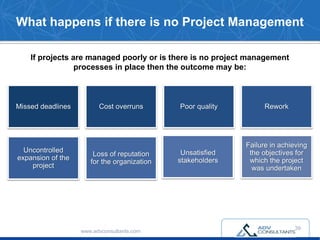
What happens if there is no Project Management
If projects are managed poorly or is there is no project management
processes in place then the outcome may be:
www.advconsultants.com
Missed deadlines Cost overruns Poor quality Rework
Uncontrolled
expansion of the
project
Loss of reputation
for the organization
Unsatisfied
stakeholders
Failure in achieving
the objectives for
which the project
was undertaken
39
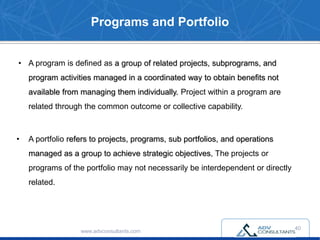
Programs and Portfolio
• A program is defined as a group of related projects, subprograms, and
program activities managed in a coordinated way to obtain benefits not
available from managing them individually. Project within a program are
related through the common outcome or collective capability.
• A portfolio refers to projects, programs, sub portfolios, and operations
managed as a group to achieve strategic objectives, The projects or
programs of the portfolio may not necessarily be interdependent or directly
related.
www.advconsultants.com
40
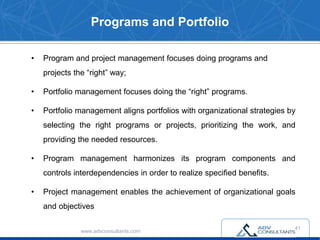
Programs and Portfolio
• Program and project management focuses doing programs and
projects the “right” way;
• Portfolio management focuses doing the “right” programs.
• Portfolio management aligns portfolios with organizational strategies by
selecting the right programs or projects, prioritizing the work, and
providing the needed resources.
• Program management harmonizes its program components and
controls interdependencies in order to realize specified benefits.
• Project management enables the achievement of organizational goals
and objectives
www.advconsultants.com
41
Start Teaching Today!
Purchase the Entire Slide Deck
• The PMP/CAPM
Instructor slides are
based on the PMBOK
6th edition.
• Total of 489 teaching
Slides
• Covers the entire
PMBOK 6th Edition
including Agile
Methodology
• Each chapter comes
with a set of
questions for students
to review in class
• Make it yours today:
– www.advconsultants.com/prod
uct/pmp-capm-instructor-
slides/
www.advconsultants.com
42

Instructor Slides - PMP/CAPM PMBOK 6th Edition

  • 1.
    Project Management Professional (PMP) ExamPreparation (Based on Guide to PMBOK 6th Edition) www.ADVConsultants.comwww.advconsultants.com 1
  • 2.
    Start Teaching Today! Purchasethe Entire Slide Deck • The PMP/CAPM Instructor slides are based on the PMBOK 6th edition. • Total of 489 teaching Slides • Covers the entire PMBOK 6th Edition including Agile Methodology • Each chapter comes with a set of questions for students to review in class • Make it yours today: – www.advconsultants.com/prod uct/pmp-capm-instructor- slides/ www.advconsultants.com 2
  • 3.
    Project Management Professional(PMP) Project Management Institute www.pmi.org Project Management Institute Established in 1969 and headquartered outside Philadelphia, Pennsylvania USA, the Project Management Institute (PMI) is the world’s leading for project management professional association with 500,082 Project Management Professionals (PMP). Benefits of CAPM/PMP® Certification A widely recognized credential – currently the most sought after certification in the world. Certification has created a world-wide consistency for project terms, processes and standards PMP CAPM PMI Membership $129 yearly $129 yearly PMI Member’s Fee $405 $225 PMI Non-Member’s Fee $555 $300 Certified Associate in Project Management (CAPM)® www.advconsultants.com 3
  • 4.
    Is it worthto be PMP/CAPM Certified?  Salary: The PMP certification has a positive effect on the Project Manager’s salary.  Market Demand: The demand for the PMP is big, and it’s growing every day, and there is no sign that this demand will lessen in time. In fact the demand has actually increased even with the 2008-2009 recession.  Prestige and Recognition: The PMP is still a prestigious certification, with difficult eligibility criteria, a hard test, as well as requiring constant maintenance (e.g. acquiring PDUs). The PMP certification is highly regarded both in the United States and internationally.  Increased Project Management Knowledge: Studying for the PMP will help the applicant learn new Project Management concepts, or understand concepts better. www.advconsultants.com 4
  • 5.
    PMP® Certification EligibilityRequirements (CAPM)® Certification Eligibility Requirements • Months must not overlap • Hours may overlap • The experience in project during last 8 years Education Background PM Experience PM Education PMP • Bachelor’s Degree • Global Equivalent • 36+ Months • 4,500+ Hours • 35 Contact Hours • High School Diploma • Associate’s Degree • Global Equivalent • 60+ Months • 7,500+ Hours • 35 Contact Hours CAPM • High School Diploma • Associate’s Degree • Global Equivalent • 1,500 Hours • 23 Contact Hours 5 www.advconsultants.com
  • 6.
    www.advconsultants.com Application Process forthe Exam 6 Project Time Cost Procurement Risk Communication Integration Scope Quality HR
  • 7.
  • 8.
  • 9.
  • 10.
  • 11.
  • 12.
    Application Picked ForAudit • PMI holds the right to ‘Audit’ candidates application. • The process is generally applied randomly & only after candidate has paid for the examination • PMI sends back the details of 4500Hrs of experience back to candidate and asks for formal verification of each project by the concerned contact person. (detailed and very simple step by step procedure will be informed by the PMI through mail) • Candidate should submit all the projects data duly signed (hard copy) by the contact person back to PMI • Upon satisfactory submission PMI will send the confirmation letter to the candidate to schedule the exam. www.advconsultants.com 12
  • 13.
    www.advconsultants.com Format of thePMP Exam • Computer based exam conducted in Prometric centers. • 200 multiple choice questions to be answered within 4 hours. • Each question has exactly one correct answer. • Out of these 200 questions, 25 questions are research questions. These are randomly placed throughout the exam. These questions are not evaluated while computing exam results. You will only be evaluated on the basis of 175 questions 13 Format of the CAPM Exam • Computer based exam conducted in Prometric centers. • 150 multiple choice questions to be answered within 3 hours. • Out of these 150 questions, 15 questions are research questions. These are randomly placed throughout the exam. These questions are not evaluated while computing exam results. You will only be evaluated on the basis of 135 questions
  • 14.
    Format of thePMP/CAPM Exam • On clicking the final submission button, the system will compute the results immediately and provide you with the Pass or Fail message. Do not forget to collect the result- sheet from the Examination center invigilator/coordinator. • To pass the PMP examination, you must answer a minimum of 106 of the 200 scored questions correctly. • To pass the CAMP examination, you must answer a minimum of 106 of the 150 scored questions correctly. www.advconsultants.com 14
  • 15.
    www.advconsultants.com Format of thePMP Exam • There is no negative marking in the exam. Unanswered questions are treated as wrong questions. • After clearing the exam, you will receive the PMP certificate by mail within 2 months. 15
  • 16.
    Distribution of Questionsin the PMP/CAPM Exam Topics Percentage of Questions Initiation 13% Planning 24% Executing 30% Monitoring & Controlling 25% Closing 8% Chapter Introduction to Project Management 6% Project Environment 6% Role of the Project Manager 7% Project Integration Management 9% Project Scope Management 9% Project Schedule Management 8% Project Cost Management 8% Project Quality Management 7% Project Resource Management 8% Project Communication Management 10% Project Risk Management 8% Project Procurement Management 4% Project Stakeholder Management 9% CAPM PMP www.advconsultants.com 16
  • 17.
    PMP Question Types www.advconsultants.com •Situational questions test your ability to identify the relevant and ignore irrelevant content. These questions tend to be lengthy so it is especially important to read and accurately identify the ACTUAL question, so that you can eliminate insignificant information. 17
  • 18.
    PMP Question Types •Formula-based questions are more than just “solving for the median” or calculating earned value. There are about 49 PMP formulas that you must know backwards and forwards, ranging from simple averages to Probability and Depreciation. You must know both the formula and how to perform the calculation in order to get the answer right. www.advconsultants.com 18
  • 19.
    PMP Question Types •Knowledge-based questions require you to know facts — most often from the PMBOK Guide. These questions also occasionally ask which processes belong to which Knowledge Area, or which Inputs, Tools & Techniques or Outputs go with which process. Sometimes you are asked to identify an example chart or graph, such as recognizing a RACI or Pareto chart. 19 www.advconsultants.com
  • 20.
    PMP Question Types Interpretationalquestions may also test your ability to deduce a situation or condition. For example: “If your project has an SPI and a CPI both greater than 1, how well is your project performing?” Specific Technique questions will contain a tool or technique like a network diagram and ask you to provide an element that’s inherent in that diagram such as forward pass or backward pass. www.advconsultants.com 20
  • 21.
    21 Answer the questionsfrom PMI’s perspective, not from your real –world experiences 21 www.advconsultants.com
  • 22.
    Tricks for thePMP Exam • Bring the authorization letter from PMI to the test site • Bring snacks, you can not eat in the test room, but you can out of the room. • The exam will not be adapted according to you, 200 Q’s will be selected in the beginning and it will not be changed • You can mark questions in order to return to it back • Most of the questions are situational • You can re-take the exam for 2 times only. www.advconsultants.com 22
  • 23.
    Seven Steps inthe Journey towards PMP Mandatory training/ PM education for 35 hours of credits 2 Receipt of PMP examination eligibility letter from PMI (Time: two weeks) 4 Contact local Prometric center and fix up examination date 6 Review PMI.ORG for requirements eligibility 1 Submit PMP/CAPM examination Application. 3 Prepare for the exam Time: 3 to 5 months 5 Execute, Succeed & Celebrate! 7 Most candidates read the PMBOK® Guide through at least twice: it is not an ‘easy read. As of 2018 750,000 Project Management Professionals (PMP) around the globe www.advconsultants.com 23
  • 24.
    Instructors • Instructor Name InstructorEmail www.advconsultants.com 24
  • 25.
    www.advconsultants.com Class Logistics 25 • SessionSchedule • Session Dates (5/19, 5/20, 5/26, 5/27 & 6/2) • Start/Stop Times (9 am – 5 pm) • Homework • Breaks • Facilities • Classroom Etiquette
  • 26.
    Class Agenda Day OneDay Two Day Three Day Four Day 5 • Introduction • Foundation Concepts • Process Framework • Integration Mgmt. • Scope Mgmt. • Schedule Mgmt. • Cost Mgmt. • Quality Mgmt. • Resource Mgmt. • Communication Mgmt. • Risk Mgmt. • Procurement Mgmt. • Stakeholder Mgmt. • Professional Ethnics and Responsibility • Review Exercises • Mock Exam www.advconsultants.com 26
  • 27.
    www.advconsultants.com Class Goal • PASSon FIRST TRY! • P – Pare down the bulk of focus on the critical pieces • A – Analyze key concepts • S – Structure the concepts to understand • S –Study the material and practice questions 27
  • 28.
    Class Members Introductions •Name • Background • What do you plan to do with your PMP® / CAPM certification? www.advconsultants.com 28
  • 29.
  • 30.
  • 31.
    What is aProject ? 31 A project is a temporary endeavor undertaken to create a unique, product, service, or result. Temporary endeavor: with a beginning and an end, not an on-gong effort 31www.advconsultants.com
  • 32.
    • Unique Productthat can either be a component of another item, an enhancement or correction to an item, or a new end item in itself (e.g., iPhone X, new housing development). • Unique Service or a capability to perform a service (e.g., helpdesk, admin support). • Unique Result such as an outcome or document (e.g., medical research, market research for housing development). www.advconsultants.com What is a Project? 32
  • 33.
    Projects Drive Change Projectsdrive change in organizations. From a business perspective, a project is aimed at moving an organization from one state to another state in order to achieve a specific objective. Current state in the organization is before the project starts. The Future state is the desired outcome of the change driven by the project. www.advconsultants.com Organization Business Value Time Current State Future State Project Activities • Activity A • Activity B • Activity C • Etc. 33
  • 34.
    Projects Enable BusinessValue Creation Business value is defined as the net quantifiable benefit derived from a business endeavor. It can be tangible, intangible or both. www.advconsultants.com Examples of tangible elements include Examples of intangible elements include • Monetary assets • Stockholder equity • Utility • Fixtures • Tools • Market Share • Goodwill • Brand recognition • Public benefit • Trademarks • Strategic alignment • Reputation 34
  • 35.
    Project Initiation Context www.advconsultants.com Organizationalleaders initiate projects in response to factors acting upon their organizations. These factors influence an organization’s ongoing operations and business strategies. Leaders respond to these factors in order to keep the organization viable. Projects provide the means for organizations to successfully make changes necessary to deal with these factors. The ultimate goal should be to link the strategic objectives of the organization and the business value of each project. 35
  • 36.
    Why are ProjectsInitiated • An electronics firm authorizes a new project to develop a faster, cheaper, and smaller laptop based on advances in computer memory and electronics technology. • A car company authorizes a project to build more fuel efficient cars in response to gasoline shortage. • A public company authorizes a project to create a new service for electric car sharing to reduce pollution. www.advconsultants.com 36
  • 37.
    What is ProjectManagement www.advconsultants.com • Project Management is defined as the application of knowledge, skills, tools, and techniques to project activities to meet the project requirements. • Project management is accomplished through the appropriate application and integration of the project management processes identified for the project. • Project management enables organizations to execute projects effectively and efficiently. 37
  • 38.
    Why is ProjectManagement Important? www.advconsultants.com Meet business objectives Satisfy stakeholder expectations Be more predictable Increase chances of success Deliver the right products at the right time Resolve problems and issues Respond to risks in a timely manner Optimize the use of organizational resources Identify, recover, or terminate failing projects Manage constraints (e.g., scope, quality, schedule, costs, resources) Balance the influence of constraints on the project Effective and efficient project management help the individuals: 38
  • 39.
    What happens ifthere is no Project Management If projects are managed poorly or is there is no project management processes in place then the outcome may be: www.advconsultants.com Missed deadlines Cost overruns Poor quality Rework Uncontrolled expansion of the project Loss of reputation for the organization Unsatisfied stakeholders Failure in achieving the objectives for which the project was undertaken 39
  • 40.
    Programs and Portfolio •A program is defined as a group of related projects, subprograms, and program activities managed in a coordinated way to obtain benefits not available from managing them individually. Project within a program are related through the common outcome or collective capability. • A portfolio refers to projects, programs, sub portfolios, and operations managed as a group to achieve strategic objectives, The projects or programs of the portfolio may not necessarily be interdependent or directly related. www.advconsultants.com 40
  • 41.
    Programs and Portfolio •Program and project management focuses doing programs and projects the “right” way; • Portfolio management focuses doing the “right” programs. • Portfolio management aligns portfolios with organizational strategies by selecting the right programs or projects, prioritizing the work, and providing the needed resources. • Program management harmonizes its program components and controls interdependencies in order to realize specified benefits. • Project management enables the achievement of organizational goals and objectives www.advconsultants.com 41
  • 42.
    Start Teaching Today! Purchasethe Entire Slide Deck • The PMP/CAPM Instructor slides are based on the PMBOK 6th edition. • Total of 489 teaching Slides • Covers the entire PMBOK 6th Edition including Agile Methodology • Each chapter comes with a set of questions for students to review in class • Make it yours today: – www.advconsultants.com/prod uct/pmp-capm-instructor- slides/ www.advconsultants.com 42