THE PROJECT MANAGEMENT
PLAN IN 20 STEPS
Author: Marco De Santis, PMP
2014
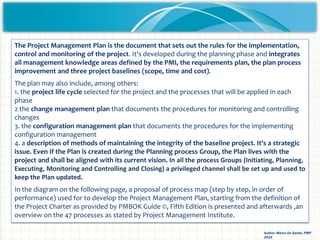
The Project Management Plan is the document that sets out the rules for the implementation,
control and monitoring of the project. It's developed during the planning phase and integrates
all management knowledge areas defined by the PMI, the requirements plan, the plan process
improvement and three project baselines (scope, time and cost).
The plan may also include, among others:
1. the project life cycle selected for the project and the processes that will be applied in each
phase
2 the change management plan that documents the procedures for monitoring and controlling
changes
3. the configuration management plan that documents the procedures for the implementing
configuration management
4. a description of methods of maintaining the integrity of the baseline project. It's a strategic
issue. Even if the Plan is created during the Planning process Group, the Plan lives with the
project and shall be aligned with its current vision. In all the process Groups (Initiating, Planning,
Executing, Monitoring and Controlling and Closing) a privileged channel shall be set up and used to
keep the Plan updated.
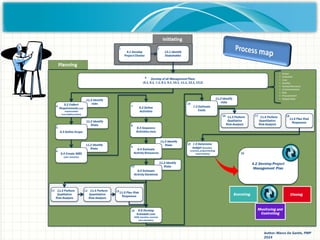
In the diagram on the following page, a proposal of process map (step by step, in order of
performance) used for to develop the Project Management Plan, starting from the definition of
the Project Charter as provided by PMBOK Guide ©, Fifth Edition is presented and afterwards ,an
overview on the 47 processes as stated by Project Management Institute.
Author: Marco De Santis, PMP
2014
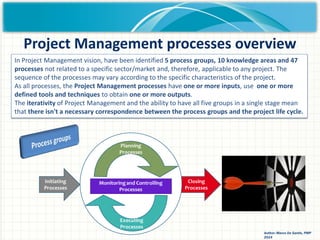
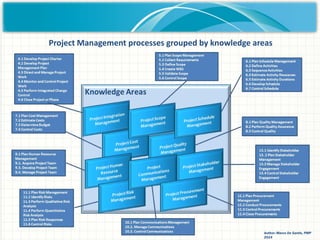
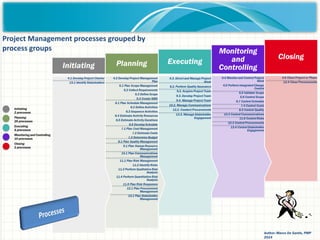
In Project Management vision, have been identified 5 process groups, 10 knowledge areas and 47
processes not related to a specific sector/market and, therefore, applicable to any project. The
sequence of the processes may vary according to the specific characteristics of the project.
As all processes, the Project Management processes have one or more inputs, use one or more
defined tools and techniques to obtain one or more outputs.
The iterativity of Project Management and the ability to have all five groups in a single stage mean
that there isn't a necessary correspondence between the process groups and the project life cycle.
Project Management processes overview
Author: Marco De Santis, PMP
2014
Project Management processes grouped by knowledge areas
Author: Marco De Santis, PMP
2014
Project Management processes grouped by
process groups
Author: Marco De Santis, PMP
2014

The Project Management Plan in 20 steps

  • 1.
  • 2.
    Author: Marco DeSantis, PMP 2014 The Project Management Plan is the document that sets out the rules for the implementation, control and monitoring of the project. It's developed during the planning phase and integrates all management knowledge areas defined by the PMI, the requirements plan, the plan process improvement and three project baselines (scope, time and cost). The plan may also include, among others: 1. the project life cycle selected for the project and the processes that will be applied in each phase 2 the change management plan that documents the procedures for monitoring and controlling changes 3. the configuration management plan that documents the procedures for the implementing configuration management 4. a description of methods of maintaining the integrity of the baseline project. It's a strategic issue. Even if the Plan is created during the Planning process Group, the Plan lives with the project and shall be aligned with its current vision. In all the process Groups (Initiating, Planning, Executing, Monitoring and Controlling and Closing) a privileged channel shall be set up and used to keep the Plan updated. In the diagram on the following page, a proposal of process map (step by step, in order of performance) used for to develop the Project Management Plan, starting from the definition of the Project Charter as provided by PMBOK Guide ©, Fifth Edition is presented and afterwards ,an overview on the 47 processes as stated by Project Management Institute.
  • 3.
    Author: Marco DeSantis, PMP 2014
  • 4.
    In Project Managementvision, have been identified 5 process groups, 10 knowledge areas and 47 processes not related to a specific sector/market and, therefore, applicable to any project. The sequence of the processes may vary according to the specific characteristics of the project. As all processes, the Project Management processes have one or more inputs, use one or more defined tools and techniques to obtain one or more outputs. The iterativity of Project Management and the ability to have all five groups in a single stage mean that there isn't a necessary correspondence between the process groups and the project life cycle. Project Management processes overview Author: Marco De Santis, PMP 2014
  • 5.
    Project Management processesgrouped by knowledge areas Author: Marco De Santis, PMP 2014
  • 6.
    Project Management processesgrouped by process groups Author: Marco De Santis, PMP 2014