Bacillus
Bacillus
• Classification
– All are large Gram-positive bacilli
– Are aerobic
– Form endospores
– Most are found in dust and soil
– Bacillus anthracis is the major pathogen in the group
• Morphology and Cultural Characteristics (Bacillus
anthracis)
Bacillus anthracis
– G+B with square cut ends
– Form endospores
– Non-motile
– Capsule made of glutamic acid (a polypeptide).
• The capsule is not found in cultured bacteria unless the
bacteria are grown on bicarbonate containing media and in the
presence of increased CO² concentrations.
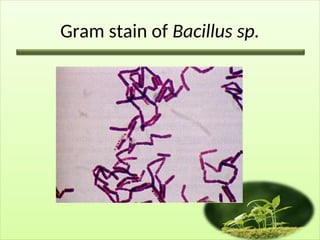
Gram stain of Bacillus sp.
Endospores of Bacillus sp.
Bacillus anthracis
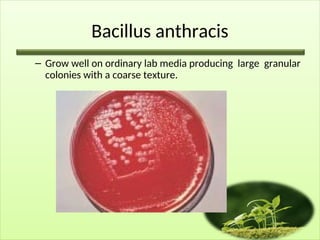
– Grow well on ordinary lab media producing large granular
colonies with a coarse texture.
B. anthracis
• Virulence factors
– Capsule­helps organism to resist phagocytosis but
antibodies are not protective.
– Exotoxin­is very complex and is produced only when the
bacteria is growing in animal tissues.
Bacillus anthracis
• Clinical significance
– Anthrax which is the disease caused by B. anthracis is
essentially a disease of animals who acquire the organism by
ingestion or inhalation of spores.
• The spores are extremely resistant to adverse chemicals and physical
environments.
• They may remain a source of infection in soil for 20-30 years.
– Man acquires anthrax usually from contact with animal
products; less commonly from working in an agricultural
setting with infected animals.
Bacillus anthracis
– Man may acquire the organism through skin abrasions, by
inhalation of spores, or by ingestion. The disease that
develops depends upon the mode of transmission:
• Pulmonary (Woolsorter‘s disease)­Spores are inhaled
and germinate in the lungs where they multiply and
spread to cause a fatal septicemia or meningitis.
– This is the most serious form of the disease.
• Intestinal anthrax­results from ingestion of spores.
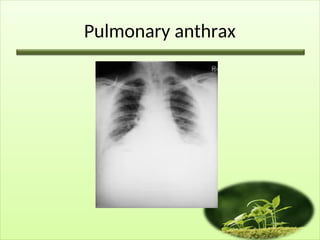
Pulmonary anthrax
Cutaneous Anthrax
Bacillus
• Antibiotic susceptibility and treatment
– Penicillin or tetracycline
– A short-term PA vaccine is available for industrial workers
and others at high risk.
• Other Bacillus species
– Bacillus subtilis, and occasional other species may
occasionally cause opportunistic infections.
– Bacillus cereus is a major cause of enterotoxin food
poisoning;
• The toxin is protein in nature and can be destroyed by heating;
• Food poisoning occurs after ingestion of pre-formed toxin;
– Vomiting occurs 1-5 hours after ingestion
Bacillus
– B. cereus is also an opportunistic pathogen that has
been cultured from cases of septicemia, endocarditis,
meningitis, wound infections, pneumonia, and fulminant
eye infections
• In addition to the enterotoxin that bacteria may produce, a
dermonecrotic and a lethal toxin, hemolysins, lecithinase,
proteases, and nucleases may be involved in its pathogenesis
• Clindamycin with or without gentamycin may be used for
treatment of infections
Laboratory diagnosis
• Specimen- must be labeled high risk.
• pus(cutaenous).
• blood(septicaemia).
• CSF(meningitis),
• sputum (pulmonary anthrax).
Microscopy
• -Large gram positive bacillus
• -capsulated seen in tissues .
• The capsules contains polypeptide this stains
red-mauve with loffler’s polychrome
methylene blue reaction known as
Mcfaydeans reaction.
Culture :-
• Grows aerobically temp range of 12-45o
C with
optimum of 37o
C.sporulation occurs at 25-30o
C
• In blood agar :-The colonies grow to a size of 2-5
mm in diameter ,grey white ,irregular with a
wavy margin they could be non hemolytic or
slightly hemolytic. Saprophytic bacillus are
markedly hemolytic.
• In broth :-Shows a thick skin called a pellicle.
• Agar plate:- produce grey circular discs with a wavy
margin (medusa head appearance )
• Gelatin stab;- they grow along the wire puncture(with
lateral spikes)the organism slowly liquefies the gelatin
along and out from the line of inoculation. The inverted
fir tree pattern is characteristic of B.anthracis.
Biochemical tests:
• Gelatin stab- liquefies gelatin (fir tree pattern).
• Ferments glucose and sucrose.
• Converts nitrate to nitrites.
Ascholis test:-This test is used to test anthrax
infection in organs and tissues from suspected
carcasses or from purified material.

Bacillus.recentppt.ppt Bacillus powerpoint

  • 1.
  • 2.
    Bacillus • Classification – Allare large Gram-positive bacilli – Are aerobic – Form endospores – Most are found in dust and soil – Bacillus anthracis is the major pathogen in the group • Morphology and Cultural Characteristics (Bacillus anthracis)
  • 3.
    Bacillus anthracis – G+Bwith square cut ends – Form endospores – Non-motile – Capsule made of glutamic acid (a polypeptide). • The capsule is not found in cultured bacteria unless the bacteria are grown on bicarbonate containing media and in the presence of increased CO² concentrations.
  • 4.
    Gram stain ofBacillus sp.
  • 5.
  • 6.
    Bacillus anthracis – Growwell on ordinary lab media producing large granular colonies with a coarse texture.
  • 7.
    B. anthracis • Virulencefactors – Capsule­helps organism to resist phagocytosis but antibodies are not protective. – Exotoxin­is very complex and is produced only when the bacteria is growing in animal tissues.
  • 8.
    Bacillus anthracis • Clinicalsignificance – Anthrax which is the disease caused by B. anthracis is essentially a disease of animals who acquire the organism by ingestion or inhalation of spores. • The spores are extremely resistant to adverse chemicals and physical environments. • They may remain a source of infection in soil for 20-30 years. – Man acquires anthrax usually from contact with animal products; less commonly from working in an agricultural setting with infected animals.
  • 9.
    Bacillus anthracis – Manmay acquire the organism through skin abrasions, by inhalation of spores, or by ingestion. The disease that develops depends upon the mode of transmission: • Pulmonary (Woolsorter‘s disease)­Spores are inhaled and germinate in the lungs where they multiply and spread to cause a fatal septicemia or meningitis. – This is the most serious form of the disease. • Intestinal anthrax­results from ingestion of spores.
  • 10.
  • 11.
  • 12.
    Bacillus • Antibiotic susceptibilityand treatment – Penicillin or tetracycline – A short-term PA vaccine is available for industrial workers and others at high risk. • Other Bacillus species – Bacillus subtilis, and occasional other species may occasionally cause opportunistic infections. – Bacillus cereus is a major cause of enterotoxin food poisoning; • The toxin is protein in nature and can be destroyed by heating; • Food poisoning occurs after ingestion of pre-formed toxin; – Vomiting occurs 1-5 hours after ingestion
  • 13.
    Bacillus – B. cereusis also an opportunistic pathogen that has been cultured from cases of septicemia, endocarditis, meningitis, wound infections, pneumonia, and fulminant eye infections • In addition to the enterotoxin that bacteria may produce, a dermonecrotic and a lethal toxin, hemolysins, lecithinase, proteases, and nucleases may be involved in its pathogenesis • Clindamycin with or without gentamycin may be used for treatment of infections
  • 14.
    Laboratory diagnosis • Specimen-must be labeled high risk. • pus(cutaenous). • blood(septicaemia). • CSF(meningitis), • sputum (pulmonary anthrax).
  • 15.
    Microscopy • -Large grampositive bacillus • -capsulated seen in tissues . • The capsules contains polypeptide this stains red-mauve with loffler’s polychrome methylene blue reaction known as Mcfaydeans reaction.
  • 16.
    Culture :- • Growsaerobically temp range of 12-45o C with optimum of 37o C.sporulation occurs at 25-30o C • In blood agar :-The colonies grow to a size of 2-5 mm in diameter ,grey white ,irregular with a wavy margin they could be non hemolytic or slightly hemolytic. Saprophytic bacillus are markedly hemolytic.
  • 17.
    • In broth:-Shows a thick skin called a pellicle. • Agar plate:- produce grey circular discs with a wavy margin (medusa head appearance ) • Gelatin stab;- they grow along the wire puncture(with lateral spikes)the organism slowly liquefies the gelatin along and out from the line of inoculation. The inverted fir tree pattern is characteristic of B.anthracis.
  • 18.
    Biochemical tests: • Gelatinstab- liquefies gelatin (fir tree pattern). • Ferments glucose and sucrose. • Converts nitrate to nitrites. Ascholis test:-This test is used to test anthrax infection in organs and tissues from suspected carcasses or from purified material.