Animal adaptations
A note from your teacher:
Go through the slides in order. Anything in orange requires you to type or interact in
some way. There will be directions with each item in orange.
Adaptations: Click the link to watch a video about
animal adaptations.
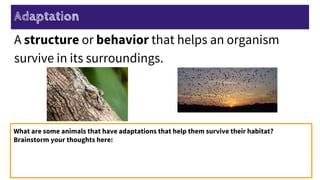
A structure or behavior that helps an organism
survive in its surroundings.
What are some animals that have adaptations that help them survive their habitat?
Brainstorm your thoughts here:
Adaptation
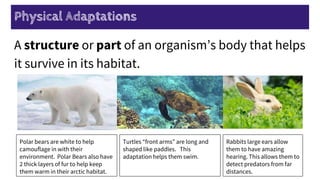
A structure or part of an organism’s body that helps
it survive in its habitat.
Physical Adaptations
Polar bears are white to help
camouflage in with their
environment. Polar Bears also have
2 thick layers of fur to help keep
them warm in their arctic habitat.
Turtles “front arms” are long and
shaped like paddles. This
adaptation helps them swim.
Rabbits large ears allow
them to have amazing
hearing. This allows them to
detect predators from far
distances.
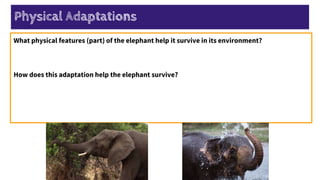
What physical features (part) of the elephant help it survive in its environment?
How does this adaptation help the elephant survive?
Physical Adaptations
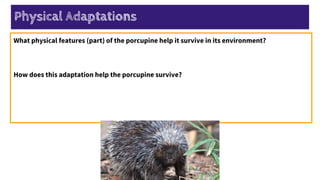
What physical features (part) of the porcupine help it survive in its environment?
How does this adaptation help the porcupine survive?
Physical Adaptations
What physical features (part) of the giraffe help it survive in its environment?
How does this adaptation help the giraffe survive?
Physical Adaptations
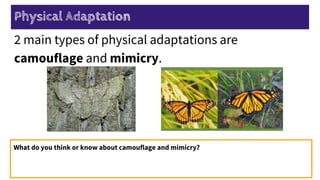
2 main types of physical adaptations are
camouflage and mimicry.
What do you think or know about camouflage and mimicry?
Physical Adaptation
Camouflage
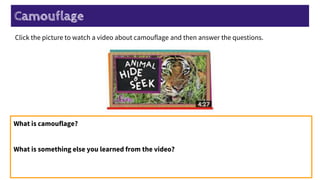
Click the picture to watch a video about camouflage and then answer the questions.
What is camouflage?
What is something else you learned from the video?
Camouflage
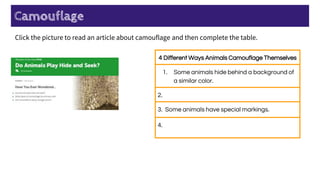
Click the picture to read an article about camouflage and then complete the table.
4 Different Ways Animals Camouflage Themselves
1. Some animals hide behind a background of
a similar color.
2.
3. Some animals have special markings.
4.
Camouflage
Insert 2 pictures of animals that use camouflage .
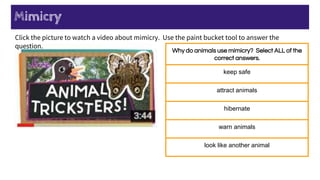
Mimicry
Why do animals use mimicry? Select ALL of the
correct answers.
keep safe
attract animals
hibernate
warn animals
look like another animal
Click the picture to watch a video about mimicry. Use the paint bucket tool to answer the
question.
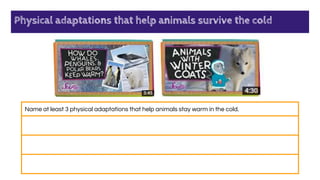
Physical adaptations that help animals survive the cold
Name at least 3 physical adaptations that help animals stay warm in the cold.
Behavioral Adaptations
A behavior that helps an organism survive in its
habitat.
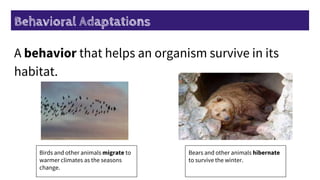
Birds and other animals migrate to
warmer climates as the seasons
change.
Bears and other animals hibernate
to survive the winter.
Behavioral Adaptations
What do you already know about migration and hibernation?
Migration
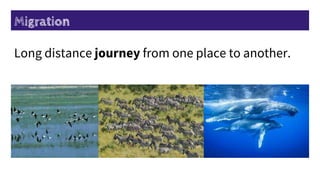
Long distance journey from one place to another.
Migration
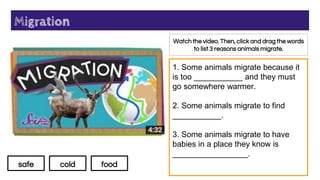
Watch the video. Then, click and drag the words
to list 3 reasons animals migrate.
1. Some animals migrate because it
is too ___________ and they must
go somewhere warmer.
2. Some animals migrate to find
___________.
3. Some animals migrate to have
babies in a place they know is
_________________.
safe cold food
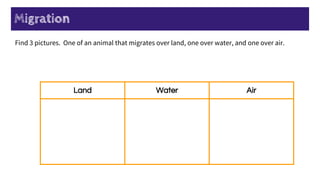
Migration
Land Water Air
Find 3 pictures. One of an animal that migrates over land, one over water, and one over air.
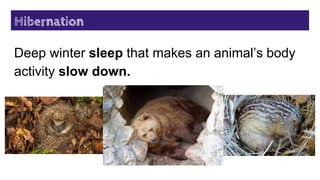
Hibernation
Deep winter sleep that makes an animal’s body
activity slow down.
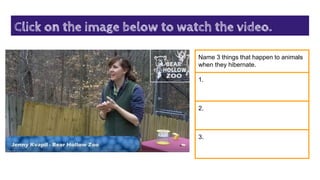
Click on the image below to watch the video.
Name 3 things that happen to animals
when they hibernate.
1.
2.
3.
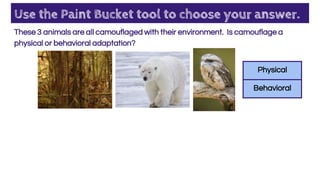
Use the Paint Bucket tool to choose your answer.
These 3 animals are all camouflaged with their environment. Is camouflage a
physical or behavioral adaptation?
Physical
Behavioral
Animal Adaptations
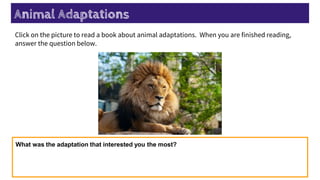
Click on the picture to read a book about animal adaptations. When you are finished reading,
answer the question below.
What was the adaptation that interested you the most?
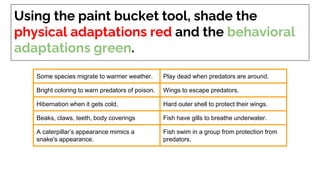
Using the paint bucket tool, shade the
physical adaptations red and the behavioral
adaptations green.
Some species migrate to warmer weather. Play dead when predators are around.
Bright coloring to warn predators of poison. Wings to escape predators.
Hibernation when it gets cold. Hard outer shell to protect their wings.
Beaks, claws, teeth, body coverings Fish have gills to breathe underwater.
A caterpillar’s appearance mimics a
snake's appearance.
Fish swim in a group from protection from
predators.

Animal Adaptations

  • 1.
  • 2.
    A note fromyour teacher: Go through the slides in order. Anything in orange requires you to type or interact in some way. There will be directions with each item in orange.
  • 3.
    Adaptations: Click thelink to watch a video about animal adaptations.
  • 4.
    A structure orbehavior that helps an organism survive in its surroundings. What are some animals that have adaptations that help them survive their habitat? Brainstorm your thoughts here: Adaptation
  • 5.
    A structure orpart of an organism’s body that helps it survive in its habitat. Physical Adaptations Polar bears are white to help camouflage in with their environment. Polar Bears also have 2 thick layers of fur to help keep them warm in their arctic habitat. Turtles “front arms” are long and shaped like paddles. This adaptation helps them swim. Rabbits large ears allow them to have amazing hearing. This allows them to detect predators from far distances.
  • 6.
    What physical features(part) of the elephant help it survive in its environment? How does this adaptation help the elephant survive? Physical Adaptations
  • 7.
    What physical features(part) of the porcupine help it survive in its environment? How does this adaptation help the porcupine survive? Physical Adaptations
  • 8.
    What physical features(part) of the giraffe help it survive in its environment? How does this adaptation help the giraffe survive? Physical Adaptations
  • 9.
    2 main typesof physical adaptations are camouflage and mimicry. What do you think or know about camouflage and mimicry? Physical Adaptation
  • 10.
    Camouflage Click the pictureto watch a video about camouflage and then answer the questions. What is camouflage? What is something else you learned from the video?
  • 11.
    Camouflage Click the pictureto read an article about camouflage and then complete the table. 4 Different Ways Animals Camouflage Themselves 1. Some animals hide behind a background of a similar color. 2. 3. Some animals have special markings. 4.
  • 12.
    Camouflage Insert 2 picturesof animals that use camouflage .
  • 13.
    Mimicry Why do animalsuse mimicry? Select ALL of the correct answers. keep safe attract animals hibernate warn animals look like another animal Click the picture to watch a video about mimicry. Use the paint bucket tool to answer the question.
  • 14.
    Physical adaptations thathelp animals survive the cold Name at least 3 physical adaptations that help animals stay warm in the cold.
  • 15.
    Behavioral Adaptations A behaviorthat helps an organism survive in its habitat. Birds and other animals migrate to warmer climates as the seasons change. Bears and other animals hibernate to survive the winter.
  • 16.
    Behavioral Adaptations What doyou already know about migration and hibernation?
  • 17.
    Migration Long distance journeyfrom one place to another.
  • 18.
    Migration Watch the video.Then, click and drag the words to list 3 reasons animals migrate. 1. Some animals migrate because it is too ___________ and they must go somewhere warmer. 2. Some animals migrate to find ___________. 3. Some animals migrate to have babies in a place they know is _________________. safe cold food
  • 19.
    Migration Land Water Air Find3 pictures. One of an animal that migrates over land, one over water, and one over air.
  • 20.
    Hibernation Deep winter sleepthat makes an animal’s body activity slow down.
  • 21.
    Click on theimage below to watch the video. Name 3 things that happen to animals when they hibernate. 1. 2. 3.
  • 22.
    Use the PaintBucket tool to choose your answer. These 3 animals are all camouflaged with their environment. Is camouflage a physical or behavioral adaptation? Physical Behavioral
  • 23.
    Animal Adaptations Click onthe picture to read a book about animal adaptations. When you are finished reading, answer the question below. What was the adaptation that interested you the most?
  • 24.
    Using the paintbucket tool, shade the physical adaptations red and the behavioral adaptations green. Some species migrate to warmer weather. Play dead when predators are around. Bright coloring to warn predators of poison. Wings to escape predators. Hibernation when it gets cold. Hard outer shell to protect their wings. Beaks, claws, teeth, body coverings Fish have gills to breathe underwater. A caterpillar’s appearance mimics a snake's appearance. Fish swim in a group from protection from predators.

Editor's Notes

  • #2 This document is created to be more self paced and self taught for students. The document includes resources from the CIP folder in one document for students to work independently.