Adaptations
Adaptations
An adaptation is a characteristic that enables an
organism to survive in an environment.

Adaptations contribute to the fitness and survival
of individuals
Adaptations result from natural selection
    - there is variation within a population
    - organisms with the characteristics that
          enable their survival will survive
    - those organims that survive, reproduce
          to pass on these characteristics.


         Remember Charles Darwin
Three types of adaptations
• Structural – physical characteristics
  eg thick fur coats


• Physiological –the processes occuring in an
  organism eg Hibernation

• Behavioural – actions of an organism
  eg basking in sun
Frill necked lizards (Chlamydosaurus kingii) bask in
the sun until they reach an adequate core body temp,
then they will retreat into the shade.
The cladodes of the
she-oak (casuarinas)
have tiny little leaves
that can only be seen
with a lens. This
reduces surface area
for water retention.
The Australian alpine grasshopper
(Koscioscula tristis) has a blue colouring at
higher temperatures and an almost black
colour at low temperatures.
The leaves of the Eucalypt hang vertically to
reduce the area that is exposed to the sun in
the hottest part of the day.
Penguins use
countercurrent
exchange to prevent
heat loss. The warm
blood in arteries heats
the cool blood
returning to the body.
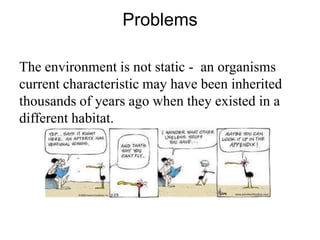
Problems

The environment is not static - an organisms
current characteristic may have been inherited
thousands of years ago when they existed in a
different habitat.
Vestigal Organs
 Vestigal organs are the remnants of fully
functional structures in their ancestors

Dolphins and whales have lungs which are of no
use for living in water
Therefore:
• An adaptation refers to both the current state of
  being adapted and to the dynamic evolutionary
  process that leads to the adaptation
Looking at Fossils
Fossils can tell us a
lot about the history
of life on earth
But interpreting the
characteristics of fossils is even
         more difficult
                 Are the bony plates
                 of the stegosaurus
                 for defence,
                 temperature
                 regulation or to
                 attract a mate?
Many adaptations are not obvious
Missconceptions
“An adaptation is a change in an organism that
helps it survive and reproduce in its
environment”
Misconception
“An adaptation is a change in an organism
produced as a response to a change in the
environment e.g phototropism”

Adaptations

  • 1.
  • 2.
    Adaptations An adaptation isa characteristic that enables an organism to survive in an environment. Adaptations contribute to the fitness and survival of individuals
  • 3.
    Adaptations result fromnatural selection - there is variation within a population - organisms with the characteristics that enable their survival will survive - those organims that survive, reproduce to pass on these characteristics. Remember Charles Darwin
  • 4.
    Three types ofadaptations • Structural – physical characteristics eg thick fur coats • Physiological –the processes occuring in an organism eg Hibernation • Behavioural – actions of an organism eg basking in sun
  • 5.
    Frill necked lizards(Chlamydosaurus kingii) bask in the sun until they reach an adequate core body temp, then they will retreat into the shade.
  • 6.
    The cladodes ofthe she-oak (casuarinas) have tiny little leaves that can only be seen with a lens. This reduces surface area for water retention.
  • 7.
    The Australian alpinegrasshopper (Koscioscula tristis) has a blue colouring at higher temperatures and an almost black colour at low temperatures.
  • 8.
    The leaves ofthe Eucalypt hang vertically to reduce the area that is exposed to the sun in the hottest part of the day.
  • 9.
    Penguins use countercurrent exchange toprevent heat loss. The warm blood in arteries heats the cool blood returning to the body.
  • 10.
    Problems The environment isnot static - an organisms current characteristic may have been inherited thousands of years ago when they existed in a different habitat.
  • 11.
    Vestigal Organs Vestigalorgans are the remnants of fully functional structures in their ancestors Dolphins and whales have lungs which are of no use for living in water
  • 12.
    Therefore: • An adaptationrefers to both the current state of being adapted and to the dynamic evolutionary process that leads to the adaptation
  • 13.
    Looking at Fossils Fossilscan tell us a lot about the history of life on earth
  • 14.
    But interpreting the characteristicsof fossils is even more difficult Are the bony plates of the stegosaurus for defence, temperature regulation or to attract a mate?
  • 15.
  • 17.
    Missconceptions “An adaptation isa change in an organism that helps it survive and reproduce in its environment”
  • 18.
    Misconception “An adaptation isa change in an organism produced as a response to a change in the environment e.g phototropism”