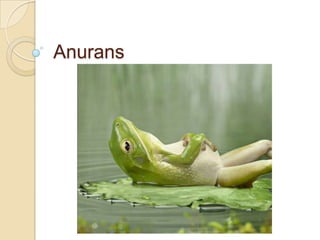
Anurans
Kingdom: Animalia
Phylum: Chordata
Class: Amphibia
Subclass:
Lissamphibia
Order: Anura
•The order Anura contains 4,810 species in 33
families.
•About 88% of amphibian species are frogs.
• From a taxonomic perspective, all members of the
order Anura are frogs, but only members of the family
Bufonidae are considered "true toads". The use of
the term "frog" in common names usually refers to
species that are aquatic or semi-aquatic with smooth
and/or moist skins, and the term "toad" generally
refers to species that tend to be terrestrial with dry,
warty skin.
•Frogs and toads are broadly classified into three
suborders: Archaeobatrachia, which includes four
families of primitive frogs; Mesobatrachia, which
includes five families of more evolutionary
intermediate frogs; and Neobatrachia, by far the
largest group, which contains the remaining 24
Morphology and Physiology
The morphology of frogs is dramatically different from most
other vertebrates. Compared with the other two groups of
amphibians, (salamanders and caecilians), frogs are unusual
because they lack tails as adults and their legs are more
suited to jumping than walking. The physiology of frogs is
generally like that of other amphibians (and differs from other
terrestrial vertebrates) because oxygen can pass through
their highly permeable skin. This unique feature allows frogs
to respire largely through their skins. The ribs are poorly
developed so the lungs are filled by buccal pumping. It has
been shown that a frog that has been deprived of its lungs
can continue living, respiring entirely through its
skin. Because the oxygen is dissolved in an aqueous film on
the skin and passes from there to the blood, the skin must
remain moist at all times; this makes frogs susceptible to
many toxins in the environment, some of which can similarly
dissolve in the layer of water and be passed into their
bloodstream. This may be one of the causes of the decline in
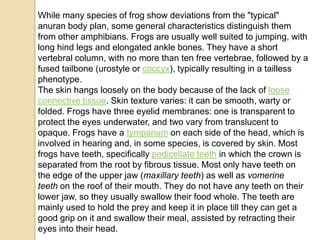
While many species of frog show deviations from the "typical"
anuran body plan, some general characteristics distinguish them
from other amphibians. Frogs are usually well suited to jumping, with
long hind legs and elongated ankle bones. They have a short
vertebral column, with no more than ten free vertebrae, followed by a
fused tailbone (urostyle or coccyx), typically resulting in a tailless
phenotype.
The skin hangs loosely on the body because of the lack of loose
connective tissue. Skin texture varies: it can be smooth, warty or
folded. Frogs have three eyelid membranes: one is transparent to
protect the eyes underwater, and two vary from translucent to
opaque. Frogs have a tympanum on each side of the head, which is
involved in hearing and, in some species, is covered by skin. Most
frogs have teeth, specifically pedicellate teeth in which the crown is
separated from the root by fibrous tissue. Most only have teeth on
the edge of the upper jaw (maxillary teeth) as well as vomerine
teeth on the roof of their mouth. They do not have any teeth on their
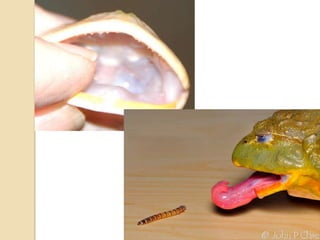
lower jaw, so they usually swallow their food whole. The teeth are
mainly used to hold the prey and keep it in place till they can get a
good grip on it and swallow their meal, assisted by retracting their
eyes into their head.
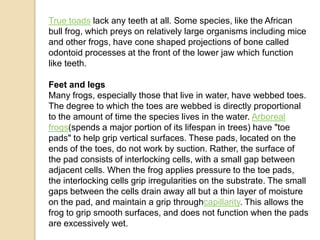
True toads lack any teeth at all. Some species, like the African
bull frog, which preys on relatively large organisms including mice
and other frogs, have cone shaped projections of bone called
odontoid processes at the front of the lower jaw which function
like teeth.

Feet and legs
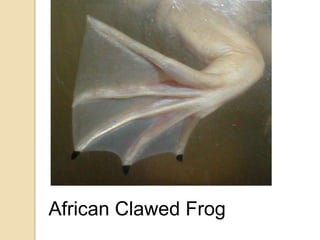
Many frogs, especially those that live in water, have webbed toes.
The degree to which the toes are webbed is directly proportional
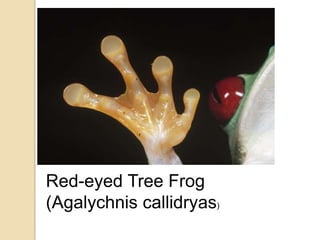
to the amount of time the species lives in the water. Arboreal
frogs(spends a major portion of its lifespan in trees) have "toe
pads" to help grip vertical surfaces. These pads, located on the
ends of the toes, do not work by suction. Rather, the surface of
the pad consists of interlocking cells, with a small gap between
adjacent cells. When the frog applies pressure to the toe pads,
the interlocking cells grip irregularities on the substrate. The small
gaps between the cells drain away all but a thin layer of moisture
on the pad, and maintain a grip throughcapillarity. This allows the
frog to grip smooth surfaces, and does not function when the pads
are excessively wet.
Red-eyed Tree Frog
(Agalychnis callidryas)
African Clawed Frog
In many arboreal frogs, a small "intercalary structure" in
each toe increases the surface area touching the
substrate. Furthermore, since hopping through trees can
be dangerous, many arboreal frogs have hip joints that
allow both hopping and walking. Some frogs that live high
in trees even possess an elaborate degree of webbing
between their toes, as do aquatic frogs. In these arboreal
frogs, the webs allow the frogs to "parachute" or control
their glide from one position in the canopy to another.
Ground-dwelling frogs generally lack the adaptations of
aquatic and arboreal frogs. Most have smaller toe pads, if
any, and little webbing. Some burrowing frogs have a toe
extension—a metatarsal tubercle—that helps them to
burrow. The hind legs of ground dwellers are more
muscular than those of aqueous and tree-dwelling frogs.
Skin
Being cold-blooded, frogs have to adopt behaviour patterns to
regulate their temperature. To warm up they can move into the
sun or onto a warm surface and to cool down they can move
into the shade or adopt a stance that exposes the minimum
area of skin to the air. This involves squatting down, tucking the
forefeet under the chin and the hind feet under the belly. The
colour of a frog's skin is used for thermo-regulation. In cool
damp conditions the colour will be darker than on a hot dry day.
Many frogs are able to absorb water and oxygen directly
through the skin, especially around the pelvic area. However,
the permeability of a frog's skin can also result in water loss.
Glands located all over the body exude mucus which helps
keep the skin moist and reduces evaporation. Some glands on
the hands and chest of males are specialized to produce sticky
secretions to aid in amplexus. Similar glands in tree frogs
produce a glue-like substance on the adhesive discs of the
feet.
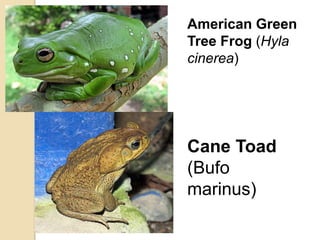
American Green
Tree Frog (Hyla
cinerea)


Cane Toad
(Bufo
marinus)
Some tree frogs reduce water loss by having a waterproof layer of
skin and several South American species coat their skin with a
waxy secretion. Others frogs have adopted behaviours to conserve
water, including becoming nocturnal and resting in a water-
conserving position. This posture involves the frog lying with its
toes and fingers tucked under its body and chin with no gap
between the body and the substrate. Some frog species will also
rest in large groups with each frog pressed against its neighbours.
This reduces the amount of skin exposed to the air or a dry surface,
and thus reduces water loss. Camouflage is a common defensive
mechanism in frogs. Most camouflaged frogs are nocturnal, which
adds to their ability to hide. Nocturnal frogs usually find the ideal
camouflaged position during the day to sleep. Some frogs have
the ability to change colour, but this is usually restricted to shades
of one or two colours. Features such as warts and skin folds are
usually found on ground-dwelling frogs, where a smooth skin would
not disguise them effectively. Arboreal frogs usually have smooth
skin, enabling them to disguise themselves as leaves. Certain frogs
change colour between night and day, as light and moisture
stimulate the pigment cells and cause them to expand or contract.
Poison
Many frogs contain mild toxins that make them unpalatable to
potential predators. For example, all toads have large poison
glands—the parotoid glands—located behind the eyes, on the top
of the head. Some frogs, such as some poison dart frogs, are
especially toxic. The chemical makeup of toxins in frogs varies from
irritants to hallucinogens, convulsants, nerve poisons,
and vasoconstrictors. Many predators of frogs have adapted to
tolerate high levels of these poisons. Others, including humans,
may be severely affected.
Some frogs obtain poisons from the ants and other arthropods they
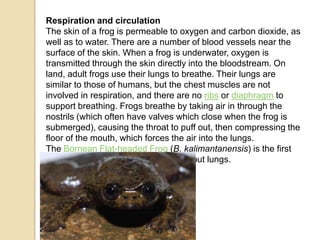
eat. Poisonous frogs tend to advertise their toxicity with bright
colours, an adaptive strategy known as aposematism. There are at
least two non-poisonous species of frogs in tropical America
(Eleutherodactylus gaigei and Lithodytes lineatus) that mimic the
colouration of dart poison frogs' coloration for self-protection
(Batesian mimicry).
Dendrobates
azureus (top)
and
Dendrobates
leucomelas
Respiration and circulation
The skin of a frog is permeable to oxygen and carbon dioxide, as
well as to water. There are a number of blood vessels near the
surface of the skin. When a frog is underwater, oxygen is
transmitted through the skin directly into the bloodstream. On
land, adult frogs use their lungs to breathe. Their lungs are
similar to those of humans, but the chest muscles are not
involved in respiration, and there are no ribs or diaphragm to
support breathing. Frogs breathe by taking air in through the
nostrils (which often have valves which close when the frog is
submerged), causing the throat to puff out, then compressing the
floor of the mouth, which forces the air into the lungs.
The Bornean Flat-headed Frog (B. kalimantanensis) is the first
species of frog known to science without lungs.
Frogs are known for their three-chambered heart, which they
share with all tetrapods except birds, crocodilians and mammals.
In the three-chambered heart, oxygenated blood from the lungs
and de-oxygenated blood from the respiring tissues enter by
separate atria, and are directed via a spiral valve to the
appropriate vessel—aorta for oxygenated blood and pulmonary
artery for deoxygenated blood. This special structure is essential
to keeping the mixing of the two types of blood to a minimum,
which enables frogs to have higher metabolic rates, and to be
more active than otherwise.

Digestion and excretion

Frogs have teeth along their upper jaw called maxillary teeth,
which are used to hold food before it is swallowed. These teeth
are very weak, and cannot be used to chew or catch and harm
agile prey. Instead, the frog uses its sticky, cleft tongue to catch
flies and other small moving prey.
The eyes assist in the swallowing of food as they are
able to be retracted through holes in the skull and
help push food down the throat. The food then moves
through the esophagus into the stomach where
digestive enzymes are added and it is churned up. It
then proceeds to the small intestine (duodenum and
ileum) where most digestion occurs. Pancreatic juice
from the pancreas, and bile, produced by the liver
and stored in the gallbladder, are secreted into the
small intestine, where the fluids digest the food and
the nutrients are absorbed. The food residue passes
into the large intestine where water is absorbed and
wastes are routed to the cloaca.
The excretory system is similar to that of mammals.
There are two kidneys which remove urea from the
blood and convert it into urine. This passes along
paired ureters to the urinary bladder from which it is
vented periodically into the cloaca. All bodily wastes
Reproductive system
In many species the male is smaller and slimmer than the female. Males
have vocal cords and make a range of croaks, particularly in the breeding
season, and in some species they also have vocal sacs to amplify the
sound. In the male the two testes are attached to the kidneys and sperm
passes into the kidneys through fine tubes called efferent ducts. They then
travel through the ureters which are consequently called urinogenital ducts
in the male frog. There is no penis and sperm are ejected from the cloaca
directly onto the eggs that the female is laying during amplexus. The
ovaries of the female frog are also beside the kidneys and the eggs pass
down a pair of oviducts to the exterior. During amplexus, the firm grip of the
male frog stimulates the release of eggs, usually wrapped in jelly, as
spawn.
Nervous system
The frog has a highly developed nervous system which consists of a
brain, spinal cord and nerves. Many parts of the frog's brain
correspond with those of humans. The brain consists of two
olfactory lobes, two cerebral hemispheres, a pineal body, two optic
lobes, a cerebellum and a medulla oblongata. Muscular
coordination and posture are controlled by the cerebellum and the
medulla oblongata regulates respiration, digestion and other
automatic functions. The relative size of the cerebrum of a frog is
much smaller than that of a human. Frogs have ten cranial
nerves(nerves which pass information from the outside directly to
the brain) and ten pairs of spinal nerves (nerves which pass
information from extremities to the brain through the spinal cord). By
contrast, all amniotes (mammals, birds and reptiles) have twelve
cranial nerves. Frogs do not have external ears; the eardrums
(tympanic membranes) are directly exposed. As in all animals, the
ear contains semicircular canals which help control balance and
orientation. Due to their short cochlea, frogs use electrical tuning to
expand their range of audible frequencies.
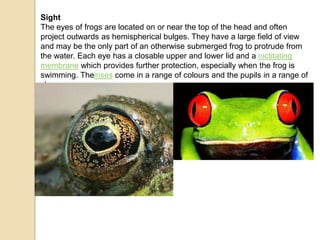
Sight
The eyes of frogs are located on or near the top of the head and often
project outwards as hemispherical bulges. They have a large field of view
and may be the only part of an otherwise submerged frog to protrude from
the water. Each eye has a closable upper and lower lid and a nictitating
membrane which provides further protection, especially when the frog is
swimming. Theirises come in a range of colours and the pupils in a range of
shapes.
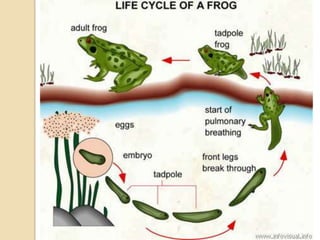
Life Cycle
The life cycle of frogs, like that of other
amphibians, consists of four main stages:
egg, tadpole, metamorphosis and adult.
The reliance of frogs on an aquatic
environment for the egg and tadpole
stages gives rise to a variety of breeding
behaviours that include the well-known
mating calls used by the males of most
species to attract females to the bodies of
water that they have chosen for breeding.
Some frogs also look after their eggs—
and in some cases even the tadpoles—
Summary
Major Characteristics of Lissamphibians
 •Double or paired occipital condyle
 •Two types of skin glands (mucous & granular)
 •Fat bodies associated with gonads
 •Double-channeled sensory papillae in the
 inner ear
 •Green rods (a special type of visual cell, unknown
 in caecilians)
 •Ribs do not encircle body
 •Ability to elevate the eye (with levator
 bulbi muscle)
 •Forced pump respiratory mechanism
 •Cylindrical centra (the main body of the vertebra;
 cylindrical centra are also found in several groups
 of early tetrapods)
•Pedicellate teeth (the crown of the teeth is separated
from the root by a zone of fibrous tissue; also found in
some Dissorophoidea; the teeth of some
fossil salamanders are not pedicellate)
•Bicuspid teeth (two cusps per tooth, also found in
juvenile dissorophoids)
•Operculum (small bone in the skull, linked to shoulder
girdle by the opercularis muscle; perhaps involved in
hearing and balance; absent in caecilians and some
salamanders, fused to the stapes (ear bones) in most
anurans)
•Loss of posterior skull bones (also
in Microsauria and Dissorophoidea)
•Small, widely separated pterygoids (also found
in Temnospondyli and Nectridea)
•Wide cultriform process of the parasphenoid (also
found in some Microsauria (Rhynchonchos)
Summary: Anurans
 Major Characteristics:
When only living taxa are considered, a list of
synapomorphies of Anura would include many of the
obvious distinctive features of frogs:

•Shortened vertebral column (nine or fewer presacral
vertebrae)
•Presence of a urostyle formed from developing tail
vertebrae
•Absence of tail in adults
Hindlimb longer than forelimb
•Fusion of radius and ulna into a single element
Fusion of tibia and fibula into a single element
Elongate ankle bones (tibiale and fibulare = astragalus
and calcaneum)
•Absence of a prefrontal bone
Fusion of separate hyobranchial elements
into a hyobranchial (=hyoid) plate
•A tongue that lacks intrinsic skeletal
support from the hyobranchial plate
A tadpole, with keratinous beaks and
denticles as larval mouthparts
•A single median spiracle in the larva
(characteristic of Orton's Type 3 tadpole)
•Large subcutaneous lymph spaces
between the skin and muscle layer
Two protractor lentis muscles attached to
lens

Anurans

  • 1.
  • 2.
    Kingdom: Animalia Phylum: Chordata Class:Amphibia Subclass: Lissamphibia Order: Anura
  • 3.
    •The order Anuracontains 4,810 species in 33 families. •About 88% of amphibian species are frogs. • From a taxonomic perspective, all members of the order Anura are frogs, but only members of the family Bufonidae are considered "true toads". The use of the term "frog" in common names usually refers to species that are aquatic or semi-aquatic with smooth and/or moist skins, and the term "toad" generally refers to species that tend to be terrestrial with dry, warty skin. •Frogs and toads are broadly classified into three suborders: Archaeobatrachia, which includes four families of primitive frogs; Mesobatrachia, which includes five families of more evolutionary intermediate frogs; and Neobatrachia, by far the largest group, which contains the remaining 24
  • 4.
    Morphology and Physiology Themorphology of frogs is dramatically different from most other vertebrates. Compared with the other two groups of amphibians, (salamanders and caecilians), frogs are unusual because they lack tails as adults and their legs are more suited to jumping than walking. The physiology of frogs is generally like that of other amphibians (and differs from other terrestrial vertebrates) because oxygen can pass through their highly permeable skin. This unique feature allows frogs to respire largely through their skins. The ribs are poorly developed so the lungs are filled by buccal pumping. It has been shown that a frog that has been deprived of its lungs can continue living, respiring entirely through its skin. Because the oxygen is dissolved in an aqueous film on the skin and passes from there to the blood, the skin must remain moist at all times; this makes frogs susceptible to many toxins in the environment, some of which can similarly dissolve in the layer of water and be passed into their bloodstream. This may be one of the causes of the decline in
  • 5.
    While many speciesof frog show deviations from the "typical" anuran body plan, some general characteristics distinguish them from other amphibians. Frogs are usually well suited to jumping, with long hind legs and elongated ankle bones. They have a short vertebral column, with no more than ten free vertebrae, followed by a fused tailbone (urostyle or coccyx), typically resulting in a tailless phenotype. The skin hangs loosely on the body because of the lack of loose connective tissue. Skin texture varies: it can be smooth, warty or folded. Frogs have three eyelid membranes: one is transparent to protect the eyes underwater, and two vary from translucent to opaque. Frogs have a tympanum on each side of the head, which is involved in hearing and, in some species, is covered by skin. Most frogs have teeth, specifically pedicellate teeth in which the crown is separated from the root by fibrous tissue. Most only have teeth on the edge of the upper jaw (maxillary teeth) as well as vomerine teeth on the roof of their mouth. They do not have any teeth on their lower jaw, so they usually swallow their food whole. The teeth are mainly used to hold the prey and keep it in place till they can get a good grip on it and swallow their meal, assisted by retracting their eyes into their head.
  • 6.
    True toads lackany teeth at all. Some species, like the African bull frog, which preys on relatively large organisms including mice and other frogs, have cone shaped projections of bone called odontoid processes at the front of the lower jaw which function like teeth. Feet and legs Many frogs, especially those that live in water, have webbed toes. The degree to which the toes are webbed is directly proportional to the amount of time the species lives in the water. Arboreal frogs(spends a major portion of its lifespan in trees) have "toe pads" to help grip vertical surfaces. These pads, located on the ends of the toes, do not work by suction. Rather, the surface of the pad consists of interlocking cells, with a small gap between adjacent cells. When the frog applies pressure to the toe pads, the interlocking cells grip irregularities on the substrate. The small gaps between the cells drain away all but a thin layer of moisture on the pad, and maintain a grip throughcapillarity. This allows the frog to grip smooth surfaces, and does not function when the pads are excessively wet.
  • 7.
  • 8.
  • 9.
    In many arborealfrogs, a small "intercalary structure" in each toe increases the surface area touching the substrate. Furthermore, since hopping through trees can be dangerous, many arboreal frogs have hip joints that allow both hopping and walking. Some frogs that live high in trees even possess an elaborate degree of webbing between their toes, as do aquatic frogs. In these arboreal frogs, the webs allow the frogs to "parachute" or control their glide from one position in the canopy to another. Ground-dwelling frogs generally lack the adaptations of aquatic and arboreal frogs. Most have smaller toe pads, if any, and little webbing. Some burrowing frogs have a toe extension—a metatarsal tubercle—that helps them to burrow. The hind legs of ground dwellers are more muscular than those of aqueous and tree-dwelling frogs.
  • 10.
    Skin Being cold-blooded, frogshave to adopt behaviour patterns to regulate their temperature. To warm up they can move into the sun or onto a warm surface and to cool down they can move into the shade or adopt a stance that exposes the minimum area of skin to the air. This involves squatting down, tucking the forefeet under the chin and the hind feet under the belly. The colour of a frog's skin is used for thermo-regulation. In cool damp conditions the colour will be darker than on a hot dry day. Many frogs are able to absorb water and oxygen directly through the skin, especially around the pelvic area. However, the permeability of a frog's skin can also result in water loss. Glands located all over the body exude mucus which helps keep the skin moist and reduces evaporation. Some glands on the hands and chest of males are specialized to produce sticky secretions to aid in amplexus. Similar glands in tree frogs produce a glue-like substance on the adhesive discs of the feet.
  • 11.
    American Green Tree Frog(Hyla cinerea) Cane Toad (Bufo marinus)
  • 12.
    Some tree frogsreduce water loss by having a waterproof layer of skin and several South American species coat their skin with a waxy secretion. Others frogs have adopted behaviours to conserve water, including becoming nocturnal and resting in a water- conserving position. This posture involves the frog lying with its toes and fingers tucked under its body and chin with no gap between the body and the substrate. Some frog species will also rest in large groups with each frog pressed against its neighbours. This reduces the amount of skin exposed to the air or a dry surface, and thus reduces water loss. Camouflage is a common defensive mechanism in frogs. Most camouflaged frogs are nocturnal, which adds to their ability to hide. Nocturnal frogs usually find the ideal camouflaged position during the day to sleep. Some frogs have the ability to change colour, but this is usually restricted to shades of one or two colours. Features such as warts and skin folds are usually found on ground-dwelling frogs, where a smooth skin would not disguise them effectively. Arboreal frogs usually have smooth skin, enabling them to disguise themselves as leaves. Certain frogs change colour between night and day, as light and moisture stimulate the pigment cells and cause them to expand or contract.
  • 13.
    Poison Many frogs containmild toxins that make them unpalatable to potential predators. For example, all toads have large poison glands—the parotoid glands—located behind the eyes, on the top of the head. Some frogs, such as some poison dart frogs, are especially toxic. The chemical makeup of toxins in frogs varies from irritants to hallucinogens, convulsants, nerve poisons, and vasoconstrictors. Many predators of frogs have adapted to tolerate high levels of these poisons. Others, including humans, may be severely affected. Some frogs obtain poisons from the ants and other arthropods they eat. Poisonous frogs tend to advertise their toxicity with bright colours, an adaptive strategy known as aposematism. There are at least two non-poisonous species of frogs in tropical America (Eleutherodactylus gaigei and Lithodytes lineatus) that mimic the colouration of dart poison frogs' coloration for self-protection (Batesian mimicry).
  • 14.
  • 15.
    Respiration and circulation Theskin of a frog is permeable to oxygen and carbon dioxide, as well as to water. There are a number of blood vessels near the surface of the skin. When a frog is underwater, oxygen is transmitted through the skin directly into the bloodstream. On land, adult frogs use their lungs to breathe. Their lungs are similar to those of humans, but the chest muscles are not involved in respiration, and there are no ribs or diaphragm to support breathing. Frogs breathe by taking air in through the nostrils (which often have valves which close when the frog is submerged), causing the throat to puff out, then compressing the floor of the mouth, which forces the air into the lungs. The Bornean Flat-headed Frog (B. kalimantanensis) is the first species of frog known to science without lungs.
  • 16.
    Frogs are knownfor their three-chambered heart, which they share with all tetrapods except birds, crocodilians and mammals. In the three-chambered heart, oxygenated blood from the lungs and de-oxygenated blood from the respiring tissues enter by separate atria, and are directed via a spiral valve to the appropriate vessel—aorta for oxygenated blood and pulmonary artery for deoxygenated blood. This special structure is essential to keeping the mixing of the two types of blood to a minimum, which enables frogs to have higher metabolic rates, and to be more active than otherwise. Digestion and excretion Frogs have teeth along their upper jaw called maxillary teeth, which are used to hold food before it is swallowed. These teeth are very weak, and cannot be used to chew or catch and harm agile prey. Instead, the frog uses its sticky, cleft tongue to catch flies and other small moving prey.
  • 18.
    The eyes assistin the swallowing of food as they are able to be retracted through holes in the skull and help push food down the throat. The food then moves through the esophagus into the stomach where digestive enzymes are added and it is churned up. It then proceeds to the small intestine (duodenum and ileum) where most digestion occurs. Pancreatic juice from the pancreas, and bile, produced by the liver and stored in the gallbladder, are secreted into the small intestine, where the fluids digest the food and the nutrients are absorbed. The food residue passes into the large intestine where water is absorbed and wastes are routed to the cloaca. The excretory system is similar to that of mammals. There are two kidneys which remove urea from the blood and convert it into urine. This passes along paired ureters to the urinary bladder from which it is vented periodically into the cloaca. All bodily wastes
  • 19.
    Reproductive system In manyspecies the male is smaller and slimmer than the female. Males have vocal cords and make a range of croaks, particularly in the breeding season, and in some species they also have vocal sacs to amplify the sound. In the male the two testes are attached to the kidneys and sperm passes into the kidneys through fine tubes called efferent ducts. They then travel through the ureters which are consequently called urinogenital ducts in the male frog. There is no penis and sperm are ejected from the cloaca directly onto the eggs that the female is laying during amplexus. The ovaries of the female frog are also beside the kidneys and the eggs pass down a pair of oviducts to the exterior. During amplexus, the firm grip of the male frog stimulates the release of eggs, usually wrapped in jelly, as spawn.
  • 20.
    Nervous system The froghas a highly developed nervous system which consists of a brain, spinal cord and nerves. Many parts of the frog's brain correspond with those of humans. The brain consists of two olfactory lobes, two cerebral hemispheres, a pineal body, two optic lobes, a cerebellum and a medulla oblongata. Muscular coordination and posture are controlled by the cerebellum and the medulla oblongata regulates respiration, digestion and other automatic functions. The relative size of the cerebrum of a frog is much smaller than that of a human. Frogs have ten cranial nerves(nerves which pass information from the outside directly to the brain) and ten pairs of spinal nerves (nerves which pass information from extremities to the brain through the spinal cord). By contrast, all amniotes (mammals, birds and reptiles) have twelve cranial nerves. Frogs do not have external ears; the eardrums (tympanic membranes) are directly exposed. As in all animals, the ear contains semicircular canals which help control balance and orientation. Due to their short cochlea, frogs use electrical tuning to expand their range of audible frequencies.
  • 21.
    Sight The eyes offrogs are located on or near the top of the head and often project outwards as hemispherical bulges. They have a large field of view and may be the only part of an otherwise submerged frog to protrude from the water. Each eye has a closable upper and lower lid and a nictitating membrane which provides further protection, especially when the frog is swimming. Theirises come in a range of colours and the pupils in a range of shapes.
  • 22.
    Life Cycle The lifecycle of frogs, like that of other amphibians, consists of four main stages: egg, tadpole, metamorphosis and adult. The reliance of frogs on an aquatic environment for the egg and tadpole stages gives rise to a variety of breeding behaviours that include the well-known mating calls used by the males of most species to attract females to the bodies of water that they have chosen for breeding. Some frogs also look after their eggs— and in some cases even the tadpoles—
  • 24.
    Summary Major Characteristics ofLissamphibians •Double or paired occipital condyle •Two types of skin glands (mucous & granular) •Fat bodies associated with gonads •Double-channeled sensory papillae in the inner ear •Green rods (a special type of visual cell, unknown in caecilians) •Ribs do not encircle body •Ability to elevate the eye (with levator bulbi muscle) •Forced pump respiratory mechanism •Cylindrical centra (the main body of the vertebra; cylindrical centra are also found in several groups of early tetrapods)
  • 25.
    •Pedicellate teeth (thecrown of the teeth is separated from the root by a zone of fibrous tissue; also found in some Dissorophoidea; the teeth of some fossil salamanders are not pedicellate) •Bicuspid teeth (two cusps per tooth, also found in juvenile dissorophoids) •Operculum (small bone in the skull, linked to shoulder girdle by the opercularis muscle; perhaps involved in hearing and balance; absent in caecilians and some salamanders, fused to the stapes (ear bones) in most anurans) •Loss of posterior skull bones (also in Microsauria and Dissorophoidea) •Small, widely separated pterygoids (also found in Temnospondyli and Nectridea) •Wide cultriform process of the parasphenoid (also found in some Microsauria (Rhynchonchos)
  • 26.
    Summary: Anurans MajorCharacteristics: When only living taxa are considered, a list of synapomorphies of Anura would include many of the obvious distinctive features of frogs: •Shortened vertebral column (nine or fewer presacral vertebrae) •Presence of a urostyle formed from developing tail vertebrae •Absence of tail in adults Hindlimb longer than forelimb •Fusion of radius and ulna into a single element Fusion of tibia and fibula into a single element Elongate ankle bones (tibiale and fibulare = astragalus and calcaneum)
  • 27.
    •Absence of aprefrontal bone Fusion of separate hyobranchial elements into a hyobranchial (=hyoid) plate •A tongue that lacks intrinsic skeletal support from the hyobranchial plate A tadpole, with keratinous beaks and denticles as larval mouthparts •A single median spiracle in the larva (characteristic of Orton's Type 3 tadpole) •Large subcutaneous lymph spaces between the skin and muscle layer Two protractor lentis muscles attached to lens