Unit 4
TRANSFORMER & ELECTRIC WIRING
Course : B.Tech
Branch : EE
Semester : II
Subject : Elements of Electrical Engineering
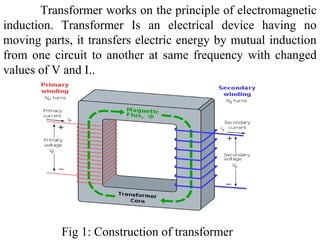
Transformer works on the principle of electromagnetic
induction. Transformer Is an electrical device having no
moving parts, it transfers electric energy by mutual induction
from one circuit to another at same frequency with changed
values of V and I..
Fig 1: Construction of transformer
WORKING PRINCIPLE OF TRANSFORMER
When primary winding is connected to an ac source an
exciting current flows through the winding. As the current is
alternating it will produce an alternating flux in the core which
will be linked by both the primary and secondary windings.
E1=V1
• Where ,E1 is induced emf in primary V1 is applied voltage
in primary Power transferred from the primary to the
secondary circuit by electromagnetic induction.
•Flux in the core will alternate at same frequency of the supply
voltage. Frequency of induced emf in secondary is the same as
that of the supply voltage. Magnitude of emf induced in
secondary winding will depend upon its number of turns.
In a transformer if the number of turns in
secondary winding is less than that in the primary
winding it is called step-down transformer.
In a transformer if the number of turns in
secondary winding is higher than that in the primary
winding it is called step-up transformer.
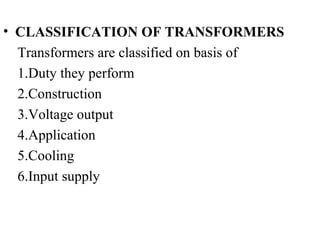
• CLASSIFICATION OF TRANSFORMERS
Transformers are classified on basis of
1.Duty they perform
2.Construction
3.Voltage output
4.Application
5.Cooling
6.Input supply
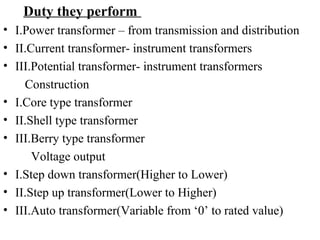
Duty they perform
• I.Power transformer – from transmission and distribution
• II.Current transformer- instrument transformers
• III.Potential transformer- instrument transformers
Construction
• I.Core type transformer
• II.Shell type transformer
• III.Berry type transformer
Voltage output
• I.Step down transformer(Higher to Lower)
• II.Step up transformer(Lower to Higher)
• III.Auto transformer(Variable from ‘0’ to rated value)
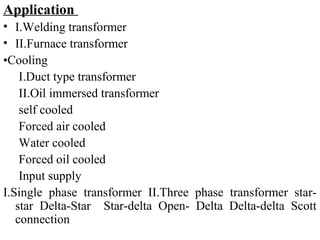
Application
• I.Welding transformer
• II.Furnace transformer
•Cooling
I.Duct type transformer
II.Oil immersed transformer
self cooled
Forced air cooled
Water cooled
Forced oil cooled
Input supply
I.Single phase transformer II.Three phase transformer star-
star Delta-Star Star-delta Open- Delta Delta-delta Scott
connection
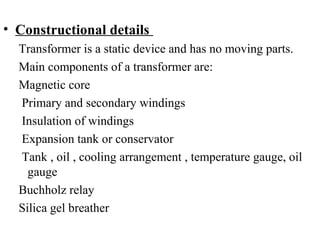
• Constructional details
Transformer is a static device and has no moving parts.
Main components of a transformer are:
Magnetic core
Primary and secondary windings
Insulation of windings
Expansion tank or conservator
Tank , oil , cooling arrangement , temperature gauge, oil
gauge
Buchholz relay
Silica gel breather
(1) MAGNETIC CORE
• Magnetic core consists of an iron core. The core is
laminated and made of silicon steel. Thickness varies from
0.35mm to 0.5mm. Laminations are insulated from each
other by coating then with a thin coat of varnish. Various
types of stampings and laminations employed in the
construction of transformers.
There are two types of transformer cores ,they are
• (a) Shell type (b)Core type
• Shell type – Two windings are carried by central limb. Core
is made up of E and I stampings and has three limbs. Has
two parallel paths for magnetic flux.
• Core type- Has two limbs for two windings and is made up
of two L-type stampings. Has only one magnetic path.
(2) Winding
There are two windings in a transformer. They are primary
and secondary windings. Made up of copper.
(3) Insulation
Paper is still used as basic conductor insulation. For
power transformers enamelled copper with paper insulation
is also used.
(4) Insulating oil
The coil used in transformer protects the paper from dirt
and moisture and removes the heat produced in the core and
coils, It also acts as insulating medium. Oil must possess
following properties: High dielectric strength
Free from inorganic acid ,alkali and corrosive sulphur.
Low viscosity to provide good heat transfer.
(5)EXPANSION TANK or Conservator
A small auxiliary oil tank mounted above the
transformer and connected to main tank by a pipe.
Its function is to keep transformer tank full of oil.
(6)TEMPERATURE GAUGE
Is to indicate hot oil or hottest spot temperature.
It is self contained weather proof unit made of alarm
contacts.
• (7) OIL GAUGE
Every transformer is fitted with an oil gauge to indicate
the oil level present inside the tank. It is provided with an
alarm contact which gives an alarm when the oil level drops
beyond permissible height due to oil leak or due to any
other reason.
• (8) BUCHHOLZ RELAY
First warning that fault is present is given by presence of
bubbles in oil. It gives an alarm in case of minor fault and to
disconnect transformer From the supply mains in case of
severe faults.
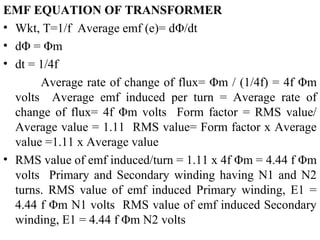
EMF EQUATION OF TRANSFORMER
• Wkt, T=1/f Average emf (e)= dΦ/dt
• dΦ = Φm
• dt = 1/4f
Average rate of change of flux= Φm / (1/4f) = 4f Φm
volts Average emf induced per turn = Average rate of
change of flux= 4f Φm volts Form factor = RMS value/
Average value = 1.11 RMS value= Form factor x Average
value =1.11 x Average value
• RMS value of emf induced/turn = 1.11 x 4f Φm = 4.44 f Φm
volts Primary and Secondary winding having N1 and N2
turns. RMS value of emf induced Primary winding, E1 =
4.44 f Φm N1 volts RMS value of emf induced Secondary
winding, E1 = 4.44 f Φm N2 volts
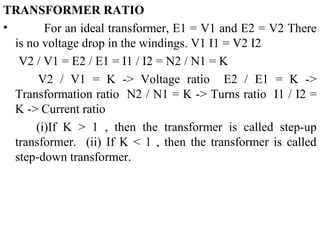
TRANSFORMER RATIO
• For an ideal transformer, E1 = V1 and E2 = V2 There
is no voltage drop in the windings. V1 I1 = V2 I2
V2 / V1 = E2 / E1 = I1 / I2 = N2 / N1 = K
V2 / V1 = K -> Voltage ratio E2 / E1 = K ->
Transformation ratio N2 / N1 = K -> Turns ratio I1 / I2 =
K -> Current ratio
(i)If K > 1 , then the transformer is called step-up
transformer. (ii) If K < 1 , then the transformer is called
step-down transformer.
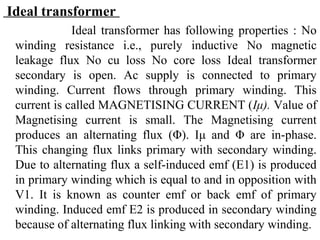
Ideal transformer
Ideal transformer has following properties : No
winding resistance i.e., purely inductive No magnetic
leakage flux No cu loss No core loss Ideal transformer
secondary is open. Ac supply is connected to primary
winding. Current flows through primary winding. This
current is called MAGNETISING CURRENT (Iμ). Value of
Magnetising current is small. The Magnetising current
produces an alternating flux (Φ). Iμ and Φ are in-phase.
This changing flux links primary with secondary winding.
Due to alternating flux a self-induced emf (E1) is produced
in primary winding which is equal to and in opposition with
V1. It is known as counter emf or back emf of primary
winding. Induced emf E2 is produced in secondary winding
because of alternating flux linking with secondary winding.
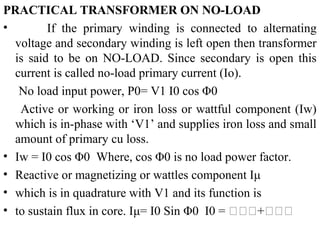
PRACTICAL TRANSFORMER ON NO-LOAD
• If the primary winding is connected to alternating
voltage and secondary winding is left open then transformer
is said to be on NO-LOAD. Since secondary is open this
current is called no-load primary current (Io).
No load input power, P0= V1 I0 cos Φ0
Active or working or iron loss or wattful component (Iw)
which is in-phase with ‘V1’ and supplies iron loss and small
amount of primary cu loss.
• Iw = I0 cos Φ0 Where, cos Φ0 is no load power factor.
• Reactive or magnetizing or wattles component Iμ
• which is in quadrature with V1 and its function is
• to sustain flux in core. Iμ= I0 Sin Φ0 I0 = 𝐈𝐈𝐈+𝐈𝐈𝐈
Transformer winding resistance
In practical transformer the winding have some
resistances. Primary winding has primary resistance(R2)
Transformer winding leakage reactance
Primary leakage flux(ΦL1) – All the flux generated by the
primary winding does notlink with secondary winding.
Some part of flux passes through air rather than around the
core. This flux is in -phase with I1
Secondary leakage flux(ΦL2) – Leakage flux is set up in
secondary winding. This flux induces eL2 in secondary
winding. This flux ΦL2 does not link with primary is also
in-phase with I2.
R0 =Resistance representing the core loss R1=Resistance
of the primary winding X1=Reactance of the primary
winding R2 =Resistance of the secondary winding
X2=Reactance of the secondary winding
E1 = E.M.F. induced in the primary winding E2=E.M.F.
induced in the secondary winding
• The equivalent circuit consists of two circuits, one
representing the primary winding and another is the
secondary winding. • The transfer of power from one circuit
to other takes place due to mutual induction.
• EQUIVALENT CIRCUIT OF TRANSFORMER
REFFERED TO PRIMARY
If all the secondary parameters are transferred to primary
side we get equivalent circuit of transformer referred to
primary.
TESTING IN TRANSFORMER
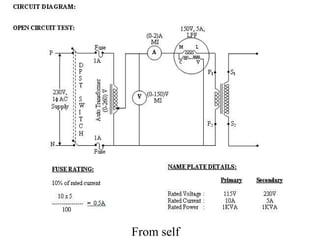
OPEN CIRCUIT / NO-LOAD TEST ON TRANSFORMER
PURPOSE OF THIS TEST IS TO DETERMINE
Core loss or Iron loss Or Magnetic loss (Pi)
No load current (I0)
Shunt branch parameters R0 and X0
One of the winding is kept open.
Rated voltage at rated frequency is applied to other(LV)
winding.
A voltmeter, wattmeter, and an ammeter are connected in LV
side of the transformer.
Ammeter > Reads No-Load Current, I0
Voltmeter > Reads Applied Voltage, V0
Wattmeter> Reads No-Load Input Power, W0 or P0
From self
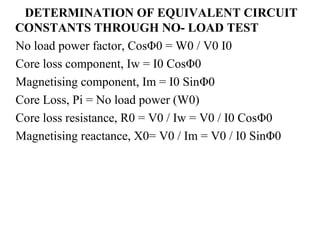
DETERMINATION OF EQUIVALENT CIRCUIT
CONSTANTS THROUGH NO- LOAD TEST
No load power factor, CosΦ0 = W0 / V0 I0
Core loss component, Iw = I0 CosΦ0
Magnetising component, Im = I0 SinΦ0
Core Loss, Pi = No load power (W0)
Core loss resistance, R0 = V0 / Iw = V0 / I0 CosΦ0
Magnetising reactance, X0= V0 / Im = V0 / I0 SinΦ0
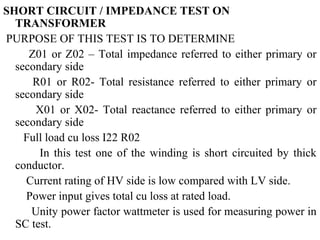
SHORT CIRCUIT / IMPEDANCE TEST ON
TRANSFORMER
PURPOSE OF THIS TEST IS TO DETERMINE
Z01 or Z02 – Total impedance referred to either primary or
secondary side
R01 or R02- Total resistance referred to either primary or
secondary side
X01 or X02- Total reactance referred to either primary or
secondary side
Full load cu loss I22 R02
In this test one of the winding is short circuited by thick
conductor.
Current rating of HV side is low compared with LV side.
Power input gives total cu loss at rated load.
Unity power factor wattmeter is used for measuring power in
SC test.
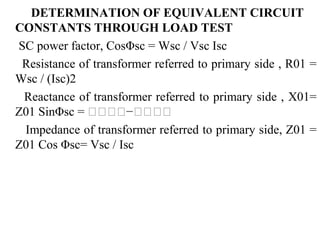
DETERMINATION OF EQUIVALENT CIRCUIT
CONSTANTS THROUGH LOAD TEST
SC power factor, CosΦsc = Wsc / Vsc Isc
Resistance of transformer referred to primary side , R01 =
Wsc / (Isc)2
Reactance of transformer referred to primary side , X01=
Z01 SinΦsc = 𝐈𝐈𝐈𝐈−𝐈𝐈𝐈𝐈
Impedance of transformer referred to primary side, Z01 =
Z01 Cos Φsc= Vsc / Isc
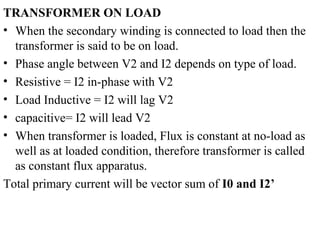
TRANSFORMER ON LOAD
• When the secondary winding is connected to load then the
transformer is said to be on load.
• Phase angle between V2 and I2 depends on type of load.
• Resistive = I2 in-phase with V2
• Load Inductive = I2 will lag V2
• capacitive= I2 will lead V2
• When transformer is loaded, Flux is constant at no-load as
well as at loaded condition, therefore transformer is called
as constant flux apparatus.
Total primary current will be vector sum of I0 and I2’
VOLTAGE REGULATION
• Regulation of transformer is defined as reduction in
magnitude of terminal voltage due to load wrt no-load
terminal voltage.
% Regulation = |V2 on no-load| - |V2 when loaded|
/ |V2 on no-load|
LAGGING POWER FACTOR
% Regulation = [I1 R01 cos Φ+ I1X01sin Φ ] X 100 /V1
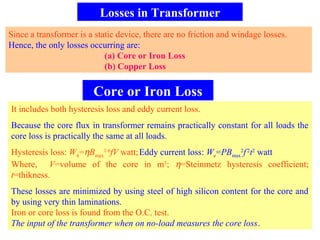
Losses in Transformer
Since a transformer is a static device, there are no friction and windage losses.
Hence, the only losses occurring are:
(a) Core or Iron Loss
(b) Copper Loss
Core or Iron Loss
It includes both hysteresis loss and eddy current loss.
Because the core flux in transformer remains practically constant for all loads the
core loss is practically the same at all loads.
Hysteresis loss: Wh=ηBmax
1.6
fV watt;Eddy current loss: We=PBmax
2
f2
t2
watt
Where, V=volume of the core in m3
; η=Steinmetz hysteresis coefficient;
t=thikness.
These losses are minimized by using steel of high silicon content for the core and
by using very thin laminations.
Iron or core loss is found from the O.C. test.
The input of the transformer when on no-load measures the core loss.
Copper Loss
This loss is due to the ohmic resistance of the transformer
windings.
Total Cu loss=I1
2
R1+I2
2
R2= I1
2
R01=I2
2
R02.
It is clear that Cu loss is proportional to (current)2
or kVA2
.
So, Cu loss at half-load is one-fourth [(1/2)2
=1/4] of that at full
load.
Cu loss at one-quarter-load is one-sixteen [(1/4)2
=1/16] of that at
full load.
Cu loss at five-fourths -load is twenty five by-sixteen
[(5/4)2
=25/16] of that at full load.
The value of copper loss is found from the short-circuit test.
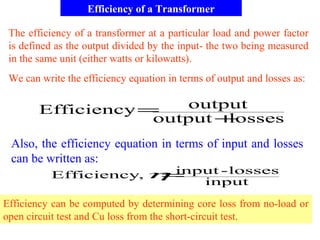
Efficiency of a Transformer
The efficiency of a transformer at a particular load and power factor
is defined as the output divided by the input- the two being measured
in the same unit (either watts or kilowatts).
lossesoutput
outputEfficiency
+
=
We can write the efficiency equation in terms of output and losses as:
input
losses-input,Efficiency =η
Efficiency can be computed by determining core loss from no-load or
open circuit test and Cu loss from the short-circuit test.
Also, the efficiency equation in terms of input and losses
can be written as:
•
Sumpner's test or back to back test on
transformer is another method for
determining transformer efficiency, voltage
regulation and heating under loaded
conditions. Short circuit and open circuit tests on
transformer can give us parameters of equivalent
circuit of transformer, but they can not help us in
finding the heating information. Unlike O.C. and
S.C. tests, actual loading is simulated in Sumpner's
test. Thus the Sumpner's test give more accurate
results of regulation and efficiency than O.C. and
S.C. tests.
Sumpner's test or back to back test can be
employed only when two identical transformers are
available. Both transformers are connected to supply
such that one transformer is loaded on another. Primaries
of the two identical transformers are connected in
parallel across a supply. Secondaries are connected in
series such that emf's of them are opposite to each other.
Another low voltage supply is connected in series with
secondaries to get the readings, as shown in the circuit
In above diagram, T1 and T2 are identical
transformers. Secondaries of them are connected in
voltage opposition, i.e. EEF and EGH. Both the emf's cancel
each other, as transformers are identical. In this case, as
per superposition theorem, no current flows through
secondary. And thus the no load test is simulated. The
current drawn from V1 is 2I0, Thus input power
measured by wattmeter W1 is equal to iron losses of
both transformers.
i.e. iron loss per transformer Pi = W1/2.
• Now, a small voltage V2 is injected into
secondary with the help of a low voltage
transformer. The voltage V2 is adjusted so that,
the rated current I2 flows through the
secondary. In this case, both primaries and
secondaries carry rated current. Thus short
circuit test is simulated and wattmeter
W2 shows total full load copper losses of both
transformers.
i.e. copper loss per transformer PCu = W2/2.
Autotransformer
From self b.l.theraja
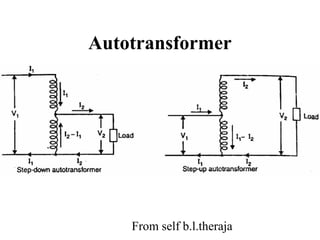
An autotransformer has a single winding on an
iron ccre and a part of winding is Common to both the
primary and secondary circuits. Fig. shows the
connections of a step-down autotransformer whereas
Fig. shows theconnections of a step-up
autotransformer. In either case, the winding having
N1 turns is the primary winding and winding be
having N2 turns is the secondary
winding. Note that the primary and secondary
windings are connected
electrically as well as magnetically. Therefore, power
from the primary is
transferred to the secondary conductively as well as
inductively (transformer action).
Theory of Autotransformer
• Fig. (7.38 (i)) shows an ideal step-down
autotransformer on load. Here winding
• 1-3 having N1 turns is the primary winding while
winding 2-3 having N2 turns is
• the secondary winding. The input current is I1
while the output or load current is
• I2. Note that portion 1-2 of the winding has N1 -
N2 turns and voltage across this
• portion of the winding is V1 - V2. The current
through the common portion of
• the winding is I2 - I1.
Advantages and Disadvantages of autotransformers
Advantages
• (i) An autotransformer requires less Cu than a two-
winding transformer of similar rating.
• (ii) An autotransformer operates at a higher efficiency
than a two-winding Transformer of similar rating.
• (iii) An autotransformer has better voltage regulation
than a two-winding transformer of the same rating.
• (iv) An autotransformer has smaller size than a two-
winding transformer of the same rating.
• (v) An autotransformer requires smaller exciting current
than a two-winding transformer of the same rating.
• It may be noted that these advantages of the
autotransformer decrease as the ratio of transformation
increases. Therefore, an autotransformer has marked
Connectors and switches
• An electrical connector is an electro-
mechanical device for joining electrical circuits as
an interface using a mechanical assembly.
Connectors consist of plugs (male-ended) and jacks
(female-ended). The connection may be temporary,
as for portable equipment, require a tool for assembly
and removal, or serve as a permanent electrical joint
between two wires or devices. An adapter can be
used to effectively bring together dissimilar
connectors.
Factors affecting electrical wiring
1.Durability:-Type of wiring selected for particular
application must be sufficiently durable .It should fulfill
the requirement of the consumer. It should be according to
proper specification.
2.Safety:-As there is danger of loosing life in case of electric
shocks, safety must be observed strictly.
3.Accessibility:-There should be certain prevision for future
expansion.
4.Cost:-There must be proper balance between convenience
and look of the wiring from installation cost point of view.
Cont..
5.Maintainance:-The maintainance cost of
wiring should be as low as possible.There
should be scope for further extension of
wiring . Renewal of wiring should be easily
possible.
Types of Wiring
1)Cleat wiring
2)CTS wiring or "FRS wiring or batten wiring
3)Metal sheathed wiring or lead sheathed wiring
4)Casing and capping
5)Conduit wiring
1)Cleat Wiring:
• Introduction
• The types of wiring to be adopted is dependent on
various factors, viz, durability, safety, appearance,
cost, consumer's budget etc.
• Cleat Wiring
• This System uses insulated Cables sub protected in
porcelain cleats.
Cont..
• Cleat wiring is recommended only for temporary
installations. The cleats are made in pairs having
bottom and top halves. The bottom half is
grooved to receive the wire and the top half is
for cable grip. Initially the bottom and top cleats
are fixed on the wall loosely according to the
layout. Then the cable is drawn, tensioned and
the cleats are tightened by the screw. Cleats are
of three types, having one, two or three grooves,
so as to receive one, two or three wires. Two
types of cleats.
Cont….
• Cleat wiring is one of the cheapest wiring
considering the initial cost and labor, and is
most suitable for temporary n :ring. This
wiring can be quickly installed, easily
inspected and altered. When not required,
this wiring could be dismantled without
damage to the cables, cleats and
accessories.
• Advantages:
I) Easy installation.
Materials can be retrieved for reuse.
Flexibility provided for inspection, modifications and
expansion.
Relatively economical.
Skilled manpower not required.
Disadvantages:
Appearance is not good.
Open system of wiring requiring regular cleaning.
Higher risk of mechanical injury.
•
Cont…
• Metal Sheathed or Lead Sheathed wiring: The wiring
is similar to that of CTS but the conductors (two or
three) are individually insulated and covered with a
common outer lead-aluminum alloy sheath. The
sheath protects the cable against dampness.
atmospheric extremities and mechanical damages.
The sheath is earthed at every junction to provide a
path to ground for the leakage current. They are fixed
by means of metal clips on wooden battens. The
wiring system is very expensive. It is suitable for low
voltage installations.
• Lead-sheathed electrical wiring in Pilot
quarters
• Precautions to be taken during installation: The
clips used to fix the cables on battens should
not react with the sheath.
• Lead sheath should be properly earthed to
prevent shocks due to leakage currents.
• Cables should not be run in damp places and in
areas where chemicals (may react with the
lead) are used.
• Advantages: Easy installation and is
aesthetic in appearance.
• Highly durable.
• Suitable in adverse climatic conditions
provided the joints arc not exposed.
• Disadvantages:
• Requires skilled labor-
• 'Very expensive.
• Unsuitable for- eilcolicfli industries.
• Casing and Capping:
• It consists of insulated conductors laid inside rectangular,
teakwood or PVC boxes having grooves inside it. A
rectangular strip of wood called capping having same
width as that of casing is fixed over it. Both the casing and
the capping are screwed together at every 15 crns- Casing
is attached to the wall. Two or more wires of same polarity
are drawn through different grooves- The system is
suitable for indoor and domestic installations.
• Cheaper than lead sheathed and conduit wiring.
• Provides good isolation as the conductors are placed apart
reducing the risk of short circuit.
• Easily accessible for inspection and repairs.
• Since the wires are not exposed to atmosphere, insulation
is less affected by dust, dirt and climatic variations.
Domestic wiring system
• Accessories required for domestic wiring:-
a)Wire and cable
b)Flexible cords
c)Switch:-They are classified in two types:-
I)Tumbler switch
II) Flush switches
 According to operation required they are classified as
 One way switch
 Two way switch
 Centre off switch
 Double pole switch
 push button switch
 Table lamp switch
REFRENCES-IMAGES
• http://www.globalspec.com/ImageRepository/LearnMore/201
REFERENCE- BOOK
• B.L.Theraja, “Electrical Technology Vol.1”, S.Chand Publication.
• D.P.Kothari, “Basic Electrical Engineering”, Tata McGraw-Hill
publication.
• U.A.Patel “Circuits and Networks”.
WEB REFRENCE
WWW.SCRIBD.COM
WWW.AUTHORSTREAM.COM

B tech ee ii_ eee_ u-4_ transformer & electrical wiring_dipen patel

  • 1.
    Unit 4 TRANSFORMER &ELECTRIC WIRING Course : B.Tech Branch : EE Semester : II Subject : Elements of Electrical Engineering
  • 2.
    Transformer works onthe principle of electromagnetic induction. Transformer Is an electrical device having no moving parts, it transfers electric energy by mutual induction from one circuit to another at same frequency with changed values of V and I.. Fig 1: Construction of transformer
  • 3.
    WORKING PRINCIPLE OFTRANSFORMER When primary winding is connected to an ac source an exciting current flows through the winding. As the current is alternating it will produce an alternating flux in the core which will be linked by both the primary and secondary windings. E1=V1 • Where ,E1 is induced emf in primary V1 is applied voltage in primary Power transferred from the primary to the secondary circuit by electromagnetic induction. •Flux in the core will alternate at same frequency of the supply voltage. Frequency of induced emf in secondary is the same as that of the supply voltage. Magnitude of emf induced in secondary winding will depend upon its number of turns.
  • 4.
    In a transformerif the number of turns in secondary winding is less than that in the primary winding it is called step-down transformer. In a transformer if the number of turns in secondary winding is higher than that in the primary winding it is called step-up transformer.
  • 5.
    • CLASSIFICATION OFTRANSFORMERS Transformers are classified on basis of 1.Duty they perform 2.Construction 3.Voltage output 4.Application 5.Cooling 6.Input supply
  • 6.
    Duty they perform •I.Power transformer – from transmission and distribution • II.Current transformer- instrument transformers • III.Potential transformer- instrument transformers Construction • I.Core type transformer • II.Shell type transformer • III.Berry type transformer Voltage output • I.Step down transformer(Higher to Lower) • II.Step up transformer(Lower to Higher) • III.Auto transformer(Variable from ‘0’ to rated value)
  • 7.
    Application • I.Welding transformer •II.Furnace transformer •Cooling I.Duct type transformer II.Oil immersed transformer self cooled Forced air cooled Water cooled Forced oil cooled Input supply I.Single phase transformer II.Three phase transformer star- star Delta-Star Star-delta Open- Delta Delta-delta Scott connection
  • 8.
    • Constructional details Transformeris a static device and has no moving parts. Main components of a transformer are: Magnetic core Primary and secondary windings Insulation of windings Expansion tank or conservator Tank , oil , cooling arrangement , temperature gauge, oil gauge Buchholz relay Silica gel breather
  • 9.
    (1) MAGNETIC CORE •Magnetic core consists of an iron core. The core is laminated and made of silicon steel. Thickness varies from 0.35mm to 0.5mm. Laminations are insulated from each other by coating then with a thin coat of varnish. Various types of stampings and laminations employed in the construction of transformers. There are two types of transformer cores ,they are • (a) Shell type (b)Core type • Shell type – Two windings are carried by central limb. Core is made up of E and I stampings and has three limbs. Has two parallel paths for magnetic flux. • Core type- Has two limbs for two windings and is made up of two L-type stampings. Has only one magnetic path.
  • 10.
    (2) Winding There aretwo windings in a transformer. They are primary and secondary windings. Made up of copper. (3) Insulation Paper is still used as basic conductor insulation. For power transformers enamelled copper with paper insulation is also used. (4) Insulating oil The coil used in transformer protects the paper from dirt and moisture and removes the heat produced in the core and coils, It also acts as insulating medium. Oil must possess following properties: High dielectric strength Free from inorganic acid ,alkali and corrosive sulphur. Low viscosity to provide good heat transfer.
  • 11.
    (5)EXPANSION TANK orConservator A small auxiliary oil tank mounted above the transformer and connected to main tank by a pipe. Its function is to keep transformer tank full of oil. (6)TEMPERATURE GAUGE Is to indicate hot oil or hottest spot temperature. It is self contained weather proof unit made of alarm contacts.
  • 12.
    • (7) OILGAUGE Every transformer is fitted with an oil gauge to indicate the oil level present inside the tank. It is provided with an alarm contact which gives an alarm when the oil level drops beyond permissible height due to oil leak or due to any other reason. • (8) BUCHHOLZ RELAY First warning that fault is present is given by presence of bubbles in oil. It gives an alarm in case of minor fault and to disconnect transformer From the supply mains in case of severe faults.
  • 13.
    EMF EQUATION OFTRANSFORMER • Wkt, T=1/f Average emf (e)= dΦ/dt • dΦ = Φm • dt = 1/4f Average rate of change of flux= Φm / (1/4f) = 4f Φm volts Average emf induced per turn = Average rate of change of flux= 4f Φm volts Form factor = RMS value/ Average value = 1.11 RMS value= Form factor x Average value =1.11 x Average value • RMS value of emf induced/turn = 1.11 x 4f Φm = 4.44 f Φm volts Primary and Secondary winding having N1 and N2 turns. RMS value of emf induced Primary winding, E1 = 4.44 f Φm N1 volts RMS value of emf induced Secondary winding, E1 = 4.44 f Φm N2 volts
  • 14.
    TRANSFORMER RATIO • Foran ideal transformer, E1 = V1 and E2 = V2 There is no voltage drop in the windings. V1 I1 = V2 I2 V2 / V1 = E2 / E1 = I1 / I2 = N2 / N1 = K V2 / V1 = K -> Voltage ratio E2 / E1 = K -> Transformation ratio N2 / N1 = K -> Turns ratio I1 / I2 = K -> Current ratio (i)If K > 1 , then the transformer is called step-up transformer. (ii) If K < 1 , then the transformer is called step-down transformer.
  • 15.
    Ideal transformer Ideal transformerhas following properties : No winding resistance i.e., purely inductive No magnetic leakage flux No cu loss No core loss Ideal transformer secondary is open. Ac supply is connected to primary winding. Current flows through primary winding. This current is called MAGNETISING CURRENT (Iμ). Value of Magnetising current is small. The Magnetising current produces an alternating flux (Φ). Iμ and Φ are in-phase. This changing flux links primary with secondary winding. Due to alternating flux a self-induced emf (E1) is produced in primary winding which is equal to and in opposition with V1. It is known as counter emf or back emf of primary winding. Induced emf E2 is produced in secondary winding because of alternating flux linking with secondary winding.
  • 16.
    PRACTICAL TRANSFORMER ONNO-LOAD • If the primary winding is connected to alternating voltage and secondary winding is left open then transformer is said to be on NO-LOAD. Since secondary is open this current is called no-load primary current (Io). No load input power, P0= V1 I0 cos Φ0 Active or working or iron loss or wattful component (Iw) which is in-phase with ‘V1’ and supplies iron loss and small amount of primary cu loss. • Iw = I0 cos Φ0 Where, cos Φ0 is no load power factor. • Reactive or magnetizing or wattles component Iμ • which is in quadrature with V1 and its function is • to sustain flux in core. Iμ= I0 Sin Φ0 I0 = 𝐈𝐈𝐈+𝐈𝐈𝐈
  • 17.
    Transformer winding resistance Inpractical transformer the winding have some resistances. Primary winding has primary resistance(R2) Transformer winding leakage reactance Primary leakage flux(ΦL1) – All the flux generated by the primary winding does notlink with secondary winding. Some part of flux passes through air rather than around the core. This flux is in -phase with I1 Secondary leakage flux(ΦL2) – Leakage flux is set up in secondary winding. This flux induces eL2 in secondary winding. This flux ΦL2 does not link with primary is also in-phase with I2.
  • 18.
    R0 =Resistance representingthe core loss R1=Resistance of the primary winding X1=Reactance of the primary winding R2 =Resistance of the secondary winding X2=Reactance of the secondary winding E1 = E.M.F. induced in the primary winding E2=E.M.F. induced in the secondary winding • The equivalent circuit consists of two circuits, one representing the primary winding and another is the secondary winding. • The transfer of power from one circuit to other takes place due to mutual induction. • EQUIVALENT CIRCUIT OF TRANSFORMER REFFERED TO PRIMARY If all the secondary parameters are transferred to primary side we get equivalent circuit of transformer referred to primary.
  • 19.
    TESTING IN TRANSFORMER OPENCIRCUIT / NO-LOAD TEST ON TRANSFORMER PURPOSE OF THIS TEST IS TO DETERMINE Core loss or Iron loss Or Magnetic loss (Pi) No load current (I0) Shunt branch parameters R0 and X0 One of the winding is kept open. Rated voltage at rated frequency is applied to other(LV) winding. A voltmeter, wattmeter, and an ammeter are connected in LV side of the transformer. Ammeter > Reads No-Load Current, I0 Voltmeter > Reads Applied Voltage, V0 Wattmeter> Reads No-Load Input Power, W0 or P0
  • 20.
  • 21.
    DETERMINATION OF EQUIVALENTCIRCUIT CONSTANTS THROUGH NO- LOAD TEST No load power factor, CosΦ0 = W0 / V0 I0 Core loss component, Iw = I0 CosΦ0 Magnetising component, Im = I0 SinΦ0 Core Loss, Pi = No load power (W0) Core loss resistance, R0 = V0 / Iw = V0 / I0 CosΦ0 Magnetising reactance, X0= V0 / Im = V0 / I0 SinΦ0
  • 22.
    SHORT CIRCUIT /IMPEDANCE TEST ON TRANSFORMER PURPOSE OF THIS TEST IS TO DETERMINE Z01 or Z02 – Total impedance referred to either primary or secondary side R01 or R02- Total resistance referred to either primary or secondary side X01 or X02- Total reactance referred to either primary or secondary side Full load cu loss I22 R02 In this test one of the winding is short circuited by thick conductor. Current rating of HV side is low compared with LV side. Power input gives total cu loss at rated load. Unity power factor wattmeter is used for measuring power in SC test.
  • 23.
    DETERMINATION OF EQUIVALENTCIRCUIT CONSTANTS THROUGH LOAD TEST SC power factor, CosΦsc = Wsc / Vsc Isc Resistance of transformer referred to primary side , R01 = Wsc / (Isc)2 Reactance of transformer referred to primary side , X01= Z01 SinΦsc = 𝐈𝐈𝐈𝐈−𝐈𝐈𝐈𝐈 Impedance of transformer referred to primary side, Z01 = Z01 Cos Φsc= Vsc / Isc
  • 24.
    TRANSFORMER ON LOAD •When the secondary winding is connected to load then the transformer is said to be on load. • Phase angle between V2 and I2 depends on type of load. • Resistive = I2 in-phase with V2 • Load Inductive = I2 will lag V2 • capacitive= I2 will lead V2 • When transformer is loaded, Flux is constant at no-load as well as at loaded condition, therefore transformer is called as constant flux apparatus. Total primary current will be vector sum of I0 and I2’
  • 25.
    VOLTAGE REGULATION • Regulationof transformer is defined as reduction in magnitude of terminal voltage due to load wrt no-load terminal voltage. % Regulation = |V2 on no-load| - |V2 when loaded| / |V2 on no-load| LAGGING POWER FACTOR % Regulation = [I1 R01 cos Φ+ I1X01sin Φ ] X 100 /V1
  • 26.
    Losses in Transformer Sincea transformer is a static device, there are no friction and windage losses. Hence, the only losses occurring are: (a) Core or Iron Loss (b) Copper Loss Core or Iron Loss It includes both hysteresis loss and eddy current loss. Because the core flux in transformer remains practically constant for all loads the core loss is practically the same at all loads. Hysteresis loss: Wh=ηBmax 1.6 fV watt;Eddy current loss: We=PBmax 2 f2 t2 watt Where, V=volume of the core in m3 ; η=Steinmetz hysteresis coefficient; t=thikness. These losses are minimized by using steel of high silicon content for the core and by using very thin laminations. Iron or core loss is found from the O.C. test. The input of the transformer when on no-load measures the core loss.
  • 27.
    Copper Loss This lossis due to the ohmic resistance of the transformer windings. Total Cu loss=I1 2 R1+I2 2 R2= I1 2 R01=I2 2 R02. It is clear that Cu loss is proportional to (current)2 or kVA2 . So, Cu loss at half-load is one-fourth [(1/2)2 =1/4] of that at full load. Cu loss at one-quarter-load is one-sixteen [(1/4)2 =1/16] of that at full load. Cu loss at five-fourths -load is twenty five by-sixteen [(5/4)2 =25/16] of that at full load. The value of copper loss is found from the short-circuit test.
  • 28.
    Efficiency of aTransformer The efficiency of a transformer at a particular load and power factor is defined as the output divided by the input- the two being measured in the same unit (either watts or kilowatts). lossesoutput outputEfficiency + = We can write the efficiency equation in terms of output and losses as: input losses-input,Efficiency =η Efficiency can be computed by determining core loss from no-load or open circuit test and Cu loss from the short-circuit test. Also, the efficiency equation in terms of input and losses can be written as:
  • 29.
    • Sumpner's test orback to back test on transformer is another method for determining transformer efficiency, voltage regulation and heating under loaded conditions. Short circuit and open circuit tests on transformer can give us parameters of equivalent circuit of transformer, but they can not help us in finding the heating information. Unlike O.C. and S.C. tests, actual loading is simulated in Sumpner's test. Thus the Sumpner's test give more accurate results of regulation and efficiency than O.C. and S.C. tests.
  • 30.
    Sumpner's test orback to back test can be employed only when two identical transformers are available. Both transformers are connected to supply such that one transformer is loaded on another. Primaries of the two identical transformers are connected in parallel across a supply. Secondaries are connected in series such that emf's of them are opposite to each other. Another low voltage supply is connected in series with secondaries to get the readings, as shown in the circuit
  • 31.
    In above diagram,T1 and T2 are identical transformers. Secondaries of them are connected in voltage opposition, i.e. EEF and EGH. Both the emf's cancel each other, as transformers are identical. In this case, as per superposition theorem, no current flows through secondary. And thus the no load test is simulated. The current drawn from V1 is 2I0, Thus input power measured by wattmeter W1 is equal to iron losses of both transformers. i.e. iron loss per transformer Pi = W1/2.
  • 32.
    • Now, asmall voltage V2 is injected into secondary with the help of a low voltage transformer. The voltage V2 is adjusted so that, the rated current I2 flows through the secondary. In this case, both primaries and secondaries carry rated current. Thus short circuit test is simulated and wattmeter W2 shows total full load copper losses of both transformers. i.e. copper loss per transformer PCu = W2/2.
  • 33.
  • 34.
    An autotransformer hasa single winding on an iron ccre and a part of winding is Common to both the primary and secondary circuits. Fig. shows the connections of a step-down autotransformer whereas Fig. shows theconnections of a step-up autotransformer. In either case, the winding having N1 turns is the primary winding and winding be having N2 turns is the secondary winding. Note that the primary and secondary windings are connected electrically as well as magnetically. Therefore, power from the primary is transferred to the secondary conductively as well as inductively (transformer action).
  • 35.
    Theory of Autotransformer •Fig. (7.38 (i)) shows an ideal step-down autotransformer on load. Here winding • 1-3 having N1 turns is the primary winding while winding 2-3 having N2 turns is • the secondary winding. The input current is I1 while the output or load current is • I2. Note that portion 1-2 of the winding has N1 - N2 turns and voltage across this • portion of the winding is V1 - V2. The current through the common portion of • the winding is I2 - I1.
  • 36.
    Advantages and Disadvantagesof autotransformers Advantages • (i) An autotransformer requires less Cu than a two- winding transformer of similar rating. • (ii) An autotransformer operates at a higher efficiency than a two-winding Transformer of similar rating. • (iii) An autotransformer has better voltage regulation than a two-winding transformer of the same rating. • (iv) An autotransformer has smaller size than a two- winding transformer of the same rating. • (v) An autotransformer requires smaller exciting current than a two-winding transformer of the same rating. • It may be noted that these advantages of the autotransformer decrease as the ratio of transformation increases. Therefore, an autotransformer has marked
  • 37.
    Connectors and switches •An electrical connector is an electro- mechanical device for joining electrical circuits as an interface using a mechanical assembly. Connectors consist of plugs (male-ended) and jacks (female-ended). The connection may be temporary, as for portable equipment, require a tool for assembly and removal, or serve as a permanent electrical joint between two wires or devices. An adapter can be used to effectively bring together dissimilar connectors.
  • 38.
    Factors affecting electricalwiring 1.Durability:-Type of wiring selected for particular application must be sufficiently durable .It should fulfill the requirement of the consumer. It should be according to proper specification. 2.Safety:-As there is danger of loosing life in case of electric shocks, safety must be observed strictly. 3.Accessibility:-There should be certain prevision for future expansion. 4.Cost:-There must be proper balance between convenience and look of the wiring from installation cost point of view.
  • 39.
    Cont.. 5.Maintainance:-The maintainance costof wiring should be as low as possible.There should be scope for further extension of wiring . Renewal of wiring should be easily possible.
  • 40.
    Types of Wiring 1)Cleatwiring 2)CTS wiring or "FRS wiring or batten wiring 3)Metal sheathed wiring or lead sheathed wiring 4)Casing and capping 5)Conduit wiring 1)Cleat Wiring: • Introduction • The types of wiring to be adopted is dependent on various factors, viz, durability, safety, appearance, cost, consumer's budget etc. • Cleat Wiring • This System uses insulated Cables sub protected in porcelain cleats.
  • 41.
    Cont.. • Cleat wiringis recommended only for temporary installations. The cleats are made in pairs having bottom and top halves. The bottom half is grooved to receive the wire and the top half is for cable grip. Initially the bottom and top cleats are fixed on the wall loosely according to the layout. Then the cable is drawn, tensioned and the cleats are tightened by the screw. Cleats are of three types, having one, two or three grooves, so as to receive one, two or three wires. Two types of cleats.
  • 42.
    Cont…. • Cleat wiringis one of the cheapest wiring considering the initial cost and labor, and is most suitable for temporary n :ring. This wiring can be quickly installed, easily inspected and altered. When not required, this wiring could be dismantled without damage to the cables, cleats and accessories.
  • 43.
    • Advantages: I) Easyinstallation. Materials can be retrieved for reuse. Flexibility provided for inspection, modifications and expansion. Relatively economical. Skilled manpower not required. Disadvantages: Appearance is not good. Open system of wiring requiring regular cleaning. Higher risk of mechanical injury. •
  • 44.
    Cont… • Metal Sheathedor Lead Sheathed wiring: The wiring is similar to that of CTS but the conductors (two or three) are individually insulated and covered with a common outer lead-aluminum alloy sheath. The sheath protects the cable against dampness. atmospheric extremities and mechanical damages. The sheath is earthed at every junction to provide a path to ground for the leakage current. They are fixed by means of metal clips on wooden battens. The wiring system is very expensive. It is suitable for low voltage installations.
  • 45.
    • Lead-sheathed electricalwiring in Pilot quarters • Precautions to be taken during installation: The clips used to fix the cables on battens should not react with the sheath. • Lead sheath should be properly earthed to prevent shocks due to leakage currents. • Cables should not be run in damp places and in areas where chemicals (may react with the lead) are used.
  • 46.
    • Advantages: Easyinstallation and is aesthetic in appearance. • Highly durable. • Suitable in adverse climatic conditions provided the joints arc not exposed. • Disadvantages: • Requires skilled labor- • 'Very expensive. • Unsuitable for- eilcolicfli industries.
  • 47.
    • Casing andCapping: • It consists of insulated conductors laid inside rectangular, teakwood or PVC boxes having grooves inside it. A rectangular strip of wood called capping having same width as that of casing is fixed over it. Both the casing and the capping are screwed together at every 15 crns- Casing is attached to the wall. Two or more wires of same polarity are drawn through different grooves- The system is suitable for indoor and domestic installations. • Cheaper than lead sheathed and conduit wiring. • Provides good isolation as the conductors are placed apart reducing the risk of short circuit. • Easily accessible for inspection and repairs. • Since the wires are not exposed to atmosphere, insulation is less affected by dust, dirt and climatic variations.
  • 48.
    Domestic wiring system •Accessories required for domestic wiring:- a)Wire and cable b)Flexible cords c)Switch:-They are classified in two types:- I)Tumbler switch II) Flush switches  According to operation required they are classified as  One way switch  Two way switch  Centre off switch  Double pole switch  push button switch  Table lamp switch
  • 49.
  • 50.
    REFERENCE- BOOK • B.L.Theraja,“Electrical Technology Vol.1”, S.Chand Publication. • D.P.Kothari, “Basic Electrical Engineering”, Tata McGraw-Hill publication. • U.A.Patel “Circuits and Networks”. WEB REFRENCE WWW.SCRIBD.COM WWW.AUTHORSTREAM.COM