Made by
Jemish
1-JEMISH (Mefgi ,Rajkot)
 1. life of installation
 2. future extension or alterations
 3. construction of building
 4. fire hazards or other special conditions
 5. corrosive fumes
 6. dampness
 7. type of wire and material used
 8. nature of load (lighting of power)
 9. safety of the system
 10. cost of wiring system
2-JEMISH (Mefgi ,Rajkot)
 1. single-phase two-wire system
 2. three-phase three-wire system
 3. three-phase four-wire system
3-JEMISH (Mefgi ,Rajkot)
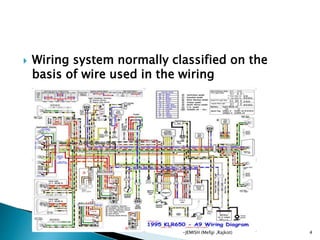
 Wiring system normally classified on the
basis of wire used in the wiring
4-JEMISH (Mefgi ,Rajkot)
 Commonly used types of wiring systems for
residential buildings ,commercial buildings
etc.
 1. Cleat wiring
 2. Wooden casing and capping wiring
 3. C. T. S or T. R. S. wiring
 4.Metal Sheathed or Lead Sheathed wiring
 5. Conduit wiring
5-JEMISH (Mefgi ,Rajkot)
6-JEMISH (Mefgi ,Rajkot)
 Cleat wiring is normally used for temporary
wiring purpose.
 Ex..functions, marriages…etc.
 In this type of wiring vulcanized india
rubber(V.I.R) or polyvinyl chloride(PVC)
insulated wires are used as conductors.
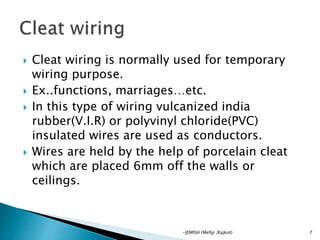
 Wires are held by the help of porcelain cleat
which are placed 6mm off the walls or
ceilings.
7-JEMISH (Mefgi ,Rajkot)
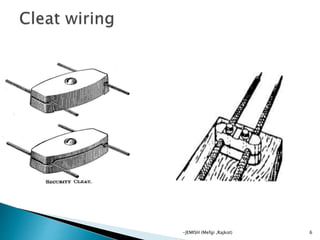
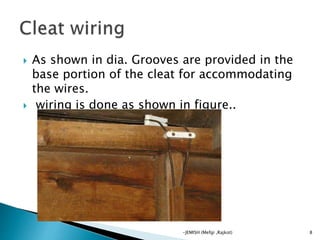
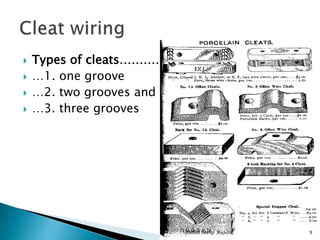
 As shown in dia. Grooves are provided in the
base portion of the cleat for accommodating
the wires.
 wiring is done as shown in figure..
8-JEMISH (Mefgi ,Rajkot)
 Types of cleats…………
 …1. one groove
 …2. two grooves and
 …3. three grooves
9-JEMISH (Mefgi ,Rajkot)
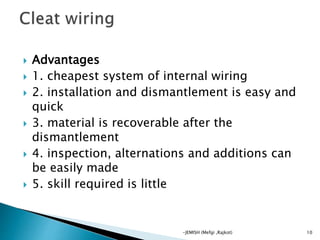
 Advantages
 1. cheapest system of internal wiring
 2. installation and dismantlement is easy and
quick
 3. material is recoverable after the
dismantlement
 4. inspection, alternations and additions can
be easily made
 5. skill required is little
10-JEMISH (Mefgi ,Rajkot)
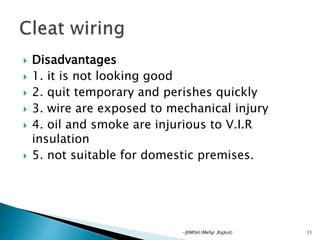
 Disadvantages
 1. it is not looking good
 2. quit temporary and perishes quickly
 3. wire are exposed to mechanical injury
 4. oil and smoke are injurious to V.I.R
insulation
 5. not suitable for domestic premises.
11-JEMISH (Mefgi ,Rajkot)
 Field of application
 1. the wiring of this type is suitable for
temporary installations in dry places.
 2. this is also accepted where appearance is
not so important and cheapness is the main
consideration
12-JEMISH (Mefgi ,Rajkot)
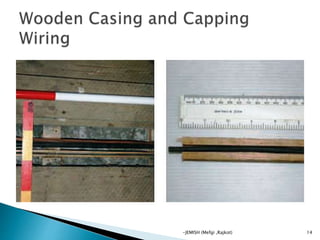
 This is one of the cheapest type of wiring and
is commonly used for house wiring.
 The cable used in this type of wiring is either
V.I.R or P.V.C or any approved insulated
cables.
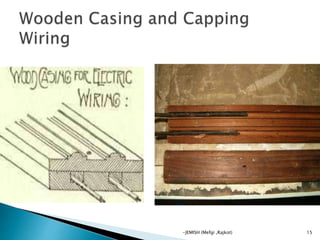
 Casing consist of V-shaped grooves and is
covered by rectangular strip of teak wood
known as capping.
 This type of wiring adopted up to 250 V in
dry places and in places where no risk of fire.
13-JEMISH (Mefgi ,Rajkot)
14-JEMISH (Mefgi ,Rajkot)
15-JEMISH (Mefgi ,Rajkot)
 Advantages
 1. better appearance than cleat wiring
 2. cheap in cost
 3. easy to install and rewire
 4. easy to inspect by opening the capping
16-JEMISH (Mefgi ,Rajkot)
 Disadvantages
 1. not suitable in damp places
 2. risk of fire
 3. this type of wiring can only be used on
surface and can not be concealed in plaster.
 4.Since it requires better workmanship ,
labour cost is more
17-JEMISH (Mefgi ,Rajkot)
 Field of application
 This type of wiring is suitable for low voltage
domestic installations in dry places and
where there is no risk of fire hazards
18-JEMISH (Mefgi ,Rajkot)
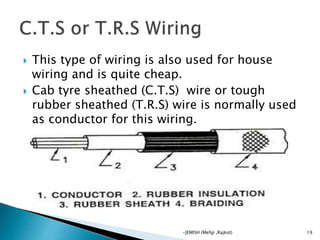
 This type of wiring is also used for house
wiring and is quite cheap.
 Cab tyre sheathed (C.T.S) wire or tough
rubber sheathed (T.R.S) wire is normally used
as conductor for this wiring.
19-JEMISH (Mefgi ,Rajkot)
 The wires are run on the teak wooden battens
which are fixed on the wall or the ceiling by
means of screws and wooden plugs.
 C.T.S OR T.R.S cables used are not much
affected by chemicals , water, and steam.
20-JEMISH (Mefgi ,Rajkot)
 Advantages
 1. it is easy to install and repair
 2. it gives better appearance
 3. its life is long
 4. it is fire proof up to a certain limit
 5. it is cheaper than other types of wiring
except cleat wiring
 6. conductors have strong insulations
 7. chemicals do not affect the conductor
insulation
21-JEMISH (Mefgi ,Rajkot)
 Disadvantages
 1. the conductors are open and liable to
mechanical injury thus this type of wiring
cannot be used in workshops etc.
 2. its use in places open to sun and rain is
restricted
 3. good workmanship is suitable where acids
and alkalis to be prescut.
22-JEMISH (Mefgi ,Rajkot)
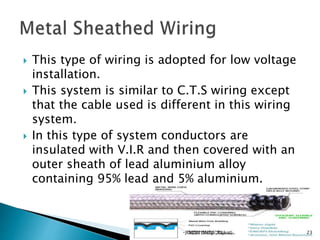
 This type of wiring is adopted for low voltage
installation.
 This system is similar to C.T.S wiring except
that the cable used is different in this wiring
system.
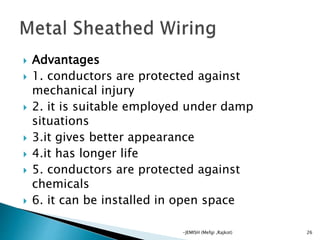
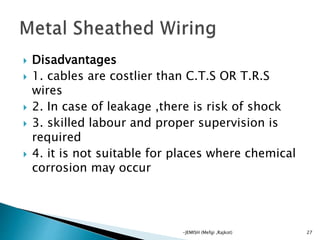
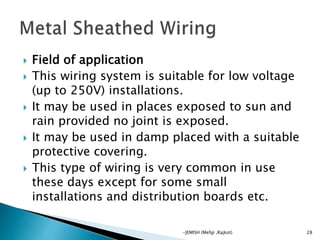
 In this type of system conductors are
insulated with V.I.R and then covered with an
outer sheath of lead aluminium alloy
containing 95% lead and 5% aluminium.
23-JEMISH (Mefgi ,Rajkot)
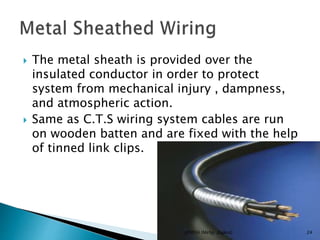
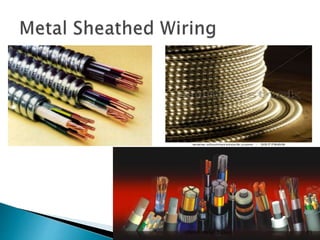
 The metal sheath is provided over the
insulated conductor in order to protect
system from mechanical injury , dampness,
and atmospheric action.
 Same as C.T.S wiring system cables are run
on wooden batten and are fixed with the help
of tinned link clips.
24-JEMISH (Mefgi ,Rajkot)
25-JEMISH (Mefgi ,Rajkot)
 Advantages
 1. conductors are protected against
mechanical injury
 2. it is suitable employed under damp
situations
 3.it gives better appearance
 4.it has longer life
 5. conductors are protected against
chemicals
 6. it can be installed in open space
26-JEMISH (Mefgi ,Rajkot)
 Disadvantages
 1. cables are costlier than C.T.S OR T.R.S
wires
 2. In case of leakage ,there is risk of shock
 3. skilled labour and proper supervision is
required
 4. it is not suitable for places where chemical
corrosion may occur
27-JEMISH (Mefgi ,Rajkot)
 Field of application
 This wiring system is suitable for low voltage
(up to 250V) installations.
 It may be used in places exposed to sun and
rain provided no joint is exposed.
 It may be used in damp placed with a suitable
protective covering.
 This type of wiring is very common in use
these days except for some small
installations and distribution boards etc.
28-JEMISH (Mefgi ,Rajkot)
29-JEMISH (Mefgi ,Rajkot)
 Conduit wiring system is best for domestic
and commercial installations.
 It provide proper protection to the
installation against fire hazards, shock,
mechanical damage and dampness.
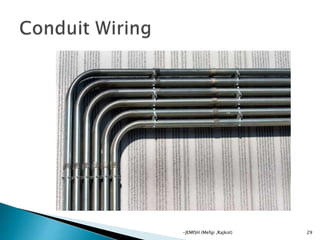
 The cable used in this system is either V.I.R
or P.V.C insulated and is run in mild steel or
P.V.C pipes called conduits.
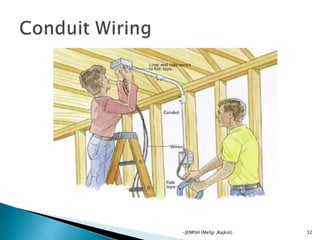
 Conduits carrying the insulated wires can be
installed on the surface of the walls or
concealed in the walls and the ceiling.
30-JEMISH (Mefgi ,Rajkot)
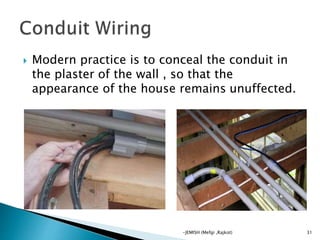
 Modern practice is to conceal the conduit in
the plaster of the wall , so that the
appearance of the house remains unuffected.
31-JEMISH (Mefgi ,Rajkot)
32-JEMISH (Mefgi ,Rajkot)
 Advantages
 1. conduit provides protection against
mechanical injury and fire & is shock proof
 2. conduit provides protection against
chemicals
 3. the whole system is water proof
 4. conductors are safety secured from
moisture
 5. this wiring has far better look
 6. it has a longer life
33-JEMISH (Mefgi ,Rajkot)
 Disadvantages
 1. it is costly system of wiring
 2. it requires more time for erection
 3. it requires highly skilled labour
 4. internal condensation of moisture may
cause damage to the insulation unless the
system outlets are drained and ventilated
34-JEMISH (Mefgi ,Rajkot)
 Field of application
 1. places where considerable dust of puff is
present such as textile mills, saw mills, flour
mills etc.
 2. damp situations
 3. in workshops for lighting and motor wiring
 4. places where there is possibility of fire hazards
such as in oil mills, varnish factories, etc.
 5.placed where important documents are kept
such as record room
 6.residential and public buildings where the
appearance is of prime importance
35-JEMISH (Mefgi ,Rajkot)
36-JEMISH (Mefgi ,Rajkot)

Electrical wiring BY Jemish

  • 1.
  • 2.
     1. lifeof installation  2. future extension or alterations  3. construction of building  4. fire hazards or other special conditions  5. corrosive fumes  6. dampness  7. type of wire and material used  8. nature of load (lighting of power)  9. safety of the system  10. cost of wiring system 2-JEMISH (Mefgi ,Rajkot)
  • 3.
     1. single-phasetwo-wire system  2. three-phase three-wire system  3. three-phase four-wire system 3-JEMISH (Mefgi ,Rajkot)
  • 4.
     Wiring systemnormally classified on the basis of wire used in the wiring 4-JEMISH (Mefgi ,Rajkot)
  • 5.
     Commonly usedtypes of wiring systems for residential buildings ,commercial buildings etc.  1. Cleat wiring  2. Wooden casing and capping wiring  3. C. T. S or T. R. S. wiring  4.Metal Sheathed or Lead Sheathed wiring  5. Conduit wiring 5-JEMISH (Mefgi ,Rajkot)
  • 6.
  • 7.
     Cleat wiringis normally used for temporary wiring purpose.  Ex..functions, marriages…etc.  In this type of wiring vulcanized india rubber(V.I.R) or polyvinyl chloride(PVC) insulated wires are used as conductors.  Wires are held by the help of porcelain cleat which are placed 6mm off the walls or ceilings. 7-JEMISH (Mefgi ,Rajkot)
  • 8.
     As shownin dia. Grooves are provided in the base portion of the cleat for accommodating the wires.  wiring is done as shown in figure.. 8-JEMISH (Mefgi ,Rajkot)
  • 9.
     Types ofcleats…………  …1. one groove  …2. two grooves and  …3. three grooves 9-JEMISH (Mefgi ,Rajkot)
  • 10.
     Advantages  1.cheapest system of internal wiring  2. installation and dismantlement is easy and quick  3. material is recoverable after the dismantlement  4. inspection, alternations and additions can be easily made  5. skill required is little 10-JEMISH (Mefgi ,Rajkot)
  • 11.
     Disadvantages  1.it is not looking good  2. quit temporary and perishes quickly  3. wire are exposed to mechanical injury  4. oil and smoke are injurious to V.I.R insulation  5. not suitable for domestic premises. 11-JEMISH (Mefgi ,Rajkot)
  • 12.
     Field ofapplication  1. the wiring of this type is suitable for temporary installations in dry places.  2. this is also accepted where appearance is not so important and cheapness is the main consideration 12-JEMISH (Mefgi ,Rajkot)
  • 13.
     This isone of the cheapest type of wiring and is commonly used for house wiring.  The cable used in this type of wiring is either V.I.R or P.V.C or any approved insulated cables.  Casing consist of V-shaped grooves and is covered by rectangular strip of teak wood known as capping.  This type of wiring adopted up to 250 V in dry places and in places where no risk of fire. 13-JEMISH (Mefgi ,Rajkot)
  • 14.
  • 15.
  • 16.
     Advantages  1.better appearance than cleat wiring  2. cheap in cost  3. easy to install and rewire  4. easy to inspect by opening the capping 16-JEMISH (Mefgi ,Rajkot)
  • 17.
     Disadvantages  1.not suitable in damp places  2. risk of fire  3. this type of wiring can only be used on surface and can not be concealed in plaster.  4.Since it requires better workmanship , labour cost is more 17-JEMISH (Mefgi ,Rajkot)
  • 18.
     Field ofapplication  This type of wiring is suitable for low voltage domestic installations in dry places and where there is no risk of fire hazards 18-JEMISH (Mefgi ,Rajkot)
  • 19.
     This typeof wiring is also used for house wiring and is quite cheap.  Cab tyre sheathed (C.T.S) wire or tough rubber sheathed (T.R.S) wire is normally used as conductor for this wiring. 19-JEMISH (Mefgi ,Rajkot)
  • 20.
     The wiresare run on the teak wooden battens which are fixed on the wall or the ceiling by means of screws and wooden plugs.  C.T.S OR T.R.S cables used are not much affected by chemicals , water, and steam. 20-JEMISH (Mefgi ,Rajkot)
  • 21.
     Advantages  1.it is easy to install and repair  2. it gives better appearance  3. its life is long  4. it is fire proof up to a certain limit  5. it is cheaper than other types of wiring except cleat wiring  6. conductors have strong insulations  7. chemicals do not affect the conductor insulation 21-JEMISH (Mefgi ,Rajkot)
  • 22.
     Disadvantages  1.the conductors are open and liable to mechanical injury thus this type of wiring cannot be used in workshops etc.  2. its use in places open to sun and rain is restricted  3. good workmanship is suitable where acids and alkalis to be prescut. 22-JEMISH (Mefgi ,Rajkot)
  • 23.
     This typeof wiring is adopted for low voltage installation.  This system is similar to C.T.S wiring except that the cable used is different in this wiring system.  In this type of system conductors are insulated with V.I.R and then covered with an outer sheath of lead aluminium alloy containing 95% lead and 5% aluminium. 23-JEMISH (Mefgi ,Rajkot)
  • 24.
     The metalsheath is provided over the insulated conductor in order to protect system from mechanical injury , dampness, and atmospheric action.  Same as C.T.S wiring system cables are run on wooden batten and are fixed with the help of tinned link clips. 24-JEMISH (Mefgi ,Rajkot)
  • 25.
  • 26.
     Advantages  1.conductors are protected against mechanical injury  2. it is suitable employed under damp situations  3.it gives better appearance  4.it has longer life  5. conductors are protected against chemicals  6. it can be installed in open space 26-JEMISH (Mefgi ,Rajkot)
  • 27.
     Disadvantages  1.cables are costlier than C.T.S OR T.R.S wires  2. In case of leakage ,there is risk of shock  3. skilled labour and proper supervision is required  4. it is not suitable for places where chemical corrosion may occur 27-JEMISH (Mefgi ,Rajkot)
  • 28.
     Field ofapplication  This wiring system is suitable for low voltage (up to 250V) installations.  It may be used in places exposed to sun and rain provided no joint is exposed.  It may be used in damp placed with a suitable protective covering.  This type of wiring is very common in use these days except for some small installations and distribution boards etc. 28-JEMISH (Mefgi ,Rajkot)
  • 29.
  • 30.
     Conduit wiringsystem is best for domestic and commercial installations.  It provide proper protection to the installation against fire hazards, shock, mechanical damage and dampness.  The cable used in this system is either V.I.R or P.V.C insulated and is run in mild steel or P.V.C pipes called conduits.  Conduits carrying the insulated wires can be installed on the surface of the walls or concealed in the walls and the ceiling. 30-JEMISH (Mefgi ,Rajkot)
  • 31.
     Modern practiceis to conceal the conduit in the plaster of the wall , so that the appearance of the house remains unuffected. 31-JEMISH (Mefgi ,Rajkot)
  • 32.
  • 33.
     Advantages  1.conduit provides protection against mechanical injury and fire & is shock proof  2. conduit provides protection against chemicals  3. the whole system is water proof  4. conductors are safety secured from moisture  5. this wiring has far better look  6. it has a longer life 33-JEMISH (Mefgi ,Rajkot)
  • 34.
     Disadvantages  1.it is costly system of wiring  2. it requires more time for erection  3. it requires highly skilled labour  4. internal condensation of moisture may cause damage to the insulation unless the system outlets are drained and ventilated 34-JEMISH (Mefgi ,Rajkot)
  • 35.
     Field ofapplication  1. places where considerable dust of puff is present such as textile mills, saw mills, flour mills etc.  2. damp situations  3. in workshops for lighting and motor wiring  4. places where there is possibility of fire hazards such as in oil mills, varnish factories, etc.  5.placed where important documents are kept such as record room  6.residential and public buildings where the appearance is of prime importance 35-JEMISH (Mefgi ,Rajkot)
  • 36.

Editor's Notes

  • #36 Q: What is the definition of a shock absorber? A: A careless electrician!
  • #37 Q: Why are electricians always up to date? A: Because they are "Current specialists".