Taylor Series Revisited 
Major: All Engineering Majors 
Authors: Autar Kaw, Luke Snyder 
http://numericalmethods.eng.usf.edu 
Transforming Numerical Methods Education for STEM 
Undergraduates 
12/06/14 http://numericalmethods.eng.usf.edu 1
Taylor Series Revisited 
http://numericalmethods.eng.usf.edu
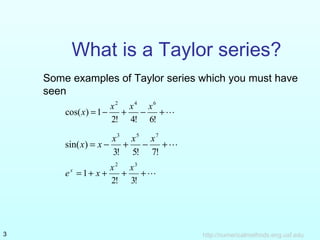
What is a Taylor series? 
Some examples of Taylor series which you must have 
seen 
x2 x4 x6 x 
= - + - + 
2! 4! 6! 
cos( ) 1 
x3 x5 x7 x x 
= - + - + 
3! 5! 7! 
sin( ) 
x2 x3 ex x 
= + + + + 
2! 3! 
1 
http://3 numericalmethods.eng.usf.edu
General Taylor Series 
The general form of the Taylor series is given by 
( ) ( ) ( ) ( ) ¢¢¢ 
( ) + 
f x h f x f x h f x h f x h 
+ = + ¢ + 2 + 
3 
¢ 
2! 3! 
provided that all derivatives of f(x) are continuous and 
exist in the interval [x,x+h] 
What does this mean in plain 
EAsn Agrlicshhim?edes would have said, “Give me the value of the function 
at a single point, and the value of all (first, second, and so on) its 
derivatives at that single point, and I can give you the value of the 
function at any other point” (fine print excluded) 
http://4 numericalmethods.eng.usf.edu
Example—Taylor Series 
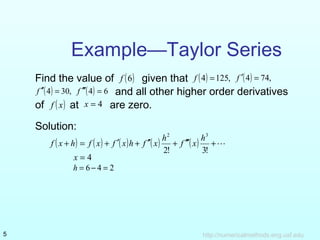
Find the value of f (6) given that f (4) = 125, f ¢(4) = 74, 
f ¢¢(4) = 30, f ¢¢¢(4) = 6 and all other higher order derivatives 
of f ( x) at x = 4 are zero. 
Solution: 
2 h3 f x h f x f x h f x h f x 
( + ) = ( ) + ¢( ) + ¢¢( ) + ¢¢¢( ) + 
2! 3! 
x = 4 
h = 6 - 4 = 2 
http://5 numericalmethods.eng.usf.edu
Example (cont.) 
Solution: (cont.) 
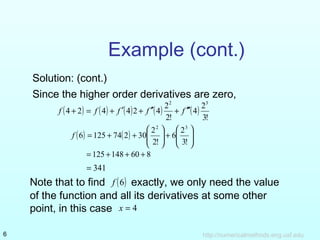
Since the higher order derivatives are zero, 
2 3 
4 2 
4 2 4 4 2 4 2 
( ) ( ) ( ) ( ) ( ) 
3! 
f + = f + f ¢ + f ¢¢ + f ¢¢¢ 
2! 
ö 
÷ø 
ö 
æ 
÷ + æ 
2 3 
6 2 
6 125 74 2 30 2 
( ) ( ) ÷ ÷ø 
ç çè 
ç çè 
= + + 
3! 
2! 
f 
= 125 +148 + 60 + 8 
= 341 
Note that to find f (6) exactly, we only need the value 
of the function and all its derivatives at some other 
point, in this case x = 4 
http://6 numericalmethods.eng.usf.edu
Derivation for Maclaurin Series for ex 
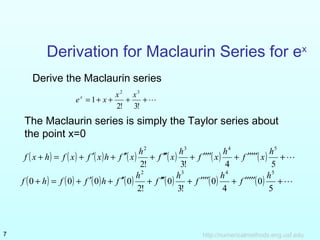
Derive the Maclaurin series 
x2 x3 ex x 
= + + + + 
2! 3! 
1 
The Maclaurin series is simply the Taylor series about 
the point x=0 
( + ) = ( ) + ¢( ) + ¢¢( ) + ¢¢¢( ) + ¢¢¢¢( ) + ¢¢¢¢¢( ) + 
2 3 4 f x h f x f x h f x h f x h f x h f x 
h5 2! 3! 4 5 
( + ) = ( ) + ¢( ) + ¢¢( ) + ¢¢¢( ) + ¢¢¢¢( ) + ¢¢¢¢¢( ) + 
2 3 4 h5 f h f f h f h f h f h f 
5 
0 
4 
0 
3! 
0 
2! 
0 0 0 0 
http://7 numericalmethods.eng.usf.edu
Derivation (cont.) 
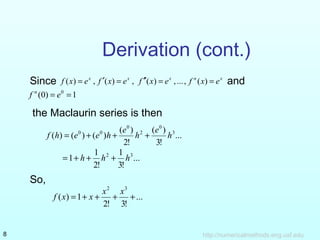
Since f (x) = ex , f ¢(x) = ex , f ¢¢(x) = ex , ... , f n (x) = ex and 
f n (0) = e0 =1 
the Maclaurin series is then 
... 
0 
0 
f h = e0 + e0 h + e h + e h 
( ) ( ) ( ) ( ) ( ) 
3 
3! 
2! 
2 
... 
=1+ h + 1 h2 + 1 
h3 
3! 
2! 
So, 
... 
2 3 
f x = + x + x + x + 
2! 3! 
( ) 1 
http://8 numericalmethods.eng.usf.edu
Error in Taylor Series 
The Taylor polynomial of order n of a function f(x) 
with (n+1) continuous derivatives in the domain 
[x,x+h] is given by 
n 
2 
f x h f x f x h f x h f x h n 
( + ) = ( ) + ¢ ( ) + ( ) + + ( n ) ( ) + 
R ( x) 
n 
 
2! ! 
'' 
where the remainder is given by 
n 
+ 
1 
( ) ( ) f ( ) (c) 
R x = x - 
h n 
n 
n 
+ 
1 
+ 
( 1)! 
where 
x < c < x + h 
that is, c is some point in the domain [x,x+h] 
http://9 numericalmethods.eng.usf.edu
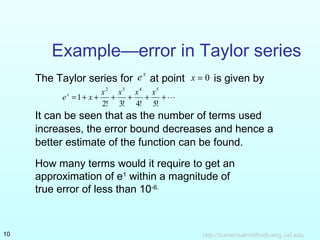
Example—error in Taylor series 
The Taylor series for ex at point x = 0 is given by 
x2 x3 x4 x5 ex x 
= + + + + + + 
2! 3! 4! 5! 
1 
It can be seen that as the number of terms used 
increases, the error bound decreases and hence a 
better estimate of the function can be found. 
How many terms would it require to get an 
approximation of e1 within a magnitude of 
true error of less than 10-6. 
http://10 numericalmethods.eng.usf.edu
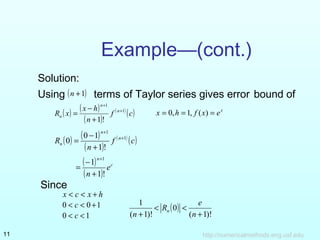
Example—(cont.) 
Solution: 
Using (n +1) terms of Taylor series gives error bound of 
( ) ( ) 
n 
+ 
1 
1 ! 
R x x h n 
= - f ( ) ( (c) 
x = 0,h = 1, f (x) = ex 
n 
) 
( ) ( ) 
n 
+ 
1 
+ 
n 
+ 
+ 
1 
1 ! 
= - 
( ) 
( ) 
0 0 1 + 
R n 
( ) 
f ( ) (c) 
n 
n 
1 
c 
1 n 
+ 
1 
e 
n + 
1 ! 
= - 
Since 
x < c < x + h 
0 < c < 0 +1 
0 < c < 1 
R e 
( ) 
+ 
n n 
+ n 
( 1)! 
< < 
0 
1 
( 1)! 
http://11 numericalmethods.eng.usf.edu
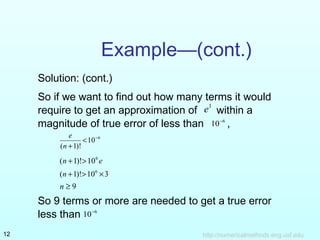
Example—(cont.) 
Solution: (cont.) 
So if we want to find out how many terms it would 
require to get an approximation of e1 within a 
magnitude of true error of less than 10-6 , 
< - 
10 6 
e 
n + 
( 1)! 
(n +1)!>106 e 
(n +1)!>106 ´3 
n ³ 9 
So 9 terms or more are needed to get a true error 
less than 10-6 
http://12 numericalmethods.eng.usf.edu
Additional Resources 
For all resources on this topic such as digital 
audiovisual lectures, primers, textbook chapters, 
multiple-choice tests, worksheets in MATLAB, 
MATHEMATICA, MathCad and MAPLE, blogs, related 
physical problems, please visit 
http://numericalmethods.eng.usf.edu/topics/taylor_serie 
s.html
THE END 
http://numericalmethods.eng.usf.edu

Taylor and maclaurian series

  • 1.
    Taylor Series Revisited Major: All Engineering Majors Authors: Autar Kaw, Luke Snyder http://numericalmethods.eng.usf.edu Transforming Numerical Methods Education for STEM Undergraduates 12/06/14 http://numericalmethods.eng.usf.edu 1
  • 2.
    Taylor Series Revisited http://numericalmethods.eng.usf.edu
  • 3.
    What is aTaylor series? Some examples of Taylor series which you must have seen x2 x4 x6 x = - + - + 2! 4! 6! cos( ) 1 x3 x5 x7 x x = - + - + 3! 5! 7! sin( ) x2 x3 ex x = + + + + 2! 3! 1 http://3 numericalmethods.eng.usf.edu
  • 4.
    General Taylor Series The general form of the Taylor series is given by ( ) ( ) ( ) ( ) ¢¢¢ ( ) + f x h f x f x h f x h f x h + = + ¢ + 2 + 3 ¢ 2! 3! provided that all derivatives of f(x) are continuous and exist in the interval [x,x+h] What does this mean in plain EAsn Agrlicshhim?edes would have said, “Give me the value of the function at a single point, and the value of all (first, second, and so on) its derivatives at that single point, and I can give you the value of the function at any other point” (fine print excluded) http://4 numericalmethods.eng.usf.edu
  • 5.
    Example—Taylor Series Findthe value of f (6) given that f (4) = 125, f ¢(4) = 74, f ¢¢(4) = 30, f ¢¢¢(4) = 6 and all other higher order derivatives of f ( x) at x = 4 are zero. Solution: 2 h3 f x h f x f x h f x h f x ( + ) = ( ) + ¢( ) + ¢¢( ) + ¢¢¢( ) + 2! 3! x = 4 h = 6 - 4 = 2 http://5 numericalmethods.eng.usf.edu
  • 6.
    Example (cont.) Solution:(cont.) Since the higher order derivatives are zero, 2 3 4 2 4 2 4 4 2 4 2 ( ) ( ) ( ) ( ) ( ) 3! f + = f + f ¢ + f ¢¢ + f ¢¢¢ 2! ö ÷ø ö æ ÷ + æ 2 3 6 2 6 125 74 2 30 2 ( ) ( ) ÷ ÷ø ç çè ç çè = + + 3! 2! f = 125 +148 + 60 + 8 = 341 Note that to find f (6) exactly, we only need the value of the function and all its derivatives at some other point, in this case x = 4 http://6 numericalmethods.eng.usf.edu
  • 7.
    Derivation for MaclaurinSeries for ex Derive the Maclaurin series x2 x3 ex x = + + + + 2! 3! 1 The Maclaurin series is simply the Taylor series about the point x=0 ( + ) = ( ) + ¢( ) + ¢¢( ) + ¢¢¢( ) + ¢¢¢¢( ) + ¢¢¢¢¢( ) + 2 3 4 f x h f x f x h f x h f x h f x h f x h5 2! 3! 4 5 ( + ) = ( ) + ¢( ) + ¢¢( ) + ¢¢¢( ) + ¢¢¢¢( ) + ¢¢¢¢¢( ) + 2 3 4 h5 f h f f h f h f h f h f 5 0 4 0 3! 0 2! 0 0 0 0 http://7 numericalmethods.eng.usf.edu
  • 8.
    Derivation (cont.) Sincef (x) = ex , f ¢(x) = ex , f ¢¢(x) = ex , ... , f n (x) = ex and f n (0) = e0 =1 the Maclaurin series is then ... 0 0 f h = e0 + e0 h + e h + e h ( ) ( ) ( ) ( ) ( ) 3 3! 2! 2 ... =1+ h + 1 h2 + 1 h3 3! 2! So, ... 2 3 f x = + x + x + x + 2! 3! ( ) 1 http://8 numericalmethods.eng.usf.edu
  • 9.
    Error in TaylorSeries The Taylor polynomial of order n of a function f(x) with (n+1) continuous derivatives in the domain [x,x+h] is given by n 2 f x h f x f x h f x h f x h n ( + ) = ( ) + ¢ ( ) + ( ) + + ( n ) ( ) + R ( x) n  2! ! '' where the remainder is given by n + 1 ( ) ( ) f ( ) (c) R x = x - h n n n + 1 + ( 1)! where x < c < x + h that is, c is some point in the domain [x,x+h] http://9 numericalmethods.eng.usf.edu
  • 10.
    Example—error in Taylorseries The Taylor series for ex at point x = 0 is given by x2 x3 x4 x5 ex x = + + + + + + 2! 3! 4! 5! 1 It can be seen that as the number of terms used increases, the error bound decreases and hence a better estimate of the function can be found. How many terms would it require to get an approximation of e1 within a magnitude of true error of less than 10-6. http://10 numericalmethods.eng.usf.edu
  • 11.
    Example—(cont.) Solution: Using(n +1) terms of Taylor series gives error bound of ( ) ( ) n + 1 1 ! R x x h n = - f ( ) ( (c) x = 0,h = 1, f (x) = ex n ) ( ) ( ) n + 1 + n + + 1 1 ! = - ( ) ( ) 0 0 1 + R n ( ) f ( ) (c) n n 1 c 1 n + 1 e n + 1 ! = - Since x < c < x + h 0 < c < 0 +1 0 < c < 1 R e ( ) + n n + n ( 1)! < < 0 1 ( 1)! http://11 numericalmethods.eng.usf.edu
  • 12.
    Example—(cont.) Solution: (cont.) So if we want to find out how many terms it would require to get an approximation of e1 within a magnitude of true error of less than 10-6 , < - 10 6 e n + ( 1)! (n +1)!>106 e (n +1)!>106 ´3 n ³ 9 So 9 terms or more are needed to get a true error less than 10-6 http://12 numericalmethods.eng.usf.edu
  • 13.
    Additional Resources Forall resources on this topic such as digital audiovisual lectures, primers, textbook chapters, multiple-choice tests, worksheets in MATLAB, MATHEMATICA, MathCad and MAPLE, blogs, related physical problems, please visit http://numericalmethods.eng.usf.edu/topics/taylor_serie s.html
  • 14.