Electro Dynamometer type Wattmeter
Power Measurement
Dynamometer type Wattmeter
Principle:
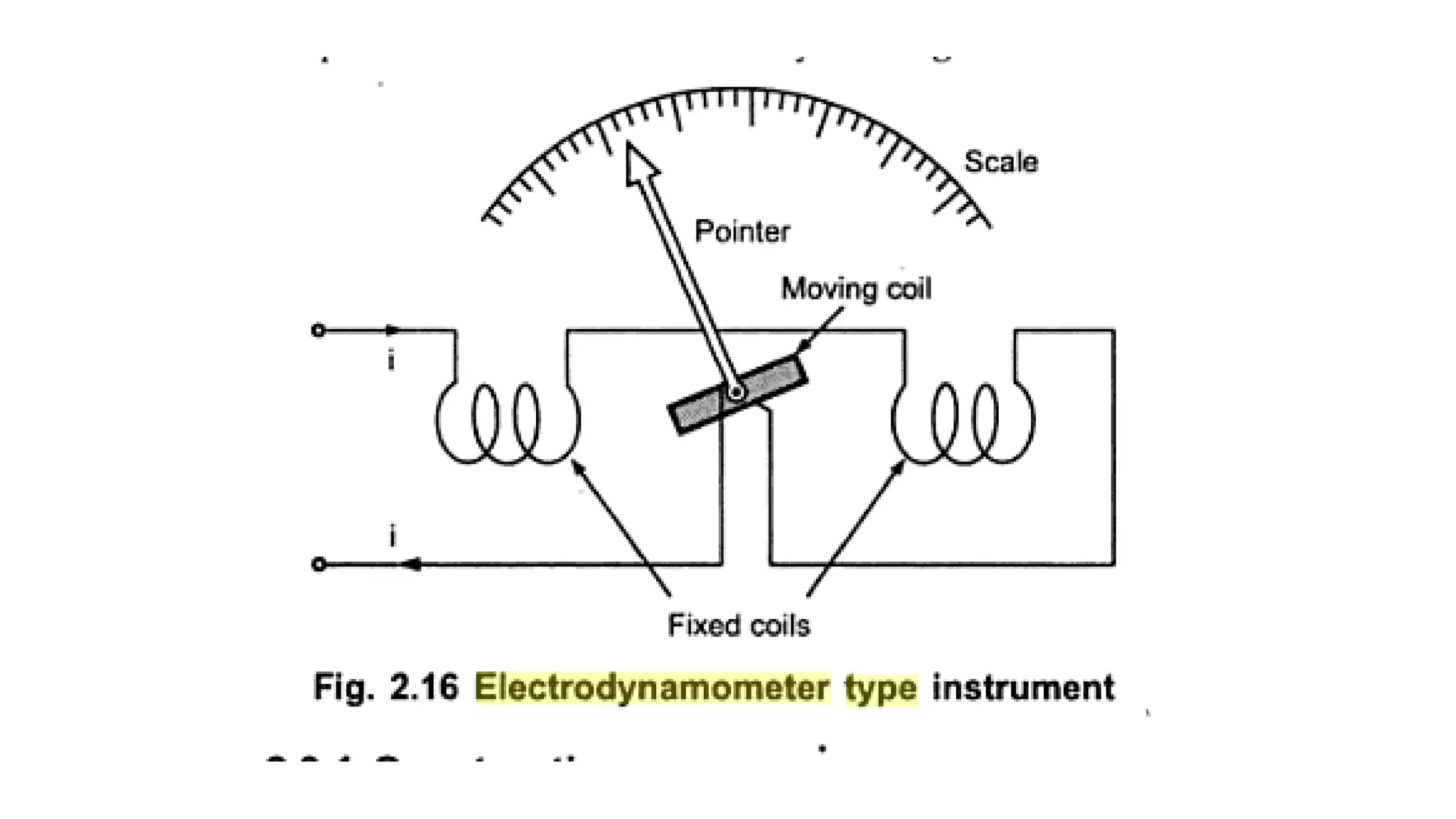
When a current carrying moving coil is
placed in a magnetic field produced by the
current carrying fixed coil, a mechanical force is
exerted on the coil sides of the moving coil and
deflection takes place.
•Same as PMMC except permanent magnet is
replaced by fixed coils.
•Same current both in fixed coil and moving coil.
•Torque exerted on moving coil α meter current
squared.
• deflection α average torque α average of the
current squared.
•Meter scale easily calibrated to read rms value.
Torque eqn
• D.C. operation : For D.C current of I1 and I2,
• For A.C operation
Advantages
•Can be used on both DC & AC circuits.
•Uniform scale.
•High degree of accuracy can be obtained.
Disadvantages
•At low power factors, the inductances of the
potential coil causes serious errors.
•The reading of the instrument may be affected
by stray fields acting on the moving coil.
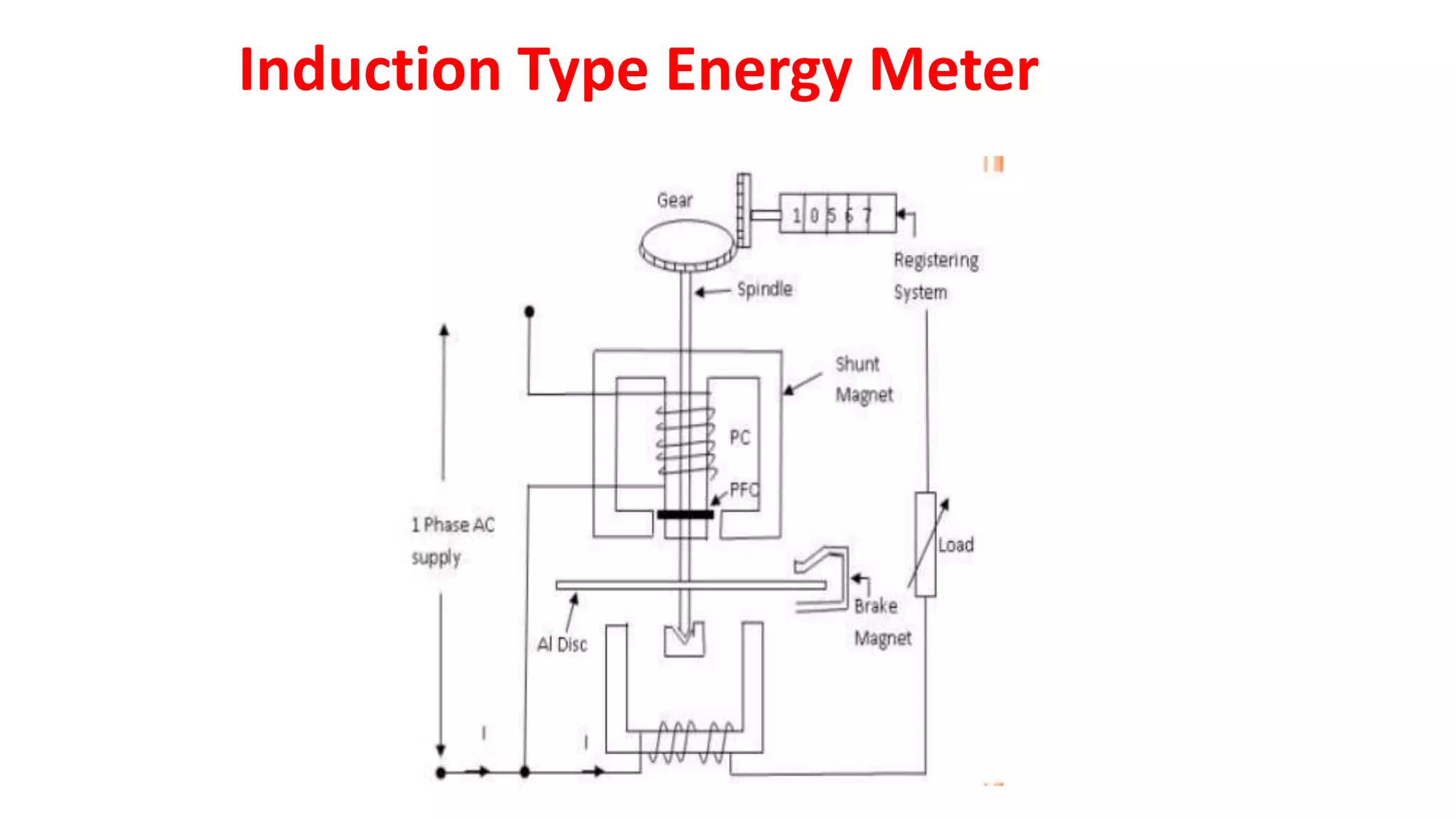
Induction Type Energy Meter
Principle
• When AC current flows through two suitably located coils
(current coil & potential coil), they produce rotating magnetic field
which is cut by the metallic disc suspended near to the coils, thus an
e.m.f. is induced in the disc which circulates eddy currents in it.
• By the interaction of rotating magnetic field & eddy currents,
electromagnetic torque is developed which causes the disc to
rotate.
• Used on AC system only.
Construction
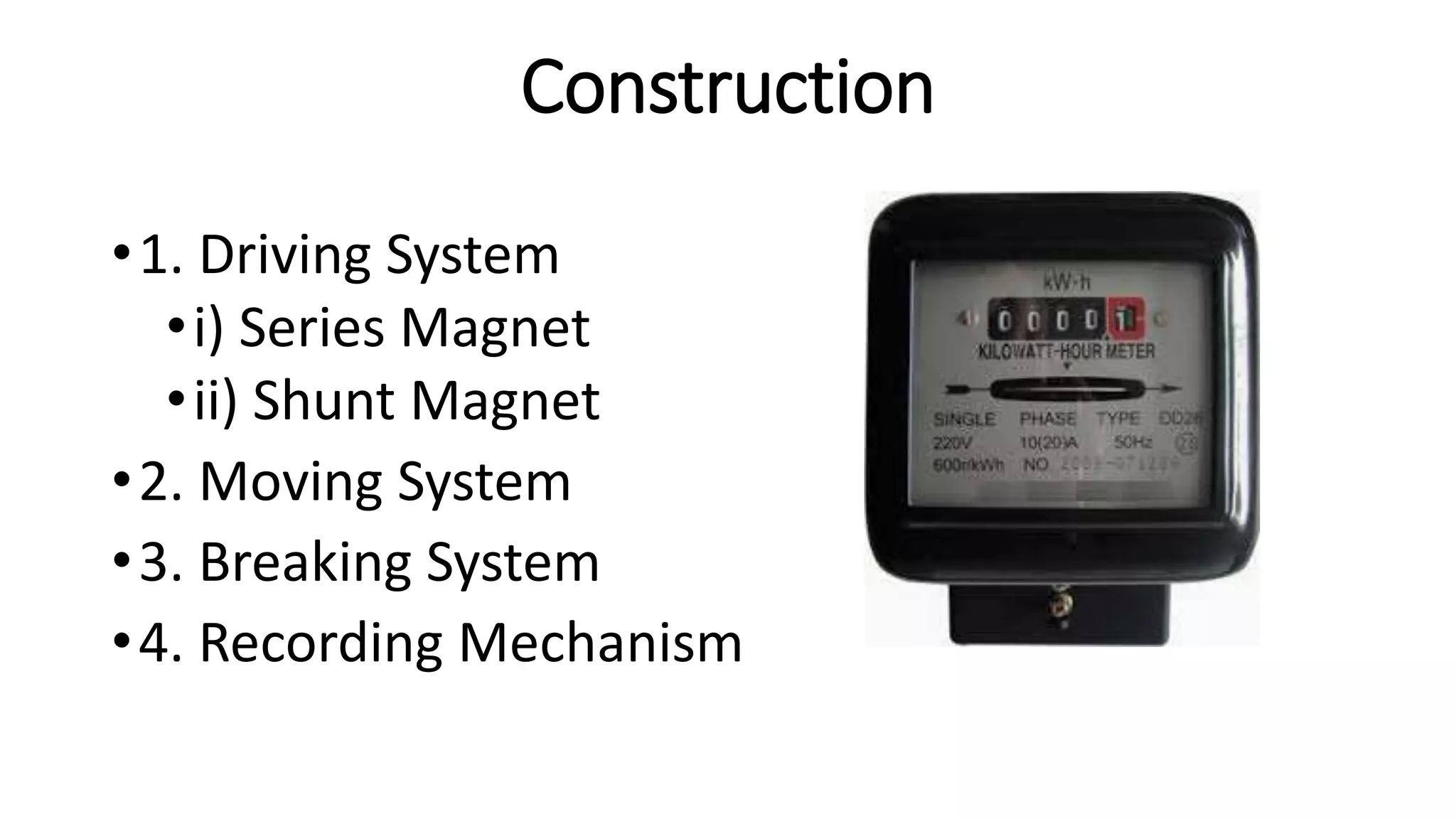
•1. Driving System
•i) Series Magnet
•ii) Shunt Magnet
•2. Moving System
•3. Breaking System
•4. Recording Mechanism
Induction Type Energy Meter
Working Principle:
When the energy meter is connected in the circuit, the current
coil carries the load current and pressure coil carries the current
proportional to the supply voltage.
The magnetic field produced by the series magnet is in phase
with the line current and the magnetic field produced by the shunt
magnet is in quadrature with the applied voltage.
Thus, a phase difference exists between the fluxes produced
by the two coils. This sets up a rotating field which interacts with
the disc and produces a driving torque, thus disc starts rotating.
The number of revolutions made by the disc depends upon the
energy passing through the meter.
The spindle is geared to the recording mechanism so that
electrical energy consumed in the circuit is directly registered in
kWh.
Driving System
• Series Magnet:
It is placed below the aluminum disc and produces the magnetic field (Φsc),
which is proportional to & in phase with line current.
• Shunt Magnet:
• It is placed above the aluminum disc. It produces a field (Φsh) proportional
to the applied voltage. This field is in phase with the current flowing
through the pressure coil, but is in quadrature with the applied voltage.
Moving System
• It consists of a light aluminum disc
mounted on a vertical spindle.
• The disc is positioned in the air gap
between series & shunt magnet.
• The spindle is supported by a cup shaped
jeweled bearing at the bottom end & has a
spring journal bearing at the top end.
• Since there is no control spring, the disc
makes continuous rotation under the action
of deflecting torque.
Braking System:
A permanent magnet positioned near the edge
of the aluminum disc, forms the braking system.
When the disc moves in the field of the braking
magnet, flux is cut & eddy currents are induced in
the disc.
The direction of induced currents is such that it
opposes the rotation, thus braking torque is
produced.
Since the induced currents are proportional to
the speed of disc (N), therefore braking torque (Tb) is
proportional to the disc speed. i.e.
Tb α N
Recording Mechanism:
The function of recording or
registering mechanism is to record continuously a
number on the dial which is proportional to the
revolutions made by the moving system.
The number of revolutions of the disc is a
measure of the electrical energy passing through the
meter.
Electrodynamometer

Electrodynamometer

  • 1.
  • 2.
  • 5.
    Dynamometer type Wattmeter Principle: Whena current carrying moving coil is placed in a magnetic field produced by the current carrying fixed coil, a mechanical force is exerted on the coil sides of the moving coil and deflection takes place.
  • 6.
    •Same as PMMCexcept permanent magnet is replaced by fixed coils. •Same current both in fixed coil and moving coil. •Torque exerted on moving coil α meter current squared. • deflection α average torque α average of the current squared. •Meter scale easily calibrated to read rms value.
  • 9.
  • 10.
    • D.C. operation: For D.C current of I1 and I2,
  • 11.
    • For A.Coperation
  • 14.
    Advantages •Can be usedon both DC & AC circuits. •Uniform scale. •High degree of accuracy can be obtained. Disadvantages •At low power factors, the inductances of the potential coil causes serious errors. •The reading of the instrument may be affected by stray fields acting on the moving coil.
  • 15.
  • 18.
    Induction Type EnergyMeter Principle • When AC current flows through two suitably located coils (current coil & potential coil), they produce rotating magnetic field which is cut by the metallic disc suspended near to the coils, thus an e.m.f. is induced in the disc which circulates eddy currents in it. • By the interaction of rotating magnetic field & eddy currents, electromagnetic torque is developed which causes the disc to rotate. • Used on AC system only.
  • 19.
    Construction •1. Driving System •i)Series Magnet •ii) Shunt Magnet •2. Moving System •3. Breaking System •4. Recording Mechanism
  • 20.
  • 21.
    Working Principle: When theenergy meter is connected in the circuit, the current coil carries the load current and pressure coil carries the current proportional to the supply voltage. The magnetic field produced by the series magnet is in phase with the line current and the magnetic field produced by the shunt magnet is in quadrature with the applied voltage. Thus, a phase difference exists between the fluxes produced by the two coils. This sets up a rotating field which interacts with the disc and produces a driving torque, thus disc starts rotating. The number of revolutions made by the disc depends upon the energy passing through the meter. The spindle is geared to the recording mechanism so that electrical energy consumed in the circuit is directly registered in kWh.
  • 22.
    Driving System • SeriesMagnet: It is placed below the aluminum disc and produces the magnetic field (Φsc), which is proportional to & in phase with line current. • Shunt Magnet: • It is placed above the aluminum disc. It produces a field (Φsh) proportional to the applied voltage. This field is in phase with the current flowing through the pressure coil, but is in quadrature with the applied voltage.
  • 23.
    Moving System • Itconsists of a light aluminum disc mounted on a vertical spindle. • The disc is positioned in the air gap between series & shunt magnet. • The spindle is supported by a cup shaped jeweled bearing at the bottom end & has a spring journal bearing at the top end. • Since there is no control spring, the disc makes continuous rotation under the action of deflecting torque.
  • 24.
    Braking System: A permanentmagnet positioned near the edge of the aluminum disc, forms the braking system. When the disc moves in the field of the braking magnet, flux is cut & eddy currents are induced in the disc. The direction of induced currents is such that it opposes the rotation, thus braking torque is produced. Since the induced currents are proportional to the speed of disc (N), therefore braking torque (Tb) is proportional to the disc speed. i.e. Tb α N
  • 25.
    Recording Mechanism: The functionof recording or registering mechanism is to record continuously a number on the dial which is proportional to the revolutions made by the moving system. The number of revolutions of the disc is a measure of the electrical energy passing through the meter.