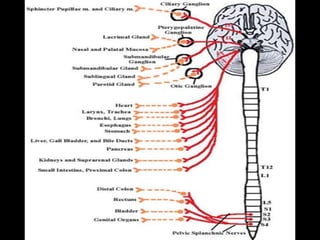
The Sympathetic Nervous
System
THE VEGETATIVE NERVOUS SYSTEM
THE PARASYMPATHETIC PART
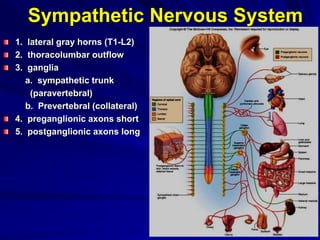
Sympathetic Nervous System
1. lateral gray horns (T1-L2)
2. thoracolumbar outflow
3. ganglia
a. sympathetic trunk
(paravertebral)
b. Prevertebral (collateral)
4. preganglionic axons short
5. postganglionic axons long
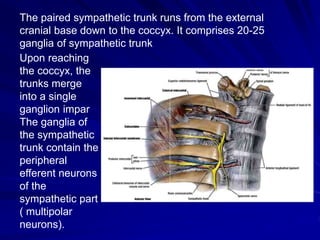
The paired sympathetic trunk runs from the external
cranial base down to the coccyx. It comprises 20-25
ganglia of sympathetic trunk
Upon reaching
the coccyx, the
trunks merge
into a single
ganglion impar
The ganglia of
the sympathetic
trunk contain the
peripheral
efferent neurons
of the
sympathetic part
( multipolar
neurons).
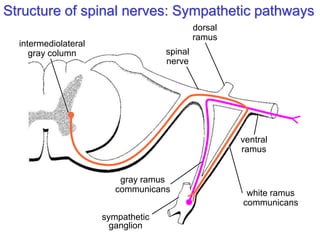
spinal
nerve
dorsal
ramus
ventral
ramus
gray ramus
communicans white ramus
communicans
sympathetic
ganglion
intermediolateral
gray column
Structure of spinal nerves: Sympathetic pathways
Sympathetic System: Postganglionic Cell Bodies
Paravertebral
ganglia
Prevertebral
ganglia
• celiac ganglion
• sup. mesent. g.
• inf. mesent. g.
aorta
sympathetic
trunk (chain)
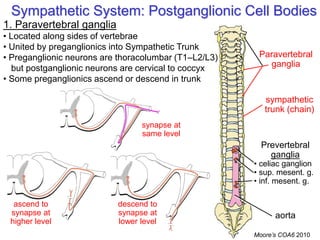
1. Paravertebral ganglia
• Located along sides of vertebrae
• United by preganglionics into Sympathetic Trunk
• Preganglionic neurons are thoracolumbar (T1–L2/L3)
but postganglionic neurons are cervical to coccyx
• Some preganglionics ascend or descend in trunk
synapse at
same level
ascend to
synapse at
higher level
descend to
synapse at
lower level
Moore’s COA6 2010
Sympathetic System: Postganglionic Cell Bodies
Paravertebral
ganglia
Prevertebral
ganglia
• celiac ganglion
• sup. mesent. g.
• inf. mesent. g.
aorta
sympathetic
trunk (chain)
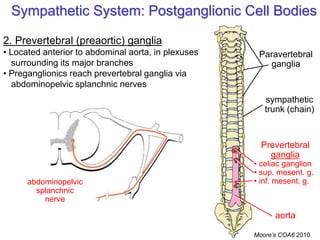
2. Prevertebral (preaortic) ganglia
• Located anterior to abdominal aorta, in plexuses
surrounding its major branches
• Preganglionics reach prevertebral ganglia via
abdominopelvic splanchnic nerves
Moore’s COA6 2010
abdominopelvic
splanchnic
nerve
Sympathetic System: Summary
Moore’s COA6 2010
T1
L2
somatic tissues
(body wall, limbs)
visceral tissues
(organs)
postganglionics
via 31 spinal
nerves
to somatic tissues
of neck, body wall,
and limbs
sympathetic
trunk
prevertebral
ganglia
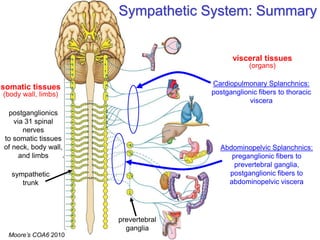
Cardiopulmonary Splanchnics:
postganglionic fibers to thoracic
viscera
Abdominopelvic Splanchnics:
preganglionic fibers to
prevertebral ganglia,
postganglionic fibers to
abdominopelvic viscera
Moore’s COA6 2010
somatic tissues
(body wall, limbs)
visceral tissues
(organs)
Sympathetic System: Preganglionic Cell Bodies
• Preganglionic cell bodies in
intermediolateral gray
• T1 – L2/L3
• Somatotopic organization
intermediolateral
gray columns
lateral
horn
T1 –
L2/L3
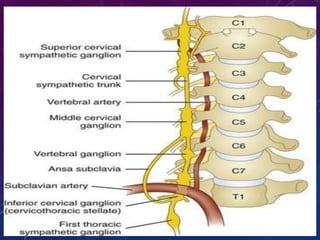
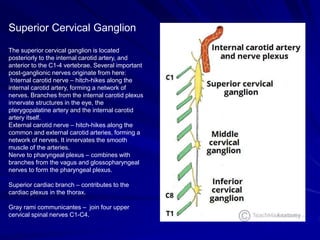
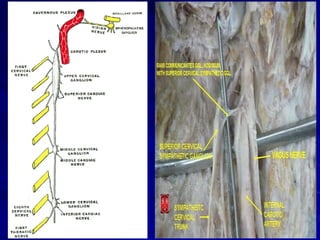
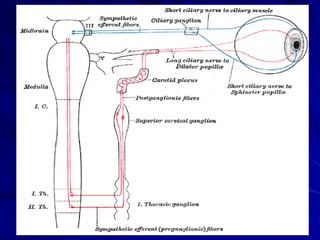
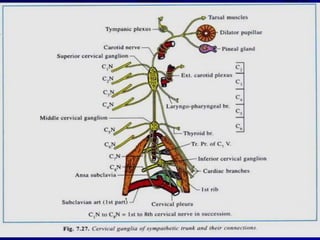
Superior Cervical Ganglion
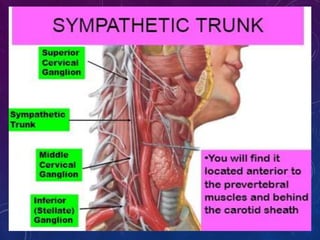
The superior cervical ganglion is located
posteriorly to the internal carotid artery, and
anterior to the C1-4 vertebrae. Several important
post-ganglionic nerves originate from here:
Internal carotid nerve – hitch-hikes along the
internal carotid artery, forming a network of
nerves. Branches from the internal carotid plexus
innervate structures in the eye, the
pterygopalatine artery and the internal carotid
artery itself.
External carotid nerve – hitch-hikes along the
common and external carotid arteries, forming a
network of nerves. It innervates the smooth
muscle of the arteries.
Nerve to pharyngeal plexus – combines with
branches from the vagus and glossopharyngeal
nerves to form the pharyngeal plexus.
Superior cardiac branch – contributes to the
cardiac plexus in the thorax.
Gray rami communicantes – join four upper
cervical spinal nerves C1-C4.
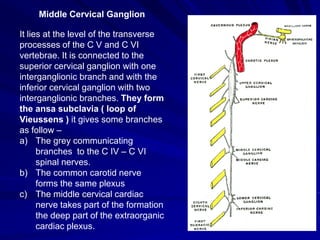
Middle Cervical Ganglion
It lies at the level of the transverse
processes of the C V and C VI
vertebrae. It is connected to the
superior cervical ganglion with one
interganglionic branch and with the
inferior cervical ganglion with two
interganglionic branches. They form
the ansa subclavia ( loop of
Vieussens ) it gives some branches
as follow –
a) The grey communicating
branches to the C IV – C VI
spinal nerves.
b) The common carotid nerve
forms the same plexus
c) The middle cervical cardiac
nerve takes part of the formation
the deep part of the extraorganic
cardiac plexus.
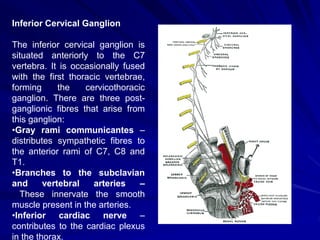
Inferior Cervical Ganglion
The inferior cervical ganglion is
situated anteriorly to the C7
vertebra. It is occasionally fused
with the first thoracic vertebrae,
forming the cervicothoracic
ganglion. There are three post-
ganglionic fibres that arise from
this ganglion:
•Gray rami communicantes –
distributes sympathetic fibres to
the anterior rami of C7, C8 and
T1.
•Branches to the subclavian
and vertebral arteries –
These innervate the smooth
muscle present in the arteries.
•Inferior cardiac nerve –
contributes to the cardiac plexus
in the thorax.
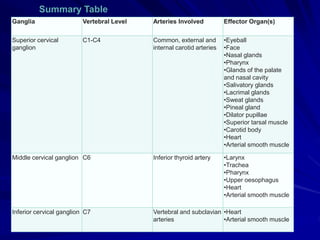
Ganglia Vertebral Level Arteries Involved Effector Organ(s)
Superior cervical
ganglion
C1-C4 Common, external and
internal carotid arteries
•Eyeball
•Face
•Nasal glands
•Pharynx
•Glands of the palate
and nasal cavity
•Salivatory glands
•Lacrimal glands
•Sweat glands
•Pineal gland
•Dilator pupillae
•Superior tarsal muscle
•Carotid body
•Heart
•Arterial smooth muscle
Middle cervical ganglion C6 Inferior thyroid artery •Larynx
•Trachea
•Pharynx
•Upper oesophagus
•Heart
•Arterial smooth muscle
Inferior cervical ganglion C7 Vertebral and subclavian
arteries
•Heart
•Arterial smooth muscle
Summary Table
•
The thoracic part of sympathetic trunk comprises 10 to 12 thoracic
ganglia situated on the heads of ribs below the parietal pleura.
Posteriorly one can distinguish the posterior intercostal arteries and
veins. The thoracic ganglia give the following branches:
1. the grey communicating branches pass to the corresponding
intercostal branches
2. Thoracic cardiac branches
3. The visceral branches which take part in innervation of the
vessels and viscera of the thoracic cavity –
• Oesophageal branches
• Bronchial branches
• Pulmonary branches
4. The greater splanchnic nerve
5. The lesser splanchnic nerve
6, The lowest splanchnic nerve
The lumbar ganglia are situated on the anterolateral surfaces of the
lumbar vertebral bodies. Each lumbar ganglion has two types of
branches-
1. The grey communicating branches – to the lumbar nerves.
2. The lumbar splanchnic nerves which contain mostly preganglionic
fibers and go to the coeliac autonomic plexuses of the abdominal
cavity.
The sacral or pelvic part of the sympathetic trunk is situated on the
pelvic surface of the sacrum medial to the sacral foramina. They give
some branches-
1. The grey communicating branches – to the sacral nerves.
2. The sacral splanchnic nerves – which contain mostly
preganglionic fibres and proceed to the superior and inferior
hypogastric plexuses.
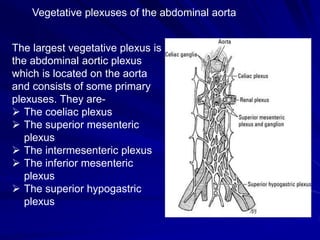
Vegetative plexuses of the abdominal aorta
The largest vegetative plexus is
the abdominal aortic plexus
which is located on the aorta
and consists of some primary
plexuses. They are-
 The coeliac plexus
 The superior mesenteric
plexus
 The intermesenteric plexus
 The inferior mesenteric
plexus
 The superior hypogastric
plexus
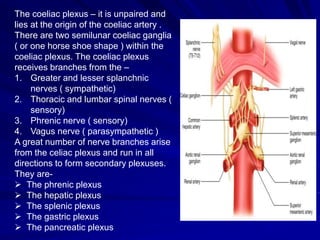
The coeliac plexus – it is unpaired and
lies at the origin of the coeliac artery .
There are two semilunar coeliac ganglia
( or one horse shoe shape ) within the
coeliac plexus. The coeliac plexus
receives branches from the –
1. Greater and lesser splanchnic
nerves ( sympathetic)
2. Thoracic and lumbar spinal nerves (
sensory)
3. Phrenic nerve ( sensory)
4. Vagus nerve ( parasympathetic )
A great number of nerve branches arise
from the celiac plexus and run in all
directions to form secondary plexuses.
They are-
 The phrenic plexus
 The hepatic plexus
 The splenic plexus
 The gastric plexus
 The pancreatic plexus
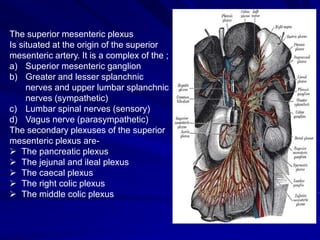
The superior mesenteric plexus
Is situated at the origin of the superior
mesenteric artery. It is a complex of the ;
a) Superior mesenteric ganglion
b) Greater and lesser splanchnic
nerves and upper lumbar splanchnic
nerves (sympathetic)
c) Lumbar spinal nerves (sensory)
d) Vagus nerve (parasympathetic)
The secondary plexuses of the superior
mesenteric plexus are-
 The pancreatic plexus
 The jejunal and ileal plexus
 The caecal plexus
 The right colic plexus
 The middle colic plexus
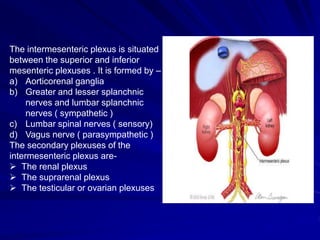
The intermesenteric plexus is situated
between the superior and inferior
mesenteric plexuses . It is formed by –
a) Aorticorenal ganglia
b) Greater and lesser splanchnic
nerves and lumbar splanchnic
nerves ( sympathetic )
c) Lumbar spinal nerves ( sensory)
d) Vagus nerve ( parasympathetic )
The secondary plexuses of the
intermesenteric plexus are-
 The renal plexus
 The suprarenal plexus
 The testicular or ovarian plexuses
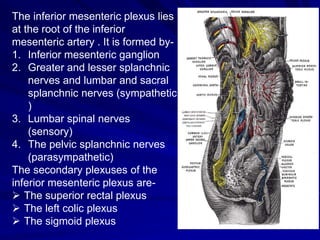
The inferior mesenteric plexus lies
at the root of the inferior
mesenteric artery . It is formed by-
1. Inferior mesenteric ganglion
2. Greater and lesser splanchnic
nerves and lumbar and sacral
splanchnic nerves (sympathetic
)
3. Lumbar spinal nerves
(sensory)
4. The pelvic splanchnic nerves
(parasympathetic)
The secondary plexuses of the
inferior mesenteric plexus are-
 The superior rectal plexus
 The left colic plexus
 The sigmoid plexus
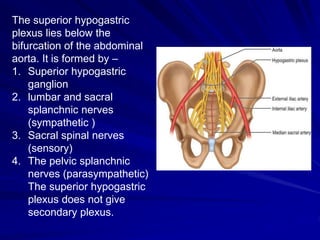
The superior hypogastric
plexus lies below the
bifurcation of the abdominal
aorta. It is formed by –
1. Superior hypogastric
ganglion
2. lumbar and sacral
splanchnic nerves
(sympathetic )
3. Sacral spinal nerves
(sensory)
4. The pelvic splanchnic
nerves (parasympathetic)
The superior hypogastric
plexus does not give
secondary plexus.
THE PELVIC PLEXUS
The inferior hypogastric plexus
is paired and the continuation
of the unpaired superior
hypogastric plexus . It lies on
the posterior wall of the lesser
pelvis.
The secondary plexuses of the
inferior hypogastric plexus are-
• The rectal plexus
• The vesical plexus
• The prostatic plexus
• The uterovaginal plexus
• The plexus of the vas
deferens
Visceral Afferents and Referred Pain
Somatic sensation:
• conscious, sharp, well-localized
• touch, pain, temperature, pressure, proprioception
Visceral sensation:
• often unconscious; if conscious: dull, poorly-localized
• distension, blood gas, blood pressure, cramping, irritants
dorsal root ganglion
Visceral sensory nerves [GVA]
• run with sympathetic &
parasympathetic nerves
• cell bodies in dorsal root ganglion
• nerve ending in viscera
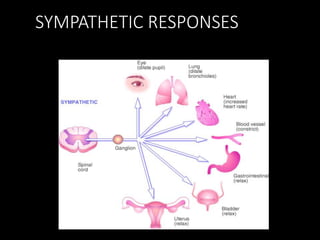
SYMPATHETIC RESPONSES
The Sympathetic Nervous System

The Sympathetic Nervous System

  • 1.
    The Sympathetic Nervous System THEVEGETATIVE NERVOUS SYSTEM THE PARASYMPATHETIC PART
  • 2.
    Sympathetic Nervous System 1.lateral gray horns (T1-L2) 2. thoracolumbar outflow 3. ganglia a. sympathetic trunk (paravertebral) b. Prevertebral (collateral) 4. preganglionic axons short 5. postganglionic axons long
  • 3.
    The paired sympathetictrunk runs from the external cranial base down to the coccyx. It comprises 20-25 ganglia of sympathetic trunk Upon reaching the coccyx, the trunks merge into a single ganglion impar The ganglia of the sympathetic trunk contain the peripheral efferent neurons of the sympathetic part ( multipolar neurons).
  • 4.
    spinal nerve dorsal ramus ventral ramus gray ramus communicans whiteramus communicans sympathetic ganglion intermediolateral gray column Structure of spinal nerves: Sympathetic pathways
  • 5.
    Sympathetic System: PostganglionicCell Bodies Paravertebral ganglia Prevertebral ganglia • celiac ganglion • sup. mesent. g. • inf. mesent. g. aorta sympathetic trunk (chain) 1. Paravertebral ganglia • Located along sides of vertebrae • United by preganglionics into Sympathetic Trunk • Preganglionic neurons are thoracolumbar (T1–L2/L3) but postganglionic neurons are cervical to coccyx • Some preganglionics ascend or descend in trunk synapse at same level ascend to synapse at higher level descend to synapse at lower level Moore’s COA6 2010
  • 6.
    Sympathetic System: PostganglionicCell Bodies Paravertebral ganglia Prevertebral ganglia • celiac ganglion • sup. mesent. g. • inf. mesent. g. aorta sympathetic trunk (chain) 2. Prevertebral (preaortic) ganglia • Located anterior to abdominal aorta, in plexuses surrounding its major branches • Preganglionics reach prevertebral ganglia via abdominopelvic splanchnic nerves Moore’s COA6 2010 abdominopelvic splanchnic nerve
  • 7.
    Sympathetic System: Summary Moore’sCOA6 2010 T1 L2 somatic tissues (body wall, limbs) visceral tissues (organs) postganglionics via 31 spinal nerves to somatic tissues of neck, body wall, and limbs sympathetic trunk prevertebral ganglia Cardiopulmonary Splanchnics: postganglionic fibers to thoracic viscera Abdominopelvic Splanchnics: preganglionic fibers to prevertebral ganglia, postganglionic fibers to abdominopelvic viscera
  • 10.
    Moore’s COA6 2010 somatictissues (body wall, limbs) visceral tissues (organs) Sympathetic System: Preganglionic Cell Bodies • Preganglionic cell bodies in intermediolateral gray • T1 – L2/L3 • Somatotopic organization intermediolateral gray columns lateral horn T1 – L2/L3
  • 11.
    Superior Cervical Ganglion Thesuperior cervical ganglion is located posteriorly to the internal carotid artery, and anterior to the C1-4 vertebrae. Several important post-ganglionic nerves originate from here: Internal carotid nerve – hitch-hikes along the internal carotid artery, forming a network of nerves. Branches from the internal carotid plexus innervate structures in the eye, the pterygopalatine artery and the internal carotid artery itself. External carotid nerve – hitch-hikes along the common and external carotid arteries, forming a network of nerves. It innervates the smooth muscle of the arteries. Nerve to pharyngeal plexus – combines with branches from the vagus and glossopharyngeal nerves to form the pharyngeal plexus. Superior cardiac branch – contributes to the cardiac plexus in the thorax. Gray rami communicantes – join four upper cervical spinal nerves C1-C4.
  • 14.
    Middle Cervical Ganglion Itlies at the level of the transverse processes of the C V and C VI vertebrae. It is connected to the superior cervical ganglion with one interganglionic branch and with the inferior cervical ganglion with two interganglionic branches. They form the ansa subclavia ( loop of Vieussens ) it gives some branches as follow – a) The grey communicating branches to the C IV – C VI spinal nerves. b) The common carotid nerve forms the same plexus c) The middle cervical cardiac nerve takes part of the formation the deep part of the extraorganic cardiac plexus.
  • 15.
    Inferior Cervical Ganglion Theinferior cervical ganglion is situated anteriorly to the C7 vertebra. It is occasionally fused with the first thoracic vertebrae, forming the cervicothoracic ganglion. There are three post- ganglionic fibres that arise from this ganglion: •Gray rami communicantes – distributes sympathetic fibres to the anterior rami of C7, C8 and T1. •Branches to the subclavian and vertebral arteries – These innervate the smooth muscle present in the arteries. •Inferior cardiac nerve – contributes to the cardiac plexus in the thorax.
  • 17.
    Ganglia Vertebral LevelArteries Involved Effector Organ(s) Superior cervical ganglion C1-C4 Common, external and internal carotid arteries •Eyeball •Face •Nasal glands •Pharynx •Glands of the palate and nasal cavity •Salivatory glands •Lacrimal glands •Sweat glands •Pineal gland •Dilator pupillae •Superior tarsal muscle •Carotid body •Heart •Arterial smooth muscle Middle cervical ganglion C6 Inferior thyroid artery •Larynx •Trachea •Pharynx •Upper oesophagus •Heart •Arterial smooth muscle Inferior cervical ganglion C7 Vertebral and subclavian arteries •Heart •Arterial smooth muscle Summary Table •
  • 18.
    The thoracic partof sympathetic trunk comprises 10 to 12 thoracic ganglia situated on the heads of ribs below the parietal pleura. Posteriorly one can distinguish the posterior intercostal arteries and veins. The thoracic ganglia give the following branches: 1. the grey communicating branches pass to the corresponding intercostal branches 2. Thoracic cardiac branches 3. The visceral branches which take part in innervation of the vessels and viscera of the thoracic cavity – • Oesophageal branches • Bronchial branches • Pulmonary branches 4. The greater splanchnic nerve 5. The lesser splanchnic nerve 6, The lowest splanchnic nerve
  • 19.
    The lumbar gangliaare situated on the anterolateral surfaces of the lumbar vertebral bodies. Each lumbar ganglion has two types of branches- 1. The grey communicating branches – to the lumbar nerves. 2. The lumbar splanchnic nerves which contain mostly preganglionic fibers and go to the coeliac autonomic plexuses of the abdominal cavity. The sacral or pelvic part of the sympathetic trunk is situated on the pelvic surface of the sacrum medial to the sacral foramina. They give some branches- 1. The grey communicating branches – to the sacral nerves. 2. The sacral splanchnic nerves – which contain mostly preganglionic fibres and proceed to the superior and inferior hypogastric plexuses.
  • 20.
    Vegetative plexuses ofthe abdominal aorta The largest vegetative plexus is the abdominal aortic plexus which is located on the aorta and consists of some primary plexuses. They are-  The coeliac plexus  The superior mesenteric plexus  The intermesenteric plexus  The inferior mesenteric plexus  The superior hypogastric plexus
  • 21.
    The coeliac plexus– it is unpaired and lies at the origin of the coeliac artery . There are two semilunar coeliac ganglia ( or one horse shoe shape ) within the coeliac plexus. The coeliac plexus receives branches from the – 1. Greater and lesser splanchnic nerves ( sympathetic) 2. Thoracic and lumbar spinal nerves ( sensory) 3. Phrenic nerve ( sensory) 4. Vagus nerve ( parasympathetic ) A great number of nerve branches arise from the celiac plexus and run in all directions to form secondary plexuses. They are-  The phrenic plexus  The hepatic plexus  The splenic plexus  The gastric plexus  The pancreatic plexus
  • 22.
    The superior mesentericplexus Is situated at the origin of the superior mesenteric artery. It is a complex of the ; a) Superior mesenteric ganglion b) Greater and lesser splanchnic nerves and upper lumbar splanchnic nerves (sympathetic) c) Lumbar spinal nerves (sensory) d) Vagus nerve (parasympathetic) The secondary plexuses of the superior mesenteric plexus are-  The pancreatic plexus  The jejunal and ileal plexus  The caecal plexus  The right colic plexus  The middle colic plexus
  • 23.
    The intermesenteric plexusis situated between the superior and inferior mesenteric plexuses . It is formed by – a) Aorticorenal ganglia b) Greater and lesser splanchnic nerves and lumbar splanchnic nerves ( sympathetic ) c) Lumbar spinal nerves ( sensory) d) Vagus nerve ( parasympathetic ) The secondary plexuses of the intermesenteric plexus are-  The renal plexus  The suprarenal plexus  The testicular or ovarian plexuses
  • 24.
    The inferior mesentericplexus lies at the root of the inferior mesenteric artery . It is formed by- 1. Inferior mesenteric ganglion 2. Greater and lesser splanchnic nerves and lumbar and sacral splanchnic nerves (sympathetic ) 3. Lumbar spinal nerves (sensory) 4. The pelvic splanchnic nerves (parasympathetic) The secondary plexuses of the inferior mesenteric plexus are-  The superior rectal plexus  The left colic plexus  The sigmoid plexus
  • 25.
    The superior hypogastric plexuslies below the bifurcation of the abdominal aorta. It is formed by – 1. Superior hypogastric ganglion 2. lumbar and sacral splanchnic nerves (sympathetic ) 3. Sacral spinal nerves (sensory) 4. The pelvic splanchnic nerves (parasympathetic) The superior hypogastric plexus does not give secondary plexus.
  • 26.
    THE PELVIC PLEXUS Theinferior hypogastric plexus is paired and the continuation of the unpaired superior hypogastric plexus . It lies on the posterior wall of the lesser pelvis. The secondary plexuses of the inferior hypogastric plexus are- • The rectal plexus • The vesical plexus • The prostatic plexus • The uterovaginal plexus • The plexus of the vas deferens
  • 27.
    Visceral Afferents andReferred Pain Somatic sensation: • conscious, sharp, well-localized • touch, pain, temperature, pressure, proprioception Visceral sensation: • often unconscious; if conscious: dull, poorly-localized • distension, blood gas, blood pressure, cramping, irritants dorsal root ganglion Visceral sensory nerves [GVA] • run with sympathetic & parasympathetic nerves • cell bodies in dorsal root ganglion • nerve ending in viscera
  • 29.