Brain stem
Brain stem 1
Basic Structure of Brain Stem
 1. Roof Plate
 2.Tegmentum
 3. Basal Portion
Brain stem 2
Basilar (Basal) Portion
 Descending Fibers from Cerebral Cortex
 1. Corticospinal Tract
 2. Corticobulbar Tract
 3. Corticopontocerebellar Fiber
Corticopontine Fiber
Pons Proper (Ventral Pons)
Pontocerebellar Fiber
Brain stem 3
Basal Portion Descending Tracts
 Corticospinal Tract
 Origin: Cerebral Cortex
Brodmann Area 4 (Primary Motor Area, M I)
Brodmann Area 6 (Premotor Area, PM )
Brodmann Area 3,1,2 (Primary Somesthetic Area, S I)
Brodmann Area 5 (Anterior Portion of Sup. Parietal Lobule)
 Corona Radiata
 lnternal Capsule, Posterior Limb
 Crus Cerebri, Middle Portion
 Longitudinal Pontine Fiber
 Pyramid - pyramidal decussation
 Corticospinal Tract - Lateral and Anterior
 Termination: Spinal Gray (Rexed IV-IX)
Brain stem 4
 Corticobulbar Tract
 - Corticofugal fibers projecting to, and terminating in,
portions of lower brainstem
 - Termination:
 1) motor nuclei (upper motor neuron pathway)
hypoglossal, ambiguus, facial motor,
trigeminal motor, abducens, trochlear
and oculomotor nucleus
 2) sensory relay nuclei
nuclei gracilis and cuneatus, trigeminal
sensory nucleus, solitary tract nucleus
 3) reticular formation (corticoreticular fiber)
Basal Portion Descending Tracts
Brain stem 5
Basal Portion Descending Tracts
 Corticobulbar Tract - UMN Pathway
 - Corticofugal fibers projecting to cranial motor nuclei
 GSE - hypoglossal (XII), abducens (VI),
trochlear (IV) and oculomotor (III) nucleus
 SVE - ambiguus (IX, X, XI), facial motor (VII),
trigeminal motor (V) nucleus
 - largely bilateral
laryngeal, pharyngeal, palatal and upper facial
muscles of mastication and extraocular muscles
 - unilateral
lower facial musculature (facial palsy)
SCM and trapezius (uncrossed) --- spinal accessory
 - Pseudobulbar Palsy --- syndrome of bilateral UMN lesion
Brain stem 6
Basal Portion Descending Tracts
 Corticopontocerebellar Fiber
 - Corticofugal fibers projecting to
cerebellar hemisphere
 - consists of 2 neuron chain
 1. Corticopontine fiber projecting to
pontine nuclei
 2. Pontocerebellar fiber
crossed mudline and enter cerebellum
as middle cerebellar peduncle
Brain stem 7
Roof Plate
 Midbrain
Superior Colliculus: vision
Inferior Colliculus: hearing
 Closed Medulla
Nucleus Gracilis et Cuneatus:
discriminative touch sensation
 cf. Cerebelum: equilibrium
Brain stem 8
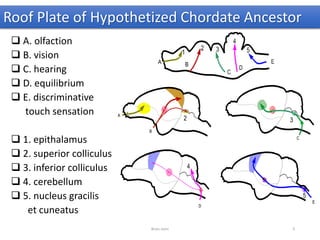
Roof Plate of Hypothetized Chordate Ancestor
 A. olfaction
 B. vision
 C. hearing
 D. equilibrium
 E. discriminative
touch sensation
 1. epithalamus
 2. superior colliculus
 3. inferior colliculus
 4. cerebellum
 5. nucleus gracilis
et cuneatus
Brain stem 9
Tegmentum
 Cranial nerve Nuclei
 Precerebellar Nuclei
 Reticular Formation
 Tracts
 Ascending Cortical Pathway
 Cerebellar Circuits
 Descending Tract
 Composite Bundle
Brain stem 10
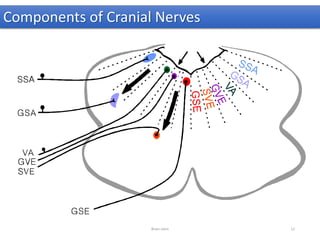
 Cranial
Nerves
 Columns of
 Brain Stem
 Motor Column
 1. GSE
 2. SVE
 3. GVE
 Sensory Column
 4. VA (GVA & SVA)
 5. GSA
 6. SSA Brain stem 11
Components of Cranial Nerves
Brain stem 12
General Somatic Efferent Nuclei (GSE)
 Hypoglossal Nucleus XII
 Abducens Nucleus VI
 Trochlear Nucleus IV
 Oculomotor Nucleus III
Brain stem 13
Special Visceral Efferent Nuclei (SVE)
 Nucleus Ambiguus IX, X, XI
 Facial Motor Nucleus VII
 Trigeminal Motor Nucleus V
Brain stem 14
General Visceral Efferent Nuclei (GVE)
 Dorsal Motor Nucleus of Vagus X
 Inferior Salivatory Nucleus IX
 Superior Salivatory Nucleus VII
 Edinger-Westphal Nucleus III
Brain stem 15
 Motor Nuclei of
Cranial Nerves
 1. GSE
III, IV, VI, XII
 2. SVE
V, VII,
IX, X, XI
 3. GVE
III, VII, IX, X
Brain stem 16
General Somatic Afferent Nuclei (GSA)
 Trigeminal Sensory Nucleus V, VII, IX, X
 Mesencephalic Tract Nucleus
 Principal (Main) Sensory Nucleus
 Spinal Tract Nucleus
pars oralis
pars interpolaris
pars caudalis
Brain stem 17
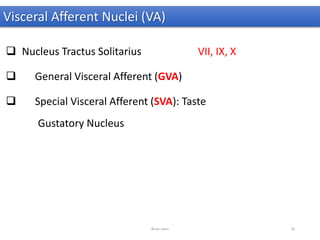
Visceral Afferent Nuclei (VA)
 Nucleus Tractus Solitarius VII, IX, X
 General Visceral Afferent (GVA)
 Special Visceral Afferent (SVA): Taste
Gustatory Nucleus
Brain stem 18
Special Somatic Afferent Nuclei (SSA)
 Cochlear Nucleus VIIIc
Dorsal Cochlear Nucleus
Ventral Cochlear Nucleus
 Vestibular Nucleus VIIIv
Medial Vestibular Nucleus
Lateral Vestibular Nucleus
Superior Vestibular Nucleus
Inferior Vestibular Nucleus
Brain stem 19
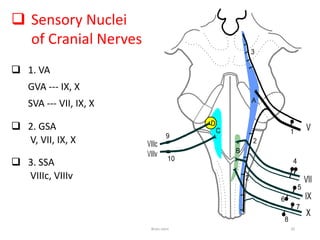
 Sensory Nuclei
of Cranial Nerves
 1. VA
GVA --- IX, X
SVA --- VII, IX, X
 2. GSA
V, VII, IX, X
 3. SSA
VIIIc, VIIIv
Brain stem 20
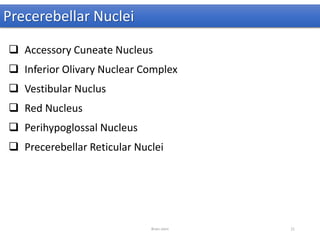
Precerebellar Nuclei
 Accessory Cuneate Nucleus
 Inferior Olivary Nuclear Complex
 Vestibular Nuclus
 Red Nucleus
 Perihypoglossal Nucleus
 Precerebellar Reticular Nuclei
Brain stem 21
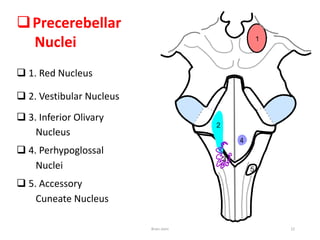
Precerebellar
Nuclei
 1. Red Nucleus
 2. Vestibular Nucleus
 3. Inferior Olivary
Nucleus
 4. Perhypoglossal
Nuclei
 5. Accessory
Cuneate Nucleus
Brain stem 22
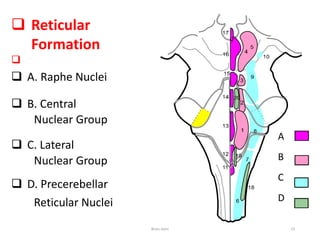
 Reticular
Formation

 A. Raphe Nuclei
 B. Central
Nuclear Group
 C. Lateral
Nuclear Group
 D. Precerebellar
Reticular Nuclei
A
B
C
D
Brain stem 23
Central Nuclear Group of Reticular Formation
 Gigantocellular Reticular Nucleus
 Caudal Reticulopontine Nucleus
 Oral Reticulopontine Nucleus
 Subcuneiform Nucleus
 Cuneiform Nucleus
Brain stem 24
Lateral Nuclear Group of Reticular Formation
 Central Nucleus of Medulla Oblongata
 Superficial Ventrolateral Reticular Area
 Parvicellular Reticular Nucleus
 Parabrachial Nucleus
 Pedunculopontine Nucleus
Brain stem 25
Raphe Nuclei - Serotonergic Neuron
 Nucleus Raphe Obscrus, B2
 Nucleus Raphe Pallidus, B1
 Nucleus Raphe Magnus, B3
 Pontine Raphe Nucleus, B5
 Median Raphe or Superior Central Nucleus, B6, B8
 Dorsal Raphe Nucleus, B7
 Nucleus Linealis
Brain stem 26
Norepinephrinergic & Dopaminergic Neuron
 Norepinephrinergic Neuron
Nucleus Locus Ceruleus, A6
 Dopaminergic Neuron
Retrorubral Area, A8
Ventral Tegmental Area, A10
Substantia Nigra, Pars Compacta, A9
Brain stem 27
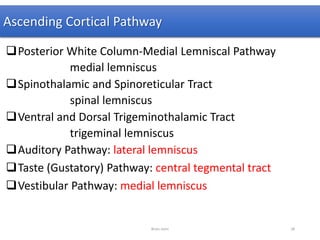
Ascending Cortical Pathway
Posterior White Column-Medial Lemniscal Pathway
medial lemniscus
Spinothalamic and Spinoreticular Tract
spinal lemniscus
Ventral and Dorsal Trigeminothalamic Tract
trigeminal lemniscus
Auditory Pathway: lateral lemniscus
Taste (Gustatory) Pathway: central tegmental tract
Vestibular Pathway: medial lemniscus
Brain stem 28
Ascending Cortical System General Sensation
 Brain Stem Pathways for General
Sensation
 Touch & Proprioception from body
Posterior White Colum-Medial Lemniscal Pathway
 Pain & Temperature from body
Spinothalamic Tract
cf. Spinoreticular or Spinoreticulothalamic Tract
 General Sensation from Face
Trigeminothalamic Tracts
Brain stem 29
Posterior White Column - medial Lemniscal Pathway
& Spinothalamic Tract
Brain stem 30
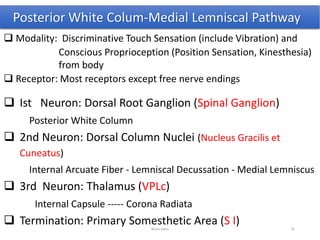
Posterior White Colum-Medial Lemniscal Pathway
 Modality: Discriminative Touch Sensation (include Vibration) and
Conscious Proprioception (Position Sensation, Kinesthesia)
from body
 Receptor: Most receptors except free nerve endings
 Ist Neuron: Dorsal Root Ganglion (Spinal Ganglion)
Posterior White Column
 2nd Neuron: Dorsal Column Nuclei (Nucleus Gracilis et
Cuneatus)
Internal Arcuate Fiber - Lemniscal Decussation - Medial Lemniscus
 3rd Neuron: Thalamus (VPLc)
Internal Capsule ----- Corona Radiata
 Termination: Primary Somesthetic Area (S I)Brain stem 31
DRG: Dorsal Root Ganglion
1. Posterior White Column
A. Nucleus gracilis
B. Nucleus cuneatus
2. Medial Lemniscus
3. Corona Radiata
C. Thalamus (VPLc)
D. Cerebral Cortex (S I)
Posterior White Column-Medial Lemniscal Pathway
DRG
D
Brain stem 32
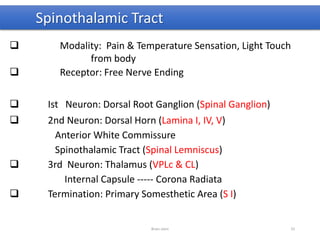
Spinothalamic Tract
 Modality: Pain & Temperature Sensation, Light Touch
from body
 Receptor: Free Nerve Ending
 Ist Neuron: Dorsal Root Ganglion (Spinal Ganglion)
 2nd Neuron: Dorsal Horn (Lamina I, IV, V)
Anterior White Commissure
Spinothalamic Tract (Spinal Lemniscus)
 3rd Neuron: Thalamus (VPLc & CL)
Internal Capsule ----- Corona Radiata
 Termination: Primary Somesthetic Area (S I)
Brain stem 33
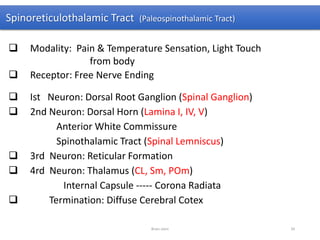
Spinoreticulothalamic Tract (Paleospinothalamic Tract)
 Modality: Pain & Temperature Sensation, Light Touch
from body
 Receptor: Free Nerve Ending
 Ist Neuron: Dorsal Root Ganglion (Spinal Ganglion)
 2nd Neuron: Dorsal Horn (Lamina I, IV, V)
Anterior White Commissure
Spinothalamic Tract (Spinal Lemniscus)
 3rd Neuron: Reticular Formation
 4rd Neuron: Thalamus (CL, Sm, POm)
Internal Capsule ----- Corona Radiata
 Termination: Diffuse Cerebral Cotex
Brain stem 34
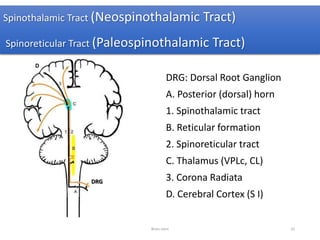
DRG: Dorsal Root Ganglion
A. Posterior (dorsal) horn
1. Spinothalamic tract
B. Reticular formation
2. Spinoreticular tract
C. Thalamus (VPLc, CL)
3. Corona Radiata
D. Cerebral Cortex (S I)
Spinothalamic Tract (Neospinothalamic Tract)
Spinoreticular Tract (Paleospinothalamic Tract)
DRG
D
Brain stem 35
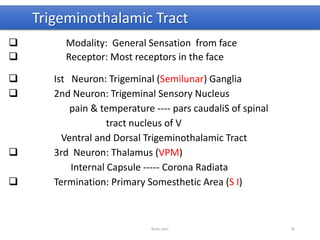
Trigeminothalamic Tract
 Modality: General Sensation from face
 Receptor: Most receptors in the face
 Ist Neuron: Trigeminal (Semilunar) Ganglia
 2nd Neuron: Trigeminal Sensory Nucleus
pain & temperature ---- pars caudaliS of spinal
tract nucleus of V
Ventral and Dorsal Trigeminothalamic Tract
 3rd Neuron: Thalamus (VPM)
Internal Capsule ----- Corona Radiata
 Termination: Primary Somesthetic Area (S I)
Brain stem 36
Trigeminothalamic Tract
A. trigeminal ganglion
B. trigeminal sensory
nucleus
C. thalamus (VPM)
D. cerebral cortex (S I)
1. spinal tract of
trigeminal nerve
2. ventral
trigeminothalamic tract
3. dorsal
trigeminothalamic tract
4. corona radiata
V. trigeminal nerve
Brain stem 37
Ascending Cortical System Special Sensation
 Brain Stem Pathways for Special Sensation
 Gustatory Sensation (Taste, SVA)
----- Taste Pathway
 Auditory Sensation (Hearing, SSA)
----- Auditory Pathway
 Vestibular Sensation (Equilibrium, SSA)
----- Vestibular Pathway
Brain stem 38
Auditory Pathway
 Modality: Auditory Sensation (Hearing)
 Receptor: Organ of Coti of Cochlear Duct
Cranial Nerve: VIIIc
 1st Neuron: Spiral Ganglion
 2nd Neuron: Cochlear Nucleus, Ventral & Dorsal
dorsal, intermediate and ventral acoustic striae
trapezoid body
lateral lemniscus
 3rd Neuron: Inferior Colliculus
brachium of inferior colliculus
 4th Neuron: Medial Geniculate Nucleus (MG)
auditory radiation
 Termination: Primary Auditory Area (A I)
Brodmann area 31, 32
Brain stem 39
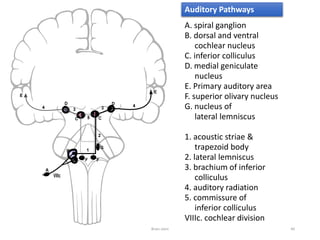
Auditory Pathways
A. spiral ganglion
B. dorsal and ventral
cochlear nucleus
C. inferior colliculus
D. medial geniculate
nucleus
E. Primary auditory area
F. superior olivary nucleus
G. nucleus of
lateral lemniscus
1. acoustic striae &
trapezoid body
2. lateral lemniscus
3. brachium of inferior
colliculus
4. auditory radiation
5. commissure of
inferior colliculus
VIIIc. cochlear division
Brain stem 40
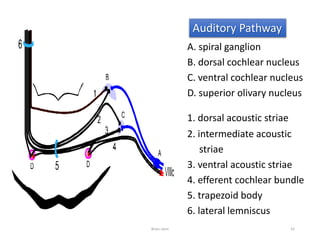
Auditory Pathway
A. spiral ganglion
B. dorsal cochlear nucleus
C. ventral cochlear nucleus
D. superior olivary nucleus
1. dorsal acoustic striae
2. intermediate acoustic
striae
3. ventral acoustic striae
4. efferent cochlear bundle
5. trapezoid body
6. lateral lemniscus
Brain stem 41
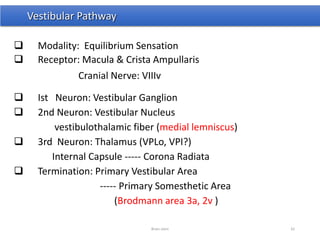
Vestibular Pathway
 Modality: Equilibrium Sensation
 Receptor: Macula & Crista Ampullaris
Cranial Nerve: VIIIv
 Ist Neuron: Vestibular Ganglion
 2nd Neuron: Vestibular Nucleus
vestibulothalamic fiber (medial lemniscus)
 3rd Neuron: Thalamus (VPLo, VPI?)
Internal Capsule ----- Corona Radiata
 Termination: Primary Vestibular Area
----- Primary Somesthetic Area
(Brodmann area 3a, 2v )
Brain stem 42
1. Vestibulocerebellar
Tract
2. Vestibulospinal Tract
3. Vestibulothalamic Tract
4. Medial Longitudinal
fasciculus (MLF)
- ascending portion
- descending portion
- interstitiospinal tract
Brain stem 43
Vestibular Pathway
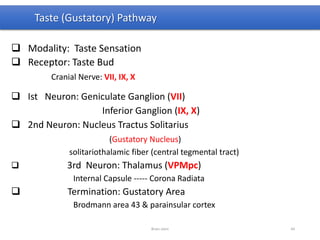
Taste (Gustatory) Pathway
 Modality: Taste Sensation
 Receptor: Taste Bud
Cranial Nerve: VII, IX, X
 Ist Neuron: Geniculate Ganglion (VII)
Inferior Ganglion (IX, X)
 2nd Neuron: Nucleus Tractus Solitarius
(Gustatory Nucleus)
solitariothalamic fiber (central tegmental tract)
 3rd Neuron: Thalamus (VPMpc)
Internal Capsule ----- Corona Radiata
 Termination: Gustatory Area
Brodmann area 43 & parainsular cortex
Brain stem 44
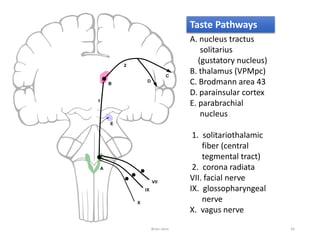
Taste Pathways
A. nucleus tractus
solitarius
(gustatory nucleus)
B. thalamus (VPMpc)
C. Brodmann area 43
D. parainsular cortex
E. parabrachial
nucleus
1. solitariothalamic
fiber (central
tegmental tract)
2. corona radiata
VII. facial nerve
IX. glossopharyngeal
nerve
X. vagus nerve
Brain stem 45
Cerebellar Circuits
 Superior, Middle and Inferior Cerebellar Peduncle
 Vestibulocerebellum - Vestibular Nucleus
 Spinocerebellum - Red Nucleus and Spinal Cord
 Pontocerebellum - Cerebral Cortex and Pontine Nuclei
 Inferior Olivary Nuclear Complex
Brain stem 46
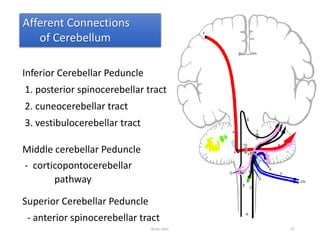
Inferior Cerebellar Peduncle
1. posterior spinocerebellar tract
2. cuneocerebellar tract
3. vestibulocerebellar tract
Middle cerebellar Peduncle
- corticopontocerebellar
pathway
Superior Cerebellar Peduncle
- anterior spinocerebellar tract
Brain stem 47
Afferent Connections
of Cerebellum
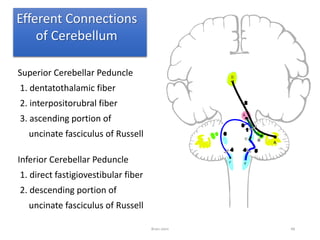
Superior Cerebellar Peduncle
1. dentatothalamic fiber
2. interpositorubral fiber
3. ascending portion of
uncinate fasciculus of Russell
Inferior Cerebellar Peduncle
1. direct fastigiovestibular fiber
2. descending portion of
uncinate fasciculus of Russell
Brain stem 48
Efferent Connections
of Cerebellum
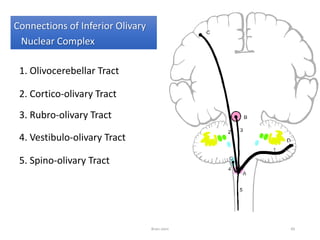
1. Olivocerebellar Tract
2. Cortico-olivary Tract
3. Rubro-olivary Tract
4. Vestibulo-olivary Tract
5. Spino-olivary Tract
Brain stem 49
Connections of Inferior Olivary
Nuclear Complex
Descending Tracts
 Rubrospinal Tract
 Tectospinal tract
 Vestibulospinal Tract
 Reticulospinal Tract
pontine and medullary
 Descending Autonomic Pathway
Brain stem 50
Brain Stem Descending Tracts
 Descending Tracts from Brain Stem
 Dorsolateral (Motor) Pathway
Rubrospinal Tract
 Ventromedial (Motor) Pathway
Tectospinal Tract
 Vestibulospinal Tract
 MLF (Medial Longitudinal Fasciculus)
- interstitiospinal tract
 Sensory Modulation pathways
 Raphespinal & Cerulospinal Pathways
 Descending Autonomic Pathways
Brain stem 51
Composite Bundle
 Medial Longitudinal Fasciculus (MLF)
 Dorsal Longitudinal Fasciculus (DLF)
 Central Tegmental Tract
Brain stem 52
Components of Medial Longitudinal Fasciculus (MLF)
 Descending Components
Medial Vestibulospinal Tract
from medial and inferior vestibular nucleus
Interstitiospinal Tract
from interstitial nucleus of Cajal
 Ascending Components
Efferents from Medial Vestibular Nucleus
contralateral III, IV, interstitial nucleus
bilateral VI nucleus
Efferents from Superior Vestibular Nucleus
ipsilateral III, IV, interstitial nucleus
Brain stem 53
 Ascending Components
solitariohypothalamic fiber
(visceral afferent fiber)
ascending serotonergic fiber
 Descending Component
descending fibers from hypothalamus
to periaqueductal gray and
dorsal tegmental nucleus
Components of Dorsal Longitudinal Fasciculus
(DLF, fasciculus of Schütz)
Brain stem 54
Components of Central Tegmental Tract
 Ascending Components
reticulothalamic fiber
solitariothalamic fiber
(secondary taste fiber)
 Descending Component
rubro-olivary tract
Brain stem 55
Spinomedullary Transition (Level of Pyramidal Decussation)
 Roof Plate - fasciculus gracilis and fasciculus cuneatus
 Tegmentum
Cranial and Spinal Nerve Nuclei
Supraspinal Nucleus
Spinal Nucleus of Trigeminal Nerve, Pars Caudalis
 Reticular Formation
Central Nucleus of Medulla Oblongata
(Ventral Reticular Nucleus)
 Unclassified Nuclei
Retroambiguus Nucleus
 Tracts
Spinal Tracts of Trigeminal Nerve
 Basal Part - Pyramid, Pyramidal Decussation
Brain stem 56
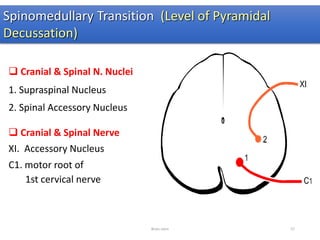
 Cranial & Spinal N. Nuclei
1. Supraspinal Nucleus
2. Spinal Accessory Nucleus
 Cranial & Spinal Nerve
XI. Accessory Nucleus
C1. motor root of
1st cervical nerve
Spinomedullary Transition (Level of Pyramidal
Decussation)
Brain stem 57
Lower Medulla (Level of Lemniscal Decussation)
 Roof Plate - nucleus gracilis and nucleus cuneatus
 Tegmentum
 Cranial and Spinal Nerve Nuclei
Hypoglossal Nucleus, Ambiguus Nucleus
Solitary Tract Nucleus, Dorsal Motor Nucleus of X
 Reticular Formation
Lateral Reticular Nucleus
 Precerebellar Nuclei
Inferior Olivary Nuclear Complex
 Tracts
Ventral Trigeminothalamic Tract
Internal Arcuate Fiber, Lemniscal Decussation
 Basal Part - Pyramid, Pyramidal Decussation
Brain stem 58
Lower Medulla
(Level of Lemniscal
Decussation)
Roof Plate
A. Nucleus Gracilis
B. Nucleus Cuneatus
Cranial Nerve Nuclei
1. Hypoglossal Nucleus
2. Nucleus Ambiguus
3. Dorsal Motor Nucleus of X
4. Nucleus Tractus Solitarius
5. Spinal Tract Nucleus of
Trigeminal Nerve
Brain stem 59
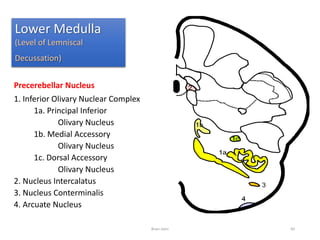
Lower Medulla
(Level of Lemniscal
Decussation)
Precerebellar Nucleus
1. Inferior Olivary Nuclear Complex
1a. Principal Inferior
Olivary Nucleus
1b. Medial Accessory
Olivary Nucleus
1c. Dorsal Accessory
Olivary Nucleus
2. Nucleus Intercalatus
3. Nucleus Conterminalis
4. Arcuate Nucleus
Brain stem 60
Lower Medulla
(Level of Lemniscal
Decussation)
Reticular Formation
1. Lateral Reticular Nucleus
2. Central Nucleus of
Medulla Oblongata
2d. subnucleus dorsalis
2v. subnucleus ventralis
Brain stem 61
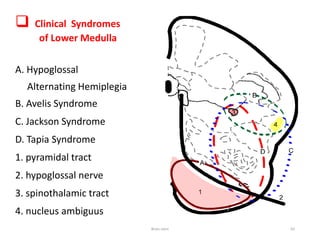
 Clinical Syndromes
of Lower Medulla
A. Hypoglossal
Alternating Hemiplegia
B. Avelis Syndrome
C. Jackson Syndrome
D. Tapia Syndrome
1. pyramidal tract
2. hypoglossal nerve
3. spinothalamic tract
4. nucleus ambiguus
Brain stem 62
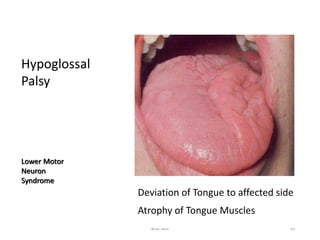
Hypoglossal
Palsy
Lower Motor
Neuron
Syndrome
Deviation of Tongue to affected side
Atrophy of Tongue Muscles
Brain stem 63
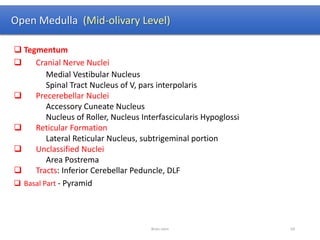
Open Medulla (Mid-olivary Level)
 Tegmentum
 Cranial Nerve Nuclei
Medial Vestibular Nucleus
Spinal Tract Nucleus of V, pars interpolaris
 Precerebellar Nuclei
Accessory Cuneate Nucleus
Nucleus of Roller, Nucleus Interfascicularis Hypoglossi
 Reticular Formation
Lateral Reticular Nucleus, subtrigeminal portion
 Unclassified Nuclei
Area Postrema
 Tracts: Inferior Cerebellar Peduncle, DLF
 Basal Part - Pyramid
Brain stem 64
Cranial Nerve Nuclei
1. Hypoglossal Nucleus
2. Nucleus Ambiguus
3. Dorsal Motor Nucleus of X
4. Nucleus Tractus Solitarius
5. Spinal Tract Nucleus,
pars interpolaris
6. Medial Vestibular Nucleus
Open Medulla
(Mid-olivary Level)
Brain stem 65
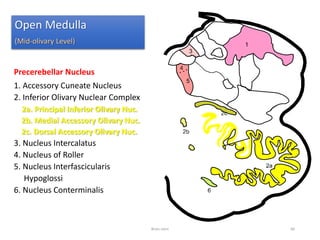
Open Medulla
(Mid-olivary Level)
Precerebellar Nucleus
1. Accessory Cuneate Nucleus
2. Inferior Olivary Nuclear Complex
2a. Principal Inferior Olivary Nuc.
2b. Medial Accessory Olivary Nuc.
2c. Dorsal Accessory Olivary Nuc.
3. Nucleus Intercalatus
4. Nucleus of Roller
5. Nucleus Interfascicularis
Hypoglossi
6. Nucleus Conterminalis
Brain stem 66
Open Medulla (Mid-olivary Level)
XII. Hypoglossal Nerve
1. Hypoglossal Nucleus
X. Vagus Nerve
2. Nucleus Ambiguus
3. Dorsal Motor Nucleus of
X
4. Nucleus Tractus Solitarius
5. Spinal Tract Nucleus of V
Brain stem 67
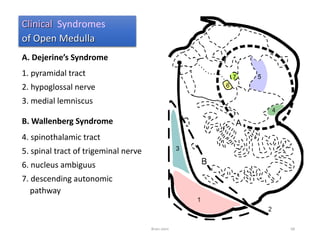
A. Dejerine’s Syndrome
1. pyramidal tract
2. hypoglossal nerve
3. medial lemniscus
B. Wallenberg Syndrome
4. spinothalamic tract
5. spinal tract of trigeminal nerve
6. nucleus ambiguus
7. descending autonomic
pathway
Clinical Syndromes
of Open Medulla
Brain stem 68
Wallenberg Syndrome
Spinothalamic tract
- contralateral loss of pain and
temperature sensation at the body
Spinal tract of trigeminal nerve
- ipsilateral loss of pain and
temperature sensation at the face
Nucleus ambiguus
- dysphageia, dysarthria, hoarseness
Descending autonomic pathway
- Horner’s syndrome
(meiosis, ptosis, anhydrosis) Brain stem 69
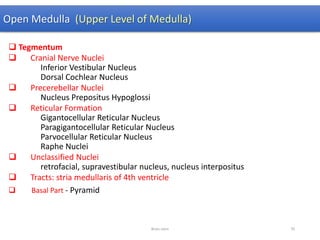
Open Medulla (Upper Level of Medulla)
 Tegmentum
 Cranial Nerve Nuclei
Inferior Vestibular Nucleus
Dorsal Cochlear Nucleus
 Precerebellar Nuclei
Nucleus Prepositus Hypoglossi
 Reticular Formation
Gigantocellular Reticular Nucleus
Paragigantocellular Reticular Nucleus
Parvocellular Reticular Nucleus
Raphe Nuclei
 Unclassified Nuclei
retrofacial, supravestibular nucleus, nucleus interpositus
 Tracts: stria medullaris of 4th ventricle
 Basal Part - Pyramid
Brain stem 70
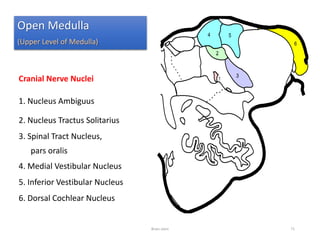
Cranial Nerve Nuclei
1. Nucleus Ambiguus
2. Nucleus Tractus Solitarius
3. Spinal Tract Nucleus,
pars oralis
4. Medial Vestibular Nucleus
5. Inferior Vestibular Nucleus
6. Dorsal Cochlear Nucleus
Open Medulla
(Upper Level of Medulla)
Brain stem 71
Open Medulla
(Upper Level of Medulla)
Precerebellar Nucleus
1. Inferior Olivary Nuclear Complex
1a. Principal Inferior Olivary Nuc.
1b. Medial Accessory Olivary Nuc.
1c. Dorsal Accessory Olivary Nuc.
2. Nucleus Prepositus Hypoglossi
3. Pontobulbar Body
4. Arcuate Nucleus
5. Medial Vestibular Nucleus
6. Inferior Vestibular Nucleus
Brain stem 72
Open Medulla
(Upper Level of Medulla)
Reticular Formation
1. Paramedian reticular Nucleus
2. Gigantocellular Reticular Nucleus
3. paragigantocellular
Reticular Nucleus
4. Parvocellular Reticular Nucleus
5. Nucleus raphe Obscrus (B2)
6. Nucleus Raphe Pallidus (B1)
7. Nucleus Raphe Magnus (B3)
Unclassifiied Nuclei
A. Nucleus Retrofacialis
B. Supravestibular Nucleus
C. Nucleus Interpositus
Brain stem 73
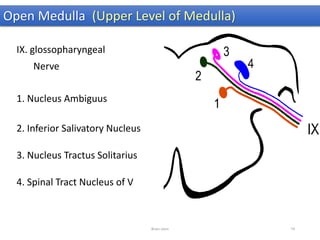
IX. glossopharyngeal
Nerve
1. Nucleus Ambiguus
2. Inferior Salivatory Nucleus
3. Nucleus Tractus Solitarius
4. Spinal Tract Nucleus of V
Open Medulla (Upper Level of Medulla)
Brain stem 74
Pontomedullary Junction
 Tegmentum
 Cranial Nerve Nuclei
Facial Motor Nucleus
Ventral Cochlear Nucleus
 Precerebellar Nuclei
 Reticular Formation
 Unclassified Nuclei
nucleus ovalis
 Tracts
 Basal Part - Pyramid
 Cranial Nerve - Vestibulocochlear Nerve (VIII)
Facial Nerve (VII)
Brain stem 75
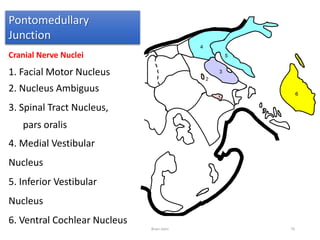
Cranial Nerve Nuclei
1. Facial Motor Nucleus
2. Nucleus Ambiguus
3. Spinal Tract Nucleus,
pars oralis
4. Medial Vestibular
Nucleus
5. Inferior Vestibular
Nucleus
6. Ventral Cochlear Nucleus
Pontomedullary
Junction
Brain stem 76
Pontomedullary
Junction
Precerebellar Nucleus
1. Principal Inferior
Olivary Nucleus
2. Nucleus Prepositus
Hypoglossi
3. Pontobulbar Body
4. Arcuate Nucleus
5. Medial Vestibular
Nucleus
6. Inferior Vestibular
Nucleus Brain stem 77
Pontomedullary
Junction
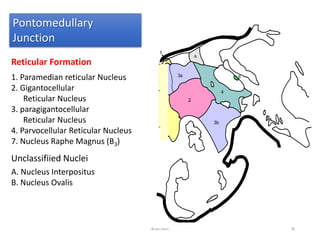
Reticular Formation
1. Paramedian reticular Nucleus
2. Gigantocellular
Reticular Nucleus
3. paragigantocellular
Reticular Nucleus
4. Parvocellular Reticular Nucleus
7. Nucleus Raphe Magnus (B3)
Unclassifiied Nuclei
A. Nucleus Interpositus
B. Nucleus Ovalis
Brain stem 78
Lower Pons (Level of Abducens Nucleus)
 Tegmentum
 Cranial Nerve Nuclei
Abducens Nucleus, Main Sensory Nucleus of V
 Nuclei of Auditory Pathway
Superior Olivary Nuclear Complex
 Reticular Formation
Caudal Pontine Reticular & Subceruleus Nucleus
 Tracts
Trapezoid Body, lateral Lemniscus,
Central tegmental Tract
 Basal Part: Pons Proper:
Pontine Nuclei,
Transverse Pontine Fiber,
Longitudinal Pontine Fiber (Pyramidal Tract)
Brain stem 79
Lower Pons (Level of Abducens Nucleus)
Cranial Nerve Nuclei
1. Abducens Nucleus
2. Main Sensory Nucleus of V
3. Lateral vestibular Nucleus
4. Superior Vestibular Nucleus
Auditory Relay Nuclei
A. Superior Olivary Nucleus
B. Nucleus of Trapezoid body
Brain stem 80
Lower Pons (Level of Abducens Nucleus)
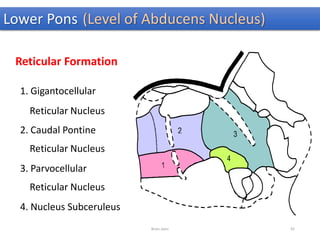
Reticular Formation
1. Gigantocellular
Reticular Nucleus
2. Caudal Pontine
Reticular Nucleus
3. Parvocellular
Reticular Nucleus
4. Nucleus Subceruleus
Brain stem 81
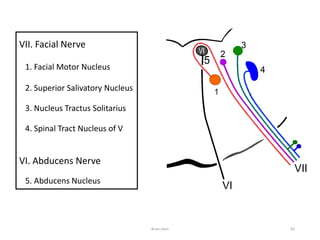
VII. Facial Nerve
1. Facial Motor Nucleus
2. Superior Salivatory Nucleus
3. Nucleus Tractus Solitarius
4. Spinal Tract Nucleus of V
VI. Abducens Nerve
5. Abducens Nucleus
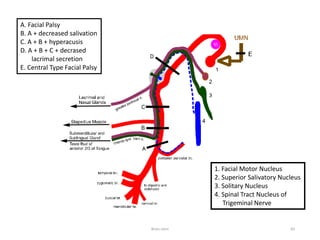
Brain stem 82
A. Facial Palsy
B. A + decreased salivation
C. A + B + hyperacusis
D. A + B + C + decrased
lacrimal secretion
E. Central Type Facial Palsy
1. Facial Motor Nucleus
2. Superior Salivatory Nucleus
3. Solitary Nucleus
4. Spinal Tract Nucleus of
Trigeminal Nerve
Brain stem 83
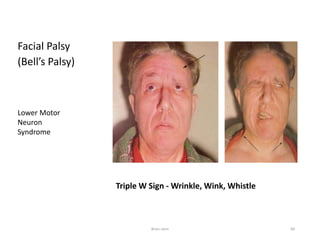
Facial Palsy
(Bell’s Palsy)
Lower Motor
Neuron
Syndrome
Triple W Sign - Wrinkle, Wink, Whistle
Brain stem 84
Right facial paralysis
Facial Palsy (Bell’s Palsy)
Brain stem 85
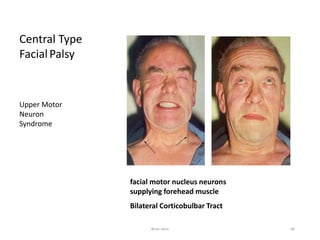
Central Type
FacialPalsy
Upper Motor
Neuron
Syndrome
facial motor nucleus neurons
supplying forehead muscle
Bilateral Corticobulbar Tract
Brain stem 86
Abducens
Palsy
Lower Motor
Neuron
Syndrome
Lateral Gaze Paralysis
Brain stem 87
Upper Pons (Level of Trigeminal Motor Nucleus)
 Tegmentum
 Cranial Nerve Nuclei
Trigeminal Motor Nucleus,
Mesencephalic Tract Nucleus of Trigeminal Nerve
 Nuclei of Auditory Pathway
Nucleus of Lateral Lemniscus
 Reticular Formation
Reticular Tegmental Nucleus
 Unclassified Nucleus
Pontine Central Gray: Ch6
 Tracts
Trigeminal Nerve Fiber
 Basal Part: Pons Proper
Brain stem 88
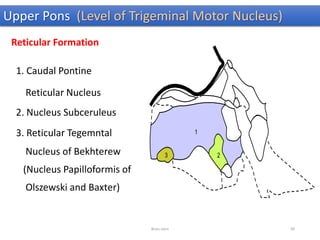
Upper Pons (Level of Trigeminal Motor Nucleus)
 Cranial Nerve Nuclei
1. Trigeminal Motor Nucleus
2. Main Sensory Nucleus of V
3. Mesencephalic Tract
Nucleus of V
4. Superior Vestibular Nucleus
Auditory Relay Nuclei
A. Nucleus of Lateral Lemniscus
Brain stem 89
Upper Pons (Level of Trigeminal Motor Nucleus)
Reticular Formation
1. Caudal Pontine
Reticular Nucleus
2. Nucleus Subceruleus
3. Reticular Tegemntal
Nucleus of Bekhterew
(Nucleus Papilloformis of
Olszewski and Baxter)
Brain stem 90
A. Millard-Gubler Syndrome
B. Raymond Syndrome
C. Foville Syndrome
D. Raymond-Cestan Syndrome
E. Marie-Poix Syndrome
1. pyramidal tract
2. MLF
3. medial lemniscus
4. spinothalamic tract
5. trigeminal motor nucleus
6. main sensory nucleus of V
7. spinal tract of trigeminal nerve
8. middle cerebellar peduncle
Clinical Syndromes
of Pons
Brain stem 91
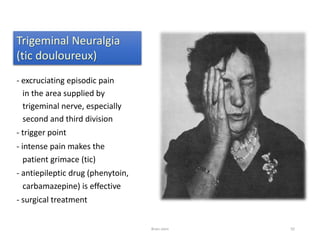
Trigeminal Neuralgia
(tic douloureux)
- excruciating episodic pain
in the area supplied by
trigeminal nerve, especially
second and third division
- trigger point
- intense pain makes the
patient grimace (tic)
- antiepileptic drug (phenytoin,
carbamazepine) is effective
- surgical treatment
Brain stem 92
Lower Midbrain (Level of Inferior Colliculus)
 Roof Plate - Tectum: Inferior Colliculus
 Tegmentum
 Cranial Nerve Nuclei
Trochlear Nucleus
 Reticular Formation
Cuneiform, Pedunculopontine, Parabrachial
and Median Raphe (Superior Central) Nucleus
 Unclassified Nuclei
Periaqueductal Gray
 Tracts
Decussation of Superior Cerebellar Peduncle
 Basal Part - Crus Cerebri, Pons Proper
Brain stem 93
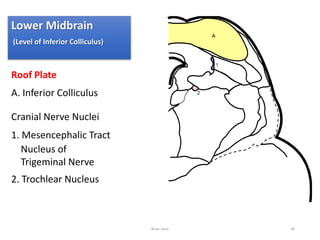
Roof Plate
A. Inferior Colliculus
Cranial Nerve Nuclei
1. Mesencephalic Tract
Nucleus of
Trigeminal Nerve
2. Trochlear Nucleus
Brain stem 94
Lower Midbrain
(Level of Inferior Colliculus)
Reticular Formation
1. Cuneiform Nucleus
2. Pedunculopontine Nucleus
3. Nucleus Locus ceruleus
4. Parabrachial Nucleus
5. Dorsal Raphe Nucleus
6. Median Raphe Nucleus
Unclassified Nuclei
A. Periaqueductal Gray
B. Dorsal Tegmental Nucleus
of Gudden
C. Interpeduncular Nucleus
D. Parabigeminal Nucleus
C
6
5
Brain stem 95
Lower Midbrain
(Level of Inferior
Colliculus)
Upper Midbrain (Level of Superior Colliculus)
 Roof Plate - Tectum: Superior Colliculus
 Tegmentum
 Cranial Nerve Nuclei
Oculomotor and Edinger-Westphal Nucleus
 Reticular Formation - Subcuneiform Nucleus
 Precerebellar Nuclei
Red Nucleus
 Unclassified Nuclei
Substantia Nigra, Paranigral, Paralemniscal
Nucleus
Ventral Tegmental Area (VTA)
 Tracts
Brachium of Inferior Colliculus
 Basal Part - Crus Cerebri
Brain stem 96
Roof Plate
A. Superior Colliculus
Precerebellar Nucleus
B. Red Nucleus
Cranial Nerve Nuclei
1. Mesencephalic Tract
Nucleus of V
2. Oculomotor Nucleus
3. Edinger-Westphal Nucleus
Brain stem 97
Upper Midbrain
(Level of Superior Colliculus)
Reticular Formation
A. Cuneiform Nucleus
B. Subcuneiform Nucleus
Unclassified Nuclei
1. Periaqueductal Gray
2. Paralemniscal Nucleus
3. Substantia Nigra
3a. Pars Compacta
3b. Pars Reticulata
4. Paranigral Nucleus
5. Ventral Tegmental Area
Brain stem 98
Upper Midbrain
(Level of Superior Colliculus)
A. Weber Syndrome
B. Foix Syndrome
C. Benedikt’s Syndrome
D. Claude Syndrome
E. Parinaud’s Syndrome
1. pyramidal tract
2. superior cerebellar peduncle
3. red nucleus
4. medial lemniscus
5. superior colliculus
6. cerebral aqueduct
7. MLF
8. oculomotor nucleus
Brain stem 99
Clinical Syndromes
of Upper Midbrain
 Pyramidal tract
- contralateral UMN syndrome
at the body and lower face
(contralateral hemiparesis)
 Oculomotor Nerve
- ipsilateral ocular palsy
- external strabismus
- mydriasis
- loss of accommodation
- normal consensual light reflex
Brain stem 100

Brain stem

  • 1.
  • 2.
    Basic Structure ofBrain Stem  1. Roof Plate  2.Tegmentum  3. Basal Portion Brain stem 2
  • 3.
    Basilar (Basal) Portion Descending Fibers from Cerebral Cortex  1. Corticospinal Tract  2. Corticobulbar Tract  3. Corticopontocerebellar Fiber Corticopontine Fiber Pons Proper (Ventral Pons) Pontocerebellar Fiber Brain stem 3
  • 4.
    Basal Portion DescendingTracts  Corticospinal Tract  Origin: Cerebral Cortex Brodmann Area 4 (Primary Motor Area, M I) Brodmann Area 6 (Premotor Area, PM ) Brodmann Area 3,1,2 (Primary Somesthetic Area, S I) Brodmann Area 5 (Anterior Portion of Sup. Parietal Lobule)  Corona Radiata  lnternal Capsule, Posterior Limb  Crus Cerebri, Middle Portion  Longitudinal Pontine Fiber  Pyramid - pyramidal decussation  Corticospinal Tract - Lateral and Anterior  Termination: Spinal Gray (Rexed IV-IX) Brain stem 4
  • 5.
     Corticobulbar Tract - Corticofugal fibers projecting to, and terminating in, portions of lower brainstem  - Termination:  1) motor nuclei (upper motor neuron pathway) hypoglossal, ambiguus, facial motor, trigeminal motor, abducens, trochlear and oculomotor nucleus  2) sensory relay nuclei nuclei gracilis and cuneatus, trigeminal sensory nucleus, solitary tract nucleus  3) reticular formation (corticoreticular fiber) Basal Portion Descending Tracts Brain stem 5
  • 6.
    Basal Portion DescendingTracts  Corticobulbar Tract - UMN Pathway  - Corticofugal fibers projecting to cranial motor nuclei  GSE - hypoglossal (XII), abducens (VI), trochlear (IV) and oculomotor (III) nucleus  SVE - ambiguus (IX, X, XI), facial motor (VII), trigeminal motor (V) nucleus  - largely bilateral laryngeal, pharyngeal, palatal and upper facial muscles of mastication and extraocular muscles  - unilateral lower facial musculature (facial palsy) SCM and trapezius (uncrossed) --- spinal accessory  - Pseudobulbar Palsy --- syndrome of bilateral UMN lesion Brain stem 6
  • 7.
    Basal Portion DescendingTracts  Corticopontocerebellar Fiber  - Corticofugal fibers projecting to cerebellar hemisphere  - consists of 2 neuron chain  1. Corticopontine fiber projecting to pontine nuclei  2. Pontocerebellar fiber crossed mudline and enter cerebellum as middle cerebellar peduncle Brain stem 7
  • 8.
    Roof Plate  Midbrain SuperiorColliculus: vision Inferior Colliculus: hearing  Closed Medulla Nucleus Gracilis et Cuneatus: discriminative touch sensation  cf. Cerebelum: equilibrium Brain stem 8
  • 9.
    Roof Plate ofHypothetized Chordate Ancestor  A. olfaction  B. vision  C. hearing  D. equilibrium  E. discriminative touch sensation  1. epithalamus  2. superior colliculus  3. inferior colliculus  4. cerebellum  5. nucleus gracilis et cuneatus Brain stem 9
  • 10.
    Tegmentum  Cranial nerveNuclei  Precerebellar Nuclei  Reticular Formation  Tracts  Ascending Cortical Pathway  Cerebellar Circuits  Descending Tract  Composite Bundle Brain stem 10
  • 11.
     Cranial Nerves  Columnsof  Brain Stem  Motor Column  1. GSE  2. SVE  3. GVE  Sensory Column  4. VA (GVA & SVA)  5. GSA  6. SSA Brain stem 11
  • 12.
    Components of CranialNerves Brain stem 12
  • 13.
    General Somatic EfferentNuclei (GSE)  Hypoglossal Nucleus XII  Abducens Nucleus VI  Trochlear Nucleus IV  Oculomotor Nucleus III Brain stem 13
  • 14.
    Special Visceral EfferentNuclei (SVE)  Nucleus Ambiguus IX, X, XI  Facial Motor Nucleus VII  Trigeminal Motor Nucleus V Brain stem 14
  • 15.
    General Visceral EfferentNuclei (GVE)  Dorsal Motor Nucleus of Vagus X  Inferior Salivatory Nucleus IX  Superior Salivatory Nucleus VII  Edinger-Westphal Nucleus III Brain stem 15
  • 16.
     Motor Nucleiof Cranial Nerves  1. GSE III, IV, VI, XII  2. SVE V, VII, IX, X, XI  3. GVE III, VII, IX, X Brain stem 16
  • 17.
    General Somatic AfferentNuclei (GSA)  Trigeminal Sensory Nucleus V, VII, IX, X  Mesencephalic Tract Nucleus  Principal (Main) Sensory Nucleus  Spinal Tract Nucleus pars oralis pars interpolaris pars caudalis Brain stem 17
  • 18.
    Visceral Afferent Nuclei(VA)  Nucleus Tractus Solitarius VII, IX, X  General Visceral Afferent (GVA)  Special Visceral Afferent (SVA): Taste Gustatory Nucleus Brain stem 18
  • 19.
    Special Somatic AfferentNuclei (SSA)  Cochlear Nucleus VIIIc Dorsal Cochlear Nucleus Ventral Cochlear Nucleus  Vestibular Nucleus VIIIv Medial Vestibular Nucleus Lateral Vestibular Nucleus Superior Vestibular Nucleus Inferior Vestibular Nucleus Brain stem 19
  • 20.
     Sensory Nuclei ofCranial Nerves  1. VA GVA --- IX, X SVA --- VII, IX, X  2. GSA V, VII, IX, X  3. SSA VIIIc, VIIIv Brain stem 20
  • 21.
    Precerebellar Nuclei  AccessoryCuneate Nucleus  Inferior Olivary Nuclear Complex  Vestibular Nuclus  Red Nucleus  Perihypoglossal Nucleus  Precerebellar Reticular Nuclei Brain stem 21
  • 22.
    Precerebellar Nuclei  1. RedNucleus  2. Vestibular Nucleus  3. Inferior Olivary Nucleus  4. Perhypoglossal Nuclei  5. Accessory Cuneate Nucleus Brain stem 22
  • 23.
     Reticular Formation   A.Raphe Nuclei  B. Central Nuclear Group  C. Lateral Nuclear Group  D. Precerebellar Reticular Nuclei A B C D Brain stem 23
  • 24.
    Central Nuclear Groupof Reticular Formation  Gigantocellular Reticular Nucleus  Caudal Reticulopontine Nucleus  Oral Reticulopontine Nucleus  Subcuneiform Nucleus  Cuneiform Nucleus Brain stem 24
  • 25.
    Lateral Nuclear Groupof Reticular Formation  Central Nucleus of Medulla Oblongata  Superficial Ventrolateral Reticular Area  Parvicellular Reticular Nucleus  Parabrachial Nucleus  Pedunculopontine Nucleus Brain stem 25
  • 26.
    Raphe Nuclei -Serotonergic Neuron  Nucleus Raphe Obscrus, B2  Nucleus Raphe Pallidus, B1  Nucleus Raphe Magnus, B3  Pontine Raphe Nucleus, B5  Median Raphe or Superior Central Nucleus, B6, B8  Dorsal Raphe Nucleus, B7  Nucleus Linealis Brain stem 26
  • 27.
    Norepinephrinergic & DopaminergicNeuron  Norepinephrinergic Neuron Nucleus Locus Ceruleus, A6  Dopaminergic Neuron Retrorubral Area, A8 Ventral Tegmental Area, A10 Substantia Nigra, Pars Compacta, A9 Brain stem 27
  • 28.
    Ascending Cortical Pathway PosteriorWhite Column-Medial Lemniscal Pathway medial lemniscus Spinothalamic and Spinoreticular Tract spinal lemniscus Ventral and Dorsal Trigeminothalamic Tract trigeminal lemniscus Auditory Pathway: lateral lemniscus Taste (Gustatory) Pathway: central tegmental tract Vestibular Pathway: medial lemniscus Brain stem 28
  • 29.
    Ascending Cortical SystemGeneral Sensation  Brain Stem Pathways for General Sensation  Touch & Proprioception from body Posterior White Colum-Medial Lemniscal Pathway  Pain & Temperature from body Spinothalamic Tract cf. Spinoreticular or Spinoreticulothalamic Tract  General Sensation from Face Trigeminothalamic Tracts Brain stem 29
  • 30.
    Posterior White Column- medial Lemniscal Pathway & Spinothalamic Tract Brain stem 30
  • 31.
    Posterior White Colum-MedialLemniscal Pathway  Modality: Discriminative Touch Sensation (include Vibration) and Conscious Proprioception (Position Sensation, Kinesthesia) from body  Receptor: Most receptors except free nerve endings  Ist Neuron: Dorsal Root Ganglion (Spinal Ganglion) Posterior White Column  2nd Neuron: Dorsal Column Nuclei (Nucleus Gracilis et Cuneatus) Internal Arcuate Fiber - Lemniscal Decussation - Medial Lemniscus  3rd Neuron: Thalamus (VPLc) Internal Capsule ----- Corona Radiata  Termination: Primary Somesthetic Area (S I)Brain stem 31
  • 32.
    DRG: Dorsal RootGanglion 1. Posterior White Column A. Nucleus gracilis B. Nucleus cuneatus 2. Medial Lemniscus 3. Corona Radiata C. Thalamus (VPLc) D. Cerebral Cortex (S I) Posterior White Column-Medial Lemniscal Pathway DRG D Brain stem 32
  • 33.
    Spinothalamic Tract  Modality:Pain & Temperature Sensation, Light Touch from body  Receptor: Free Nerve Ending  Ist Neuron: Dorsal Root Ganglion (Spinal Ganglion)  2nd Neuron: Dorsal Horn (Lamina I, IV, V) Anterior White Commissure Spinothalamic Tract (Spinal Lemniscus)  3rd Neuron: Thalamus (VPLc & CL) Internal Capsule ----- Corona Radiata  Termination: Primary Somesthetic Area (S I) Brain stem 33
  • 34.
    Spinoreticulothalamic Tract (PaleospinothalamicTract)  Modality: Pain & Temperature Sensation, Light Touch from body  Receptor: Free Nerve Ending  Ist Neuron: Dorsal Root Ganglion (Spinal Ganglion)  2nd Neuron: Dorsal Horn (Lamina I, IV, V) Anterior White Commissure Spinothalamic Tract (Spinal Lemniscus)  3rd Neuron: Reticular Formation  4rd Neuron: Thalamus (CL, Sm, POm) Internal Capsule ----- Corona Radiata  Termination: Diffuse Cerebral Cotex Brain stem 34
  • 35.
    DRG: Dorsal RootGanglion A. Posterior (dorsal) horn 1. Spinothalamic tract B. Reticular formation 2. Spinoreticular tract C. Thalamus (VPLc, CL) 3. Corona Radiata D. Cerebral Cortex (S I) Spinothalamic Tract (Neospinothalamic Tract) Spinoreticular Tract (Paleospinothalamic Tract) DRG D Brain stem 35
  • 36.
    Trigeminothalamic Tract  Modality:General Sensation from face  Receptor: Most receptors in the face  Ist Neuron: Trigeminal (Semilunar) Ganglia  2nd Neuron: Trigeminal Sensory Nucleus pain & temperature ---- pars caudaliS of spinal tract nucleus of V Ventral and Dorsal Trigeminothalamic Tract  3rd Neuron: Thalamus (VPM) Internal Capsule ----- Corona Radiata  Termination: Primary Somesthetic Area (S I) Brain stem 36
  • 37.
    Trigeminothalamic Tract A. trigeminalganglion B. trigeminal sensory nucleus C. thalamus (VPM) D. cerebral cortex (S I) 1. spinal tract of trigeminal nerve 2. ventral trigeminothalamic tract 3. dorsal trigeminothalamic tract 4. corona radiata V. trigeminal nerve Brain stem 37
  • 38.
    Ascending Cortical SystemSpecial Sensation  Brain Stem Pathways for Special Sensation  Gustatory Sensation (Taste, SVA) ----- Taste Pathway  Auditory Sensation (Hearing, SSA) ----- Auditory Pathway  Vestibular Sensation (Equilibrium, SSA) ----- Vestibular Pathway Brain stem 38
  • 39.
    Auditory Pathway  Modality:Auditory Sensation (Hearing)  Receptor: Organ of Coti of Cochlear Duct Cranial Nerve: VIIIc  1st Neuron: Spiral Ganglion  2nd Neuron: Cochlear Nucleus, Ventral & Dorsal dorsal, intermediate and ventral acoustic striae trapezoid body lateral lemniscus  3rd Neuron: Inferior Colliculus brachium of inferior colliculus  4th Neuron: Medial Geniculate Nucleus (MG) auditory radiation  Termination: Primary Auditory Area (A I) Brodmann area 31, 32 Brain stem 39
  • 40.
    Auditory Pathways A. spiralganglion B. dorsal and ventral cochlear nucleus C. inferior colliculus D. medial geniculate nucleus E. Primary auditory area F. superior olivary nucleus G. nucleus of lateral lemniscus 1. acoustic striae & trapezoid body 2. lateral lemniscus 3. brachium of inferior colliculus 4. auditory radiation 5. commissure of inferior colliculus VIIIc. cochlear division Brain stem 40
  • 41.
    Auditory Pathway A. spiralganglion B. dorsal cochlear nucleus C. ventral cochlear nucleus D. superior olivary nucleus 1. dorsal acoustic striae 2. intermediate acoustic striae 3. ventral acoustic striae 4. efferent cochlear bundle 5. trapezoid body 6. lateral lemniscus Brain stem 41
  • 42.
    Vestibular Pathway  Modality:Equilibrium Sensation  Receptor: Macula & Crista Ampullaris Cranial Nerve: VIIIv  Ist Neuron: Vestibular Ganglion  2nd Neuron: Vestibular Nucleus vestibulothalamic fiber (medial lemniscus)  3rd Neuron: Thalamus (VPLo, VPI?) Internal Capsule ----- Corona Radiata  Termination: Primary Vestibular Area ----- Primary Somesthetic Area (Brodmann area 3a, 2v ) Brain stem 42
  • 43.
    1. Vestibulocerebellar Tract 2. VestibulospinalTract 3. Vestibulothalamic Tract 4. Medial Longitudinal fasciculus (MLF) - ascending portion - descending portion - interstitiospinal tract Brain stem 43 Vestibular Pathway
  • 44.
    Taste (Gustatory) Pathway Modality: Taste Sensation  Receptor: Taste Bud Cranial Nerve: VII, IX, X  Ist Neuron: Geniculate Ganglion (VII) Inferior Ganglion (IX, X)  2nd Neuron: Nucleus Tractus Solitarius (Gustatory Nucleus) solitariothalamic fiber (central tegmental tract)  3rd Neuron: Thalamus (VPMpc) Internal Capsule ----- Corona Radiata  Termination: Gustatory Area Brodmann area 43 & parainsular cortex Brain stem 44
  • 45.
    Taste Pathways A. nucleustractus solitarius (gustatory nucleus) B. thalamus (VPMpc) C. Brodmann area 43 D. parainsular cortex E. parabrachial nucleus 1. solitariothalamic fiber (central tegmental tract) 2. corona radiata VII. facial nerve IX. glossopharyngeal nerve X. vagus nerve Brain stem 45
  • 46.
    Cerebellar Circuits  Superior,Middle and Inferior Cerebellar Peduncle  Vestibulocerebellum - Vestibular Nucleus  Spinocerebellum - Red Nucleus and Spinal Cord  Pontocerebellum - Cerebral Cortex and Pontine Nuclei  Inferior Olivary Nuclear Complex Brain stem 46
  • 47.
    Inferior Cerebellar Peduncle 1.posterior spinocerebellar tract 2. cuneocerebellar tract 3. vestibulocerebellar tract Middle cerebellar Peduncle - corticopontocerebellar pathway Superior Cerebellar Peduncle - anterior spinocerebellar tract Brain stem 47 Afferent Connections of Cerebellum
  • 48.
    Superior Cerebellar Peduncle 1.dentatothalamic fiber 2. interpositorubral fiber 3. ascending portion of uncinate fasciculus of Russell Inferior Cerebellar Peduncle 1. direct fastigiovestibular fiber 2. descending portion of uncinate fasciculus of Russell Brain stem 48 Efferent Connections of Cerebellum
  • 49.
    1. Olivocerebellar Tract 2.Cortico-olivary Tract 3. Rubro-olivary Tract 4. Vestibulo-olivary Tract 5. Spino-olivary Tract Brain stem 49 Connections of Inferior Olivary Nuclear Complex
  • 50.
    Descending Tracts  RubrospinalTract  Tectospinal tract  Vestibulospinal Tract  Reticulospinal Tract pontine and medullary  Descending Autonomic Pathway Brain stem 50
  • 51.
    Brain Stem DescendingTracts  Descending Tracts from Brain Stem  Dorsolateral (Motor) Pathway Rubrospinal Tract  Ventromedial (Motor) Pathway Tectospinal Tract  Vestibulospinal Tract  MLF (Medial Longitudinal Fasciculus) - interstitiospinal tract  Sensory Modulation pathways  Raphespinal & Cerulospinal Pathways  Descending Autonomic Pathways Brain stem 51
  • 52.
    Composite Bundle  MedialLongitudinal Fasciculus (MLF)  Dorsal Longitudinal Fasciculus (DLF)  Central Tegmental Tract Brain stem 52
  • 53.
    Components of MedialLongitudinal Fasciculus (MLF)  Descending Components Medial Vestibulospinal Tract from medial and inferior vestibular nucleus Interstitiospinal Tract from interstitial nucleus of Cajal  Ascending Components Efferents from Medial Vestibular Nucleus contralateral III, IV, interstitial nucleus bilateral VI nucleus Efferents from Superior Vestibular Nucleus ipsilateral III, IV, interstitial nucleus Brain stem 53
  • 54.
     Ascending Components solitariohypothalamicfiber (visceral afferent fiber) ascending serotonergic fiber  Descending Component descending fibers from hypothalamus to periaqueductal gray and dorsal tegmental nucleus Components of Dorsal Longitudinal Fasciculus (DLF, fasciculus of Schütz) Brain stem 54
  • 55.
    Components of CentralTegmental Tract  Ascending Components reticulothalamic fiber solitariothalamic fiber (secondary taste fiber)  Descending Component rubro-olivary tract Brain stem 55
  • 56.
    Spinomedullary Transition (Levelof Pyramidal Decussation)  Roof Plate - fasciculus gracilis and fasciculus cuneatus  Tegmentum Cranial and Spinal Nerve Nuclei Supraspinal Nucleus Spinal Nucleus of Trigeminal Nerve, Pars Caudalis  Reticular Formation Central Nucleus of Medulla Oblongata (Ventral Reticular Nucleus)  Unclassified Nuclei Retroambiguus Nucleus  Tracts Spinal Tracts of Trigeminal Nerve  Basal Part - Pyramid, Pyramidal Decussation Brain stem 56
  • 57.
     Cranial &Spinal N. Nuclei 1. Supraspinal Nucleus 2. Spinal Accessory Nucleus  Cranial & Spinal Nerve XI. Accessory Nucleus C1. motor root of 1st cervical nerve Spinomedullary Transition (Level of Pyramidal Decussation) Brain stem 57
  • 58.
    Lower Medulla (Levelof Lemniscal Decussation)  Roof Plate - nucleus gracilis and nucleus cuneatus  Tegmentum  Cranial and Spinal Nerve Nuclei Hypoglossal Nucleus, Ambiguus Nucleus Solitary Tract Nucleus, Dorsal Motor Nucleus of X  Reticular Formation Lateral Reticular Nucleus  Precerebellar Nuclei Inferior Olivary Nuclear Complex  Tracts Ventral Trigeminothalamic Tract Internal Arcuate Fiber, Lemniscal Decussation  Basal Part - Pyramid, Pyramidal Decussation Brain stem 58
  • 59.
    Lower Medulla (Level ofLemniscal Decussation) Roof Plate A. Nucleus Gracilis B. Nucleus Cuneatus Cranial Nerve Nuclei 1. Hypoglossal Nucleus 2. Nucleus Ambiguus 3. Dorsal Motor Nucleus of X 4. Nucleus Tractus Solitarius 5. Spinal Tract Nucleus of Trigeminal Nerve Brain stem 59
  • 60.
    Lower Medulla (Level ofLemniscal Decussation) Precerebellar Nucleus 1. Inferior Olivary Nuclear Complex 1a. Principal Inferior Olivary Nucleus 1b. Medial Accessory Olivary Nucleus 1c. Dorsal Accessory Olivary Nucleus 2. Nucleus Intercalatus 3. Nucleus Conterminalis 4. Arcuate Nucleus Brain stem 60
  • 61.
    Lower Medulla (Level ofLemniscal Decussation) Reticular Formation 1. Lateral Reticular Nucleus 2. Central Nucleus of Medulla Oblongata 2d. subnucleus dorsalis 2v. subnucleus ventralis Brain stem 61
  • 62.
     Clinical Syndromes ofLower Medulla A. Hypoglossal Alternating Hemiplegia B. Avelis Syndrome C. Jackson Syndrome D. Tapia Syndrome 1. pyramidal tract 2. hypoglossal nerve 3. spinothalamic tract 4. nucleus ambiguus Brain stem 62
  • 63.
    Hypoglossal Palsy Lower Motor Neuron Syndrome Deviation ofTongue to affected side Atrophy of Tongue Muscles Brain stem 63
  • 64.
    Open Medulla (Mid-olivaryLevel)  Tegmentum  Cranial Nerve Nuclei Medial Vestibular Nucleus Spinal Tract Nucleus of V, pars interpolaris  Precerebellar Nuclei Accessory Cuneate Nucleus Nucleus of Roller, Nucleus Interfascicularis Hypoglossi  Reticular Formation Lateral Reticular Nucleus, subtrigeminal portion  Unclassified Nuclei Area Postrema  Tracts: Inferior Cerebellar Peduncle, DLF  Basal Part - Pyramid Brain stem 64
  • 65.
    Cranial Nerve Nuclei 1.Hypoglossal Nucleus 2. Nucleus Ambiguus 3. Dorsal Motor Nucleus of X 4. Nucleus Tractus Solitarius 5. Spinal Tract Nucleus, pars interpolaris 6. Medial Vestibular Nucleus Open Medulla (Mid-olivary Level) Brain stem 65
  • 66.
    Open Medulla (Mid-olivary Level) PrecerebellarNucleus 1. Accessory Cuneate Nucleus 2. Inferior Olivary Nuclear Complex 2a. Principal Inferior Olivary Nuc. 2b. Medial Accessory Olivary Nuc. 2c. Dorsal Accessory Olivary Nuc. 3. Nucleus Intercalatus 4. Nucleus of Roller 5. Nucleus Interfascicularis Hypoglossi 6. Nucleus Conterminalis Brain stem 66
  • 67.
    Open Medulla (Mid-olivaryLevel) XII. Hypoglossal Nerve 1. Hypoglossal Nucleus X. Vagus Nerve 2. Nucleus Ambiguus 3. Dorsal Motor Nucleus of X 4. Nucleus Tractus Solitarius 5. Spinal Tract Nucleus of V Brain stem 67
  • 68.
    A. Dejerine’s Syndrome 1.pyramidal tract 2. hypoglossal nerve 3. medial lemniscus B. Wallenberg Syndrome 4. spinothalamic tract 5. spinal tract of trigeminal nerve 6. nucleus ambiguus 7. descending autonomic pathway Clinical Syndromes of Open Medulla Brain stem 68
  • 69.
    Wallenberg Syndrome Spinothalamic tract -contralateral loss of pain and temperature sensation at the body Spinal tract of trigeminal nerve - ipsilateral loss of pain and temperature sensation at the face Nucleus ambiguus - dysphageia, dysarthria, hoarseness Descending autonomic pathway - Horner’s syndrome (meiosis, ptosis, anhydrosis) Brain stem 69
  • 70.
    Open Medulla (UpperLevel of Medulla)  Tegmentum  Cranial Nerve Nuclei Inferior Vestibular Nucleus Dorsal Cochlear Nucleus  Precerebellar Nuclei Nucleus Prepositus Hypoglossi  Reticular Formation Gigantocellular Reticular Nucleus Paragigantocellular Reticular Nucleus Parvocellular Reticular Nucleus Raphe Nuclei  Unclassified Nuclei retrofacial, supravestibular nucleus, nucleus interpositus  Tracts: stria medullaris of 4th ventricle  Basal Part - Pyramid Brain stem 70
  • 71.
    Cranial Nerve Nuclei 1.Nucleus Ambiguus 2. Nucleus Tractus Solitarius 3. Spinal Tract Nucleus, pars oralis 4. Medial Vestibular Nucleus 5. Inferior Vestibular Nucleus 6. Dorsal Cochlear Nucleus Open Medulla (Upper Level of Medulla) Brain stem 71
  • 72.
    Open Medulla (Upper Levelof Medulla) Precerebellar Nucleus 1. Inferior Olivary Nuclear Complex 1a. Principal Inferior Olivary Nuc. 1b. Medial Accessory Olivary Nuc. 1c. Dorsal Accessory Olivary Nuc. 2. Nucleus Prepositus Hypoglossi 3. Pontobulbar Body 4. Arcuate Nucleus 5. Medial Vestibular Nucleus 6. Inferior Vestibular Nucleus Brain stem 72
  • 73.
    Open Medulla (Upper Levelof Medulla) Reticular Formation 1. Paramedian reticular Nucleus 2. Gigantocellular Reticular Nucleus 3. paragigantocellular Reticular Nucleus 4. Parvocellular Reticular Nucleus 5. Nucleus raphe Obscrus (B2) 6. Nucleus Raphe Pallidus (B1) 7. Nucleus Raphe Magnus (B3) Unclassifiied Nuclei A. Nucleus Retrofacialis B. Supravestibular Nucleus C. Nucleus Interpositus Brain stem 73
  • 74.
    IX. glossopharyngeal Nerve 1. NucleusAmbiguus 2. Inferior Salivatory Nucleus 3. Nucleus Tractus Solitarius 4. Spinal Tract Nucleus of V Open Medulla (Upper Level of Medulla) Brain stem 74
  • 75.
    Pontomedullary Junction  Tegmentum Cranial Nerve Nuclei Facial Motor Nucleus Ventral Cochlear Nucleus  Precerebellar Nuclei  Reticular Formation  Unclassified Nuclei nucleus ovalis  Tracts  Basal Part - Pyramid  Cranial Nerve - Vestibulocochlear Nerve (VIII) Facial Nerve (VII) Brain stem 75
  • 76.
    Cranial Nerve Nuclei 1.Facial Motor Nucleus 2. Nucleus Ambiguus 3. Spinal Tract Nucleus, pars oralis 4. Medial Vestibular Nucleus 5. Inferior Vestibular Nucleus 6. Ventral Cochlear Nucleus Pontomedullary Junction Brain stem 76
  • 77.
    Pontomedullary Junction Precerebellar Nucleus 1. PrincipalInferior Olivary Nucleus 2. Nucleus Prepositus Hypoglossi 3. Pontobulbar Body 4. Arcuate Nucleus 5. Medial Vestibular Nucleus 6. Inferior Vestibular Nucleus Brain stem 77
  • 78.
    Pontomedullary Junction Reticular Formation 1. Paramedianreticular Nucleus 2. Gigantocellular Reticular Nucleus 3. paragigantocellular Reticular Nucleus 4. Parvocellular Reticular Nucleus 7. Nucleus Raphe Magnus (B3) Unclassifiied Nuclei A. Nucleus Interpositus B. Nucleus Ovalis Brain stem 78
  • 79.
    Lower Pons (Levelof Abducens Nucleus)  Tegmentum  Cranial Nerve Nuclei Abducens Nucleus, Main Sensory Nucleus of V  Nuclei of Auditory Pathway Superior Olivary Nuclear Complex  Reticular Formation Caudal Pontine Reticular & Subceruleus Nucleus  Tracts Trapezoid Body, lateral Lemniscus, Central tegmental Tract  Basal Part: Pons Proper: Pontine Nuclei, Transverse Pontine Fiber, Longitudinal Pontine Fiber (Pyramidal Tract) Brain stem 79
  • 80.
    Lower Pons (Levelof Abducens Nucleus) Cranial Nerve Nuclei 1. Abducens Nucleus 2. Main Sensory Nucleus of V 3. Lateral vestibular Nucleus 4. Superior Vestibular Nucleus Auditory Relay Nuclei A. Superior Olivary Nucleus B. Nucleus of Trapezoid body Brain stem 80
  • 81.
    Lower Pons (Levelof Abducens Nucleus) Reticular Formation 1. Gigantocellular Reticular Nucleus 2. Caudal Pontine Reticular Nucleus 3. Parvocellular Reticular Nucleus 4. Nucleus Subceruleus Brain stem 81
  • 82.
    VII. Facial Nerve 1.Facial Motor Nucleus 2. Superior Salivatory Nucleus 3. Nucleus Tractus Solitarius 4. Spinal Tract Nucleus of V VI. Abducens Nerve 5. Abducens Nucleus Brain stem 82
  • 83.
    A. Facial Palsy B.A + decreased salivation C. A + B + hyperacusis D. A + B + C + decrased lacrimal secretion E. Central Type Facial Palsy 1. Facial Motor Nucleus 2. Superior Salivatory Nucleus 3. Solitary Nucleus 4. Spinal Tract Nucleus of Trigeminal Nerve Brain stem 83
  • 84.
    Facial Palsy (Bell’s Palsy) LowerMotor Neuron Syndrome Triple W Sign - Wrinkle, Wink, Whistle Brain stem 84
  • 85.
    Right facial paralysis FacialPalsy (Bell’s Palsy) Brain stem 85
  • 86.
    Central Type FacialPalsy Upper Motor Neuron Syndrome facialmotor nucleus neurons supplying forehead muscle Bilateral Corticobulbar Tract Brain stem 86
  • 87.
  • 88.
    Upper Pons (Levelof Trigeminal Motor Nucleus)  Tegmentum  Cranial Nerve Nuclei Trigeminal Motor Nucleus, Mesencephalic Tract Nucleus of Trigeminal Nerve  Nuclei of Auditory Pathway Nucleus of Lateral Lemniscus  Reticular Formation Reticular Tegmental Nucleus  Unclassified Nucleus Pontine Central Gray: Ch6  Tracts Trigeminal Nerve Fiber  Basal Part: Pons Proper Brain stem 88
  • 89.
    Upper Pons (Levelof Trigeminal Motor Nucleus)  Cranial Nerve Nuclei 1. Trigeminal Motor Nucleus 2. Main Sensory Nucleus of V 3. Mesencephalic Tract Nucleus of V 4. Superior Vestibular Nucleus Auditory Relay Nuclei A. Nucleus of Lateral Lemniscus Brain stem 89
  • 90.
    Upper Pons (Levelof Trigeminal Motor Nucleus) Reticular Formation 1. Caudal Pontine Reticular Nucleus 2. Nucleus Subceruleus 3. Reticular Tegemntal Nucleus of Bekhterew (Nucleus Papilloformis of Olszewski and Baxter) Brain stem 90
  • 91.
    A. Millard-Gubler Syndrome B.Raymond Syndrome C. Foville Syndrome D. Raymond-Cestan Syndrome E. Marie-Poix Syndrome 1. pyramidal tract 2. MLF 3. medial lemniscus 4. spinothalamic tract 5. trigeminal motor nucleus 6. main sensory nucleus of V 7. spinal tract of trigeminal nerve 8. middle cerebellar peduncle Clinical Syndromes of Pons Brain stem 91
  • 92.
    Trigeminal Neuralgia (tic douloureux) -excruciating episodic pain in the area supplied by trigeminal nerve, especially second and third division - trigger point - intense pain makes the patient grimace (tic) - antiepileptic drug (phenytoin, carbamazepine) is effective - surgical treatment Brain stem 92
  • 93.
    Lower Midbrain (Levelof Inferior Colliculus)  Roof Plate - Tectum: Inferior Colliculus  Tegmentum  Cranial Nerve Nuclei Trochlear Nucleus  Reticular Formation Cuneiform, Pedunculopontine, Parabrachial and Median Raphe (Superior Central) Nucleus  Unclassified Nuclei Periaqueductal Gray  Tracts Decussation of Superior Cerebellar Peduncle  Basal Part - Crus Cerebri, Pons Proper Brain stem 93
  • 94.
    Roof Plate A. InferiorColliculus Cranial Nerve Nuclei 1. Mesencephalic Tract Nucleus of Trigeminal Nerve 2. Trochlear Nucleus Brain stem 94 Lower Midbrain (Level of Inferior Colliculus)
  • 95.
    Reticular Formation 1. CuneiformNucleus 2. Pedunculopontine Nucleus 3. Nucleus Locus ceruleus 4. Parabrachial Nucleus 5. Dorsal Raphe Nucleus 6. Median Raphe Nucleus Unclassified Nuclei A. Periaqueductal Gray B. Dorsal Tegmental Nucleus of Gudden C. Interpeduncular Nucleus D. Parabigeminal Nucleus C 6 5 Brain stem 95 Lower Midbrain (Level of Inferior Colliculus)
  • 96.
    Upper Midbrain (Levelof Superior Colliculus)  Roof Plate - Tectum: Superior Colliculus  Tegmentum  Cranial Nerve Nuclei Oculomotor and Edinger-Westphal Nucleus  Reticular Formation - Subcuneiform Nucleus  Precerebellar Nuclei Red Nucleus  Unclassified Nuclei Substantia Nigra, Paranigral, Paralemniscal Nucleus Ventral Tegmental Area (VTA)  Tracts Brachium of Inferior Colliculus  Basal Part - Crus Cerebri Brain stem 96
  • 97.
    Roof Plate A. SuperiorColliculus Precerebellar Nucleus B. Red Nucleus Cranial Nerve Nuclei 1. Mesencephalic Tract Nucleus of V 2. Oculomotor Nucleus 3. Edinger-Westphal Nucleus Brain stem 97 Upper Midbrain (Level of Superior Colliculus)
  • 98.
    Reticular Formation A. CuneiformNucleus B. Subcuneiform Nucleus Unclassified Nuclei 1. Periaqueductal Gray 2. Paralemniscal Nucleus 3. Substantia Nigra 3a. Pars Compacta 3b. Pars Reticulata 4. Paranigral Nucleus 5. Ventral Tegmental Area Brain stem 98 Upper Midbrain (Level of Superior Colliculus)
  • 99.
    A. Weber Syndrome B.Foix Syndrome C. Benedikt’s Syndrome D. Claude Syndrome E. Parinaud’s Syndrome 1. pyramidal tract 2. superior cerebellar peduncle 3. red nucleus 4. medial lemniscus 5. superior colliculus 6. cerebral aqueduct 7. MLF 8. oculomotor nucleus Brain stem 99 Clinical Syndromes of Upper Midbrain
  • 100.
     Pyramidal tract -contralateral UMN syndrome at the body and lower face (contralateral hemiparesis)  Oculomotor Nerve - ipsilateral ocular palsy - external strabismus - mydriasis - loss of accommodation - normal consensual light reflex Brain stem 100