Augmented Reality
in Education
By
Ifeyinwa Aladiume
APUS EDUC 626
September 27, 2015
Definition
O Augmented reality (AR) is a live, direct or
indirect, view of a physical, real-world
environment whose elements are augmented
by computer-generated sensory input such as
sound, video, graphics or GPS data.
O Artificial information about the environment
and its objects can be overlaid on the real
world.
O Augmented Reality technology in the
classrooms provide for visual displays
O Facilitates contextual learning since we retain
eighty percent of visual content in our short-
term memory compared to twenty percent of
oral content
O AR is predicted to be the future of education
within the next five years. Some schools are
already early adopters.
Future of AR
O The 2011 horizon report states that “the ability to
transfer learning from one context to another is a
significant skill, one that AR can facilitate in its
overt use of context and layering (Horizon
Report, 2011)
O Pence states, “Although virtual worlds, such as
Second Life, have become popular for education,
it seems probable that augmented reality will
affect higher education sooner and more
profoundly than virtual worlds” (Pence, 2011)
Benefits and Uses of AR in Education
O Aligns with constructivist concepts and situated
learning
O Learner based
O Increases student engagement
O Provides visual and interactive forms of
authentic learning
O Training
O Discovery Based Learning
O Augmented Books
O Augmented Reality to Model Objects
O Game Based Learning
AR Tools
O ZSpace is a model exploration and
presentation tool that allows students
compare, dissect, analyze, measure,
annotate and explore 500+ 3D models.
O It enables educators create complex content
scenes.
O It's easy to add labels, make annotations,
take measurements, integrate multiple
models to build a rich scene and create
video tours of students ‘models for sharing.
O http://edu.zspace.com/#
O https://vimeo.com/124832600
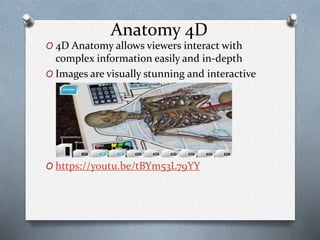
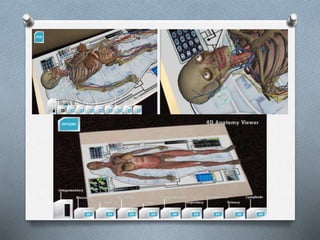
Anatomy 4D
O 4D Anatomy allows viewers interact with
complex information easily and in-depth
O Images are visually stunning and interactive
O https://youtu.be/tBYm53L79YY
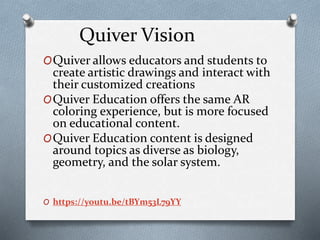
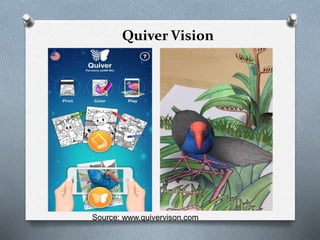
Quiver Vision
OQuiver allows educators and students to
create artistic drawings and interact with
their customized creations
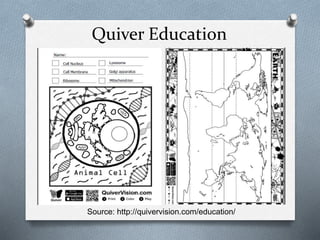
OQuiver Education offers the same AR
coloring experience, but is more focused
on educational content.
OQuiver Education content is designed
around topics as diverse as biology,
geometry, and the solar system.
O https://youtu.be/tBYm53L79YY
Quiver Vision
Source: www.quivervison.com
Quiver Education
Source: http://quivervision.com/education/
References
O https://edshelf.com/tool/anatomy-4d/
O http://educationar.wikispaces.com/Augme
nted+Reality+in+Education
O http://net.educause.edu/ir/library/pdf/HR20
11.pdf
O http://quivervision.com/
O http://quivervision.com/education/

Augmented reality in education

  • 1.
    Augmented Reality in Education By IfeyinwaAladiume APUS EDUC 626 September 27, 2015
  • 2.
    Definition O Augmented reality(AR) is a live, direct or indirect, view of a physical, real-world environment whose elements are augmented by computer-generated sensory input such as sound, video, graphics or GPS data. O Artificial information about the environment and its objects can be overlaid on the real world.
  • 3.
    O Augmented Realitytechnology in the classrooms provide for visual displays O Facilitates contextual learning since we retain eighty percent of visual content in our short- term memory compared to twenty percent of oral content O AR is predicted to be the future of education within the next five years. Some schools are already early adopters.
  • 4.
    Future of AR OThe 2011 horizon report states that “the ability to transfer learning from one context to another is a significant skill, one that AR can facilitate in its overt use of context and layering (Horizon Report, 2011) O Pence states, “Although virtual worlds, such as Second Life, have become popular for education, it seems probable that augmented reality will affect higher education sooner and more profoundly than virtual worlds” (Pence, 2011)
  • 5.
    Benefits and Usesof AR in Education O Aligns with constructivist concepts and situated learning O Learner based O Increases student engagement O Provides visual and interactive forms of authentic learning O Training O Discovery Based Learning O Augmented Books O Augmented Reality to Model Objects O Game Based Learning
  • 6.
    AR Tools O ZSpaceis a model exploration and presentation tool that allows students compare, dissect, analyze, measure, annotate and explore 500+ 3D models. O It enables educators create complex content scenes. O It's easy to add labels, make annotations, take measurements, integrate multiple models to build a rich scene and create video tours of students ‘models for sharing. O http://edu.zspace.com/# O https://vimeo.com/124832600
  • 7.
    Anatomy 4D O 4DAnatomy allows viewers interact with complex information easily and in-depth O Images are visually stunning and interactive O https://youtu.be/tBYm53L79YY
  • 9.
    Quiver Vision OQuiver allowseducators and students to create artistic drawings and interact with their customized creations OQuiver Education offers the same AR coloring experience, but is more focused on educational content. OQuiver Education content is designed around topics as diverse as biology, geometry, and the solar system. O https://youtu.be/tBYm53L79YY
  • 10.
  • 11.
  • 12.
    References O https://edshelf.com/tool/anatomy-4d/ O http://educationar.wikispaces.com/Augme nted+Reality+in+Education Ohttp://net.educause.edu/ir/library/pdf/HR20 11.pdf O http://quivervision.com/ O http://quivervision.com/education/