Augmented Reality
for E-Learning
Kamalika Dutta
Seminar: Augmented Reality, Mobile & Wearable Engineering seminar in cooperation with Bitstars
Software Engineering Group, RWTH Aachen, 2015
Education
(Looking back)
What changed?
Courtesy: Tasmanian Archive and Heritage Office (1)
Blurring of boundaries
Courtesy: Patrick Powers (2)
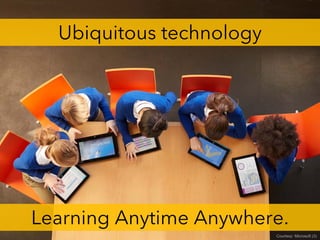
Ubiquitous technology
Learning Anytime Anywhere.
Courtesy: Microsoft (3)
Here‘s what I‘m covering today:
• E-Learning
• Augmented Reality
• Augmented Reality for E-Learning
• Example Applications
• Benefits of AR for E-Learning
• Detriments of AR for E-Learning
• Future Work
• Conclusion
E-Learning
Courtesy: Pexels.com (4)
Learning is
Social and connected
Personal and self-directed
Shared and transparent
Rich in content
Fun.
E-Learning is a type of formalized teaching and
learning system specifically designed to be carried out
remotely by using electronic communication.
Relevant, reliable educational content
Engaging user experience
Explicit learner support
Rich in content
Easy access
Mobile Learning is popular because:
Personal mass media
Enables Augmented Reality.
Always carried
Always on
Captures context
Augmented Reality
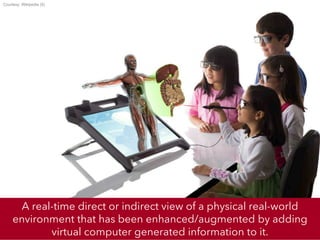
A real-time direct or indirect view of a physical real-world
environment that has been enhanced/augmented by adding
virtual computer generated information to it.
Courtesy: Wikipedia (5)
Augmented Reality
for E-Learning
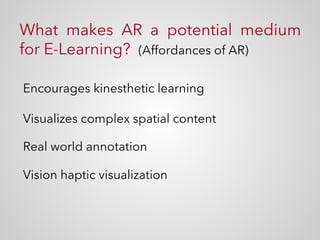
What makes AR a potential medium
for E-Learning? (Affordances of AR)
Encourages kinesthetic learning
Visualizes complex spatial content
Real world annotation
Vision haptic visualization
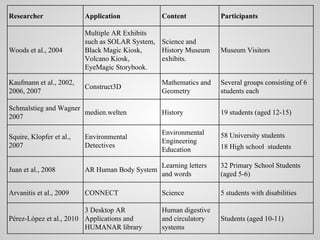
Example applications from
available literature
Researcher Application Content Participants
Woods et al., 2004
Multiple AR Exhibits
such as SOLAR System,
Black Magic Kiosk,
Volcano Kiosk,
EyeMagic Storybook.
Science and
History Museum
exhibits.
Museum Visitors
Kaufmann et al., 2002,
2006, 2007
Construct3D
Mathematics and
Geometry
Several groups consisting of 6
students each
Schmalstieg and Wagner
2007
medien.welten History 19 students (aged 12-15)
Squire, Klopfer et al.,
2007
Environmental
Detectives
Environmental
Engineering
Education
58 University students
18 High school students
Juan et al., 2008 AR Human Body System
Learning letters
and words
32 Primary School Students
(aged 5-6)
Arvanitis et al., 2009 CONNECT Science 5 students with disabilities
Pérez-López et al., 2010
3 Desktop AR
Applications and
HUMANAR library
Human digestive
and circulatory
systems
Students (aged 10-11)
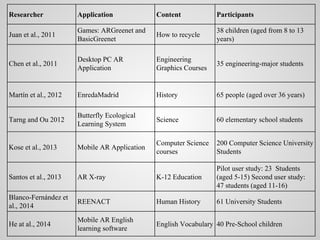
Researcher Application Content Participants
Juan et al., 2011
Games: ARGreenet and
BasicGreenet
How to recycle
38 children (aged from 8 to 13
years)
Chen et al., 2011
Desktop PC AR
Application
Engineering
Graphics Courses
35 engineering-major students
Martín et al., 2012 EnredaMadrid History 65 people (aged over 36 years)
Tarng and Ou 2012
Butterfly Ecological
Learning System
Science 60 elementary school students
Kose et al., 2013 Mobile AR Application
Computer Science
courses
200 Computer Science University
Students
Santos et al., 2013 AR X-ray K-12 Education
Pilot user study: 23 Students
(aged 5-15) Second user study:
47 students (aged 11-16)
Blanco-Fernández et
al., 2014
REENACT Human History 61 University Students
He at al., 2014
Mobile AR English
learning software
English Vocabulary 40 Pre-School children
Types of AR
E-Learning applications
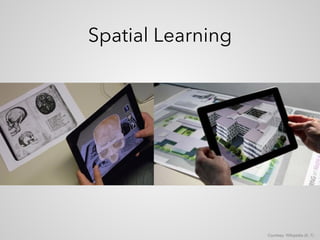
Spatial Learning
Courtesy: Wikipedia (6, 7)
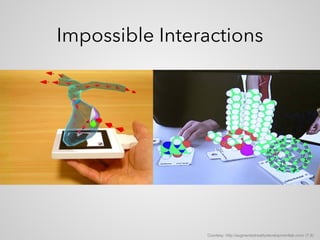
Impossible Interactions
Courtesy: http://augmentedrealitydevelopmentlab.com/ (7,8)
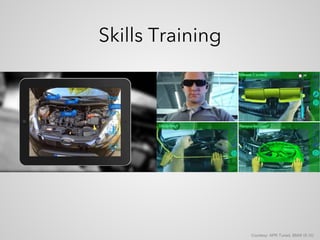
Skills Training
Courtesy: APR Tuned, BMW (9,10)
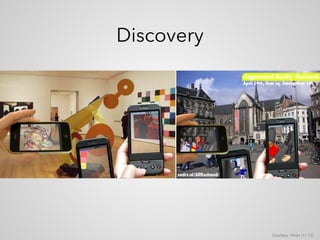
Discovery
Courtesy: Flickr (11,12)
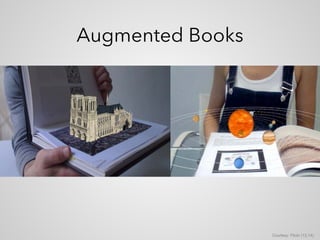
Augmented Books
Courtesy: Flickr (13,14)
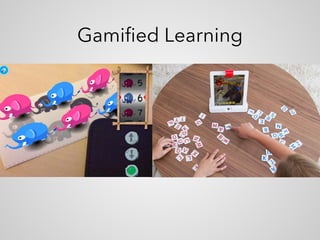
Gamified Learning
A quick look at a variety of
learning applications that use AR.
(Video)
Benefits of AR for E-Learning
• Better Understanding of content
• Long term memory retention
• Better collaboration
• Increased motivation
Detriments of AR for E-Learning
• Attention tunnelling
• Usability difficulties
• Ineffective classroom integration
• Learner differences
Future Work
• Investigate how AR designers can maximize the
potential learning benefits.
• Generate guidelines for designing effective
educational AR experiences.
• Improve integration into classroom pedagogy.
• Identify curriculum topics and types of content that
are currently difficult to teach using other media and
are worth the investment cost for AR.
• Think about AR for specially-abled learners.
Conclusion
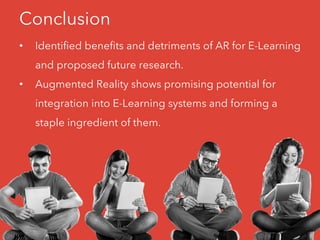
• Identified benefits and detriments of AR for E-Learning
and proposed future research.
• Augmented Reality shows promising potential for
integration into E-Learning systems and forming a
staple ingredient of them.
Education = Future
Thank you
References
(1)https://www.flickr.com/photos/tasmanianarchiveandheritageoffice/7126687909
(2)http://www.slideshare.net/patrickpowers59/social-media-trends-in-us-higher-education
(3)http://static.pexels.com/wp-content/uploads/2014/06/apple-black-clean-425.jpg
(4)http://www.microsoft.com/global/es-
xl/news/publishingimages/Generic_EducationCommitment_hero_Thumb.jpg
(5)http://upload.wikimedia.org/wikipedia/commons/a/ae/ZSpace_200_with_students.jpg
(6)http://upload.wikimedia.org/wikipedia/commons/f/f4/App_iSkull,_an_augmented_hum
an_skull.jpg
(7)http://augmentedrealitydevelopmentlab.com/Blog/wp-
content/uploads/2011/02/composit02.jpg
(8)http://ww1.prweb.com/prfiles/2011/02/14/4607804/PassItOnFinal105912.jpg
(9)https://aprtunedrosario.files.wordpress.com/2013/05/aprtunedrosariomotorsporttuneo
autosrosarioargentinaaprargentinapotencializacionmodificanoptimizacionmotoresaudis
eatporsche2-0-inglobe.jpg
(10)http://www.designboom.com/cms/images/-andy01/bmw1.jpg
(11) https://www.flickr.com/photos/sndrv/5034204552
(12)https://www.flickr.com/photos/sndrv/4519088620
(13) http://toweboffice.com/ar/wp-content/uploads/2013/09/AR-Concept3.jpg
(14)http://b.vimeocdn.com/ts/746/561/74656175_640.jpg
(15)http://topbestappsforkids.com/bestappsforkids/Augmented-Reality-learning-app-
iPad-iPhone-Android-Kindle-Fire.jpg
Licences
(1)https://creativecommons.org/publicdomain/zero/1.0/legalcode
(2)https://creativecommons.org/licenses/by/4.0/legalcode
(3)https://creativecommons.org/licenses/by/2.0/legalcode

Augmented Reality for E-Learning