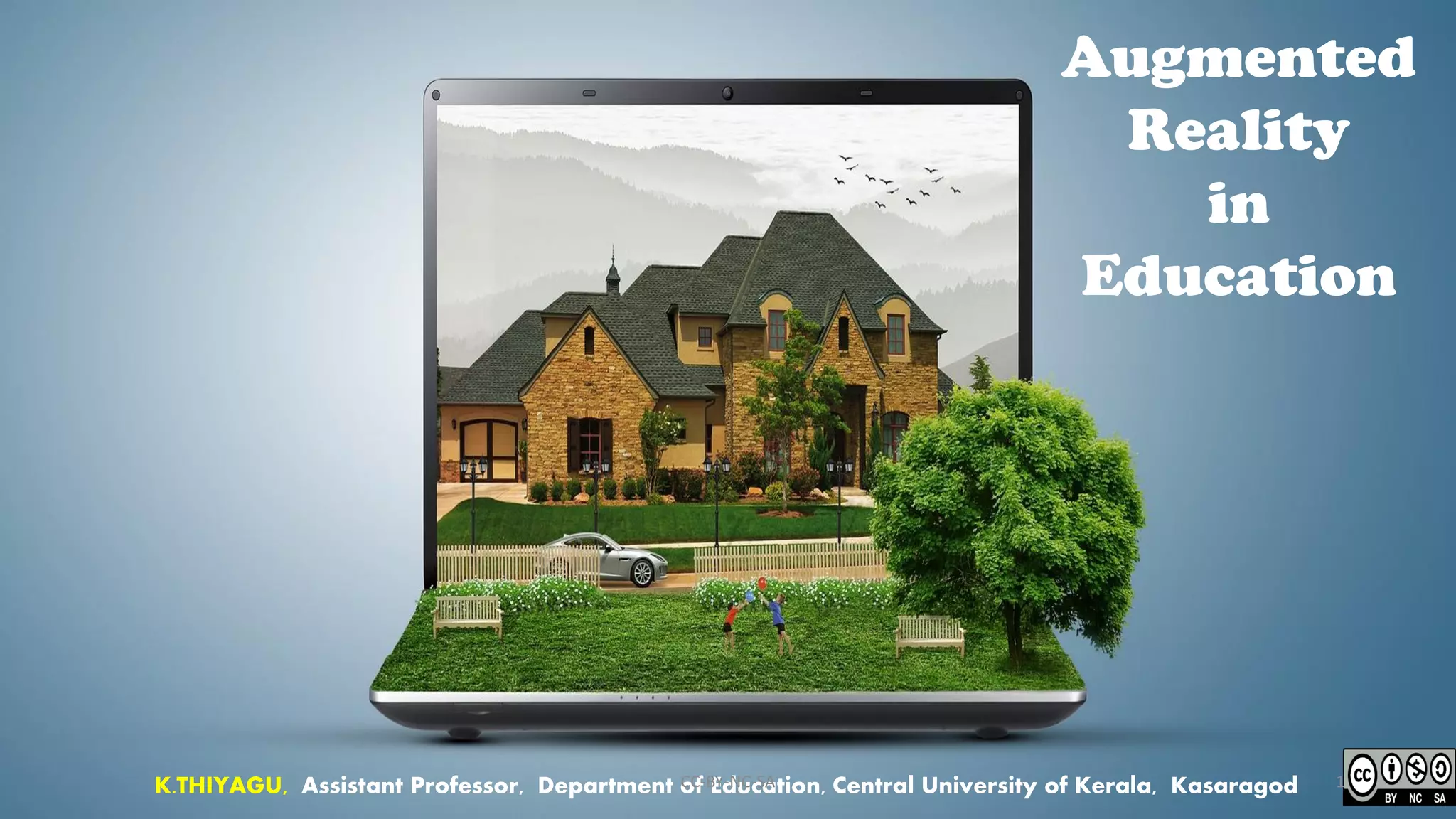
Augmented
Reality
in
Education
K.THIYAGU, Assistant Professor, Department of Education, Central University of Kerala, KasaragodCC-BY-NC-SA 1
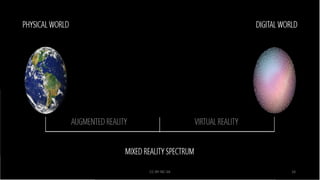
Augmented Reality (AR)
Virtual Reality (VR)
Mixed Reality (MR)
CC-BY-NC-SA 2
Technology
is
Not the Enemy.
Instead,
It’s
a
Tremendous Gift.
CC-BY-NC-SA 3
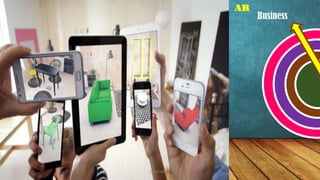
Business
AR
CC-BY-NC-SA 4
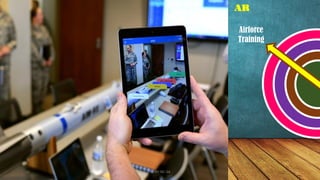
Airforce
Training
AR
CC-BY-NC-SA 5
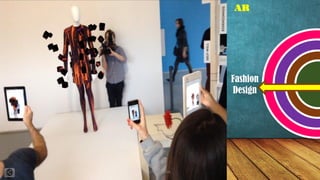
Fashion
Design
AR
CC-BY-NC-SA 6
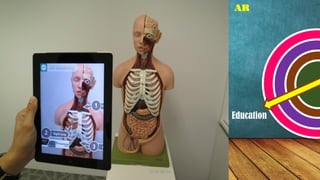
Education
AR
CC-BY-NC-SA 7
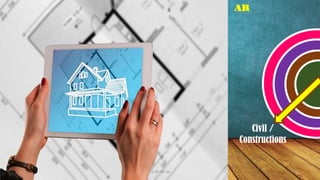
Civil /
Constructions
AR
CC-BY-NC-SA 8
Game
AR
CC-BY-NC-SA 9
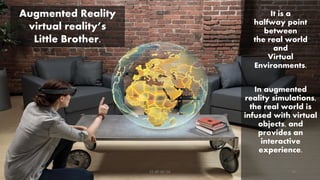
It is a
halfway point
between
the real world
and
Virtual
Environments.
In augmented
reality simulations,
the real world is
infused with virtual
objects, and
provides an
interactive
experience.
Augmented Reality
virtual reality’s
Little Brother.
CC-BY-NC-SA 10
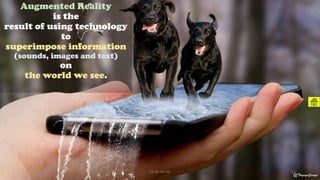
Augmented Reality
is the
result of using technology
to
superimpose information
(sounds, images and text)
on
the world we see.
@ThiyaguSuriya
CC-BY-NC-SA 11
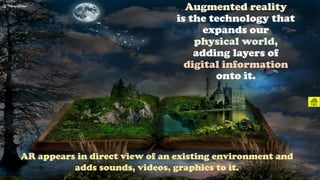
Augmented reality
is the technology that
expands our
physical world,
adding layers of
digital information
onto it.
AR appears in direct view of an existing environment and
adds sounds, videos, graphics to it.
@ThiyaguSuriya
CC-BY-NC-SA 12
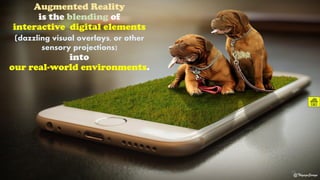
Augmented Reality
is the blending of
interactive digital elements
(dazzling visual overlays, or other
sensory projections)
into
our real-world environments.
@ThiyaguSuriya
CC-BY-NC-SA 13
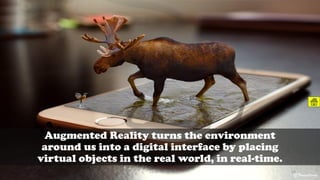
Augmented Reality turns the environment
around us into a digital interface by placing
virtual objects in the real world, in real-time.
@ThiyaguSuriya
CC-BY-NC-SA 14
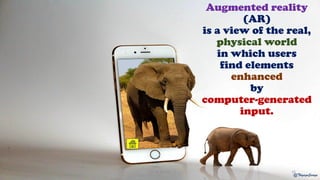
Augmented reality
(AR)
is a view of the real,
physical world
in which users
find elements
enhanced
by
computer-generated
input.
@ThiyaguSuriya
CC-BY-NC-SA 15
CC-BY-NC-SA 16
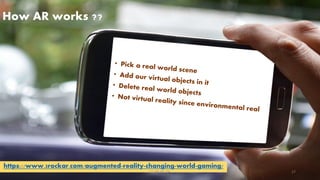
How AR works ??
https://www.3rockar.com/augmented-reality-changing-world-gaming/
CC-BY-NC-SA 17
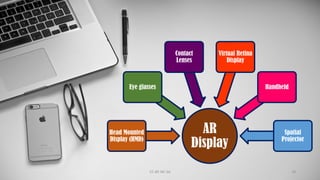
AR
Display
Head Mounted
Display (HMD)
Eye glasses
Contact
Lenses
Virtual Retina
Display
Handheld
Spatial
Projector
CC-BY-NC-SA 18
Types
of
AR
CC-BY-NC-SA 19
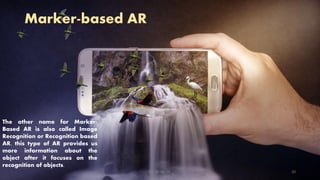
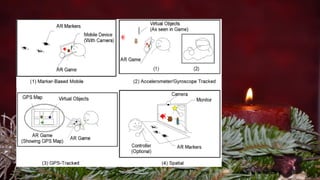
Marker-based AR
The other name for Marker-
Based AR is also called Image
Recognition or Recognition based
AR. this type of AR provides us
more information about the
object after it focuses on the
recognition of objects.
CC-BY-NC-SA 20
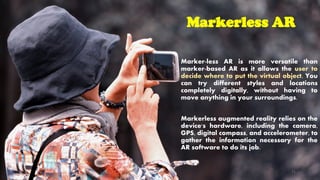
Markerless AR
Marker-less AR is more versatile than
marker-based AR as it allows the user to
decide where to put the virtual object. You
can try different styles and locations
completely digitally, without having to
move anything in your surroundings.
Markerless augmented reality relies on the
device's hardware, including the camera,
GPS, digital compass, and accelerometer, to
gather the information necessary for the
AR software to do its job.
CC-BY-NC-SA 21
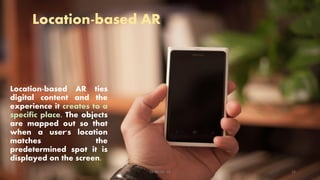
Location-based AR
Location-based AR ties
digital content and the
experience it creates to a
specific place. The objects
are mapped out so that
when a user's location
matches the
predetermined spot it is
displayed on the screen.
CC-BY-NC-SA 22
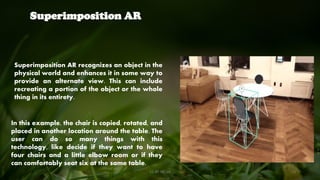
Superimposition AR
In this example, the chair is copied, rotated, and
placed in another location around the table. The
user can do so many things with this
technology, like decide if they want to have
four chairs and a little elbow room or if they
can comfortably seat six at the same table.
Superimposition AR recognizes an object in the
physical world and enhances it in some way to
provide an alternate view. This can include
recreating a portion of the object or the whole
thing in its entirety.
CC-BY-NC-SA 23
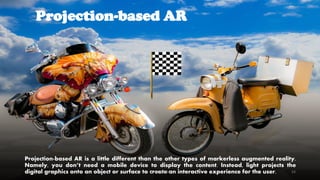
Projection-based AR
Projection-based AR is a little different than the other types of markerless augmented reality.
Namely, you don’t need a mobile device to display the content. Instead, light projects the
digital graphics onto an object or surface to create an interactive experience for the user.CC-BY-NC-SA 24
CC-BY-NC-SA 25
AR Application
• Quiver
• Elements 4D
• Blippar
• Star walk
• Spacecraft AR
CC-BY-NC-SA 26
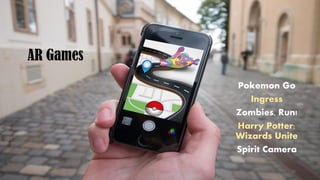
AR Games
Pokemon Go
Ingress
Zombies, Run!
Harry Potter:
Wizards Unite
Spirit Camera
CC-BY-NC-SA 27
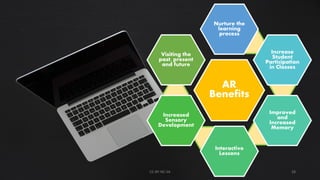
AR
Benefits
Nurture the
learning
process
Increase
Student
Participation
in Classes
Improved
and
Increased
Memory
Interactive
Lessons
Increased
Sensory
Development
Visiting the
past, present
and future
CC-BY-NC-SA 28
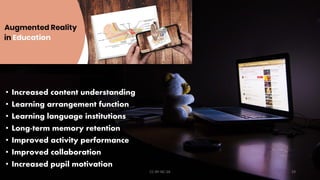
• Increased content understanding
• Learning arrangement function
• Learning language institutions
• Long-term memory retention
• Improved activity performance
• Improved collaboration
• Increased pupil motivation
CC-BY-NC-SA 29
Virtual Reality
(VR)
is the use of
computer technology
to
create a
simulated environment.
@ThiyaguSuriya
CC-BY-NC-SA 30
Virtual Reality
is a
simulated experience
that can be
similar to
or
completely different
from the
real world.
@ThiyaguSuriya
CC-BY-NC-SA 31
Virtual reality is the creation of a virtual environment
presented to our senses in such a way that
we experience it as if we were really there.
@ThiyaguSuriya CC-BY-NC-SA 32
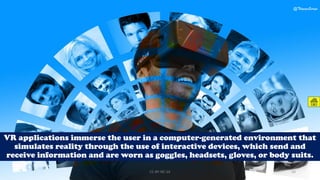
VR applications immerse the user in a computer-generated environment that
simulates reality through the use of interactive devices, which send and
receive information and are worn as goggles, headsets, gloves, or body suits.
@ThiyaguSuriya
CC-BY-NC-SA 33
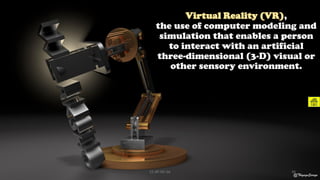
Virtual Reality (VR),
the use of computer modeling and
simulation that enables a person
to interact with an artificial
three-dimensional (3-D) visual or
other sensory environment.
@ThiyaguSuriya
CC-BY-NC-SA 34
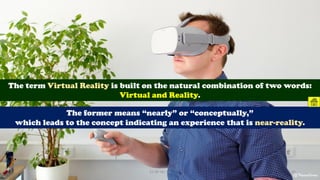
The term Virtual Reality is built on the natural combination of two words:
Virtual and Reality.
The former means “nearly” or “conceptually,”
which leads to the concept indicating an experience that is near-reality.
@ThiyaguSuriya
CC-BY-NC-SA 35
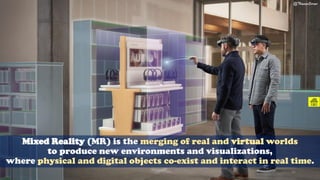
Mixed Reality (MR) is the merging of real and virtual worlds
to produce new environments and visualizations,
where physical and digital objects co-exist and interact in real time.
@ThiyaguSuriya
CC-BY-NC-SA 36
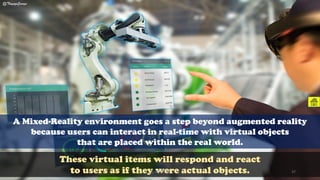
A Mixed-Reality environment goes a step beyond augmented reality
because users can interact in real-time with virtual objects
that are placed within the real world.
These virtual items will respond and react
to users as if they were actual objects.
@ThiyaguSuriya
CC-BY-NC-SA 37
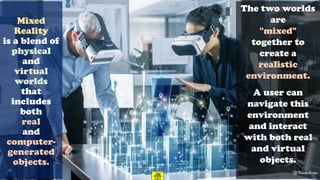
Mixed
Reality
is a blend of
physical
and
virtual
worlds
that
includes
both
real
and
computer-
generated
objects.
The two worlds
are
"mixed"
together to
create a
realistic
environment.
A user can
navigate this
environment
and interact
with both real
and virtual
objects.
@ThiyaguSuriyaCC-BY-NC-SA 38
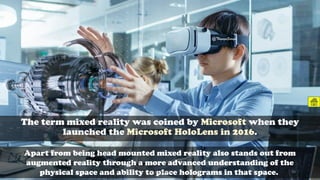
The term mixed reality was coined by Microsoft when they
launched the Microsoft HoloLens in 2016.
Apart from being head mounted mixed reality also stands out from
augmented reality through a more advanced understanding of the
physical space and ability to place holograms in that space.
@ThiyaguSuriya
CC-BY-NC-SA 39
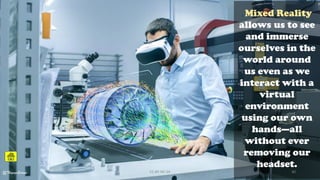
. Mixed Reality
allows us to see
and immerse
ourselves in the
world around
us even as we
interact with a
virtual
environment
using our own
hands—all
without ever
removing our
headset.
@ThiyaguSuriya CC-BY-NC-SA 40
CC-BY-NC-SA 41
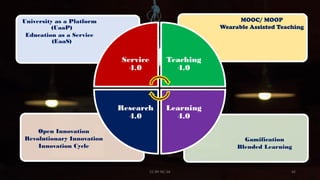
Gamification
Blended Learning
Open Innovation
Revolutionary Innovation
Innovation Cycle
MOOC/ MOOP
Wearable Assisted Teaching
University as a Platform
(UaaP)
Education as a Service
(EaaS)
Service
4.0
Teaching
4.0
Learning
4.0
Research
4.0
CC-BY-NC-SA 42
Thank You
CC-BY-NC-SA 43

Augmented Reality in Education - Thiyagu

  • 1.
    Augmented Reality in Education K.THIYAGU, Assistant Professor,Department of Education, Central University of Kerala, KasaragodCC-BY-NC-SA 1
  • 2.
    Augmented Reality (AR) VirtualReality (VR) Mixed Reality (MR) CC-BY-NC-SA 2
  • 3.
  • 4.
  • 5.
  • 6.
  • 7.
  • 8.
  • 9.
  • 10.
    It is a halfwaypoint between the real world and Virtual Environments. In augmented reality simulations, the real world is infused with virtual objects, and provides an interactive experience. Augmented Reality virtual reality’s Little Brother. CC-BY-NC-SA 10
  • 11.
    Augmented Reality is the resultof using technology to superimpose information (sounds, images and text) on the world we see. @ThiyaguSuriya CC-BY-NC-SA 11
  • 12.
    Augmented reality is thetechnology that expands our physical world, adding layers of digital information onto it. AR appears in direct view of an existing environment and adds sounds, videos, graphics to it. @ThiyaguSuriya CC-BY-NC-SA 12
  • 13.
    Augmented Reality is theblending of interactive digital elements (dazzling visual overlays, or other sensory projections) into our real-world environments. @ThiyaguSuriya CC-BY-NC-SA 13
  • 14.
    Augmented Reality turnsthe environment around us into a digital interface by placing virtual objects in the real world, in real-time. @ThiyaguSuriya CC-BY-NC-SA 14
  • 15.
    Augmented reality (AR) is aview of the real, physical world in which users find elements enhanced by computer-generated input. @ThiyaguSuriya CC-BY-NC-SA 15
  • 16.
  • 17.
    How AR works?? https://www.3rockar.com/augmented-reality-changing-world-gaming/ CC-BY-NC-SA 17
  • 18.
    AR Display Head Mounted Display (HMD) Eyeglasses Contact Lenses Virtual Retina Display Handheld Spatial Projector CC-BY-NC-SA 18
  • 19.
  • 20.
    Marker-based AR The othername for Marker- Based AR is also called Image Recognition or Recognition based AR. this type of AR provides us more information about the object after it focuses on the recognition of objects. CC-BY-NC-SA 20
  • 21.
    Markerless AR Marker-less ARis more versatile than marker-based AR as it allows the user to decide where to put the virtual object. You can try different styles and locations completely digitally, without having to move anything in your surroundings. Markerless augmented reality relies on the device's hardware, including the camera, GPS, digital compass, and accelerometer, to gather the information necessary for the AR software to do its job. CC-BY-NC-SA 21
  • 22.
    Location-based AR Location-based ARties digital content and the experience it creates to a specific place. The objects are mapped out so that when a user's location matches the predetermined spot it is displayed on the screen. CC-BY-NC-SA 22
  • 23.
    Superimposition AR In thisexample, the chair is copied, rotated, and placed in another location around the table. The user can do so many things with this technology, like decide if they want to have four chairs and a little elbow room or if they can comfortably seat six at the same table. Superimposition AR recognizes an object in the physical world and enhances it in some way to provide an alternate view. This can include recreating a portion of the object or the whole thing in its entirety. CC-BY-NC-SA 23
  • 24.
    Projection-based AR Projection-based ARis a little different than the other types of markerless augmented reality. Namely, you don’t need a mobile device to display the content. Instead, light projects the digital graphics onto an object or surface to create an interactive experience for the user.CC-BY-NC-SA 24
  • 25.
  • 26.
    AR Application • Quiver •Elements 4D • Blippar • Star walk • Spacecraft AR CC-BY-NC-SA 26
  • 27.
    AR Games Pokemon Go Ingress Zombies,Run! Harry Potter: Wizards Unite Spirit Camera CC-BY-NC-SA 27
  • 28.
  • 29.
    • Increased contentunderstanding • Learning arrangement function • Learning language institutions • Long-term memory retention • Improved activity performance • Improved collaboration • Increased pupil motivation CC-BY-NC-SA 29
  • 30.
    Virtual Reality (VR) is theuse of computer technology to create a simulated environment. @ThiyaguSuriya CC-BY-NC-SA 30
  • 31.
    Virtual Reality is a simulatedexperience that can be similar to or completely different from the real world. @ThiyaguSuriya CC-BY-NC-SA 31
  • 32.
    Virtual reality isthe creation of a virtual environment presented to our senses in such a way that we experience it as if we were really there. @ThiyaguSuriya CC-BY-NC-SA 32
  • 33.
    VR applications immersethe user in a computer-generated environment that simulates reality through the use of interactive devices, which send and receive information and are worn as goggles, headsets, gloves, or body suits. @ThiyaguSuriya CC-BY-NC-SA 33
  • 34.
    Virtual Reality (VR), theuse of computer modeling and simulation that enables a person to interact with an artificial three-dimensional (3-D) visual or other sensory environment. @ThiyaguSuriya CC-BY-NC-SA 34
  • 35.
    The term VirtualReality is built on the natural combination of two words: Virtual and Reality. The former means “nearly” or “conceptually,” which leads to the concept indicating an experience that is near-reality. @ThiyaguSuriya CC-BY-NC-SA 35
  • 36.
    Mixed Reality (MR)is the merging of real and virtual worlds to produce new environments and visualizations, where physical and digital objects co-exist and interact in real time. @ThiyaguSuriya CC-BY-NC-SA 36
  • 37.
    A Mixed-Reality environmentgoes a step beyond augmented reality because users can interact in real-time with virtual objects that are placed within the real world. These virtual items will respond and react to users as if they were actual objects. @ThiyaguSuriya CC-BY-NC-SA 37
  • 38.
    Mixed Reality is a blendof physical and virtual worlds that includes both real and computer- generated objects. The two worlds are "mixed" together to create a realistic environment. A user can navigate this environment and interact with both real and virtual objects. @ThiyaguSuriyaCC-BY-NC-SA 38
  • 39.
    The term mixedreality was coined by Microsoft when they launched the Microsoft HoloLens in 2016. Apart from being head mounted mixed reality also stands out from augmented reality through a more advanced understanding of the physical space and ability to place holograms in that space. @ThiyaguSuriya CC-BY-NC-SA 39
  • 40.
    . Mixed Reality allowsus to see and immerse ourselves in the world around us even as we interact with a virtual environment using our own hands—all without ever removing our headset. @ThiyaguSuriya CC-BY-NC-SA 40
  • 41.
  • 42.
    Gamification Blended Learning Open Innovation RevolutionaryInnovation Innovation Cycle MOOC/ MOOP Wearable Assisted Teaching University as a Platform (UaaP) Education as a Service (EaaS) Service 4.0 Teaching 4.0 Learning 4.0 Research 4.0 CC-BY-NC-SA 42
  • 43.