CONNECTING AUGMENTED REALITY
TO HIGHER EDUCATION:
MASH-UP MODELS IN
VIRTUAL WORLDS

Nil GÖKSEL CANBEK, Anadolu University,TURKEY
Jace HARGIS, University of the Pacific, USA

Edulearn11, Barcelona
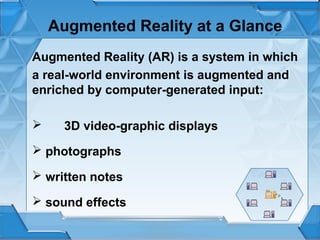
Augmented Reality at a Glance
Augmented Reality (AR) is a system in which
a real-world environment is augmented and
enriched by computer-generated input:


3D video-graphic displays

 photographs
 written notes
 sound effects
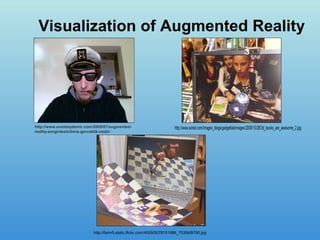
Visualization of Augmented Reality

http://www.erenbaydemir.com/2009/07/augmentedreality-zenginlestirilmis-gerceklik-nedir/

http://farm5.static.flickr.com/4009/5078151986_7535bf8790.jpg
AR as a Connective Tool
Description of AR:
runs interactively in real time;
blends the real and immersive objects in a
simulated virtual middle ground.
(Azuma, 2001)
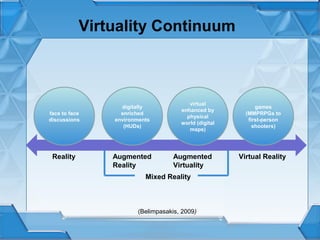
Virtuality Continuum

face to face
discussions

Reality

digitally
enriched
environments
(HUDs)

Augmented
Reality

virtual
enhanced by
physical
world (digital
maps)

Augmented
Virtuality

Mixed Reality

(Belimpasakis, 2009)

games
(MMPRPGs to
first-person
shooters)

Virtual Reality
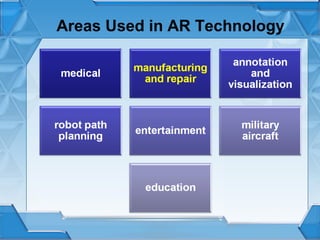
Areas Used in AR Technology
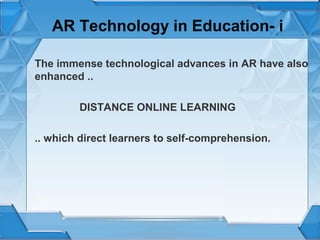
AR Technology in Education- i
The immense technological advances in AR have also
enhanced ..
DISTANCE ONLINE LEARNING
.. which direct learners to self-comprehension.
AR Technology in Education- ii
 Many higher education institutions are willing to
integrate AR technology with their existing online
teaching models (Liarokapis & Anderson, 2010);
 “online learning provides support in the workings
of networks of individual social actors which
function as online learning communities”
(Kehrwald, 2007);


AR as a powerful system facilitates both
individual and collaborative learning efforts at
distance.
Virtual Learning through AR
Mash-ups

Under AR technology, mash-ups:
combine disparate data from more than
one source;
facilitate the learning experience as
supportive tools of education.
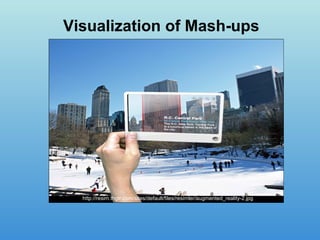
Visualization of Mash-ups

http://resim.thgtr.com/sites/default/files/resimler/augmented_reality-2.jpg
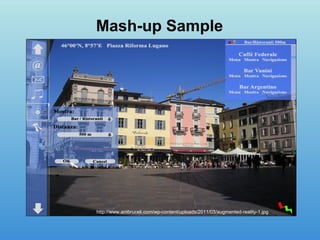
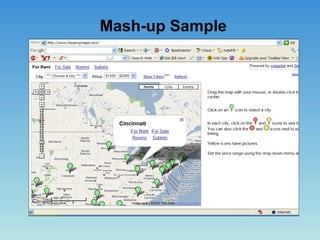
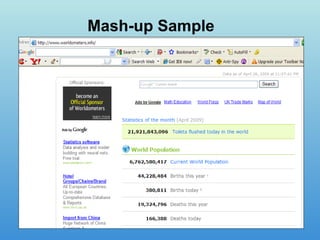
Mash-up Sample

http://www.ambruceli.com/wp-content/uploads/2011/03/augmented-reality-1.jpg
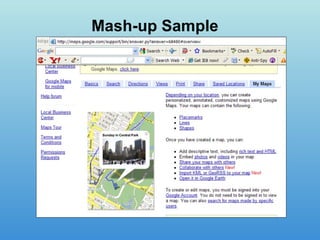
Mash-up Sample
• Your Subtopics Go Here
Mash-up Sample
• Your Subtopics Go Here
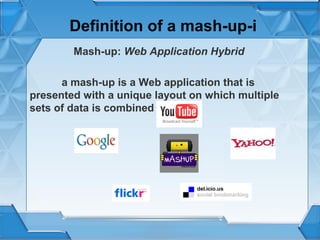
Definition of a mash-up-i
Mash-up: Web Application Hybrid
a mash-up is a Web application that is
presented with a unique layout on which multiple
sets of data is combined
Definition of a mash-up- ii
mash-ups collect data and blend contents from a key
driving source like Internet and deliver them to different
e-clients (Kulathuramaiyer, 2007);
mash-ups refer to a new type of application that
mingles at least two different web services (Bell, 2009).
Mash-up Sample
• Your Subtopics Go Here
Learning through Mash-ups
 integrate multiple visual tools into one
immersive milieu;
 correlates different data;
 form a new educational application built
upon creative and critical thinking;
(Jonassen, 2000)

 process, present and store permanent
information.
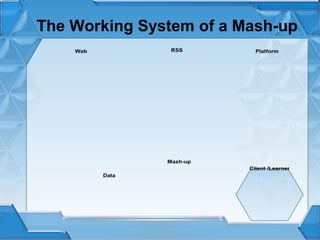
The Working System of a Mash-up
RSS
Feed

Web
Services

Mash-up
Application
Data

Platform
Services

Client /Learner
The Educational Use of Mash-ups
‘geology and natural sciences’
 SweetSearch

is a search engine that

searches websites and content that is educatorapprove
 OneGeology

is a website that offers

dynamic geological maps of the world
 MIT OpenCourseWare

is a web-based

publication of courses offered at the
Massachusetts Institute of Technology.
The Limitations of Educational Mash-ups
 mash-ups has not been significantly explored
(creative writing and history);
 before using mash-ups, the advantages and
disadvantages should be analyzed;
 current mash-ups available for use should be
searched carefully; mash-ups may not be accurate
or completely open, restricted Information/ paid
subscription (Anand et.al., 2010).
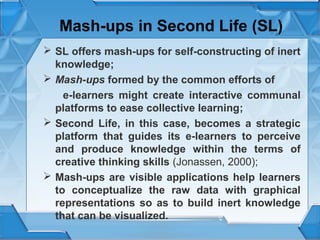
Mash-ups in Second Life (SL)
 SL offers mash-ups for self-constructing of inert
knowledge;
 Mash-ups formed by the common efforts of
e-learners might create interactive communal
platforms to ease collective learning;
 Second Life, in this case, becomes a strategic
platform that guides its e-learners to perceive
and produce knowledge within the terms of
creative thinking skills (Jonassen, 2000);
 Mash-ups are visible applications help learners
to conceptualize the raw data with graphical
representations so as to build inert knowledge
that can be visualized.
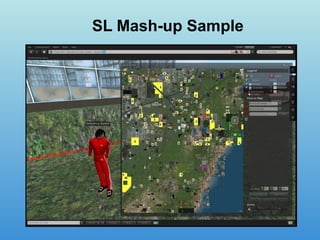
SL Mash-up Sample
Conclusion-i
Learning Journey could be more enjoyable with
Mash-ups!
The characteristics and potentials of mash-ups
reinforced by AR Technologies could make learning
easier for e-learners while creating permanent
knowledge and authentic experiences with data
based on real life simulations.
Conclusion-ii
As a variation of VR- AR Technology can be used:
to assist teaching within VWs
to connect online applications
to start an interactive education
to create meaningful immersive data including:
spatial three-dimensional models
images
textual information
video
animations and sound
(Liarokapis & Anderson 2010)
Conclusion-iii

the benefits of low threshold, menu-drive
technologies such as mash-ups, are an attractive
enhancement to teaching and learning!
Thank you !

ngoksel@anadolu.edu.tr
jhargis@pacific.edu

Nil göksel canbek edulearn11

  • 1.
    CONNECTING AUGMENTED REALITY TOHIGHER EDUCATION: MASH-UP MODELS IN VIRTUAL WORLDS Nil GÖKSEL CANBEK, Anadolu University,TURKEY Jace HARGIS, University of the Pacific, USA Edulearn11, Barcelona
  • 2.
    Augmented Reality ata Glance Augmented Reality (AR) is a system in which a real-world environment is augmented and enriched by computer-generated input:  3D video-graphic displays  photographs  written notes  sound effects
  • 3.
    Visualization of AugmentedReality http://www.erenbaydemir.com/2009/07/augmentedreality-zenginlestirilmis-gerceklik-nedir/ http://farm5.static.flickr.com/4009/5078151986_7535bf8790.jpg
  • 4.
    AR as aConnective Tool Description of AR: runs interactively in real time; blends the real and immersive objects in a simulated virtual middle ground. (Azuma, 2001)
  • 5.
    Virtuality Continuum face toface discussions Reality digitally enriched environments (HUDs) Augmented Reality virtual enhanced by physical world (digital maps) Augmented Virtuality Mixed Reality (Belimpasakis, 2009) games (MMPRPGs to first-person shooters) Virtual Reality
  • 6.
    Areas Used inAR Technology
  • 7.
    AR Technology inEducation- i The immense technological advances in AR have also enhanced .. DISTANCE ONLINE LEARNING .. which direct learners to self-comprehension.
  • 8.
    AR Technology inEducation- ii  Many higher education institutions are willing to integrate AR technology with their existing online teaching models (Liarokapis & Anderson, 2010);  “online learning provides support in the workings of networks of individual social actors which function as online learning communities” (Kehrwald, 2007);  AR as a powerful system facilitates both individual and collaborative learning efforts at distance.
  • 9.
    Virtual Learning throughAR Mash-ups Under AR technology, mash-ups: combine disparate data from more than one source; facilitate the learning experience as supportive tools of education.
  • 10.
  • 11.
  • 12.
    Mash-up Sample • YourSubtopics Go Here
  • 13.
    Mash-up Sample • YourSubtopics Go Here
  • 14.
    Definition of amash-up-i Mash-up: Web Application Hybrid a mash-up is a Web application that is presented with a unique layout on which multiple sets of data is combined
  • 15.
    Definition of amash-up- ii mash-ups collect data and blend contents from a key driving source like Internet and deliver them to different e-clients (Kulathuramaiyer, 2007); mash-ups refer to a new type of application that mingles at least two different web services (Bell, 2009).
  • 16.
    Mash-up Sample • YourSubtopics Go Here
  • 17.
    Learning through Mash-ups integrate multiple visual tools into one immersive milieu;  correlates different data;  form a new educational application built upon creative and critical thinking; (Jonassen, 2000)  process, present and store permanent information.
  • 18.
    The Working Systemof a Mash-up RSS Feed Web Services Mash-up Application Data Platform Services Client /Learner
  • 19.
    The Educational Useof Mash-ups ‘geology and natural sciences’  SweetSearch is a search engine that searches websites and content that is educatorapprove  OneGeology is a website that offers dynamic geological maps of the world  MIT OpenCourseWare is a web-based publication of courses offered at the Massachusetts Institute of Technology.
  • 20.
    The Limitations ofEducational Mash-ups  mash-ups has not been significantly explored (creative writing and history);  before using mash-ups, the advantages and disadvantages should be analyzed;  current mash-ups available for use should be searched carefully; mash-ups may not be accurate or completely open, restricted Information/ paid subscription (Anand et.al., 2010).
  • 21.
    Mash-ups in SecondLife (SL)  SL offers mash-ups for self-constructing of inert knowledge;  Mash-ups formed by the common efforts of e-learners might create interactive communal platforms to ease collective learning;  Second Life, in this case, becomes a strategic platform that guides its e-learners to perceive and produce knowledge within the terms of creative thinking skills (Jonassen, 2000);  Mash-ups are visible applications help learners to conceptualize the raw data with graphical representations so as to build inert knowledge that can be visualized.
  • 22.
  • 23.
    Conclusion-i Learning Journey couldbe more enjoyable with Mash-ups! The characteristics and potentials of mash-ups reinforced by AR Technologies could make learning easier for e-learners while creating permanent knowledge and authentic experiences with data based on real life simulations.
  • 24.
    Conclusion-ii As a variationof VR- AR Technology can be used: to assist teaching within VWs to connect online applications to start an interactive education to create meaningful immersive data including: spatial three-dimensional models images textual information video animations and sound (Liarokapis & Anderson 2010)
  • 25.
    Conclusion-iii the benefits oflow threshold, menu-drive technologies such as mash-ups, are an attractive enhancement to teaching and learning!
  • 26.