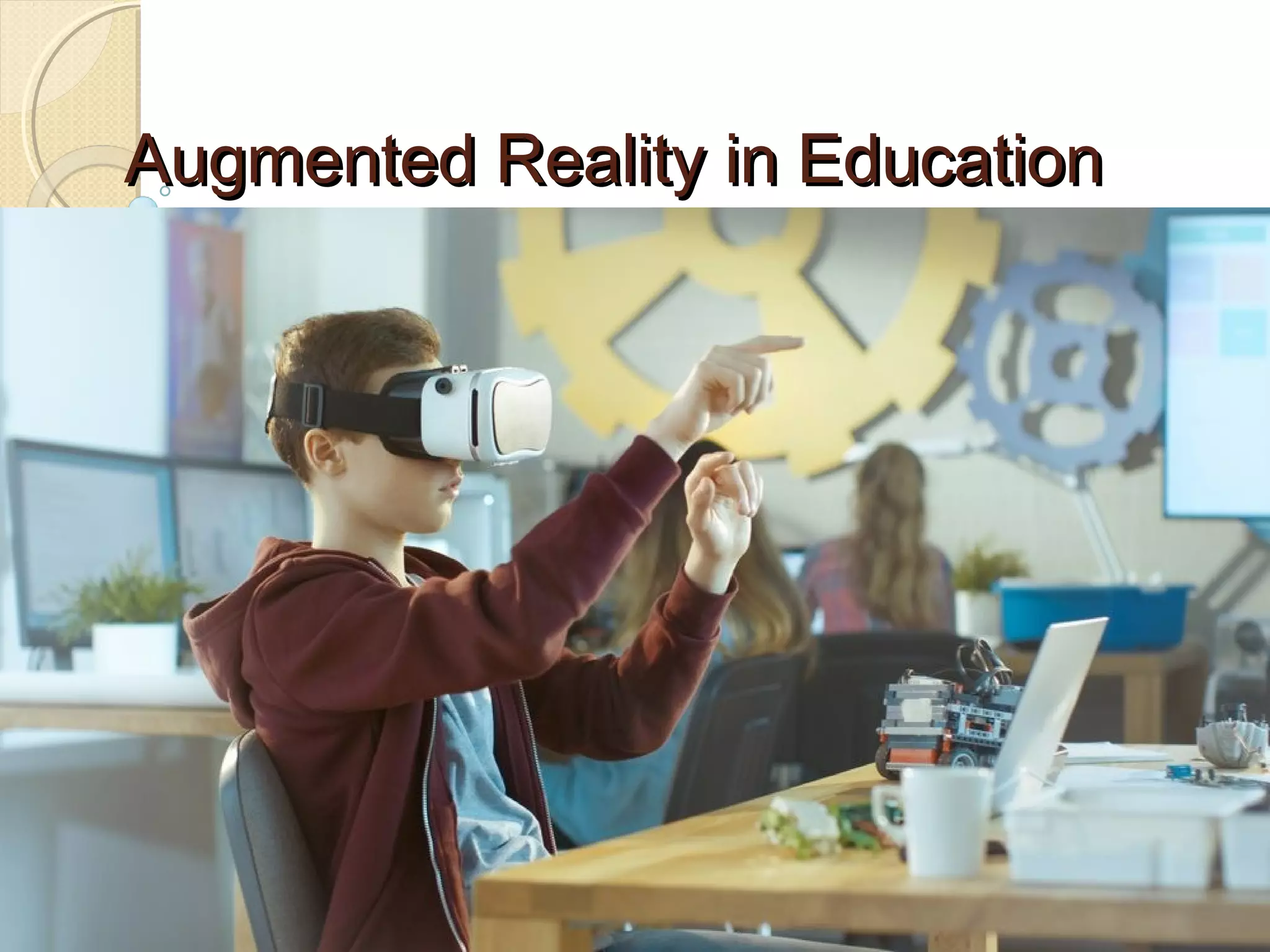
Augmented Reality in EducationAugmented Reality in Education
ContentContent
• Introduction
• Technologies of AR systems
• AR in classroom
• AR in electronics
• AR in medical education
• AR in engineering graphics
• AR in reality
• Advantages and disadvantages
• Conclusion
• References
IntroductionIntroduction
Virtual Reality is defined
as "the use of computer
technology to create a
simulated environment.
"When you view VR, you
are viewing a completely
different reality than the
one in front of you.
VIRTUAL REALITY AUGMENTED REALITY
• Augmented reality adds
digital elements to a live
view often by using the
camera on a
smartphone. AR is used
in apps for smartphones
and tablets.
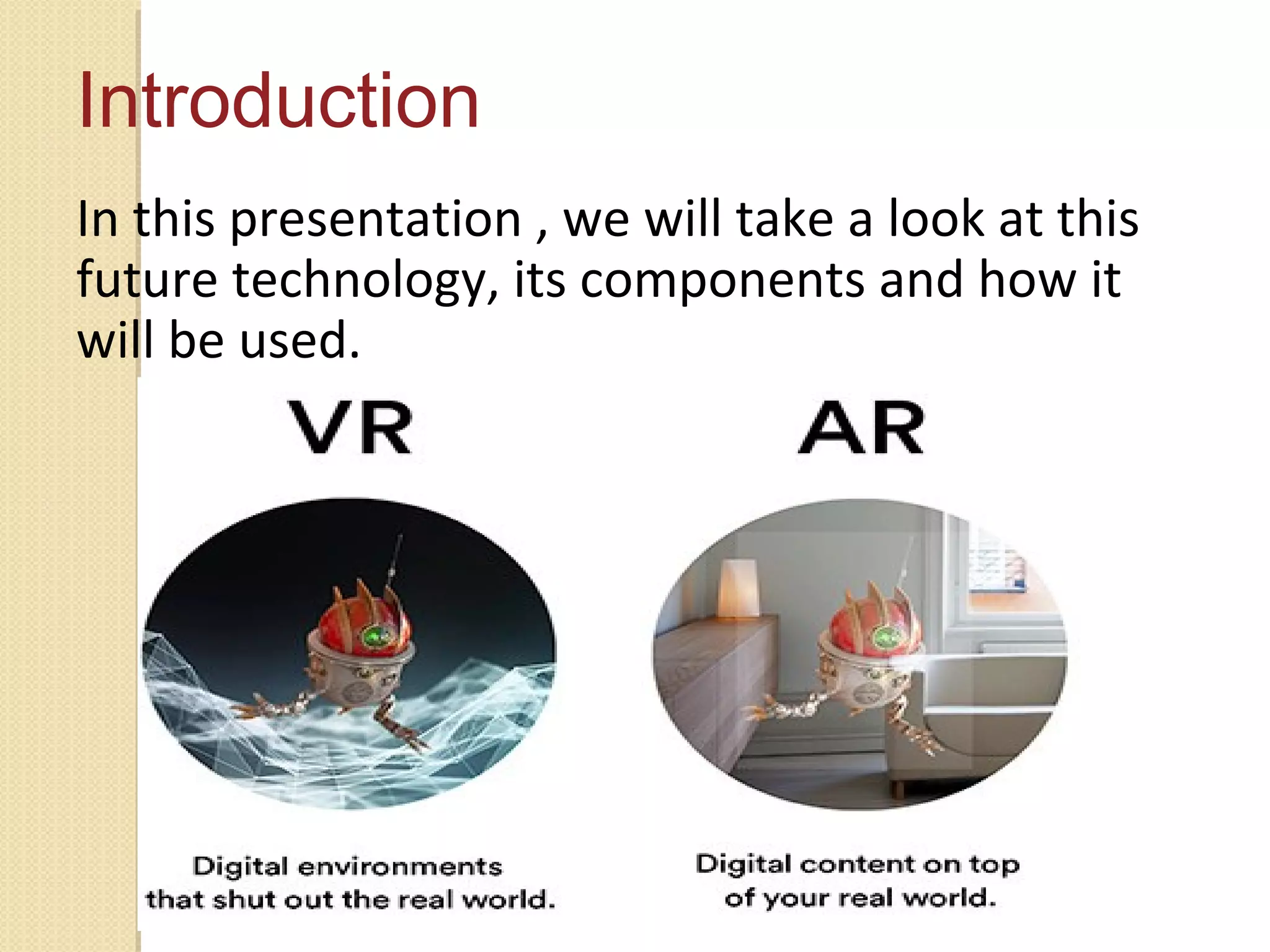
In this presentation , we will take a look at this
future technology, its components and how it
will be used.
Introduction
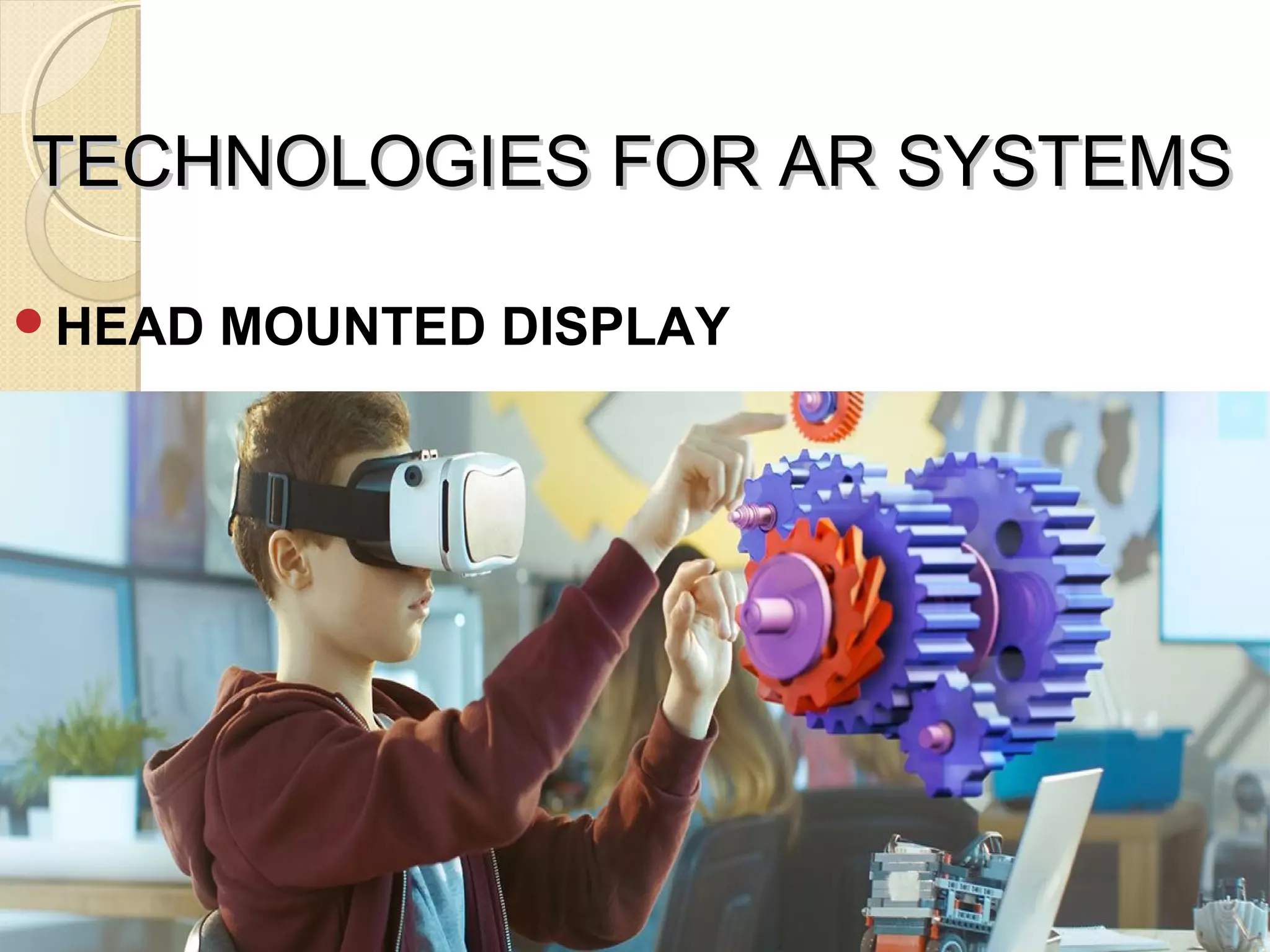
TECHNOLOGIES FOR AR SYSTEMSTECHNOLOGIES FOR AR SYSTEMS
HEAD MOUNTED DISPLAY
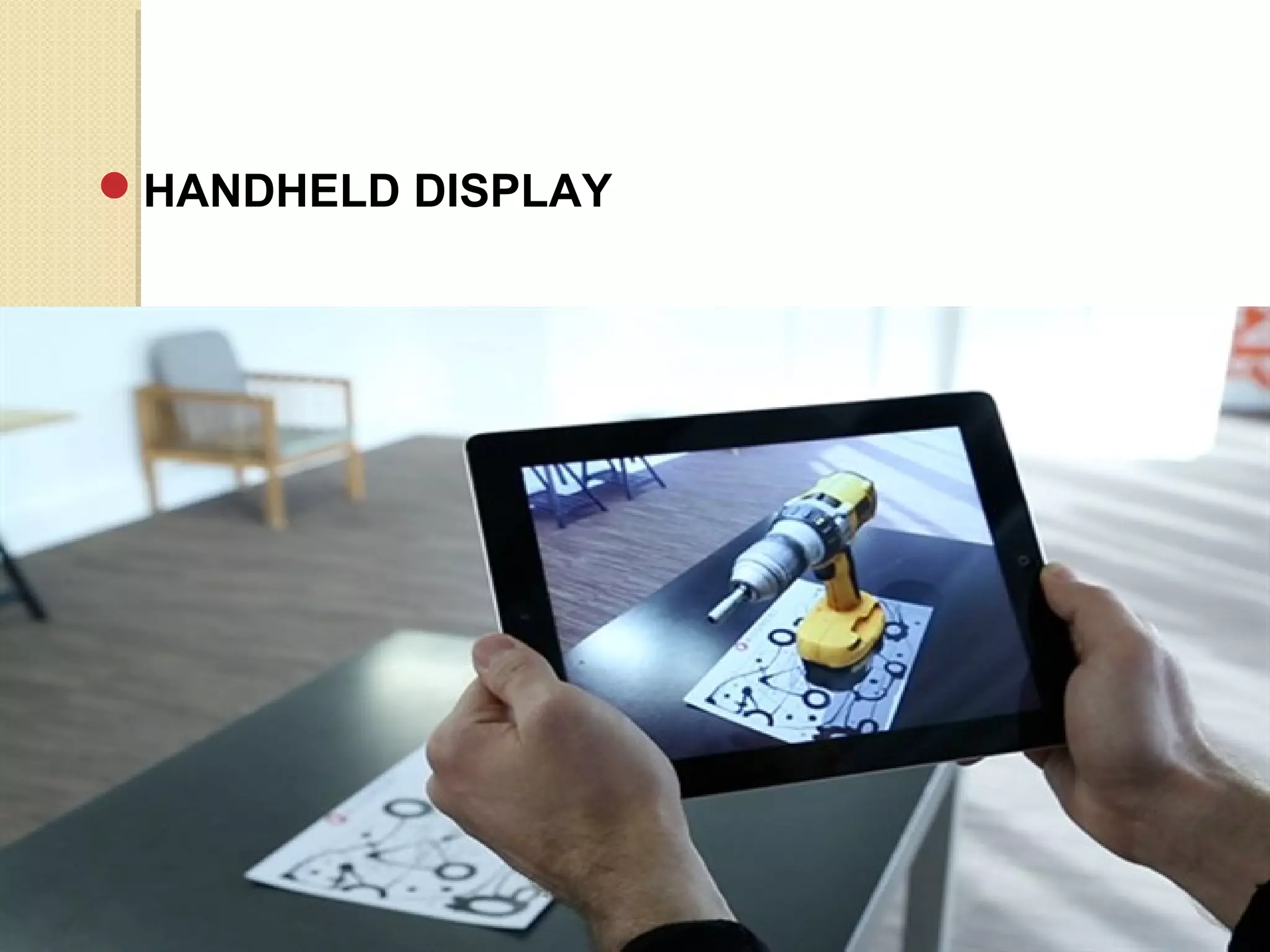
HANDHELD DISPLAY
PINCH GLOVESPINCH GLOVES
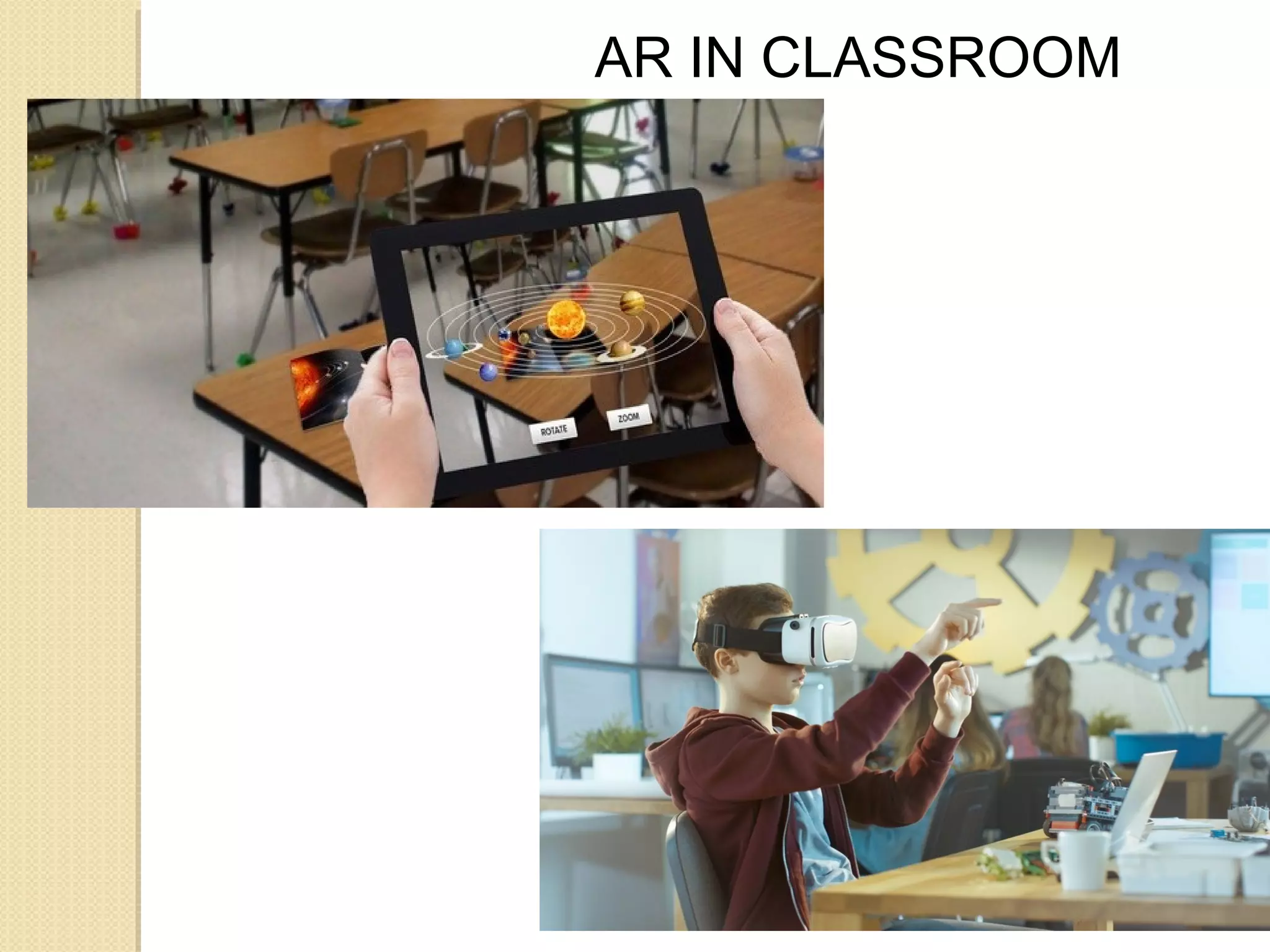
AR IN CLASSROOMAR IN CLASSROOM
• AR enables students to experience a different learning
cycle that will make them retain more knowledge
longer. As Confucius said: ‘’I hear and I forget; I see
and I remember; I do and I understand’’.
• In educational settings, AR has been used to
complement a standard curriculum. Text, graphics,
video, and audio may be superimposed into a student's
real-time environment. Textbooks, flashcards and other
educational reading material may contain embedded
"markers” or triggers that, when scanned by an AR
device, produced supplementary information to the
student rendered in a multimedia format
AR IN CLASSROOM
AR ELECTRONICS
• Augmented reality can be used in different areas. One such
area is electronics,
• five ways in which augmented reality can be used in
electronics.
Build new devices
Repair electronics
Teach about electronic interfaces
Instills creativity in kids
Troubleshoot electronic problems
AR ELECTRONICSAR ELECTRONICS
AR IN MEDICAL EDUCATIONAR IN MEDICAL EDUCATION
In medical education the phrase, “see one, do one,
teach one” is the creed by which students become
professionals and go on to help the next
generation. AR already exist in medical education
and subject areas that AR applications cover include
anatomy, surgery, and forensic medicine.
Additionally, AR have a place in medical training and
already assist in actual medical procedures.
AR IN MEDICAL EDUCATIONAR IN MEDICAL EDUCATION
AR IN ENGINEERING
GRAPHICS
The AR-based Engineering Graphics System uses normal books
as the interface. Students can turn the pages of these books,
look at the problem inside the book, and finish their assignment
much the way they are reading and writing on an ordinary
sheet. However, if they focus a camera on the marker, a 3D
virtual models pop-up in the computer screen over the real
pages. The virtual models superimposed upon the real page will
serve as the tip for imagining the relationship between the 3D
geometry and their 2D projection.
AR IN ENGINEERING GRAPHICSAR IN ENGINEERING GRAPHICS
AR IN REALITYAR IN REALITY
The following tech giants are actively developing (or
investing) in AR technologies:
•Microsoft has released its Hololens head-mounted AR device
(www.microsoft.com/en us/hololens),
•Google has launched Tango (https://get.google. com/tango),
Facebook recently announced an ambitious AR plan,1 and
•Apple just showed off its new ARKit as the “largest AR platform
in the world.”
AR IN REALITYAR IN REALITY
Numerous AR headsets have been presented to public, three of
which are shown in Figure below, a pioneering headset (Google
Glass), a product from a tech giant (Microsoft’s Hololens), and a
counterpart from a startup (HiScene’s HiAR Glasses).
AR IN REALITY
Augmented VS Virtual RealityAugmented VS Virtual Reality
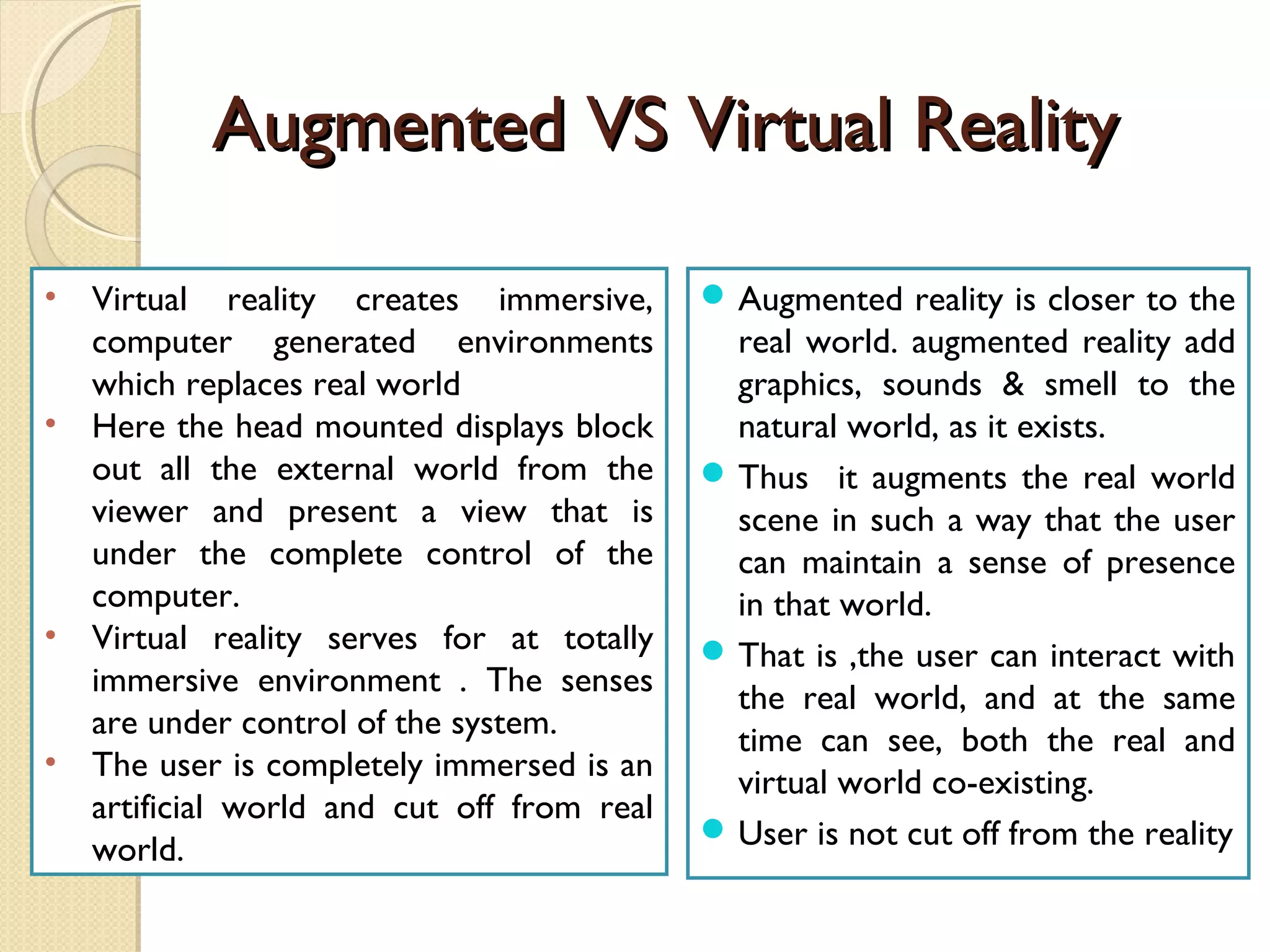
Augmented reality is closer to the
real world. augmented reality add
graphics, sounds & smell to the
natural world, as it exists.
Thus it augments the real world
scene in such a way that the user
can maintain a sense of presence
in that world.
That is ,the user can interact with
the real world, and at the same
time can see, both the real and
virtual world co-existing.
User is not cut off from the reality
• Virtual reality creates immersive,
computer generated environments
which replaces real world
• Here the head mounted displays block
out all the external world from the
viewer and present a view that is
under the complete control of the
computer.
• Virtual reality serves for at totally
immersive environment . The senses
are under control of the system.
• The user is completely immersed is an
artificial world and cut off from real
world.
ADVANTAGESADVANTAGES
• Individualized learning
• Motivation
• Savings
• Fostering the learning proccess
• Wide variety of fields
• Developing student’s creativity and
curiosity
• Educating the consumer
• Aiding the physician
• Aiding sales
 Benefits of Augmented
Reality as an Edtech
Solution
 Benefits of augmented
reality in healthcare
 Benefits of augmented reality
in gaming
• Hands-free gameplay
• Real First-person Experience
• A Real Three-dimensional Gameplay
Experience
DISADVANTAGESDISADVANTAGES
 No control over personal details
 Addictive and laziness
 Deteriorates Human Connections
 Lack Of Flexibility.
 Functionality Issues.
APPLICATIONS OF ARAPPLICATIONS OF AR
Military AR Applications
AR applications in Navigation
AR applications in
Maintenance and Repair
In general augmented reality has wide area of applications in most
of the fields
ConclusionConclusion
Using augmented reality systems learners interact with
the 3D information, objects and events in a natural way.
The educational experience offered by Augmented
Reality is different for a number of reasons as,
•Support of seamless interaction between real and virtual
environments.
• The use of a tangible interface metaphor for object
manipulation.
•The ability to transition smoothly between reality and
virtuality.
REFERENCESREFERENCES
 Haibin Ling – (ieee journal-2017) -Augmented
Reality in Reality - https://ieeexplore.ieee.org/document/7999155
 The Future of Learning at the Workplace Is Augmented Reality- Fridolin
Wild, Oxford Brookes University – (ieee journal-2016)
https://ieeexplore.ieee.org/document/7598181
 S Zagoranski , S. Divjak –(ieee journal-2016) - Use of Augmented Reality in
Education https://ieeexplore.ieee.org/document/1248213/authors#authors
 Mehmet Kesim, Yasin Ozarslan (scienceDirect-2012)– Augmented Reality
in Education: Current Technologies and the Potential for Education -
https://www.sciencedirect.com/science/article/pii/S1877042812023907
 Iulian Radu- (ieee journal-2013 ) - Why should my students use AR? A
comparative review of the educational impacts of
augmented-reality https://ieeexplore.
ieee.org/document/6402590/authors#authors
 Heen Chen,Kaiping Feng,Chunliu Mo,Siyuan Cheng, Zhongning Guo,Yizhu
Huang – (ieee journal-2012) - Application of Augmented Reality in
Engineering Graphics Education -
https://ieeexplore.ieee.org/abstract/document/6132125
REFERENCESREFERENCES
Augmented Reality In Education

Augmented Reality In Education

  • 1.
    Augmented Reality inEducationAugmented Reality in Education
  • 2.
    ContentContent • Introduction • Technologiesof AR systems • AR in classroom • AR in electronics • AR in medical education • AR in engineering graphics • AR in reality • Advantages and disadvantages • Conclusion • References
  • 3.
    IntroductionIntroduction Virtual Reality isdefined as "the use of computer technology to create a simulated environment. "When you view VR, you are viewing a completely different reality than the one in front of you. VIRTUAL REALITY AUGMENTED REALITY • Augmented reality adds digital elements to a live view often by using the camera on a smartphone. AR is used in apps for smartphones and tablets.
  • 4.
    In this presentation, we will take a look at this future technology, its components and how it will be used. Introduction
  • 5.
    TECHNOLOGIES FOR ARSYSTEMSTECHNOLOGIES FOR AR SYSTEMS HEAD MOUNTED DISPLAY
  • 6.
  • 7.
  • 8.
    AR IN CLASSROOMARIN CLASSROOM • AR enables students to experience a different learning cycle that will make them retain more knowledge longer. As Confucius said: ‘’I hear and I forget; I see and I remember; I do and I understand’’. • In educational settings, AR has been used to complement a standard curriculum. Text, graphics, video, and audio may be superimposed into a student's real-time environment. Textbooks, flashcards and other educational reading material may contain embedded "markers” or triggers that, when scanned by an AR device, produced supplementary information to the student rendered in a multimedia format
  • 9.
  • 10.
    AR ELECTRONICS • Augmentedreality can be used in different areas. One such area is electronics, • five ways in which augmented reality can be used in electronics. Build new devices Repair electronics Teach about electronic interfaces Instills creativity in kids Troubleshoot electronic problems
  • 11.
  • 12.
    AR IN MEDICALEDUCATIONAR IN MEDICAL EDUCATION In medical education the phrase, “see one, do one, teach one” is the creed by which students become professionals and go on to help the next generation. AR already exist in medical education and subject areas that AR applications cover include anatomy, surgery, and forensic medicine. Additionally, AR have a place in medical training and already assist in actual medical procedures.
  • 13.
    AR IN MEDICALEDUCATIONAR IN MEDICAL EDUCATION
  • 14.
    AR IN ENGINEERING GRAPHICS TheAR-based Engineering Graphics System uses normal books as the interface. Students can turn the pages of these books, look at the problem inside the book, and finish their assignment much the way they are reading and writing on an ordinary sheet. However, if they focus a camera on the marker, a 3D virtual models pop-up in the computer screen over the real pages. The virtual models superimposed upon the real page will serve as the tip for imagining the relationship between the 3D geometry and their 2D projection.
  • 15.
    AR IN ENGINEERINGGRAPHICSAR IN ENGINEERING GRAPHICS
  • 16.
    AR IN REALITYARIN REALITY The following tech giants are actively developing (or investing) in AR technologies: •Microsoft has released its Hololens head-mounted AR device (www.microsoft.com/en us/hololens), •Google has launched Tango (https://get.google. com/tango), Facebook recently announced an ambitious AR plan,1 and •Apple just showed off its new ARKit as the “largest AR platform in the world.”
  • 17.
    AR IN REALITYARIN REALITY Numerous AR headsets have been presented to public, three of which are shown in Figure below, a pioneering headset (Google Glass), a product from a tech giant (Microsoft’s Hololens), and a counterpart from a startup (HiScene’s HiAR Glasses).
  • 18.
  • 19.
    Augmented VS VirtualRealityAugmented VS Virtual Reality Augmented reality is closer to the real world. augmented reality add graphics, sounds & smell to the natural world, as it exists. Thus it augments the real world scene in such a way that the user can maintain a sense of presence in that world. That is ,the user can interact with the real world, and at the same time can see, both the real and virtual world co-existing. User is not cut off from the reality • Virtual reality creates immersive, computer generated environments which replaces real world • Here the head mounted displays block out all the external world from the viewer and present a view that is under the complete control of the computer. • Virtual reality serves for at totally immersive environment . The senses are under control of the system. • The user is completely immersed is an artificial world and cut off from real world.
  • 20.
    ADVANTAGESADVANTAGES • Individualized learning •Motivation • Savings • Fostering the learning proccess • Wide variety of fields • Developing student’s creativity and curiosity • Educating the consumer • Aiding the physician • Aiding sales  Benefits of Augmented Reality as an Edtech Solution  Benefits of augmented reality in healthcare  Benefits of augmented reality in gaming • Hands-free gameplay • Real First-person Experience • A Real Three-dimensional Gameplay Experience
  • 21.
    DISADVANTAGESDISADVANTAGES  No controlover personal details  Addictive and laziness  Deteriorates Human Connections  Lack Of Flexibility.  Functionality Issues.
  • 22.
    APPLICATIONS OF ARAPPLICATIONSOF AR Military AR Applications AR applications in Navigation AR applications in Maintenance and Repair In general augmented reality has wide area of applications in most of the fields
  • 23.
    ConclusionConclusion Using augmented realitysystems learners interact with the 3D information, objects and events in a natural way. The educational experience offered by Augmented Reality is different for a number of reasons as, •Support of seamless interaction between real and virtual environments. • The use of a tangible interface metaphor for object manipulation. •The ability to transition smoothly between reality and virtuality.
  • 24.
    REFERENCESREFERENCES  Haibin Ling– (ieee journal-2017) -Augmented Reality in Reality - https://ieeexplore.ieee.org/document/7999155  The Future of Learning at the Workplace Is Augmented Reality- Fridolin Wild, Oxford Brookes University – (ieee journal-2016) https://ieeexplore.ieee.org/document/7598181  S Zagoranski , S. Divjak –(ieee journal-2016) - Use of Augmented Reality in Education https://ieeexplore.ieee.org/document/1248213/authors#authors  Mehmet Kesim, Yasin Ozarslan (scienceDirect-2012)– Augmented Reality in Education: Current Technologies and the Potential for Education - https://www.sciencedirect.com/science/article/pii/S1877042812023907
  • 25.
     Iulian Radu-(ieee journal-2013 ) - Why should my students use AR? A comparative review of the educational impacts of augmented-reality https://ieeexplore. ieee.org/document/6402590/authors#authors  Heen Chen,Kaiping Feng,Chunliu Mo,Siyuan Cheng, Zhongning Guo,Yizhu Huang – (ieee journal-2012) - Application of Augmented Reality in Engineering Graphics Education - https://ieeexplore.ieee.org/abstract/document/6132125 REFERENCESREFERENCES