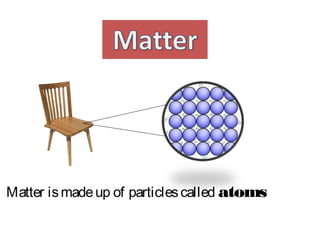
Matter ismadeup of particlescalled atoms
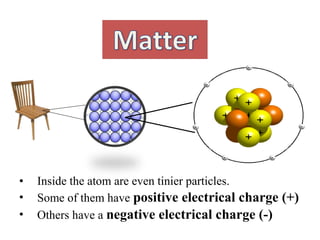
• Inside the atom are even tinier particles.
• Some of them have positive electrical charge (+)
• Others have a negative electrical charge (-)
The (+) and (-) charges are like the north pole and south pole
of a magnet.
North pole and north pole = repel
South pole and south pole = repel
Like poles repel ( go away ) from each other.
The (+) and (-) charges are like the north pole and south pole
of a magnet.
North pole and south pole = attract
Opposite poles ( attract ) pull each other.
( + ) and ( + ) = repel
( - ) and ( - ) = repel
( + ) and ( - ) = attract
( - ) and ( + ) = attract
Count the number of (+) and (-)
charges in an atom.
Most matter has the same number
of (+) and (-) charges.
This means that the atom is
neutral
Which charge do you think it moves
easily out of the atom?
(-) charge moves easily out of the atom.
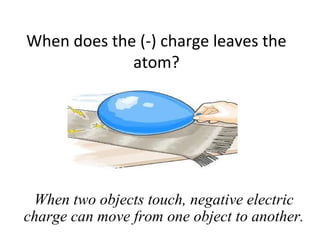
When does the (-) charge leaves the
atom?
When two objects touch, negative electric
charge can move from one object to another.
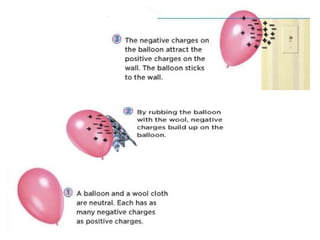
Rub a balloon with wool cloth.
What do you think?
The cloth or the balloon (-) charges moves
more easily than the other?
Rub a balloon with wool cloth.
The balloon is buildup of (-) charges.
the wool is buildup of (+) charges
Has more of one kind of
charge than the other.
Static electricity
The buildup of electrical
charges on an object.
What happens when you hold the
negatively charged balloon near a wall?
The (-) charge of the balloon repels the (-) charge of the wall and
attracts the (+) charge of the wall.
This pull makes the balloon stick to the wall.
How have you experienced static
electricity?
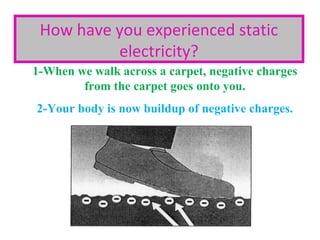
1-When we walk across a carpet, negative charges
from the carpet goes onto you.
2-Your body is now buildup of negative charges.
The negative charges are kept on our body
until we touch something and then :
How have you experienced static
electricity?
The movement of the charges is called discharge.
The shock that you feel is the fast movement
of negative charges from your body to
another object.
How have you experienced static
electricity?
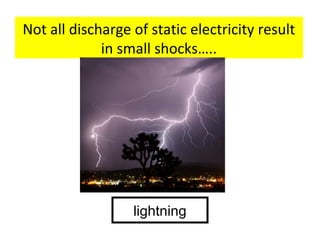
Not all discharge of static electricity result
in small shocks…..
lightning
Lightning is a discharge of static electricity
during a storm.
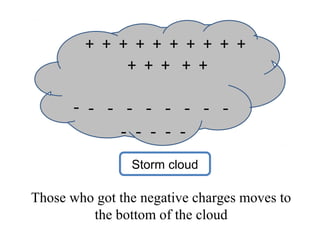
Storm cloud
Ice and water droplets rub against each other
- - - - - - - - -
- - - - -
Storm cloud
Those who got the negative charges moves to
the bottom of the cloud
+ + + + + + + + + +
+ + + + +
If the build up of negative charges gets large
enough, the charges jump to the ground as
lightning
Experiments
• Rub a balloon with your hair and stick it to the wall.
• Rub a ruler with your hair and stick it to a paper.
How have you experienced static
electricity?

Atom,static electricity

  • 2.
    Matter ismadeup ofparticlescalled atoms
  • 3.
    • Inside theatom are even tinier particles. • Some of them have positive electrical charge (+) • Others have a negative electrical charge (-)
  • 4.
    The (+) and(-) charges are like the north pole and south pole of a magnet. North pole and north pole = repel South pole and south pole = repel Like poles repel ( go away ) from each other.
  • 5.
    The (+) and(-) charges are like the north pole and south pole of a magnet. North pole and south pole = attract Opposite poles ( attract ) pull each other.
  • 6.
    ( + )and ( + ) = repel ( - ) and ( - ) = repel ( + ) and ( - ) = attract ( - ) and ( + ) = attract
  • 7.
    Count the numberof (+) and (-) charges in an atom.
  • 8.
    Most matter hasthe same number of (+) and (-) charges. This means that the atom is neutral
  • 9.
    Which charge doyou think it moves easily out of the atom? (-) charge moves easily out of the atom.
  • 10.
    When does the(-) charge leaves the atom? When two objects touch, negative electric charge can move from one object to another.
  • 11.
    Rub a balloonwith wool cloth. What do you think? The cloth or the balloon (-) charges moves more easily than the other?
  • 12.
    Rub a balloonwith wool cloth. The balloon is buildup of (-) charges. the wool is buildup of (+) charges
  • 13.
    Has more ofone kind of charge than the other.
  • 14.
    Static electricity The buildupof electrical charges on an object.
  • 15.
    What happens whenyou hold the negatively charged balloon near a wall? The (-) charge of the balloon repels the (-) charge of the wall and attracts the (+) charge of the wall. This pull makes the balloon stick to the wall.
  • 18.
    How have youexperienced static electricity? 1-When we walk across a carpet, negative charges from the carpet goes onto you. 2-Your body is now buildup of negative charges.
  • 19.
    The negative chargesare kept on our body until we touch something and then : How have you experienced static electricity?
  • 20.
    The movement ofthe charges is called discharge. The shock that you feel is the fast movement of negative charges from your body to another object. How have you experienced static electricity?
  • 21.
    Not all dischargeof static electricity result in small shocks….. lightning
  • 22.
    Lightning is adischarge of static electricity during a storm.
  • 23.
    Storm cloud Ice andwater droplets rub against each other
  • 24.
    - - -- - - - - - - - - - - Storm cloud Those who got the negative charges moves to the bottom of the cloud + + + + + + + + + + + + + + +
  • 25.
    If the buildup of negative charges gets large enough, the charges jump to the ground as lightning
  • 26.
    Experiments • Rub aballoon with your hair and stick it to the wall. • Rub a ruler with your hair and stick it to a paper. How have you experienced static electricity?