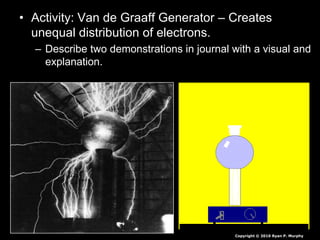
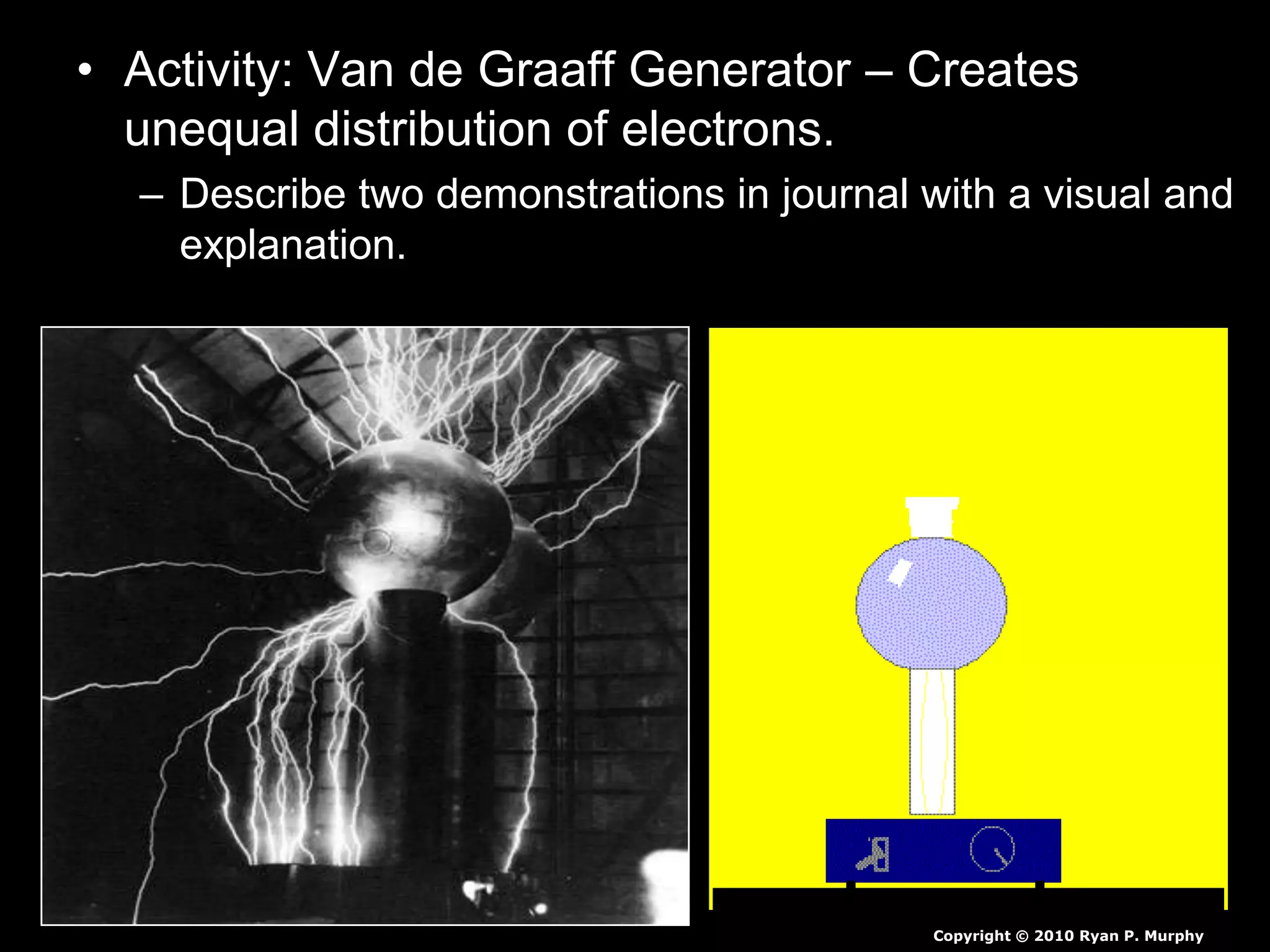



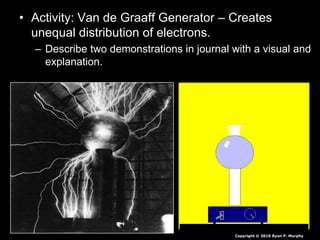







• Activity: Van de Graaff Generator – Creates
unequal distribution of electrons.
– Describe two demonstrations in journal with a visual and
explanation.
Copyright © 2010 Ryan P. Murphy
• RED SLIDE: These are notes that are very
important and should be recorded in your
science journal.
Copyright © 2010 Ryan P. Murphy
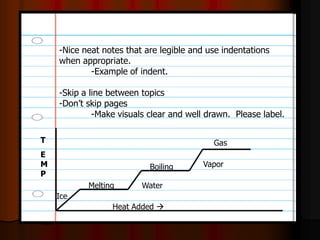
-Nice neat notes that are legible and use indentations
when appropriate.
-Example of indent.
-Skip a line between topics
-Don’t skip pages
-Make visuals clear and well drawn. Please label.
Ice
Melting Water
Boiling Vapor
GasT
E
M
P
Heat Added 
• RED SLIDE: These are notes that are very
important and should be recorded in your
science journal.
• BLACK SLIDE: Pay attention, follow
directions, complete projects as described
and answer required questions neatly.
Copyright © 2010 Ryan P. Murphy
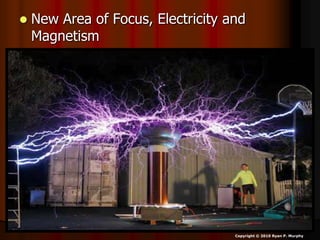
 New Area of Focus, Electricity and
Magnetism
Copyright © 2010 Ryan P. Murphy
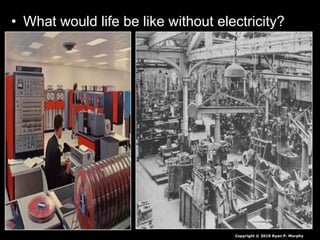
• What would life be like without electricity?
Copyright © 2010 Ryan P. Murphy
• Much different than it is for most of us.
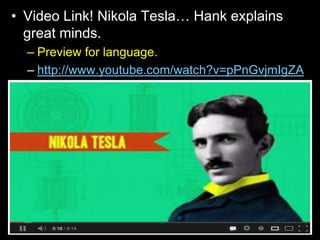
• Video Link! Nikola Tesla… Hank explains
great minds.
– Preview for language.
– http://www.youtube.com/watch?v=pPnGvjmIgZA
• Does somebody want to try and define the
word electricity?
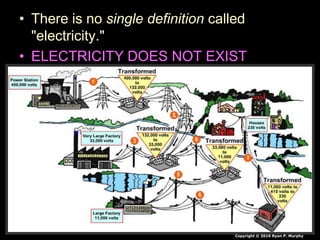
• There is no single definition called
"electricity."
Copyright © 2010 Ryan P. Murphy
• There is no single definition called
"electricity."
• ELECTRICITY DOES NOT EXIST
Copyright © 2010 Ryan P. Murphy
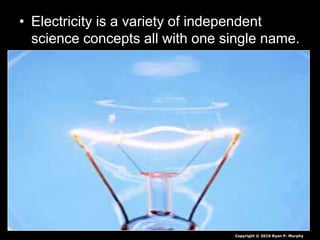
• Electricity is a variety of independent
science concepts all with one single name.
Copyright © 2010 Ryan P. Murphy
• These are the questions and definitions we need to know
to generate a definition for electricity?
– What is electric charge?
– What is electrical energy?
– What are electrons
– What is electric current?
– What is an imbalance of charge?
– What is an electric field?
– What is voltage?
– What is electric power?
– What is a spark?
– What is electromagnetism?
– What is electrical science?
– What is electrodynamics?
– What is electrostatics?
– What are electrical phenomena?
Copyright © 2010 Ryan P. Murphy
• These are the questions and definitions we need to know
to generate a definition for electricity?
– What is electric charge?
– What is electrical energy?
– What are electrons
– What is electric current?
– What is an imbalance of charge?
– What is an electric field?
– What is voltage?
– What is electric power?
– What is a spark?
– What is electromagnetism?
– What is electrical science?
– What is electrodynamics?
– What is electrostatics?
– What are electrical phenomena?
Copyright © 2010 Ryan P. Murphy
 Electricity is related to charges, and both
electrons (-) and protons (+) carry a
charge.
Copyright © 2010 Ryan P. Murphy
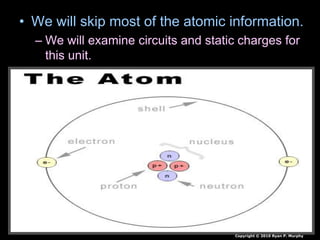
• We will skip most of the atomic information.
– We will examine circuits and static charges for
this unit.
Copyright © 2010 Ryan P. Murphy
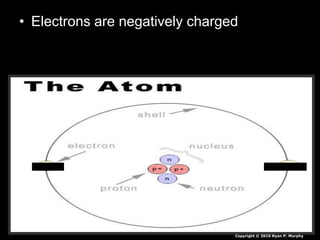
• Electrons are negatively charged
Copyright © 2010 Ryan P. Murphy
• Electrons are negatively charged
Copyright © 2010 Ryan P. Murphy
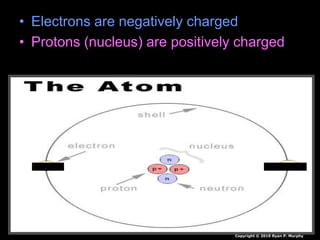
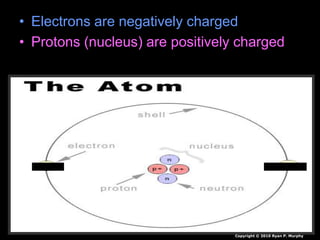
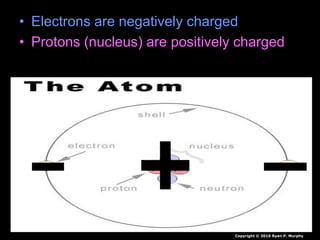
• Electrons are negatively charged
• Protons (nucleus) are positively charged
Copyright © 2010 Ryan P. Murphy
• Electrons are negatively charged
• Protons (nucleus) are positively charged
Copyright © 2010 Ryan P. Murphy
• Electrons are negatively charged
• Protons (nucleus) are positively charged
Copyright © 2010 Ryan P. Murphy
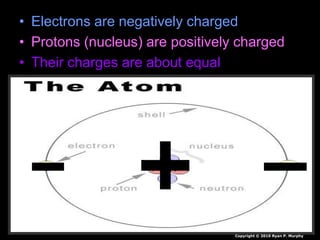
• Electrons are negatively charged
• Protons (nucleus) are positively charged
• Their charges are about equal
Copyright © 2010 Ryan P. Murphy
• Electrons are negatively charged
• Protons (nucleus) are positively charged
• Add Electrons – Atom becomes more
negatively charged.
Copyright © 2010 Ryan P. Murphy
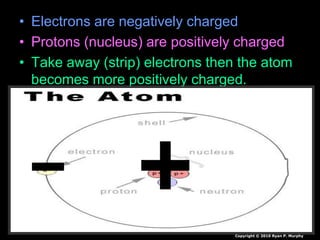
• Electrons are negatively charged
• Protons (nucleus) are positively charged
• Take away (strip) electrons then the atom
becomes more positively charged.
Copyright © 2010 Ryan P. Murphy
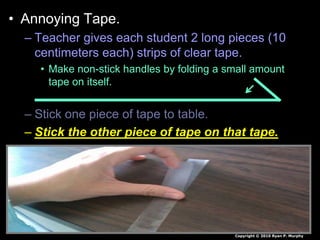
• Annoying Tape.
– Teacher gives each student 2 long pieces (10
centimeters each) strips of clear tape.
• Make non-stick handles by folding a small amount
tape on itself.
Copyright © 2010 Ryan P. Murphy
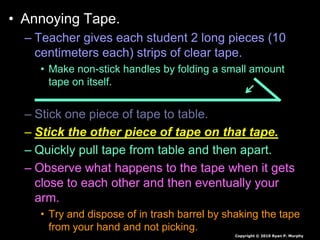
• Annoying Tape.
– Teacher gives each student 2 long pieces (10
centimeters each) strips of clear tape.
• Make non-stick handles by folding a small amount
tape on itself.
– Stick one piece of tape to table.
– Stick the other piece of tape on that tape.
– Quickly pull tape from table and then apart.
– Observe what happens to the tape when it gets
close to each other and then eventually your
arm.
• Try and dispose of in trash barrel by shaking the tape
from your hand and not picking.
Copyright © 2010 Ryan P. Murphy
• Annoying Tape.
– Teacher gives each student 2 long pieces (10
centimeters each) strips of clear tape.
• Make non-stick handles by folding a small amount
tape on itself.
– Stick one piece of tape to table.
– Stick the other piece of tape on that tape.
– Quickly pull tape from table and then apart.
– Observe what happens to the tape when it gets
close to each other and then eventually your
arm.
• Try and dispose of in trash barrel by shaking the tape
from your hand and not picking.
Copyright © 2010 Ryan P. Murphy
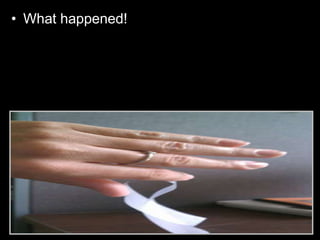
• What happened!
• What happened!
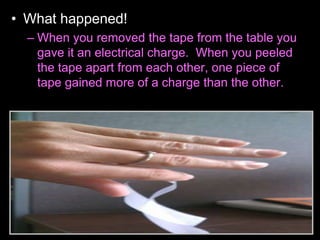
– When you removed the tape from the table you
gave it an electrical charge. When you peeled
the tape apart from each other, one piece of
tape gained more of a charge than the other.
• What happened!
– When you removed the tape from the table you
gave it an electrical charge. When you peeled
the tape apart from each other, one piece of
tape gained more of a charge than the other.
• Opposite charges attract (+) (-)
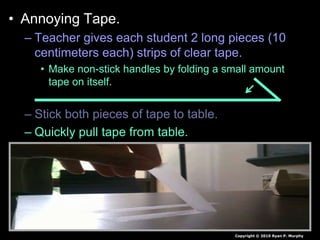
• Annoying Tape.
– Teacher gives each student 2 long pieces (10
centimeters each) strips of clear tape.
• Make non-stick handles by folding a small amount
tape on itself.
– Stick both pieces of tape to table.
– Quickly pull tape from table.
– Observe what happens to the tape when it gets
close to each other and then eventually your
arm.
• Try and dispose of in trash barrel by shaking the tape
from your hand and not picking.
Copyright © 2010 Ryan P. Murphy
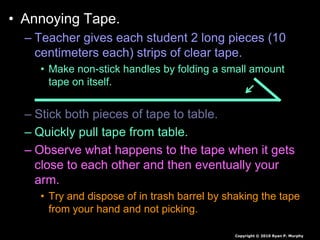
• Annoying Tape.
– Teacher gives each student 2 long pieces (10
centimeters each) strips of clear tape.
• Make non-stick handles by folding a small amount
tape on itself.
– Stick both pieces of tape to table.
– Quickly pull tape from table.
– Observe what happens to the tape when it gets
close to each other and then eventually your
arm.
• Try and dispose of in trash barrel by shaking the tape
from your hand and not picking.
Copyright © 2010 Ryan P. Murphy
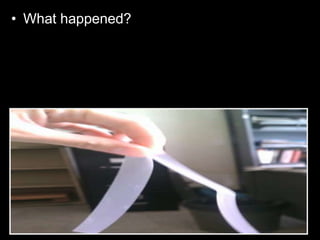
• What happened?
• What happened?
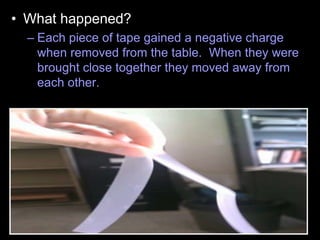
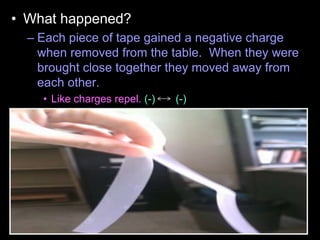
– Each piece of tape gained a negative charge
when removed from the table. When they were
brought close together they moved away from
each other.
• What happened?
– Each piece of tape gained a negative charge
when removed from the table. When they were
brought close together they moved away from
each other.
• Like charges repel. (-) (-)
• Life occurs because of electrostatic charges.
• Without them, life would simple unravel.
• Life occurs because of electrostatic charges.
• Without them, life would simple unravel.
Electricity. Learn more at…
http://science.howstuffworks.com/electri
city.htm
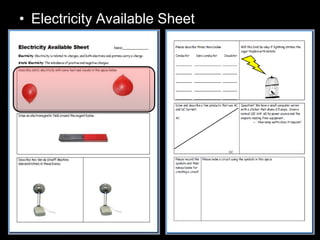
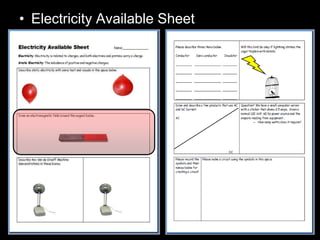
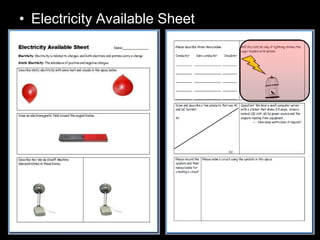
• Electricity Available Sheet
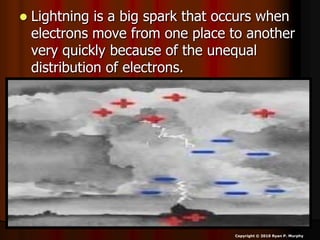
 Lightning is a big spark that occurs when
electrons move from one place to another
very quickly because of the unequal
distribution of electrons.
Copyright © 2010 Ryan P. Murphy
• Electricity Available Sheet
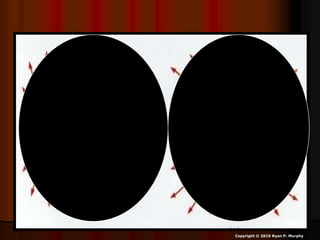
 Electric Fields: The funky area near any
electrically-charged object.
 Replace electrostatic for funky.
Copyright © 2010 Ryan P. Murphy
 Electric Fields: The funky area near any
electrically-charged object.
 Replace electrostatic for funky.
Copyright © 2010 Ryan P. Murphy
 Electric Fields: The funky area near any
electrically-charged object.
 Replace electrostatic for funky.
Copyright © 2010 Ryan P. Murphy
• Visit a magnetic field simulator.
http://phet.colorado.edu/en/simulation/mag
nets-and-electromagnets
Copyright © 2010 Ryan P. Murphy
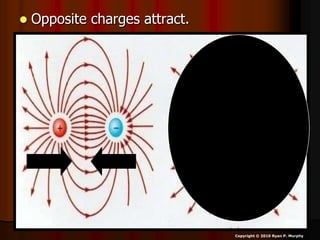
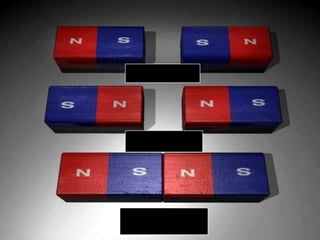
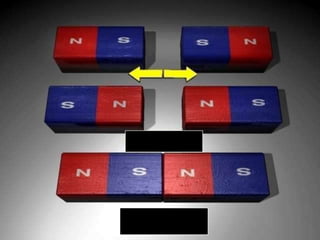
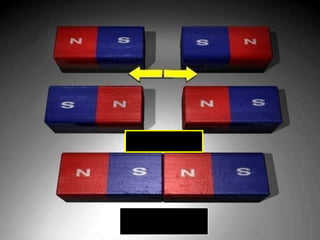
 Opposite charges attract.
Copyright © 2010 Ryan P. Murphy
 Opposite charges attract.
Copyright © 2010 Ryan P. Murphy
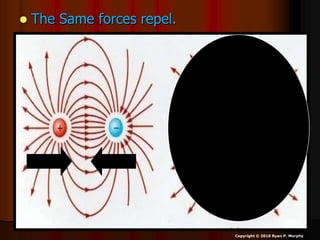
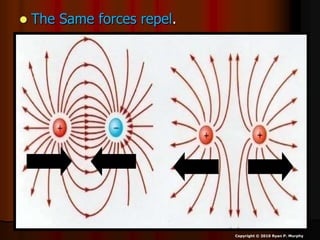
 The Same forces repel.
Copyright © 2010 Ryan P. Murphy
 The Same forces repel.
Copyright © 2010 Ryan P. Murphy
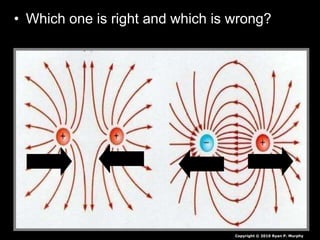
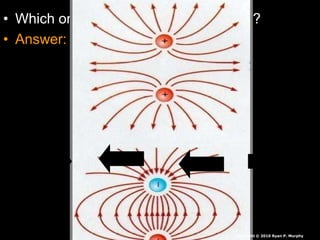
• Which one is right and which is wrong?
Copyright © 2010 Ryan P. Murphy
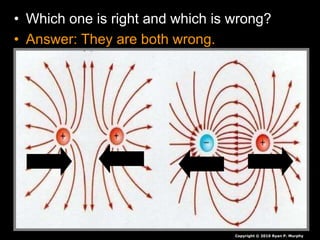
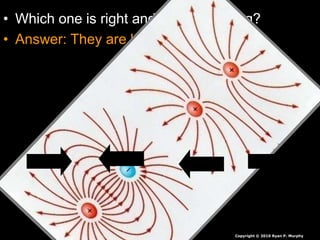
• Which one is right and which is wrong?
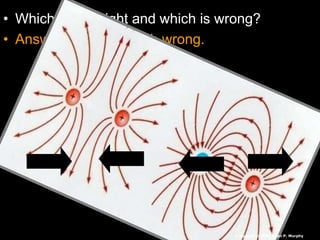
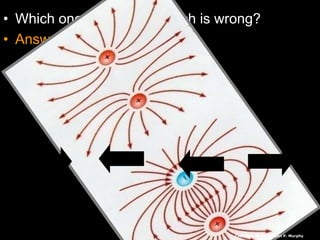
• Answer: They are both wrong.
Copyright © 2010 Ryan P. Murphy
• Which one is right and which is wrong?
• Answer: They are both wrong.
Copyright © 2010 Ryan P. Murphy
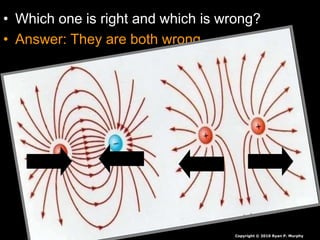
• Which one is right and which is wrong?
• Answer: They are both wrong.
Copyright © 2010 Ryan P. Murphy
• Which one is right and which is wrong?
• Answer: They are both wrong.
Copyright © 2010 Ryan P. Murphy
• Which one is right and which is wrong?
• Answer: They are both wrong.
Copyright © 2010 Ryan P. Murphy
• Which one is right and which is wrong?
• Answer: They are both wrong.
Copyright © 2010 Ryan P. Murphy
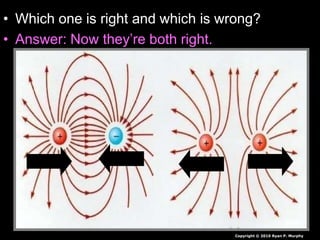
• Which one is right and which is wrong?
• Answer: Now they’re both right.
Copyright © 2010 Ryan P. Murphy
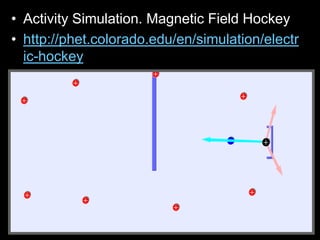
• Activity Simulation. Magnetic Field Hockey
• http://phet.colorado.edu/en/simulation/electr
ic-hockey
Reminder to teacher to reset
the arrows!
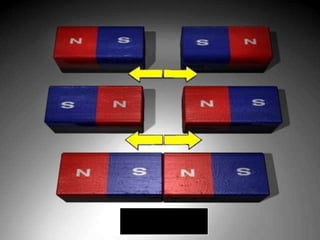
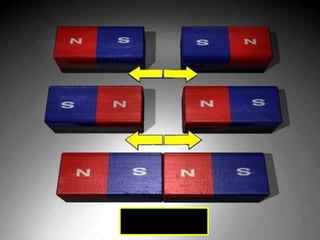
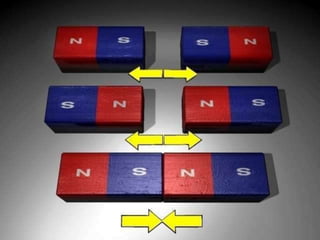
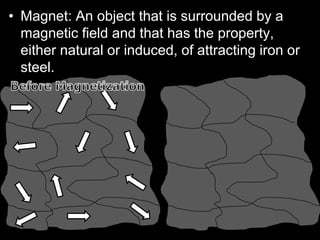
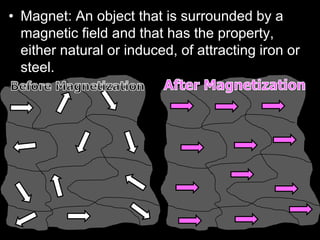
• Magnet: An object that is surrounded by a
magnetic field and that has the property,
either natural or induced, of attracting iron or
steel.
• Magnet: An object that is surrounded by a
magnetic field and that has the property,
either natural or induced, of attracting iron or
steel.
• Magnet: An object that is surrounded by a
magnetic field and that has the property,
either natural or induced, of attracting iron or
steel.
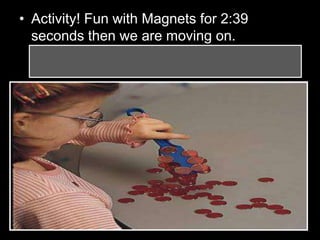
• Activity! Fun with Magnets for 2:39
seconds then we are moving on.
– The class can earn additional “play time” with
good behavior.
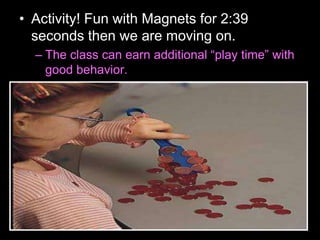
• Activity! Fun with Magnets for 2:39
seconds then we are moving on.
– The class can earn additional “play time” with
good behavior.
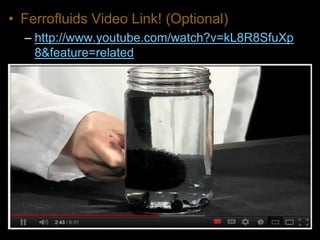
• Ferrofluids Video Link! (Optional)
– http://www.youtube.com/watch?v=kL8R8SfuXp
8&feature=related
• Activity. The Fonz
– Try and pick up paper hole punches with a
plastic comb.
– Next run the comb through your hair and over
your clothes to collect a charge.
– Try again. What happened?
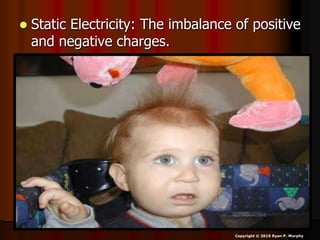
 Static Electricity: The imbalance of positive
and negative charges.
Copyright © 2010 Ryan P. Murphy
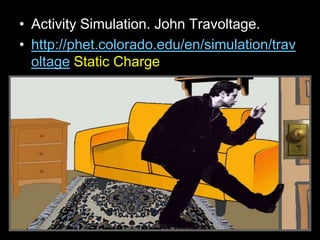
• Activity Simulation. John Travoltage.
• http://phet.colorado.edu/en/simulation/trav
oltage Static Charge
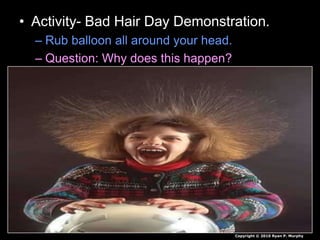
• Activity- Bad Hair Day Demonstration.
– Rub balloon all around your head.
– Question: Why does this happen?
Copyright © 2010 Ryan P. Murphy
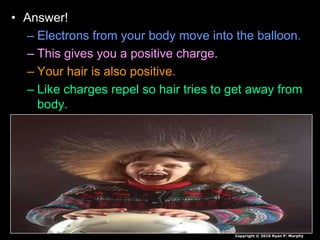
• Answer!
– Electrons from your body move into the balloon.
– This gives you a positive charge.
– Your hair is also positive.
– Like charges repel so hair tries to get away from
body.
Copyright © 2010 Ryan P. Murphy
• Answer!
– Electrons from your body move into the balloon.
– This gives you a positive charge.
– Your hair is also positive.
– Like charges repel so hair tries to get away from
body.
Copyright © 2010 Ryan P. Murphy
+
+
+? ?
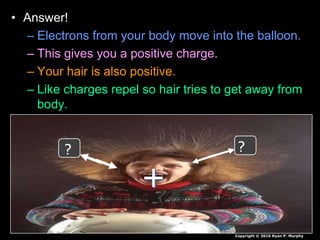
• Answer!
– Electrons from your body move into the balloon.
– This gives you a positive charge.
– Your hair is also positive.
– Like charges repel so hair tries to get away from
body.
Copyright © 2010 Ryan P. Murphy
+
+
? ?
• Answer!
– Electrons from your body move into the balloon.
– This gives you a positive charge.
– Your hair is also positive.
– Like charges repel so hair tries to get away from
body.
Copyright © 2010 Ryan P. Murphy
+
+
+
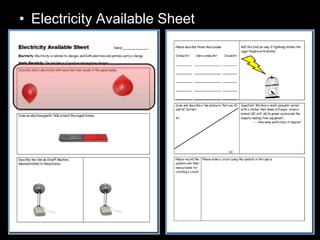
• Electricity Available Sheet
• Demonstration - Static Electricity
– Observe two balloons without a build up of a
charge.
Copyright © 2010 Ryan P. Murphy
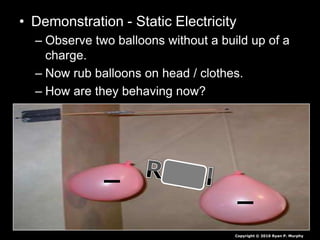
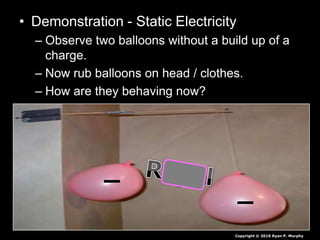
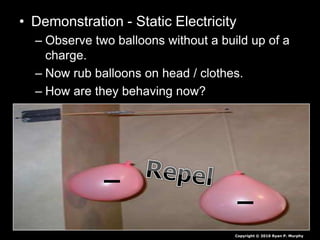
• Demonstration - Static Electricity
– Observe two balloons without a build up of a
charge.
– Now rub balloons on head / clothes.
– How are they behaving now?
Copyright © 2010 Ryan P. Murphy
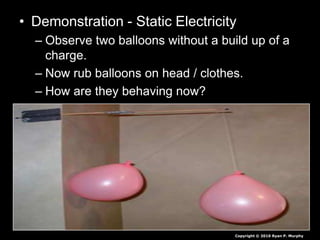
• Demonstration - Static Electricity
– Observe two balloons without a build up of a
charge.
– Now rub balloons on head / clothes.
– How are they behaving now?
Copyright © 2010 Ryan P. Murphy
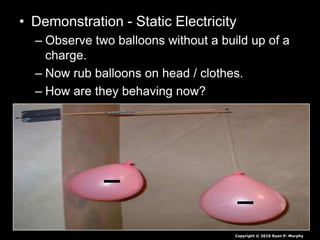
• Demonstration - Static Electricity
– Observe two balloons without a build up of a
charge.
– Now rub balloons on head / clothes.
– How are they behaving now?
Copyright © 2010 Ryan P. Murphy
• Demonstration - Static Electricity
– Observe two balloons without a build up of a
charge.
– Now rub balloons on head / clothes.
– How are they behaving now?
Copyright © 2010 Ryan P. Murphy
• Demonstration - Static Electricity
– Observe two balloons without a build up of a
charge.
– Now rub balloons on head / clothes.
– How are they behaving now?
Copyright © 2010 Ryan P. Murphy
• Demonstration - Static Electricity
– Observe two balloons without a build up of a
charge.
– Now rub balloons on head / clothes.
– How are they behaving now?
Copyright © 2010 Ryan P. Murphy
• Activity! Static Balloons
Copyright © 2010 Ryan P. Murphy
• Activity! Static Balloons
– Blow up a balloon and tie it off.
Copyright © 2010 Ryan P. Murphy
• Activity! Static Balloons
– Blow up a balloon and tie it off.
– Write name on it with soft pen.
Copyright © 2010 Ryan P. Murphy
• Activity! Static Balloons
– Blow up a balloon and tie it off.
– Write name on it with soft pen.
– Rub balloon against hair and quickly stick to wall
(everyone together).
Copyright © 2010 Ryan P. Murphy
• Activity! Static Balloons
– Blow up a balloon and tie it off.
– Write name on it with soft pen.
– Rub balloon against hair and quickly stick to wall
(everyone together).
– Observe what happens, Whose balloon will last the
longest?
Copyright © 2010 Ryan P. Murphy
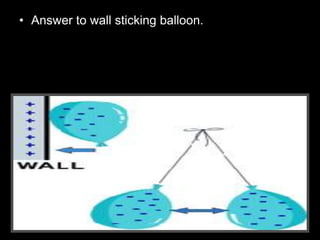
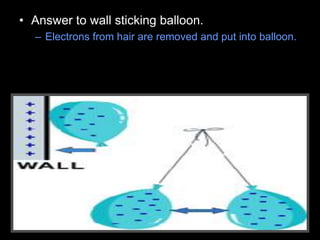
• Answer to wall sticking balloon.
– Electrons from hair are removed and put into balloon.
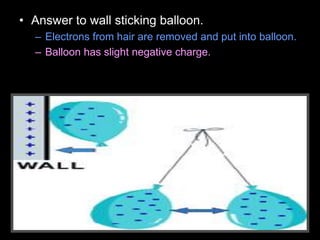
• Answer to wall sticking balloon.
– Electrons from hair are removed and put into balloon.
– Balloon has slight negative charge.
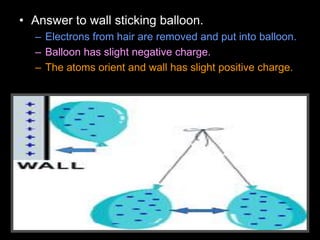
• Answer to wall sticking balloon.
– Electrons from hair are removed and put into balloon.
– Balloon has slight negative charge.
– The atoms orient and wall has slight positive charge.
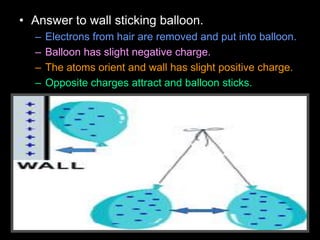
• Answer to wall sticking balloon.
– Electrons from hair are removed and put into balloon.
– Balloon has slight negative charge.
– The atoms orient and wall has slight positive charge.
– Opposite charges attract and balloon sticks.
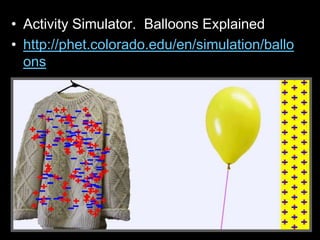
• Activity Simulator. Balloons Explained
• http://phet.colorado.edu/en/simulation/ballo
ons
• We usually only
notice static
electricity in the
winter when the air
is very dry.
• We usually only
notice static
electricity in the
winter when the air
is very dry. During
the summer, the air
is more humid.
• We usually only
notice static
electricity in the
winter when the air
is very dry. During
the summer, the air
is more humid.
– The water in the air
helps electrons
move off you more
quickly, so you can’t
build up a large
static charge.
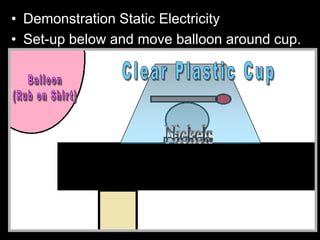
• Demonstration Static Electricity
• Set-up below and move balloon around cup.
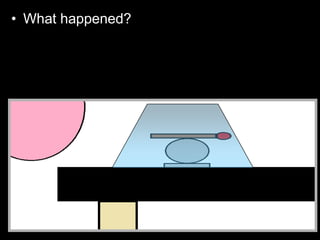
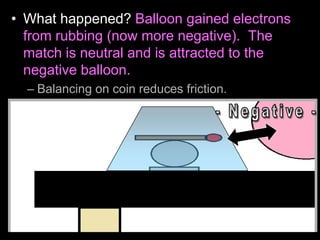
• What happened? Balloon gained electrons
from rubbing (
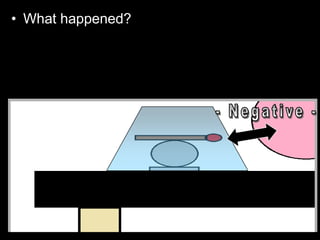
• What happened? Balloon gained electrons
from rubbing (now more negative). The
match is neutral and is attracted to the
negative balloon.
– Balancing on coin reduces friction.
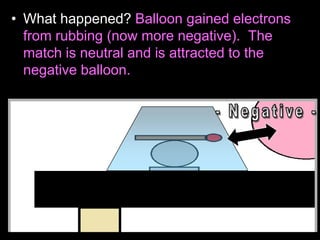
• What happened? Balloon gained electrons
from rubbing (now more negative). The
match is neutral and is attracted to the
negative balloon.
• What happened? Balloon gained electrons
from rubbing (now more negative). The
match is neutral and is attracted to the
negative balloon.
– Balancing on coin reduces friction.
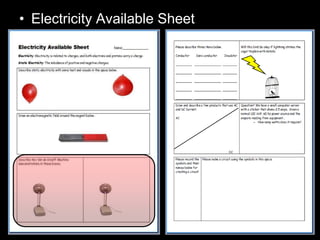
• Electricity Available Sheet
• Activities Van de Graaff generator
• Please read safety and operation
precautions on this link.
– http://hypertextbook.com/eworld/vdg.shtml
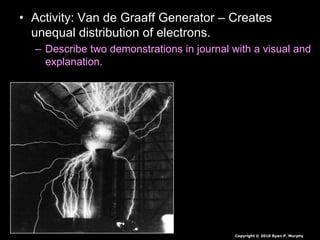
• Activity: Van de Graaff Generator – Creates
unequal distribution of electrons.
– Describe two demonstrations in journal with a visual and
explanation.
Copyright © 2010 Ryan P. Murphy
• Activity: Van de Graaff Generator – Creates
unequal distribution of electrons.
– Describe two demonstrations in journal with a visual and
explanation.
Copyright © 2010 Ryan P. Murphy
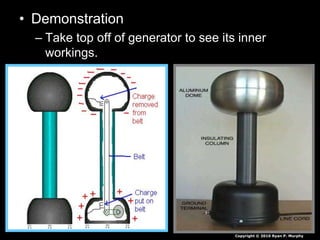
• Demonstration
– Take top off of generator to see its inner
workings.
Copyright © 2010 Ryan P. Murphy
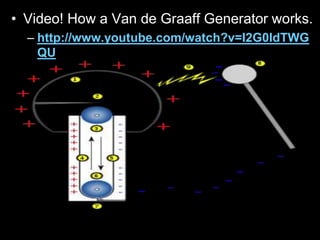
• Video! How a Van de Graaff Generator works.
– http://www.youtube.com/watch?v=I2G0IdTWG
QU
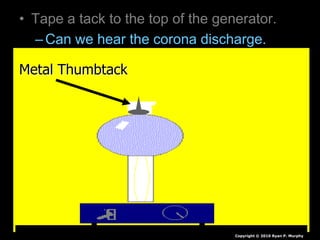
• Tape a tack to the top of the generator.
–Can we hear the corona discharge.
Metal Thumbtack
Copyright © 2010 Ryan P. Murphy
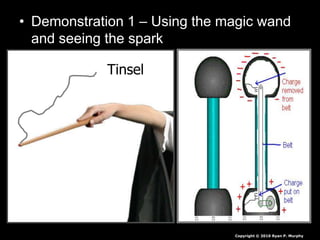
• Demonstration 1 – Using the magic wand
and seeing the spark
Copyright © 2010 Ryan P. Murphy
Tinsel
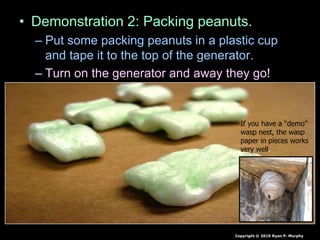
• Demonstration 2: Packing peanuts.
– Put some packing peanuts in a plastic cup
and tape it to the top of the generator.
– Turn on the generator and away they go!
Copyright © 2010 Ryan P. Murphy
If you have a “demo”
wasp nest, the wasp
paper in pieces works
very well.
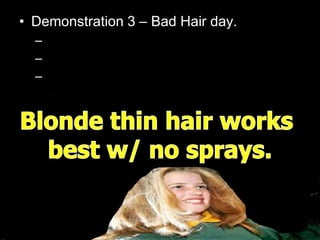
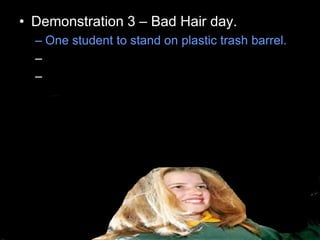
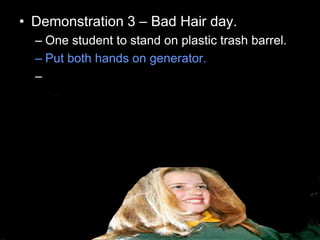
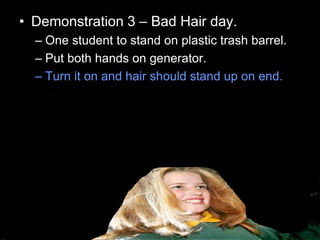
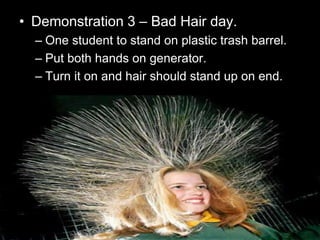
• Demonstration 3 – Bad Hair day.
– One student to stand on plastic trash barrel.
– Put both hands on generator.
– Turn it on and hair should stand up on end.
• Demonstration 3 – Bad Hair day.
– One student to stand on plastic trash barrel.
– Put both hands on generator.
– Turn it on and hair should stand up on end.
• Demonstration 3 – Bad Hair day.
– One student to stand on plastic trash barrel.
– Put both hands on generator.
– Turn it on and hair should stand up on end.
• Demonstration 3 – Bad Hair day.
– One student to stand on plastic trash barrel.
– Put both hands on generator.
– Turn it on and hair should stand up on end.
• Demonstration 3 – Bad Hair day.
– One student to stand on plastic trash barrel.
– Put both hands on generator.
– Turn it on and hair should stand up on end.
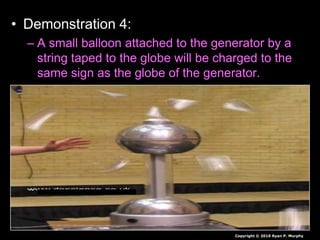
• Demonstration 4:
– A small balloon attached to the generator by a
string taped to the globe will be charged to the
same sign as the globe of the generator.
Copyright © 2010 Ryan P. Murphy
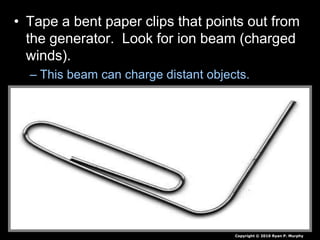
• Tape a bent paper clips that points out from
the generator. Look for ion beam (charged
winds).
– This beam can charge distant objects.
Copyright © 2010 Ryan P. Murphy
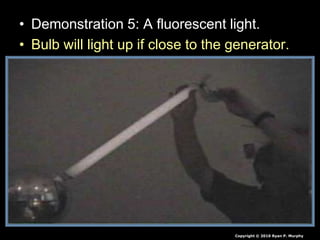
• Demonstration 5: A fluorescent light.
• Bulb will light up if close to the generator.
Copyright © 2010 Ryan P. Murphy
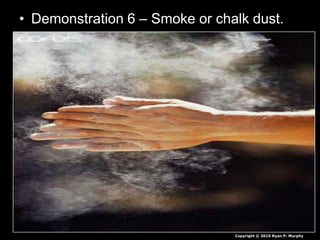
• Demonstration 6 – Smoke or chalk dust.
Copyright © 2010 Ryan P. Murphy
• Other Demonstrations:
– Blow bubbles near the generator.
– Place aluminum pie plate on generator in
stack.
– Light a candle near generator to observe
electrical winds.
– Tape many long strips of tissue paper to
generator.
– Tie an aluminum can so it hangs just above
the generator.
Copyright © 2010 Ryan P. Murphy
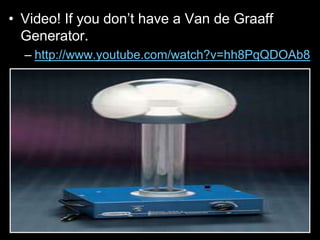
• Video! If you don’t have a Van de Graaff
Generator.
– http://www.youtube.com/watch?v=hh8PqQDOAb8
• Coulombs Law: Any two charged objects will
create a force on each other. Opposite
charges will produce an attractive force while
similar charges will produce a repulsive
force.
• Coulombs Law: Any two charged objects will
create a force on each other. Opposite
charges will produce an attractive force while
similar charges will produce a repulsive
force.
• Coulombs Law: Any two charged objects will
create a force on each other. Opposite
charges will produce an attractive force while
similar charges will produce a repulsive
force.
• Coulombs Law: Any two charged objects will
create a force on each other. Opposite
charges will produce an attractive force while
similar charges will produce a repulsive
force.
• Coulombs Law: Any two charged objects will
create a force on each other. Opposite
charges will produce an attractive force while
similar charges will produce a repulsive
force.
• Coulombs Law: Any two charged objects will
create a force on each other. Opposite
charges will produce an attractive force while
similar charges will produce a repulsive
force.
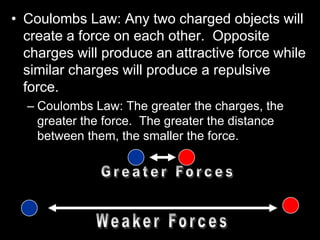
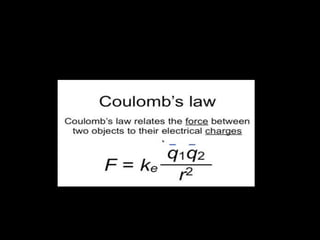
– Coulombs Law: The greater the charges, the
greater the force. The greater the distance
between them, the smaller the force.
• Coulombs Law: Any two charged objects will
create a force on each other. Opposite
charges will produce an attractive force while
similar charges will produce a repulsive
force.
– Coulombs Law: The greater the charges, the
greater the force. The greater the distance
between them, the smaller the force.
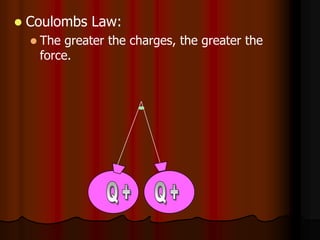
 Coulombs Law:
 The greater the charges, the greater the
force.
 Coulombs Law:
 The greater the charges, the greater the
force.
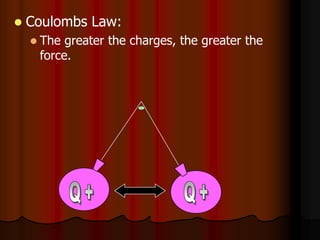
 Coulombs Law:
 The greater the charges, the greater the
force.
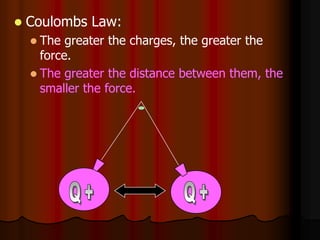
 The greater the distance between them, the
smaller the force.
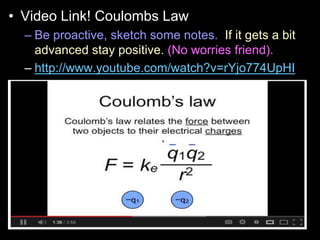
• Video Link! Coulombs Law
– Be proactive, sketch some notes. If it gets a bit
advanced stay positive. (No worries here).
– http://www.youtube.com/watch?v=rYjo774UpHI
• Video Link! Coulombs Law
– Be proactive, sketch some notes. If it gets a bit
advanced stay positive. (No worries friend).
– http://www.youtube.com/watch?v=rYjo774UpHI
• Electricity Available Sheet
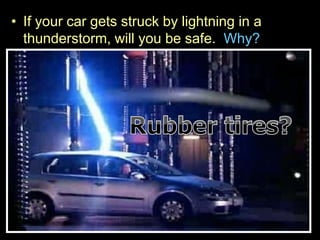
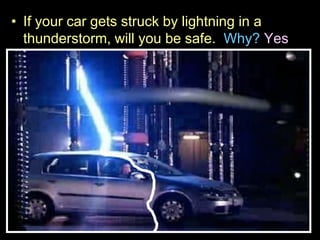
• If your car gets struck by lightning in a
thunderstorm, will you be safe. Why?
• If your car gets struck by lightning in a
thunderstorm, will you be safe. Why?
• If your car gets struck by lightning in a
thunderstorm, will you be safe. Why?
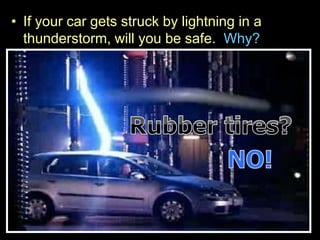
• If your car gets struck by lightning in a
thunderstorm, will you be safe. Why? Yes
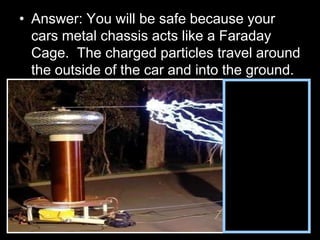
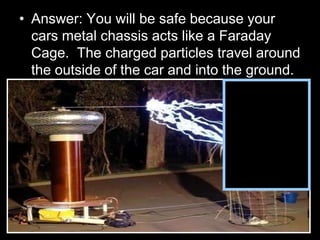
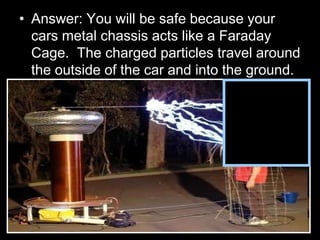
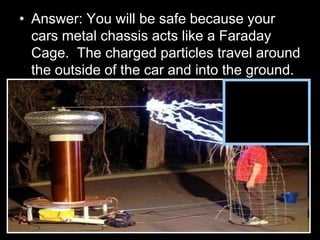
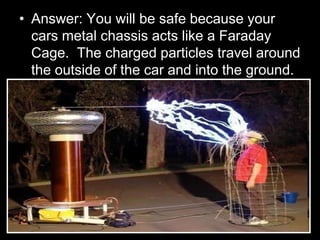
• Answer: You will be safe because your
cars metal chassis acts like a Faraday
Cage.
• Answer: You will be safe because your
cars metal chassis acts like a Faraday
Cage. The charged particles travel around
the outside of the car and into the ground.
• Answer: You will be safe because your
cars metal chassis acts like a Faraday
Cage. The charged particles travel around
the outside of the car and into the ground.
• Answer: You will be safe because your
cars metal chassis acts like a Faraday
Cage. The charged particles travel around
the outside of the car and into the ground.
• Answer: You will be safe because your
cars metal chassis acts like a Faraday
Cage. The charged particles travel around
the outside of the car and into the ground.
• Answer: You will be safe because your
cars metal chassis acts like a Faraday
Cage. The charged particles travel around
the outside of the car and into the ground.
• Answer: You will be safe because your
cars metal chassis acts like a Faraday
Cage. The charged particles travel around
the outside of the car and into the ground.
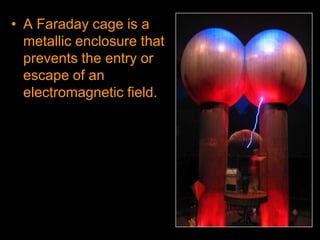
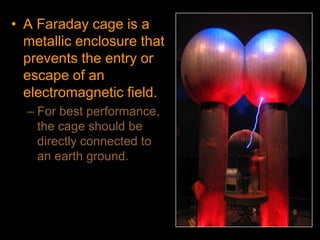
• A Faraday cage is a
metallic enclosure that
prevents the entry or
escape of an
electromagnetic field.
• A Faraday cage is a
metallic enclosure that
prevents the entry or
escape of an
electromagnetic field.
– For best performance,
the cage should be
directly connected to
an earth ground.
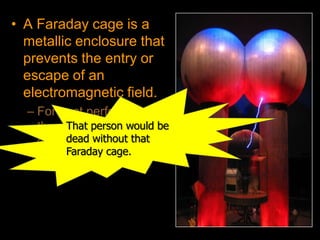
• A Faraday cage is a
metallic enclosure that
prevents the entry or
escape of an
electromagnetic field.
– For best performance,
the cage should be
directly connected to
an earth ground.
That person would be
dead without that
Faraday cage.
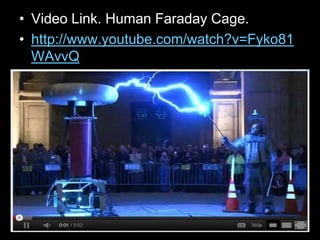
• Video Link. Human Faraday Cage.
• http://www.youtube.com/watch?v=Fyko81
WAvvQ
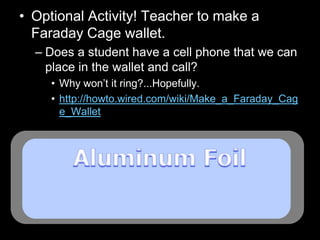
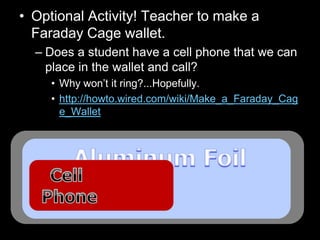
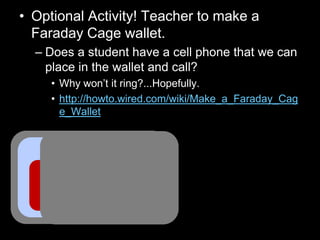
• Optional Activity! Teacher to make a
Faraday Cage wallet.
– Does a student have a cell phone that we can
place in the wallet and call?
• Why won’t it ring?...Hopefully.
• http://howto.wired.com/wiki/Make_a_Faraday_Cag
e_Wallet
• Optional Activity! Teacher to make a
Faraday Cage wallet.
– Does a student have a cell phone that we can
place in the wallet and call?
• Why won’t it ring?...Hopefully.
• http://howto.wired.com/wiki/Make_a_Faraday_Cag
e_Wallet
• Optional Activity! Teacher to make a
Faraday Cage wallet.
– Does a student have a cell phone that we can
place in the wallet and call?
• Why won’t it ring?...Hopefully.
• http://howto.wired.com/wiki/Make_a_Faraday_Cag
e_Wallet
• Optional Activity! Teacher to make a
Faraday Cage wallet.
– Does a student have a cell phone that we can
place in the wallet and call?
• Why won’t it ring?...Hopefully.
• http://howto.wired.com/wiki/Make_a_Faraday_Cag
e_Wallet
• Optional Activity! Teacher to make a
Faraday Cage wallet.
– Does a student have a cell phone that we can
place in the wallet and call?
• Why won’t it ring?...Hopefully.
• http://howto.wired.com/wiki/Make_a_Faraday_Cag
e_Wallet
• http://sciencepowerpoint.comWebsite Link:
http://sciencepowerpoint.com/Energy_Topics_Unit.html
Areas of Focus within The Matter, Energy, and the Environment Unit.
There is no such thing as a free lunch, Matter, Dark Matter, Elements and
Compounds, States of Matter, Solids, Liquids, Gases, Plasma, Law Conservation of
Matter, Physical Change, Chemical Change, Gas Laws, Charles Law, Avogadro’s
Law, Ideal Gas Law, Pascal’s Law, Viscosity, Archimedes
Principle, Buoyancy, Seven Forms of Energy, Nuclear Energy, Electromagnet
Spectrum, Waves / Wavelengths, Light (Visible
Light), Refraction, Diffraction, Lens, Convex /
Concave, Radiation, Electricity, Lightning, Static Electricity, Magnetism, Coulomb’s
Law, Conductors, Insulators, Semi-conductors, AC and DC
current, Amps, Watts, Resistance, Magnetism, Faraday’s
Law, Compass, Relativity, Einstein, and E=MC2, Energy, First Law of
Thermodynamics, Second Law of Thermodynamics, Third Law of
Thermodynamics, Industrial Processes, Environmental Studies, The 4
R’s, Sustainability, Human Population Growth, Carrying Capacity, Green
Design, Renewable Forms of Energy.
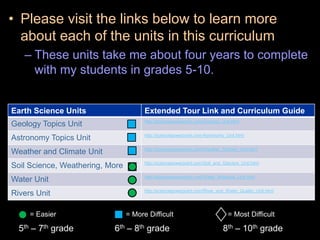
• Please visit the links below to learn more
about each of the units in this curriculum
– These units take me about four years to complete
with my students in grades 5-10.
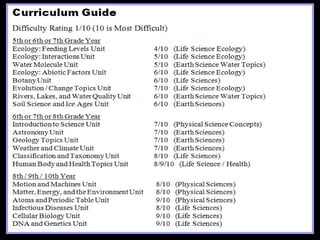
Earth Science Units Extended Tour Link and Curriculum Guide
Geology Topics Unit http://sciencepowerpoint.com/Geology_Unit.html
Astronomy Topics Unit http://sciencepowerpoint.com/Astronomy_Unit.html
Weather and Climate Unit http://sciencepowerpoint.com/Weather_Climate_Unit.html
Soil Science, Weathering, More http://sciencepowerpoint.com/Soil_and_Glaciers_Unit.html
Water Unit http://sciencepowerpoint.com/Water_Molecule_Unit.html
Rivers Unit http://sciencepowerpoint.com/River_and_Water_Quality_Unit.html
= Easier = More Difficult = Most Difficult
5th – 7th grade 6th – 8th grade 8th – 10th grade
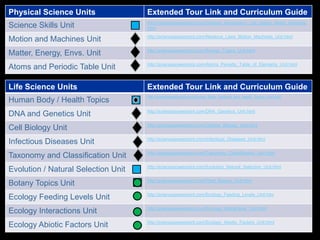
Physical Science Units Extended Tour Link and Curriculum Guide
Science Skills Unit http://sciencepowerpoint.com/Science_Introduction_Lab_Safety_Metric_Methods.
html
Motion and Machines Unit http://sciencepowerpoint.com/Newtons_Laws_Motion_Machines_Unit.html
Matter, Energy, Envs. Unit http://sciencepowerpoint.com/Energy_Topics_Unit.html
Atoms and Periodic Table Unit http://sciencepowerpoint.com/Atoms_Periodic_Table_of_Elements_Unit.html
Life Science Units Extended Tour Link and Curriculum Guide
Human Body / Health Topics
http://sciencepowerpoint.com/Human_Body_Systems_and_Health_Topics_Unit.html
DNA and Genetics Unit http://sciencepowerpoint.com/DNA_Genetics_Unit.html
Cell Biology Unit http://sciencepowerpoint.com/Cellular_Biology_Unit.html
Infectious Diseases Unit http://sciencepowerpoint.com/Infectious_Diseases_Unit.html
Taxonomy and Classification Unit http://sciencepowerpoint.com/Taxonomy_Classification_Unit.html
Evolution / Natural Selection Unit http://sciencepowerpoint.com/Evolution_Natural_Selection_Unit.html
Botany Topics Unit http://sciencepowerpoint.com/Plant_Botany_Unit.html
Ecology Feeding Levels Unit http://sciencepowerpoint.com/Ecology_Feeding_Levels_Unit.htm
Ecology Interactions Unit http://sciencepowerpoint.com/Ecology_Interactions_Unit.html
Ecology Abiotic Factors Unit http://sciencepowerpoint.com/Ecology_Abiotic_Factors_Unit.html
• The entire four year curriculum can be found at...
http://sciencepowerpoint.com/ Please feel free to
contact me with any questions you may have.
Thank you for your interest in this curriculum.
Sincerely,
Ryan Murphy M.Ed
www.sciencepowerpoint@gmail.com
• http://sciencepowerpoint.comWebsite Link:

Van de graaff generator lesson powerpoint, Electricity, Static Electricity

  • 1.
    • Activity: Vande Graaff Generator – Creates unequal distribution of electrons. – Describe two demonstrations in journal with a visual and explanation. Copyright © 2010 Ryan P. Murphy
  • 3.
    • RED SLIDE:These are notes that are very important and should be recorded in your science journal. Copyright © 2010 Ryan P. Murphy
  • 4.
    -Nice neat notesthat are legible and use indentations when appropriate. -Example of indent. -Skip a line between topics -Don’t skip pages -Make visuals clear and well drawn. Please label. Ice Melting Water Boiling Vapor GasT E M P Heat Added 
  • 5.
    • RED SLIDE:These are notes that are very important and should be recorded in your science journal. • BLACK SLIDE: Pay attention, follow directions, complete projects as described and answer required questions neatly. Copyright © 2010 Ryan P. Murphy
  • 6.
     New Areaof Focus, Electricity and Magnetism Copyright © 2010 Ryan P. Murphy
  • 7.
    • What wouldlife be like without electricity? Copyright © 2010 Ryan P. Murphy
  • 8.
    • Much differentthan it is for most of us.
  • 9.
    • Much differentthan it is for most of us.
  • 10.
    • Video Link!Nikola Tesla… Hank explains great minds. – Preview for language. – http://www.youtube.com/watch?v=pPnGvjmIgZA
  • 11.
    • Does somebodywant to try and define the word electricity?
  • 12.
    • There isno single definition called "electricity." Copyright © 2010 Ryan P. Murphy
  • 13.
    • There isno single definition called "electricity." • ELECTRICITY DOES NOT EXIST Copyright © 2010 Ryan P. Murphy
  • 14.
    • Electricity isa variety of independent science concepts all with one single name. Copyright © 2010 Ryan P. Murphy
  • 15.
    • These arethe questions and definitions we need to know to generate a definition for electricity? – What is electric charge? – What is electrical energy? – What are electrons – What is electric current? – What is an imbalance of charge? – What is an electric field? – What is voltage? – What is electric power? – What is a spark? – What is electromagnetism? – What is electrical science? – What is electrodynamics? – What is electrostatics? – What are electrical phenomena? Copyright © 2010 Ryan P. Murphy
  • 16.
    • These arethe questions and definitions we need to know to generate a definition for electricity? – What is electric charge? – What is electrical energy? – What are electrons – What is electric current? – What is an imbalance of charge? – What is an electric field? – What is voltage? – What is electric power? – What is a spark? – What is electromagnetism? – What is electrical science? – What is electrodynamics? – What is electrostatics? – What are electrical phenomena? Copyright © 2010 Ryan P. Murphy
  • 17.
     Electricity isrelated to charges, and both electrons (-) and protons (+) carry a charge. Copyright © 2010 Ryan P. Murphy
  • 18.
    • We willskip most of the atomic information. – We will examine circuits and static charges for this unit. Copyright © 2010 Ryan P. Murphy
  • 19.
    • Electrons arenegatively charged Copyright © 2010 Ryan P. Murphy
  • 20.
    • Electrons arenegatively charged Copyright © 2010 Ryan P. Murphy
  • 21.
    • Electrons arenegatively charged • Protons (nucleus) are positively charged Copyright © 2010 Ryan P. Murphy
  • 22.
    • Electrons arenegatively charged • Protons (nucleus) are positively charged Copyright © 2010 Ryan P. Murphy
  • 23.
    • Electrons arenegatively charged • Protons (nucleus) are positively charged Copyright © 2010 Ryan P. Murphy
  • 24.
    • Electrons arenegatively charged • Protons (nucleus) are positively charged • Their charges are about equal Copyright © 2010 Ryan P. Murphy
  • 25.
    • Electrons arenegatively charged • Protons (nucleus) are positively charged • Add Electrons – Atom becomes more negatively charged. Copyright © 2010 Ryan P. Murphy
  • 26.
    • Electrons arenegatively charged • Protons (nucleus) are positively charged • Take away (strip) electrons then the atom becomes more positively charged. Copyright © 2010 Ryan P. Murphy
  • 27.
    • Annoying Tape. –Teacher gives each student 2 long pieces (10 centimeters each) strips of clear tape. • Make non-stick handles by folding a small amount tape on itself. Copyright © 2010 Ryan P. Murphy
  • 28.
    • Annoying Tape. –Teacher gives each student 2 long pieces (10 centimeters each) strips of clear tape. • Make non-stick handles by folding a small amount tape on itself. – Stick one piece of tape to table. – Stick the other piece of tape on that tape. – Quickly pull tape from table and then apart. – Observe what happens to the tape when it gets close to each other and then eventually your arm. • Try and dispose of in trash barrel by shaking the tape from your hand and not picking. Copyright © 2010 Ryan P. Murphy
  • 29.
    • Annoying Tape. –Teacher gives each student 2 long pieces (10 centimeters each) strips of clear tape. • Make non-stick handles by folding a small amount tape on itself. – Stick one piece of tape to table. – Stick the other piece of tape on that tape. – Quickly pull tape from table and then apart. – Observe what happens to the tape when it gets close to each other and then eventually your arm. • Try and dispose of in trash barrel by shaking the tape from your hand and not picking. Copyright © 2010 Ryan P. Murphy
  • 30.
  • 31.
    • What happened! –When you removed the tape from the table you gave it an electrical charge. When you peeled the tape apart from each other, one piece of tape gained more of a charge than the other.
  • 32.
    • What happened! –When you removed the tape from the table you gave it an electrical charge. When you peeled the tape apart from each other, one piece of tape gained more of a charge than the other. • Opposite charges attract (+) (-)
  • 33.
    • Annoying Tape. –Teacher gives each student 2 long pieces (10 centimeters each) strips of clear tape. • Make non-stick handles by folding a small amount tape on itself. – Stick both pieces of tape to table. – Quickly pull tape from table. – Observe what happens to the tape when it gets close to each other and then eventually your arm. • Try and dispose of in trash barrel by shaking the tape from your hand and not picking. Copyright © 2010 Ryan P. Murphy
  • 34.
    • Annoying Tape. –Teacher gives each student 2 long pieces (10 centimeters each) strips of clear tape. • Make non-stick handles by folding a small amount tape on itself. – Stick both pieces of tape to table. – Quickly pull tape from table. – Observe what happens to the tape when it gets close to each other and then eventually your arm. • Try and dispose of in trash barrel by shaking the tape from your hand and not picking. Copyright © 2010 Ryan P. Murphy
  • 35.
  • 36.
    • What happened? –Each piece of tape gained a negative charge when removed from the table. When they were brought close together they moved away from each other.
  • 37.
    • What happened? –Each piece of tape gained a negative charge when removed from the table. When they were brought close together they moved away from each other. • Like charges repel. (-) (-)
  • 38.
    • Life occursbecause of electrostatic charges.
  • 39.
    • Life occursbecause of electrostatic charges. • Without them, life would simple unravel.
  • 40.
    • Life occursbecause of electrostatic charges. • Without them, life would simple unravel. Electricity. Learn more at… http://science.howstuffworks.com/electri city.htm
  • 41.
  • 42.
     Lightning isa big spark that occurs when electrons move from one place to another very quickly because of the unequal distribution of electrons. Copyright © 2010 Ryan P. Murphy
  • 44.
  • 45.
  • 46.
     Electric Fields:The funky area near any electrically-charged object.  Replace electrostatic for funky. Copyright © 2010 Ryan P. Murphy
  • 47.
     Electric Fields:The funky area near any electrically-charged object.  Replace electrostatic for funky. Copyright © 2010 Ryan P. Murphy
  • 48.
     Electric Fields:The funky area near any electrically-charged object.  Replace electrostatic for funky. Copyright © 2010 Ryan P. Murphy
  • 49.
    • Visit amagnetic field simulator. http://phet.colorado.edu/en/simulation/mag nets-and-electromagnets
  • 50.
    Copyright © 2010Ryan P. Murphy
  • 51.
     Opposite chargesattract. Copyright © 2010 Ryan P. Murphy
  • 52.
     Opposite chargesattract. Copyright © 2010 Ryan P. Murphy
  • 53.
     The Sameforces repel. Copyright © 2010 Ryan P. Murphy
  • 54.
     The Sameforces repel. Copyright © 2010 Ryan P. Murphy
  • 55.
    • Which oneis right and which is wrong? Copyright © 2010 Ryan P. Murphy
  • 56.
    • Which oneis right and which is wrong? • Answer: They are both wrong. Copyright © 2010 Ryan P. Murphy
  • 57.
    • Which oneis right and which is wrong? • Answer: They are both wrong. Copyright © 2010 Ryan P. Murphy
  • 58.
    • Which oneis right and which is wrong? • Answer: They are both wrong. Copyright © 2010 Ryan P. Murphy
  • 59.
    • Which oneis right and which is wrong? • Answer: They are both wrong. Copyright © 2010 Ryan P. Murphy
  • 60.
    • Which oneis right and which is wrong? • Answer: They are both wrong. Copyright © 2010 Ryan P. Murphy
  • 61.
    • Which oneis right and which is wrong? • Answer: They are both wrong. Copyright © 2010 Ryan P. Murphy
  • 62.
    • Which oneis right and which is wrong? • Answer: Now they’re both right. Copyright © 2010 Ryan P. Murphy
  • 63.
    • Activity Simulation.Magnetic Field Hockey • http://phet.colorado.edu/en/simulation/electr ic-hockey
  • 71.
    Reminder to teacherto reset the arrows!
  • 72.
    • Magnet: Anobject that is surrounded by a magnetic field and that has the property, either natural or induced, of attracting iron or steel.
  • 73.
    • Magnet: Anobject that is surrounded by a magnetic field and that has the property, either natural or induced, of attracting iron or steel.
  • 74.
    • Magnet: Anobject that is surrounded by a magnetic field and that has the property, either natural or induced, of attracting iron or steel.
  • 75.
    • Activity! Funwith Magnets for 2:39 seconds then we are moving on. – The class can earn additional “play time” with good behavior.
  • 76.
    • Activity! Funwith Magnets for 2:39 seconds then we are moving on. – The class can earn additional “play time” with good behavior.
  • 77.
    • Ferrofluids VideoLink! (Optional) – http://www.youtube.com/watch?v=kL8R8SfuXp 8&feature=related
  • 78.
    • Activity. TheFonz – Try and pick up paper hole punches with a plastic comb. – Next run the comb through your hair and over your clothes to collect a charge. – Try again. What happened?
  • 79.
     Static Electricity:The imbalance of positive and negative charges. Copyright © 2010 Ryan P. Murphy
  • 80.
    • Activity Simulation.John Travoltage. • http://phet.colorado.edu/en/simulation/trav oltage Static Charge
  • 81.
    • Activity- BadHair Day Demonstration. – Rub balloon all around your head. – Question: Why does this happen? Copyright © 2010 Ryan P. Murphy
  • 82.
    • Answer! – Electronsfrom your body move into the balloon. – This gives you a positive charge. – Your hair is also positive. – Like charges repel so hair tries to get away from body. Copyright © 2010 Ryan P. Murphy
  • 83.
    • Answer! – Electronsfrom your body move into the balloon. – This gives you a positive charge. – Your hair is also positive. – Like charges repel so hair tries to get away from body. Copyright © 2010 Ryan P. Murphy + + +? ?
  • 84.
    • Answer! – Electronsfrom your body move into the balloon. – This gives you a positive charge. – Your hair is also positive. – Like charges repel so hair tries to get away from body. Copyright © 2010 Ryan P. Murphy + + ? ?
  • 85.
    • Answer! – Electronsfrom your body move into the balloon. – This gives you a positive charge. – Your hair is also positive. – Like charges repel so hair tries to get away from body. Copyright © 2010 Ryan P. Murphy + + +
  • 86.
  • 87.
    • Demonstration -Static Electricity – Observe two balloons without a build up of a charge. Copyright © 2010 Ryan P. Murphy
  • 88.
    • Demonstration -Static Electricity – Observe two balloons without a build up of a charge. – Now rub balloons on head / clothes. – How are they behaving now? Copyright © 2010 Ryan P. Murphy
  • 89.
    • Demonstration -Static Electricity – Observe two balloons without a build up of a charge. – Now rub balloons on head / clothes. – How are they behaving now? Copyright © 2010 Ryan P. Murphy
  • 90.
    • Demonstration -Static Electricity – Observe two balloons without a build up of a charge. – Now rub balloons on head / clothes. – How are they behaving now? Copyright © 2010 Ryan P. Murphy
  • 91.
    • Demonstration -Static Electricity – Observe two balloons without a build up of a charge. – Now rub balloons on head / clothes. – How are they behaving now? Copyright © 2010 Ryan P. Murphy
  • 92.
    • Demonstration -Static Electricity – Observe two balloons without a build up of a charge. – Now rub balloons on head / clothes. – How are they behaving now? Copyright © 2010 Ryan P. Murphy
  • 93.
    • Demonstration -Static Electricity – Observe two balloons without a build up of a charge. – Now rub balloons on head / clothes. – How are they behaving now? Copyright © 2010 Ryan P. Murphy
  • 94.
    • Activity! StaticBalloons Copyright © 2010 Ryan P. Murphy
  • 95.
    • Activity! StaticBalloons – Blow up a balloon and tie it off. Copyright © 2010 Ryan P. Murphy
  • 96.
    • Activity! StaticBalloons – Blow up a balloon and tie it off. – Write name on it with soft pen. Copyright © 2010 Ryan P. Murphy
  • 97.
    • Activity! StaticBalloons – Blow up a balloon and tie it off. – Write name on it with soft pen. – Rub balloon against hair and quickly stick to wall (everyone together). Copyright © 2010 Ryan P. Murphy
  • 98.
    • Activity! StaticBalloons – Blow up a balloon and tie it off. – Write name on it with soft pen. – Rub balloon against hair and quickly stick to wall (everyone together). – Observe what happens, Whose balloon will last the longest? Copyright © 2010 Ryan P. Murphy
  • 99.
    • Answer towall sticking balloon.
  • 100.
    • Answer towall sticking balloon. – Electrons from hair are removed and put into balloon.
  • 101.
    • Answer towall sticking balloon. – Electrons from hair are removed and put into balloon. – Balloon has slight negative charge.
  • 102.
    • Answer towall sticking balloon. – Electrons from hair are removed and put into balloon. – Balloon has slight negative charge. – The atoms orient and wall has slight positive charge.
  • 103.
    • Answer towall sticking balloon. – Electrons from hair are removed and put into balloon. – Balloon has slight negative charge. – The atoms orient and wall has slight positive charge. – Opposite charges attract and balloon sticks.
  • 104.
    • Activity Simulator.Balloons Explained • http://phet.colorado.edu/en/simulation/ballo ons
  • 106.
    • We usuallyonly notice static electricity in the winter when the air is very dry.
  • 107.
    • We usuallyonly notice static electricity in the winter when the air is very dry. During the summer, the air is more humid.
  • 108.
    • We usuallyonly notice static electricity in the winter when the air is very dry. During the summer, the air is more humid. – The water in the air helps electrons move off you more quickly, so you can’t build up a large static charge.
  • 109.
    • Demonstration StaticElectricity • Set-up below and move balloon around cup.
  • 110.
    • What happened?Balloon gained electrons from rubbing (
  • 111.
    • What happened?Balloon gained electrons from rubbing (now more negative). The match is neutral and is attracted to the negative balloon. – Balancing on coin reduces friction.
  • 112.
    • What happened?Balloon gained electrons from rubbing (now more negative). The match is neutral and is attracted to the negative balloon.
  • 113.
    • What happened?Balloon gained electrons from rubbing (now more negative). The match is neutral and is attracted to the negative balloon. – Balancing on coin reduces friction.
  • 114.
  • 115.
    • Activities Vande Graaff generator • Please read safety and operation precautions on this link. – http://hypertextbook.com/eworld/vdg.shtml
  • 116.
    • Activity: Vande Graaff Generator – Creates unequal distribution of electrons. – Describe two demonstrations in journal with a visual and explanation. Copyright © 2010 Ryan P. Murphy
  • 117.
    • Activity: Vande Graaff Generator – Creates unequal distribution of electrons. – Describe two demonstrations in journal with a visual and explanation. Copyright © 2010 Ryan P. Murphy
  • 118.
    • Demonstration – Taketop off of generator to see its inner workings. Copyright © 2010 Ryan P. Murphy
  • 119.
    • Video! Howa Van de Graaff Generator works. – http://www.youtube.com/watch?v=I2G0IdTWG QU
  • 120.
    • Tape atack to the top of the generator. –Can we hear the corona discharge. Metal Thumbtack Copyright © 2010 Ryan P. Murphy
  • 122.
    • Demonstration 1– Using the magic wand and seeing the spark Copyright © 2010 Ryan P. Murphy Tinsel
  • 124.
    • Demonstration 2:Packing peanuts. – Put some packing peanuts in a plastic cup and tape it to the top of the generator. – Turn on the generator and away they go! Copyright © 2010 Ryan P. Murphy If you have a “demo” wasp nest, the wasp paper in pieces works very well.
  • 126.
    • Demonstration 3– Bad Hair day. – One student to stand on plastic trash barrel. – Put both hands on generator. – Turn it on and hair should stand up on end.
  • 127.
    • Demonstration 3– Bad Hair day. – One student to stand on plastic trash barrel. – Put both hands on generator. – Turn it on and hair should stand up on end.
  • 128.
    • Demonstration 3– Bad Hair day. – One student to stand on plastic trash barrel. – Put both hands on generator. – Turn it on and hair should stand up on end.
  • 129.
    • Demonstration 3– Bad Hair day. – One student to stand on plastic trash barrel. – Put both hands on generator. – Turn it on and hair should stand up on end.
  • 130.
    • Demonstration 3– Bad Hair day. – One student to stand on plastic trash barrel. – Put both hands on generator. – Turn it on and hair should stand up on end.
  • 132.
    • Demonstration 4: –A small balloon attached to the generator by a string taped to the globe will be charged to the same sign as the globe of the generator. Copyright © 2010 Ryan P. Murphy
  • 134.
    • Tape abent paper clips that points out from the generator. Look for ion beam (charged winds). – This beam can charge distant objects. Copyright © 2010 Ryan P. Murphy
  • 136.
    • Demonstration 5:A fluorescent light. • Bulb will light up if close to the generator. Copyright © 2010 Ryan P. Murphy
  • 138.
    • Demonstration 6– Smoke or chalk dust. Copyright © 2010 Ryan P. Murphy
  • 140.
    • Other Demonstrations: –Blow bubbles near the generator. – Place aluminum pie plate on generator in stack. – Light a candle near generator to observe electrical winds. – Tape many long strips of tissue paper to generator. – Tie an aluminum can so it hangs just above the generator. Copyright © 2010 Ryan P. Murphy
  • 141.
    • Video! Ifyou don’t have a Van de Graaff Generator. – http://www.youtube.com/watch?v=hh8PqQDOAb8
  • 142.
    • Coulombs Law:Any two charged objects will create a force on each other. Opposite charges will produce an attractive force while similar charges will produce a repulsive force.
  • 143.
    • Coulombs Law:Any two charged objects will create a force on each other. Opposite charges will produce an attractive force while similar charges will produce a repulsive force.
  • 144.
    • Coulombs Law:Any two charged objects will create a force on each other. Opposite charges will produce an attractive force while similar charges will produce a repulsive force.
  • 145.
    • Coulombs Law:Any two charged objects will create a force on each other. Opposite charges will produce an attractive force while similar charges will produce a repulsive force.
  • 146.
    • Coulombs Law:Any two charged objects will create a force on each other. Opposite charges will produce an attractive force while similar charges will produce a repulsive force.
  • 147.
    • Coulombs Law:Any two charged objects will create a force on each other. Opposite charges will produce an attractive force while similar charges will produce a repulsive force. – Coulombs Law: The greater the charges, the greater the force. The greater the distance between them, the smaller the force.
  • 148.
    • Coulombs Law:Any two charged objects will create a force on each other. Opposite charges will produce an attractive force while similar charges will produce a repulsive force. – Coulombs Law: The greater the charges, the greater the force. The greater the distance between them, the smaller the force.
  • 149.
     Coulombs Law: The greater the charges, the greater the force.
  • 150.
     Coulombs Law: The greater the charges, the greater the force.
  • 151.
     Coulombs Law: The greater the charges, the greater the force.  The greater the distance between them, the smaller the force.
  • 152.
    • Video Link!Coulombs Law – Be proactive, sketch some notes. If it gets a bit advanced stay positive. (No worries here). – http://www.youtube.com/watch?v=rYjo774UpHI
  • 153.
    • Video Link!Coulombs Law – Be proactive, sketch some notes. If it gets a bit advanced stay positive. (No worries friend). – http://www.youtube.com/watch?v=rYjo774UpHI
  • 154.
  • 155.
    • If yourcar gets struck by lightning in a thunderstorm, will you be safe. Why?
  • 156.
    • If yourcar gets struck by lightning in a thunderstorm, will you be safe. Why?
  • 157.
    • If yourcar gets struck by lightning in a thunderstorm, will you be safe. Why?
  • 158.
    • If yourcar gets struck by lightning in a thunderstorm, will you be safe. Why? Yes
  • 159.
    • Answer: Youwill be safe because your cars metal chassis acts like a Faraday Cage.
  • 160.
    • Answer: Youwill be safe because your cars metal chassis acts like a Faraday Cage. The charged particles travel around the outside of the car and into the ground.
  • 161.
    • Answer: Youwill be safe because your cars metal chassis acts like a Faraday Cage. The charged particles travel around the outside of the car and into the ground.
  • 162.
    • Answer: Youwill be safe because your cars metal chassis acts like a Faraday Cage. The charged particles travel around the outside of the car and into the ground.
  • 163.
    • Answer: Youwill be safe because your cars metal chassis acts like a Faraday Cage. The charged particles travel around the outside of the car and into the ground.
  • 164.
    • Answer: Youwill be safe because your cars metal chassis acts like a Faraday Cage. The charged particles travel around the outside of the car and into the ground.
  • 165.
    • Answer: Youwill be safe because your cars metal chassis acts like a Faraday Cage. The charged particles travel around the outside of the car and into the ground.
  • 166.
    • A Faradaycage is a metallic enclosure that prevents the entry or escape of an electromagnetic field.
  • 167.
    • A Faradaycage is a metallic enclosure that prevents the entry or escape of an electromagnetic field. – For best performance, the cage should be directly connected to an earth ground.
  • 168.
    • A Faradaycage is a metallic enclosure that prevents the entry or escape of an electromagnetic field. – For best performance, the cage should be directly connected to an earth ground. That person would be dead without that Faraday cage.
  • 169.
    • Video Link.Human Faraday Cage. • http://www.youtube.com/watch?v=Fyko81 WAvvQ
  • 170.
    • Optional Activity!Teacher to make a Faraday Cage wallet. – Does a student have a cell phone that we can place in the wallet and call? • Why won’t it ring?...Hopefully. • http://howto.wired.com/wiki/Make_a_Faraday_Cag e_Wallet
  • 171.
    • Optional Activity!Teacher to make a Faraday Cage wallet. – Does a student have a cell phone that we can place in the wallet and call? • Why won’t it ring?...Hopefully. • http://howto.wired.com/wiki/Make_a_Faraday_Cag e_Wallet
  • 172.
    • Optional Activity!Teacher to make a Faraday Cage wallet. – Does a student have a cell phone that we can place in the wallet and call? • Why won’t it ring?...Hopefully. • http://howto.wired.com/wiki/Make_a_Faraday_Cag e_Wallet
  • 173.
    • Optional Activity!Teacher to make a Faraday Cage wallet. – Does a student have a cell phone that we can place in the wallet and call? • Why won’t it ring?...Hopefully. • http://howto.wired.com/wiki/Make_a_Faraday_Cag e_Wallet
  • 174.
    • Optional Activity!Teacher to make a Faraday Cage wallet. – Does a student have a cell phone that we can place in the wallet and call? • Why won’t it ring?...Hopefully. • http://howto.wired.com/wiki/Make_a_Faraday_Cag e_Wallet
  • 175.
  • 177.
    http://sciencepowerpoint.com/Energy_Topics_Unit.html Areas of Focuswithin The Matter, Energy, and the Environment Unit. There is no such thing as a free lunch, Matter, Dark Matter, Elements and Compounds, States of Matter, Solids, Liquids, Gases, Plasma, Law Conservation of Matter, Physical Change, Chemical Change, Gas Laws, Charles Law, Avogadro’s Law, Ideal Gas Law, Pascal’s Law, Viscosity, Archimedes Principle, Buoyancy, Seven Forms of Energy, Nuclear Energy, Electromagnet Spectrum, Waves / Wavelengths, Light (Visible Light), Refraction, Diffraction, Lens, Convex / Concave, Radiation, Electricity, Lightning, Static Electricity, Magnetism, Coulomb’s Law, Conductors, Insulators, Semi-conductors, AC and DC current, Amps, Watts, Resistance, Magnetism, Faraday’s Law, Compass, Relativity, Einstein, and E=MC2, Energy, First Law of Thermodynamics, Second Law of Thermodynamics, Third Law of Thermodynamics, Industrial Processes, Environmental Studies, The 4 R’s, Sustainability, Human Population Growth, Carrying Capacity, Green Design, Renewable Forms of Energy.
  • 187.
    • Please visitthe links below to learn more about each of the units in this curriculum – These units take me about four years to complete with my students in grades 5-10. Earth Science Units Extended Tour Link and Curriculum Guide Geology Topics Unit http://sciencepowerpoint.com/Geology_Unit.html Astronomy Topics Unit http://sciencepowerpoint.com/Astronomy_Unit.html Weather and Climate Unit http://sciencepowerpoint.com/Weather_Climate_Unit.html Soil Science, Weathering, More http://sciencepowerpoint.com/Soil_and_Glaciers_Unit.html Water Unit http://sciencepowerpoint.com/Water_Molecule_Unit.html Rivers Unit http://sciencepowerpoint.com/River_and_Water_Quality_Unit.html = Easier = More Difficult = Most Difficult 5th – 7th grade 6th – 8th grade 8th – 10th grade
  • 188.
    Physical Science UnitsExtended Tour Link and Curriculum Guide Science Skills Unit http://sciencepowerpoint.com/Science_Introduction_Lab_Safety_Metric_Methods. html Motion and Machines Unit http://sciencepowerpoint.com/Newtons_Laws_Motion_Machines_Unit.html Matter, Energy, Envs. Unit http://sciencepowerpoint.com/Energy_Topics_Unit.html Atoms and Periodic Table Unit http://sciencepowerpoint.com/Atoms_Periodic_Table_of_Elements_Unit.html Life Science Units Extended Tour Link and Curriculum Guide Human Body / Health Topics http://sciencepowerpoint.com/Human_Body_Systems_and_Health_Topics_Unit.html DNA and Genetics Unit http://sciencepowerpoint.com/DNA_Genetics_Unit.html Cell Biology Unit http://sciencepowerpoint.com/Cellular_Biology_Unit.html Infectious Diseases Unit http://sciencepowerpoint.com/Infectious_Diseases_Unit.html Taxonomy and Classification Unit http://sciencepowerpoint.com/Taxonomy_Classification_Unit.html Evolution / Natural Selection Unit http://sciencepowerpoint.com/Evolution_Natural_Selection_Unit.html Botany Topics Unit http://sciencepowerpoint.com/Plant_Botany_Unit.html Ecology Feeding Levels Unit http://sciencepowerpoint.com/Ecology_Feeding_Levels_Unit.htm Ecology Interactions Unit http://sciencepowerpoint.com/Ecology_Interactions_Unit.html Ecology Abiotic Factors Unit http://sciencepowerpoint.com/Ecology_Abiotic_Factors_Unit.html
  • 189.
    • The entirefour year curriculum can be found at... http://sciencepowerpoint.com/ Please feel free to contact me with any questions you may have. Thank you for your interest in this curriculum. Sincerely, Ryan Murphy M.Ed www.sciencepowerpoint@gmail.com
  • 190.