Pre AP Physics
STATIC
ELECTRICITY
•Electrostatic – the study of electrical
charges that can be collected and held in
one area.
•They flow in no particular direction
(trapped in a body)
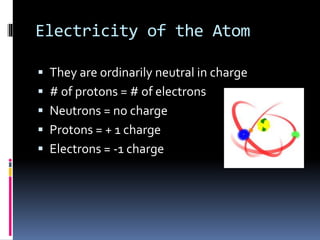
Electricity of the Atom
 They are ordinarily neutral in charge
 # of protons = # of electrons
 Neutrons = no charge
 Protons = + 1 charge
 Electrons = -1 charge
The actual charge of an
electron
-1.60217657 X 10⁻¹⁹
coulombs
Little History: Ben Franklin
 Proved lightning was
static electricity
 Invented lightning rod
 Built a static electricity
generator
 Coined the terms
positive and negative
for electrical charge
Charged objects
 Atoms become charged by gaining or losing
electrons
 An object that exhibits electrical interaction
after rubbing is said to be
charged
Rules of Attraction
Opposite will
attract
Only the electrons will
move
Like will repel
Protons will move but they
don’t leave the nucleus.
Interaction between a
charged object and a neutral
object:
 Any charged object (positive or negative) will
have an attraction interaction with a neutral
object.
Why are protons never lost or
gained?
 Protons are held in the nucleus by the
strongest forces in the universe.
Ions
 Are electrically charged particles
 Charge is unbalanced
 Negative Charge
# e > # p
 Positive charge
# p > # e
Neutral State
 Charged objects will eventually return to their
NEUTRAL state
 What/How does this happen?
 The charge “leaks off” onto the water molecules
in the air.
 On humid/rain days it would be difficult to hold a
charge for long.
Electro-negativity
Relative
electro-negativity
ranking for some
common materials
from electron
donating
materials (+, glass) to
electron accepting
materials (-,Teflon)
 Glass
 Human Hair
 Nylon
 Silk
 Fur
 Aluminum
 Paper
 Cotton
 Copper
 Rubber
 PVC
 Teflon
+ + + + +
+ + + +
+ + +
+ +
+
-
- -
- - -
- - - -
- - - - -
Grounded - neutral
 Charged objects lose their charge when
grounded.
"What is the
bottom prong of
a plug called?"
 The bottom prong of a plug is called the
ground.
 It discharges any excess
charge that may develop
in an electrical device
When grounded:
 Negatively charged
objects
 .... Lose electrons and
become neutral
 Positively charged
objects
 ... Gain electrons and
become neutral
Electroscope
 Used to test the presence of a charged object.
If no charge is present,
leaves point straight down.
Leaves separate when charge
is present.
Where do charges come from?
Rubbing materials does NOT create
electric charges. It just transfers
electrons from one material to the
other.
Transfer of charge
 Charge can be transferred between neutral
objects by FRICTION.
 Ex: Rubber rod rubbed with fur or wool will cause
electrons to transfer to the rod
 Rubber Rod gains electrons and becomes negative
 Fur/wool loses electrons and becomes positive
+
+
+
+
+
+
+
+
+
+
- -
-
-
-
-
- -
-
-
+
+
+
+
+
+
+
+
+
+
- -
-
-
-
-
- -
-
-
+
+
+
+
+
+
+
+
+
+
- -
-
-
-
-
- -
-
-
+
+
+
+
+
+
+
+
+
+
- -
-
-
-
-
- -
-
-
+
+
+
+
+
+
+
+
+
+
- -
-
-
-
-
- -
-
-
+
+
+
+
+
+
- -
-
-
-
-
- -
-
-
+
+
+
+
Conduction
 Charging by contact – direct touching
 EX: Conduction with a negative rod
How do the electrons flow
during conduction?
 When a negative charged rod comes in
contact with the knob the electrons flow into
the electroscope – charge negative
 When a postive charged rod comes in contact
with the knob the electrons flow into the rod
– charge positive
Charging by
Induction
Charging by
Induction
Induction: The production of a charge
in an uncharged body by bringing a
charged object close to it
When negatively charged rod is put near a metal can...
electrons of the can are pushed
away from the rod.
 top of the can: positive
attraction > repulsion
+
+ + +
+
metal can - -
-
-
-
-
-
-
-
- -
-
buttom of the can: negative
induced
charges attraction
repulsion
Attraction of uncharged
objects
Similarly, when charged rod is close to paper scrap..
-
-
-
-
- -
-
molecules of paper align.
 attraction between the rod
and + charge > repulsion
between the rod and - charge.
paper +
–
+
–
+
–
+
–
+
–
+
–
+
–
+
–
attraction
repulsion
Electricity, Height, and Women
https://www.youtube.com/watch?v=FGoaXZwF
lJ4&nohtml5=False
Static Discharge
Human body can not feel less than
2,000 volts of static discharge
Static charge built up by scuffing
shoes on a carpet can exceed 20,000
volts!
Lightning
What causes lightning?
 You need cold air
and warm air.
 It is a discharge of
the static electricity
that builds up in
cloud in certain
weather conditions.
 Usually when the
ground is warm and
the air is humid.
Interesting facts
 How hot is a lightning bolt? Only about 54,000 degrees Fahrenheit —
roughly five times hotter than the surface of the sun!
 Lightning flashes more than 3 million times a day worldwide — that’s
about 40 times a second. Not all those flashes hit the ground —
some happen between or inside clouds.
 An average lightning bolt can release enough energy to operate a
100-watt light bulb for more than three months straight (about 250
kilowatt-hours of energy).
 Lightning starts in cumulonimbus clouds — aka thunderheads —
which have a positive charge up top and a negative charge below.
We don’t know how the charges start, but water droplets and ice
crystals carry them.
Lightning
 Head
straight to
your car
 Move to a
lower
location

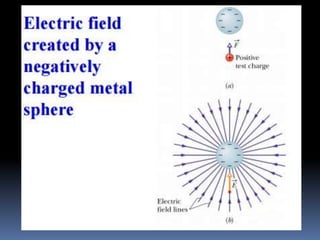
Electric Fields
 We visualize the field by drawing the
field lines
 Lines point in the same direction as the field.
 Density of lines gives the magnitude of the
field.
 Lines begin on + charges; end on – charges.
Field Lines
 Point direction a + charge
would move
 More lines = stronger field
Two positive charges..
A new force…
Electric force
Between 2 charged objects
Depends on distance and
amt. of charge
Coulomb’s Law
F =
qAqB
K
d2
K = 9 x 10⁹ N·m2/C2
Coulomb’s Law
Units
Charge - coulomb (C)
Force – Newtons (N)
Distance – meter (m)
Electric force is a vector
Van de Graaff Generator
 The globe of the generator builds up excess
electrons through conduction.
 The built electrons are repelling since they
are like charges and we know that like
charges repel so they are spread out as much
as possible.
 The charges are spread out because the globe
is a conductor, unlike electrons that are
rubbed onto the balloon, which stay in the
general area where you rub the balloon.

Static Electricity.ppt

  • 1.
  • 2.
    STATIC ELECTRICITY •Electrostatic – thestudy of electrical charges that can be collected and held in one area. •They flow in no particular direction (trapped in a body)
  • 3.
    Electricity of theAtom  They are ordinarily neutral in charge  # of protons = # of electrons  Neutrons = no charge  Protons = + 1 charge  Electrons = -1 charge
  • 4.
    The actual chargeof an electron -1.60217657 X 10⁻¹⁹ coulombs
  • 5.
    Little History: BenFranklin  Proved lightning was static electricity  Invented lightning rod  Built a static electricity generator  Coined the terms positive and negative for electrical charge
  • 6.
    Charged objects  Atomsbecome charged by gaining or losing electrons  An object that exhibits electrical interaction after rubbing is said to be charged
  • 7.
    Rules of Attraction Oppositewill attract Only the electrons will move Like will repel Protons will move but they don’t leave the nucleus.
  • 8.
    Interaction between a chargedobject and a neutral object:  Any charged object (positive or negative) will have an attraction interaction with a neutral object.
  • 9.
    Why are protonsnever lost or gained?  Protons are held in the nucleus by the strongest forces in the universe.
  • 10.
    Ions  Are electricallycharged particles  Charge is unbalanced  Negative Charge # e > # p  Positive charge # p > # e
  • 11.
    Neutral State  Chargedobjects will eventually return to their NEUTRAL state  What/How does this happen?  The charge “leaks off” onto the water molecules in the air.  On humid/rain days it would be difficult to hold a charge for long.
  • 12.
    Electro-negativity Relative electro-negativity ranking for some commonmaterials from electron donating materials (+, glass) to electron accepting materials (-,Teflon)  Glass  Human Hair  Nylon  Silk  Fur  Aluminum  Paper  Cotton  Copper  Rubber  PVC  Teflon + + + + + + + + + + + + + + + - - - - - - - - - - - - - - -
  • 13.
    Grounded - neutral Charged objects lose their charge when grounded.
  • 14.
    "What is the bottomprong of a plug called?"  The bottom prong of a plug is called the ground.  It discharges any excess charge that may develop in an electrical device
  • 15.
    When grounded:  Negativelycharged objects  .... Lose electrons and become neutral  Positively charged objects  ... Gain electrons and become neutral
  • 16.
    Electroscope  Used totest the presence of a charged object.
  • 17.
    If no chargeis present, leaves point straight down.
  • 18.
    Leaves separate whencharge is present.
  • 19.
    Where do chargescome from? Rubbing materials does NOT create electric charges. It just transfers electrons from one material to the other.
  • 20.
    Transfer of charge Charge can be transferred between neutral objects by FRICTION.  Ex: Rubber rod rubbed with fur or wool will cause electrons to transfer to the rod  Rubber Rod gains electrons and becomes negative  Fur/wool loses electrons and becomes positive
  • 22.
  • 23.
  • 24.
  • 25.
  • 26.
  • 27.
  • 28.
    Conduction  Charging bycontact – direct touching  EX: Conduction with a negative rod
  • 29.
    How do theelectrons flow during conduction?  When a negative charged rod comes in contact with the knob the electrons flow into the electroscope – charge negative  When a postive charged rod comes in contact with the knob the electrons flow into the rod – charge positive
  • 30.
  • 31.
  • 32.
    Induction: The productionof a charge in an uncharged body by bringing a charged object close to it When negatively charged rod is put near a metal can... electrons of the can are pushed away from the rod.  top of the can: positive attraction > repulsion + + + + + metal can - - - - - - - - - - - - buttom of the can: negative induced charges attraction repulsion
  • 33.
    Attraction of uncharged objects Similarly,when charged rod is close to paper scrap.. - - - - - - - molecules of paper align.  attraction between the rod and + charge > repulsion between the rod and - charge. paper + – + – + – + – + – + – + – + – attraction repulsion
  • 34.
    Electricity, Height, andWomen https://www.youtube.com/watch?v=FGoaXZwF lJ4&nohtml5=False
  • 35.
    Static Discharge Human bodycan not feel less than 2,000 volts of static discharge Static charge built up by scuffing shoes on a carpet can exceed 20,000 volts!
  • 36.
  • 37.
    What causes lightning? You need cold air and warm air.  It is a discharge of the static electricity that builds up in cloud in certain weather conditions.  Usually when the ground is warm and the air is humid.
  • 38.
    Interesting facts  Howhot is a lightning bolt? Only about 54,000 degrees Fahrenheit — roughly five times hotter than the surface of the sun!  Lightning flashes more than 3 million times a day worldwide — that’s about 40 times a second. Not all those flashes hit the ground — some happen between or inside clouds.  An average lightning bolt can release enough energy to operate a 100-watt light bulb for more than three months straight (about 250 kilowatt-hours of energy).  Lightning starts in cumulonimbus clouds — aka thunderheads — which have a positive charge up top and a negative charge below. We don’t know how the charges start, but water droplets and ice crystals carry them.
  • 39.
    Lightning  Head straight to yourcar  Move to a lower location 
  • 40.
    Electric Fields  Wevisualize the field by drawing the field lines  Lines point in the same direction as the field.  Density of lines gives the magnitude of the field.  Lines begin on + charges; end on – charges.
  • 41.
    Field Lines  Pointdirection a + charge would move  More lines = stronger field
  • 43.
  • 44.
    A new force… Electricforce Between 2 charged objects Depends on distance and amt. of charge
  • 45.
  • 46.
    Coulomb’s Law Units Charge -coulomb (C) Force – Newtons (N) Distance – meter (m) Electric force is a vector
  • 47.
    Van de GraaffGenerator  The globe of the generator builds up excess electrons through conduction.  The built electrons are repelling since they are like charges and we know that like charges repel so they are spread out as much as possible.  The charges are spread out because the globe is a conductor, unlike electrons that are rubbed onto the balloon, which stay in the general area where you rub the balloon.