Strategic Intervention Material _______________________________________-Sample.doc
1.
Developed by: JUNARP. SANTIAGO Alicia National High School
+ + + +
+ + +
+
+
-
-
-
-
-
-
-
- -
-
-
-
-
-
0
0
0 0
0
0
0
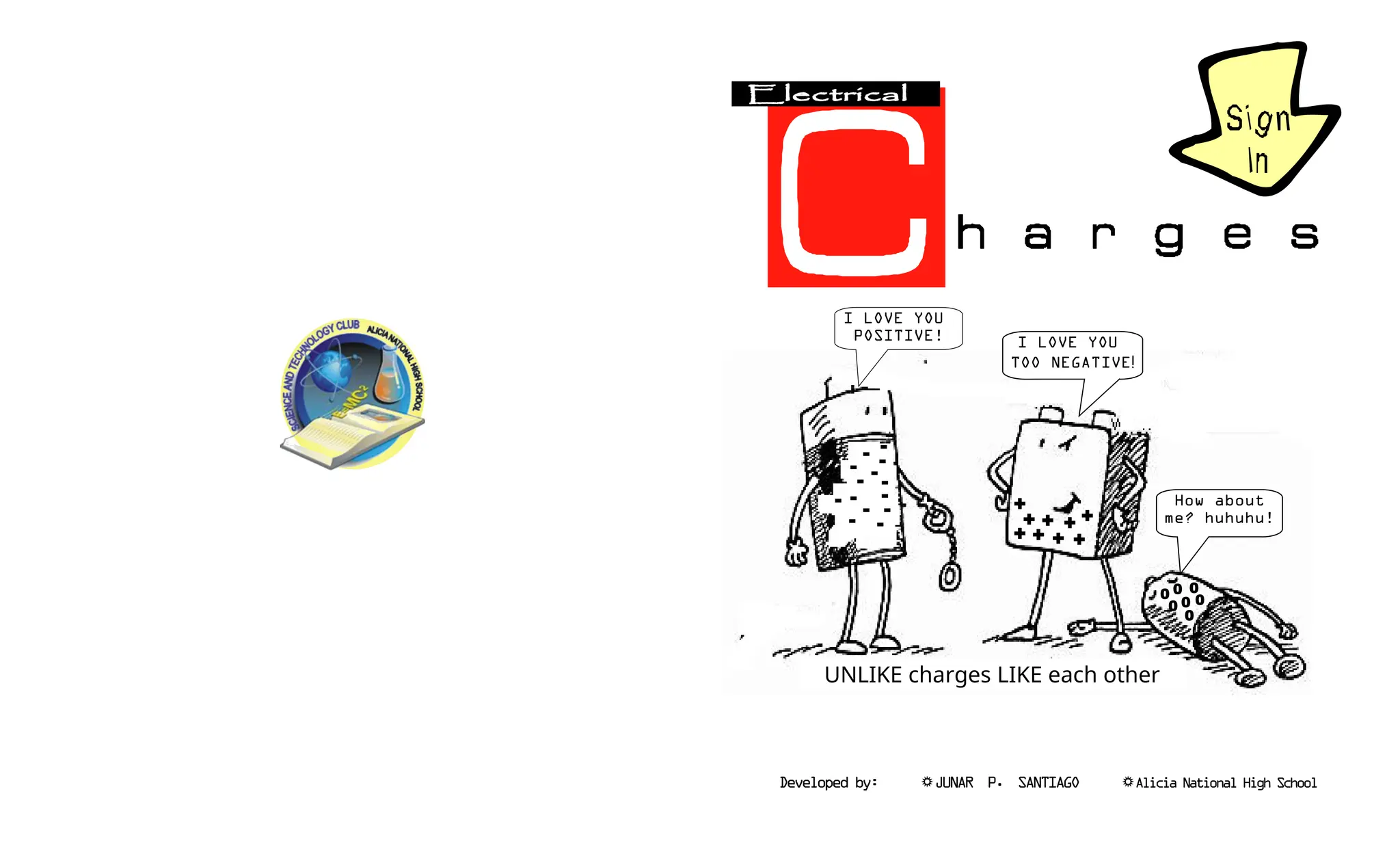
I LOVE YOU
TOO NEGATIVE!
I LOVE YOU
POSITIVE!
How about
me? huhuhu!
UNLIKE charges LIKE each other
2.
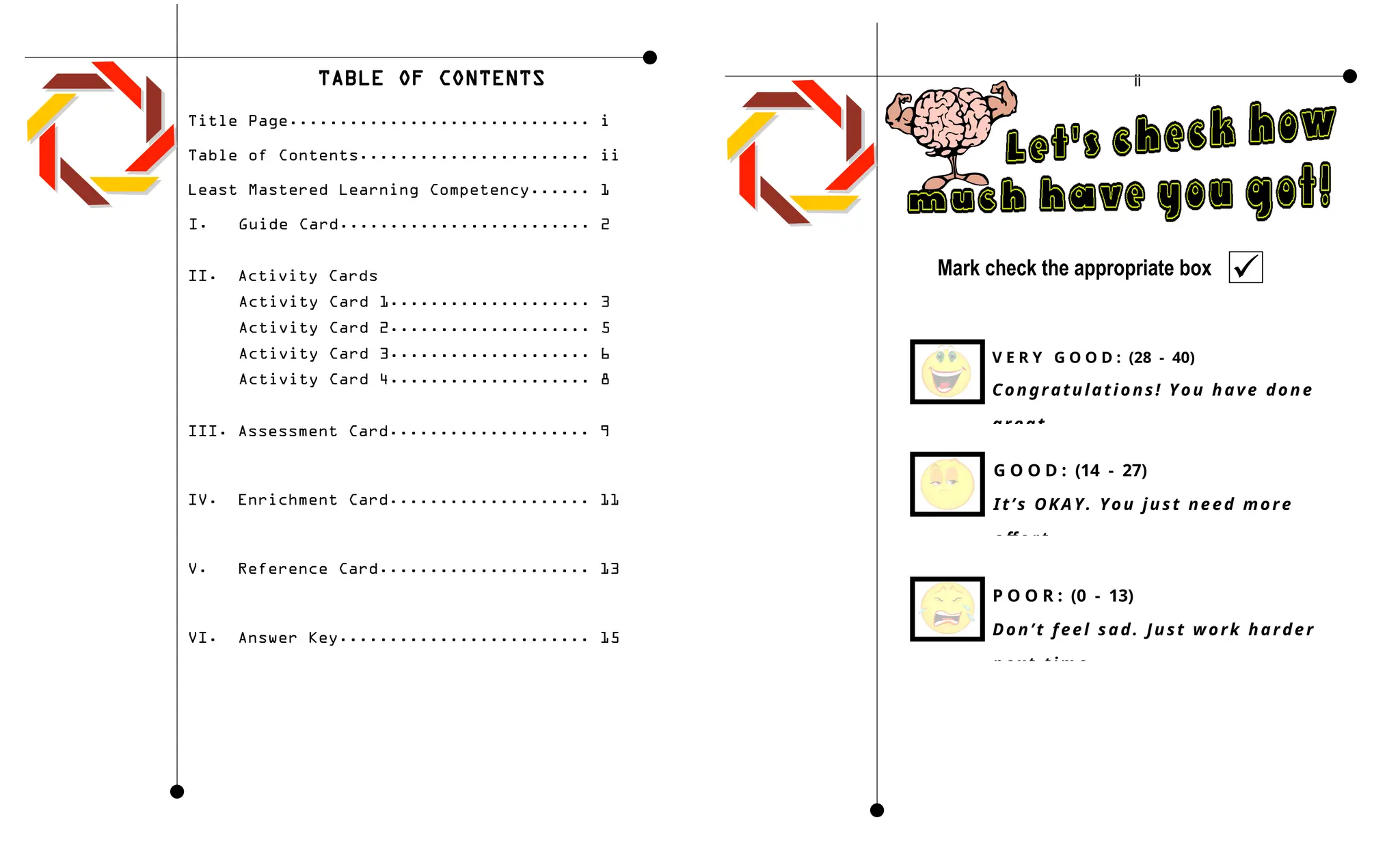
TABLE OF CONTENTS
TitlePage.............................. i
Table of Contents....................... ii
Least Mastered Learning Competency...... 1
I. Guide Card......................... 2
II. Activity Cards
Activity Card 1.................... 3
Activity Card 2.................... 5
Activity Card 3.................... 6
Activity Card 4.................... 8
III. Assessment Card.................... 9
IV. Enrichment Card.................... 11
V. Reference Card..................... 13
VI. Answer Key......................... 15
ii
V E R Y G O O D : (28 - 40)
Congratulations! You have done
great.
G O O D : (14 - 27)
It’s OKAY. You just need more
effort.
P O O R : (0 - 13)
Don’t feel sad. Just work harder
next time.
Mark check the appropriate box
3.
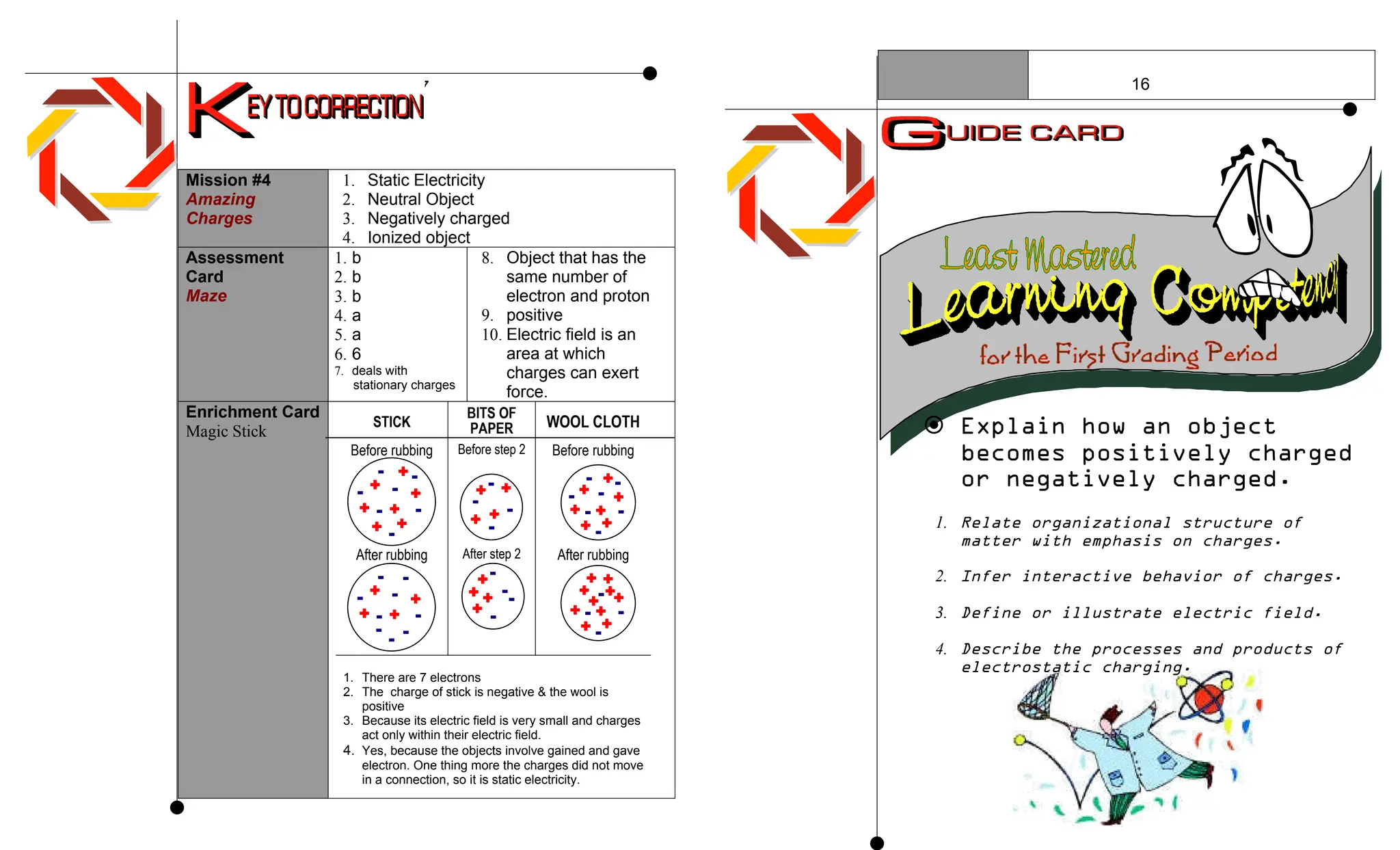
Mission #4
Amazing
Charges
1. StaticElectricity
2. Neutral Object
3. Negatively charged
4. Ionized object
Assessment
Card
Maze
1. b
2. b
3. b
4. a
5. a
6. 6
7. deals with
stationary charges
8. Object that has the
same number of
electron and proton
9. positive
10. Electric field is an
area at which
charges can exert
force.
Enrichment Card
Magic Stick
STICK
BITS OF
PAPER WOOL CLOTH
Before rubbing Before step 2 Before rubbing
After rubbing After step 2 After rubbing
1. There are 7 electrons
2. The charge of stick is negative & the wool is
positive
3. Because its electric field is very small and charges
act only within their electric field.
4. Yes, because the objects involve gained and gave
electron. One thing more the charges did not move
in a connection, so it is static electricity.
Explain how an object
becomes positively charged
or negatively charged.
1. Relate organizational structure of
matter with emphasis on charges.
2. Infer interactive behavior of charges.
3. Define or illustrate electric field.
4. Describe the processes and products of
electrostatic charging.
17
+
+
-
+ -
-
-
+
+
+
+
-
-
-
-
+ +
+
+
-
-
-
+
+
-
+ -
-
-
+
-
-
-
-
-
-
+
+ +
+
--
-
+
+
-
+ -
-
-
+
+
+
+
-
-
-
+
+
-
+ -
-
+
+
+
+
-
+
+
+
16
4.
Ooppss! STOP, LOOKand READ. Do
you want to become Pedro? BIG NO I’m
sure.
LOADING......
I have a good thing here. Wanna know? READ this…
Mission #1
Inside of Matter
Mission #2 1. Positive charge
Well, it is so easy to become the OPPOSITE
of Pedro. Just go go go! finish this material.
STUDENT’S NOTE
Mark check
Perhaps the lessons
are…
fun to study
After reading this…
I am motivated to
learn the mentioned
lessons
I am partly motivated to
learn the mentioned
lessons
I am not motivated to
learn the mentioned
lessons
boring to study
I want to finish this…
alone
with a classmate
with a group
Are you ready? Come
on, LET’S GO!
1
2
Matter
is made
up of
proton
has
which has
which has
atom
c h a r g e
electron
neutron
positive negative
which has
neutral
ELECTRIC CHARGES
Warning!
You got LOW
again Pedro!!!
Hehehe! Pedro is weak He
got low again in the exam
How sad!
Go go go! Deal with the activities ahead
and surely you will discover the
explanations of such things and etc…
Have you ever wondered
why these things happen?
[Where do charges
originate?] [What is electric field?]
1
ELECTRIC FIELD
BEHAVIOR OF
CHARGES
[What is the basic rule
about electric charge?]
AMAZING CHARGES [What is the difference
between neutral, positively
charged and negatively
charged object?] MAGIC STICK
[Why does a plastic
stick attract small
bits of paper?]
2 3
4
5
INSIDE OF MATTER
5.
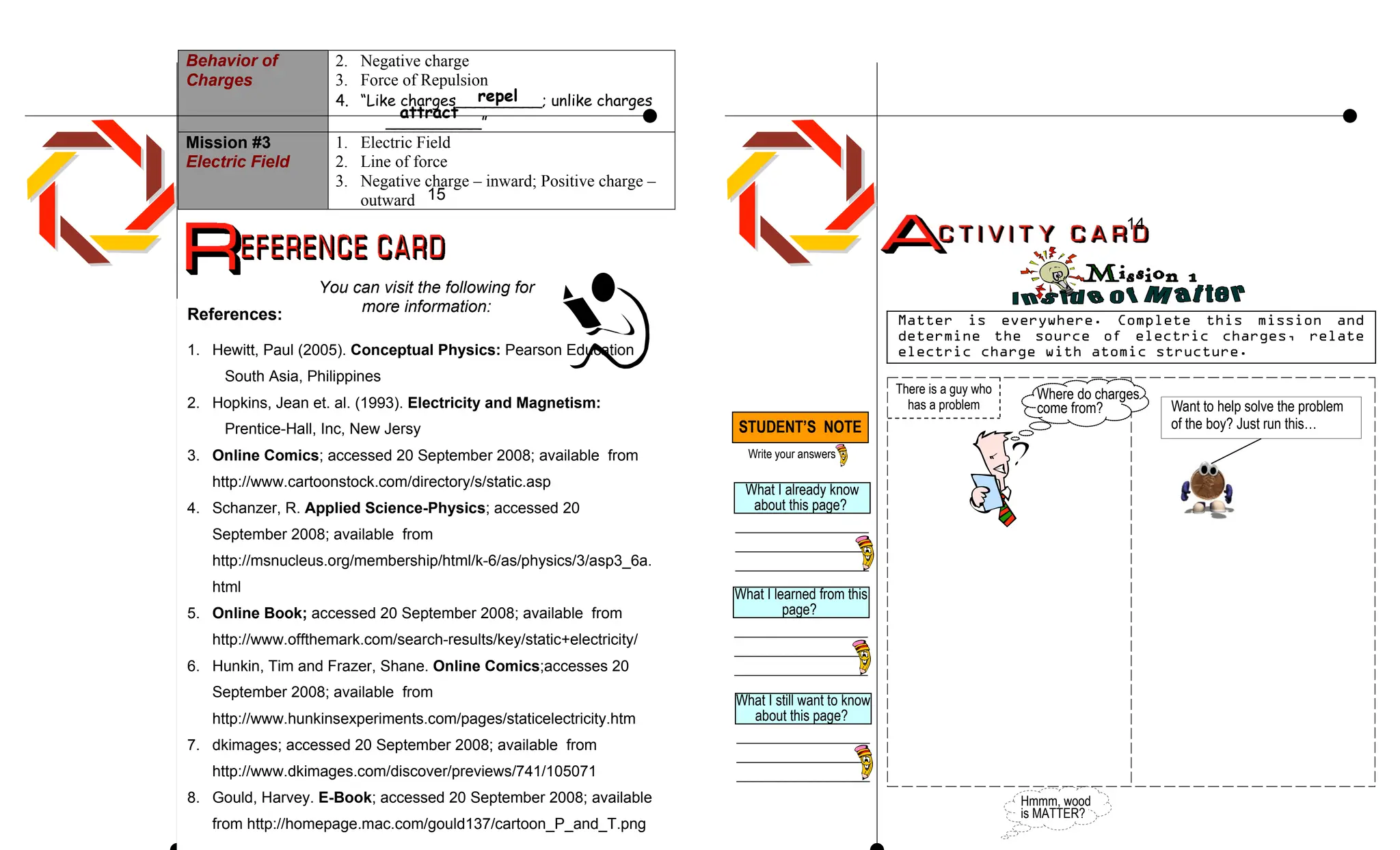
Behavior of
Charges
2. Negativecharge
3. Force of Repulsion
4. “Like charges_________; unlike charges
__________”
Mission #3
Electric Field
1. Electric Field
2. Line of force
3. Negative charge – inward; Positive charge –
outward
Matter is everywhere. Complete this mission and
determine the source of electric charges, relate
electric charge with atomic structure.
Where do charges
come from?
There is a guy who
has a problem Want to help solve the problem
of the boy? Just run this…
Hmmm, wood
is MATTER?
What I already know
about this page?
________________
________________
________________
What I learned from this
page?
________________
________________
________________
What I still want to know
about this page?
________________
________________
________________
15
14
References:
1. Hewitt, Paul (2005). Conceptual Physics: Pearson Education
South Asia, Philippines
2. Hopkins, Jean et. al. (1993). Electricity and Magnetism:
Prentice-Hall, Inc, New Jersy
3. Online Comics; accessed 20 September 2008; available from
http://www.cartoonstock.com/directory/s/static.asp
4. Schanzer, R. Applied Science-Physics; accessed 20
September 2008; available from
http://msnucleus.org/membership/html/k-6/as/physics/3/asp3_6a.
html
5. Online Book; accessed 20 September 2008; available from
http://www.offthemark.com/search-results/key/static+electricity/
6. Hunkin, Tim and Frazer, Shane. Online Comics;accesses 20
September 2008; available from
http://www.hunkinsexperiments.com/pages/staticelectricity.htm
7. dkimages; accessed 20 September 2008; available from
http://www.dkimages.com/discover/previews/741/105071
8. Gould, Harvey. E-Book; accessed 20 September 2008; available
from http://homepage.mac.com/gould137/cartoon_P_and_T.png
You can visit the following for
more information:
attract
repel
STUDENT’S NOTE
Write your answers
6.
GLOSSARY
Atom The smallestparticle of an element that
can be identified with that element.
Consists of protons and neutrons in a
nucleus surrounded by electron.
Electric field An area over which electric
charge exerts force.
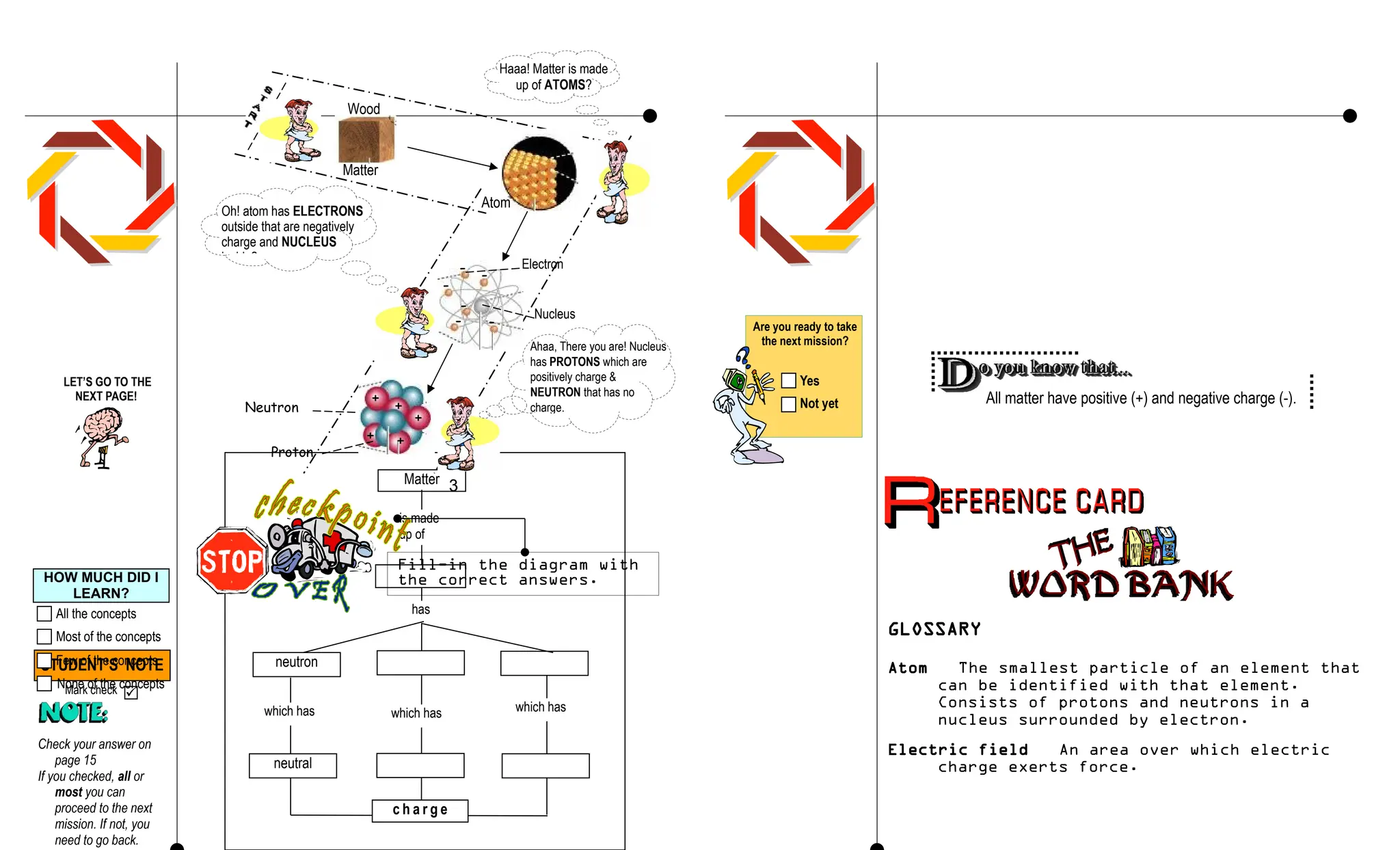
Matter
is made
up of
has
which has
which has
c h a r g e
neutron
which has
neutral
Wood
Matter
Atom
Electron
Nucleus
-
-
-
-
-
-
Neutron
Proton
+
+
+
+
+
Haaa! Matter is made
up of ATOMS?
Oh! atom has ELECTRONS
outside that are negatively
charge and NUCLEUS
inside?
Ahaa, There you are! Nucleus
has PROTONS which are
positively charge &
NEUTRON that has no
charge.
Fill-in the diagram with
the correct answers.
Are you ready to take
the next mission?
Yes
Not yet
STUDENT’S NOTE
Mark check
HOW MUCH DID I
LEARN?
Check your answer on
page 15
If you checked, all or
most you can
proceed to the next
mission. If not, you
need to go back.
All the concepts
Most of the concepts
Few of the concepts
None of the concepts
All matter have positive (+) and negative charge (-).
3 4
LET’S GO TO THE
NEXT PAGE!
7.
Electric Force Theforce that one charge
exerts on other.
Electron Negatively charged particle.
Force of Attraction Electric force exists
between unlike charges.
Force of Repulsion Electric force exists
between same charges.
Ionized An object that gained or donated
electron.
Line of force An arrow which is a
representation of electric field.
Proton Positively charged particle.
Static Electricity Is created when an object
gives up or gains electrons.
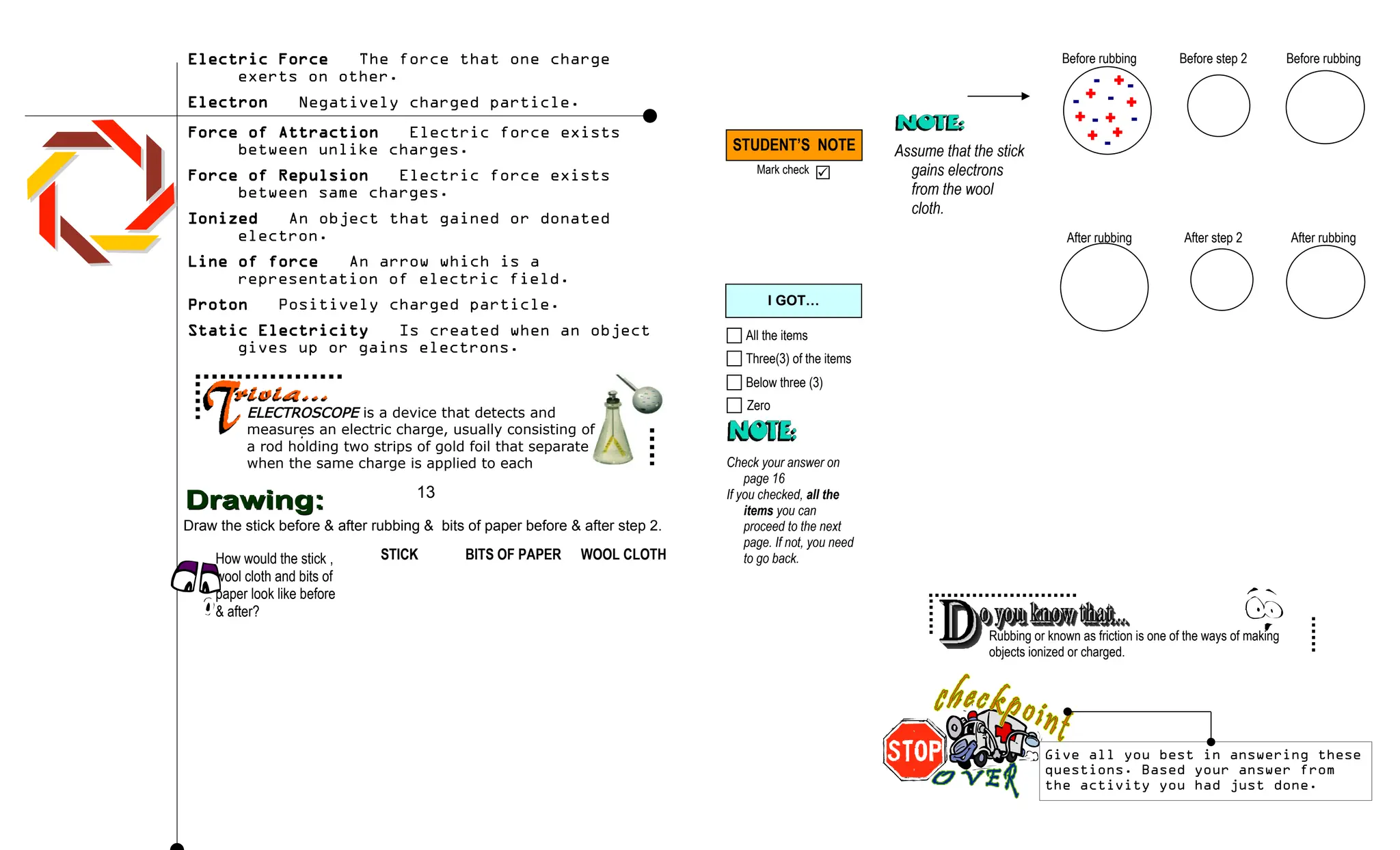
STICK BITS OF PAPER WOOL CLOTH
Before rubbing Before step 2 Before rubbing
After rubbing After step 2 After rubbing
Draw the stick before & after rubbing & bits of paper before & after step 2.
Assume that the stick
gains electrons
from the wool
cloth.
How would the stick ,
wool cloth and bits of
paper look like before
& after?
+
+
-
+ -
-
-
+
+
+
+
-
-
-
Rubbing or known as friction is one of the ways of making
objects ionized or charged.
Give all you best in answering these
questions. Based your answer from
the activity you had just done.
13
All the items
Three(3) of the items
Below three (3)
Zero
I GOT…
Check your answer on
page 16
If you checked, all the
items you can
proceed to the next
page. If not, you need
to go back.
STUDENT’S NOTE
Mark check
ELECTROSCOPE is a device that detects and
measures an electric charge, usually consisting of
a rod holding two strips of gold foil that separate
when the same charge is applied to each
8.
Upon completing thismission, you can readily
explain the basic rule about electric charges.
Also the behavior of electric charges.
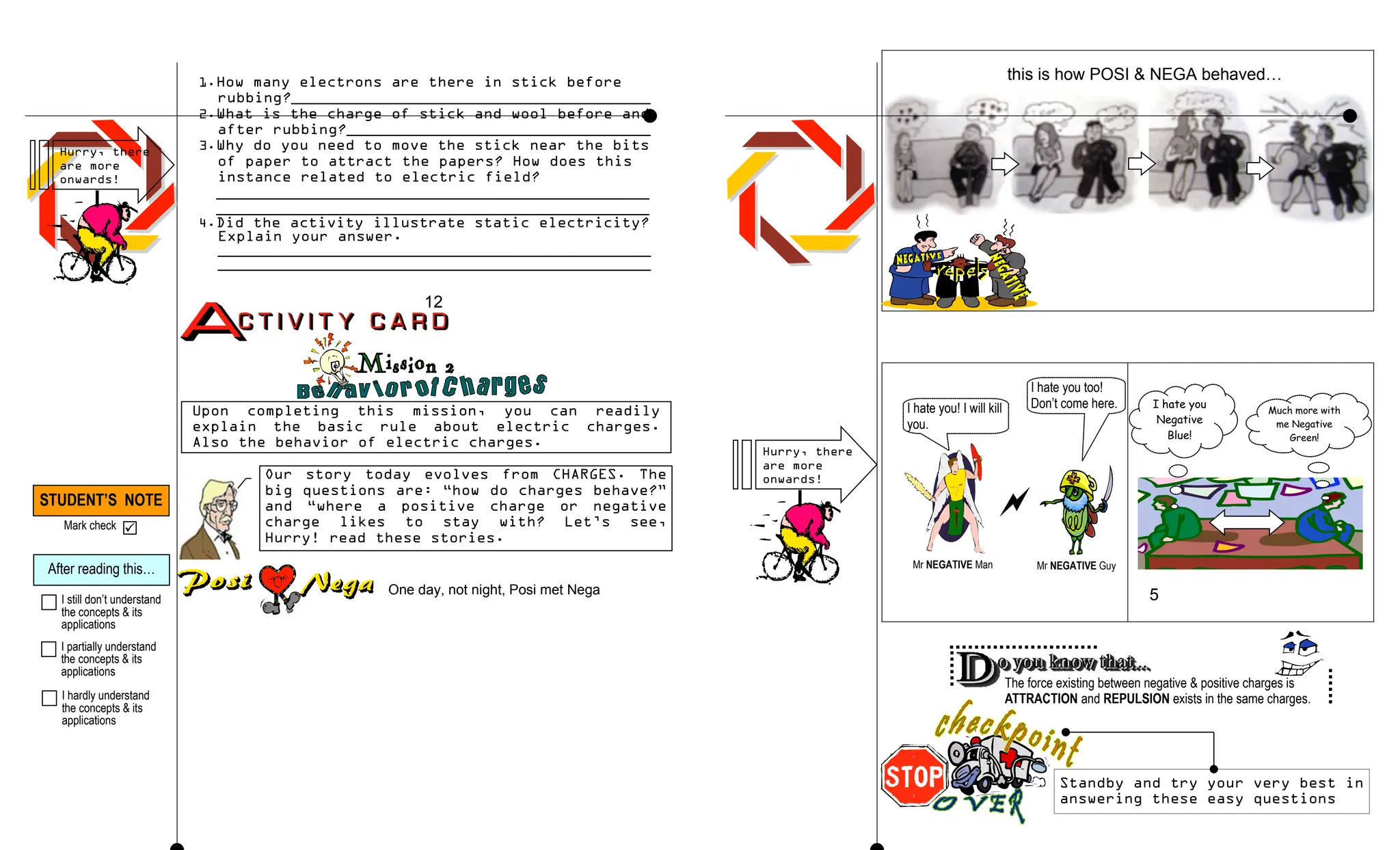
Our story today evolves from CHARGES. The
big questions are: “how do charges behave?”
and “where a positive charge or negative
charge likes to stay with? Let’s see,
Hurry! read these stories.
this is how POSI & NEGA behaved…
One day, not night, Posi met Nega
Mr NEGATIVE Man Mr NEGATIVE Guy
I hate you too!
Don’t come here.
I hate you! I will kill
you.
I hate you
Negative
Blue!
Much more with
me Negative
Green!
The force existing between negative & positive charges is
ATTRACTION and REPULSION exists in the same charges.
Standby and try your very best in
answering these easy questions
STUDENT’S NOTE
Mark check
After reading this…
I still don’t understand
the concepts & its
applications
I partially understand
the concepts & its
applications
I hardly understand
the concepts & its
applications
Hurry, there
are more
onwards!
5
1.How many electrons are there in stick before
rubbing?_______________________________________
2.What is the charge of stick and wool before and
after rubbing?_________________________________
3.Why do you need to move the stick near the bits
of paper to attract the papers? How does this
instance related to electric field?
_______________________________________________
_______________________________________________
4.Did the activity illustrate static electricity?
Explain your answer.
_______________________________________________
_______________________________________________
12
Hurry, there
are more
onwards!
9.
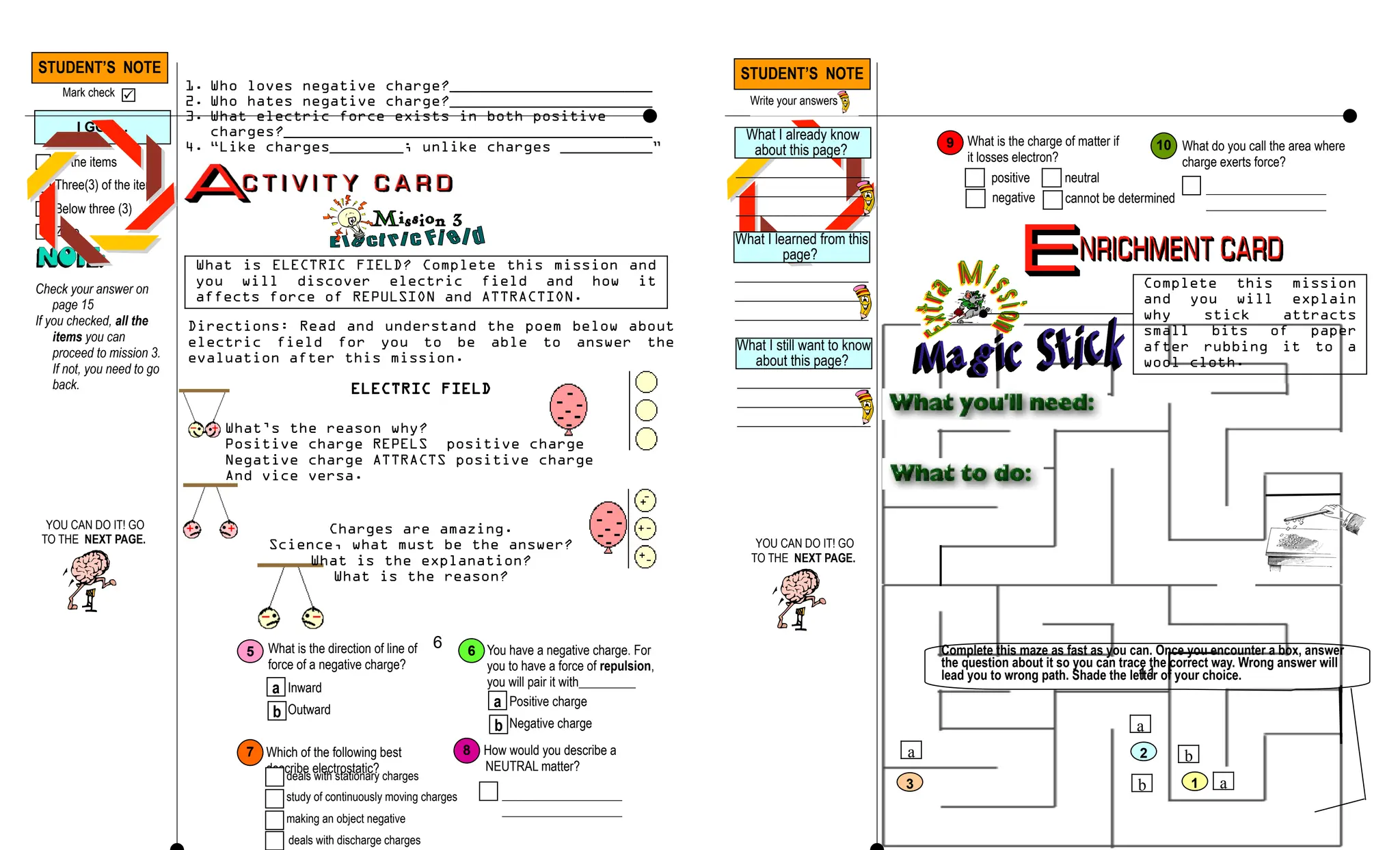
Directions: Read andunderstand the poem below about
electric field for you to be able to answer the
evaluation after this mission.
plastic stick, wool cloth, small bits of paper
1. Rub a plastic stick to the wool cloth for a minute or two.
2. Then place it near the small bits of paper. Observe what
happen.
3. Repeat step 1.
4. Position the wool cloth close to the small bits of paper.
Take note what happen.
1. Who loves negative charge?______________________
2. Who hates negative charge?______________________
3. What electric force exists in both positive
charges?________________________________________
4. “Like charges________; unlike charges __________”
STUDENT’S NOTE
Mark check
All the items
Three(3) of the items
Below three (3)
Zero
I GOT…
Check your answer on
page 15
If you checked, all the
items you can
proceed to mission 3.
If not, you need to go
back.
What is ELECTRIC FIELD? Complete this mission and
you will discover electric field and how it
affects force of REPULSION and ATTRACTION.
ELECTRIC FIELD
What’s the reason why?
Positive charge REPELS positive charge
Negative charge ATTRACTS positive charge
And vice versa.
Charges are amazing.
Science, what must be the answer?
What is the explanation?
What is the reason?
6
b
a
a
b 1
2
3
a
Complete this maze as fast as you can. Once you encounter a box, answer
the question about it so you can trace the correct way. Wrong answer will
lead you to wrong path. Shade the letter of your choice.
What is the direction of line of
force of a negative charge?
a
b
Inward
Outward
5 You have a negative charge. For
you to have a force of repulsion,
you will pair it with_________
a
b
Positive charge
Negative charge
6
7 How would you describe a
NEUTRAL matter?
___________________
___________________
8
What is the charge of matter if
it losses electron?
positive
9
Which of the following best
describe electrostatic?
What do you call the area where
charge exerts force?
___________________
___________________
10
Complete this mission
and you will explain
why stick attracts
small bits of paper
after rubbing it to a
wool cloth.
11
YOU CAN DO IT! GO
TO THE NEXT PAGE.
What I already know
about this page?
________________
________________
________________
What I learned from this
page?
________________
________________
________________
What I still want to know
about this page?
________________
________________
________________
YOU CAN DO IT! GO
TO THE NEXT PAGE.
STUDENT’S NOTE
Write your answers
deals with stationary charges
study of continuously moving charges
making an object negative
deals with discharge charges
negative
neutral
cannot be determined
10.
REPULSION
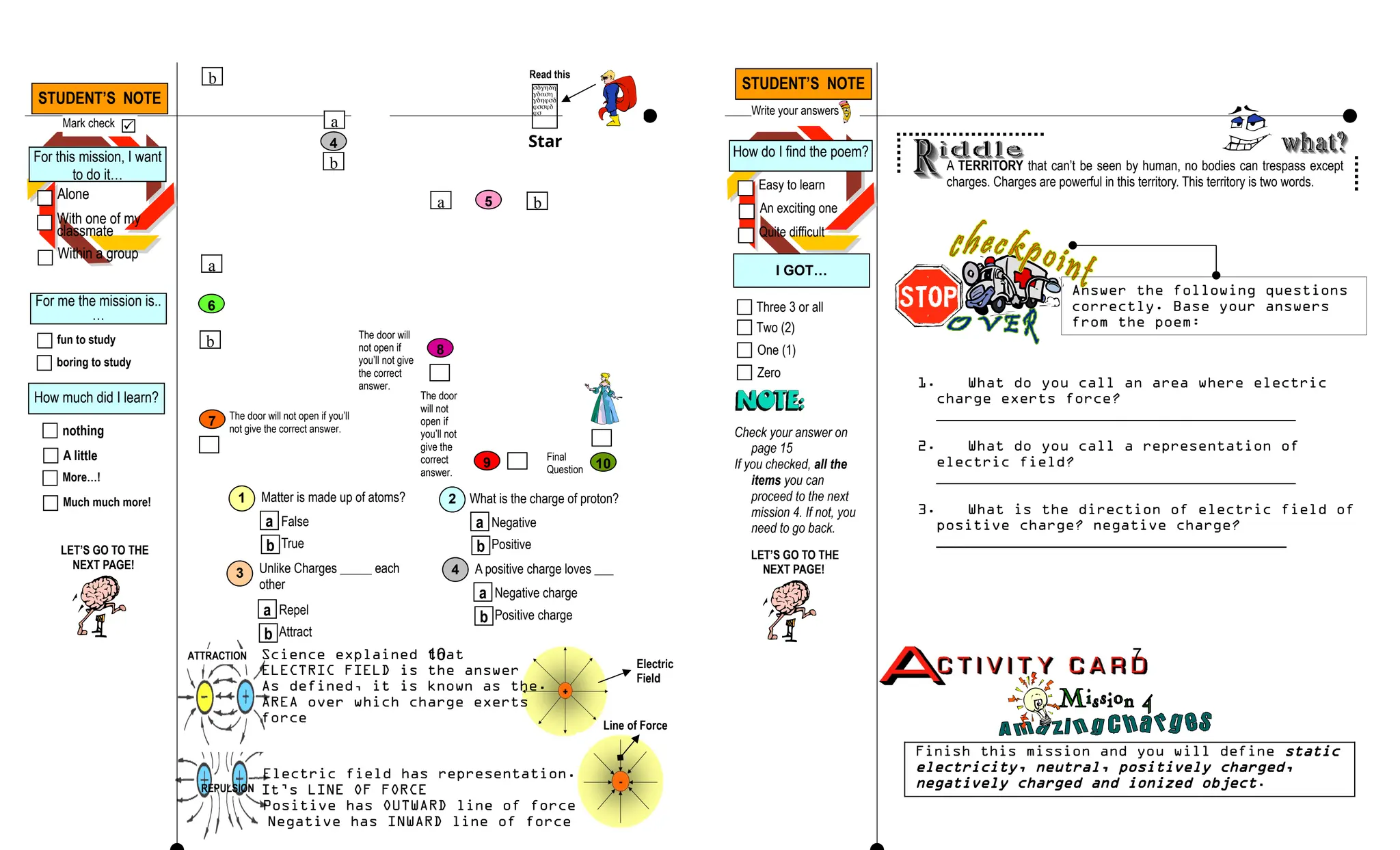
ATTRACTION Science explainedthat
ELECTRIC FIELD is the answer
As defined, it is known as the.
AREA over which charge exerts
force
Electric field has representation.
It’s LINE OF FORCE
Positive has OUTWARD line of force
Negative has INWARD line of force
Electric
Field
Line of Force
A TERRITORY that can’t be seen by human, no bodies can trespass except
charges. Charges are powerful in this territory. This territory is two words.
Answer the following questions
correctly. Base your answers
from the poem:
1. What do you call an area where electric
charge exerts force?
_______________________________________
2. What do you call a representation of
electric field?
_______________________________________
3. What is the direction of electric field of
positive charge? negative charge?
______________________________________
Finish this mission and you will define static
electricity, neutral, positively charged,
negatively charged and ionized object.
7
5
6
7
8
9
a
b
4
10
Star
t
b
a b
b
a
The door will not open if you’ll
not give the correct answer.
The door will
not open if
you’ll not give
the correct
answer.
The door
will not
open if
you’ll not
give the
correct
answer.
Final
Question
Read this
1 Matter is made up of atoms?
a
b
False
True
2 What is the charge of proton?
a
b
Negative
Positive
3 Unlike Charges _____ each
other
a
b
Repel
Attract
4 A positive charge loves ___
a
b
Negative charge
Positive charge
10
How do I find the poem?
Easy to learn
An exciting one
Quite difficult
I GOT…
Check your answer on
page 15
If you checked, all the
items you can
proceed to the next
mission 4. If not, you
need to go back.
Three 3 or all
Two (2)
Zero
One (1)
For this mission, I want
to do it…
Alone
With one of my
classmate
Within a group
For me the mission is..
…
fun to study
boring to study
How much did I learn?
nothing
A little
Much much more!
More…!
STUDENT’S NOTE
Mark check
LET’S GO TO THE
NEXT PAGE!
STUDENT’S NOTE
Write your answers
LET’S GO TO THE
NEXT PAGE!
11.
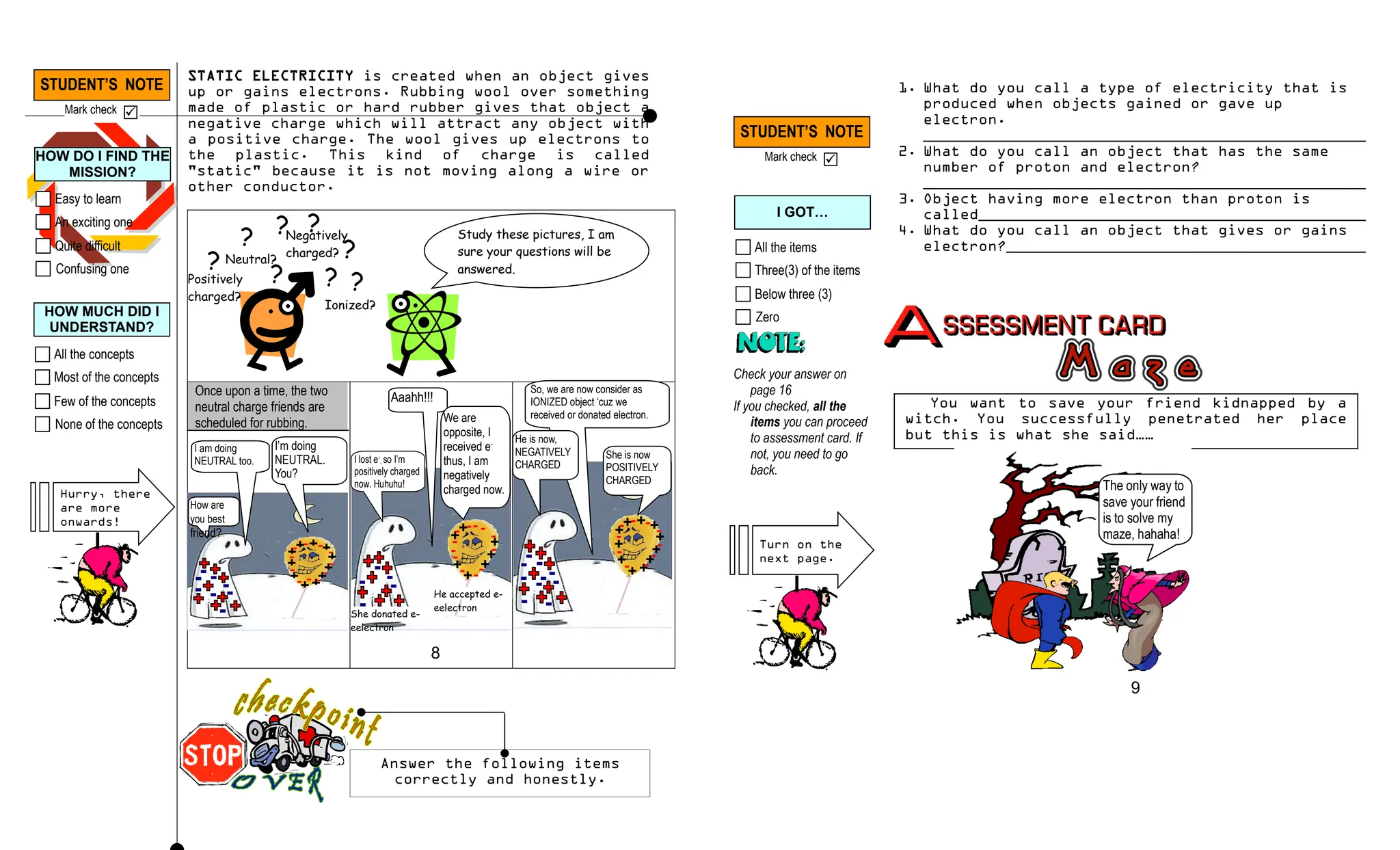
STATIC ELECTRICITY iscreated when an object gives
up or gains electrons. Rubbing wool over something
made of plastic or hard rubber gives that object a
negative charge which will attract any object with
a positive charge. The wool gives up electrons to
the plastic. This kind of charge is called
"static" because it is not moving along a wire or
other conductor.
Once upon a time, the two
neutral charge friends are
scheduled for rubbing.
+ +
+
+
+
+
+
+
+ +
+
- -
-
-
-
-
-
-
-
-
Neutral?
Positively
charged?
Negatively
charged?
Ionized?
?
?
?
?
?
?
?
?
Study these pictures, I am
sure your questions will be
answered.
How are
you best
friend?
+ +
+
+
+
+
+
+
++
+
- - -
-
-
-
-
-
-
-
I am doing
NEUTRAL too.
I’m doing
NEUTRAL.
You?
+
+
+
+
+
+
+
- -
-
-
-
-
-
-
-
-
-
-
She donated e-
eelectron
He accepted e-
eelectron
So, we are now consider as
IONIZED object ‘cuz we
received or donated electron.
He is now,
NEGATIVELY
CHARGED
She is now
POSITIVELY
CHARGED
Aaahh!!!
We are
opposite, I
received e-
thus, I am
negatively
charged now.
I lost e-
, so I’m
positively charged
now. Huhuhu!
STUDENT’S NOTE
Mark check
STUDENT’S NOTE
Mark check
Answer the following items
correctly and honestly.
1. What do you call a type of electricity that is
produced when objects gained or gave up
electron.
________________________________________________
2. What do you call an object that has the same
number of proton and electron?
________________________________________________
3. Object having more electron than proton is
called__________________________________________
4. What do you call an object that gives or gains
electron?_______________________________________
You want to save your friend kidnapped by a
witch. You successfully penetrated her place
but this is what she said……
The only way to
save your friend
is to solve my
maze, hahaha!
8
9
All the items
Three(3) of the items
Below three (3)
Zero
I GOT…
Check your answer on
page 16
If you checked, all the
items you can proceed
to assessment card. If
not, you need to go
back.
Easy to learn
An exciting one
Quite difficult
Confusing one
HOW DO I FIND THE
MISSION?
Hurry, there
are more
onwards!
All the concepts
Most of the concepts
Few of the concepts
None of the concepts
HOW MUCH DID I
UNDERSTAND?
Turn on the
next page.
-
![Ooppss! STOP, LOOK and READ. Do
you want to become Pedro? BIG NO I’m
sure.
LOADING......
I have a good thing here. Wanna know? READ this…
Mission #1
Inside of Matter
Mission #2 1. Positive charge
Well, it is so easy to become the OPPOSITE
of Pedro. Just go go go! finish this material.
STUDENT’S NOTE
Mark check
Perhaps the lessons
are…
fun to study
After reading this…
I am motivated to
learn the mentioned
lessons
I am partly motivated to
learn the mentioned
lessons
I am not motivated to
learn the mentioned
lessons
boring to study
I want to finish this…
alone
with a classmate
with a group
Are you ready? Come
on, LET’S GO!
1
2
Matter
is made
up of
proton
has
which has
which has
atom
c h a r g e
electron
neutron
positive negative
which has
neutral
ELECTRIC CHARGES
Warning!
You got LOW
again Pedro!!!
Hehehe! Pedro is weak He
got low again in the exam
How sad!
Go go go! Deal with the activities ahead
and surely you will discover the
explanations of such things and etc…
Have you ever wondered
why these things happen?
[Where do charges
originate?] [What is electric field?]
1
ELECTRIC FIELD
BEHAVIOR OF
CHARGES
[What is the basic rule
about electric charge?]
AMAZING CHARGES [What is the difference
between neutral, positively
charged and negatively
charged object?] MAGIC STICK
[Why does a plastic
stick attract small
bits of paper?]
2 3
4
5
INSIDE OF MATTER](https://image.slidesharecdn.com/sim-sample-250528111606-27399e25/75/Strategic-Intervention-Material-_______________________________________-Sample-doc-4-2048.jpg)