Static Electricity
What Is Static Electricity?
• A stationary electrical
charge that is built up on
the surface of a material
Two kinds of charges
• Positive
• Negative
+
+
+
–
–
–
Where do charges come from?
Matter is made up of atoms.
+
+
+
–
–
–
+
–
Proton (positive charge)
neutron (neutral)
electron (negative charge)
atom nucleus
Where do charges come from?
If electrons = protons neutral charge
If electrons > protons  gaining electrons = negative charge
If electrons < protons  losing electrons = positive charge
Electronegativity
Electronegativity is a measure of the tendency of an
atom to attract a bonding pair of electrons.
Elements here are
more likely to gain
or lose electrons
when bonding
(positive and
negatively charged
atoms)
Where do charges come from?
Rubbing materials together does NOT
create electric charges. It just transfers
electrons from one material to the
other.
Where do charges come from?
When a balloon rubs a piece of wool...
– electrons are pulled from the
wool to the balloon.
The balloon has more electrons than
usual.
+
+
+
+
+
–
–
–
–
–
The balloon: – charged,
The wool: +charged
wool
Insulators and conductors
Insulators: materials that do NOT allow
electrons to flow through them easily.
Insulators can be easily charged by friction as the extra
electrons gained CANNOT easily escape.
Insulators and conductors
Conductors: materials that allow
electrons to flow through them easily.
Conductors CANNOT be easily charged by friction as
the extra electrons gained can easily escape.
Charging by Friction
• Caused by rubbing two
different substances
together (friction)
• When the objects are
rubbed together, one object
will lose electrons and
another will gain electrons
Charging by Contact
• Uncharged (or neutral) objects can become
charged if they come into contact with charged
objects.
• When an uncharged object is charged with a
neutral one, it will take on the same charge as the
one that touches it.
• Example: If a negatively charged metal rod
touches a ball, the ball will become negatively
charged. Since they now have the same charge,
they will repel each other. Remember, like charges
repel!
Charging by Induction
• Requires a charged object to be moved
near a neutral one (cannot touch)
• When charging by induction, the once
neutral object always takes on the
opposite charge to the object that
approached it.
• If you rub a balloon against your hair (friction) &
is now negatively charged. The nearby wall is
neutral meaning it contains an equal number of
positive and negative charges.
• As the negatively charged balloon approaches
the neutral wall, it will repel the negative
charges at the wall’s surface, leaving behind the
positive charges. Now they are opposite charges,
and are attracted to each other.
Example of Charging by Induction
Grounding
An object is grounded when it is connected
to the earth through a connecting wire.
What is grounding?
If a charged conductor is grounded, it
will become neutral.
Grounding
How does grounding occur?
+
+
+
+
+
When we touch a metal ball of
positive charge...
Electrons flow from the
earth to the metal ball to
neutralize the metal ball.
Metal ball becomes neutral.
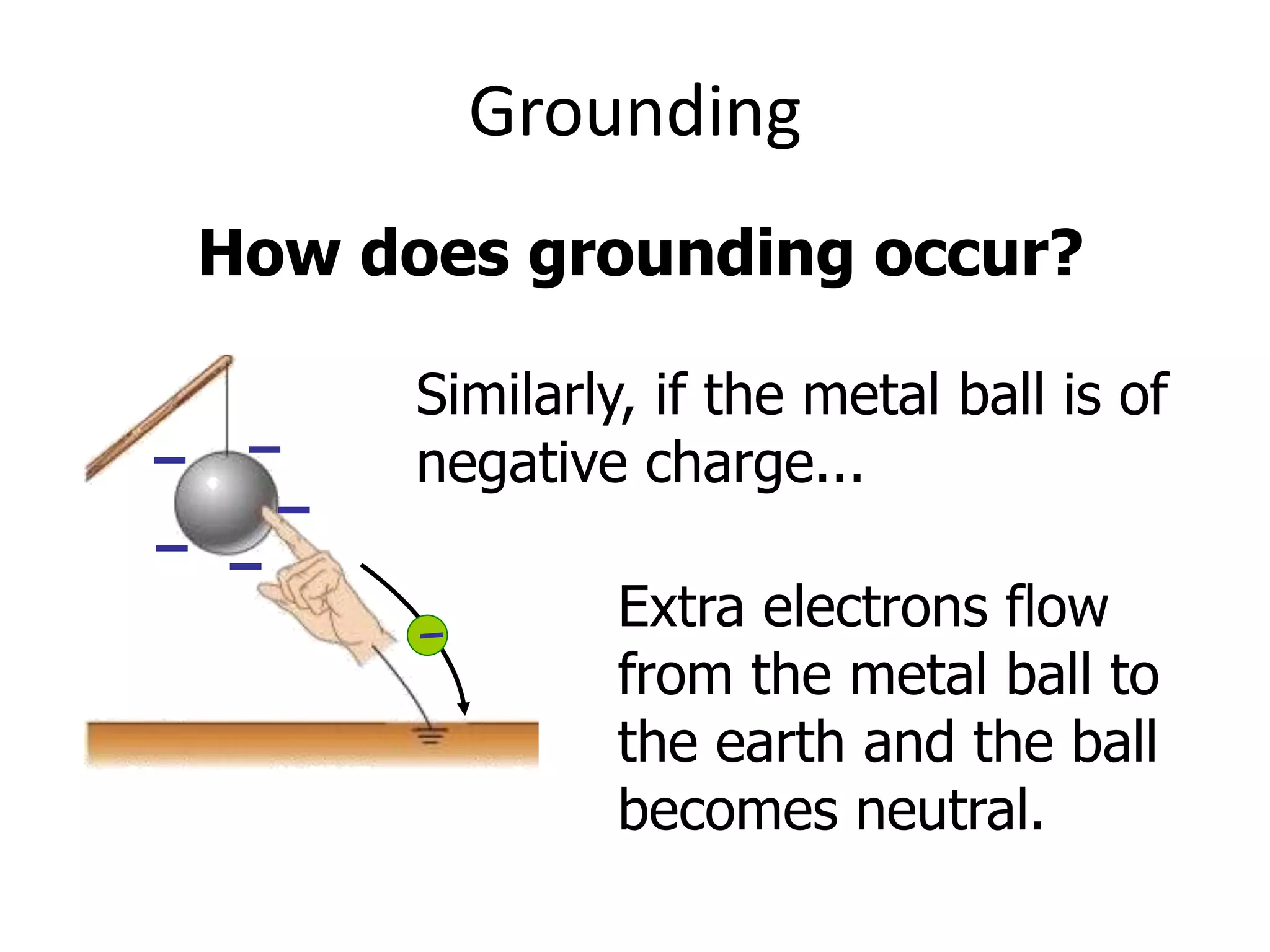
Similarly, if the metal ball is of
negative charge...
Grounding
How does grounding occur?
–
–
–
–
–
Extra electrons flow
from the metal ball to
the earth and the ball
becomes neutral.
Lightning
• A natural process where electric charges are
moving through the air.
• The jagged path is cause by the electric
charges trying to find the fastest path to the
ground.
• The electrical charges are drawn to tall
buildings because these shorten their path to
the ground.
Lightning Rods
• A metal rod (a conductor) placed on the top of
a building, and is long and pointed so it will be
the tallest part of the building.
• The rod should be the part of the building first
hit by the lightning and then should channel
the lightning into the ground.
• Lightning always seeks the fastest route to the
ground.
If the balloon can attract some paper scraps, which of the
following cannot be the charge of paper scraps?
A Neutral B Positive
C Negative
A balloon has a negative charge
when rubbed by a woolen cloth.
During rubbing, what have been transferred between the
woolen cloth and the balloon?
A Electrons B Protons
C Neutrons
A balloon has a negative charge
when rubbed by woolen cloth.
Do Now
Write a paragraph
about the cartoon. Tell
what he is trying to do.
Will it work and why?
What do you think will
happen? Use the
following words, static
electricity, lightning,
electrons, positive and
negative charges.
The End

Static electricity ppt

  • 1.
  • 2.
    What Is StaticElectricity? • A stationary electrical charge that is built up on the surface of a material
  • 3.
    Two kinds ofcharges • Positive • Negative + + + – – –
  • 4.
    Where do chargescome from? Matter is made up of atoms. + + + – – – + – Proton (positive charge) neutron (neutral) electron (negative charge) atom nucleus
  • 5.
    Where do chargescome from? If electrons = protons neutral charge If electrons > protons  gaining electrons = negative charge If electrons < protons  losing electrons = positive charge
  • 6.
    Electronegativity Electronegativity is ameasure of the tendency of an atom to attract a bonding pair of electrons. Elements here are more likely to gain or lose electrons when bonding (positive and negatively charged atoms)
  • 7.
    Where do chargescome from? Rubbing materials together does NOT create electric charges. It just transfers electrons from one material to the other.
  • 8.
    Where do chargescome from? When a balloon rubs a piece of wool... – electrons are pulled from the wool to the balloon. The balloon has more electrons than usual. + + + + + – – – – – The balloon: – charged, The wool: +charged wool
  • 9.
    Insulators and conductors Insulators:materials that do NOT allow electrons to flow through them easily. Insulators can be easily charged by friction as the extra electrons gained CANNOT easily escape.
  • 10.
    Insulators and conductors Conductors:materials that allow electrons to flow through them easily. Conductors CANNOT be easily charged by friction as the extra electrons gained can easily escape.
  • 12.
    Charging by Friction •Caused by rubbing two different substances together (friction) • When the objects are rubbed together, one object will lose electrons and another will gain electrons
  • 13.
    Charging by Contact •Uncharged (or neutral) objects can become charged if they come into contact with charged objects. • When an uncharged object is charged with a neutral one, it will take on the same charge as the one that touches it. • Example: If a negatively charged metal rod touches a ball, the ball will become negatively charged. Since they now have the same charge, they will repel each other. Remember, like charges repel!
  • 14.
    Charging by Induction •Requires a charged object to be moved near a neutral one (cannot touch) • When charging by induction, the once neutral object always takes on the opposite charge to the object that approached it.
  • 15.
    • If yourub a balloon against your hair (friction) & is now negatively charged. The nearby wall is neutral meaning it contains an equal number of positive and negative charges. • As the negatively charged balloon approaches the neutral wall, it will repel the negative charges at the wall’s surface, leaving behind the positive charges. Now they are opposite charges, and are attracted to each other. Example of Charging by Induction
  • 16.
    Grounding An object isgrounded when it is connected to the earth through a connecting wire. What is grounding? If a charged conductor is grounded, it will become neutral.
  • 17.
    Grounding How does groundingoccur? + + + + + When we touch a metal ball of positive charge... Electrons flow from the earth to the metal ball to neutralize the metal ball. Metal ball becomes neutral.
  • 18.
    Similarly, if themetal ball is of negative charge... Grounding How does grounding occur? – – – – – Extra electrons flow from the metal ball to the earth and the ball becomes neutral.
  • 19.
    Lightning • A naturalprocess where electric charges are moving through the air. • The jagged path is cause by the electric charges trying to find the fastest path to the ground. • The electrical charges are drawn to tall buildings because these shorten their path to the ground.
  • 20.
    Lightning Rods • Ametal rod (a conductor) placed on the top of a building, and is long and pointed so it will be the tallest part of the building. • The rod should be the part of the building first hit by the lightning and then should channel the lightning into the ground. • Lightning always seeks the fastest route to the ground.
  • 23.
    If the ballooncan attract some paper scraps, which of the following cannot be the charge of paper scraps? A Neutral B Positive C Negative A balloon has a negative charge when rubbed by a woolen cloth.
  • 24.
    During rubbing, whathave been transferred between the woolen cloth and the balloon? A Electrons B Protons C Neutrons A balloon has a negative charge when rubbed by woolen cloth.
  • 25.
    Do Now Write aparagraph about the cartoon. Tell what he is trying to do. Will it work and why? What do you think will happen? Use the following words, static electricity, lightning, electrons, positive and negative charges.
  • 26.