ELECTRICITY
MR. ERLISON LORENZ M. OGNILLA
Today’s Focus
• infer relationship between current
and voltage
• explain the advantage and
disadvantages of series and parallel
circuits
• explain the functions of circuit
breakers, fuses, earthing, double
insulation, and other safety devices at
home
Must know!
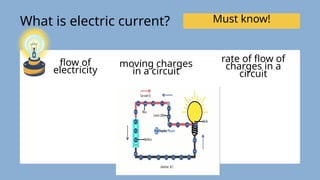
flow of
electricity
What is electric current?
moving charges
in a circuit
rate of flow of
charges in a
circuit
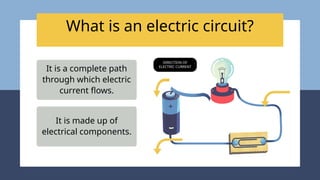
What is an electric circuit?
DIRECTION OF
ELECTRIC CURRENT
It is a complete path
through which electric
current flows.
It is made up of
electrical components.
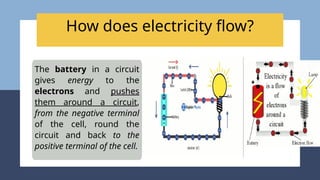
How does electricity flow?
DIRECTION OF
ELECTRIC CURRENT
The battery in a circuit
gives energy to the
electrons and pushes
them around a circuit,
from the negative terminal
of the cell, round the
circuit and back to the
positive terminal of the cell.
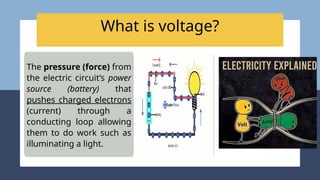
What is voltage?
DIRECTION OF
ELECTRIC CURRENT
`
The pressure (force) from
the electric circuit’s power
source (battery) that
pushes charged electrons
(current) through a
conducting loop allowing
them to do work such as
illuminating a light.
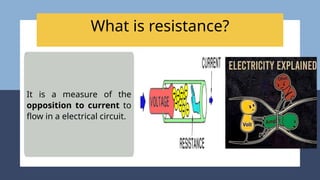
What is resistance?
DIRECTION OF
ELECTRIC CURRENT
`
It is a measure of the
opposition to current to
flow in a electrical circuit.
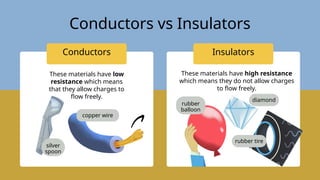
Conductors vs Insulators
These materials have low
resistance which means
that they allow charges to
flow freely.
These materials have high resistance
which means they do not allow charges
to flow freely.
Conductors Insulators
silver
spoon
copper wire
rubber
balloon
rubber tire
diamond
WITH THE HELP OF YOUR TEACHER OR CARER,
test whether your suggestions and drawings will
make the bulb light using actual batteries, a small
lightbulb, and wires.
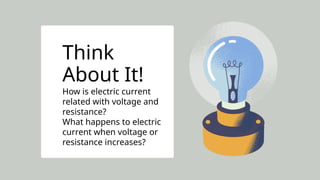
Think
About It!
How is electric current
related with voltage and
resistance?
What happens to electric
current when voltage or
resistance increases?
WITH THE HELP OF YOUR TEACHER OR CARER,
test whether your suggestions and drawings will
make the bulb light using actual batteries, a small
lightbulb, and wires.
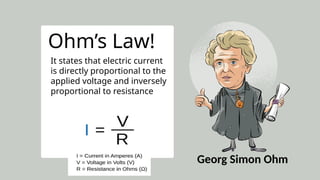
Ohm’s Law!
It states that electric current
is directly proportional to the
applied voltage and inversely
proportional to resistance
Georg Simon Ohm
WITH THE HELP OF YOUR TEACHER OR CARER,
test whether your suggestions and drawings will make
the bulb light using actual batteries, a small lightbulb,
and wires.
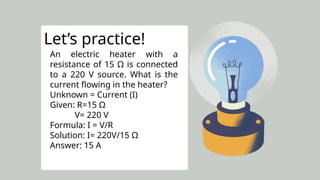
Let’s practice!
An electric heater with a
resistance of 15 Ω is connected
to a 220 V source. What is the
current flowing in the heater?
Unknown = Current (I)
Given: R=15 Ω
V= 220 V
Formula: I = V/R
Solution: I= 220V/15 Ω
Answer: 15 A
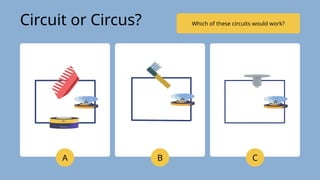
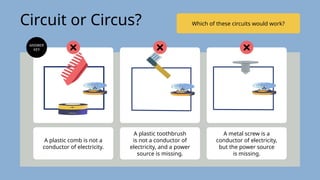
Which of these circuits would work?
A B C
Circuit or Circus?
A plastic comb is not a
conductor of electricity.
A plastic toothbrush
is not a conductor of
electricity, and a power
source is missing.
A metal screw is a
conductor of electricity,
but the power source
is missing.
Which of these circuits would work?
Circuit or Circus?
ANSWER
KEY
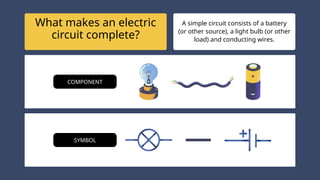
What makes an electric
circuit complete?
A simple circuit consists of a battery
(or other source), a light bulb (or other
load) and conducting wires.
COMPONENT
SYMBOL
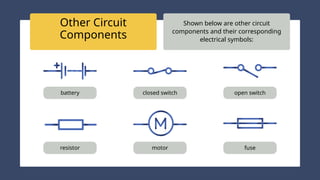
Other Circuit
Components
Shown below are other circuit
components and their corresponding
electrical symbols:
battery closed switch open switch
resistor motor fuse
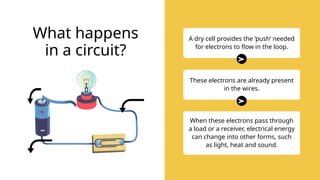
When these electrons pass through
a load or a receiver, electrical energy
can change into other forms, such
as light, heat and sound.
A dry cell provides the ‘push’ needed
for electrons to flow in the loop.
These electrons are already present
in the wires.
What happens
in a circuit?
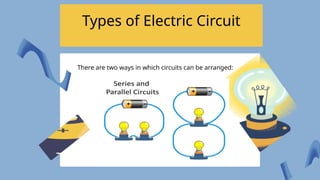
Types of Electric Circuit
There are two ways in which circuits can be arranged:
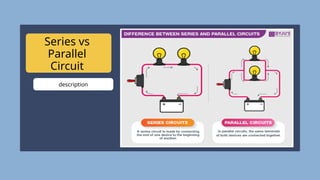
Series vs
Parallel
Circuit
description
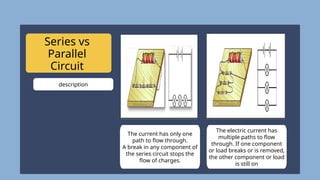
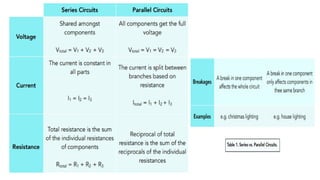
The current has only one
path to flow through.
A break in any component of
the series circuit stops the
flow of charges.
The electric current has
multiple paths to flow
through. If one component
or load breaks or is removed,
the other component or load
is still on
Series vs
Parallel
Circuit
description
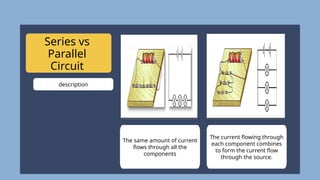
The same amount of current
flows through all the
components
The current flowing through
each component combines
to form the current flow
through the source.
Series vs
Parallel
Circuit
description
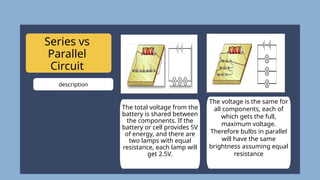
The total voltage from the
battery is shared between
the components. If the
battery or cell provides 5V
of energy, and there are
two lamps with equal
resistance, each lamp will
get 2.5V.
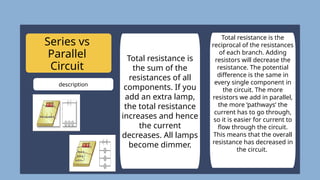
The voltage is the same for
all components, each of
which gets the full,
maximum voltage.
Therefore bulbs in parallel
will have the same
brightness assuming equal
resistance
Series vs
Parallel
Circuit
description
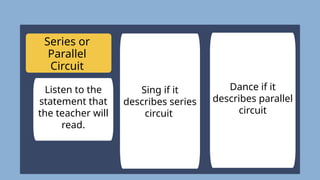
Total resistance is
the sum of the
resistances of all
components. If you
add an extra lamp,
the total resistance
increases and hence
the current
decreases. All lamps
become dimmer.
Total resistance is the
reciprocal of the resistances
of each branch. Adding
resistors will decrease the
resistance. The potential
difference is the same in
every single component in
the circuit. The more
resistors we add in parallel,
the more ‘pathways’ the
current has to go through,
so it is easier for current to
flow through the circuit.
This means that the overall
resistance has decreased in
the circuit.
Series vs
Parallel
Circuit
description
Sing if it
describes series
circuit
Dance if it
describes parallel
circuit
Series or
Parallel
Circuit
Listen to the
statement that
the teacher will
read.
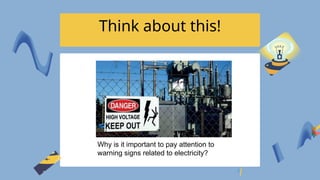
Think about this!
Why is it important to pay attention to
warning signs related to electricity?
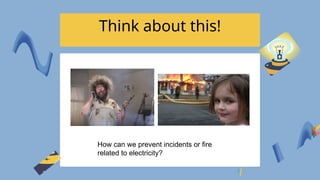
Think about this!
How can we prevent incidents or fire
related to electricity?
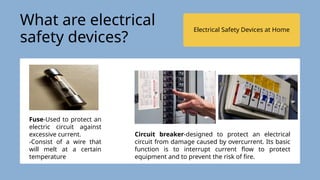
Electrical Safety Devices at Home
Fuse-Used to protect an
electric circuit against
excessive current.
-Consist of a wire that
will melt at a certain
temperature
Circuit breaker-designed to protect an electrical
circuit from damage caused by overcurrent. Its basic
function is to interrupt current flow to protect
equipment and to prevent the risk of fire.
What are electrical
safety devices?
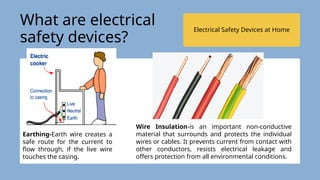
Electrical Safety Devices at Home
Earthing-Earth wire creates a
safe route for the current to
flow through, if the live wire
touches the casing.
Wire Insulation-is an important non-conductive
material that surrounds and protects the individual
wires or cables. It prevents current from contact with
other conductors, resists electrical leakage and
offers protection from all environmental conditions.
What are electrical
safety devices?

Electricity Lessons for Grade 8 Science.pptx

  • 1.
  • 2.
    Today’s Focus • inferrelationship between current and voltage • explain the advantage and disadvantages of series and parallel circuits • explain the functions of circuit breakers, fuses, earthing, double insulation, and other safety devices at home
  • 3.
    Must know! flow of electricity Whatis electric current? moving charges in a circuit rate of flow of charges in a circuit
  • 4.
    What is anelectric circuit? DIRECTION OF ELECTRIC CURRENT It is a complete path through which electric current flows. It is made up of electrical components.
  • 5.
    How does electricityflow? DIRECTION OF ELECTRIC CURRENT The battery in a circuit gives energy to the electrons and pushes them around a circuit, from the negative terminal of the cell, round the circuit and back to the positive terminal of the cell.
  • 6.
    What is voltage? DIRECTIONOF ELECTRIC CURRENT ` The pressure (force) from the electric circuit’s power source (battery) that pushes charged electrons (current) through a conducting loop allowing them to do work such as illuminating a light.
  • 7.
    What is resistance? DIRECTIONOF ELECTRIC CURRENT ` It is a measure of the opposition to current to flow in a electrical circuit.
  • 8.
    Conductors vs Insulators Thesematerials have low resistance which means that they allow charges to flow freely. These materials have high resistance which means they do not allow charges to flow freely. Conductors Insulators silver spoon copper wire rubber balloon rubber tire diamond
  • 9.
    WITH THE HELPOF YOUR TEACHER OR CARER, test whether your suggestions and drawings will make the bulb light using actual batteries, a small lightbulb, and wires. Think About It! How is electric current related with voltage and resistance? What happens to electric current when voltage or resistance increases?
  • 10.
    WITH THE HELPOF YOUR TEACHER OR CARER, test whether your suggestions and drawings will make the bulb light using actual batteries, a small lightbulb, and wires. Ohm’s Law! It states that electric current is directly proportional to the applied voltage and inversely proportional to resistance Georg Simon Ohm
  • 11.
    WITH THE HELPOF YOUR TEACHER OR CARER, test whether your suggestions and drawings will make the bulb light using actual batteries, a small lightbulb, and wires. Let’s practice! An electric heater with a resistance of 15 Ω is connected to a 220 V source. What is the current flowing in the heater? Unknown = Current (I) Given: R=15 Ω V= 220 V Formula: I = V/R Solution: I= 220V/15 Ω Answer: 15 A
  • 12.
    Which of thesecircuits would work? A B C Circuit or Circus?
  • 13.
    A plastic combis not a conductor of electricity. A plastic toothbrush is not a conductor of electricity, and a power source is missing. A metal screw is a conductor of electricity, but the power source is missing. Which of these circuits would work? Circuit or Circus? ANSWER KEY
  • 14.
    What makes anelectric circuit complete? A simple circuit consists of a battery (or other source), a light bulb (or other load) and conducting wires. COMPONENT SYMBOL
  • 15.
    Other Circuit Components Shown beloware other circuit components and their corresponding electrical symbols: battery closed switch open switch resistor motor fuse
  • 16.
    When these electronspass through a load or a receiver, electrical energy can change into other forms, such as light, heat and sound. A dry cell provides the ‘push’ needed for electrons to flow in the loop. These electrons are already present in the wires. What happens in a circuit?
  • 17.
    Types of ElectricCircuit There are two ways in which circuits can be arranged:
  • 18.
  • 19.
    The current hasonly one path to flow through. A break in any component of the series circuit stops the flow of charges. The electric current has multiple paths to flow through. If one component or load breaks or is removed, the other component or load is still on Series vs Parallel Circuit description
  • 20.
    The same amountof current flows through all the components The current flowing through each component combines to form the current flow through the source. Series vs Parallel Circuit description
  • 21.
    The total voltagefrom the battery is shared between the components. If the battery or cell provides 5V of energy, and there are two lamps with equal resistance, each lamp will get 2.5V. The voltage is the same for all components, each of which gets the full, maximum voltage. Therefore bulbs in parallel will have the same brightness assuming equal resistance Series vs Parallel Circuit description
  • 22.
    Total resistance is thesum of the resistances of all components. If you add an extra lamp, the total resistance increases and hence the current decreases. All lamps become dimmer. Total resistance is the reciprocal of the resistances of each branch. Adding resistors will decrease the resistance. The potential difference is the same in every single component in the circuit. The more resistors we add in parallel, the more ‘pathways’ the current has to go through, so it is easier for current to flow through the circuit. This means that the overall resistance has decreased in the circuit. Series vs Parallel Circuit description
  • 23.
    Sing if it describesseries circuit Dance if it describes parallel circuit Series or Parallel Circuit Listen to the statement that the teacher will read.
  • 25.
    Think about this! Whyis it important to pay attention to warning signs related to electricity?
  • 26.
    Think about this! Howcan we prevent incidents or fire related to electricity?
  • 27.
    Electrical Safety Devicesat Home Fuse-Used to protect an electric circuit against excessive current. -Consist of a wire that will melt at a certain temperature Circuit breaker-designed to protect an electrical circuit from damage caused by overcurrent. Its basic function is to interrupt current flow to protect equipment and to prevent the risk of fire. What are electrical safety devices?
  • 28.
    Electrical Safety Devicesat Home Earthing-Earth wire creates a safe route for the current to flow through, if the live wire touches the casing. Wire Insulation-is an important non-conductive material that surrounds and protects the individual wires or cables. It prevents current from contact with other conductors, resists electrical leakage and offers protection from all environmental conditions. What are electrical safety devices?

Editor's Notes

  • #21 Parallel-The current flowing from the source will be divided into the current flowing through each of these components.
  • #22 Series- if the battery or cell provides 5V of energy, and there are two lamps (with equal resistance), each lamp will get 2.5V.
  • #23 Total resistance is the sum of the resistances of all components. Current needs to be the same everywhere, so the higher the resistance of an individual component, the greater its share of the voltage (so that current, which is voltage / resistance, stays equal). Therefore if you add an extra lamp to a series circuit, the total resistance increases and hence the current decreases. All lamps become dimmer.
  • #24 Total resistance is the sum of the resistances of all components. Current needs to be the same everywhere, so the higher the resistance of an individual component, the greater its share of the voltage (so that current, which is voltage / resistance, stays equal). Therefore if you add an extra lamp to a series circuit, the total resistance increases and hence the current decreases. All lamps become dimmer.
  • #28 When the current jumps to unsafe levels, the electromagnet is strong enough to pull down a metal lever connected to the switch linkage. The entire linkage shifts, tilting the moving contact away from the stationary contact to break the circuit. The electricity shuts off.
  • #29 Earthing is used to protect you from an electric shock. It does this by providing a path (a protective conductor) for a fault current to flow to earth. It also causes the protective device (either a circuit-breaker or fuse) to switch off the electric current to the circuit that has the fault. https://www.youtube.com/watch?v=zLW_7TPf310