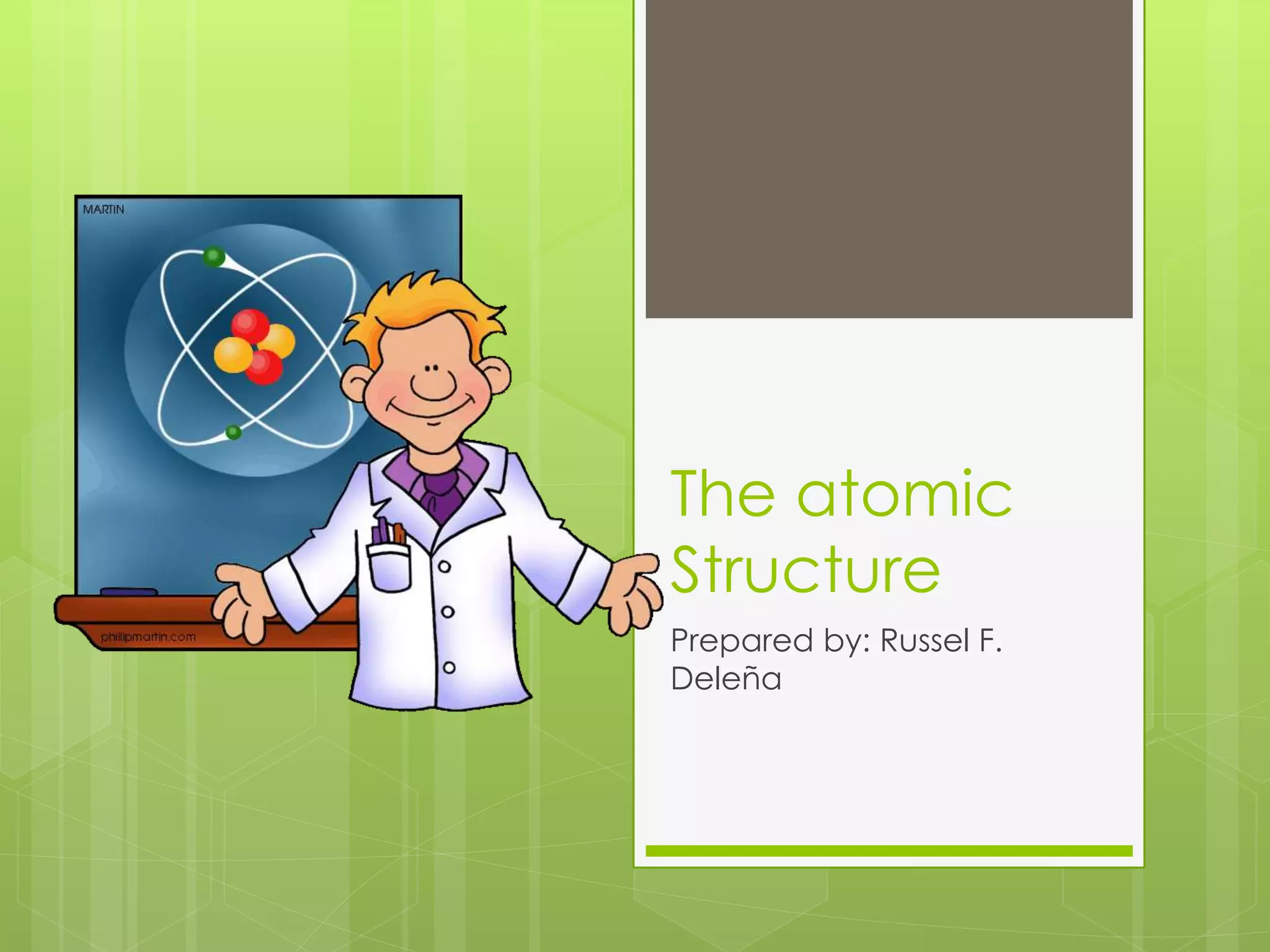
The atomic
Structure
Prepared by: Russel F.
Deleña
The atomic structure
What is a
model?
The atomic structure
SCIENTIFIC MODEL
A scientific model is a concrete
expression of a theoretical concept.
A model uses familiar ideas to explain
unfamiliar facts observed in nature
The atomic structure (model)
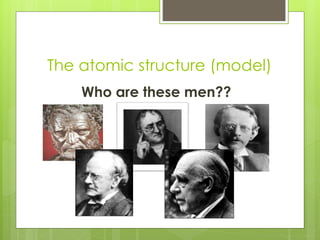
Who are these men??
The atomic structure (models)
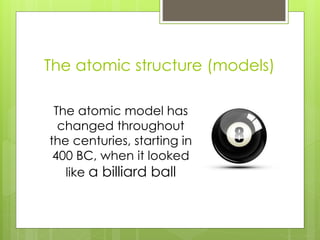
The atomic model has
changed throughout
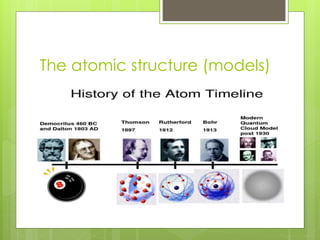
the centuries, starting in
400 BC, when it looked
like a billiard ball
The atomic structure (models)
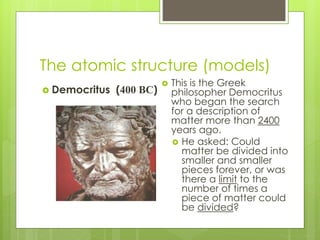
 Democritus (400 BC)
 This is the Greek
philosopher Democritus
who began the search
for a description of
matter more than 2400
years ago.
 He asked: Could
matter be divided into
smaller and smaller
pieces forever, or was
there a limit to the
number of times a
piece of matter could
be divided?
The atomic structure (models)
 His theory: Matter could not be divided
into smaller and smaller pieces forever,
eventually the smallest possible piece
would be obtained.
 This piece would be indivisible.
 He named the smallest piece of
matter “atomos,” meaning “not to be
cut.”
The atomic structure (models)
 To Democritus, atoms were small,
hard particles that were all made of
the same material but were
different shapes and sizes.
 Atoms were infinite in number,
always moving and capable of
joining together.
The atomic structure (models)
This theory was ignored and
forgotten for more than 2,000
years!
 The question is… WHY??
The atomic structure (models)
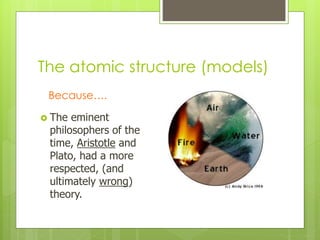
 The eminent
philosophers of the
time, Aristotle and
Plato, had a more
respected, (and
ultimately wrong)
theory.
Because….
The atomic structure (models)
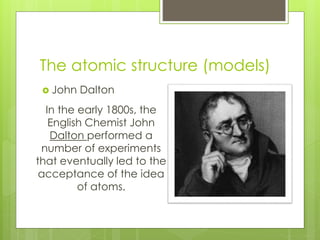
 John Dalton
In the early 1800s, the
English Chemist John
Dalton performed a
number of experiments
that eventually led to the
acceptance of the idea
of atoms.
The atomic structure (models)
 He deduced that all elements are
composed of atoms. Atoms are
indivisible and indestructible particles.
 Atoms of the same element are
exactly alike.
 Atoms of different elements are
different.
 Compounds are formed by the joining
of atoms of two or more elements.
The atomic structure (models)
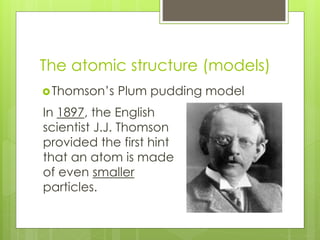
Thomson’s Plum pudding model
In 1897, the English
scientist J.J. Thomson
provided the first hint
that an atom is made
of even smaller
particles.
The atomic structure (models)
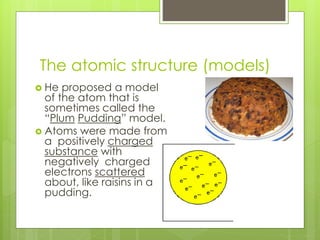
 He proposed a model
of the atom that is
sometimes called the
“Plum Pudding” model.
 Atoms were made from
a positively charged
substance with
negatively charged
electrons scattered
about, like raisins in a
pudding.
The atomic structure (models)
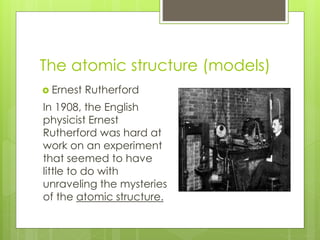
 Ernest Rutherford
In 1908, the English
physicist Ernest
Rutherford was hard at
work on an experiment
that seemed to have
little to do with
unraveling the mysteries
of the atomic structure.
The atomic structure (models)
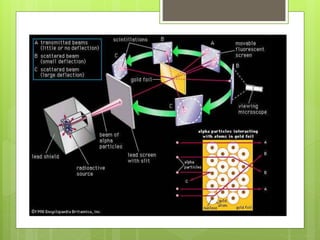
 Rutherford’s experiment Involved firing a
stream of tiny positively charged particles
at a thin sheet of gold foil (2000 atoms
thick)
The atomic structure (models)
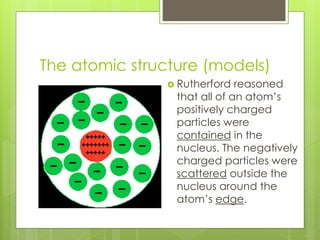
 Rutherford reasoned
that all of an atom’s
positively charged
particles were
contained in the
nucleus. The negatively
charged particles were
scattered outside the
nucleus around the
atom’s edge.
The atomic structure (models)
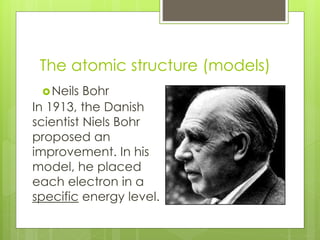
Neils Bohr
In 1913, the Danish
scientist Niels Bohr
proposed an
improvement. In his
model, he placed
each electron in a
specific energy level.
The atomic structure (models)
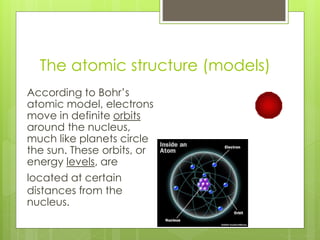
According to Bohr’s
atomic model, electrons
move in definite orbits
around the nucleus,
much like planets circle
the sun. These orbits, or
energy levels, are
located at certain
distances from the
nucleus.
The atomic structure (models)

The atomic structure (models)

  • 1.
  • 2.
  • 3.
    The atomic structure SCIENTIFICMODEL A scientific model is a concrete expression of a theoretical concept. A model uses familiar ideas to explain unfamiliar facts observed in nature
  • 4.
    The atomic structure(model) Who are these men??
  • 5.
    The atomic structure(models) The atomic model has changed throughout the centuries, starting in 400 BC, when it looked like a billiard ball
  • 6.
    The atomic structure(models)  Democritus (400 BC)  This is the Greek philosopher Democritus who began the search for a description of matter more than 2400 years ago.  He asked: Could matter be divided into smaller and smaller pieces forever, or was there a limit to the number of times a piece of matter could be divided?
  • 7.
    The atomic structure(models)  His theory: Matter could not be divided into smaller and smaller pieces forever, eventually the smallest possible piece would be obtained.  This piece would be indivisible.  He named the smallest piece of matter “atomos,” meaning “not to be cut.”
  • 8.
    The atomic structure(models)  To Democritus, atoms were small, hard particles that were all made of the same material but were different shapes and sizes.  Atoms were infinite in number, always moving and capable of joining together.
  • 9.
    The atomic structure(models) This theory was ignored and forgotten for more than 2,000 years!  The question is… WHY??
  • 10.
    The atomic structure(models)  The eminent philosophers of the time, Aristotle and Plato, had a more respected, (and ultimately wrong) theory. Because….
  • 11.
    The atomic structure(models)  John Dalton In the early 1800s, the English Chemist John Dalton performed a number of experiments that eventually led to the acceptance of the idea of atoms.
  • 12.
    The atomic structure(models)  He deduced that all elements are composed of atoms. Atoms are indivisible and indestructible particles.  Atoms of the same element are exactly alike.  Atoms of different elements are different.  Compounds are formed by the joining of atoms of two or more elements.
  • 13.
    The atomic structure(models) Thomson’s Plum pudding model In 1897, the English scientist J.J. Thomson provided the first hint that an atom is made of even smaller particles.
  • 14.
    The atomic structure(models)  He proposed a model of the atom that is sometimes called the “Plum Pudding” model.  Atoms were made from a positively charged substance with negatively charged electrons scattered about, like raisins in a pudding.
  • 15.
    The atomic structure(models)  Ernest Rutherford In 1908, the English physicist Ernest Rutherford was hard at work on an experiment that seemed to have little to do with unraveling the mysteries of the atomic structure.
  • 16.
    The atomic structure(models)  Rutherford’s experiment Involved firing a stream of tiny positively charged particles at a thin sheet of gold foil (2000 atoms thick)
  • 18.
    The atomic structure(models)  Rutherford reasoned that all of an atom’s positively charged particles were contained in the nucleus. The negatively charged particles were scattered outside the nucleus around the atom’s edge.
  • 19.
    The atomic structure(models) Neils Bohr In 1913, the Danish scientist Niels Bohr proposed an improvement. In his model, he placed each electron in a specific energy level.
  • 20.
    The atomic structure(models) According to Bohr’s atomic model, electrons move in definite orbits around the nucleus, much like planets circle the sun. These orbits, or energy levels, are located at certain distances from the nucleus.
  • 21.