CHAPTER 2
ATOMS, MOLECULES, AND IONS
Prof. Dr. Nizam M. El-Ashgar
Chemistry Department, IUG
THE ATOMIC THEORY OF MATTER
Historically:
 Greek Philosophers: matter can be subdivided into
fundamental particles.
 Democritus (460–370 BC) and other early Greek
philosophers described the material world as made up
of tiny indivisible particles they called atomos, meaning
“indivisible or uncuttable.”
 The “atomic” view of matter faded for many centuries.
 The notion of atoms reemerged in Europe during the
seventeenth century.
 That theory came from the work of John Dalton during
the period from 1803 to 1807.
THE ATOMIC THEORY
John Dalton’s 4 Postulates:
1.Each element is composed of extremely small
particles called atoms.
2.All atoms of an element are identical to each
other, but different than atoms of other elements.
3.Atoms of one element cannot be changed into
atoms of different elements by chemical
reactions; atoms are neither created or destroyed
in reactions.
4.Compounds are formed when atoms of different
elements combine in a definite ratio.
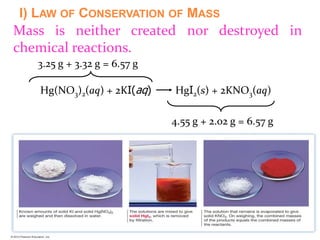
I) LAW OF CONSERVATION OF MASS
HgI2(s) + 2KNO3(aq)
Hg(NO3)2(aq) + 2KI(aq)
4.55 g + 2.02 g = 6.57 g
3.25 g + 3.32 g = 6.57 g
Mass is neither created nor destroyed in
chemical reactions.
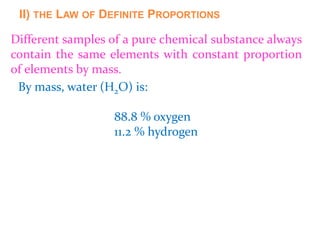
II) THE LAW OF DEFINITE PROPORTIONS
Different samples of a pure chemical substance always
contain the same elements with constant proportion
of elements by mass.
By mass, water (H2O) is:
88.8 % oxygen
11.2 % hydrogen
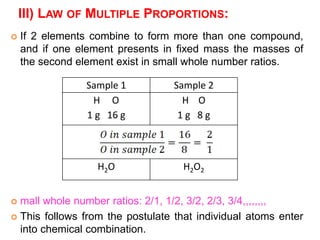
III) LAW OF MULTIPLE PROPORTIONS:
 If 2 elements combine to form more than one compound,
and if one element presents in fixed mass the masses of
the second element exist in small whole number ratios.
 mall whole number ratios: 2/1, 1/2, 3/2, 2/3, 3/4,,,,,,,,
 This follows from the postulate that individual atoms enter
into chemical combination.
Sample 1 Sample 2
H O
1 g 16 g
H O
1 g 8 g
H2O H2O2
7
J. J. Thomson (1898—1903)
 Postulated the existence of electrons using
cathode-ray tubes.
 Determined the charge-to-mass ratio of an
electron.
 The atom must also contain positive particles
that balance exactly the negative charge
carried by particles that we now call electrons.
THE DISCOVERY OF ATOMIC STRUCTURE
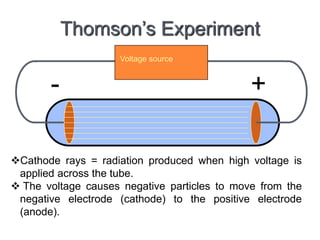
Cathode rays = radiation produced when high voltage is
applied across the tube.
 The voltage causes negative particles to move from the
negative electrode (cathode) to the positive electrode
(anode).
Thomson’s Experiment
Voltage source
+
-
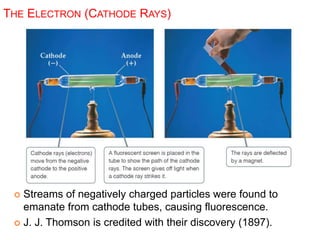
THE ELECTRON (CATHODE RAYS)
 Streams of negatively charged particles were found to
emanate from cathode tubes, causing fluorescence.
 J. J. Thomson is credited with their discovery (1897).
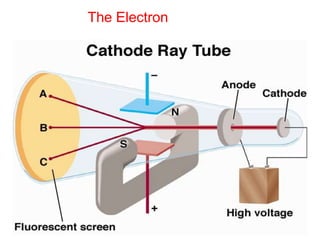
The Electron
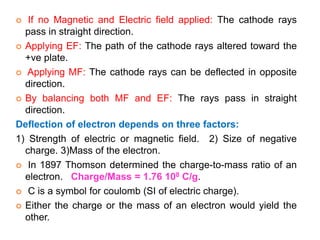
 If no Magnetic and Electric field applied: The cathode rays
pass in straight direction.
 Applying EF: The path of the cathode rays altered toward the
+ve plate.
 Applying MF: The cathode rays can be deflected in opposite
direction.
 By balancing both MF and EF: The rays pass in straight
direction.
Deflection of electron depends on three factors:
1) Strength of electric or magnetic field. 2) Size of negative
charge. 3)Mass of the electron.
 In 1897 Thomson determined the charge-to-mass ratio of an
electron. Charge/Mass = 1.76 108 C/g.
 C is a symbol for coulomb (SI of electric charge).
 Either the charge or the mass of an electron would yield the
other.
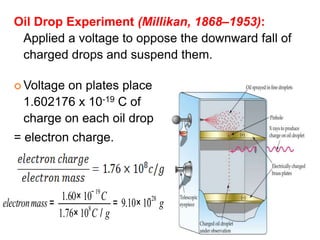
Oil Drop Experiment (Millikan, 1868–1953):
Applied a voltage to oppose the downward fall of
charged drops and suspend them.
 Voltage on plates place
1.602176 x 10⁻¹⁹ C of
charge on each oil drop
= electron charge.
electronmass =
1.60× 10− 19
C
1.76×10⁸
C / g
= 9.10×1028
g
-
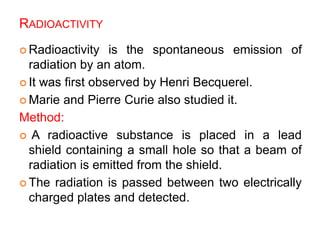
RADIOACTIVITY
 Radioactivity is the spontaneous emission of
radiation by an atom.
 It was first observed by Henri Becquerel.
 Marie and Pierre Curie also studied it.
Method:
 A radioactive substance is placed in a lead
shield containing a small hole so that a beam of
radiation is emitted from the shield.
 The radiation is passed between two electrically
charged plates and detected.
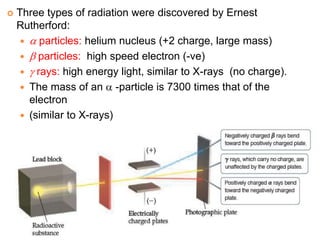
 Three types of radiation were discovered by Ernest
Rutherford:
  particles: helium nucleus (+2 charge, large mass)
  particles: high speed electron (-ve)
  rays: high energy light, similar to X-rays (no charge).
 The mass of an  -particle is 7300 times that of the
electron
 (similar to X-rays)
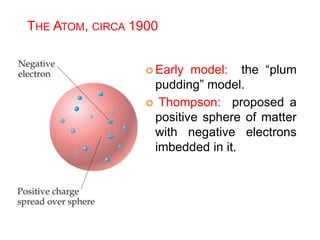
THE ATOM, CIRCA 1900
 Early model: the “plum
pudding” model.
 Thompson: proposed a
positive sphere of matter
with negative electrons
imbedded in it.
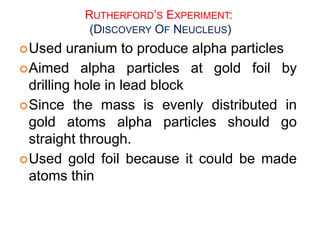
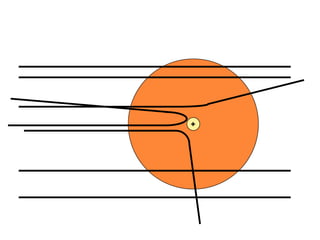
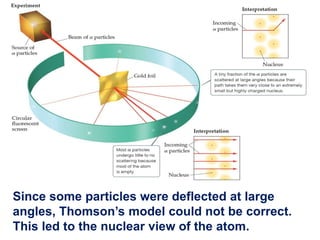
RUTHERFORD’S EXPERIMENT:
(DISCOVERY OF NEUCLEUS)
Used uranium to produce alpha particles
Aimed alpha particles at gold foil by
drilling hole in lead block
Since the mass is evenly distributed in
gold atoms alpha particles should go
straight through.
Used gold foil because it could be made
atoms thin
+
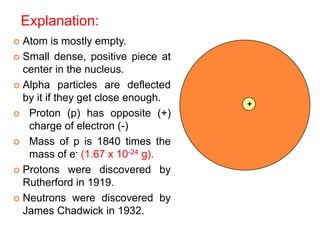
Explanation:
+
 Atom is mostly empty.
 Small dense, positive piece at
center in the nucleus.
 Alpha particles are deflected
by it if they get close enough.
 Proton (p) has opposite (+)
charge of electron (-)
 Mass of p is 1840 times the
mass of e- (1.67 x 10⁻²⁴ g).
 Protons were discovered by
Rutherford in 1919.
 Neutrons were discovered by
James Chadwick in 1932.
Since some particles were deflected at large
angles, Thomson’s model could not be correct.
This led to the nuclear view of the atom.
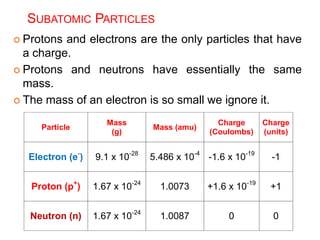
SUBATOMIC PARTICLES
 Protons and electrons are the only particles that have
a charge.
 Protons and neutrons have essentially the same
mass.
 The mass of an electron is so small we ignore it.
Particle
Mass
(g)
Mass (amu)
Charge
(Coulombs)
Charge
(units)
Electron (e-
) 9.1 x 10⁻²⁸
5.486 x 10⁻⁴
-1.6 x 10⁻¹⁹
-1
Proton (p+
) 1.67 x 10⁻²⁴
1.0073 +1.6 x 10⁻¹⁹
+1
Neutron (n) 1.67 x 10⁻²⁴
1.0087 0 0
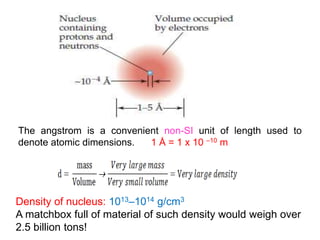
Density of nucleus: 1013–1014 g/cm3
A matchbox full of material of such density would weigh over
2.5 billion tons!
The angstrom is a convenient non-SI unit of length used to
denote atomic dimensions. 1 Å = 1 x 10 –10 m
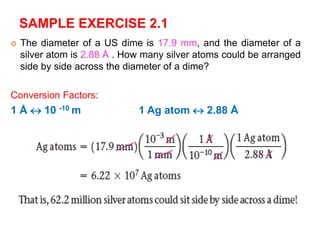
SAMPLE EXERCISE 2.1
 The diameter of a US dime is 17.9 mm, and the diameter of a
silver atom is 2.88 Å . How many silver atoms could be arranged
side by side across the diameter of a dime?
Conversion Factors:
1 Å  10 -10 m 1 Ag atom  2.88 Å
PRACTICE EXERCISE
The diameter of a carbon atom is 1.54 Å. (a) Express this diameter in
picometers. (b) How many carbon atoms could be aligned side by side
in a straight line across the width of a pencil line that is 0.20 mm wide?
Answer: (a) 154 pm, (b) 1.3 ×10⁶C atoms
ATOMIC NUMBERS, MASS NUMBERS AND ISOTOPES
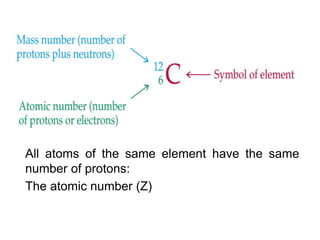
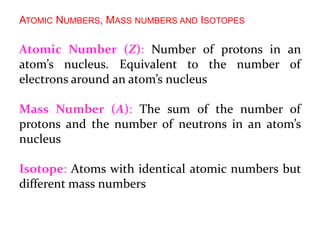
Atomic Number (Z): Number of protons in an
atom’s nucleus. Equivalent to the number of
electrons around an atom’s nucleus
Mass Number (A): The sum of the number of
protons and the number of neutrons in an atom’s
nucleus
Isotope: Atoms with identical atomic numbers but
different mass numbers
All atoms of the same element have the same
number of protons:
The atomic number (Z)
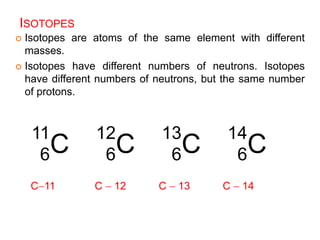
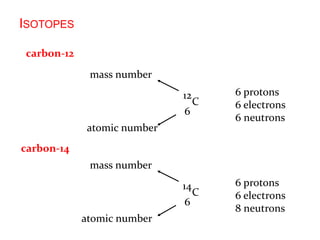
ISOTOPES
 Isotopes are atoms of the same element with different
masses.
 Isotopes have different numbers of neutrons. Isotopes
have different numbers of neutrons, but the same number
of protons.
11
6C
12
6C
13
6C
14
6C
C11 C  12 C  13 C  14
ISOTOPES
carbon-14
C
14
6
atomic number
mass number
carbon-12
C
12
6
atomic number
mass number
6 protons
6 electrons
8 neutrons
6 protons
6 electrons
6 neutrons
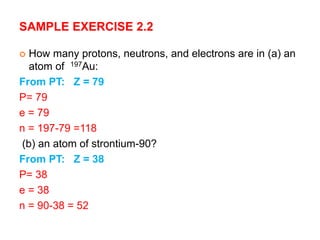
SAMPLE EXERCISE 2.2
 How many protons, neutrons, and electrons are in (a) an
atom of 197Au:
From PT: Z = 79
P= 79
e = 79
n = 197-79 =118
(b) an atom of strontium-90?
From PT: Z = 38
P= 38
e = 38
n = 90-38 = 52
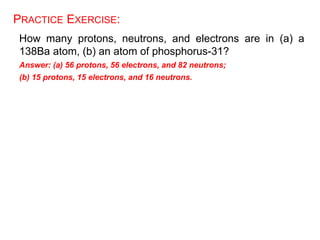
PRACTICE EXERCISE:
How many protons, neutrons, and electrons are in (a) a
138Ba atom, (b) an atom of phosphorus-31?
Answer: (a) 56 protons, 56 electrons, and 82 neutrons;
(b) 15 protons, 15 electrons, and 16 neutrons.
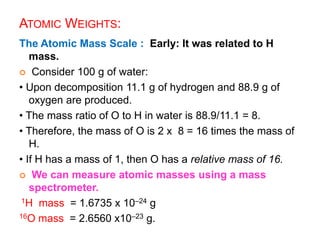
ATOMIC WEIGHTS:
The Atomic Mass Scale : Early: It was related to H
mass.
 Consider 100 g of water:
• Upon decomposition 11.1 g of hydrogen and 88.9 g of
oxygen are produced.
• The mass ratio of O to H in water is 88.9/11.1 = 8.
• Therefore, the mass of O is 2 x 8 = 16 times the mass of
H.
• If H has a mass of 1, then O has a relative mass of 16.
 We can measure atomic masses using a mass
spectrometer.
1H mass = 1.6735 x 10⁻²⁴ g
16O mass = 2.6560 x10⁻²³ g.
 Atomic mass units (amu): are convenient units to use
when dealing with extremely small masses of individual
atoms.
 The amu is 1/12 the mass of one 12C atom.
1 amu = 1.66054 x 10⁻²⁴ g
1 g = 6.02214 x10²³ amu
 By definition, the mass of 12C is exactly 12 amu.
 Now all the present atoms are assigned according to
C-12 isotopes
 A 24Mg atom has a mass approximately twice that of the
12C atom, so its mass is 24 u.
 A 4He atom has a mass approximately 1/3 that of the 12C
atom, so its mass is 4 u.
 1H atom has a mass of 1.0078 amu.
 16O atom has a mass of 15.9949 amu.
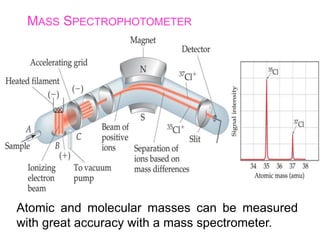
MASS SPECTROPHOTOMETER
Atomic and molecular masses can be measured
with great accuracy with a mass spectrometer.
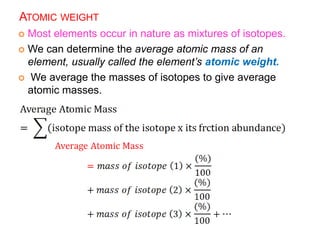
ATOMIC WEIGHT
 Most elements occur in nature as mixtures of isotopes.
 We can determine the average atomic mass of an
element, usually called the element’s atomic weight.
 We average the masses of isotopes to give average
atomic masses.
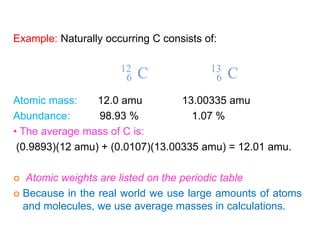
Example: Naturally occurring C consists of:
Atomic mass: 12.0 amu 13.00335 amu
Abundance: 98.93 % 1.07 %
• The average mass of C is:
(0.9893)(12 amu) + (0.0107)(13.00335 amu) = 12.01 amu.
 Atomic weights are listed on the periodic table
 Because in the real world we use large amounts of atoms
and molecules, we use average masses in calculations.
C
12
6 C
13
6
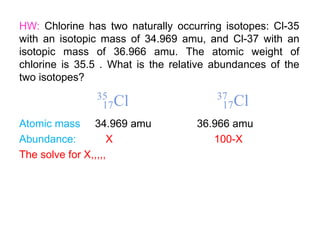
HW: Chlorine has two naturally occurring isotopes: Cl-35
with an isotopic mass of 34.969 amu, and Cl-37 with an
isotopic mass of 36.966 amu. The atomic weight of
chlorine is 35.5 . What is the relative abundances of the
two isotopes?
Atomic mass 34.969 amu 36.966 amu
Abundance: X 100-X
The solve for X,,,,,
Cl
37
17
Cl
35
17
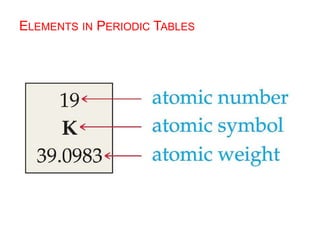
ELEMENTS IN PERIODIC TABLES
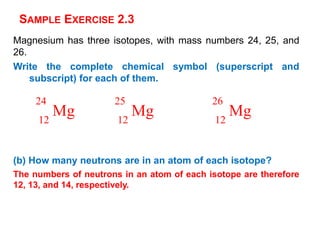
SAMPLE EXERCISE 2.3
Magnesium has three isotopes, with mass numbers 24, 25, and
26.
Write the complete chemical symbol (superscript and
subscript) for each of them.
(b) How many neutrons are in an atom of each isotope?
The numbers of neutrons in an atom of each isotope are therefore
12, 13, and 14, respectively.
Mg
24
12
Mg
25
12
Mg
26
12
PRACTICE EXERCISE
Give the complete chemical symbol for the atom that
contains 82 protons, 82 electrons, and 126 neutrons.
PRACTICE EXERCISE
Three isotopes of silicon occur in nature: 28Si (92.23%), which has an
atomic mass of 27.97693 amu; 29Si (4.68%), which has an atomic mass
of 28.97649 amu; and 30Si (3.09%), which has an atomic mass of
29.97377 amu. Calculate the atomic weight of silicon.
Answer: 28.09 amu
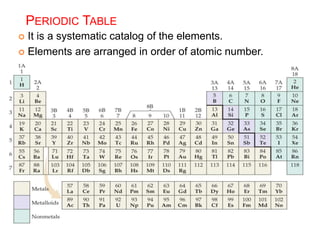
PERIODIC TABLE
 It is a systematic catalog of the elements.
 Elements are arranged in order of atomic number.
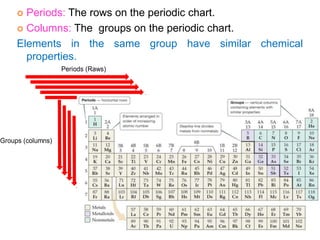
 Periods: The rows on the periodic chart.
 Columns: The groups on the periodic chart.
Elements in the same group have similar chemical
properties.
Periods (Raws)
Groups (columns)
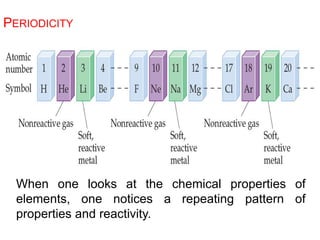
PERIODICITY
When one looks at the chemical properties of
elements, one notices a repeating pattern of
properties and reactivity.
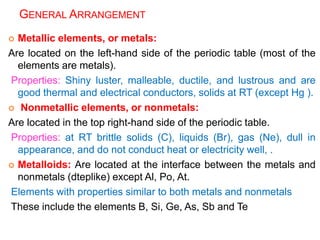
GENERAL ARRANGEMENT
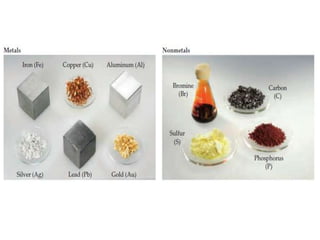
 Metallic elements, or metals:
Are located on the left-hand side of the periodic table (most of the
elements are metals).
Properties: Shiny luster, malleable, ductile, and lustrous and are
good thermal and electrical conductors, solids at RT (except Hg ).
 Nonmetallic elements, or nonmetals:
Are located in the top right-hand side of the periodic table.
Properties: at RT brittle solids (C), liquids (Br), gas (Ne), dull in
appearance, and do not conduct heat or electricity well, .
 Metalloids: Are located at the interface between the metals and
nonmetals (dteplike) except Al, Po, At.
Elements with properties similar to both metals and nonmetals
These include the elements B, Si, Ge, As, Sb and Te
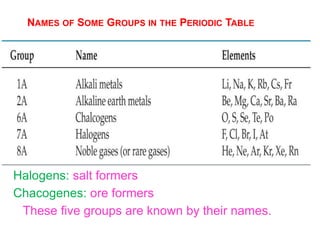
NAMES OF SOME GROUPS IN THE PERIODIC TABLE
Halogens: salt formers
Chacogenes: ore formers
These five groups are known by their names.
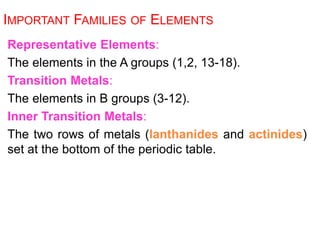
Representative Elements:
The elements in the A groups (1,2, 13-18).
Transition Metals:
The elements in B groups (3-12).
Inner Transition Metals:
The two rows of metals (lanthanides and actinides)
set at the bottom of the periodic table.
IMPORTANT FAMILIES OF ELEMENTS
SAMPLE EXERCISE 2.5
Which two of the following elements would you expect to
show the greatest similarity in chemical and physical
properties: B, Ca, F, He, Mg, P?
Solution:
Ca and Mg should be most alike because they are in the
same group (2A, the alkaline earth metals).
PRACTICE EXERCISE
Locate Na (sodium) and Br (bromine) on the periodic table. Give the
atomic number of each, and label each a metal, metalloid, or nonmetal.
2.6 MOLECULES AND MOLECULAR COMPOUNDS
 Only Nobel gases are found in nature as isolated atoms.
 Most matter is composed of molecules or ions.
 A molecule: consists of two or more atoms bound tightly
together.
Types:
1) Molecular Elements: Same two or more atoms combined with
each others.
 Diatomic molecules: made up of two same kind of atoms.
Examples: N2, O2, F2, Cl2 , , Br2, I2
 Polyatomic molecules: made up of more than two atoms of
same atoms.
Examples: S8, P4, O3
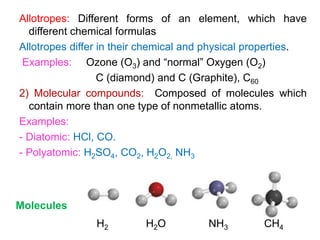
Allotropes: Different forms of an element, which have
different chemical formulas
Allotropes differ in their chemical and physical properties.
Examples: Ozone (O3) and “normal” Oxygen (O2)
C (diamond) and C (Graphite), C60
2) Molecular compounds: Composed of molecules which
contain more than one type of nonmetallic atoms.
Examples:
- Diatomic: HCl, CO.
- Polyatomic: H2SO4, CO2, H2O2, NH3
H2 H2O NH3 CH4
Molecules
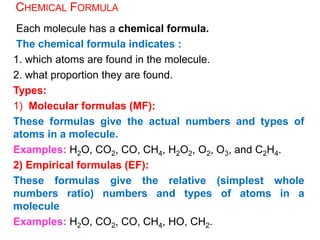
CHEMICAL FORMULA
Each molecule has a chemical formula.
The chemical formula indicates :
1. which atoms are found in the molecule.
2. what proportion they are found.
Types:
1) Molecular formulas (MF):
These formulas give the actual numbers and types of
atoms in a molecule.
Examples: H2O, CO2, CO, CH4, H2O2, O2, O3, and C2H4.
2) Empirical formulas (EF):
These formulas give the relative (simplest whole
numbers ratio) numbers and types of atoms in a
molecule
Examples: H2O, CO2, CO, CH4, HO, CH2.
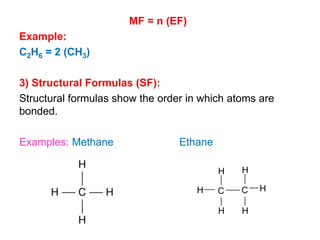
MF = n (EF)
Example:
C2H6 = 2 (CH3)
3) Structural Formulas (SF):
Structural formulas show the order in which atoms are
bonded.
Examples: Methane Ethane
H
H
H H
H
H
C C
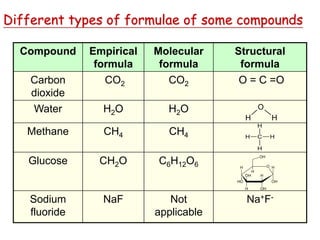
Compound Empirical
formula
Molecular
formula
Structural
formula
Carbon
dioxide
CO2 CO2 O = C =O
Water H2O H2O
Methane CH4 CH4
Glucose CH2O C6H12O6
Sodium
fluoride
NaF Not
applicable
Na+F-
Different types of formulae of some compounds
O
H H
C
H
H
H
H
O
OH
H
H
H
O
H
OH
H OH
H
OH
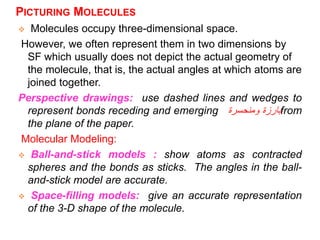
PICTURING MOLECULES
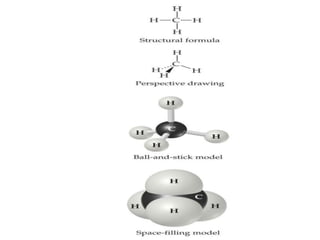
 Molecules occupy three-dimensional space.
However, we often represent them in two dimensions by
SF which usually does not depict the actual geometry of
the molecule, that is, the actual angles at which atoms are
joined together.
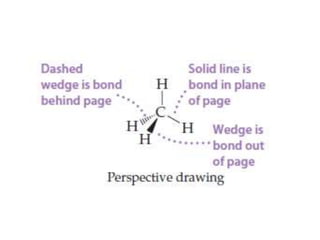
Perspective drawings: use dashed lines and wedges to
represent bonds receding and emerging ‫بارزة‬
‫ومنحسرة‬ from
the plane of the paper.
Molecular Modeling:
 Ball-and-stick models : show atoms as contracted
spheres and the bonds as sticks. The angles in the ball-
and-stick model are accurate.
 Space-filling models: give an accurate representation
of the 3-D shape of the molecule.
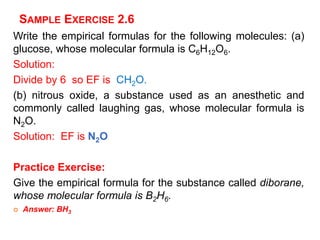
SAMPLE EXERCISE 2.6
Write the empirical formulas for the following molecules: (a)
glucose, whose molecular formula is C6H12O6.
Solution:
Divide by 6 so EF is CH2O.
(b) nitrous oxide, a substance used as an anesthetic and
commonly called laughing gas, whose molecular formula is
N2O.
Solution: EF is N2O
Practice Exercise:
Give the empirical formula for the substance called diborane,
whose molecular formula is B2H6.
 Answer: BH3
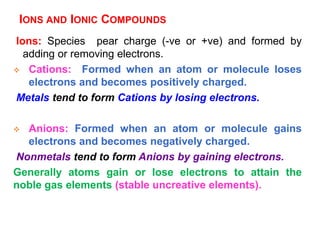
IONS AND IONIC COMPOUNDS
Ions: Species pear charge (-ve or +ve) and formed by
adding or removing electrons.
 Cations: Formed when an atom or molecule loses
electrons and becomes positively charged.
Metals tend to form Cations by losing electrons.
 Anions: Formed when an atom or molecule gains
electrons and becomes negatively charged.
Nonmetals tend to form Anions by gaining electrons.
Generally atoms gain or lose electrons to attain the
noble gas elements (stable uncreative elements).
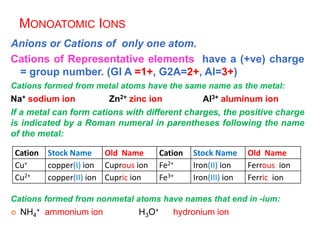
MONOATOMIC IONS
Anions or Cations of only one atom.
Cations of Representative elements have a (+ve) charge
= group number. (GI A =1+, G2A=2+, Al=3+)
Cations formed from metal atoms have the same name as the metal:
Na+ sodium ion Zn2+ zinc ion Al3+ aluminum ion
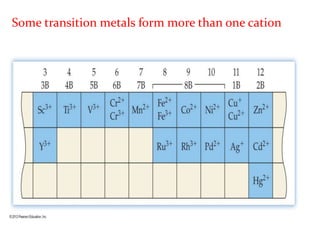
If a metal can form cations with different charges, the positive charge
is indicated by a Roman numeral in parentheses following the name
of the metal:
Cations formed from nonmetal atoms have names that end in -ium:
 NH4
+ ammonium ion H3O+ hydronium ion
Old Name
Stock Name
Cation
Old Name
Stock Name
Cation
Ferrous ion
Iron(II) ion
Fe2+
Cuprous ion
copper(I) ion
Cu+
Ferric ion
Iron(III) ion
Fe3+
Cupric ion
copper(II) ion
Cu2+
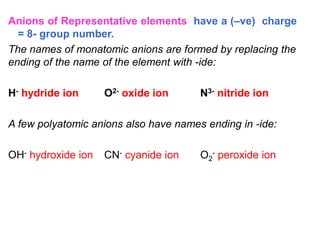
Anions of Representative elements have a (–ve) charge
= 8- group number.
The names of monatomic anions are formed by replacing the
ending of the name of the element with -ide:
H- hydride ion O2- oxide ion N3- nitride ion
A few polyatomic anions also have names ending in -ide:
OH- hydroxide ion CN- cyanide ion O2
- peroxide ion
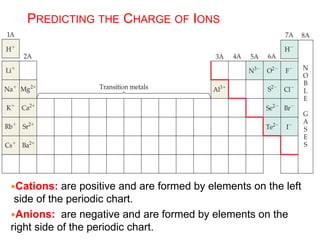
PREDICTING THE CHARGE OF IONS
Cations: are positive and are formed by elements on the left
side of the periodic chart.
Anions: are negative and are formed by elements on the
right side of the periodic chart.
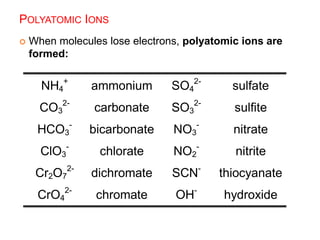
POLYATOMIC IONS
 When molecules lose electrons, polyatomic ions are
formed:
NH4
+
ammonium SO4
2-
sulfate
CO3
2-
carbonate SO3
2-
sulfite
HCO3
-
bicarbonate NO3
-
nitrate
ClO3
-
chlorate NO2
-
nitrite
Cr2O7
2-
dichromate SCN-
thiocyanate
CrO4
2-
chromate OH-
hydroxide
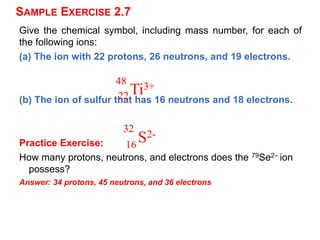
SAMPLE EXERCISE 2.7
Give the chemical symbol, including mass number, for each of
the following ions:
(a) The ion with 22 protons, 26 neutrons, and 19 electrons.
(b) The ion of sulfur that has 16 neutrons and 18 electrons.
Practice Exercise:
How many protons, neutrons, and electrons does the 79Se2– ion
possess?
Answer: 34 protons, 45 neutrons, and 36 electrons
Ti3+
48
22
S2-
32
16
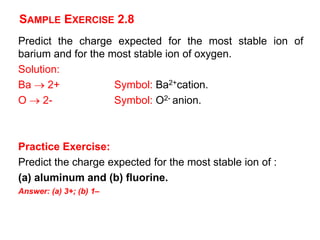
SAMPLE EXERCISE 2.8
Predict the charge expected for the most stable ion of
barium and for the most stable ion of oxygen.
Solution:
Ba  2+ Symbol: Ba2+cation.
O  2- Symbol: O2- anion.
Practice Exercise:
Predict the charge expected for the most stable ion of :
(a) aluminum and (b) fluorine.
Answer: (a) 3+; (b) 1–
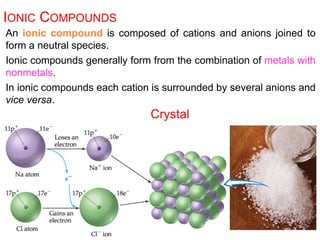
An ionic compound is composed of cations and anions joined to
form a neutral species.
Ionic compounds generally form from the combination of metals with
nonmetals.
In ionic compounds each cation is surrounded by several anions and
vice versa.
IONIC COMPOUNDS
Crystal
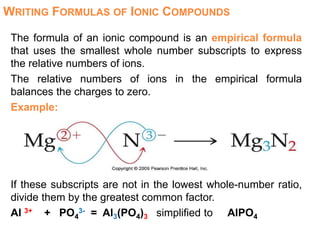
The formula of an ionic compound is an empirical formula
that uses the smallest whole number subscripts to express
the relative numbers of ions.
The relative numbers of ions in the empirical formula
balances the charges to zero.
Example:
If these subscripts are not in the lowest whole-number ratio,
divide them by the greatest common factor.
Al 3+ + PO4
3- = Al3(PO4)3 simplified to AlPO4
WRITING FORMULAS OF IONIC COMPOUNDS
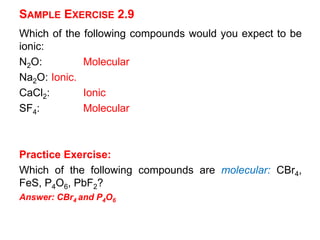
SAMPLE EXERCISE 2.9
Which of the following compounds would you expect to be
ionic:
N2O: Molecular
Na2O: Ionic.
CaCl2: Ionic
SF4: Molecular
Practice Exercise:
Which of the following compounds are molecular: CBr4,
FeS, P4O6, PbF2?
Answer: CBr4 and P4O6
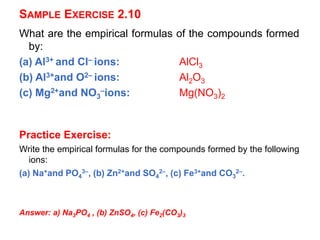
SAMPLE EXERCISE 2.10
What are the empirical formulas of the compounds formed
by:
(a) Al3+ and Cl– ions: AlCl3
(b) Al3+and O2– ions: Al2O3
(c) Mg2+and NO3
–ions: Mg(NO3)2
Practice Exercise:
Write the empirical formulas for the compounds formed by the following
ions:
(a) Na+and PO4
3–, (b) Zn2+and SO4
2–, (c) Fe3+and CO3
2–.
Answer: a) Na3PO4 , (b) ZnSO4, (c) Fe2(CO3)3
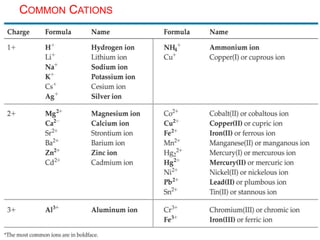
COMMON CATIONS
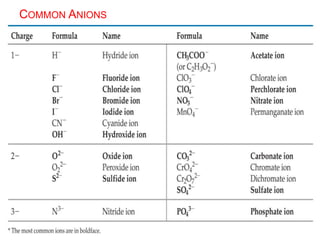
COMMON ANIONS
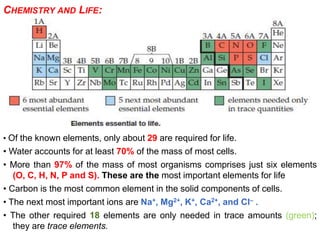
CHEMISTRY AND LIFE:
• Of the known elements, only about 29 are required for life.
• Water accounts for at least 70% of the mass of most cells.
• More than 97% of the mass of most organisms comprises just six elements
(O, C, H, N, P and S). These are the most important elements for life
• Carbon is the most common element in the solid components of cells.
• The next most important ions are Na+, Mg2+, K+, Ca2+, and Cl– .
• The other required 18 elements are only needed in trace amounts (green);
they are trace elements.
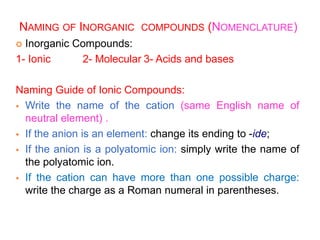
NAMING OF INORGANIC COMPOUNDS (NOMENCLATURE)
 Inorganic Compounds:
1- Ionic 2- Molecular 3- Acids and bases
Naming Guide of Ionic Compounds:
 Write the name of the cation (same English name of
neutral element) .
 If the anion is an element: change its ending to -ide;
 If the anion is a polyatomic ion: simply write the name of
the polyatomic ion.
 If the cation can have more than one possible charge:
write the charge as a Roman numeral in parentheses.
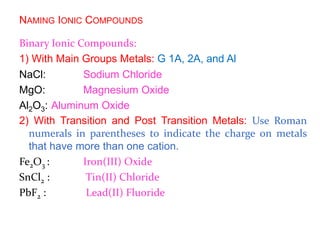
NAMING IONIC COMPOUNDS
Binary Ionic Compounds:
1) With Main Groups Metals: G 1A, 2A, and Al
NaCl: Sodium Chloride
MgO: Magnesium Oxide
Al2O3: Aluminum Oxide
2) With Transition and Post Transition Metals: Use Roman
numerals in parentheses to indicate the charge on metals
that have more than one cation.
Fe2O3 : Iron(III) Oxide
SnCl2 : Tin(II) Chloride
PbF2 : Lead(II) Fluoride
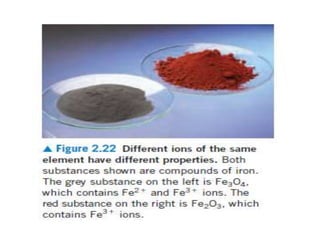
Some transition metals form more than one cation
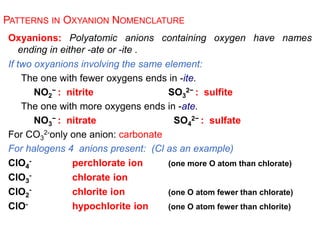
PATTERNS IN OXYANION NOMENCLATURE
Oxyanions: Polyatomic anions containing oxygen have names
ending in either -ate or -ite .
If two oxyanions involving the same element:
The one with fewer oxygens ends in -ite.
NO2
− : nitrite SO3
2− : sulfite
The one with more oxygens ends in -ate.
NO3
− : nitrate SO4
2− : sulfate
For CO3
2-only one anion: carbonate
For halogens 4 anions present: (Cl as an example)
ClO4
- perchlorate ion (one more O atom than chlorate)
ClO3
- chlorate ion
ClO2
- chlorite ion (one O atom fewer than chlorate)
ClO- hypochlorite ion (one O atom fewer than chlorite)
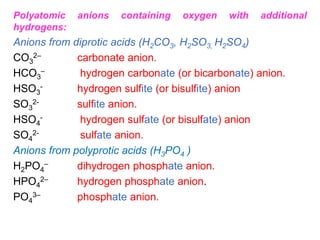
Polyatomic anions containing oxygen with additional
hydrogens:
Anions from diprotic acids (H2CO3, H2SO3, H2SO4)
CO3
2– carbonate anion.
HCO3
– hydrogen carbonate (or bicarbonate) anion.
HSO3
- hydrogen sulfite (or bisulfite) anion
SO3
2- sulfite anion.
HSO4
- hydrogen sulfate (or bisulfate) anion
SO4
2- sulfate anion.
Anions from polyprotic acids (H3PO4 )
H2PO4
– dihydrogen phosphate anion.
HPO4
2– hydrogen phosphate anion.
PO4
3– phosphate anion.
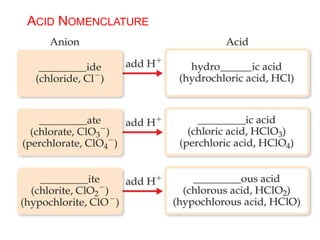
ACID NOMENCLATURE
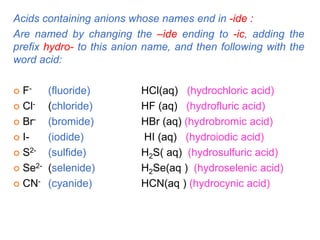
Acids containing anions whose names end in -ide :
Are named by changing the –ide ending to -ic, adding the
prefix hydro- to this anion name, and then following with the
word acid:
 F- (fluoride) HCl(aq) (hydrochloric acid)
 Cl- (chloride) HF (aq) (hydrofluric acid)
 Br- (bromide) HBr (aq) (hydrobromic acid)
 I- (iodide) HI (aq) (hydroiodic acid)
 S2- (sulfide) H2S( aq) (hydrosulfuric acid)
 Se2- (selenide) H2Se(aq ) (hydroselenic acid)
 CN- (cyanide) HCN(aq ) (hydrocynic acid)
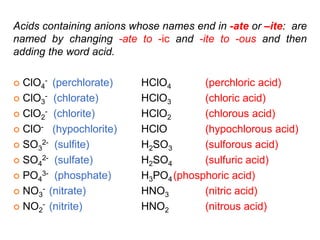
Acids containing anions whose names end in -ate or –ite: are
named by changing -ate to -ic and -ite to -ous and then
adding the word acid.
 ClO4
- (perchlorate) HClO4 (perchloric acid)
 ClO3
- (chlorate) HClO3 (chloric acid)
 ClO2
- (chlorite) HClO2 (chlorous acid)
 ClO- (hypochlorite) HClO (hypochlorous acid)
 SO3
2- (sulfite) H2SO3 (sulforous acid)
 SO4
2- (sulfate) H2SO4 (sulfuric acid)
 PO4
3- (phosphate) H3PO4(phosphoric acid)
 NO3
- (nitrate) HNO3 (nitric acid)
 NO2
- (nitrite) HNO2 (nitrous acid)
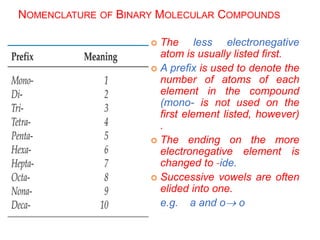
NOMENCLATURE OF BINARY MOLECULAR COMPOUNDS
 The less electronegative
atom is usually listed first.
 A prefix is used to denote the
number of atoms of each
element in the compound
(mono- is not used on the
first element listed, however)
.
 The ending on the more
electronegative element is
changed to -ide.
 Successive vowels are often
elided into one.
e.g. a and o o
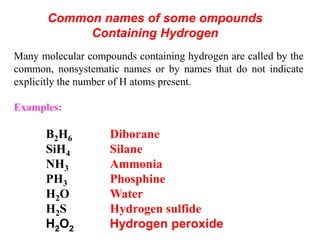
Many molecular compounds containing hydrogen are called by the
common, nonsystematic names or by names that do not indicate
explicitly the number of H atoms present.
Examples:
B2H6 Diborane
SiH4 Silane
NH3 Ammonia
PH3 Phosphine
H2O Water
H2S Hydrogen sulfide
H2O2 Hydrogen peroxide
Common names of some ompounds
Containing Hydrogen
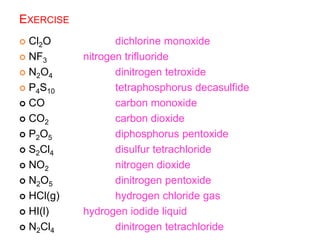
EXERCISE
 Cl2O dichlorine monoxide
 NF3 nitrogen trifluoride
 N2O4 dinitrogen tetroxide
 P4S10 tetraphosphorus decasulfide
 CO carbon monoxide
 CO2 carbon dioxide
 P2O5 diphosphorus pentoxide
 S2Cl4 disulfur tetrachloride
 NO2 nitrogen dioxide
 N2O5 dinitrogen pentoxide
 HCl(g) hydrogen chloride gas
 HI(l) hydrogen iodide liquid
 N2Cl4 dinitrogen tetrachloride
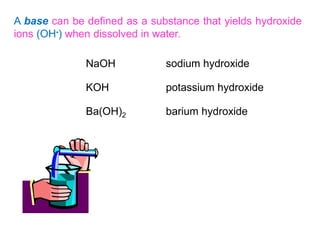
A base can be defined as a substance that yields hydroxide
ions (OH-) when dissolved in water.
NaOH sodium hydroxide
KOH potassium hydroxide
Ba(OH)2 barium hydroxide
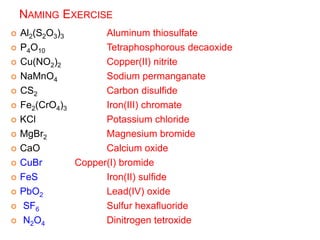
NAMING EXERCISE
 Al2(S2O3)3 Aluminum thiosulfate
 P4O10 Tetraphosphorous decaoxide
 Cu(NO2)2 Copper(II) nitrite
 NaMnO4 Sodium permanganate
 CS2 Carbon disulfide
 Fe2(CrO4)3 Iron(III) chromate
 KCl Potassium chloride
 MgBr2 Magnesium bromide
 CaO Calcium oxide
 CuBr Copper(I) bromide
 FeS Iron(II) sulfide
 PbO2 Lead(IV) oxide
 SF6 Sulfur hexafluoride
 N2O4 Dinitrogen tetroxide
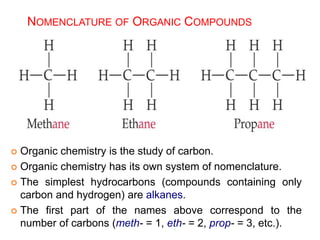
NOMENCLATURE OF ORGANIC COMPOUNDS
 Organic chemistry is the study of carbon.
 Organic chemistry has its own system of nomenclature.
 The simplest hydrocarbons (compounds containing only
carbon and hydrogen) are alkanes.
 The first part of the names above correspond to the
number of carbons (meth- = 1, eth- = 2, prop- = 3, etc.).
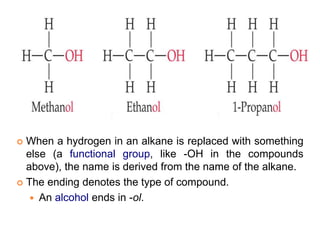
 When a hydrogen in an alkane is replaced with something
else (a functional group, like -OH in the compounds
above), the name is derived from the name of the alkane.
 The ending denotes the type of compound.
 An alcohol ends in -ol.
HOME WORK
1, 3, 4,6, 10, 14, 19, 21, 24, 28, 33, 34, 37, 40, 44, 48, 53, 55,
59, 62, 67, 72, 75, 78, 84, 88, 94, 98, 105
‫وعبرة‬ ‫قصة‬
‫ر‬
‫جل‬
‫فقير‬
‫زوجته‬
‫تصنع‬
‫الزبدة‬
‫و‬
‫هو‬
‫يبيعها‬
‫في‬
‫المدينة‬
‫الحد‬
‫البق‬
‫االت‬
‫وكانت‬
‫الزوجة‬
‫تعمل‬
‫الزبدة‬
‫على‬
‫شكل‬
‫كرة‬
‫وزنها‬
‫كيلو‬
‫وهو‬
‫يبيعها‬
‫لصاحب‬
‫ا‬
‫لبقالة‬
‫ويشتري‬
‫بثمنها‬
‫حاجات‬
‫البيت‬
.
‫وفي‬
‫أحد‬
‫االيام‬
‫شك‬
‫صاحب‬
‫المحل‬
‫بالوزن‬
‫فقام‬
‫ووزن‬
‫كل‬
‫كرة‬
‫من‬
‫كرات‬
‫الزبده‬
‫فوجدها‬
٩٠٠
‫جرام‬
‫فغضب‬
‫من‬
‫الفقير‬
.
‫وعندما‬
‫حضر‬
‫الفقير‬
‫في‬
‫اليوم‬
‫الثاني‬
‫قابله‬
‫بغضب‬
‫وقال‬
‫له‬
‫لن‬
‫اش‬
‫تري‬
‫منك‬
‫يا‬
‫غشاش‬
‫تبيعني‬
‫الزبدة‬
‫على‬
‫انها‬
‫كيلو‬
‫ولكنها‬
‫أقل‬
‫من‬
‫الكيلو‬
‫بمائة‬
‫ج‬
‫رام‬
‫حينها‬
‫حزن‬
‫الفقير‬
‫ونكس‬
‫رأسه‬
‫ثم‬
‫قال‬
‫نحن‬
‫يا‬
‫سيدي‬
‫ال‬
‫نملك‬
‫ميزان‬
‫ولكني‬
‫اشتريت‬
‫منك‬
‫كيلو‬
‫من‬
‫السكر‬
‫وجعلته‬
‫لي‬
‫مثقال‬
‫كي‬
‫ازن‬
‫به‬
‫الزبدة‬
‫تيقن‬
‫تماما‬
‫أن‬
‫مكيالك‬
‫يكال‬
‫لك‬
‫به‬

Chapter-2-Prof-N.M.pptx

  • 1.
    CHAPTER 2 ATOMS, MOLECULES,AND IONS Prof. Dr. Nizam M. El-Ashgar Chemistry Department, IUG
  • 2.
    THE ATOMIC THEORYOF MATTER Historically:  Greek Philosophers: matter can be subdivided into fundamental particles.  Democritus (460–370 BC) and other early Greek philosophers described the material world as made up of tiny indivisible particles they called atomos, meaning “indivisible or uncuttable.”  The “atomic” view of matter faded for many centuries.  The notion of atoms reemerged in Europe during the seventeenth century.  That theory came from the work of John Dalton during the period from 1803 to 1807.
  • 3.
    THE ATOMIC THEORY JohnDalton’s 4 Postulates: 1.Each element is composed of extremely small particles called atoms. 2.All atoms of an element are identical to each other, but different than atoms of other elements. 3.Atoms of one element cannot be changed into atoms of different elements by chemical reactions; atoms are neither created or destroyed in reactions. 4.Compounds are formed when atoms of different elements combine in a definite ratio.
  • 4.
    I) LAW OFCONSERVATION OF MASS HgI2(s) + 2KNO3(aq) Hg(NO3)2(aq) + 2KI(aq) 4.55 g + 2.02 g = 6.57 g 3.25 g + 3.32 g = 6.57 g Mass is neither created nor destroyed in chemical reactions.
  • 5.
    II) THE LAWOF DEFINITE PROPORTIONS Different samples of a pure chemical substance always contain the same elements with constant proportion of elements by mass. By mass, water (H2O) is: 88.8 % oxygen 11.2 % hydrogen
  • 6.
    III) LAW OFMULTIPLE PROPORTIONS:  If 2 elements combine to form more than one compound, and if one element presents in fixed mass the masses of the second element exist in small whole number ratios.  mall whole number ratios: 2/1, 1/2, 3/2, 2/3, 3/4,,,,,,,,  This follows from the postulate that individual atoms enter into chemical combination. Sample 1 Sample 2 H O 1 g 16 g H O 1 g 8 g H2O H2O2
  • 7.
    7 J. J. Thomson(1898—1903)  Postulated the existence of electrons using cathode-ray tubes.  Determined the charge-to-mass ratio of an electron.  The atom must also contain positive particles that balance exactly the negative charge carried by particles that we now call electrons. THE DISCOVERY OF ATOMIC STRUCTURE
  • 8.
    Cathode rays =radiation produced when high voltage is applied across the tube.  The voltage causes negative particles to move from the negative electrode (cathode) to the positive electrode (anode). Thomson’s Experiment Voltage source + -
  • 9.
    THE ELECTRON (CATHODERAYS)  Streams of negatively charged particles were found to emanate from cathode tubes, causing fluorescence.  J. J. Thomson is credited with their discovery (1897).
  • 10.
  • 11.
     If noMagnetic and Electric field applied: The cathode rays pass in straight direction.  Applying EF: The path of the cathode rays altered toward the +ve plate.  Applying MF: The cathode rays can be deflected in opposite direction.  By balancing both MF and EF: The rays pass in straight direction. Deflection of electron depends on three factors: 1) Strength of electric or magnetic field. 2) Size of negative charge. 3)Mass of the electron.  In 1897 Thomson determined the charge-to-mass ratio of an electron. Charge/Mass = 1.76 108 C/g.  C is a symbol for coulomb (SI of electric charge).  Either the charge or the mass of an electron would yield the other.
  • 12.
    Oil Drop Experiment(Millikan, 1868–1953): Applied a voltage to oppose the downward fall of charged drops and suspend them.  Voltage on plates place 1.602176 x 10⁻¹⁹ C of charge on each oil drop = electron charge. electronmass = 1.60× 10− 19 C 1.76×10⁸ C / g = 9.10×1028 g -
  • 13.
    RADIOACTIVITY  Radioactivity isthe spontaneous emission of radiation by an atom.  It was first observed by Henri Becquerel.  Marie and Pierre Curie also studied it. Method:  A radioactive substance is placed in a lead shield containing a small hole so that a beam of radiation is emitted from the shield.  The radiation is passed between two electrically charged plates and detected.
  • 14.
     Three typesof radiation were discovered by Ernest Rutherford:   particles: helium nucleus (+2 charge, large mass)   particles: high speed electron (-ve)   rays: high energy light, similar to X-rays (no charge).  The mass of an  -particle is 7300 times that of the electron  (similar to X-rays)
  • 15.
    THE ATOM, CIRCA1900  Early model: the “plum pudding” model.  Thompson: proposed a positive sphere of matter with negative electrons imbedded in it.
  • 16.
    RUTHERFORD’S EXPERIMENT: (DISCOVERY OFNEUCLEUS) Used uranium to produce alpha particles Aimed alpha particles at gold foil by drilling hole in lead block Since the mass is evenly distributed in gold atoms alpha particles should go straight through. Used gold foil because it could be made atoms thin
  • 17.
  • 18.
    Explanation: +  Atom ismostly empty.  Small dense, positive piece at center in the nucleus.  Alpha particles are deflected by it if they get close enough.  Proton (p) has opposite (+) charge of electron (-)  Mass of p is 1840 times the mass of e- (1.67 x 10⁻²⁴ g).  Protons were discovered by Rutherford in 1919.  Neutrons were discovered by James Chadwick in 1932.
  • 19.
    Since some particleswere deflected at large angles, Thomson’s model could not be correct. This led to the nuclear view of the atom.
  • 20.
    SUBATOMIC PARTICLES  Protonsand electrons are the only particles that have a charge.  Protons and neutrons have essentially the same mass.  The mass of an electron is so small we ignore it. Particle Mass (g) Mass (amu) Charge (Coulombs) Charge (units) Electron (e- ) 9.1 x 10⁻²⁸ 5.486 x 10⁻⁴ -1.6 x 10⁻¹⁹ -1 Proton (p+ ) 1.67 x 10⁻²⁴ 1.0073 +1.6 x 10⁻¹⁹ +1 Neutron (n) 1.67 x 10⁻²⁴ 1.0087 0 0
  • 21.
    Density of nucleus:1013–1014 g/cm3 A matchbox full of material of such density would weigh over 2.5 billion tons! The angstrom is a convenient non-SI unit of length used to denote atomic dimensions. 1 Å = 1 x 10 –10 m
  • 22.
    SAMPLE EXERCISE 2.1 The diameter of a US dime is 17.9 mm, and the diameter of a silver atom is 2.88 Å . How many silver atoms could be arranged side by side across the diameter of a dime? Conversion Factors: 1 Å  10 -10 m 1 Ag atom  2.88 Å
  • 23.
    PRACTICE EXERCISE The diameterof a carbon atom is 1.54 Å. (a) Express this diameter in picometers. (b) How many carbon atoms could be aligned side by side in a straight line across the width of a pencil line that is 0.20 mm wide? Answer: (a) 154 pm, (b) 1.3 ×10⁶C atoms
  • 24.
    ATOMIC NUMBERS, MASSNUMBERS AND ISOTOPES Atomic Number (Z): Number of protons in an atom’s nucleus. Equivalent to the number of electrons around an atom’s nucleus Mass Number (A): The sum of the number of protons and the number of neutrons in an atom’s nucleus Isotope: Atoms with identical atomic numbers but different mass numbers
  • 25.
    All atoms ofthe same element have the same number of protons: The atomic number (Z)
  • 26.
    ISOTOPES  Isotopes areatoms of the same element with different masses.  Isotopes have different numbers of neutrons. Isotopes have different numbers of neutrons, but the same number of protons. 11 6C 12 6C 13 6C 14 6C C11 C  12 C  13 C  14
  • 27.
    ISOTOPES carbon-14 C 14 6 atomic number mass number carbon-12 C 12 6 atomicnumber mass number 6 protons 6 electrons 8 neutrons 6 protons 6 electrons 6 neutrons
  • 28.
    SAMPLE EXERCISE 2.2 How many protons, neutrons, and electrons are in (a) an atom of 197Au: From PT: Z = 79 P= 79 e = 79 n = 197-79 =118 (b) an atom of strontium-90? From PT: Z = 38 P= 38 e = 38 n = 90-38 = 52
  • 29.
    PRACTICE EXERCISE: How manyprotons, neutrons, and electrons are in (a) a 138Ba atom, (b) an atom of phosphorus-31? Answer: (a) 56 protons, 56 electrons, and 82 neutrons; (b) 15 protons, 15 electrons, and 16 neutrons.
  • 30.
    ATOMIC WEIGHTS: The AtomicMass Scale : Early: It was related to H mass.  Consider 100 g of water: • Upon decomposition 11.1 g of hydrogen and 88.9 g of oxygen are produced. • The mass ratio of O to H in water is 88.9/11.1 = 8. • Therefore, the mass of O is 2 x 8 = 16 times the mass of H. • If H has a mass of 1, then O has a relative mass of 16.  We can measure atomic masses using a mass spectrometer. 1H mass = 1.6735 x 10⁻²⁴ g 16O mass = 2.6560 x10⁻²³ g.
  • 31.
     Atomic massunits (amu): are convenient units to use when dealing with extremely small masses of individual atoms.  The amu is 1/12 the mass of one 12C atom. 1 amu = 1.66054 x 10⁻²⁴ g 1 g = 6.02214 x10²³ amu  By definition, the mass of 12C is exactly 12 amu.  Now all the present atoms are assigned according to C-12 isotopes  A 24Mg atom has a mass approximately twice that of the 12C atom, so its mass is 24 u.  A 4He atom has a mass approximately 1/3 that of the 12C atom, so its mass is 4 u.  1H atom has a mass of 1.0078 amu.  16O atom has a mass of 15.9949 amu.
  • 32.
    MASS SPECTROPHOTOMETER Atomic andmolecular masses can be measured with great accuracy with a mass spectrometer.
  • 33.
    ATOMIC WEIGHT  Mostelements occur in nature as mixtures of isotopes.  We can determine the average atomic mass of an element, usually called the element’s atomic weight.  We average the masses of isotopes to give average atomic masses.
  • 34.
    Example: Naturally occurringC consists of: Atomic mass: 12.0 amu 13.00335 amu Abundance: 98.93 % 1.07 % • The average mass of C is: (0.9893)(12 amu) + (0.0107)(13.00335 amu) = 12.01 amu.  Atomic weights are listed on the periodic table  Because in the real world we use large amounts of atoms and molecules, we use average masses in calculations. C 12 6 C 13 6
  • 35.
    HW: Chlorine hastwo naturally occurring isotopes: Cl-35 with an isotopic mass of 34.969 amu, and Cl-37 with an isotopic mass of 36.966 amu. The atomic weight of chlorine is 35.5 . What is the relative abundances of the two isotopes? Atomic mass 34.969 amu 36.966 amu Abundance: X 100-X The solve for X,,,,, Cl 37 17 Cl 35 17
  • 36.
  • 37.
    SAMPLE EXERCISE 2.3 Magnesiumhas three isotopes, with mass numbers 24, 25, and 26. Write the complete chemical symbol (superscript and subscript) for each of them. (b) How many neutrons are in an atom of each isotope? The numbers of neutrons in an atom of each isotope are therefore 12, 13, and 14, respectively. Mg 24 12 Mg 25 12 Mg 26 12
  • 38.
    PRACTICE EXERCISE Give thecomplete chemical symbol for the atom that contains 82 protons, 82 electrons, and 126 neutrons.
  • 39.
    PRACTICE EXERCISE Three isotopesof silicon occur in nature: 28Si (92.23%), which has an atomic mass of 27.97693 amu; 29Si (4.68%), which has an atomic mass of 28.97649 amu; and 30Si (3.09%), which has an atomic mass of 29.97377 amu. Calculate the atomic weight of silicon. Answer: 28.09 amu
  • 40.
    PERIODIC TABLE  Itis a systematic catalog of the elements.  Elements are arranged in order of atomic number.
  • 41.
     Periods: Therows on the periodic chart.  Columns: The groups on the periodic chart. Elements in the same group have similar chemical properties. Periods (Raws) Groups (columns)
  • 42.
    PERIODICITY When one looksat the chemical properties of elements, one notices a repeating pattern of properties and reactivity.
  • 43.
    GENERAL ARRANGEMENT  Metallicelements, or metals: Are located on the left-hand side of the periodic table (most of the elements are metals). Properties: Shiny luster, malleable, ductile, and lustrous and are good thermal and electrical conductors, solids at RT (except Hg ).  Nonmetallic elements, or nonmetals: Are located in the top right-hand side of the periodic table. Properties: at RT brittle solids (C), liquids (Br), gas (Ne), dull in appearance, and do not conduct heat or electricity well, .  Metalloids: Are located at the interface between the metals and nonmetals (dteplike) except Al, Po, At. Elements with properties similar to both metals and nonmetals These include the elements B, Si, Ge, As, Sb and Te
  • 44.
    NAMES OF SOMEGROUPS IN THE PERIODIC TABLE Halogens: salt formers Chacogenes: ore formers These five groups are known by their names.
  • 46.
    Representative Elements: The elementsin the A groups (1,2, 13-18). Transition Metals: The elements in B groups (3-12). Inner Transition Metals: The two rows of metals (lanthanides and actinides) set at the bottom of the periodic table. IMPORTANT FAMILIES OF ELEMENTS
  • 47.
    SAMPLE EXERCISE 2.5 Whichtwo of the following elements would you expect to show the greatest similarity in chemical and physical properties: B, Ca, F, He, Mg, P? Solution: Ca and Mg should be most alike because they are in the same group (2A, the alkaline earth metals).
  • 48.
    PRACTICE EXERCISE Locate Na(sodium) and Br (bromine) on the periodic table. Give the atomic number of each, and label each a metal, metalloid, or nonmetal.
  • 49.
    2.6 MOLECULES ANDMOLECULAR COMPOUNDS  Only Nobel gases are found in nature as isolated atoms.  Most matter is composed of molecules or ions.  A molecule: consists of two or more atoms bound tightly together. Types: 1) Molecular Elements: Same two or more atoms combined with each others.  Diatomic molecules: made up of two same kind of atoms. Examples: N2, O2, F2, Cl2 , , Br2, I2  Polyatomic molecules: made up of more than two atoms of same atoms. Examples: S8, P4, O3
  • 50.
    Allotropes: Different formsof an element, which have different chemical formulas Allotropes differ in their chemical and physical properties. Examples: Ozone (O3) and “normal” Oxygen (O2) C (diamond) and C (Graphite), C60 2) Molecular compounds: Composed of molecules which contain more than one type of nonmetallic atoms. Examples: - Diatomic: HCl, CO. - Polyatomic: H2SO4, CO2, H2O2, NH3 H2 H2O NH3 CH4 Molecules
  • 51.
    CHEMICAL FORMULA Each moleculehas a chemical formula. The chemical formula indicates : 1. which atoms are found in the molecule. 2. what proportion they are found. Types: 1) Molecular formulas (MF): These formulas give the actual numbers and types of atoms in a molecule. Examples: H2O, CO2, CO, CH4, H2O2, O2, O3, and C2H4. 2) Empirical formulas (EF): These formulas give the relative (simplest whole numbers ratio) numbers and types of atoms in a molecule Examples: H2O, CO2, CO, CH4, HO, CH2.
  • 52.
    MF = n(EF) Example: C2H6 = 2 (CH3) 3) Structural Formulas (SF): Structural formulas show the order in which atoms are bonded. Examples: Methane Ethane H H H H H H C C
  • 53.
    Compound Empirical formula Molecular formula Structural formula Carbon dioxide CO2 CO2O = C =O Water H2O H2O Methane CH4 CH4 Glucose CH2O C6H12O6 Sodium fluoride NaF Not applicable Na+F- Different types of formulae of some compounds O H H C H H H H O OH H H H O H OH H OH H OH
  • 54.
    PICTURING MOLECULES  Moleculesoccupy three-dimensional space. However, we often represent them in two dimensions by SF which usually does not depict the actual geometry of the molecule, that is, the actual angles at which atoms are joined together. Perspective drawings: use dashed lines and wedges to represent bonds receding and emerging ‫بارزة‬ ‫ومنحسرة‬ from the plane of the paper. Molecular Modeling:  Ball-and-stick models : show atoms as contracted spheres and the bonds as sticks. The angles in the ball- and-stick model are accurate.  Space-filling models: give an accurate representation of the 3-D shape of the molecule.
  • 57.
    SAMPLE EXERCISE 2.6 Writethe empirical formulas for the following molecules: (a) glucose, whose molecular formula is C6H12O6. Solution: Divide by 6 so EF is CH2O. (b) nitrous oxide, a substance used as an anesthetic and commonly called laughing gas, whose molecular formula is N2O. Solution: EF is N2O Practice Exercise: Give the empirical formula for the substance called diborane, whose molecular formula is B2H6.  Answer: BH3
  • 58.
    IONS AND IONICCOMPOUNDS Ions: Species pear charge (-ve or +ve) and formed by adding or removing electrons.  Cations: Formed when an atom or molecule loses electrons and becomes positively charged. Metals tend to form Cations by losing electrons.  Anions: Formed when an atom or molecule gains electrons and becomes negatively charged. Nonmetals tend to form Anions by gaining electrons. Generally atoms gain or lose electrons to attain the noble gas elements (stable uncreative elements).
  • 59.
    MONOATOMIC IONS Anions orCations of only one atom. Cations of Representative elements have a (+ve) charge = group number. (GI A =1+, G2A=2+, Al=3+) Cations formed from metal atoms have the same name as the metal: Na+ sodium ion Zn2+ zinc ion Al3+ aluminum ion If a metal can form cations with different charges, the positive charge is indicated by a Roman numeral in parentheses following the name of the metal: Cations formed from nonmetal atoms have names that end in -ium:  NH4 + ammonium ion H3O+ hydronium ion Old Name Stock Name Cation Old Name Stock Name Cation Ferrous ion Iron(II) ion Fe2+ Cuprous ion copper(I) ion Cu+ Ferric ion Iron(III) ion Fe3+ Cupric ion copper(II) ion Cu2+
  • 60.
    Anions of Representativeelements have a (–ve) charge = 8- group number. The names of monatomic anions are formed by replacing the ending of the name of the element with -ide: H- hydride ion O2- oxide ion N3- nitride ion A few polyatomic anions also have names ending in -ide: OH- hydroxide ion CN- cyanide ion O2 - peroxide ion
  • 61.
    PREDICTING THE CHARGEOF IONS Cations: are positive and are formed by elements on the left side of the periodic chart. Anions: are negative and are formed by elements on the right side of the periodic chart.
  • 62.
    POLYATOMIC IONS  Whenmolecules lose electrons, polyatomic ions are formed: NH4 + ammonium SO4 2- sulfate CO3 2- carbonate SO3 2- sulfite HCO3 - bicarbonate NO3 - nitrate ClO3 - chlorate NO2 - nitrite Cr2O7 2- dichromate SCN- thiocyanate CrO4 2- chromate OH- hydroxide
  • 63.
    SAMPLE EXERCISE 2.7 Givethe chemical symbol, including mass number, for each of the following ions: (a) The ion with 22 protons, 26 neutrons, and 19 electrons. (b) The ion of sulfur that has 16 neutrons and 18 electrons. Practice Exercise: How many protons, neutrons, and electrons does the 79Se2– ion possess? Answer: 34 protons, 45 neutrons, and 36 electrons Ti3+ 48 22 S2- 32 16
  • 64.
    SAMPLE EXERCISE 2.8 Predictthe charge expected for the most stable ion of barium and for the most stable ion of oxygen. Solution: Ba  2+ Symbol: Ba2+cation. O  2- Symbol: O2- anion. Practice Exercise: Predict the charge expected for the most stable ion of : (a) aluminum and (b) fluorine. Answer: (a) 3+; (b) 1–
  • 65.
    An ionic compoundis composed of cations and anions joined to form a neutral species. Ionic compounds generally form from the combination of metals with nonmetals. In ionic compounds each cation is surrounded by several anions and vice versa. IONIC COMPOUNDS Crystal
  • 66.
    The formula ofan ionic compound is an empirical formula that uses the smallest whole number subscripts to express the relative numbers of ions. The relative numbers of ions in the empirical formula balances the charges to zero. Example: If these subscripts are not in the lowest whole-number ratio, divide them by the greatest common factor. Al 3+ + PO4 3- = Al3(PO4)3 simplified to AlPO4 WRITING FORMULAS OF IONIC COMPOUNDS
  • 67.
    SAMPLE EXERCISE 2.9 Whichof the following compounds would you expect to be ionic: N2O: Molecular Na2O: Ionic. CaCl2: Ionic SF4: Molecular Practice Exercise: Which of the following compounds are molecular: CBr4, FeS, P4O6, PbF2? Answer: CBr4 and P4O6
  • 68.
    SAMPLE EXERCISE 2.10 Whatare the empirical formulas of the compounds formed by: (a) Al3+ and Cl– ions: AlCl3 (b) Al3+and O2– ions: Al2O3 (c) Mg2+and NO3 –ions: Mg(NO3)2 Practice Exercise: Write the empirical formulas for the compounds formed by the following ions: (a) Na+and PO4 3–, (b) Zn2+and SO4 2–, (c) Fe3+and CO3 2–. Answer: a) Na3PO4 , (b) ZnSO4, (c) Fe2(CO3)3
  • 69.
  • 70.
  • 71.
    CHEMISTRY AND LIFE: •Of the known elements, only about 29 are required for life. • Water accounts for at least 70% of the mass of most cells. • More than 97% of the mass of most organisms comprises just six elements (O, C, H, N, P and S). These are the most important elements for life • Carbon is the most common element in the solid components of cells. • The next most important ions are Na+, Mg2+, K+, Ca2+, and Cl– . • The other required 18 elements are only needed in trace amounts (green); they are trace elements.
  • 72.
    NAMING OF INORGANICCOMPOUNDS (NOMENCLATURE)  Inorganic Compounds: 1- Ionic 2- Molecular 3- Acids and bases Naming Guide of Ionic Compounds:  Write the name of the cation (same English name of neutral element) .  If the anion is an element: change its ending to -ide;  If the anion is a polyatomic ion: simply write the name of the polyatomic ion.  If the cation can have more than one possible charge: write the charge as a Roman numeral in parentheses.
  • 73.
    NAMING IONIC COMPOUNDS BinaryIonic Compounds: 1) With Main Groups Metals: G 1A, 2A, and Al NaCl: Sodium Chloride MgO: Magnesium Oxide Al2O3: Aluminum Oxide 2) With Transition and Post Transition Metals: Use Roman numerals in parentheses to indicate the charge on metals that have more than one cation. Fe2O3 : Iron(III) Oxide SnCl2 : Tin(II) Chloride PbF2 : Lead(II) Fluoride
  • 75.
    Some transition metalsform more than one cation
  • 76.
    PATTERNS IN OXYANIONNOMENCLATURE Oxyanions: Polyatomic anions containing oxygen have names ending in either -ate or -ite . If two oxyanions involving the same element: The one with fewer oxygens ends in -ite. NO2 − : nitrite SO3 2− : sulfite The one with more oxygens ends in -ate. NO3 − : nitrate SO4 2− : sulfate For CO3 2-only one anion: carbonate For halogens 4 anions present: (Cl as an example) ClO4 - perchlorate ion (one more O atom than chlorate) ClO3 - chlorate ion ClO2 - chlorite ion (one O atom fewer than chlorate) ClO- hypochlorite ion (one O atom fewer than chlorite)
  • 77.
    Polyatomic anions containingoxygen with additional hydrogens: Anions from diprotic acids (H2CO3, H2SO3, H2SO4) CO3 2– carbonate anion. HCO3 – hydrogen carbonate (or bicarbonate) anion. HSO3 - hydrogen sulfite (or bisulfite) anion SO3 2- sulfite anion. HSO4 - hydrogen sulfate (or bisulfate) anion SO4 2- sulfate anion. Anions from polyprotic acids (H3PO4 ) H2PO4 – dihydrogen phosphate anion. HPO4 2– hydrogen phosphate anion. PO4 3– phosphate anion.
  • 78.
  • 79.
    Acids containing anionswhose names end in -ide : Are named by changing the –ide ending to -ic, adding the prefix hydro- to this anion name, and then following with the word acid:  F- (fluoride) HCl(aq) (hydrochloric acid)  Cl- (chloride) HF (aq) (hydrofluric acid)  Br- (bromide) HBr (aq) (hydrobromic acid)  I- (iodide) HI (aq) (hydroiodic acid)  S2- (sulfide) H2S( aq) (hydrosulfuric acid)  Se2- (selenide) H2Se(aq ) (hydroselenic acid)  CN- (cyanide) HCN(aq ) (hydrocynic acid)
  • 80.
    Acids containing anionswhose names end in -ate or –ite: are named by changing -ate to -ic and -ite to -ous and then adding the word acid.  ClO4 - (perchlorate) HClO4 (perchloric acid)  ClO3 - (chlorate) HClO3 (chloric acid)  ClO2 - (chlorite) HClO2 (chlorous acid)  ClO- (hypochlorite) HClO (hypochlorous acid)  SO3 2- (sulfite) H2SO3 (sulforous acid)  SO4 2- (sulfate) H2SO4 (sulfuric acid)  PO4 3- (phosphate) H3PO4(phosphoric acid)  NO3 - (nitrate) HNO3 (nitric acid)  NO2 - (nitrite) HNO2 (nitrous acid)
  • 81.
    NOMENCLATURE OF BINARYMOLECULAR COMPOUNDS  The less electronegative atom is usually listed first.  A prefix is used to denote the number of atoms of each element in the compound (mono- is not used on the first element listed, however) .  The ending on the more electronegative element is changed to -ide.  Successive vowels are often elided into one. e.g. a and o o
  • 82.
    Many molecular compoundscontaining hydrogen are called by the common, nonsystematic names or by names that do not indicate explicitly the number of H atoms present. Examples: B2H6 Diborane SiH4 Silane NH3 Ammonia PH3 Phosphine H2O Water H2S Hydrogen sulfide H2O2 Hydrogen peroxide Common names of some ompounds Containing Hydrogen
  • 83.
    EXERCISE  Cl2O dichlorinemonoxide  NF3 nitrogen trifluoride  N2O4 dinitrogen tetroxide  P4S10 tetraphosphorus decasulfide  CO carbon monoxide  CO2 carbon dioxide  P2O5 diphosphorus pentoxide  S2Cl4 disulfur tetrachloride  NO2 nitrogen dioxide  N2O5 dinitrogen pentoxide  HCl(g) hydrogen chloride gas  HI(l) hydrogen iodide liquid  N2Cl4 dinitrogen tetrachloride
  • 84.
    A base canbe defined as a substance that yields hydroxide ions (OH-) when dissolved in water. NaOH sodium hydroxide KOH potassium hydroxide Ba(OH)2 barium hydroxide
  • 85.
    NAMING EXERCISE  Al2(S2O3)3Aluminum thiosulfate  P4O10 Tetraphosphorous decaoxide  Cu(NO2)2 Copper(II) nitrite  NaMnO4 Sodium permanganate  CS2 Carbon disulfide  Fe2(CrO4)3 Iron(III) chromate  KCl Potassium chloride  MgBr2 Magnesium bromide  CaO Calcium oxide  CuBr Copper(I) bromide  FeS Iron(II) sulfide  PbO2 Lead(IV) oxide  SF6 Sulfur hexafluoride  N2O4 Dinitrogen tetroxide
  • 86.
    NOMENCLATURE OF ORGANICCOMPOUNDS  Organic chemistry is the study of carbon.  Organic chemistry has its own system of nomenclature.  The simplest hydrocarbons (compounds containing only carbon and hydrogen) are alkanes.  The first part of the names above correspond to the number of carbons (meth- = 1, eth- = 2, prop- = 3, etc.).
  • 87.
     When ahydrogen in an alkane is replaced with something else (a functional group, like -OH in the compounds above), the name is derived from the name of the alkane.  The ending denotes the type of compound.  An alcohol ends in -ol.
  • 88.
    HOME WORK 1, 3,4,6, 10, 14, 19, 21, 24, 28, 33, 34, 37, 40, 44, 48, 53, 55, 59, 62, 67, 72, 75, 78, 84, 88, 94, 98, 105
  • 89.
    ‫وعبرة‬ ‫قصة‬ ‫ر‬ ‫جل‬ ‫فقير‬ ‫زوجته‬ ‫تصنع‬ ‫الزبدة‬ ‫و‬ ‫هو‬ ‫يبيعها‬ ‫في‬ ‫المدينة‬ ‫الحد‬ ‫البق‬ ‫االت‬ ‫وكانت‬ ‫الزوجة‬ ‫تعمل‬ ‫الزبدة‬ ‫على‬ ‫شكل‬ ‫كرة‬ ‫وزنها‬ ‫كيلو‬ ‫وهو‬ ‫يبيعها‬ ‫لصاحب‬ ‫ا‬ ‫لبقالة‬ ‫ويشتري‬ ‫بثمنها‬ ‫حاجات‬ ‫البيت‬ . ‫وفي‬ ‫أحد‬ ‫االيام‬ ‫شك‬ ‫صاحب‬ ‫المحل‬ ‫بالوزن‬ ‫فقام‬ ‫ووزن‬ ‫كل‬ ‫كرة‬ ‫من‬ ‫كرات‬ ‫الزبده‬ ‫فوجدها‬ ٩٠٠ ‫جرام‬ ‫فغضب‬ ‫من‬ ‫الفقير‬ . ‫وعندما‬ ‫حضر‬ ‫الفقير‬ ‫في‬ ‫اليوم‬ ‫الثاني‬ ‫قابله‬ ‫بغضب‬ ‫وقال‬ ‫له‬ ‫لن‬ ‫اش‬ ‫تري‬ ‫منك‬ ‫يا‬ ‫غشاش‬ ‫تبيعني‬ ‫الزبدة‬ ‫على‬ ‫انها‬ ‫كيلو‬ ‫ولكنها‬ ‫أقل‬ ‫من‬ ‫الكيلو‬ ‫بمائة‬ ‫ج‬ ‫رام‬ ‫حينها‬ ‫حزن‬ ‫الفقير‬ ‫ونكس‬ ‫رأسه‬ ‫ثم‬ ‫قال‬ ‫نحن‬ ‫يا‬ ‫سيدي‬ ‫ال‬ ‫نملك‬ ‫ميزان‬ ‫ولكني‬ ‫اشتريت‬ ‫منك‬ ‫كيلو‬ ‫من‬ ‫السكر‬ ‫وجعلته‬ ‫لي‬ ‫مثقال‬ ‫كي‬ ‫ازن‬ ‫به‬ ‫الزبدة‬ ‫تيقن‬ ‫تماما‬ ‫أن‬ ‫مكيالك‬ ‫يكال‬ ‫لك‬ ‫به‬