Unit -2
Atomic Structure
And The Periodic Table
By: BelaynehM.
Historical Development Of The Atomic Nature
Of Substances
Empedocles (about 440 B.C.) stated that all
matter was composed of four “elements” – earth,
wind, fire and water.
The ancient Greek philosophers described matter
as continuous or discrete.
 Democritus (460 - 370 B.C)
Believed that all matter was composed of very
tiny, indivisible particles.
He called them atomos. Hence, the word ‘atom’
came from the Greek word atomos, which means
uncuttable or indivisible.
Cont…
 A “piece” is reached where further division of
any material is impossible (matter is discrete)
Thus according to Democritus matter is
discrete.
 Aristotle (384 – 322 B.C)
 He did not believe in atomos. Aristotle
thought that all matter was continuous.
Any material can be divided with out limit
(matter is continuous)
Dalton’s Atomic Theory And The Modern
Atomic Theory
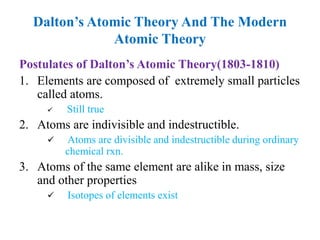
Postulates of Dalton’s Atomic Theory(1803-1810)
1. Elements are composed of extremely small particles
called atoms.
 Still true
2. Atoms are indivisible and indestructible.
 Atoms are divisible and indestructible during ordinary
chemical rxn.
3. Atoms of the same element are alike in mass, size
and other properties
 Isotopes of elements exist
Cont.
4. Atoms of different elements have different masses
and sizes.
 Still true
5. A chemical reaction involves only the separation,
combination, or rearrangement of atoms; it does not
result in their creation or destruction.
 Still true
6. Chemical compounds are formed when atoms combine in
whole-number ratios (law of multiple proportions). A
given compound always has the same relative number and
types of atoms (law of constant composition).
 Still true
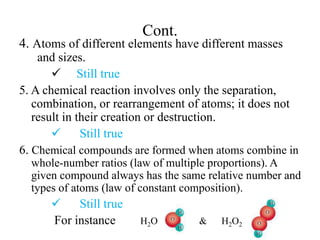
For instance H2O & H2O2
How the Modern Theory Explains the Mass
Laws
 Law of Conservation of Mass (Antoine Lavoisier's in 1774)
Mass is neither destroyed nor created during ordinary chemical
reactions.
 Law of Definite Proportions (Joseph Proust's in 1799)
The fact that a chemical compound contains the same elements in
exactly the same proportions by mass regardless of the size of the
sample or source of the compound.
 Law of Multiple Proportions (John Dalton, 1803)
If two or more different compounds are composed of the same two
elements, then the ratio of the masses of the second element
combined with a certain mass of the first elements is always a ratio
of small whole numbers.
Early Experiments To Characterize The
Atom
1. Discovery of the Electron
Cathode Rays
 In 1879, the English scientist William Crookes
(1832-1919) experimented with gas discharge tubes.
 When a very high electrical potential (~ 10,000 volts)
is applied across a gas taken in a discharge tube of a
very low pressure (~ 0.001 torr) some radiations are
emitted from cathode.
 These radiations are called cathode rays because
they came out from the cathode
Cont.
 Joseph John Thomson (1856–1940) Experiment,
the discovery of electron.
 Thomson used a discharge tube to study the electron.
 A high potential difference was applied across the
two electrodes ( anode and cathode)
 When electricity was switched on a beam of ray
emitted from the cathode.
 These rays were called cathode rays because they
came out from the cathode.
Cont.
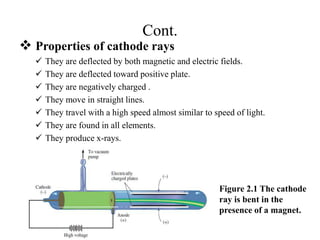
 Properties of cathode rays
 They are deflected by both magnetic and electric fields.
 They are deflected toward positive plate.
 They are negatively charged .
 They move in straight lines.
 They travel with a high speed almost similar to speed of light.
 They are found in all elements.
 They produce x-rays.
Figure 2.1 The cathode
ray is bent in the
presence of a magnet.
Cont.
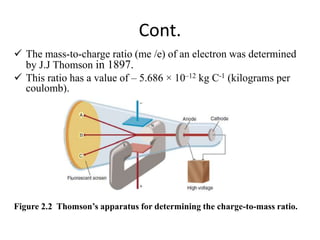
 The mass-to-charge ratio (me /e) of an electron was determined
by J.J Thomson in 1897.
 This ratio has a value of – 5.686 × 10⁻¹² kg C-1 (kilograms per
coulomb).
Figure 2.2 Thomson’s apparatus for determining the charge-to-mass ratio.
Cont.
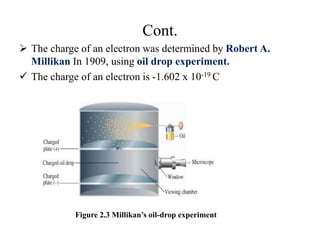
 The charge of an electron was determined by Robert A.
Millikan In 1909, using oil drop experiment.
 The charge of an electron is -1.602 x 10⁻¹⁹ C
Figure 2.3 Millikan’s oil-drop experiment
Cont.
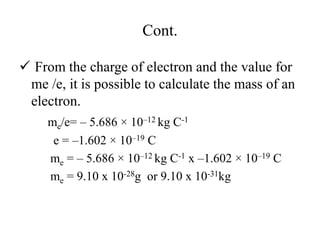
 From the charge of electron and the value for
me /e, it is possible to calculate the mass of an
electron.
me/e= – 5.686 × 10⁻¹² kg C-1
e = –1.602 × 10⁻¹⁹ C
me = – 5.686 × 10⁻¹² kg C-1 x –1.602 × 10⁻¹⁹ C
me = 9.10 x 10⁻²⁸g or 9.10 x 10⁻³¹kg
Radioactivity and Discovery of Nucleus
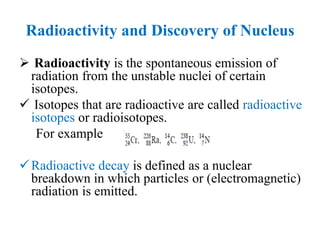
 Radioactivity is the spontaneous emission of
radiation from the unstable nuclei of certain
isotopes.
 Isotopes that are radioactive are called radioactive
isotopes or radioisotopes.
For example
Radioactive decay is defined as a nuclear
breakdown in which particles or (electromagnetic)
radiation is emitted.
Cont.
Elements with unstable nucleus that is emit
radiation are called radioactive element.
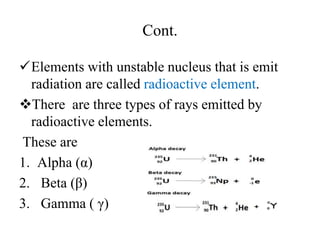
There are three types of rays emitted by
radioactive elements.
These are
1. Alpha (α)
2. Beta (β)
3. Gamma ( γ)
Cont.
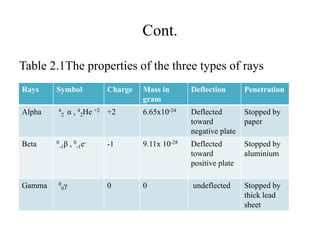
Table 2.1The properties of the three types of rays
Rays Symbol Charge Mass in
gram
Deflection Penetration
Alpha 4
2 α , 4
2He +2 +2 6.65x10⁻²⁴ Deflected
toward
negative plate
Stopped by
paper
Beta 0
-1β , 0
-1e- -1 9.11x 10⁻²⁸ Deflected
toward
positive plate
Stopped by
aluminium
Gamma 0
0γ 0 0 undeflected Stopped by
thick lead
sheet
Cont.
2. Discovery of Nucleus
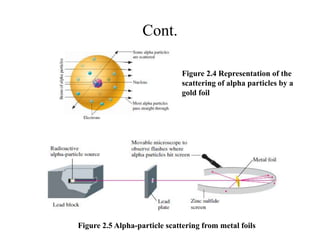
 Nucleus was discovered by E. Rutherford in 1910 , using
alpha scattering experiment.
 He allotted alpha particles to pass through gold foil. Three
main observations were made.
1. Most of the alpha particles went through the thin gold foil
without any change in path. This indicated most of the
space in an atom was empty.
2. a few alpha particles were deflected through small angles.
This showed that the nucleus has positive charge.
3. Few alpha particles reflected with large angles because of
the heavy nucleus.
Cont.
Figure 2.4 Representation of the
scattering of alpha particles by a
gold foil
Figure 2.5 Alpha-particle scattering from metal foils
Cont.
3. Discovery of Neutron
It was discovered by James Chadwick (1891-
1972) in 1932.
When Bombardment of beryllium atoms produced
a strange, highly penetrating form of radiation.
James Chadwick showed that this radiation was
best explained as a beam of neutral particles.
These particles, called neutrons, were found to
have about the same mass as protons but no
electric charge.
Make Up Of The Nucleus
1. Constituents of the Nucleus
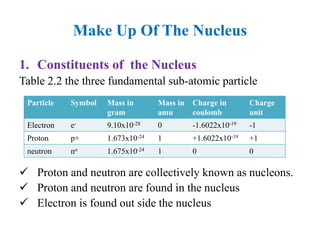
Table 2.2 the three fundamental sub-atomic particle
 Proton and neutron are collectively known as nucleons.
 Proton and neutron are found in the nucleus
 Electron is found out side the nucleus
Particle Symbol Mass in
gram
Mass in
amu
Charge in
coulomb
Charge
unit
Electron e- 9.10x10⁻²⁸ 0 -1.6022x10⁻¹⁹ -1
Proton p+ 1.673x10⁻²⁴ 1 +1.6022x10⁻¹⁹ +1
neutron no 1.675x10⁻²⁴ 1 0 0
Cont.
2. Atomic number and mass number
Atomic number(Z): is the number of proton(s)
in an atom.
Z= p=e for a neutral atom
 Mass number (A): is the sum of atomic
number and neutron number
A = Z+ n = p + n
Cont.
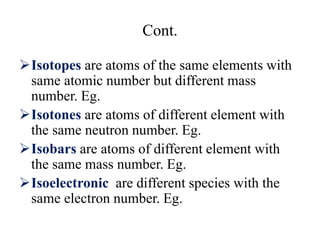
Isotopes are atoms of the same elements with
same atomic number but different mass
number. Eg.
Isotones are atoms of different element with
the same neutron number. Eg.
Isobars are atoms of different element with
the same mass number. Eg.
Isoelectronic are different species with the
same electron number. Eg.
Cont.
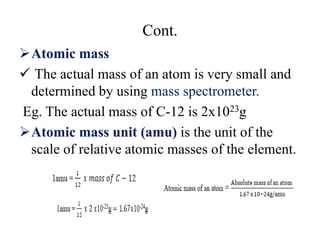
Atomic mass
 The actual mass of an atom is very small and
determined by using mass spectrometer.
Eg. The actual mass of C-12 is 2x10²³g
Atomic mass unit (amu) is the unit of the
scale of relative atomic masses of the element.
Cont.
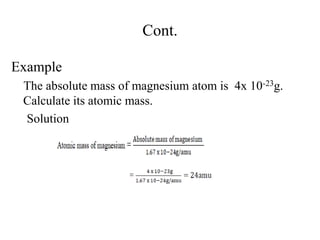
Example
The absolute mass of magnesium atom is 4x 10-23g.
Calculate its atomic mass.
Solution
Cont.
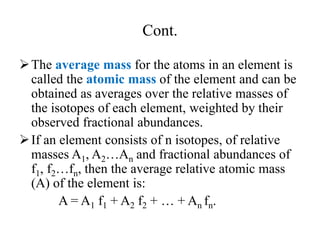
The average mass for the atoms in an element is
called the atomic mass of the element and can be
obtained as averages over the relative masses of
the isotopes of each element, weighted by their
observed fractional abundances.
If an element consists of n isotopes, of relative
masses A1, A2…An and fractional abundances of
f1, f2…fn, then the average relative atomic mass
(A) of the element is:
A = A1 f1 + A2 f2 + … + An fn.
Cont.
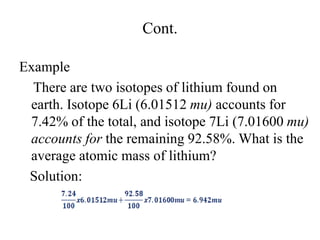
Example
There are two isotopes of lithium found on
earth. Isotope 6Li (6.01512 mu) accounts for
7.42% of the total, and isotope 7Li (7.01600 mu)
accounts for the remaining 92.58%. What is the
average atomic mass of lithium?
Solution:
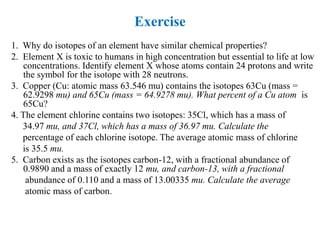
Exercise
1. Why do isotopes of an element have similar chemical properties?
2. Element X is toxic to humans in high concentration but essential to life at low
concentrations. Identify element X whose atoms contain 24 protons and write
the symbol for the isotope with 28 neutrons.
3. Copper (Cu: atomic mass 63.546 mu) contains the isotopes 63Cu (mass =
62.9298 mu) and 65Cu (mass = 64.9278 mu). What percent of a Cu atom is
65Cu?
4. The element chlorine contains two isotopes: 35Cl, which has a mass of
34.97 mu, and 37Cl, which has a mass of 36.97 mu. Calculate the
percentage of each chlorine isotope. The average atomic mass of chlorine
is 35.5 mu.
5. Carbon exists as the isotopes carbon-12, with a fractional abundance of
0.9890 and a mass of exactly 12 mu, and carbon-13, with a fractional
abundance of 0.110 and a mass of 13.00335 mu. Calculate the average
atomic mass of carbon.

Chapter 2 atomic structure

  • 1.
    Unit -2 Atomic Structure AndThe Periodic Table By: BelaynehM.
  • 2.
    Historical Development OfThe Atomic Nature Of Substances Empedocles (about 440 B.C.) stated that all matter was composed of four “elements” – earth, wind, fire and water. The ancient Greek philosophers described matter as continuous or discrete.  Democritus (460 - 370 B.C) Believed that all matter was composed of very tiny, indivisible particles. He called them atomos. Hence, the word ‘atom’ came from the Greek word atomos, which means uncuttable or indivisible.
  • 3.
    Cont…  A “piece”is reached where further division of any material is impossible (matter is discrete) Thus according to Democritus matter is discrete.  Aristotle (384 – 322 B.C)  He did not believe in atomos. Aristotle thought that all matter was continuous. Any material can be divided with out limit (matter is continuous)
  • 4.
    Dalton’s Atomic TheoryAnd The Modern Atomic Theory Postulates of Dalton’s Atomic Theory(1803-1810) 1. Elements are composed of extremely small particles called atoms.  Still true 2. Atoms are indivisible and indestructible.  Atoms are divisible and indestructible during ordinary chemical rxn. 3. Atoms of the same element are alike in mass, size and other properties  Isotopes of elements exist
  • 5.
    Cont. 4. Atoms ofdifferent elements have different masses and sizes.  Still true 5. A chemical reaction involves only the separation, combination, or rearrangement of atoms; it does not result in their creation or destruction.  Still true 6. Chemical compounds are formed when atoms combine in whole-number ratios (law of multiple proportions). A given compound always has the same relative number and types of atoms (law of constant composition).  Still true For instance H2O & H2O2
  • 6.
    How the ModernTheory Explains the Mass Laws  Law of Conservation of Mass (Antoine Lavoisier's in 1774) Mass is neither destroyed nor created during ordinary chemical reactions.  Law of Definite Proportions (Joseph Proust's in 1799) The fact that a chemical compound contains the same elements in exactly the same proportions by mass regardless of the size of the sample or source of the compound.  Law of Multiple Proportions (John Dalton, 1803) If two or more different compounds are composed of the same two elements, then the ratio of the masses of the second element combined with a certain mass of the first elements is always a ratio of small whole numbers.
  • 7.
    Early Experiments ToCharacterize The Atom 1. Discovery of the Electron Cathode Rays  In 1879, the English scientist William Crookes (1832-1919) experimented with gas discharge tubes.  When a very high electrical potential (~ 10,000 volts) is applied across a gas taken in a discharge tube of a very low pressure (~ 0.001 torr) some radiations are emitted from cathode.  These radiations are called cathode rays because they came out from the cathode
  • 8.
    Cont.  Joseph JohnThomson (1856–1940) Experiment, the discovery of electron.  Thomson used a discharge tube to study the electron.  A high potential difference was applied across the two electrodes ( anode and cathode)  When electricity was switched on a beam of ray emitted from the cathode.  These rays were called cathode rays because they came out from the cathode.
  • 9.
    Cont.  Properties ofcathode rays  They are deflected by both magnetic and electric fields.  They are deflected toward positive plate.  They are negatively charged .  They move in straight lines.  They travel with a high speed almost similar to speed of light.  They are found in all elements.  They produce x-rays. Figure 2.1 The cathode ray is bent in the presence of a magnet.
  • 10.
    Cont.  The mass-to-chargeratio (me /e) of an electron was determined by J.J Thomson in 1897.  This ratio has a value of – 5.686 × 10⁻¹² kg C-1 (kilograms per coulomb). Figure 2.2 Thomson’s apparatus for determining the charge-to-mass ratio.
  • 11.
    Cont.  The chargeof an electron was determined by Robert A. Millikan In 1909, using oil drop experiment.  The charge of an electron is -1.602 x 10⁻¹⁹ C Figure 2.3 Millikan’s oil-drop experiment
  • 12.
    Cont.  From thecharge of electron and the value for me /e, it is possible to calculate the mass of an electron. me/e= – 5.686 × 10⁻¹² kg C-1 e = –1.602 × 10⁻¹⁹ C me = – 5.686 × 10⁻¹² kg C-1 x –1.602 × 10⁻¹⁹ C me = 9.10 x 10⁻²⁸g or 9.10 x 10⁻³¹kg
  • 13.
    Radioactivity and Discoveryof Nucleus  Radioactivity is the spontaneous emission of radiation from the unstable nuclei of certain isotopes.  Isotopes that are radioactive are called radioactive isotopes or radioisotopes. For example Radioactive decay is defined as a nuclear breakdown in which particles or (electromagnetic) radiation is emitted.
  • 14.
    Cont. Elements with unstablenucleus that is emit radiation are called radioactive element. There are three types of rays emitted by radioactive elements. These are 1. Alpha (α) 2. Beta (β) 3. Gamma ( γ)
  • 15.
    Cont. Table 2.1The propertiesof the three types of rays Rays Symbol Charge Mass in gram Deflection Penetration Alpha 4 2 α , 4 2He +2 +2 6.65x10⁻²⁴ Deflected toward negative plate Stopped by paper Beta 0 -1β , 0 -1e- -1 9.11x 10⁻²⁸ Deflected toward positive plate Stopped by aluminium Gamma 0 0γ 0 0 undeflected Stopped by thick lead sheet
  • 16.
    Cont. 2. Discovery ofNucleus  Nucleus was discovered by E. Rutherford in 1910 , using alpha scattering experiment.  He allotted alpha particles to pass through gold foil. Three main observations were made. 1. Most of the alpha particles went through the thin gold foil without any change in path. This indicated most of the space in an atom was empty. 2. a few alpha particles were deflected through small angles. This showed that the nucleus has positive charge. 3. Few alpha particles reflected with large angles because of the heavy nucleus.
  • 17.
    Cont. Figure 2.4 Representationof the scattering of alpha particles by a gold foil Figure 2.5 Alpha-particle scattering from metal foils
  • 18.
    Cont. 3. Discovery ofNeutron It was discovered by James Chadwick (1891- 1972) in 1932. When Bombardment of beryllium atoms produced a strange, highly penetrating form of radiation. James Chadwick showed that this radiation was best explained as a beam of neutral particles. These particles, called neutrons, were found to have about the same mass as protons but no electric charge.
  • 19.
    Make Up OfThe Nucleus 1. Constituents of the Nucleus Table 2.2 the three fundamental sub-atomic particle  Proton and neutron are collectively known as nucleons.  Proton and neutron are found in the nucleus  Electron is found out side the nucleus Particle Symbol Mass in gram Mass in amu Charge in coulomb Charge unit Electron e- 9.10x10⁻²⁸ 0 -1.6022x10⁻¹⁹ -1 Proton p+ 1.673x10⁻²⁴ 1 +1.6022x10⁻¹⁹ +1 neutron no 1.675x10⁻²⁴ 1 0 0
  • 20.
    Cont. 2. Atomic numberand mass number Atomic number(Z): is the number of proton(s) in an atom. Z= p=e for a neutral atom  Mass number (A): is the sum of atomic number and neutron number A = Z+ n = p + n
  • 21.
    Cont. Isotopes are atomsof the same elements with same atomic number but different mass number. Eg. Isotones are atoms of different element with the same neutron number. Eg. Isobars are atoms of different element with the same mass number. Eg. Isoelectronic are different species with the same electron number. Eg.
  • 22.
    Cont. Atomic mass  Theactual mass of an atom is very small and determined by using mass spectrometer. Eg. The actual mass of C-12 is 2x10²³g Atomic mass unit (amu) is the unit of the scale of relative atomic masses of the element.
  • 23.
    Cont. Example The absolute massof magnesium atom is 4x 10-23g. Calculate its atomic mass. Solution
  • 24.
    Cont. The average massfor the atoms in an element is called the atomic mass of the element and can be obtained as averages over the relative masses of the isotopes of each element, weighted by their observed fractional abundances. If an element consists of n isotopes, of relative masses A1, A2…An and fractional abundances of f1, f2…fn, then the average relative atomic mass (A) of the element is: A = A1 f1 + A2 f2 + … + An fn.
  • 25.
    Cont. Example There are twoisotopes of lithium found on earth. Isotope 6Li (6.01512 mu) accounts for 7.42% of the total, and isotope 7Li (7.01600 mu) accounts for the remaining 92.58%. What is the average atomic mass of lithium? Solution:
  • 26.
    Exercise 1. Why doisotopes of an element have similar chemical properties? 2. Element X is toxic to humans in high concentration but essential to life at low concentrations. Identify element X whose atoms contain 24 protons and write the symbol for the isotope with 28 neutrons. 3. Copper (Cu: atomic mass 63.546 mu) contains the isotopes 63Cu (mass = 62.9298 mu) and 65Cu (mass = 64.9278 mu). What percent of a Cu atom is 65Cu? 4. The element chlorine contains two isotopes: 35Cl, which has a mass of 34.97 mu, and 37Cl, which has a mass of 36.97 mu. Calculate the percentage of each chlorine isotope. The average atomic mass of chlorine is 35.5 mu. 5. Carbon exists as the isotopes carbon-12, with a fractional abundance of 0.9890 and a mass of exactly 12 mu, and carbon-13, with a fractional abundance of 0.110 and a mass of 13.00335 mu. Calculate the average atomic mass of carbon.