ATOMIC ABSORPTION
SPECTROSCOPY (AAS)
Presented By:
G.T.ROOPESHM.PHARM
Associate Professor
Dept. Of Pharma.Chemistry
BCP-ATP
EMAIL ID: roopeshpharma@gmail.com
ATOMIC ABSORPTION SPECTROSCOPY(AAS)
CONTENTS
PRINCIPLE
THEORY
 Instrumentation
AAS (SINGLE)
AAS (Double)
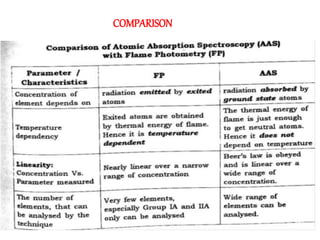
COMPARISON
Applications
Principle of AAS
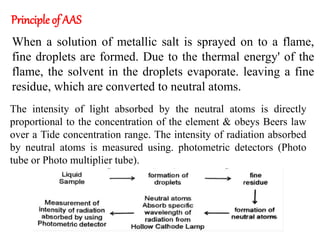
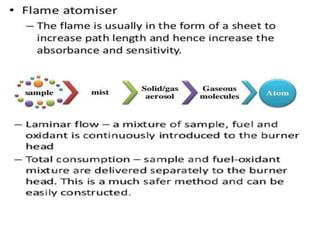
When a solution of metallic salt is sprayed on to a flame,
fine droplets are formed. Due to the thermal energy' of the
flame, the solvent in the droplets evaporate. leaving a fine
residue, which are converted to neutral atoms.
The intensity of light absorbed by the neutral atoms is directly
proportional to the concentration of the element & obeys Beers law
over a Tide concentration range. The intensity of radiation absorbed
by neutral atoms is measured using. photometric detectors (Photo
tube or Photo multiplier tube).
Theory of AAS
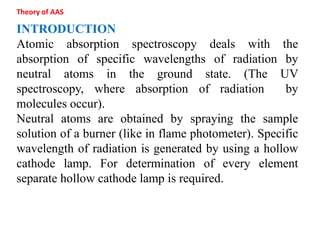
INTRODUCTION
Atomic absorption spectroscopy deals with the
absorption of specific wavelengths of radiation by
neutral atoms in the ground state. (The UV
spectroscopy, where absorption of radiation by
molecules occur).
Neutral atoms are obtained by spraying the sample
solution of a burner (like in flame photometer). Specific
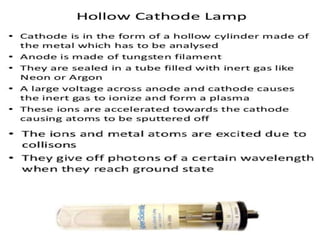
wavelength of radiation is generated by using a hollow
cathode lamp. For determination of every element
separate hollow cathode lamp is required.
Preparation of SAMPLE
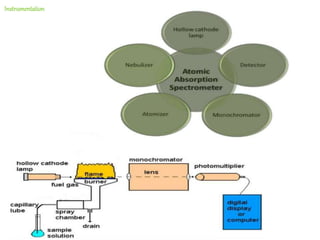
Instrumentation
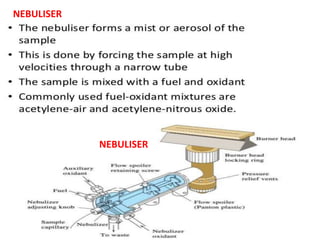
NEBULISER
NEBULISER
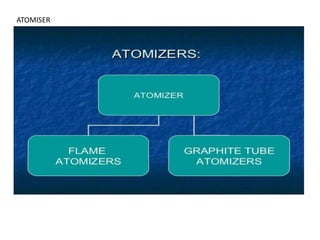
ATOMISER
GRAPHITE
TUBE
ATOMIZER
OR
ELECTRO
THERMAL
ATOMISER
GRAPHITE TUBE ATOMISER OR ELECTRO THERMAL ATOMISER
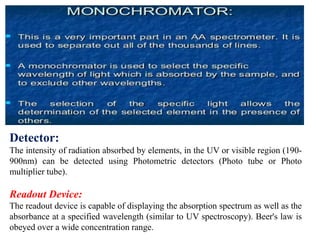
Detector:
The intensity of radiation absorbed by elements, in the UV or visible region (190-
900nm) can be detected using Photometric detectors (Photo tube or Photo
multiplier tube).
Readout Device:
The readout device is capable of displaying the absorption spectrum as well as the
absorbance at a specified wavelength (similar to UV spectroscopy). Beer's law is
obeyed over a wide concentration range.
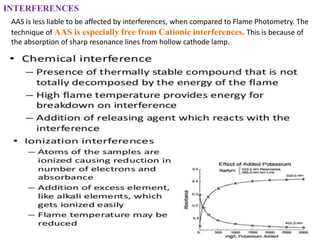
INTERFERENCES
AAS is less liable to be affected by interferences, when compared to Flame Photometry. The
technique of AAS is especially free from Cationic interferences. This is because of
the absorption of sharp resonance lines from hollow cathode lamp.
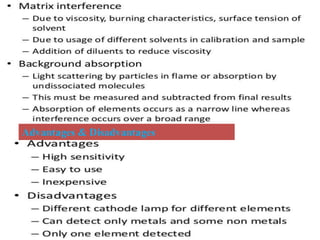
Advantages & Disadvantages
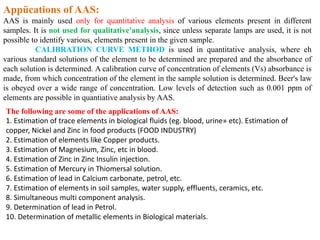
Appücations of AAS:
AAS is mainly used only for quantitative analysis of various elements present in different
samples. It is not used for qualitative'analysis, since unless separate lamps are used, it is not
possible to identify various, elements present in the given sample.
CALIBRATION CURVE METHOD is used in quantitative analysis, where eh
various standard solutions of the element to be determined are prepared and the absorbance of
each solution is determined. A calibration curve of concentration of elements (Vs) absorbance is
made, from which concentration of the element in the sample solution is determined. Beer's law
is obeyed over a wide range of concentration. Low levels of detection such as 0.001 ppm of
elements are possible in quantiative analysis by AAS.
The following are some of the applications of AAS:
1. Estimation of trace elements in biological fluids (eg. blood, urine» etc). Estimation of
copper, Nickel and Zinc in food products (FOOD INDUSTRY)
2. Estimation of elements like Copper products.
3. Estimation of Magnesium, Zinc, etc in blood.
4. Estimation of Zinc in Zinc Insulin injection.
5. Estimation of Mercury in Thiomersal solution.
6. Estimation of lead in Calcium carbonate, petrol, etc.
7. Estimation of elements in soil samples, water supply, effluents, ceramics, etc.
8. Simultaneous multi component analysis.
9. Determination of lead in Petrol.
10. Determination of metallic elements in Biological materials.
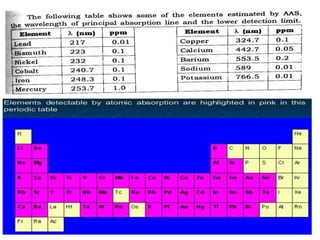
COMPARISON
APPLICATIONS OF AAS (EXPERIMENTS)
1. DETERMINATION OF Vanadium in lubricating OIL.
2. Determination of Trace elements in Contaminated soil.
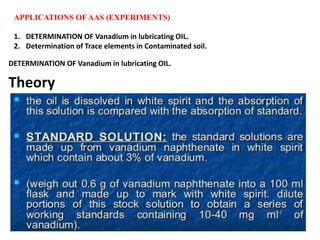
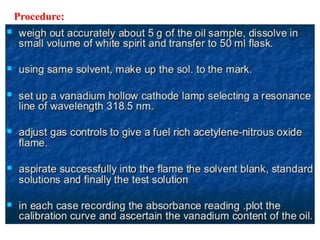
DETERMINATION OF Vanadium in lubricating OIL.
Theory
Procedure:
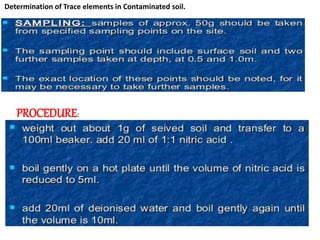
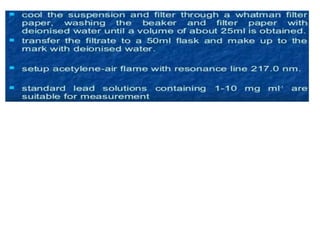
Determination of Trace elements in Contaminated soil.
PROCEDURE:
ATOMIC ABSORPTION SPECTROSCOPY ( AAS)

ATOMIC ABSORPTION SPECTROSCOPY ( AAS)

  • 1.
    ATOMIC ABSORPTION SPECTROSCOPY (AAS) PresentedBy: G.T.ROOPESHM.PHARM Associate Professor Dept. Of Pharma.Chemistry BCP-ATP EMAIL ID: roopeshpharma@gmail.com
  • 2.
    ATOMIC ABSORPTION SPECTROSCOPY(AAS) CONTENTS PRINCIPLE THEORY Instrumentation AAS (SINGLE) AAS (Double) COMPARISON Applications
  • 3.
    Principle of AAS Whena solution of metallic salt is sprayed on to a flame, fine droplets are formed. Due to the thermal energy' of the flame, the solvent in the droplets evaporate. leaving a fine residue, which are converted to neutral atoms. The intensity of light absorbed by the neutral atoms is directly proportional to the concentration of the element & obeys Beers law over a Tide concentration range. The intensity of radiation absorbed by neutral atoms is measured using. photometric detectors (Photo tube or Photo multiplier tube).
  • 4.
    Theory of AAS INTRODUCTION Atomicabsorption spectroscopy deals with the absorption of specific wavelengths of radiation by neutral atoms in the ground state. (The UV spectroscopy, where absorption of radiation by molecules occur). Neutral atoms are obtained by spraying the sample solution of a burner (like in flame photometer). Specific wavelength of radiation is generated by using a hollow cathode lamp. For determination of every element separate hollow cathode lamp is required.
  • 5.
  • 6.
  • 8.
  • 9.
  • 11.
  • 12.
    Detector: The intensity ofradiation absorbed by elements, in the UV or visible region (190- 900nm) can be detected using Photometric detectors (Photo tube or Photo multiplier tube). Readout Device: The readout device is capable of displaying the absorption spectrum as well as the absorbance at a specified wavelength (similar to UV spectroscopy). Beer's law is obeyed over a wide concentration range.
  • 13.
    INTERFERENCES AAS is lessliable to be affected by interferences, when compared to Flame Photometry. The technique of AAS is especially free from Cationic interferences. This is because of the absorption of sharp resonance lines from hollow cathode lamp.
  • 14.
  • 15.
    Appücations of AAS: AASis mainly used only for quantitative analysis of various elements present in different samples. It is not used for qualitative'analysis, since unless separate lamps are used, it is not possible to identify various, elements present in the given sample. CALIBRATION CURVE METHOD is used in quantitative analysis, where eh various standard solutions of the element to be determined are prepared and the absorbance of each solution is determined. A calibration curve of concentration of elements (Vs) absorbance is made, from which concentration of the element in the sample solution is determined. Beer's law is obeyed over a wide range of concentration. Low levels of detection such as 0.001 ppm of elements are possible in quantiative analysis by AAS. The following are some of the applications of AAS: 1. Estimation of trace elements in biological fluids (eg. blood, urine» etc). Estimation of copper, Nickel and Zinc in food products (FOOD INDUSTRY) 2. Estimation of elements like Copper products. 3. Estimation of Magnesium, Zinc, etc in blood. 4. Estimation of Zinc in Zinc Insulin injection. 5. Estimation of Mercury in Thiomersal solution. 6. Estimation of lead in Calcium carbonate, petrol, etc. 7. Estimation of elements in soil samples, water supply, effluents, ceramics, etc. 8. Simultaneous multi component analysis. 9. Determination of lead in Petrol. 10. Determination of metallic elements in Biological materials.
  • 17.
  • 18.
    APPLICATIONS OF AAS(EXPERIMENTS) 1. DETERMINATION OF Vanadium in lubricating OIL. 2. Determination of Trace elements in Contaminated soil. DETERMINATION OF Vanadium in lubricating OIL. Theory
  • 19.
  • 20.
    Determination of Traceelements in Contaminated soil. PROCEDURE: