Presented By:
G.T.ROOPESHM.PHARM
Associate Professor
Dept. Of Pharma.Chemistry
BCP-ATP
EMAIL ID: roopeshpharma@gmail.com
CONTENTS
Introduction
THEORY
PLANE POLARIZED LIGHT
OPTICAL ACTIVITY (THEORY)
Factors Affecting OPTICAL ACTIVITY
Instrumentation
POLARIMETER
Applications
INTRODUCTION
• Polarimetry is one of the important instrumental methods
employed in analysis. This measures the rotation of the
polarized light as it passes through an optically active
compound. This technique involves the measurement of
change in the direction of vibration of polarized light
when interact with an optically active compound. A
substance is said to be optically active if it rotates the plane
of the polarized light.
PLANE POLARISED LIGHT
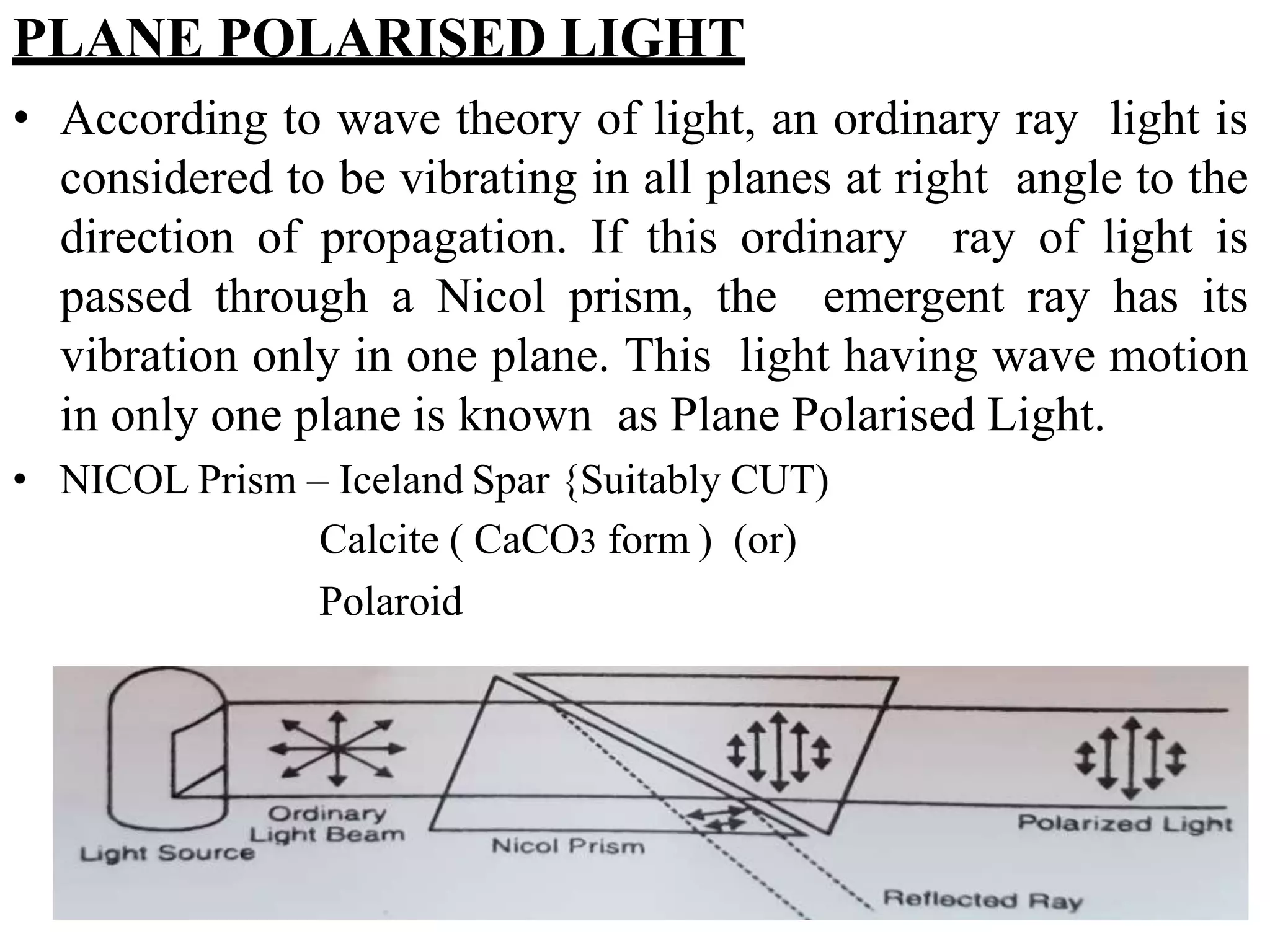
• According to wave theory of light, an ordinary ray light is
considered to be vibrating in all planes at right angle to the
direction of propagation. If this ordinary ray of light is
passed through a Nicol prism, the emergent ray has its
vibration only in one plane. This light having wave motion
in only one plane is known as Plane Polarised Light.
• NICOL Prism – Iceland Spar {Suitably CUT)
Calcite ( CaCO3 form ) (or)
Polaroid
• A plane polarized light which consists of two components of fixed
magnitude rotating in opposite directions to one another;
• The right circulatory polarized light
• The left circulatory polarized light
• Plane polarized light is the vector sum of these two components
OPTICALACTIVITY
Definition: It Has find that magnitude of
rotation depend upon the following
factors:
1.Nature of Substance
2.Length of liquid column ( l ) through which
light passes.
3.Concentration of the solution.
4.Nature of the solvent.
5.Temperature of the solution (t)
6.Wavelength of the light used
• The Rotatory Power of a given solution is generally
expressed as specific rotation. It is the number of
degress of rotation of plane polarized light produced by
one gram of the substance per ml. The measurements is
carried out at temp using sodium light. The Specific
rotation can be Calculated by the following relation:
[Îą] = specific rotation, T = temperature,
Ν = wavelength, θ= optical rotation,
c = concentration in g/100ml,
l = optical path length in dm.
Types of molecules analysed by Polarimetry:
• Molecule must be Optically active.
• Optically Active molecule contain asymmetric carbon
atom.
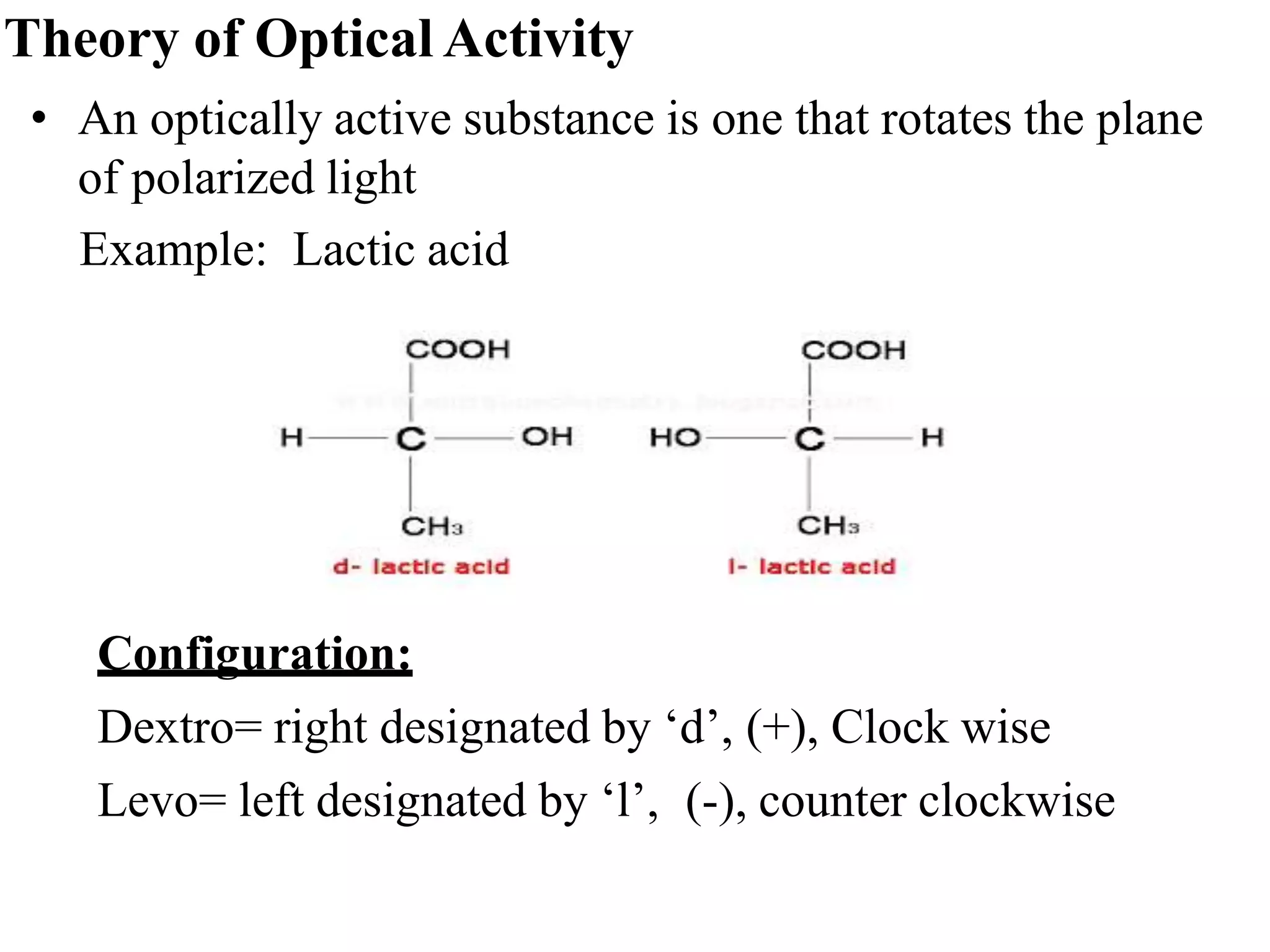
Theory of Optical Activity
• An optically active substance is one that rotates the plane
of polarized light
Example: Lactic acid
Configuration:
Dextro= right designated by ‘d’, (+), Clock wise
Levo= left designated by ‘l’, (-), counter clockwise
INSTRUMENTATION
The instrument used to measure the angle of rotation of the plane
polarized light is called “POLARIMETER”
Optical activity may be detected & measured by an
instrument → Polarimeter
• Light source – Sodium vapor lamp
• Analyzer– another Nicol prism aligned to
intercept the linearly polarized ray as it
emerges from the sample solution
• A polarimeter consists of a polarized Light
source – Sodium vapor lamp, Polarizer –
quartz prism material and Analyzer – Nicol
prism aligned to intercept the linearly
polarized ray as it emerges from the sample
solution, a graduated circle- to measure the
rotation angle, and sample tubes.
Components of Polarimeter
POLARIMETER
Jasco-p-2000-digital-polarimeter
APPLICATIONS
Quantitative application: If the specific rotation of sample is
known its concentration in the solution can be estimated.
Qualitative application: Optical activity is the only parameter
available for distinguishing between D and L isomeric forms.
Saccharimetry:
• Important practical application of polarimetry
• Determination of high conc. of sugars
• Visual saccharimeters called POLAROSCOPES
Polarimetry
Polarimetry
Polarimetry

Polarimetry

  • 1.
    Presented By: G.T.ROOPESHM.PHARM Associate Professor Dept.Of Pharma.Chemistry BCP-ATP EMAIL ID: roopeshpharma@gmail.com
  • 2.
    CONTENTS Introduction THEORY PLANE POLARIZED LIGHT OPTICALACTIVITY (THEORY) Factors Affecting OPTICAL ACTIVITY Instrumentation POLARIMETER Applications
  • 3.
    INTRODUCTION • Polarimetry isone of the important instrumental methods employed in analysis. This measures the rotation of the polarized light as it passes through an optically active compound. This technique involves the measurement of change in the direction of vibration of polarized light when interact with an optically active compound. A substance is said to be optically active if it rotates the plane of the polarized light.
  • 4.
    PLANE POLARISED LIGHT •According to wave theory of light, an ordinary ray light is considered to be vibrating in all planes at right angle to the direction of propagation. If this ordinary ray of light is passed through a Nicol prism, the emergent ray has its vibration only in one plane. This light having wave motion in only one plane is known as Plane Polarised Light. • NICOL Prism – Iceland Spar {Suitably CUT) Calcite ( CaCO3 form ) (or) Polaroid
  • 7.
    • A planepolarized light which consists of two components of fixed magnitude rotating in opposite directions to one another; • The right circulatory polarized light • The left circulatory polarized light • Plane polarized light is the vector sum of these two components
  • 8.
    OPTICALACTIVITY Definition: It Hasfind that magnitude of rotation depend upon the following factors: 1.Nature of Substance 2.Length of liquid column ( l ) through which light passes. 3.Concentration of the solution. 4.Nature of the solvent. 5.Temperature of the solution (t) 6.Wavelength of the light used
  • 9.
    • The RotatoryPower of a given solution is generally expressed as specific rotation. It is the number of degress of rotation of plane polarized light produced by one gram of the substance per ml. The measurements is carried out at temp using sodium light. The Specific rotation can be Calculated by the following relation: [α] = specific rotation, T = temperature, λ = wavelength, θ= optical rotation, c = concentration in g/100ml, l = optical path length in dm.
  • 10.
    Types of moleculesanalysed by Polarimetry: • Molecule must be Optically active. • Optically Active molecule contain asymmetric carbon atom.
  • 11.
    Theory of OpticalActivity • An optically active substance is one that rotates the plane of polarized light Example: Lactic acid Configuration: Dextro= right designated by ‘d’, (+), Clock wise Levo= left designated by ‘l’, (-), counter clockwise
  • 13.
    INSTRUMENTATION The instrument usedto measure the angle of rotation of the plane polarized light is called “POLARIMETER” Optical activity may be detected & measured by an instrument → Polarimeter
  • 15.
    • Light source– Sodium vapor lamp • Analyzer– another Nicol prism aligned to intercept the linearly polarized ray as it emerges from the sample solution • A polarimeter consists of a polarized Light source – Sodium vapor lamp, Polarizer – quartz prism material and Analyzer – Nicol prism aligned to intercept the linearly polarized ray as it emerges from the sample solution, a graduated circle- to measure the rotation angle, and sample tubes. Components of Polarimeter
  • 16.
  • 17.
  • 18.
    APPLICATIONS Quantitative application: Ifthe specific rotation of sample is known its concentration in the solution can be estimated. Qualitative application: Optical activity is the only parameter available for distinguishing between D and L isomeric forms. Saccharimetry: • Important practical application of polarimetry • Determination of high conc. of sugars • Visual saccharimeters called POLAROSCOPES