PRESENTED BY,
MS.L.SOUNDARYA
M.SC.NURSING (PEDIATRICS)
DEFINITION
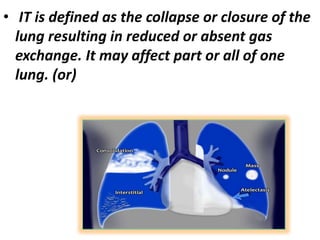
• IT is defined as the collapse or closure of the
lung resulting in reduced or absent gas
exchange. It may affect part or all of one
lung. (or)
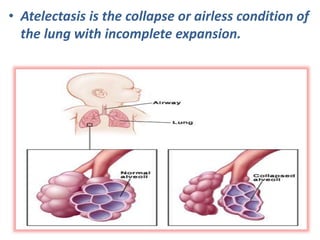
• Atelectasis is the collapse or airless condition of
the lung with incomplete expansion.
Causes
1. congenital/
primary Atelectasis-
preterm or LBW
baby.
-due to immaturity
of respiratory of
muscle, alveolar
ducts abnormality,
any pulmonary
disorders.
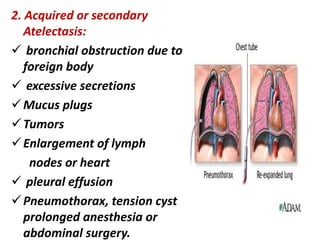
2. Acquired or secondary
Atelectasis:
 bronchial obstruction due to
foreign body
 excessive secretions
Mucus plugs
Tumors
Enlargement of lymph
nodes or heart
 pleural effusion
Pneumothorax, tension cyst
prolonged anesthesia or
abdominal surgery.
PATHOPHYSIOLOGY
PRIMARY SECONDARY
ALVEOLI FAILS TO EXPAND
# premature
-Because of immaturity of
diaphragm & other respiratory
muscles, hypermoblity of the
bones.
# due to sedation of the mother
before delivery or brain injury of
the newborn
# a mucus or meconium plug may
cause atelectasis
# neonates –lungs are not
expanded normally, the acidosis
becomes more severe, possibly
with pH values of below 7.o
ALVEOLI COLLAPSE After they
have once been expanded by
air.
# this may occur when the
infant or child has pulmonary
disease or has aspirated
mucus or a foreign body.
Clinical manifestations
• Rapid bronchial occlusion with a large
area of lung collapse causes;
• chest pain on the affected side,
• retractions,
• sudden onset of dyspnea, tachypnea,
• Cyanosis,
• Coughing,
• Rapid, shallow breathing
• Hypotension, tachycardia,
• fever, and shock may also occur.
• Irritation in the right middle and
right lower lobe bronchi may cause
-severe, hacking, nonproductive
cough.
DIAGNOSTIC EVALUATION
History collection
Physical examination
Chest x-ray
CBP
CUA
sputum test c/s
AFB staining
CT-chest /CT-
abdomen
Bronchoscopy
Radiography
oximetry
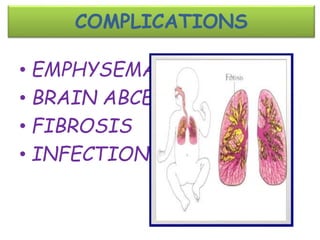
COMPLICATIONS
• EMPHYSEMA
• BRAIN ABCESS
• FIBROSIS
• INFECTIONS
PROGNOSIS
• GOOD
• POOR MAY FOUND IN MASSIVE
BACTERIAL ATELECTASIS
NURSING MANGEMENT
• Early recognition of
atelectasis
• Semi fowlers
positioning should be
maintained.
• oxygen therapy
Suction and postural drainage
may be used to reduce the amount
of mucus in the respiratory tract.
• Increased humidity in the
environment can prevent the drying
of secretions and the formations of
bronchial plugs.
• Prevent secondary infections.
• Prevent respiratory distress.
NURSING DIAGNOSIS
Ineffective breathing pattern related to:
• Hypoxia/inflammatory process
• Neuromuscular impairment
• Pain
• Musculoskeletal impairment
• Tracheobronchial obstruction
• Perception or cognitive impairment
• Anxiety
• Decreased energy and fatigue
• Decreased lung expansion
Ineffective airway clearance related to:
–stasis of secretions associated with
decreased activity, depressed ciliary
function resulting from the effect of
anesthesia, and a weak cough effort
–increased secretions associated with
irritation of the respiratory tract (can
result from inhalation anesthetics and
endotracheal intubation);
• Impaired gas exchange related to
ventilation/perfusion imbalances associated
with atelectasis/hypoventilation or
ineffective clearance of secretions.
• Fluid volume excess related to pulmonary
interstitium &alveoli as manifested by
respiratory rate variation /by auscultation /
investigation (chest)
Ineffective tissue perfusion r/t compromised
blood flow r/t respiratory distress syndrome
cyanosis of hands, feet, and around mouth.
Ineffective thermoregulation r/t immature
compensation for changes in environmental
temperature.
Imbalanced nutrition status less than body
requirements r/t poor feeding behavior
Risk for impaired parent-infant attachment
r/t interruption of bonding process.
atelectasis

atelectasis

  • 1.
  • 2.
  • 3.
    • IT isdefined as the collapse or closure of the lung resulting in reduced or absent gas exchange. It may affect part or all of one lung. (or)
  • 4.
    • Atelectasis isthe collapse or airless condition of the lung with incomplete expansion.
  • 5.
  • 6.
    1. congenital/ primary Atelectasis- pretermor LBW baby. -due to immaturity of respiratory of muscle, alveolar ducts abnormality, any pulmonary disorders.
  • 7.
    2. Acquired orsecondary Atelectasis:  bronchial obstruction due to foreign body  excessive secretions Mucus plugs Tumors Enlargement of lymph nodes or heart  pleural effusion Pneumothorax, tension cyst prolonged anesthesia or abdominal surgery.
  • 10.
  • 11.
    PRIMARY SECONDARY ALVEOLI FAILSTO EXPAND # premature -Because of immaturity of diaphragm & other respiratory muscles, hypermoblity of the bones. # due to sedation of the mother before delivery or brain injury of the newborn # a mucus or meconium plug may cause atelectasis # neonates –lungs are not expanded normally, the acidosis becomes more severe, possibly with pH values of below 7.o ALVEOLI COLLAPSE After they have once been expanded by air. # this may occur when the infant or child has pulmonary disease or has aspirated mucus or a foreign body.
  • 12.
    Clinical manifestations • Rapidbronchial occlusion with a large area of lung collapse causes; • chest pain on the affected side, • retractions, • sudden onset of dyspnea, tachypnea, • Cyanosis, • Coughing,
  • 13.
    • Rapid, shallowbreathing • Hypotension, tachycardia, • fever, and shock may also occur. • Irritation in the right middle and right lower lobe bronchi may cause -severe, hacking, nonproductive cough.
  • 14.
    DIAGNOSTIC EVALUATION History collection Physicalexamination Chest x-ray CBP CUA sputum test c/s AFB staining
  • 15.
  • 19.
    COMPLICATIONS • EMPHYSEMA • BRAINABCESS • FIBROSIS • INFECTIONS
  • 20.
    PROGNOSIS • GOOD • POORMAY FOUND IN MASSIVE BACTERIAL ATELECTASIS
  • 21.
    NURSING MANGEMENT • Earlyrecognition of atelectasis • Semi fowlers positioning should be maintained. • oxygen therapy
  • 22.
    Suction and posturaldrainage may be used to reduce the amount of mucus in the respiratory tract.
  • 23.
    • Increased humidityin the environment can prevent the drying of secretions and the formations of bronchial plugs. • Prevent secondary infections. • Prevent respiratory distress.
  • 24.
    NURSING DIAGNOSIS Ineffective breathingpattern related to: • Hypoxia/inflammatory process • Neuromuscular impairment • Pain • Musculoskeletal impairment • Tracheobronchial obstruction • Perception or cognitive impairment • Anxiety • Decreased energy and fatigue • Decreased lung expansion
  • 25.
    Ineffective airway clearancerelated to: –stasis of secretions associated with decreased activity, depressed ciliary function resulting from the effect of anesthesia, and a weak cough effort –increased secretions associated with irritation of the respiratory tract (can result from inhalation anesthetics and endotracheal intubation);
  • 26.
    • Impaired gasexchange related to ventilation/perfusion imbalances associated with atelectasis/hypoventilation or ineffective clearance of secretions. • Fluid volume excess related to pulmonary interstitium &alveoli as manifested by respiratory rate variation /by auscultation / investigation (chest)
  • 27.
    Ineffective tissue perfusionr/t compromised blood flow r/t respiratory distress syndrome cyanosis of hands, feet, and around mouth. Ineffective thermoregulation r/t immature compensation for changes in environmental temperature. Imbalanced nutrition status less than body requirements r/t poor feeding behavior Risk for impaired parent-infant attachment r/t interruption of bonding process.