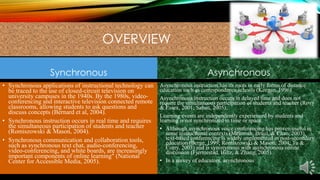
Synchronous and asynchronous interactions both have advantages and limitations for instructional purposes. Synchronous interactions occur in real-time and allow for immediate feedback but can be difficult to schedule and moderate for larger groups. Asynchronous interactions provide flexibility and allow time for reflection, but lack immediate feedback. Both interaction types are important in online learning environments to facilitate student-instructor, student-content, and student-student engagement through communication tools that are text-based, audio-based, or video-based. Effective learning environments combine asynchronous and synchronous tools to maximize interaction and engagement for diverse learners.