SYNCH  AND  SWIM: The Value of Synchronous Learning Environments (Interact! Build Community! Immediate feedback!) Michael Coghlan BAW 2010 21/1/10
STRUCTURE OF SESSION historical context value of synchronous interaction skills required in a virtual classroom (brief) applications for synchronous activity (when can you use them?)
WHO’S ONLINE TODAY?
Question: Are you A) In your office? B) In a computer suite? C) At home? D) Other?
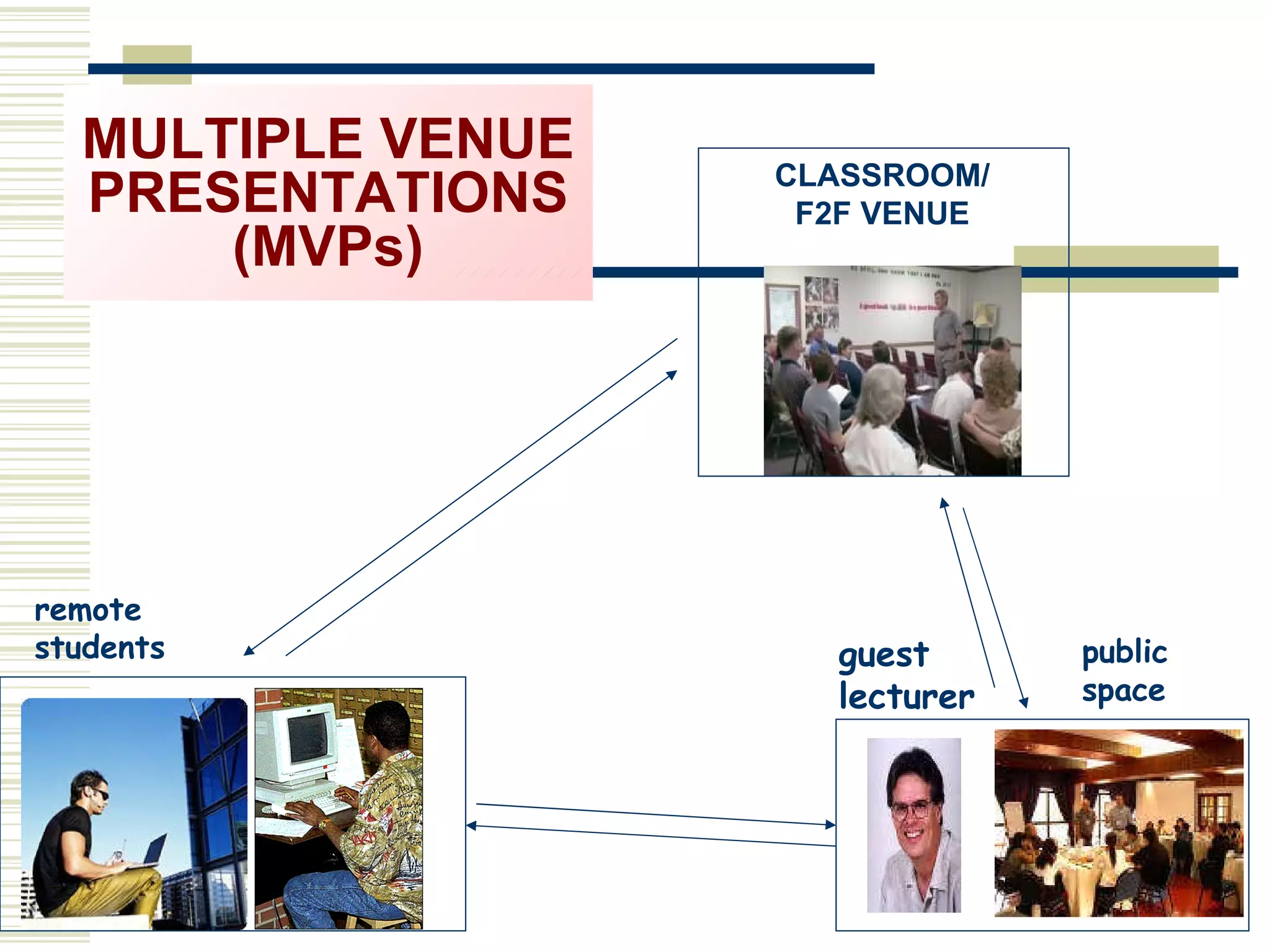
MULTIPLE VENUE PRESENTATIONS (MVPs) remote  students guest lecturer CLASSROOM/ F2F VENUE public space
What is synchronous/asynchronous communication? SYNCHRONOUS (real time) eg f2f conversation, telephone calls, chat rooms ASYNCHRONOUS – some delay between initial communication and the reply eg letters, email, forums
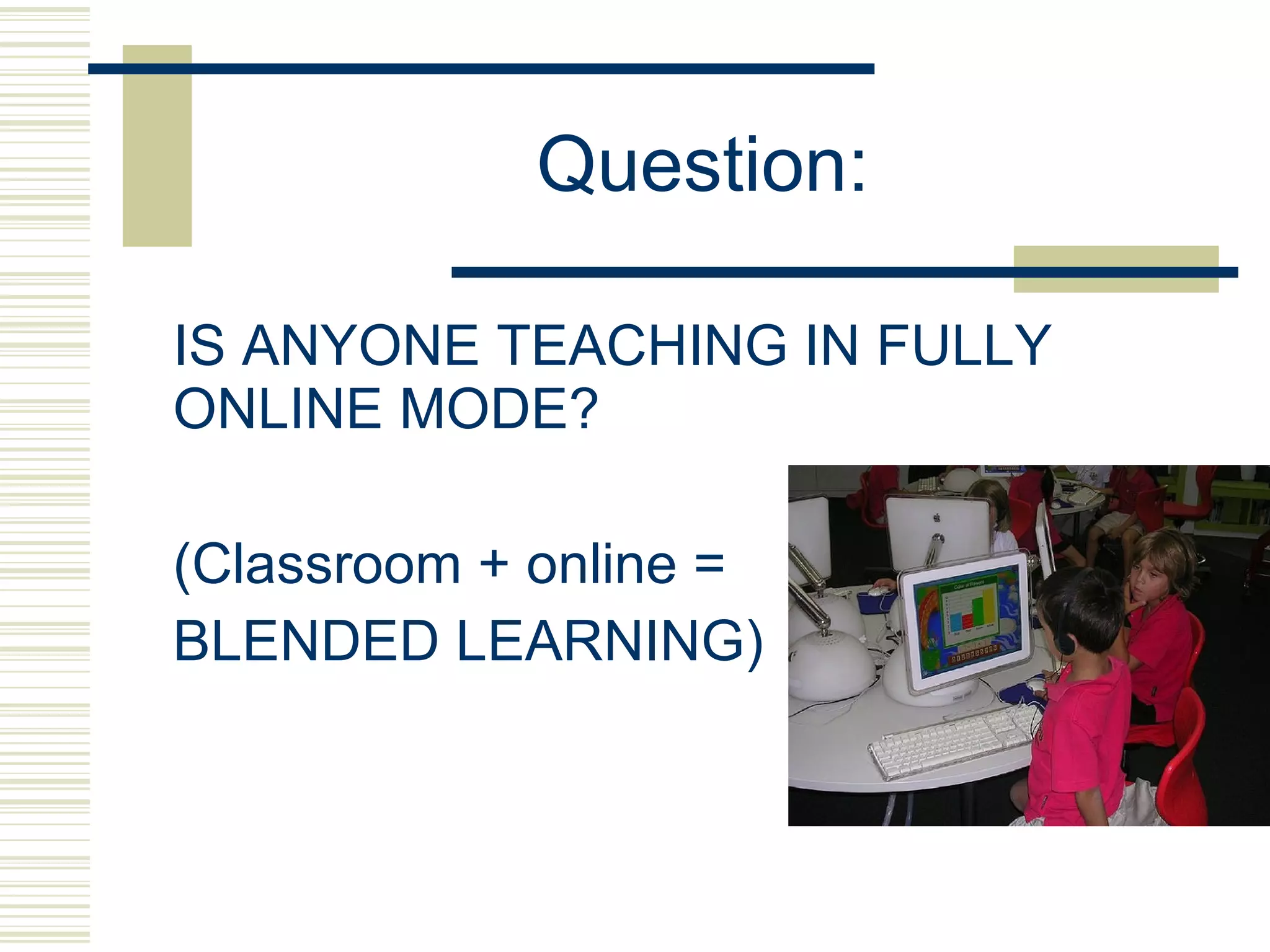
Question: IS ANYONE TEACHING IN FULLY ONLINE MODE? (Classroom + online = BLENDED LEARNING)
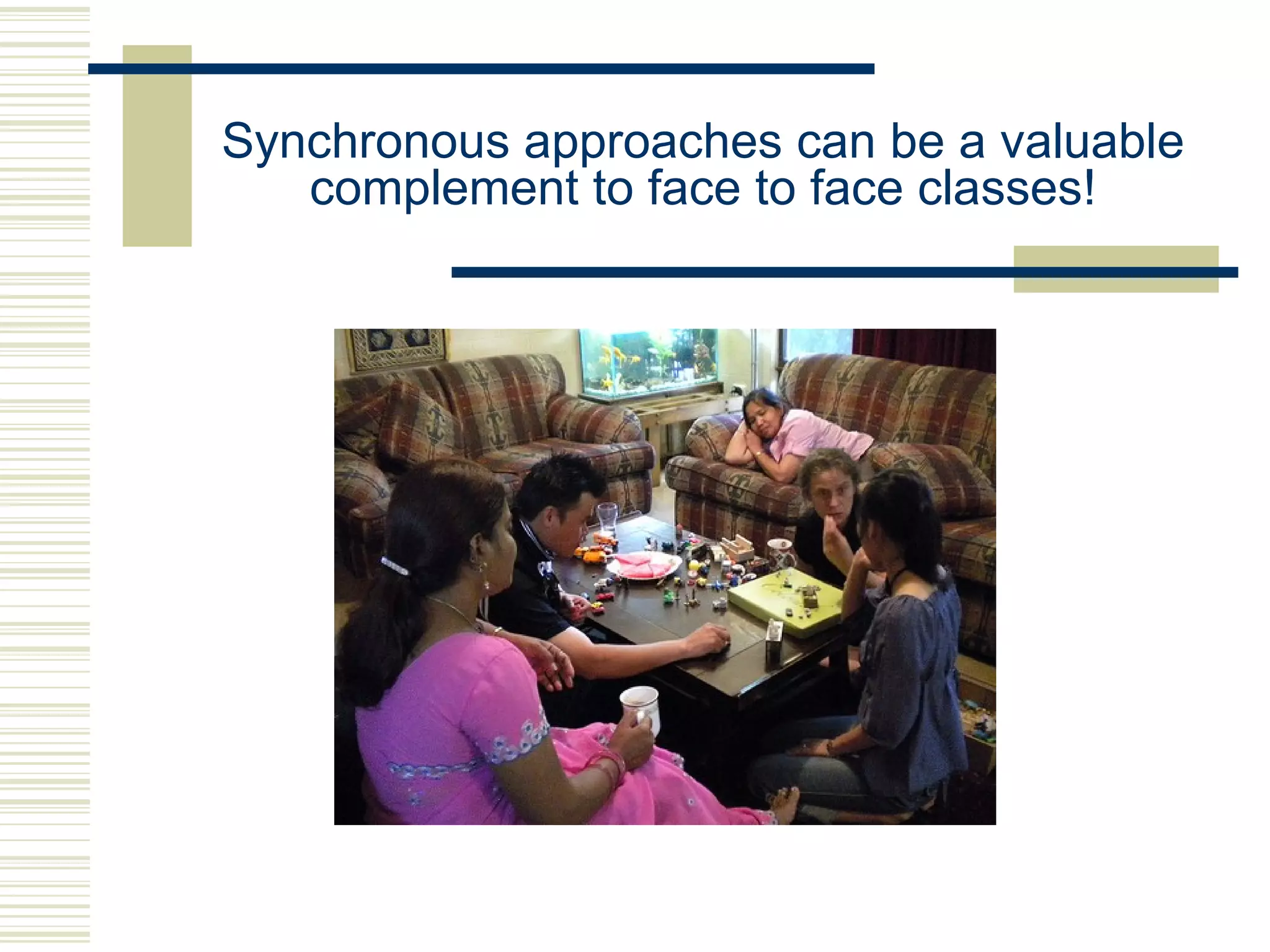
Synchronous approaches can be a valuable complement to face to face classes!
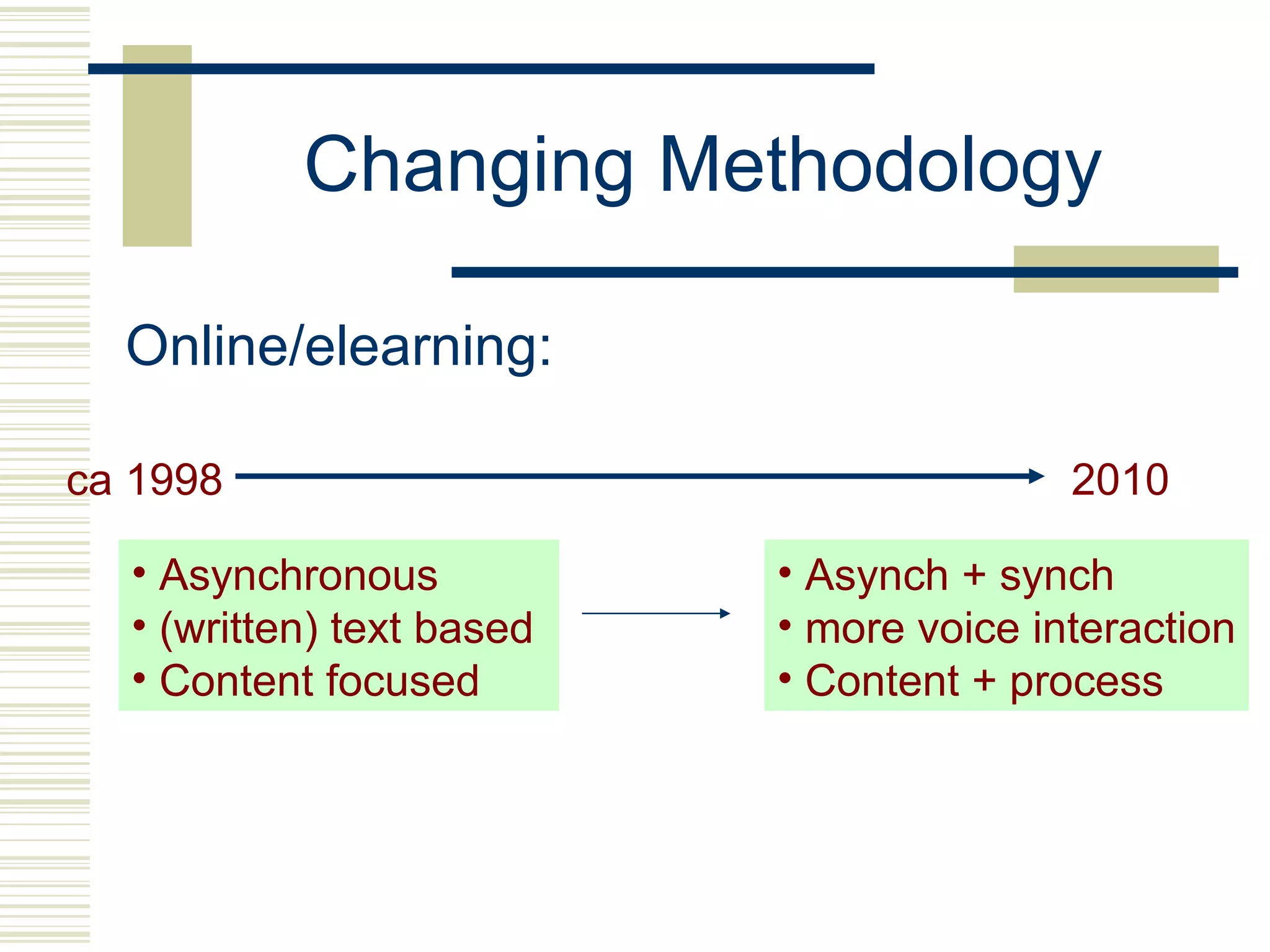
Changing Methodology Online/elearning: Asynchronous (written) text based  Content focused   Asynch + synch more voice interaction Content + process ca 1998 2010
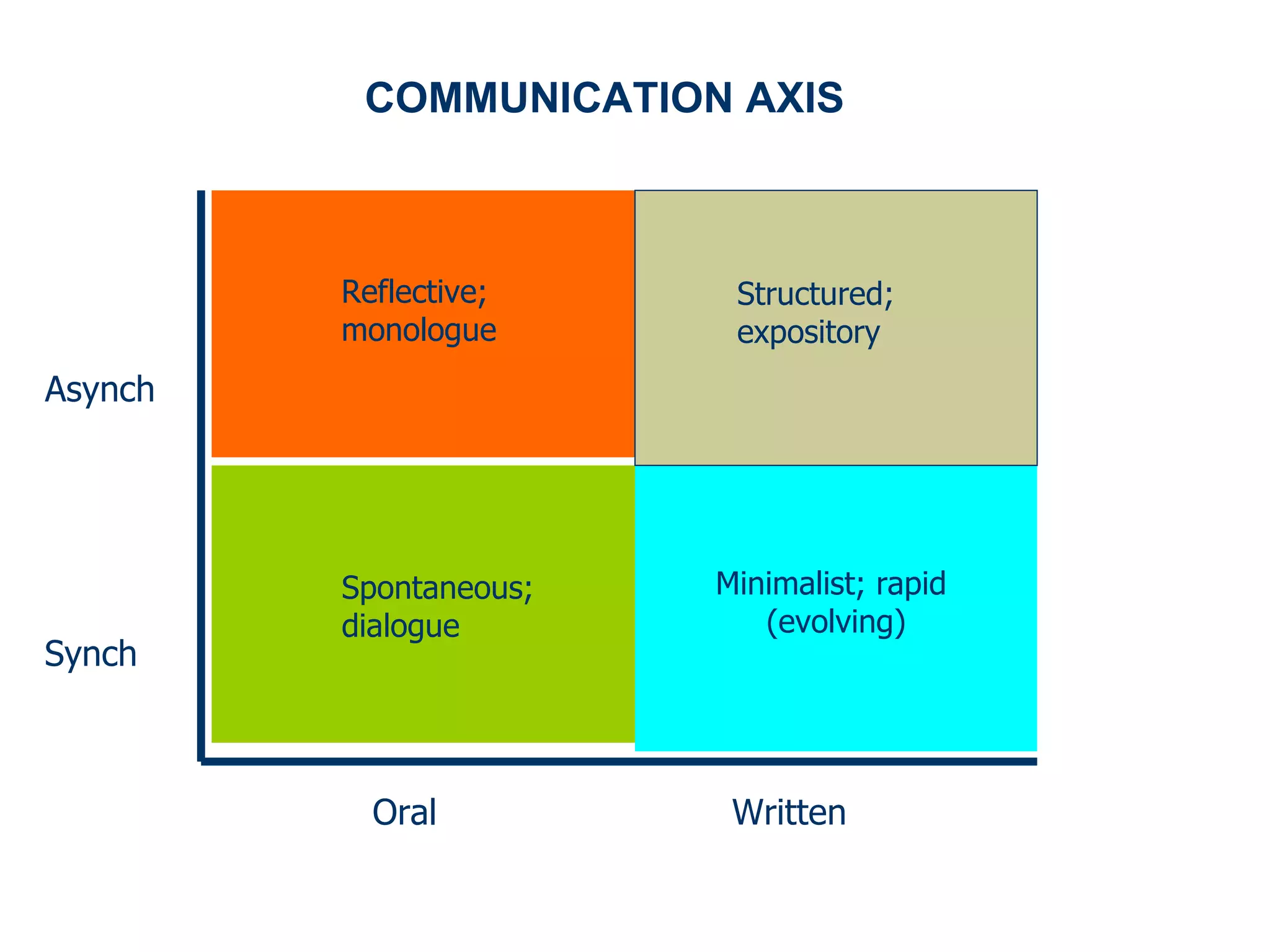
Asynch Synch Oral Written Minimalist; rapid  (evolving) COMMUNICATION AXIS Spontaneous; dialogue Reflective;  monologue Structured; expository
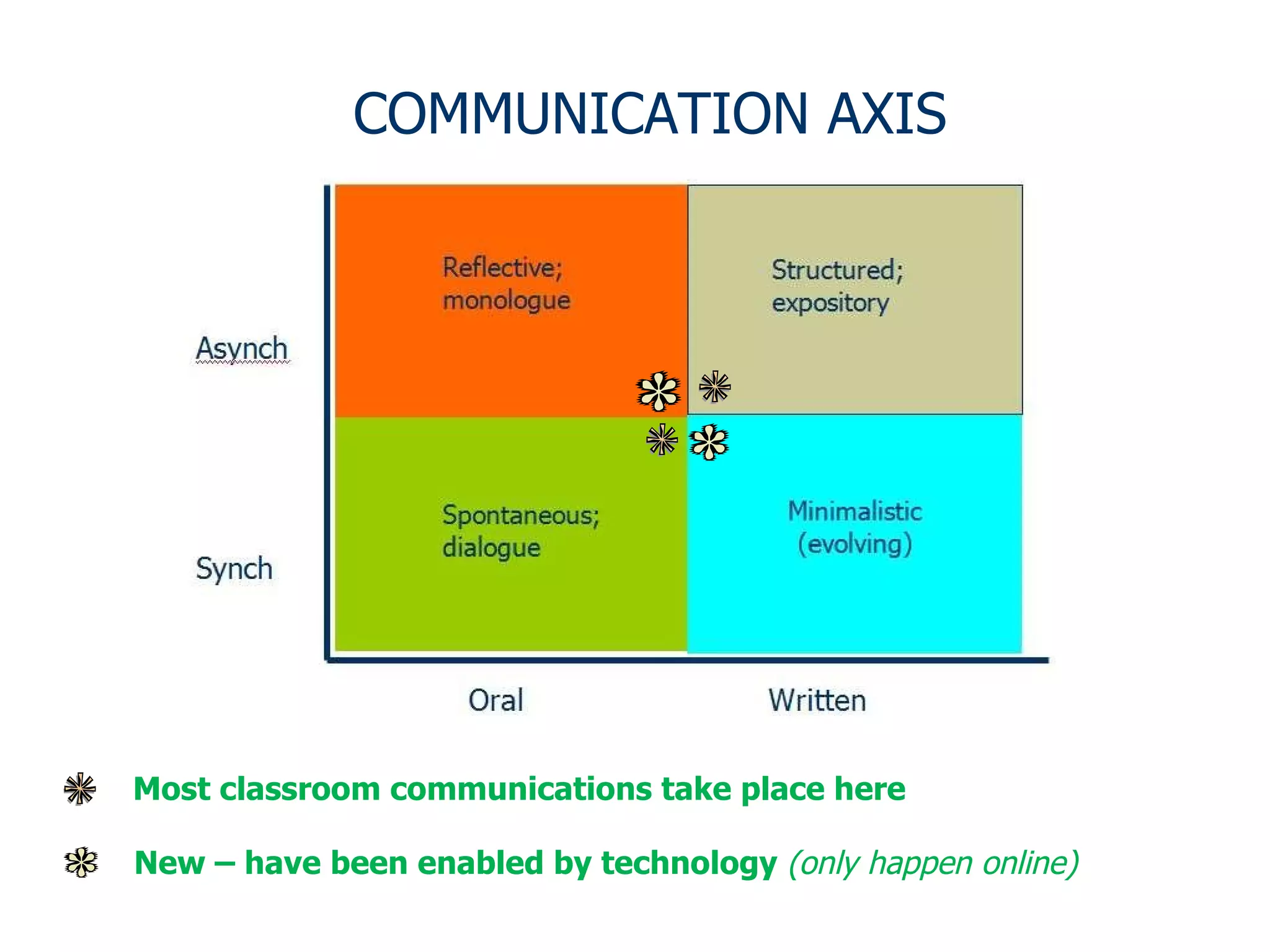
COMMUNICATION AXIS Most classroom communications take place here New – have been enabled by technology  (only happen online)
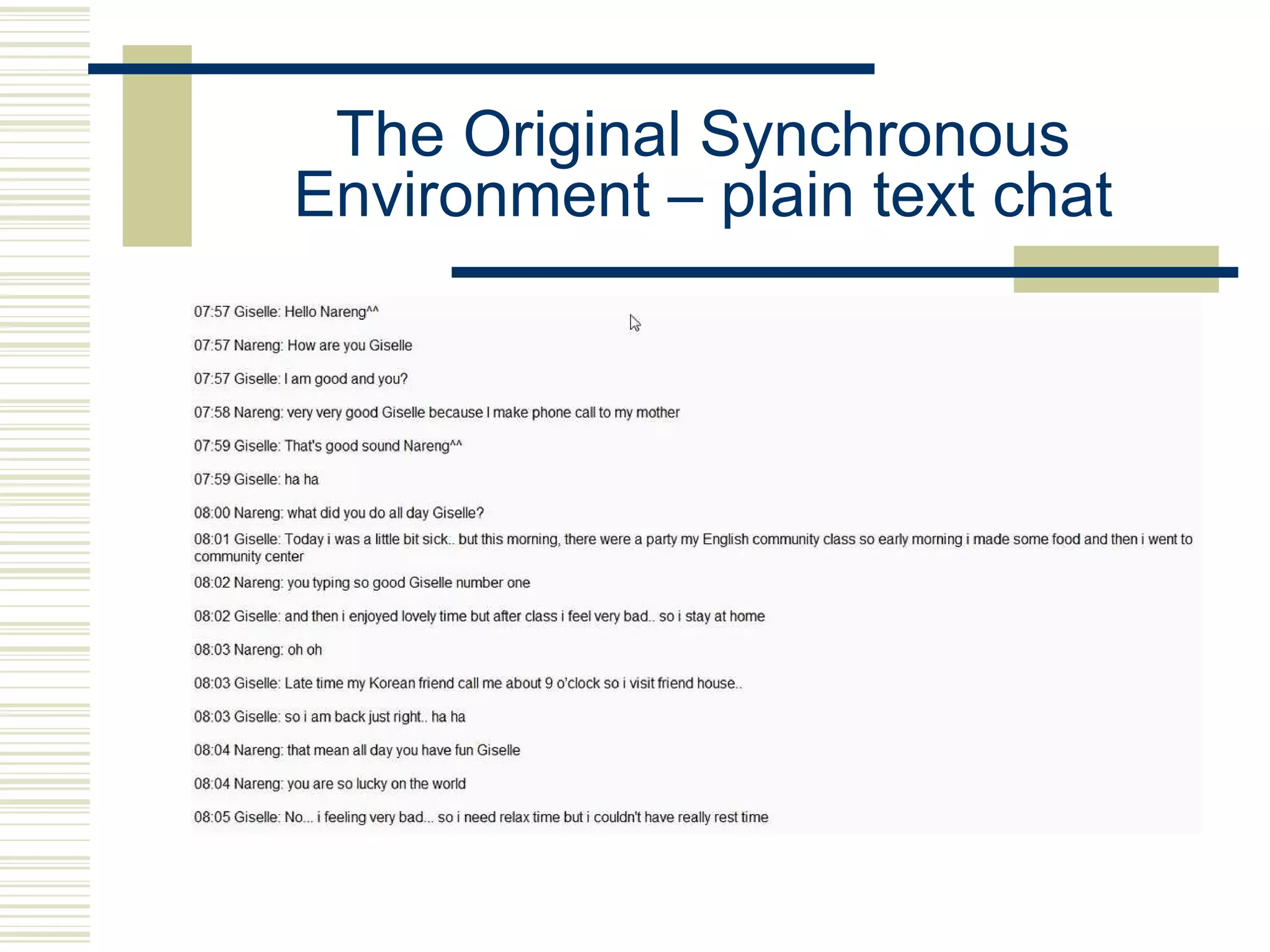
The Original Synchronous Environment – plain text chat
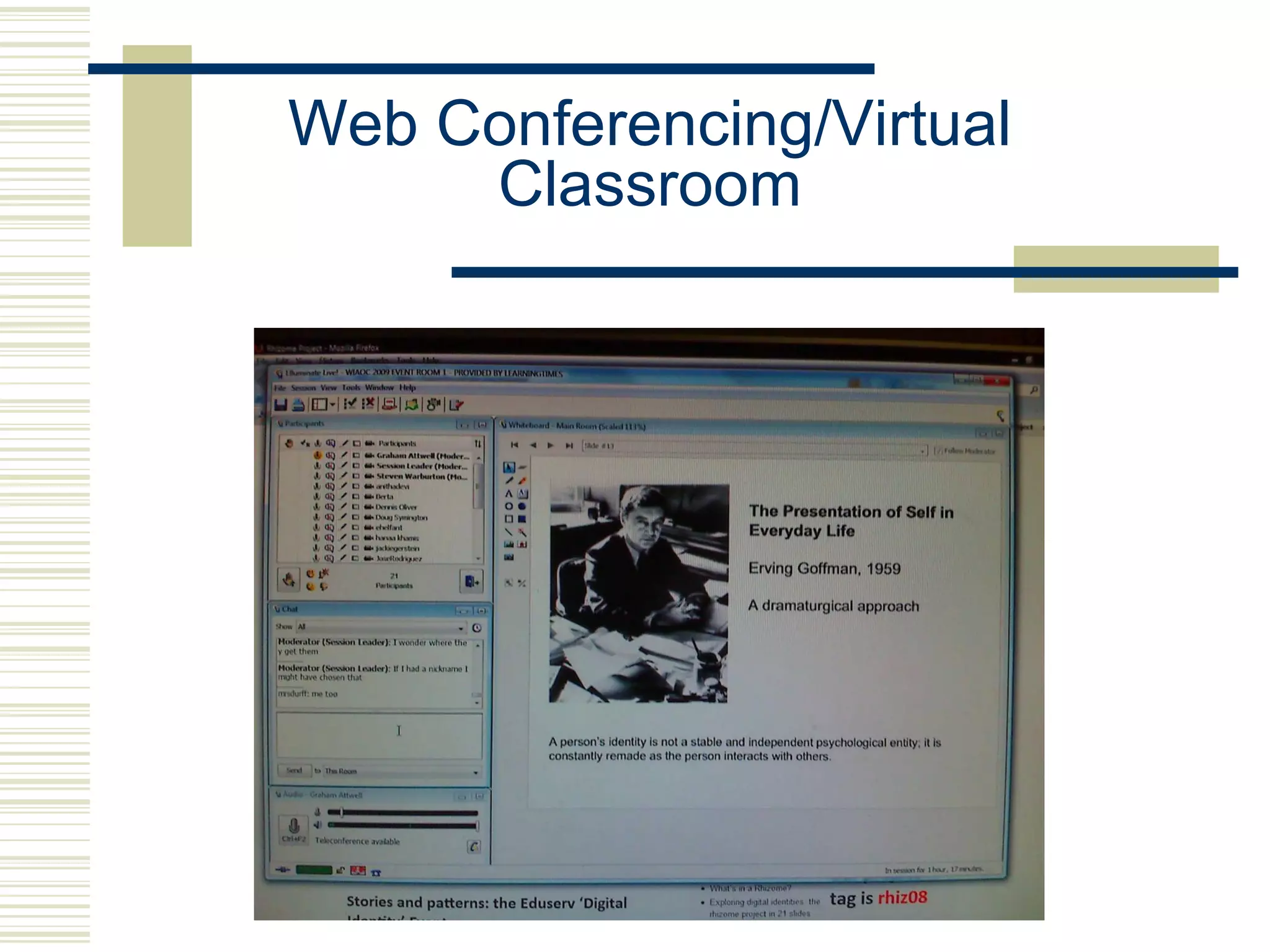
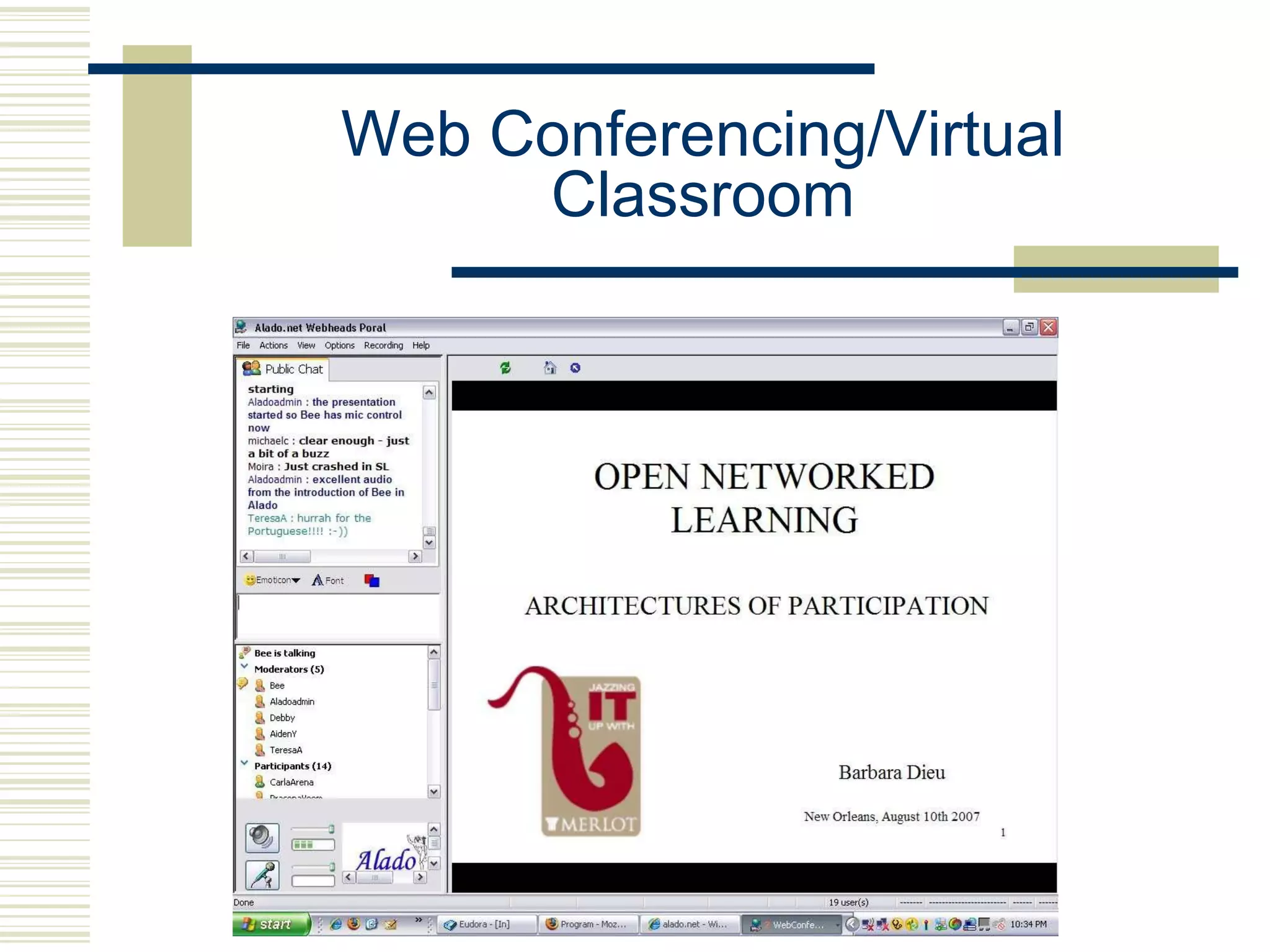
Web Conferencing/Virtual Classroom
Range of Synchronous Tools Instant messengers: Google Talk, Skype, Yahoo, MSN (text + voice) Peer to Peer/Collaborative Tools: eg Etherpad (documents), Mind Mapping, Whiteboards, etc Virtual Classrooms  Proprietary: Elluminate, Adobe Connect, etc  Free: Wiziq, DimDim, Vyew
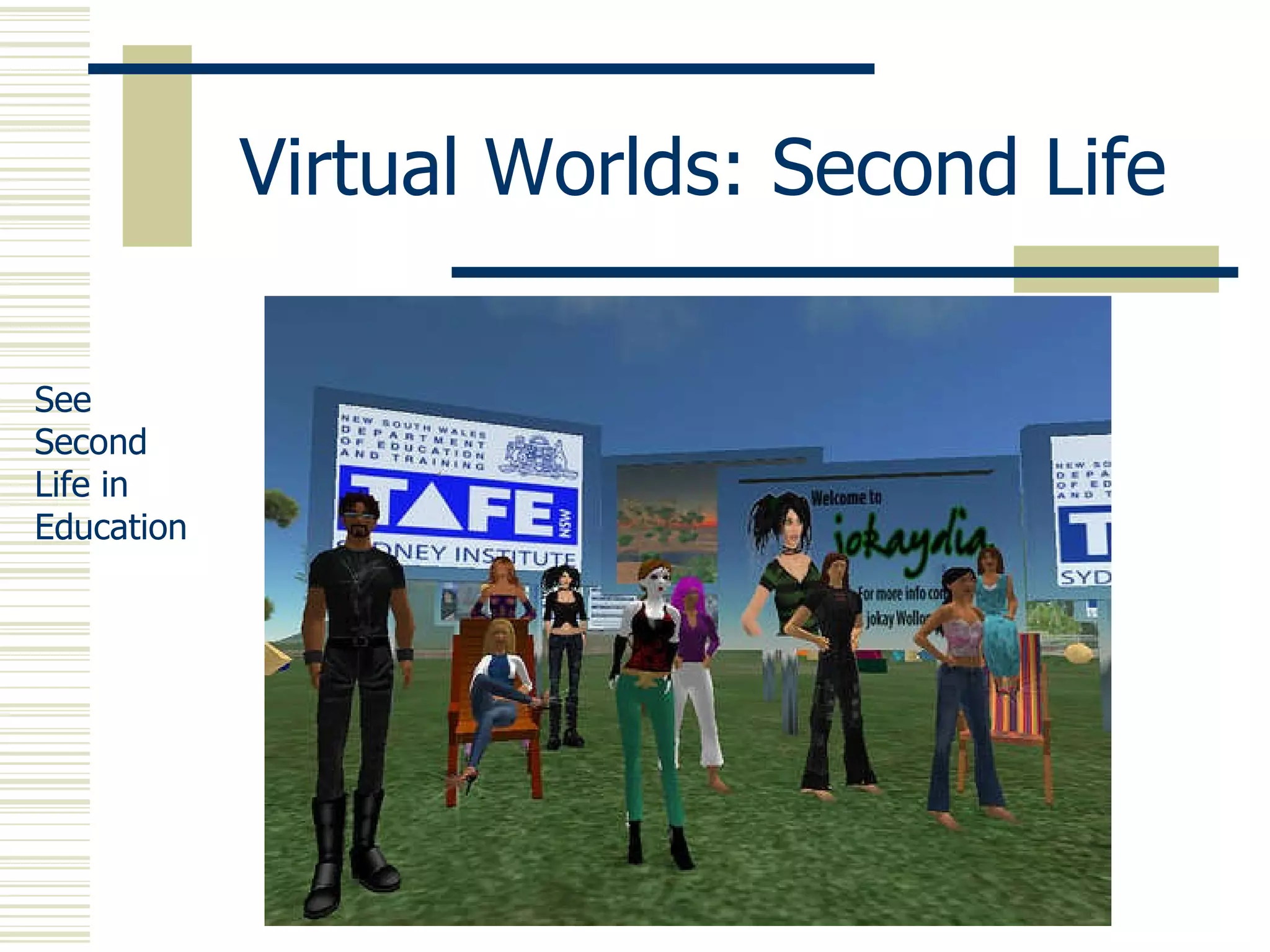
Virtual Worlds: Second Life See  Second  Life in  Education
Your Experience? Have you experienced the use of synchronous tools in online courses that you have either taught or studied?
Your Experience? How have synchronous tools been used in courses you have either taught or studied? small group work? one-on-one communications? whole class meetings? whole class instruction? other?
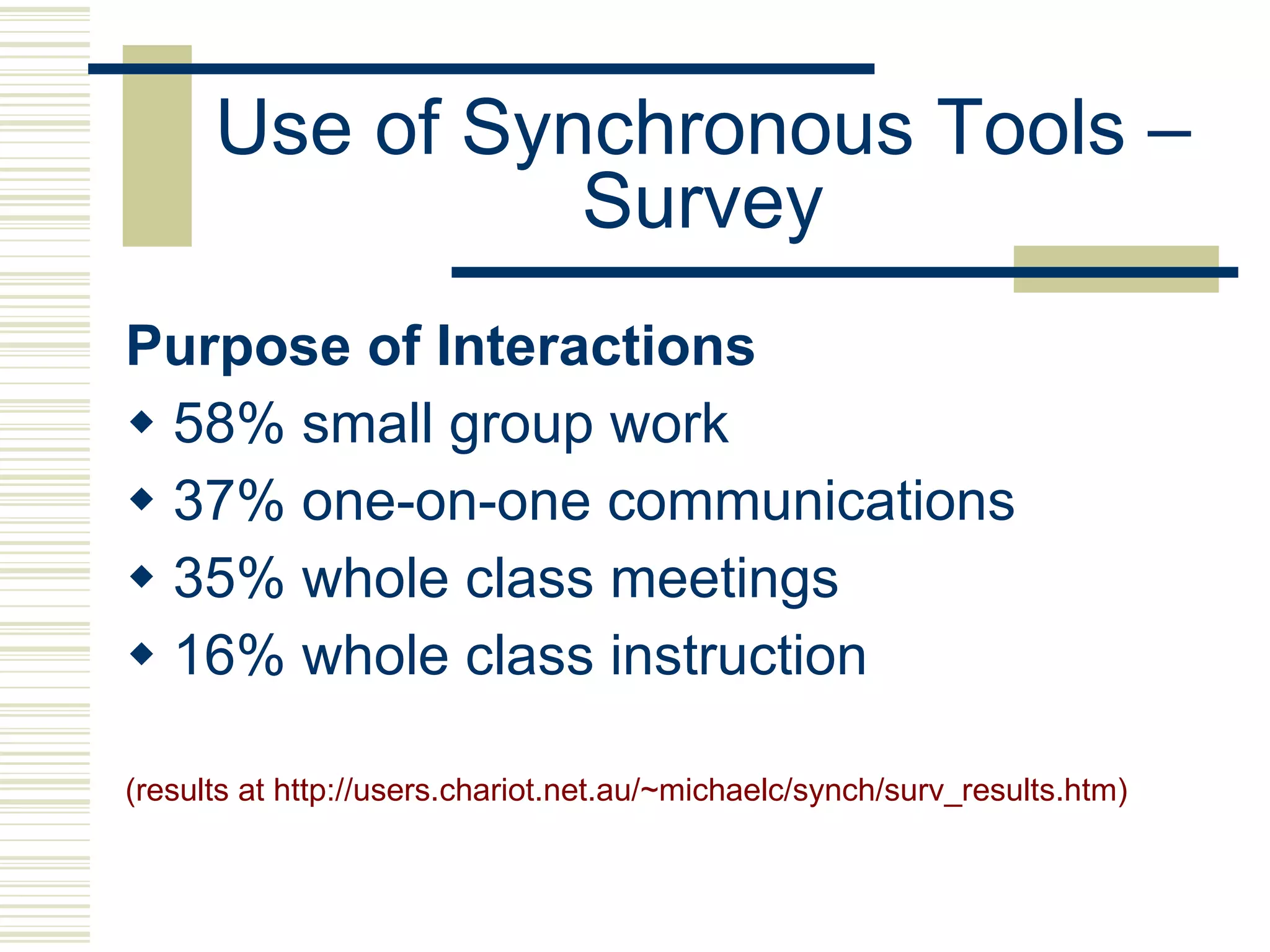
Use of Synchronous Tools – Survey Purpose of Interactions 58% small group work 37% one-on-one communications 35% whole class meetings 16% whole class instruction (results at http://users.chariot.net.au/~michaelc/synch/surv_results.htm)
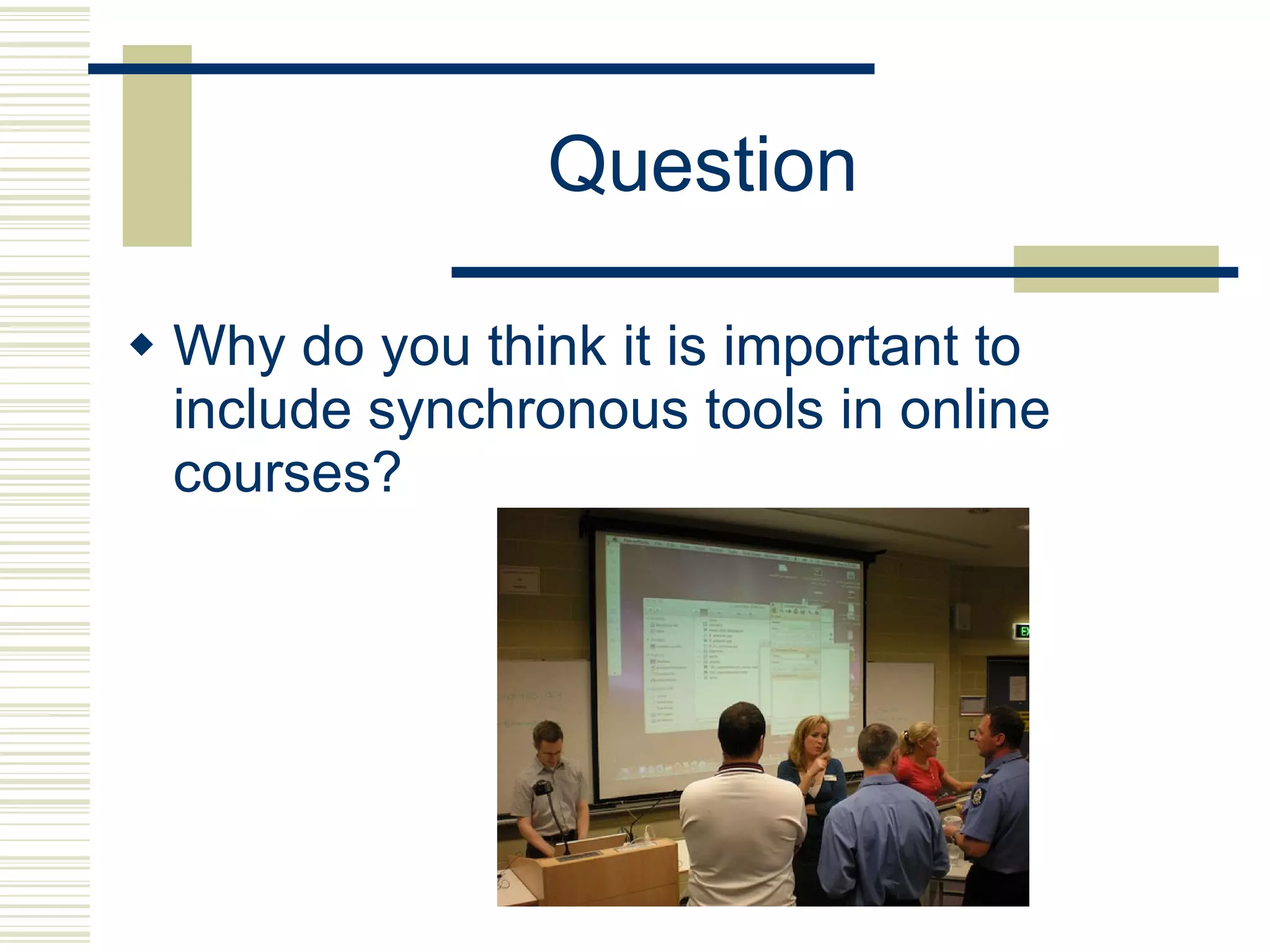
Question Why do you think it is important to include synchronous tools in online courses?
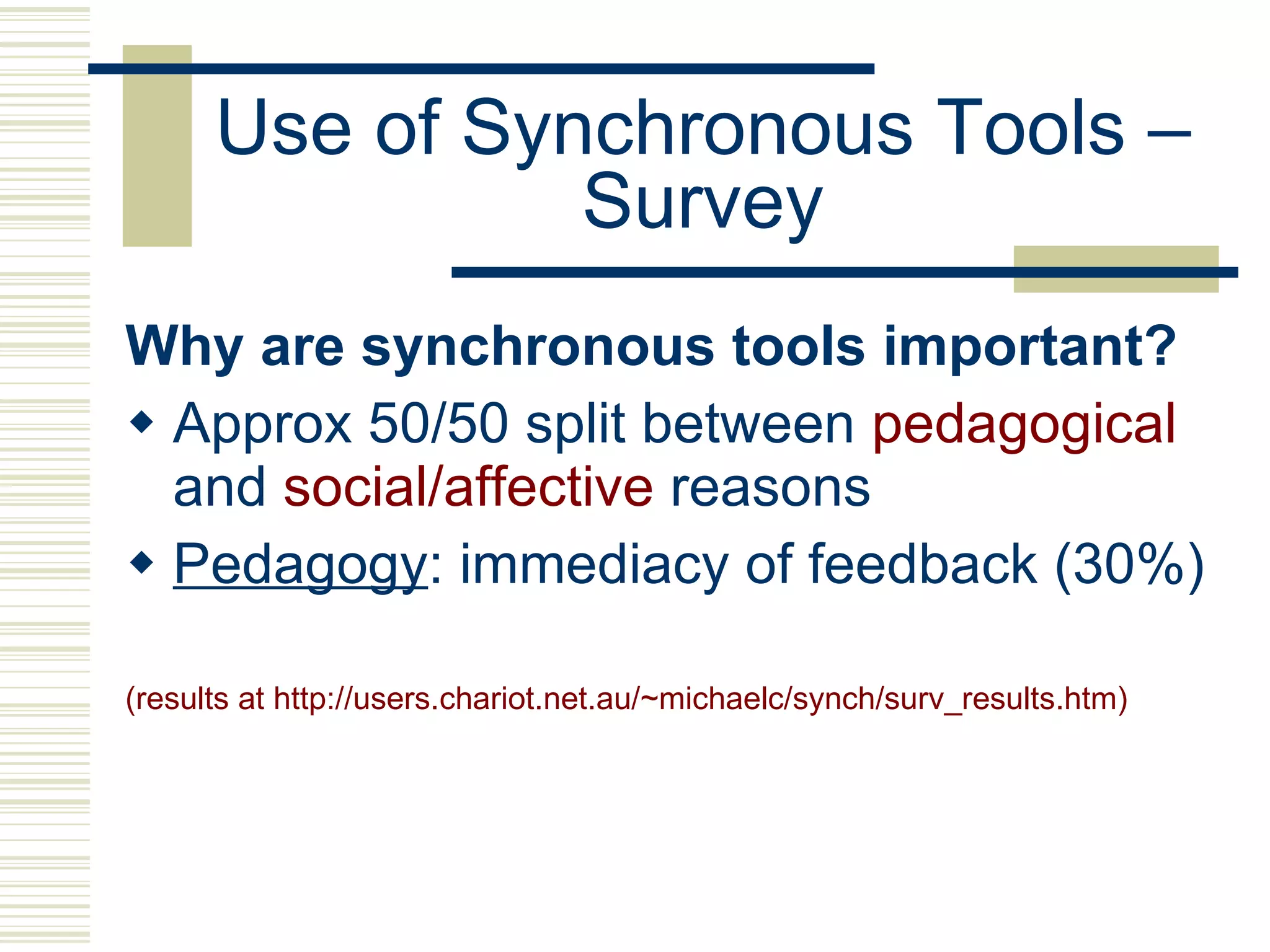
Use of Synchronous Tools – Survey Why are synchronous tools important? Approx 50/50 split between  pedagogical  and  social/affective  reasons Pedagogy : immediacy of feedback (30%) (results at http://users.chariot.net.au/~michaelc/synch/surv_results.htm)
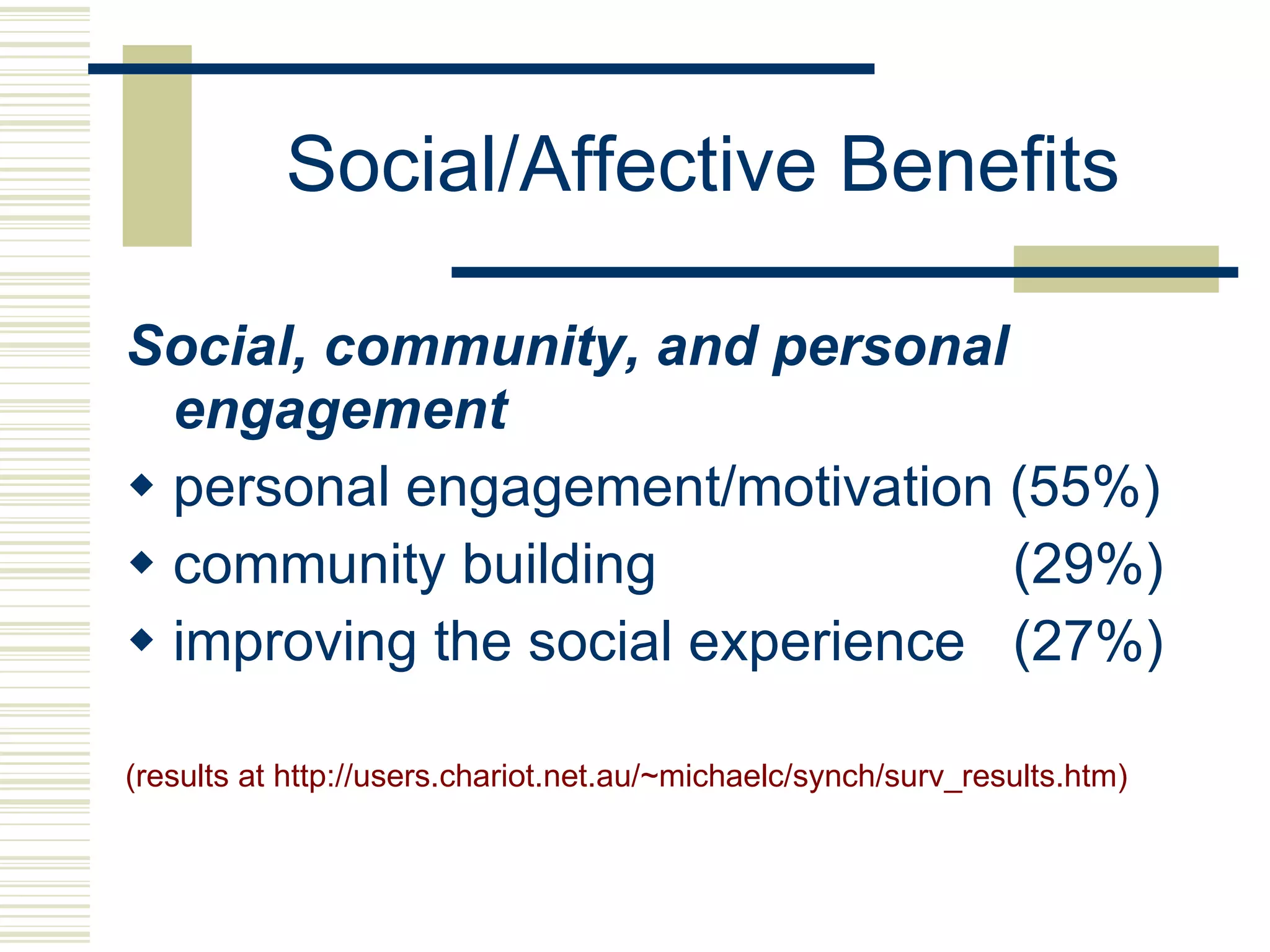
Social/Affective Benefits Social, community, and personal engagement personal engagement/motivation (55%) community building   (29%) improving the social experience  (27%) (results at http://users.chariot.net.au/~michaelc/synch/surv_results.htm)
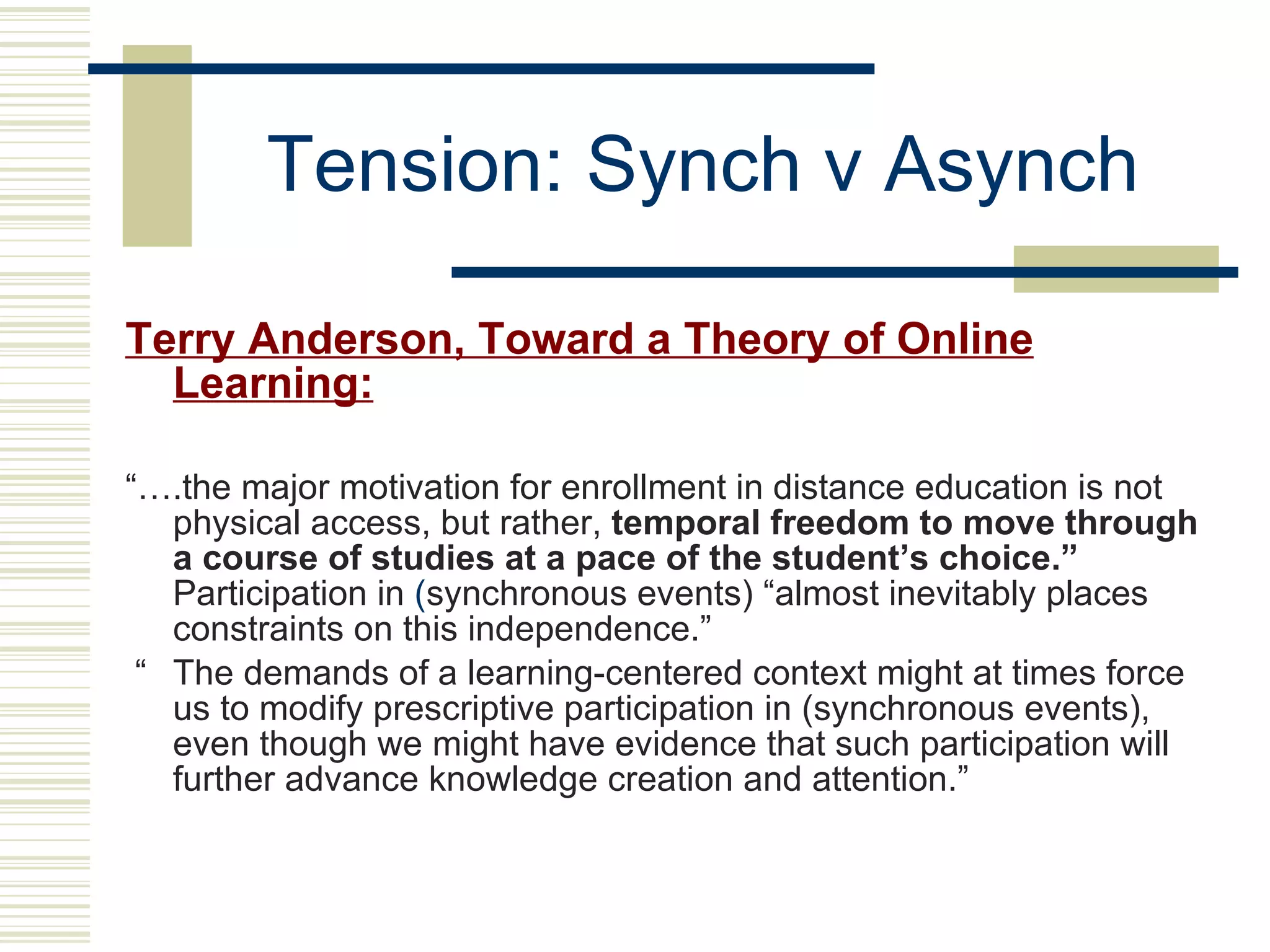
Tension: Synch v Asynch Terry Anderson, Toward a Theory of Online Learning:   “… .the major motivation for enrollment in distance education is   not physical access, but rather,  temporal freedom to move through a course of studies at a pace of the student’s choice.”  Participation in  ( synchronous events) “almost inevitably places constraints on this   independence.”   “ The   demands of a learning-centered context might at times force us to   modify prescriptive participation in (synchronous events),   even though we might have evidence that such participation will   further advance knowledge creation and attention.”
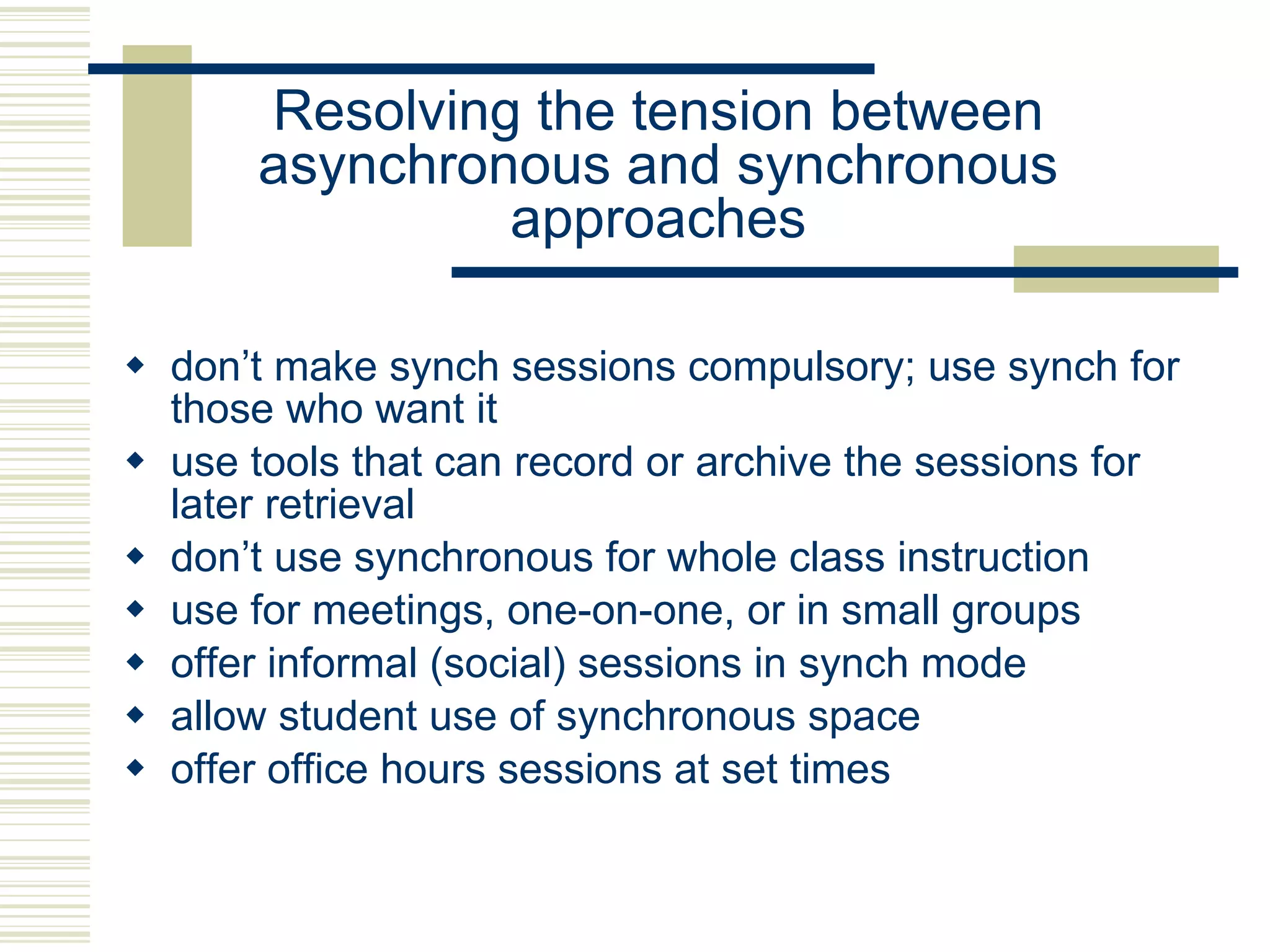
Resolving the tension between asynchronous and synchronous approaches don’t make synch sessions compulsory; use synch for those who want it use tools that can record or archive the sessions for later retrieval  don’t use synchronous for whole class instruction use for meetings, one-on-one, or in small groups offer informal (social) sessions in synch mode allow student use of synchronous space offer office hours sessions at set times
Resolving the tension between asynchronous and synchronous approaches It’s not all or nothing – use both approaches: Synch for social, spontaneous, decision making Asynch for deliberation, reflection, considered opinion
The Instructional Challenge: Methodology:  how do you use synchronous tools to maximise their impact?
 
Skills of the Live Online Presenter Golden Rule : 6-8 minutes talking at a stretch maximum Intersperse presentations with questions, polls, other speakers (from the floor), whiteboard activity Decide how to handle direct messaging – will you monitor/respond? Or ignore it? Dip in and out of it? Consider working with a producer/co-presenter More at  http://users.chariot.net.au/~michaelc/fll/blog.htm#skills
What kinds of synchronous activities can you use in classrooms? TEACHING ‘ straight lecture’ Guest lecturers Oral presentations Group work One on one (eg pronunciation) OTHER Office hours Social: student - student
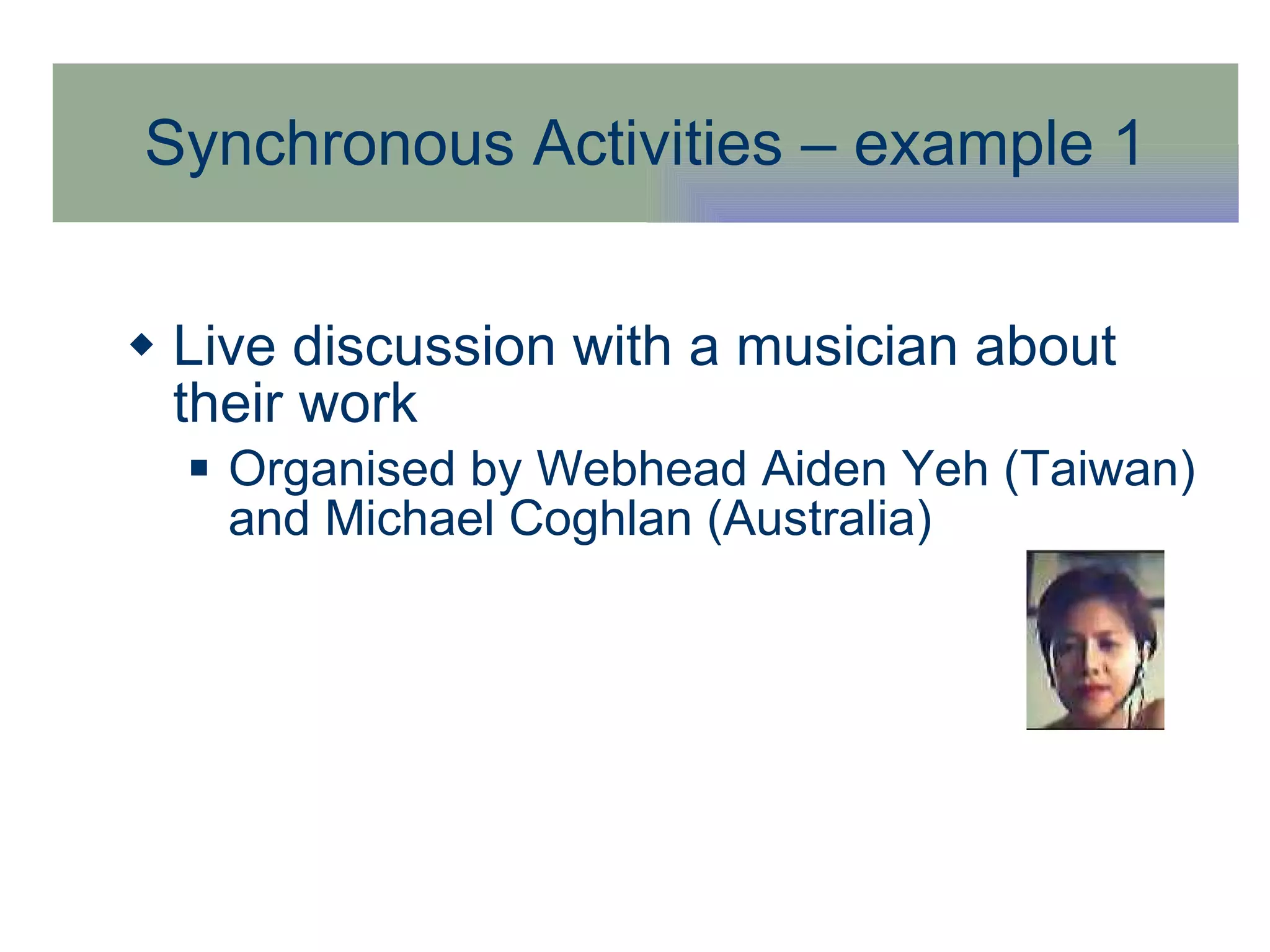
Synchronous Activities – example 1 Live discussion with a musician about  their work Organised by Webhead Aiden Yeh (Taiwan) and Michael Coghlan (Australia)
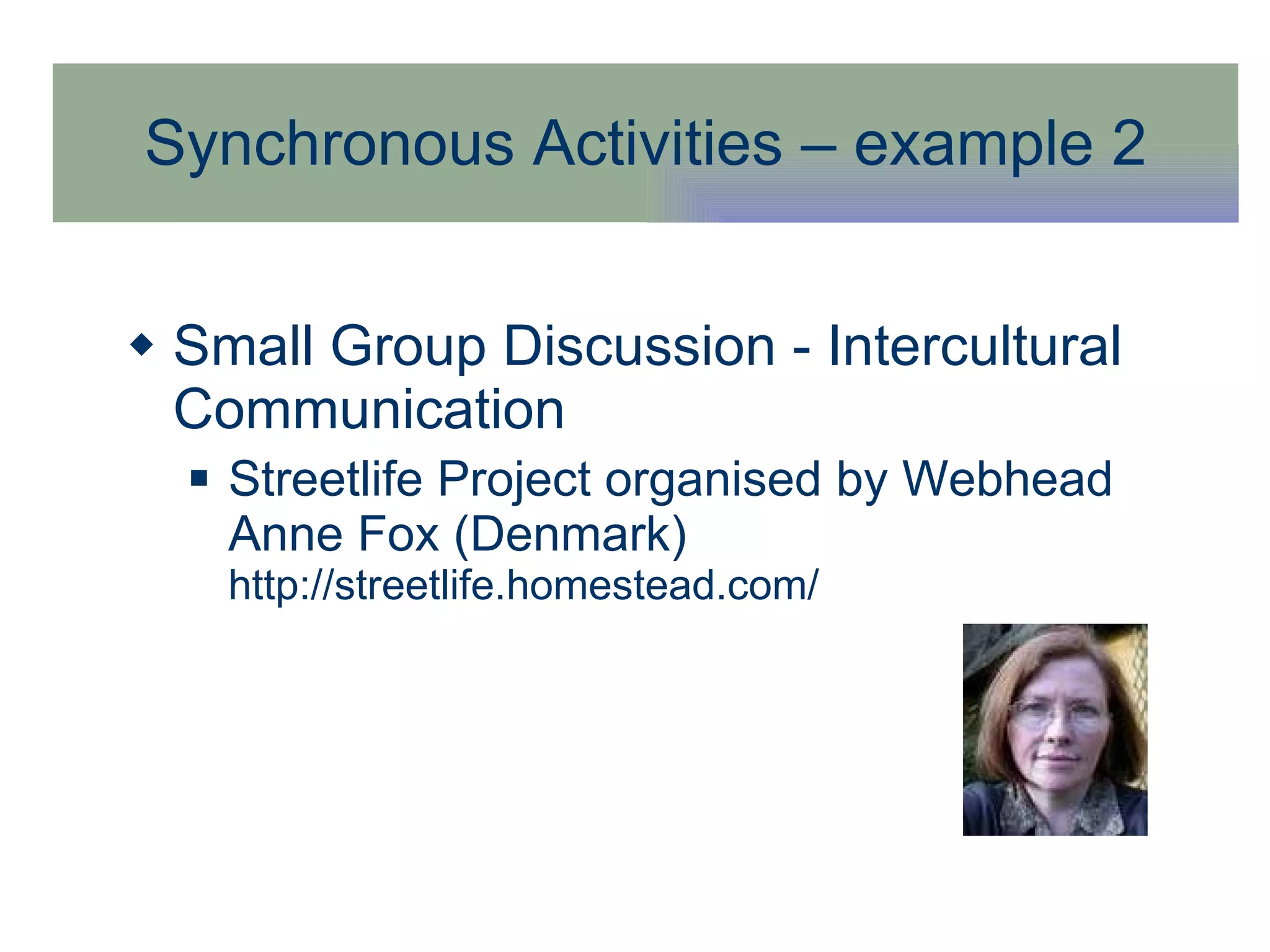
Synchronous Activities – example 2 Small Group Discussion - Intercultural Communication Streetlife Project organised by Webhead Anne Fox (Denmark)  http://streetlife.homestead.com/
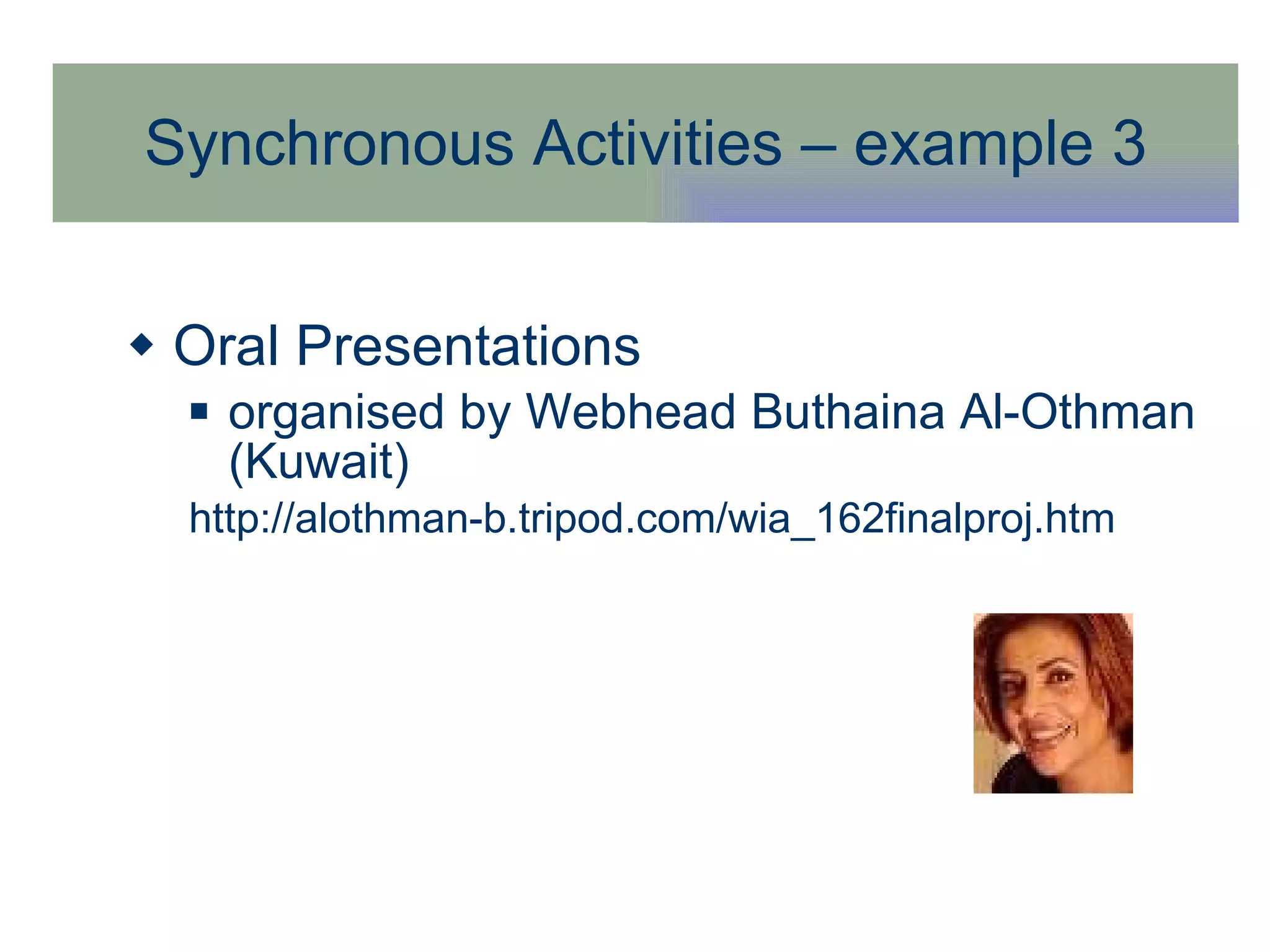
Synchronous Activities – example 3 Oral Presentations organised by Webhead Buthaina Al-Othman (Kuwait)  http:// alothman-b.tripod.com/wia_162finalproj.htm
PROFESSIONAL DEVELOPMENT Conferences, seminars Workshops and Training sessions Meetings (much more cost effective than teleconferencing)
NEAR  SYNCHRONOUS  TOOLS
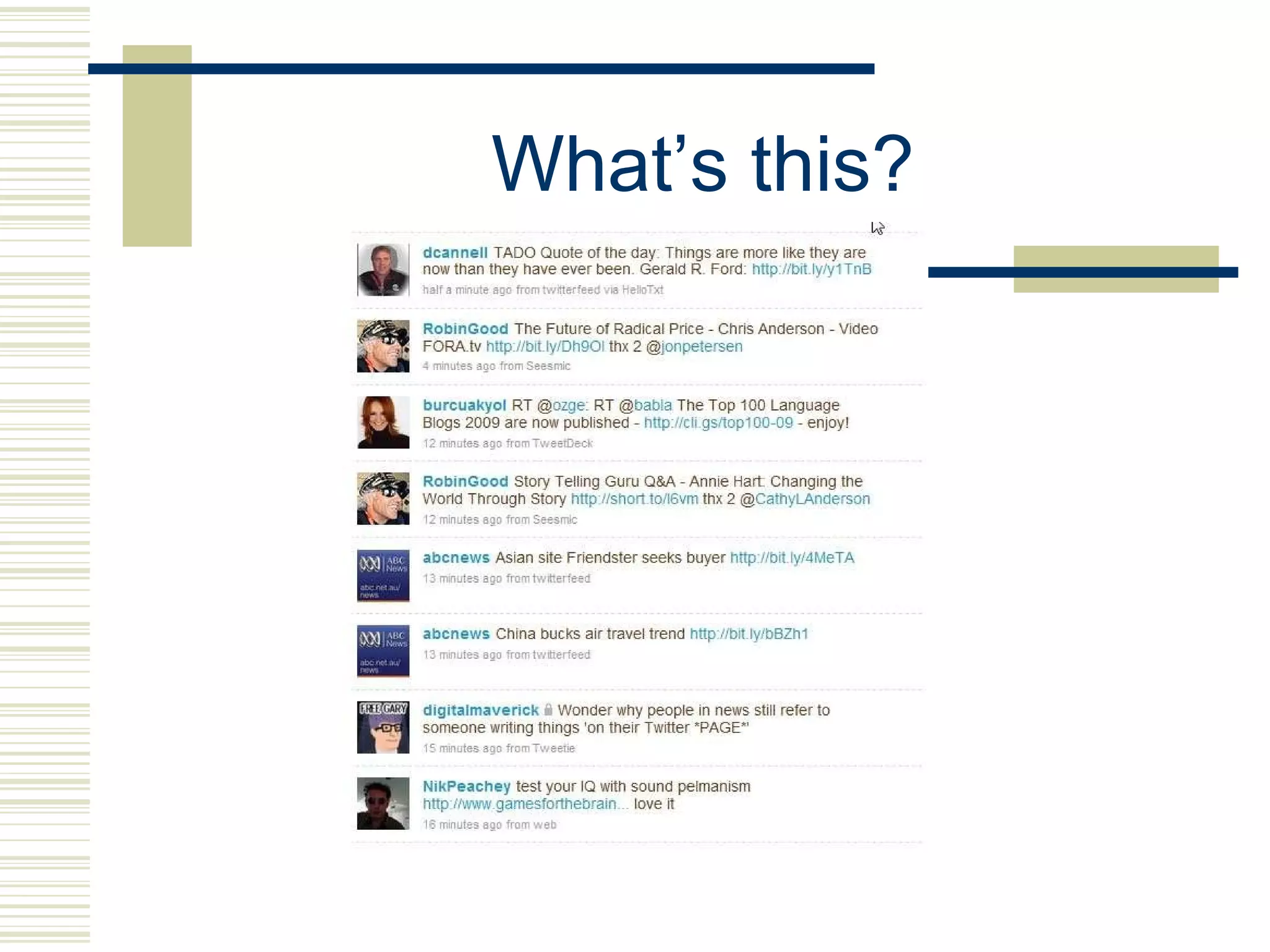
What’s this?
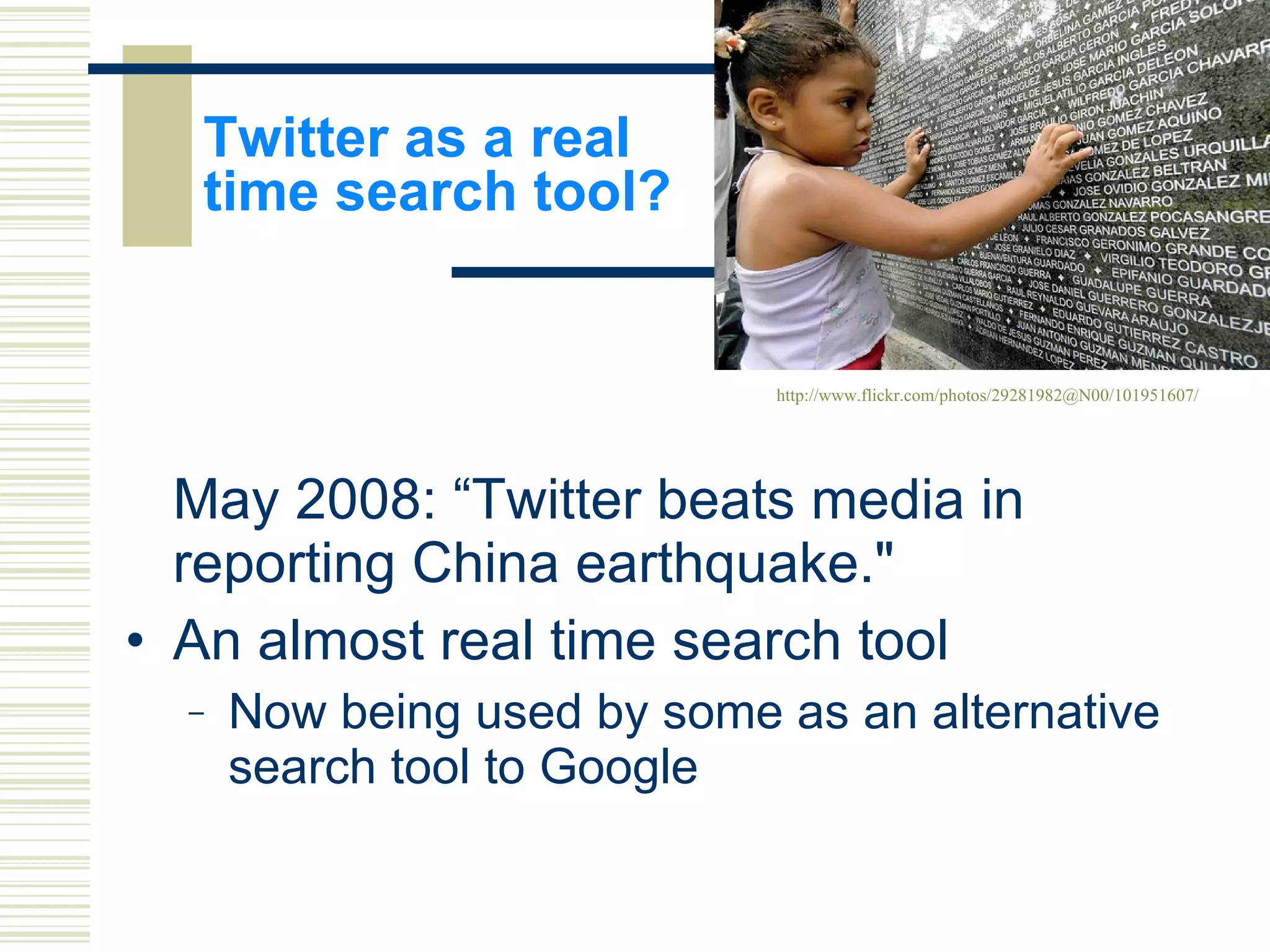
Twitter as a real  time search tool? May 2008: “Twitter beats media in reporting China earthquake."  An almost real time search tool Now being used by some as an alternative search tool to Google http://www.flickr.com/photos/29281982@N00/101951607/
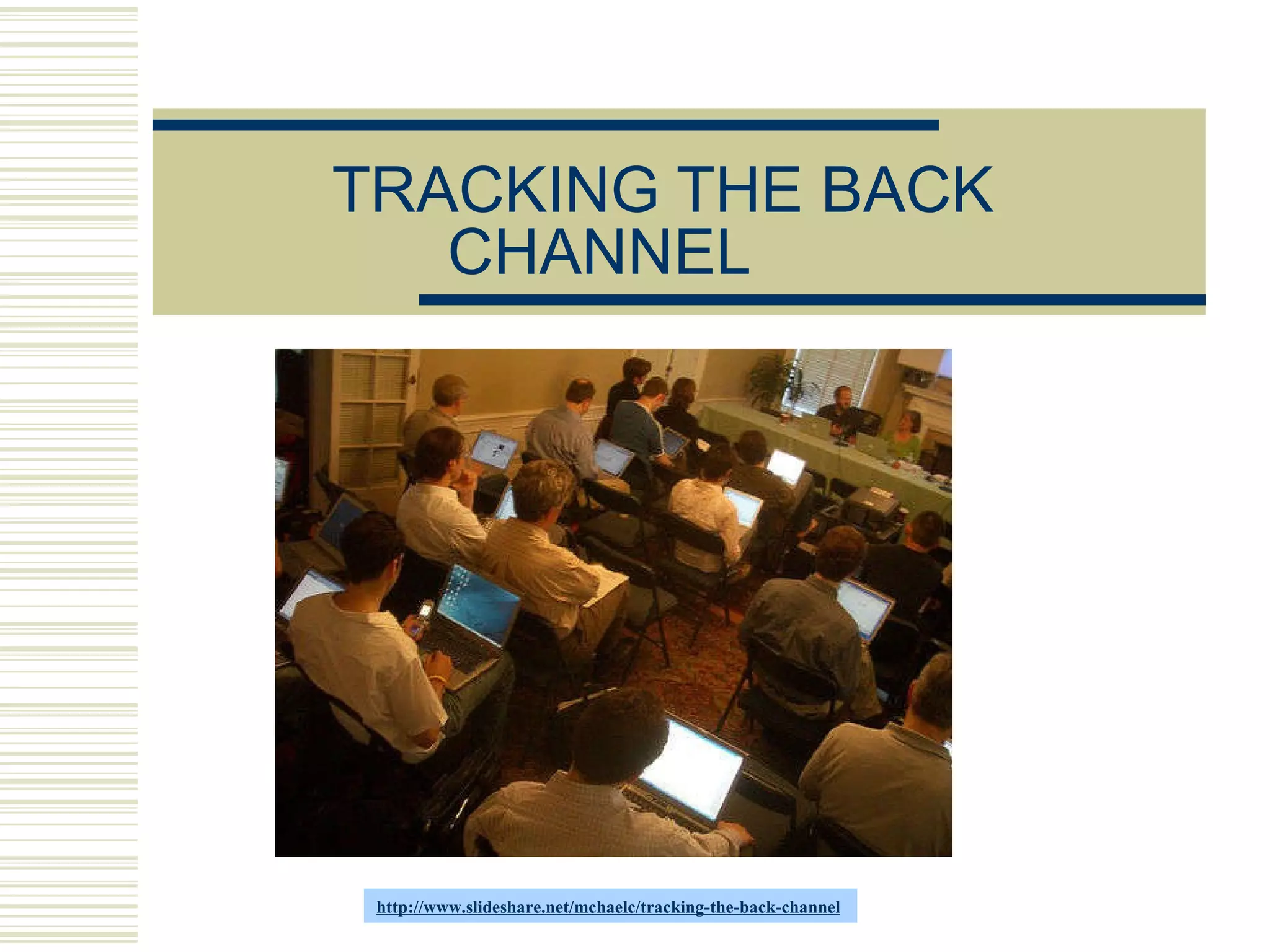
TRACKING THE BACK CHANNEL http://www.slideshare.net/mchaelc/tracking-the-back-channel
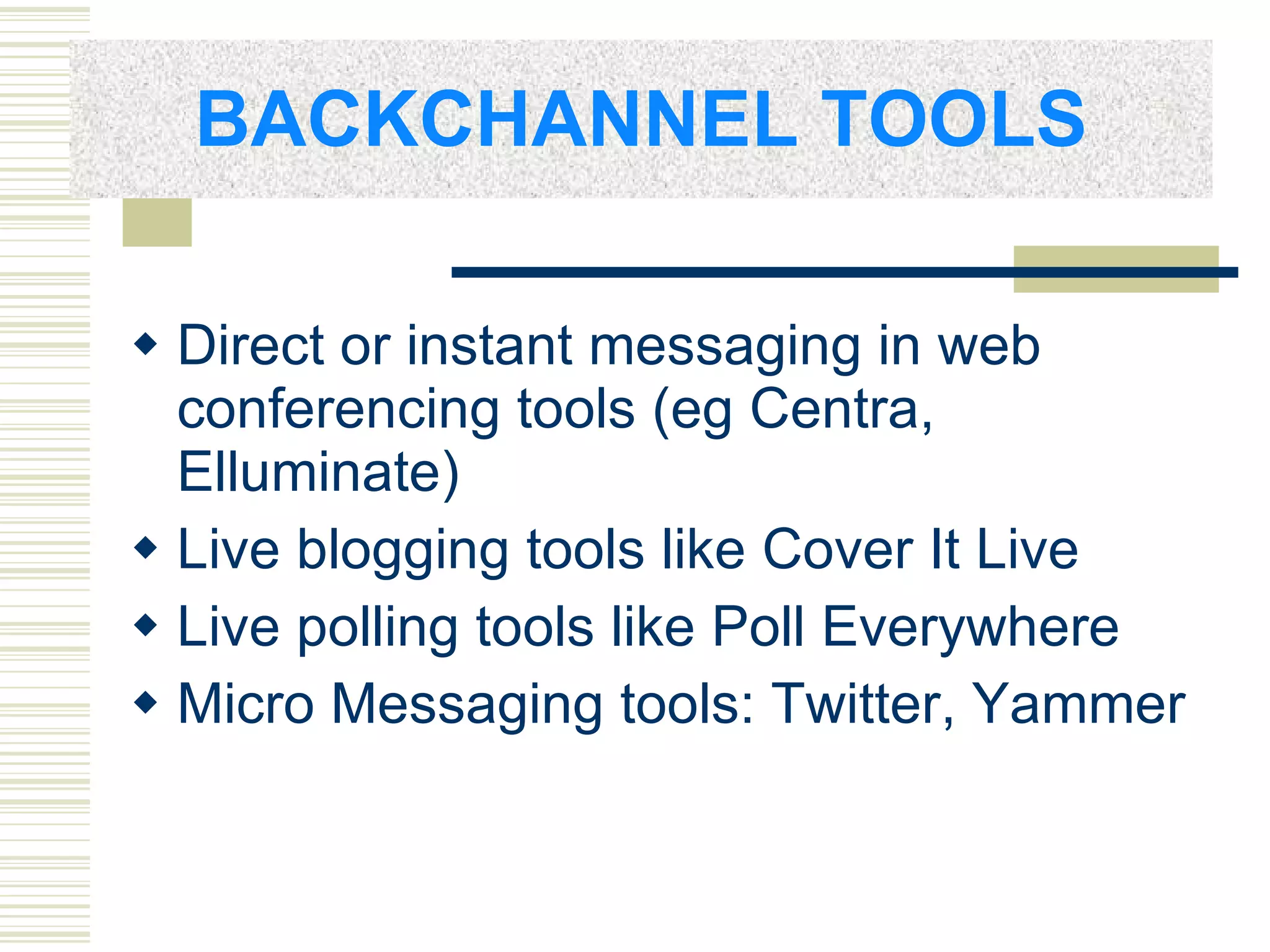
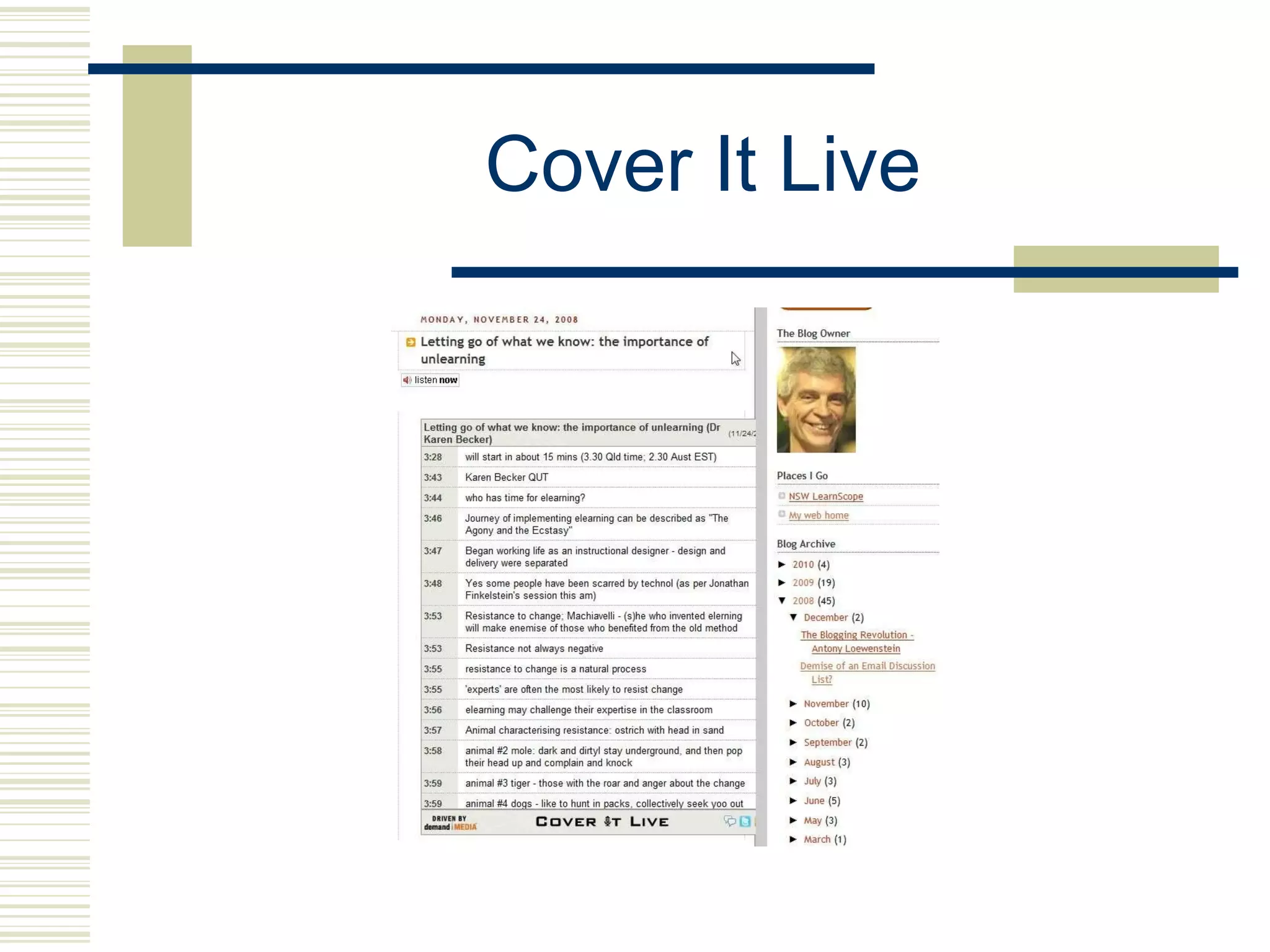
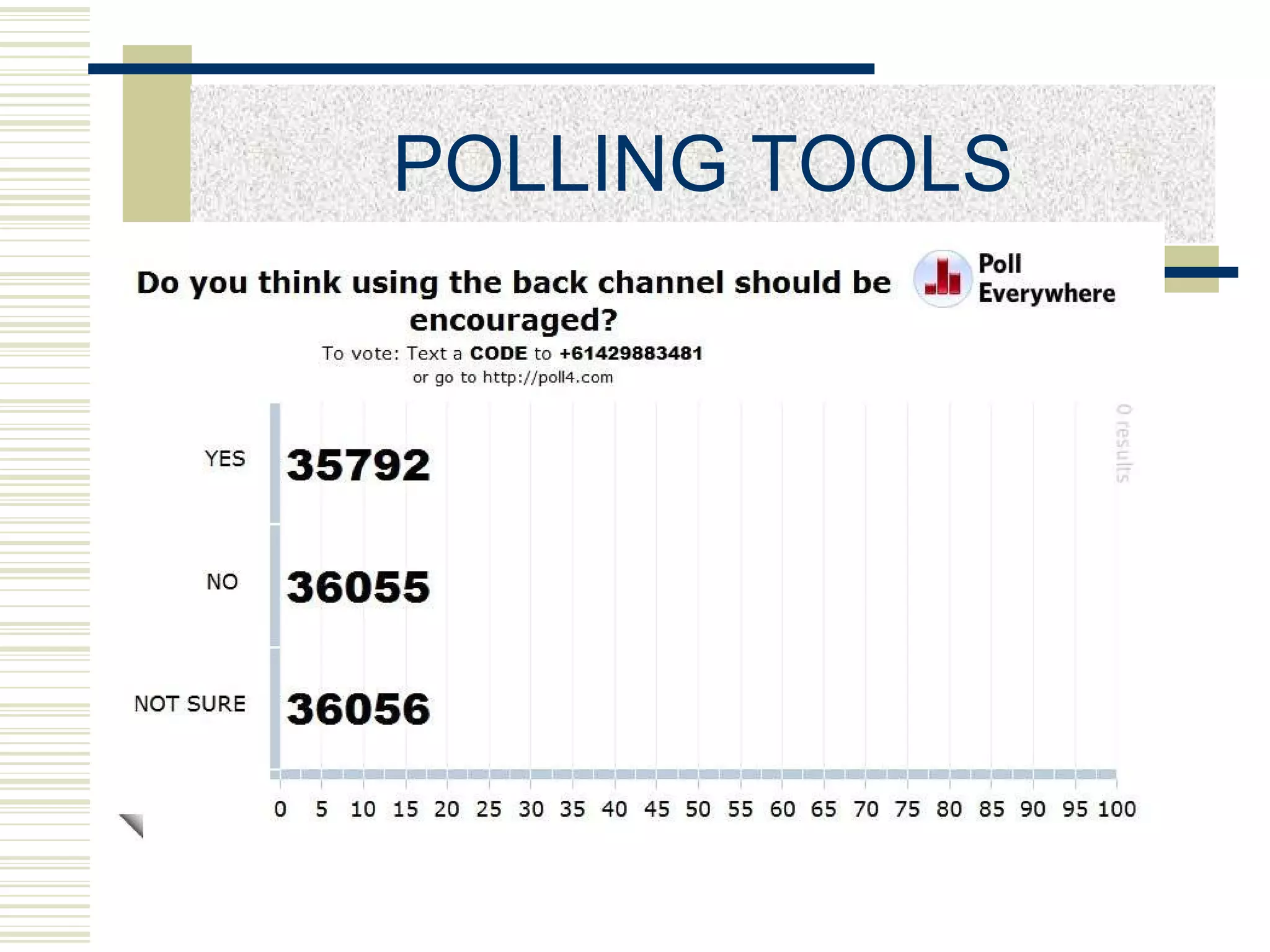
BACKCHANNEL TOOLS Direct or instant messaging in web conferencing tools (eg Centra, Elluminate) Live blogging tools like  Cover It Live Live polling tools like  Poll Everywhere Micro Messaging tools: Twitter , Yammer
Cover It Live
POLLING TOOLS
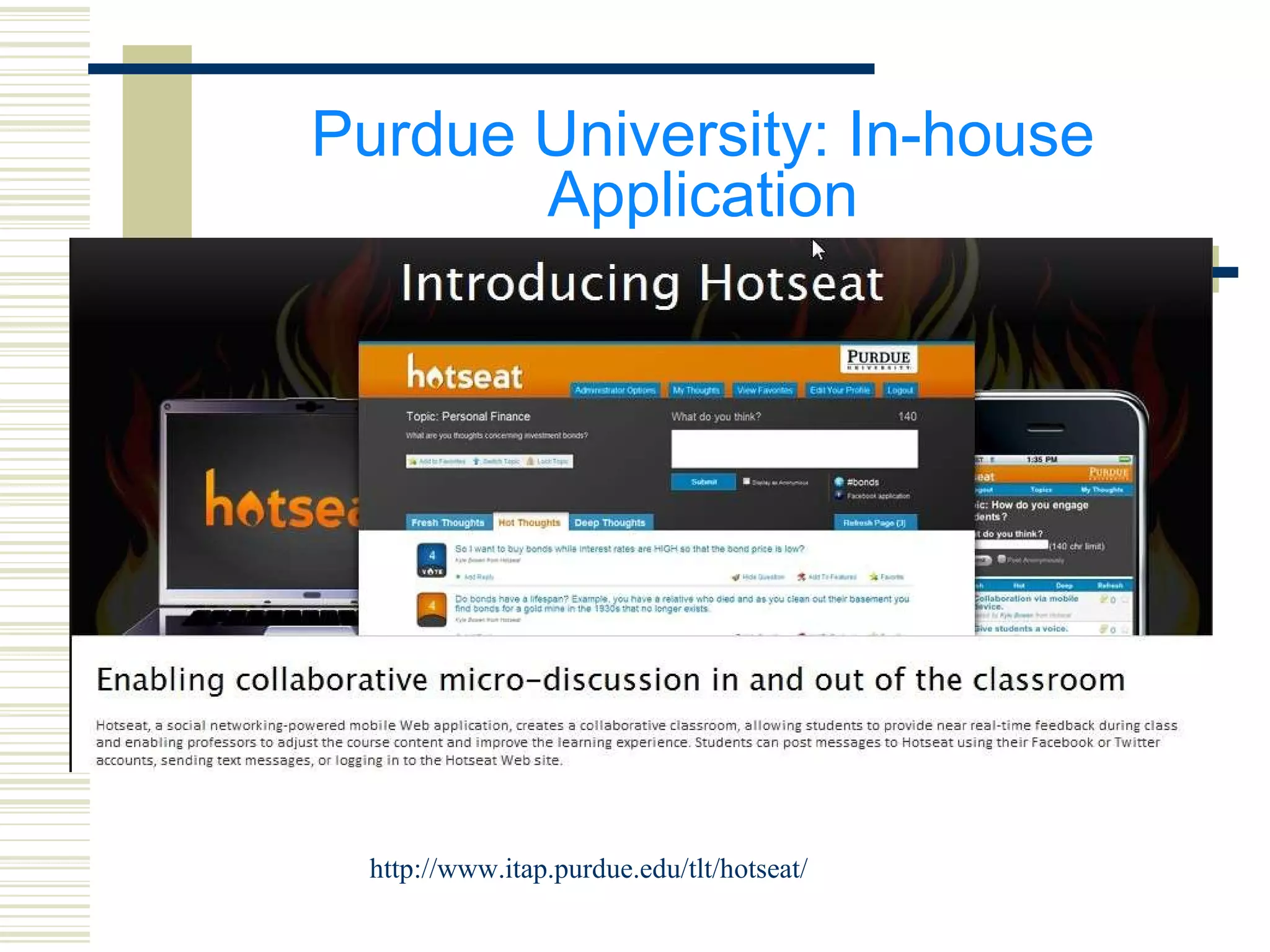
Purdue University: In-house Application http://www.itap.purdue.edu/tlt/hotseat/
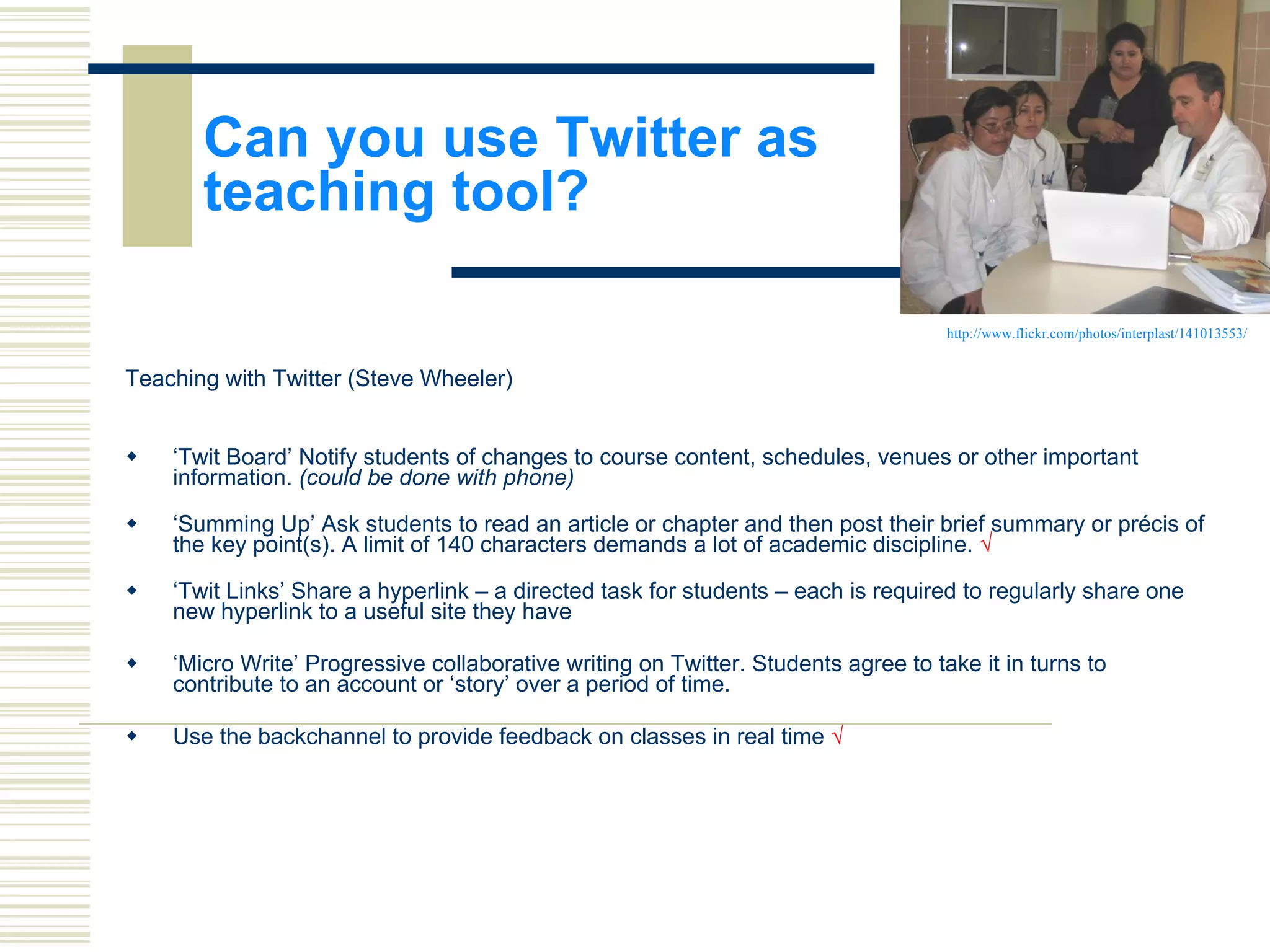
Can you use Twitter as  teaching tool? Teaching with Twitter (Steve Wheeler) ‘ Twit Board’ Notify students of changes to course content, schedules, venues or other important information.  (could be done with phone) ‘ Summing Up’ Ask students to read an article or chapter and then post their brief summary or précis of the key point(s). A limit of 140 characters demands a lot of academic discipline.  √ ‘ Twit Links’ Share a hyperlink – a directed task for students – each is required to regularly share one new hyperlink to a useful site they have ‘ Micro Write’ Progressive collaborative writing on Twitter. Students agree to take it in turns to contribute to an account or ‘story’ over a period of time. Use the backchannel to provide feedback on classes in real time  √ http://www.flickr.com/photos/interplast/141013553/
Some References Anderson, Terry; Elloumi, Fathi:  Theory and Practice of Online Learning  (April 2004) http://cde.athabascau.ca/online_book / Coghlan, Michael;  How important are synchronous tools in web-based teaching and learning environments?   http://users.chariot.net.au/~michaelc/synch/surv_discuss.htm Coghlan, Michael ; Moderating Live Synchronous Sessions  http://synchfacilitation.wikispaces.com/ Finkelstein, Jonathan; Learning in Real Time  http://www.learninginrealtime.com/ Muirhead, Brent;  Research Insights into Interactivity,  International Journal of Instructional Technology and Distance Learning , March 2004 http://www.itdl.org/Journal/Mar_04/article05.htm
Contact Details Michael Coghlan http://protopage.com/michaelc [email_address]

Synch AND Swim

  • 1.
    SYNCH AND SWIM: The Value of Synchronous Learning Environments (Interact! Build Community! Immediate feedback!) Michael Coghlan BAW 2010 21/1/10
  • 2.
    STRUCTURE OF SESSIONhistorical context value of synchronous interaction skills required in a virtual classroom (brief) applications for synchronous activity (when can you use them?)
  • 3.
  • 4.
    Question: Are youA) In your office? B) In a computer suite? C) At home? D) Other?
  • 5.
    MULTIPLE VENUE PRESENTATIONS(MVPs) remote students guest lecturer CLASSROOM/ F2F VENUE public space
  • 6.
    What is synchronous/asynchronouscommunication? SYNCHRONOUS (real time) eg f2f conversation, telephone calls, chat rooms ASYNCHRONOUS – some delay between initial communication and the reply eg letters, email, forums
  • 7.
    Question: IS ANYONETEACHING IN FULLY ONLINE MODE? (Classroom + online = BLENDED LEARNING)
  • 8.
    Synchronous approaches canbe a valuable complement to face to face classes!
  • 9.
    Changing Methodology Online/elearning:Asynchronous (written) text based Content focused Asynch + synch more voice interaction Content + process ca 1998 2010
  • 10.
    Asynch Synch OralWritten Minimalist; rapid (evolving) COMMUNICATION AXIS Spontaneous; dialogue Reflective; monologue Structured; expository
  • 11.
    COMMUNICATION AXIS Mostclassroom communications take place here New – have been enabled by technology (only happen online)
  • 12.
    The Original SynchronousEnvironment – plain text chat
  • 13.
  • 14.
  • 15.
    Range of SynchronousTools Instant messengers: Google Talk, Skype, Yahoo, MSN (text + voice) Peer to Peer/Collaborative Tools: eg Etherpad (documents), Mind Mapping, Whiteboards, etc Virtual Classrooms Proprietary: Elluminate, Adobe Connect, etc Free: Wiziq, DimDim, Vyew
  • 16.
    Virtual Worlds: SecondLife See Second Life in Education
  • 17.
    Your Experience? Haveyou experienced the use of synchronous tools in online courses that you have either taught or studied?
  • 18.
    Your Experience? Howhave synchronous tools been used in courses you have either taught or studied? small group work? one-on-one communications? whole class meetings? whole class instruction? other?
  • 19.
    Use of SynchronousTools – Survey Purpose of Interactions 58% small group work 37% one-on-one communications 35% whole class meetings 16% whole class instruction (results at http://users.chariot.net.au/~michaelc/synch/surv_results.htm)
  • 20.
    Question Why doyou think it is important to include synchronous tools in online courses?
  • 21.
    Use of SynchronousTools – Survey Why are synchronous tools important? Approx 50/50 split between pedagogical and social/affective reasons Pedagogy : immediacy of feedback (30%) (results at http://users.chariot.net.au/~michaelc/synch/surv_results.htm)
  • 22.
    Social/Affective Benefits Social,community, and personal engagement personal engagement/motivation (55%) community building (29%) improving the social experience (27%) (results at http://users.chariot.net.au/~michaelc/synch/surv_results.htm)
  • 23.
    Tension: Synch vAsynch Terry Anderson, Toward a Theory of Online Learning: “… .the major motivation for enrollment in distance education is not physical access, but rather, temporal freedom to move through a course of studies at a pace of the student’s choice.” Participation in ( synchronous events) “almost inevitably places constraints on this independence.”   “ The demands of a learning-centered context might at times force us to modify prescriptive participation in (synchronous events), even though we might have evidence that such participation will further advance knowledge creation and attention.”
  • 24.
    Resolving the tensionbetween asynchronous and synchronous approaches don’t make synch sessions compulsory; use synch for those who want it use tools that can record or archive the sessions for later retrieval don’t use synchronous for whole class instruction use for meetings, one-on-one, or in small groups offer informal (social) sessions in synch mode allow student use of synchronous space offer office hours sessions at set times
  • 25.
    Resolving the tensionbetween asynchronous and synchronous approaches It’s not all or nothing – use both approaches: Synch for social, spontaneous, decision making Asynch for deliberation, reflection, considered opinion
  • 26.
    The Instructional Challenge:Methodology: how do you use synchronous tools to maximise their impact?
  • 27.
  • 28.
    Skills of theLive Online Presenter Golden Rule : 6-8 minutes talking at a stretch maximum Intersperse presentations with questions, polls, other speakers (from the floor), whiteboard activity Decide how to handle direct messaging – will you monitor/respond? Or ignore it? Dip in and out of it? Consider working with a producer/co-presenter More at http://users.chariot.net.au/~michaelc/fll/blog.htm#skills
  • 29.
    What kinds ofsynchronous activities can you use in classrooms? TEACHING ‘ straight lecture’ Guest lecturers Oral presentations Group work One on one (eg pronunciation) OTHER Office hours Social: student - student
  • 30.
    Synchronous Activities –example 1 Live discussion with a musician about their work Organised by Webhead Aiden Yeh (Taiwan) and Michael Coghlan (Australia)
  • 31.
    Synchronous Activities –example 2 Small Group Discussion - Intercultural Communication Streetlife Project organised by Webhead Anne Fox (Denmark) http://streetlife.homestead.com/
  • 32.
    Synchronous Activities –example 3 Oral Presentations organised by Webhead Buthaina Al-Othman (Kuwait) http:// alothman-b.tripod.com/wia_162finalproj.htm
  • 33.
    PROFESSIONAL DEVELOPMENT Conferences,seminars Workshops and Training sessions Meetings (much more cost effective than teleconferencing)
  • 34.
  • 35.
  • 36.
    Twitter as areal time search tool? May 2008: “Twitter beats media in reporting China earthquake." An almost real time search tool Now being used by some as an alternative search tool to Google http://www.flickr.com/photos/29281982@N00/101951607/
  • 37.
    TRACKING THE BACKCHANNEL http://www.slideshare.net/mchaelc/tracking-the-back-channel
  • 38.
    BACKCHANNEL TOOLS Director instant messaging in web conferencing tools (eg Centra, Elluminate) Live blogging tools like Cover It Live Live polling tools like Poll Everywhere Micro Messaging tools: Twitter , Yammer
  • 39.
  • 40.
  • 41.
    Purdue University: In-houseApplication http://www.itap.purdue.edu/tlt/hotseat/
  • 42.
    Can you useTwitter as teaching tool? Teaching with Twitter (Steve Wheeler) ‘ Twit Board’ Notify students of changes to course content, schedules, venues or other important information. (could be done with phone) ‘ Summing Up’ Ask students to read an article or chapter and then post their brief summary or précis of the key point(s). A limit of 140 characters demands a lot of academic discipline. √ ‘ Twit Links’ Share a hyperlink – a directed task for students – each is required to regularly share one new hyperlink to a useful site they have ‘ Micro Write’ Progressive collaborative writing on Twitter. Students agree to take it in turns to contribute to an account or ‘story’ over a period of time. Use the backchannel to provide feedback on classes in real time √ http://www.flickr.com/photos/interplast/141013553/
  • 43.
    Some References Anderson,Terry; Elloumi, Fathi: Theory and Practice of Online Learning (April 2004) http://cde.athabascau.ca/online_book / Coghlan, Michael; How important are synchronous tools in web-based teaching and learning environments? http://users.chariot.net.au/~michaelc/synch/surv_discuss.htm Coghlan, Michael ; Moderating Live Synchronous Sessions http://synchfacilitation.wikispaces.com/ Finkelstein, Jonathan; Learning in Real Time http://www.learninginrealtime.com/ Muirhead, Brent; Research Insights into Interactivity, International Journal of Instructional Technology and Distance Learning , March 2004 http://www.itdl.org/Journal/Mar_04/article05.htm
  • 44.
    Contact Details MichaelCoghlan http://protopage.com/michaelc [email_address]