Downloaded 84 times

![same literature and the suggested ques- cess information. The receiver has more
tions were of similar character, designed time to comprehend a message because
to stimulate reflection and sharing of an immediate answer is not expected.
personal experiences relating to the lit- My interviews support this argument, as
erature in both the asynchronous and illustrated by the following quote:
synchronous settings. After the online
discussions concluded, I classified every In the [asynchronous discussions]
written sentence according to the three it is easier to find some more facts,
types of exchanges described in Table 1. maybe have a look in a book and
Some sentences included more than one do more thorough postings.
type of exchange and were counted in
more than one category. In fact, according to Kock’s estimate,18
The studies reported here were con- an exchange of 600 words requires about
ducted in a specific context and with 6 minutes for complex group tasks in
a small sample size. However, the key face-to-face settings, while exchanging
arguments are also supported by theory, the same number of words over e-mail
as will become evident. I did not use would take approximately one hour.
learning outcome measures because only
two pass/no pass grades were given in Benefits and Limitations of
the courses, making it difficult to iden- Synchronous e-Learning
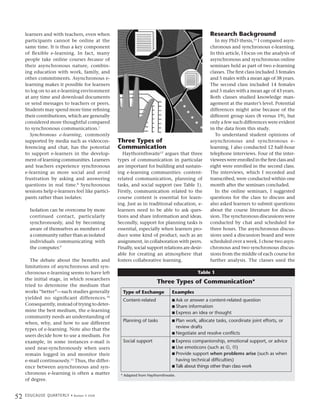
tify statistically significant differences When studying Table 2, it becomes
given the small populations. Instead, apparent that synchronous e-learning
this article relies on measures and per- supports other types of communication
ceptions of communication, which have more often than does asynchronous
been shown to have a positive effect on e-learning. Almost 60 percent of the sen-
perceived learning, grades, and quality tences related to content, while a third
assessment of assignments.14 of the sentences related to planning of
tasks. This can be explained by the fact
Benefits and Limitations of that these discussions were limited by
Asynchronous E-Learning time—the participants had to make sure
The classification of sentences from they did what was expected during the
the seminar discussions is presented scheduled three hours. In synchronous
in Table 2. Almost every sentence in e-learning, students might feel isolated discussions, participants also discussed
the asynchronous discussions of the and not part of learning communities, things other than course work. This was
smaller group, and a vast majority of which is essential for collaboration and especially evident at the beginning and
sentences in the larger group, were learning.15 When comparing the smaller end of each discussion. No apparent
classified as content-related. This is a to the larger class, it seems difficult to difference could be discerned in the syn-
remarkable result—imagine if learners get asynchronous discussions going chronous discussions when comparing
on campus spent more than 90 percent with few participants, a finding sup- the smaller and larger classes.
of their time discussing issues related to ported by previous research.16 Kock’s media naturalness hypothesis19
course content. These results can also be The cognitive model of media choice predicts that synchronous communi-
interpreted as troublesome, however. If proposed by Robert and Dennis17 theo- cation increases psychological arousal.
e-learners seldom meet face-to-face and rizes that asynchronous communica- Similarly, Robert and Dennis’s20 cogni-
teachers mainly rely on asynchronous tion increases a person’s ability to pro- tive model of media choice predicts that
Table 2
Sentences Categorized by Type of Communication and E-Learning
Type of Communication Smaller Class (n=8) Larger Class (n=19)
Synchronous Asynchronous Synchronous Asynchronous
Content-related 876 (58%) 369 (99%) 1,816 (57%) 2,438 (93%)
Planning of tasks 507 (34%) 5 (1%) 935 (29%) 131 (5%)
Social support 198 (13%) 2 (1%) 572 (18%) 124 (2%)
All sentences 1,507 (100%) 375 (100%) 3,173 (100%) 2,608 (100%)
Number 4 2008 • E D U C A U S E Q U A R T E R LY
53](https://image.slidesharecdn.com/eqm0848-120121002602-phpapp01/85/Asynchronous-vs-Synchronous-Learning-3-320.jpg)
![ate for discussions of complex issues. I chronous, and hybrid e-learning. This 11. M. Lynne Markus, “Electronic Mail as the
suggest that, other things being equal, will facilitate understanding of the com- Medium of Managerial Choice,” Orga-
nization Science, vol. 5, no. 4 (1994), pp.
synchronous e-learning better supports plex task ahead—taking advantage of
502–527.
personal participation and asynchro- emerging media in ways that benefit
12. Caroline Haythornthwaite, “Building
nous e-learning better supports cogni- learning. e Social Networks via Computer Net-
tive participation. works: Creating and Sustaining Distrib-
The research discussed here demon- uted Learning Communities,” in Build-
strates that asynchronous and synchro- Endnotes ing Virtual Communities: Learning and
nous e-learning complement each other. 1. Dongsong Zhang, J. Leon Zhao, Lina Change in Cyberspace, K. Ann Renninger
Zhou, and Jay F. Nunamaker Jr., “Can and Wesley Schumar, eds. (Cambridge:
An implication for instructors is to pro- E-Learning Replace Classroom Learn- Cambridge University Press, 2002), pp.
vide several types of asynchronous and ing?” Communications of the ACM, vol. 159–190.
synchronous communication so that 47, no. 5 (May 2004), pp. 75–79. 13. Stefan Hrastinski, “Participating in Syn-
appropriate means are available for dif- 2. Thomas L. Russell, The No Significant Dif- chronous Online Education,” PhD dis-
ferent learning activities. The combina- ference Phenomenon, 5th ed. (Montgom- sertation, Lund University, 2007, avail-
tion of these two types of e-learning ery, AL: International Distance Educa- able from http://www.lu.se/o.o.i.s?id=
tion Certification Center, 2001). 12588&postid=599311.
supports several ways for learners and
3. Alexander Romiszowski and Robin 14. Eric Fredericksen, Alexandra Picket, Peter
teachers to exchange information, col- Mason, “Computer-Mediated Commu- Shea, William Pelz, and Karen Swan, “Stu-
laborate on work, and get to know each nication,” in Handbook of Research for dent Satisfaction and Perceived Learn-
other.22 As stated earlier, many learners Educational Communications and Technol- ing with On-line Courses: Principles and
enroll in online courses because of their ogy, ed. David H. Jonassen (Mahwah, Examples from the SUNY Learning Net-
asynchronous nature, which needs to be NJ: Lawrence Erlbaum, 2004), pp. 397– work,” Journal of Asynchronous Learning
431; and Stefan Hrastinski and Christina Networks, vol. 4, no. 2 (September 2000),
taken into account. For the discussion of Keller, “Computer-Mediated Communi- pp. 7–41; and Starr Roxanne Hiltz, Nancy
complex issues, synchronous e-learning, cation in Education: A Review of Recent Coppola, Naomi Rotter, Murray Turoff,
by media such as videoconferencing, Research,” Educational Media Interna- and Raquel Benbunan-Fich, “Measuring
instant messaging and chat, and arrang- tional, vol. 4, no. 1 (March 2007), pp. the Importance of Collaborative Learn-
ing face-to-face meetings as a comple- 61–77. ing for the Effectiveness of ALN: A Multi-
4. Kinshuk and Nian-Shing Chen, “Syn- Measure, Multi-Method Approach,” Jour-
ment, may be essential as support for
chronous Methods and Applications in nal of Asynchronous Learning Networks,
students to get to know each other and E-Learning,” Campus-Wide Information vol. 4, no. 2 (2000), pp. 103–25.
for planning the tasks at hand. How- Systems, vol. 23, no. 3 (2006). 15. Haythornthwaite and Kazmer, “Bring-
ever, when discussing complex issues, 5. Etienne Wenger, Communities of Prac- ing the Internet Home”; and Haythorn-
in which time for reflection is needed, tice: Learning, Meaning, and Identity (Cam- thwaite, “Building Social Networks.”
it seems preferable to switch to asyn- bridge: Cambridge University Press, 16. Rena M. Palloff and Keith Pratt, Building
chronous e-learning and use media such 1998). Learning Communities in Cyberspace: Effec-
6. David H. Jonassen and Susan M. Land, tive Strategies for the Online Classroom (San
as e-mail, discussion boards, and blogs.
preface to Theoretical Foundations of Learn- Francisco: Jossey-Bass, 1999).
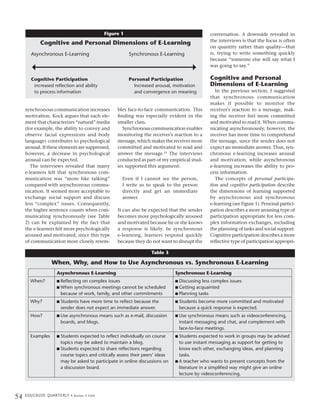
Table 3 summarizes when, why, and ing Environments, ed. David H. Jonassen 17. Lionel P. Robert and Alan R. Dennis, “Par-
how to use asynchronous versus syn- and Susan M. Land (Mahwah, NJ: Law- adox of Richness: A Cognitive Model of
chronous e-learning. rence Erlbaum, 2000), pp. iii–ix. Media Choice,” IEEE Transactions on Pro-
7. Stefan Hrastinski, “The Potential of Syn- fessional Communication, vol. 48, no. 1
Conclusion chronous Communication to Enhance (March 2005), pp. 10–21.
Participation in Online Discussions,” 18. Ned Kock, “Media Richness or Media
The media investigated in this article
paper presented at the 28th Interna- Naturalness? The Evolution of Our Bio-
have been key in transforming the focus tional Conference on Information Sys- logical Communication Apparatus and
on e-learners as individuals to e-learners tems, Montreal, Canada, December 9–12, Its Influence on Our Behavior Toward
as social participants. A parallel move 2007. E-Communication Tools,” IEEE Transac-
has occurred toward Web 2.0, which 8. Ibid. tions on Professional Communication, vol.
emphasizes the increasing use of the 9. Caroline Haythornthwaite and Michelle 48, no. 2 (June 2005), pp. 117–30.
web to support social relations. This M. Kazmer, “Bringing the Internet Home: 19. Ibid.
shift will surely lead to new ways of col- Adult Distance Learners and Their Inter- 20. Robert and Dennis, “Paradox of
net, Home, and Work Worlds,” in The Richness.”
laborating in online education. Initial Internet in Everyday Life, ed. Barry Well- 21. Ibid.
efforts include the adoption in educa- man and Caroline Haythornthwaite
tional settings of emerging media such 22. Haythornthwaite and Kazmer, “Bringing
(Malden, MA: Blackwell Publishing,
2002), pp. 431–463 [quote p. 459]. the Internet Home.”
as virtual worlds, blogs, wikis, and video
sharing, and synchronous software that 10. Charlotte Nirmalani Gunawardena and
supports audio and video. Marina Stock McIsaac, “Distance Educa-
Stefan Hrastinski (stefan.hrastinski@dis
tion,” in Handbook of Research on Educa-
An essential challenge is to critically tional Communications and Technology, ed. .uu.se) is a Research Fellow and Director of
study the benefits and limitations of David H. Jonassen, (Mahwah, NJ: Law- Master Studies in Computer and Systems Sci-
emerging types of asynchronous, syn- rence Erlbaum, 2004), pp. 355–395. ence at Uppsala University in Sweden.
Number 4 2008 • E D U C A U S E Q U A R T E R LY
55](https://image.slidesharecdn.com/eqm0848-120121002602-phpapp01/85/Asynchronous-vs-Synchronous-Learning-5-320.jpg)

This document summarizes a study that compared asynchronous and synchronous e-learning methods. The study found: - Asynchronous e-learning, such as email and discussion boards, allows learners to participate and reflect at their own pace, giving them more time to process information. However, it can be difficult to build learning communities asynchronously with few participants. - Synchronous e-learning, like video conferencing and chat, increases psychological arousal, motivation, and a sense of personal participation similar to face-to-face communication. However, it focuses more on quantity over quality of discussion. - Asynchronous e-learning better supports cognitive participation through reflection on complex issues. Synchronous e-learning better supports


![E learing rose_[autosaved]_rosemarie](https://cdn.slidesharecdn.com/ss_thumbnails/elearingroseautosavedrosemarie-210430035014-thumbnail.jpg?width=640&height=640&fit=bounds)


