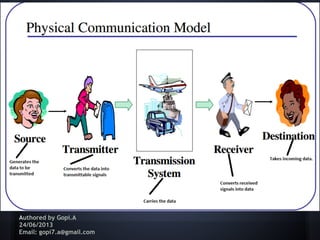
Communication Protocol
Authored by Gopi.A
24/06/2013
Email: gopi7.a@gmail.com
What is communication?
● The transmission of data from one computer to another, or from one
device to another.
● A communications device, therefore, is any machine that assists data
transmission.
For example, modems, cables, and ports are all communications
devices.
● Communications software refers to programs that make it possible to
transmit data.
(i.e) Software that makes it possible to send and receive data over
telephone lines through modems.
Authored by Gopi.A
24/06/2013
Email: gopi7.a@gmail.com
What is Protocol ?
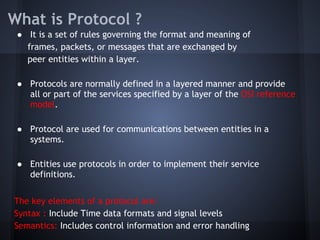
● It is a set of rules governing the format and meaning of
frames, packets, or messages that are exchanged by
peer entities within a layer.
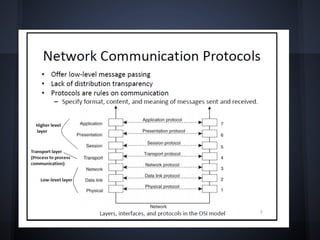
● Protocols are normally defined in a layered manner and provide
all or part of the services specified by a layer of the OSI reference
model.
● Protocol are used for communications between entities in a
systems.
● Entities use protocols in order to implement their service
definitions.
The key elements of a protocol are:
Syntax : Include Time data formats and signal levels
Semantics: Includes control information and error handling
Communications Protocol
● communications protocol is a system of digital rules for
message exchange within and/or between computers.
● The way they organize and transmit the data in bit and
bytes of electronic signals.(encode the data).
● A protocol can therefore be implemented as hardware,
software, or both. Communications protocols have to
be agreed upon by the parties involved.
● To reach agreement a protocol may be developed into
a technical standard.
Continue...
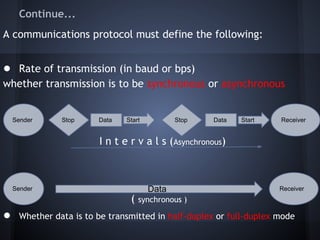
A communications protocol must define the following:
● Rate of transmission (in baud or bps)
whether transmission is to be synchronous or asynchronous
I n t e r v a l s (Asynchronous)
( synchronous )
● Whether data is to be transmitted in half-duplex or full-duplex mode
Sender Stop Data Stop Data Start Receiver
Sender ReceiverData
Start
Synchronous is real time, and asynchronous is time delayed.
Synchronous communication takes place when people are connected at the same time (real time
communication) whereas asynchronous communication does not require people to be online at the
same time.
Example
Synchronous: phone calls, skype, text chat, face-to-face talk.
Asynchronous: snail post, e-mails, springdoo messages, blogs, forums, podcasts, video blogs or vlogs
Synchronous
Advantages: you can get an immediate response; instant feedback fosters communication; there
seems to be a more emotional bonding effect between people when there is a possibility to
communicate in real time (synchronously), spontaneity.
Weaknesses: there is less time to think about what you want to say or your response to another;
time may be a limiting factor, e.g time zones; synchronous communication over the computer may
be difficult because of the speed of data transaction with slower connections; you need extra
equipment (speakers, microphone, web camera)
Asynchronous
Advantages: you have time to think about what you want to say; time is not a constraint. You can
receive the message whenever you have time and you can analyze the content of the message more
carefully so the answer you give can be even more meaningful because it has gone through a
process of elaboration.
Weaknesses: no immediate response, especially where time is significant; you may not know if the
other person has received your message; the message loses human contact.
Authored by Gopi.A
24/06/2013
Email: gopi7.a@gmail.com
Authored by Gopi.A
24/06/2013
Email: gopi7.a@gmail.com
Authored by Gopi.A
24/06/2013
Email: gopi7.a@gmail.com
Communication protocol development
methods
There are two ways of design and development of
Communication protocols
1. Informal
2. Formal Methods
Authored by Gopi.A
24/06/2013
Email: gopi7.a@gmail.com
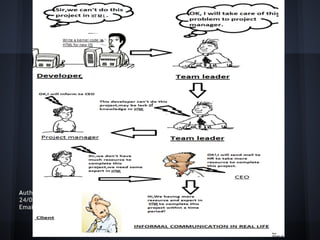
Informal
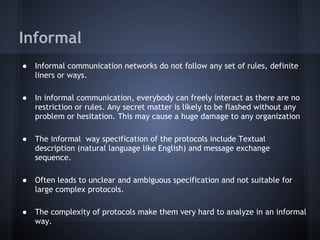
● Informal communication networks do not follow any set of rules, definite
liners or ways.
● In informal communication, everybody can freely interact as there are no
restriction or rules. Any secret matter is likely to be flashed without any
problem or hesitation. This may cause a huge damage to any organization
● The informal way specification of the protocols include Textual
description (natural language like English) and message exchange
sequence.
● Often leads to unclear and ambiguous specification and not suitable for
large complex protocols.
● The complexity of protocols make them very hard to analyze in an informal
way.
Authored by Gopi.A
24/06/2013
Email: gopi7.a@gmail.com
Formal methods
Components of a protocols are to be specified by using
the Formal methods.
- Communication Service.
- Peer entity of a protocol.
- Communication interface.
- Interaction.
● Use of formal specification languages.
● These protocols must be of high quality with higher performance
with low cost.
● After informal specification has been written,a formal
specification is created,that can be validate and simulate with a
FDT tool.This formal specification is used as model for the
implementation.
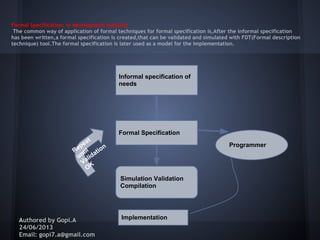
Formal Specification: in development methods
The common way of application of formal techniques for formal specification is,After the informal specification
has been written,a formal specification is created,that can be validated and simulated with FDT(Formal description
technique) tool.The formal specification is later used as a model for the implementation.
Authored by Gopi.A
24/06/2013
Email: gopi7.a@gmail.com
Informal specification of
needs
Formal Specification
Simulation Validation
Compilation
Repeat
until
Validation
OK
Implementation
Programmer
Thank you
Authored by Gopi.A
24/06/2013
Email: gopi7.a@gmail.com
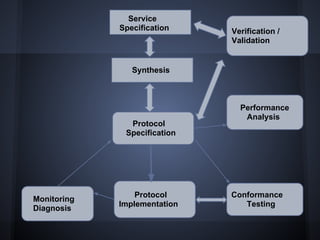
Service
Specification Verification /
Validation
Synthesis
Protocol
Specification
Performance
Analysis
Monitoring
Diagnosis
Protocol
Implementation
Conformance
Testing

Communication protocol presentation

  • 1.
    Communication Protocol Authored byGopi.A 24/06/2013 Email: gopi7.a@gmail.com
  • 2.
    What is communication? ●The transmission of data from one computer to another, or from one device to another. ● A communications device, therefore, is any machine that assists data transmission. For example, modems, cables, and ports are all communications devices. ● Communications software refers to programs that make it possible to transmit data. (i.e) Software that makes it possible to send and receive data over telephone lines through modems. Authored by Gopi.A 24/06/2013 Email: gopi7.a@gmail.com
  • 3.
    What is Protocol? ● It is a set of rules governing the format and meaning of frames, packets, or messages that are exchanged by peer entities within a layer. ● Protocols are normally defined in a layered manner and provide all or part of the services specified by a layer of the OSI reference model. ● Protocol are used for communications between entities in a systems. ● Entities use protocols in order to implement their service definitions. The key elements of a protocol are: Syntax : Include Time data formats and signal levels Semantics: Includes control information and error handling
  • 4.
    Communications Protocol ● communicationsprotocol is a system of digital rules for message exchange within and/or between computers. ● The way they organize and transmit the data in bit and bytes of electronic signals.(encode the data). ● A protocol can therefore be implemented as hardware, software, or both. Communications protocols have to be agreed upon by the parties involved. ● To reach agreement a protocol may be developed into a technical standard.
  • 5.
    Continue... A communications protocolmust define the following: ● Rate of transmission (in baud or bps) whether transmission is to be synchronous or asynchronous I n t e r v a l s (Asynchronous) ( synchronous ) ● Whether data is to be transmitted in half-duplex or full-duplex mode Sender Stop Data Stop Data Start Receiver Sender ReceiverData Start
  • 6.
    Synchronous is realtime, and asynchronous is time delayed. Synchronous communication takes place when people are connected at the same time (real time communication) whereas asynchronous communication does not require people to be online at the same time. Example Synchronous: phone calls, skype, text chat, face-to-face talk. Asynchronous: snail post, e-mails, springdoo messages, blogs, forums, podcasts, video blogs or vlogs Synchronous Advantages: you can get an immediate response; instant feedback fosters communication; there seems to be a more emotional bonding effect between people when there is a possibility to communicate in real time (synchronously), spontaneity. Weaknesses: there is less time to think about what you want to say or your response to another; time may be a limiting factor, e.g time zones; synchronous communication over the computer may be difficult because of the speed of data transaction with slower connections; you need extra equipment (speakers, microphone, web camera) Asynchronous Advantages: you have time to think about what you want to say; time is not a constraint. You can receive the message whenever you have time and you can analyze the content of the message more carefully so the answer you give can be even more meaningful because it has gone through a process of elaboration. Weaknesses: no immediate response, especially where time is significant; you may not know if the other person has received your message; the message loses human contact.
  • 7.
  • 9.
  • 10.
  • 11.
    Communication protocol development methods Thereare two ways of design and development of Communication protocols 1. Informal 2. Formal Methods Authored by Gopi.A 24/06/2013 Email: gopi7.a@gmail.com
  • 12.
    Informal ● Informal communicationnetworks do not follow any set of rules, definite liners or ways. ● In informal communication, everybody can freely interact as there are no restriction or rules. Any secret matter is likely to be flashed without any problem or hesitation. This may cause a huge damage to any organization ● The informal way specification of the protocols include Textual description (natural language like English) and message exchange sequence. ● Often leads to unclear and ambiguous specification and not suitable for large complex protocols. ● The complexity of protocols make them very hard to analyze in an informal way.
  • 13.
  • 14.
    Formal methods Components ofa protocols are to be specified by using the Formal methods. - Communication Service. - Peer entity of a protocol. - Communication interface. - Interaction. ● Use of formal specification languages. ● These protocols must be of high quality with higher performance with low cost. ● After informal specification has been written,a formal specification is created,that can be validate and simulate with a FDT tool.This formal specification is used as model for the implementation.
  • 15.
    Formal Specification: indevelopment methods The common way of application of formal techniques for formal specification is,After the informal specification has been written,a formal specification is created,that can be validated and simulated with FDT(Formal description technique) tool.The formal specification is later used as a model for the implementation. Authored by Gopi.A 24/06/2013 Email: gopi7.a@gmail.com Informal specification of needs Formal Specification Simulation Validation Compilation Repeat until Validation OK Implementation Programmer
  • 16.
    Thank you Authored byGopi.A 24/06/2013 Email: gopi7.a@gmail.com
  • 17.