Synchronous
and
Asynchronous
O Learning can occur in or out of the
classroom. It can be self-paced,
asynchronous learning or may be
instructor-led, synchronous learning. It is
suited to distance learning and in
conjunction with face-to-face teaching,
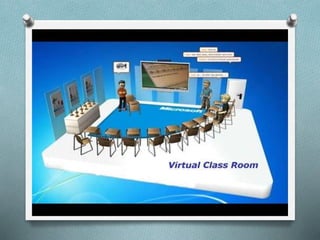
which is termed blended learning. Virtual
Classroom can be used by learners and
educators in homes, schools (both K-12
and higher education), businesses, and
other settings for effective online
collaboration.
SYNCHRONOUS
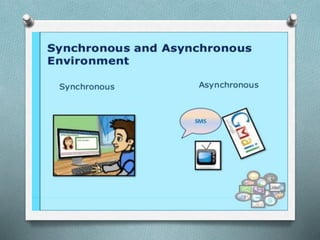
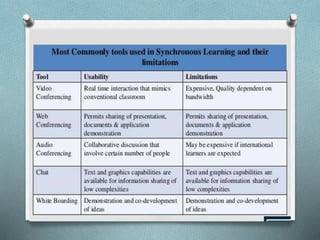
O Synchronous Learning takes place in real
time (Same time) while the trainer and
learner are physically separated from each
other (place shift).
O Examples:
O Audio/video conferencing
O Online chat
O Instant Messaging
O Live Webcasting
ASYNCHRONOUS
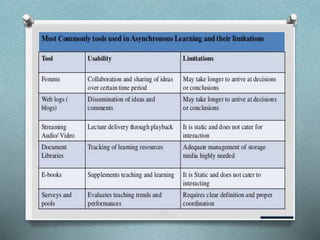
O In Asynchronous Learning the Facilitator
prepares the courseware materials before the
course takes place.
O The learner is free to decide when he wants to
study the courseware.
O Examples:
O Email
O Threaded Discussion boards
O Web-based Training
O DVD
Advantage of
Synchronous and
Asynchronous
Learning
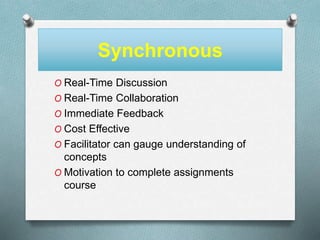
Synchronous
O Real-Time Discussion
O Real-Time Collaboration
O Immediate Feedback
O Cost Effective
O Facilitator can gauge understanding of
concepts
O Motivation to complete assignments
course
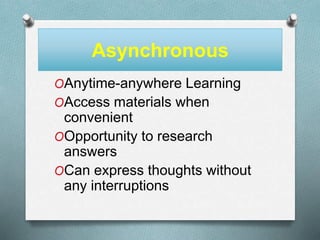
Asynchronous
OAnytime-anywhere Learning
OAccess materials when
convenient
OOpportunity to research
answers
OCan express thoughts without
any interruptions
OVirtual Learning Environment
allows learners and those
engaged in education and
teaching to free themselves from
the limitations of time and space,
and carry out learning
interactions in a flexible
timeframe and at “ virtual sites”
that are not physically tied to one
another.
OComputer technology has
made people and
information sources of
information universally
“accessible” and “available”
at any place and at any
time.
Thank You !!
Prepared By:
Girly Mae J. Lusica
3D2 SPeD

Synchronous and Asynchronous Learning

  • 1.
  • 2.
    O Learning canoccur in or out of the classroom. It can be self-paced, asynchronous learning or may be instructor-led, synchronous learning. It is suited to distance learning and in conjunction with face-to-face teaching, which is termed blended learning. Virtual Classroom can be used by learners and educators in homes, schools (both K-12 and higher education), businesses, and other settings for effective online collaboration.
  • 3.
    SYNCHRONOUS O Synchronous Learningtakes place in real time (Same time) while the trainer and learner are physically separated from each other (place shift). O Examples: O Audio/video conferencing O Online chat O Instant Messaging O Live Webcasting
  • 4.
    ASYNCHRONOUS O In AsynchronousLearning the Facilitator prepares the courseware materials before the course takes place. O The learner is free to decide when he wants to study the courseware. O Examples: O Email O Threaded Discussion boards O Web-based Training O DVD
  • 5.
  • 6.
    Synchronous O Real-Time Discussion OReal-Time Collaboration O Immediate Feedback O Cost Effective O Facilitator can gauge understanding of concepts O Motivation to complete assignments course
  • 7.
    Asynchronous OAnytime-anywhere Learning OAccess materialswhen convenient OOpportunity to research answers OCan express thoughts without any interruptions
  • 14.
    OVirtual Learning Environment allowslearners and those engaged in education and teaching to free themselves from the limitations of time and space, and carry out learning interactions in a flexible timeframe and at “ virtual sites” that are not physically tied to one another.
  • 15.
    OComputer technology has madepeople and information sources of information universally “accessible” and “available” at any place and at any time.
  • 16.
  • 17.
    Prepared By: Girly MaeJ. Lusica 3D2 SPeD