BLENDED LEARNING FOR A MASTER
   COURSE ON ENGINEERING AND
    ENVIRONMENTAL GEOLOGY


               Doan Huy Hien, PhD

      Asian Institute of Technology in Vietnam
Outlines
• Traditional training model
• Elearning model
• Blended traning model
• Environmental Engineering Geology
  Course
• Course schedule
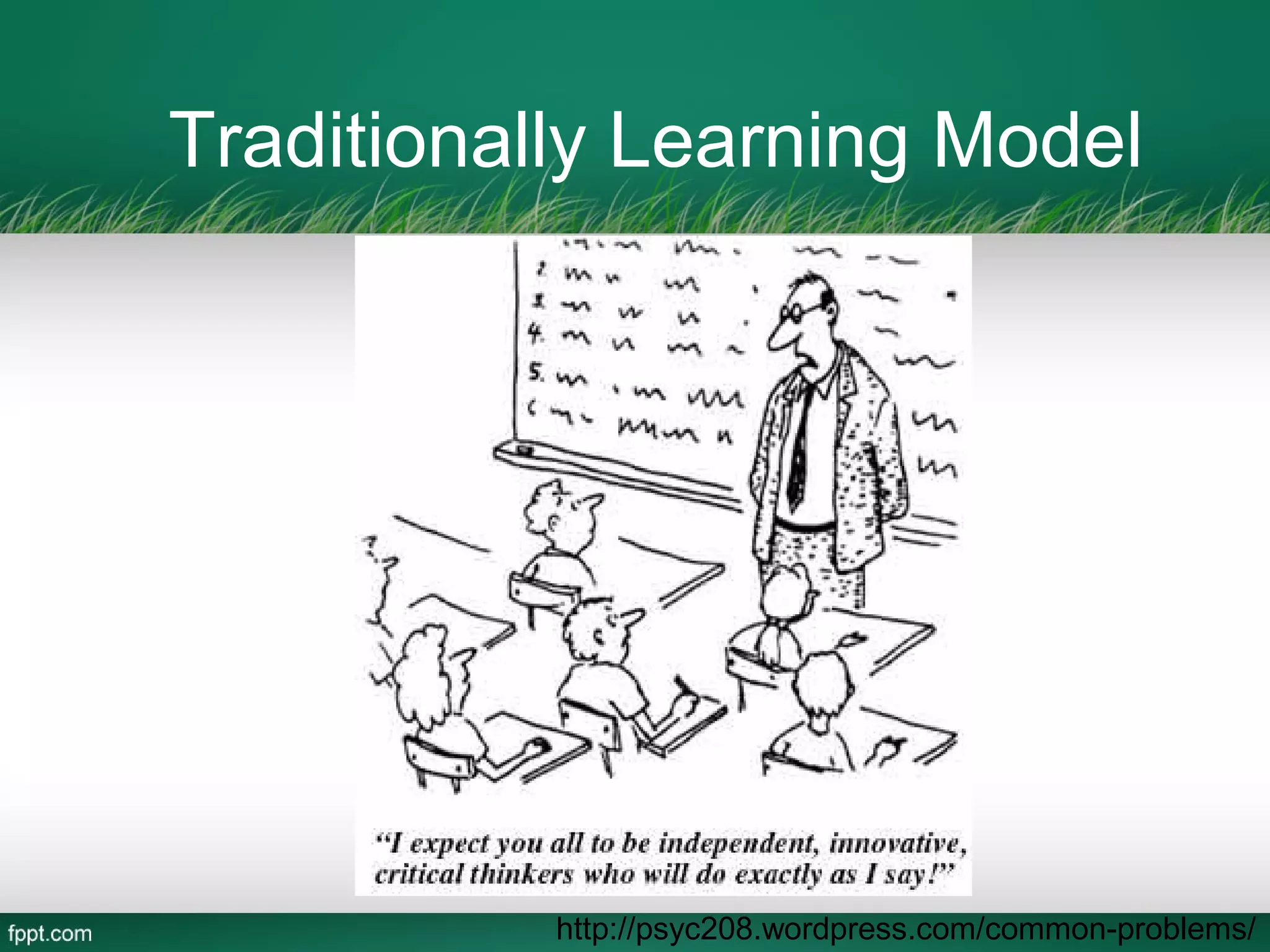
Traditionally Learning Model


           http://psyc208.wordpress.com/common-problems/
Advantages of Traditionally Learning Model

 • Closely interact between lecturer and
   trainers
 • Respond immediately to an individual
   student’s question
 • Conduct secure assessments
 • Simultaneously view common materials.
 • Give individualized assignments
Problem of Traditionally Learning Model

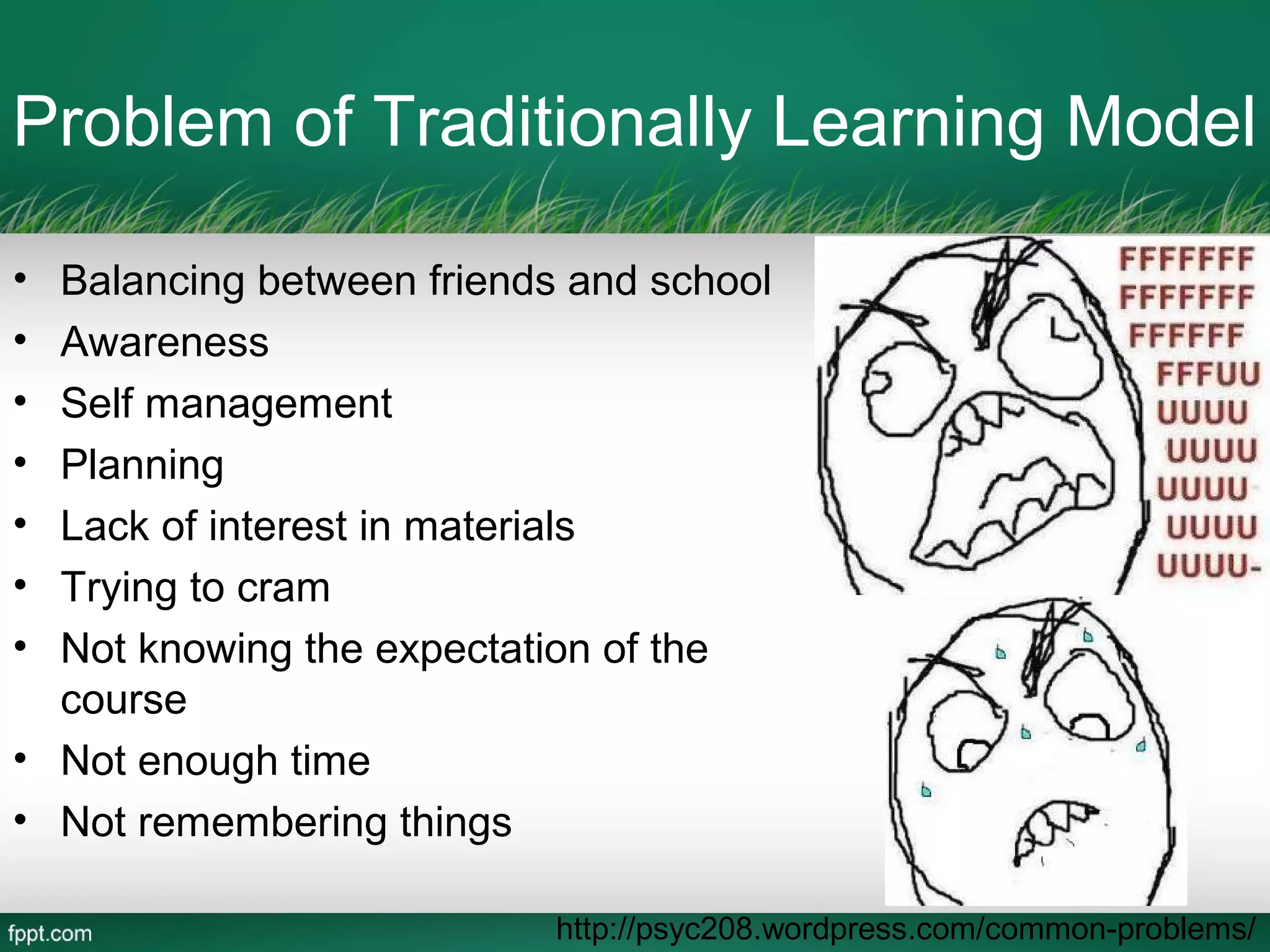
• Balancing between friends and school
• Awareness
• Self management
• Planning
• Lack of interest in materials
• Trying to cram
• Not knowing the expectation of the
  course
• Not enough time
• Not remembering things

                           http://psyc208.wordpress.com/common-problems/
Problem of Traditionally Learning Model


       Make the learners inactive
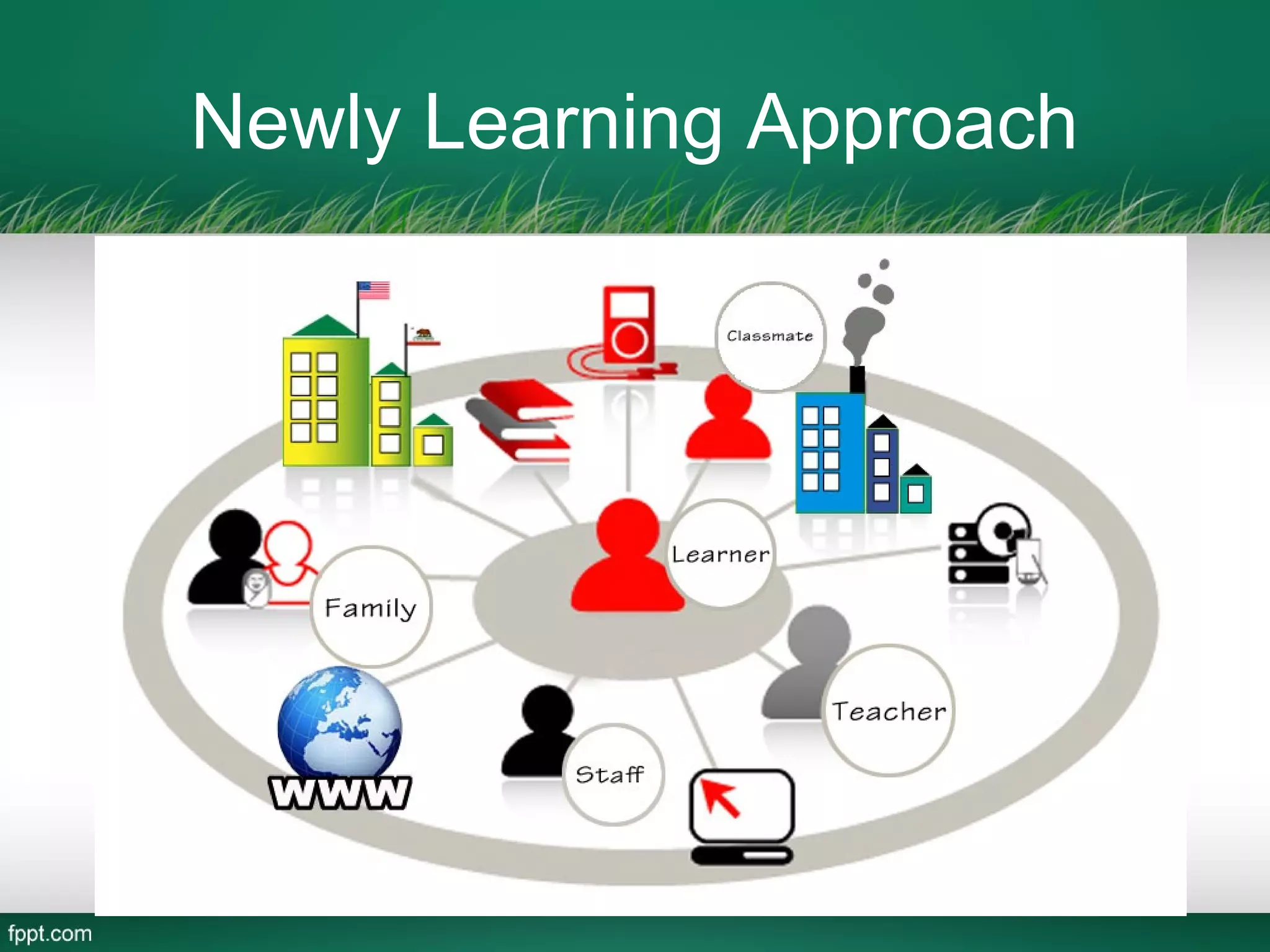
Newly Learning Approach
Elearning model

Is generally defined as any form
of learning that utilizes a
network for delivery,
interaction, or facilitation .
Elearning Mission

     Elearning is the future
   schooling for providing:
      education for all and
      increasing potential of
information telecommunication
    technology (ITC) to meet
different educational objectives
Elearning Objectives

• Expands opportunity of education
• Expands quality of learning.
• Increases delivery of learning.
• Improves efficiency of teaching.
Future of Elearning
• Nobody has the exact answer
• Graduates will be exposed to new
  information in one year than their
  grandparents in a lifetime.
• Memorizing facts will have lower value, than
  utilizing information for decision-making.
Future of Elearning, cont’d
• Multi-career.
• Change of career.
• Lifelong learning.
• Just-in-Time (JIT) learning.
• Career development: learning by the
  corporate
• Telecommuting learning: distance
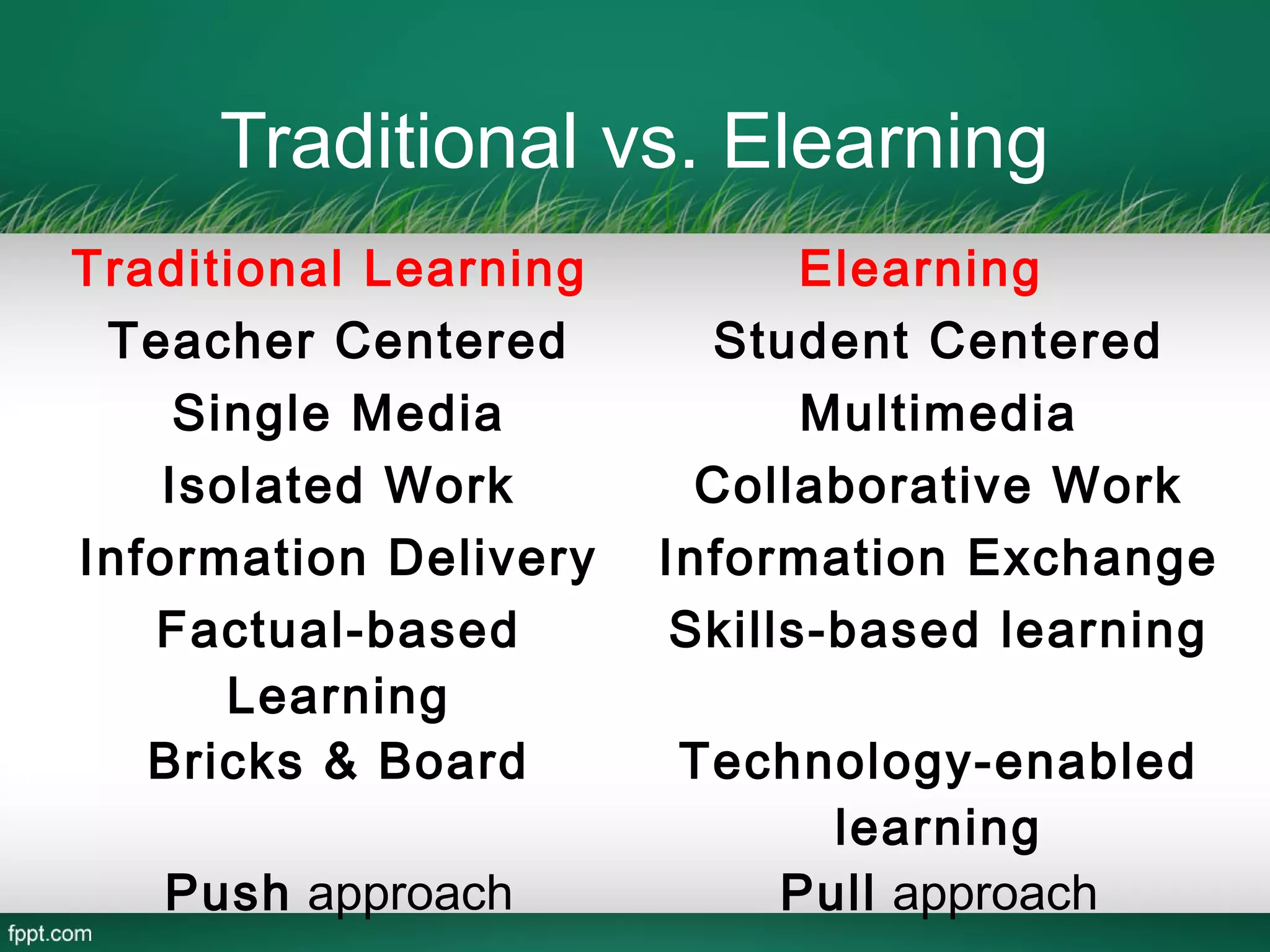
Traditional vs. Elearning
Traditional Learning          Elearning
 Teacher Centered        Student Centered
     Single Media             Multimedia
    Isolated Work        Collaborative Work
Information Delivery   Information Exchange
   Factual-based        Skills-based learning
       Learning
   Bricks & Board      Technology-enabled
                            learning
   Push approach          Pull approach
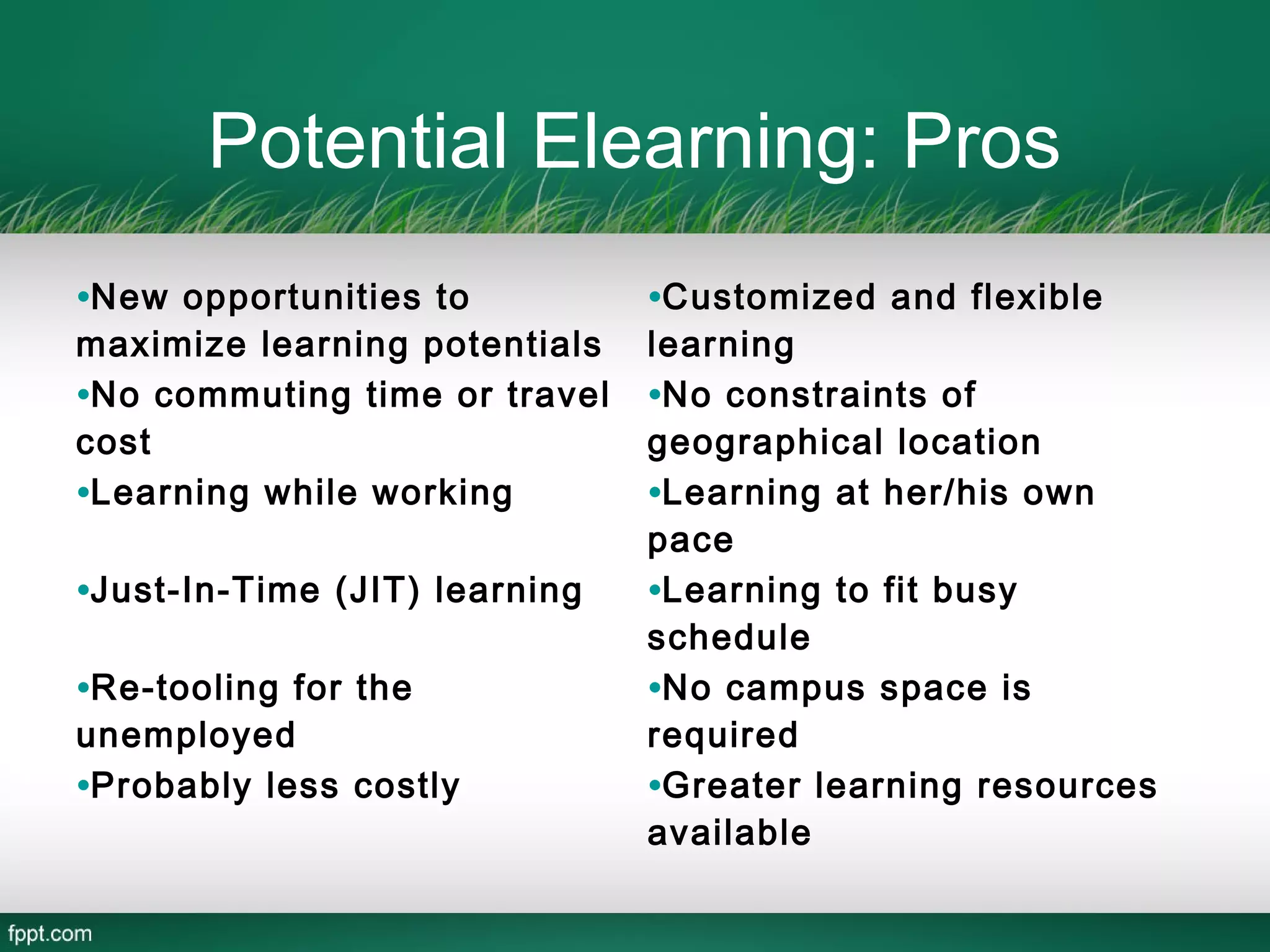
Potential Elearning: Pros
•New opportunities to          •Customized and flexible
maximize learning potentials   learning
•No commuting time or travel   •No constraints of
cost                           geographical location
•Learning while working        •Learning at her/his own
                               pace
•Just-In-Time (JIT) learning   •Learning to fit busy
                               schedule
•Re-tooling for the            •No campus space is
unemployed                     required
•Probably less costly          •Greater learning resources
                               available
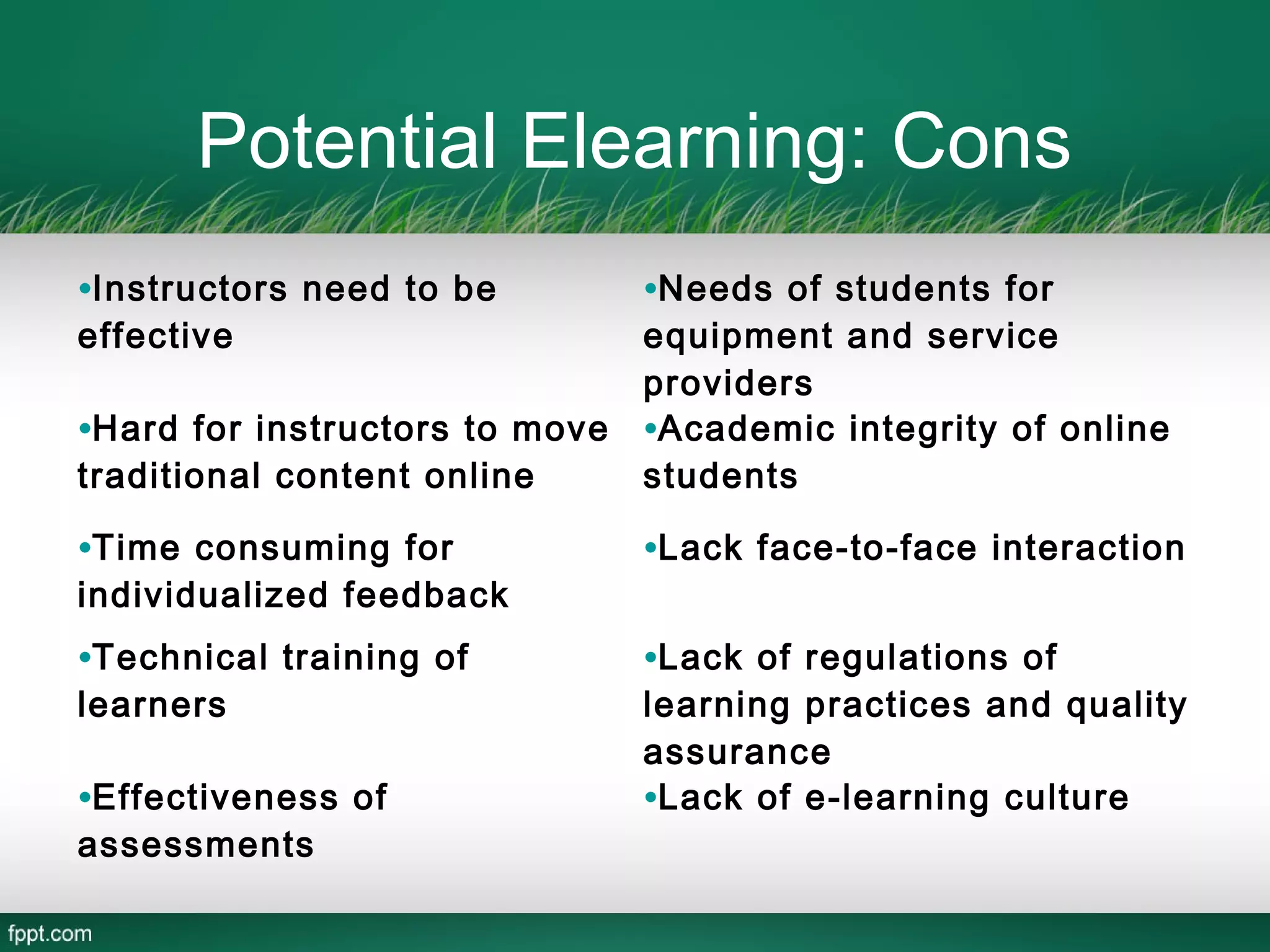
Potential Elearning: Cons
•Instructors need to be         •Needs of students for
effective                       equipment and service
                                providers
•Hard for instructors to move   •Academic integrity of online
traditional content online      students

•Time consuming for             •Lack face-to-face interaction
individualized feedback
•Technical training of          •Lack of regulations of
learners                        learning practices and quality
                                assurance
•Effectiveness of               •Lack of e-learning culture
assessments
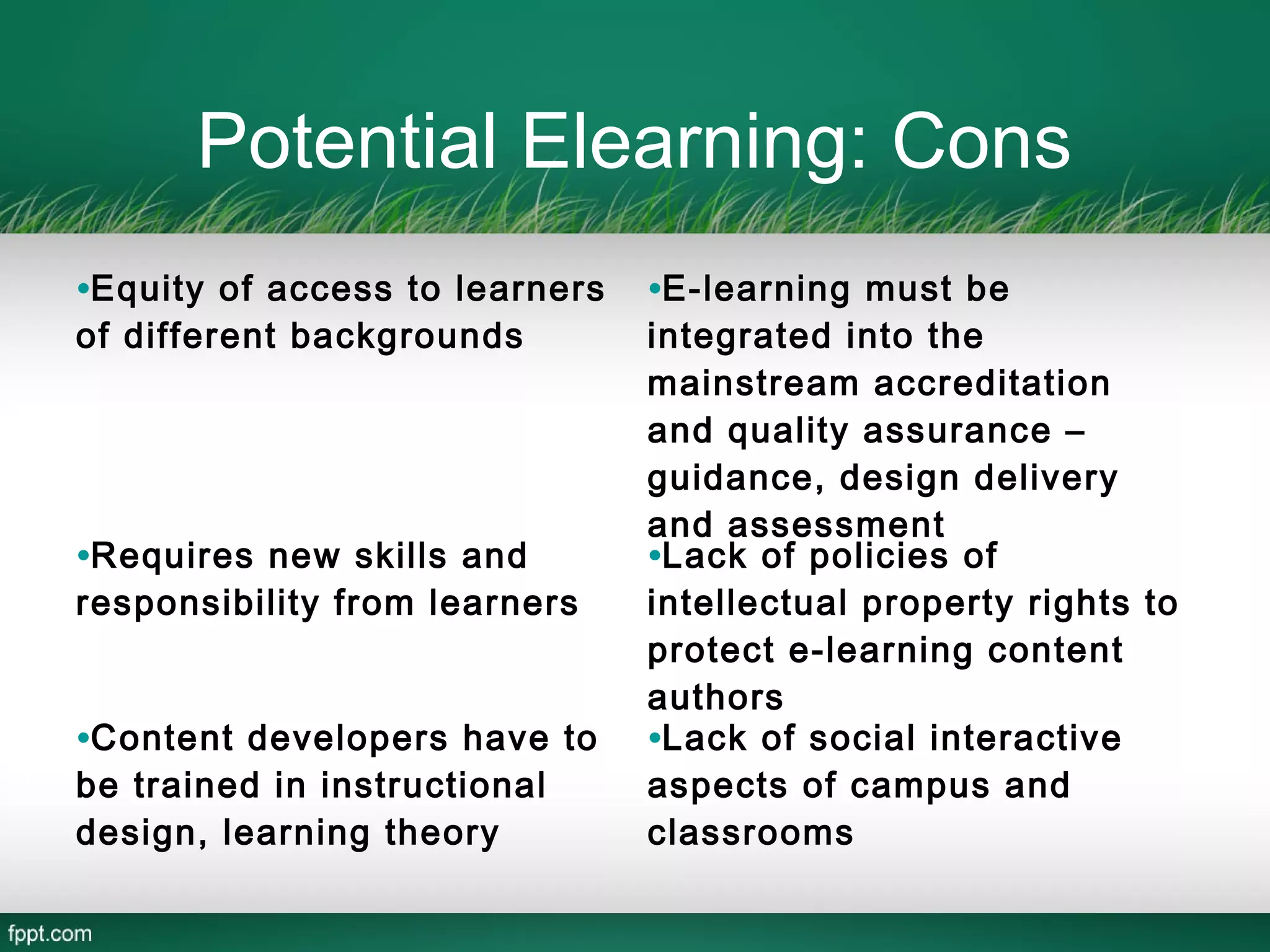
Potential Elearning: Cons
•Equity of access to learners   •E-learning must be
of different backgrounds        integrated into the
                                mainstream accreditation
                                and quality assurance –
                                guidance, design delivery
                                and assessment
•Requires new skills and        •Lack of policies of
responsibility from learners    intellectual property rights to
                                protect e-learning content
                                authors
•Content developers have to     •Lack of social interactive
be trained in instructional     aspects of campus and
design, learning theory         classrooms
Blended Learning Model
 “… the single greatest unrecognised trend in
  higher education today”
  (Young, 2002, President of Penn State
  University).
 “Blended learning the thoughtful integration of
  face-to-face and Elearning experiences. The
  basic principle is that face-to-face oral
  communication and written communication
  are optimally integrated such that the
  strengths of each are blended into a unique
  learning experience…” (Garrison & Vaughan,
  2007 p.5)
      Calls for a change in ‘culture’ of teaching.
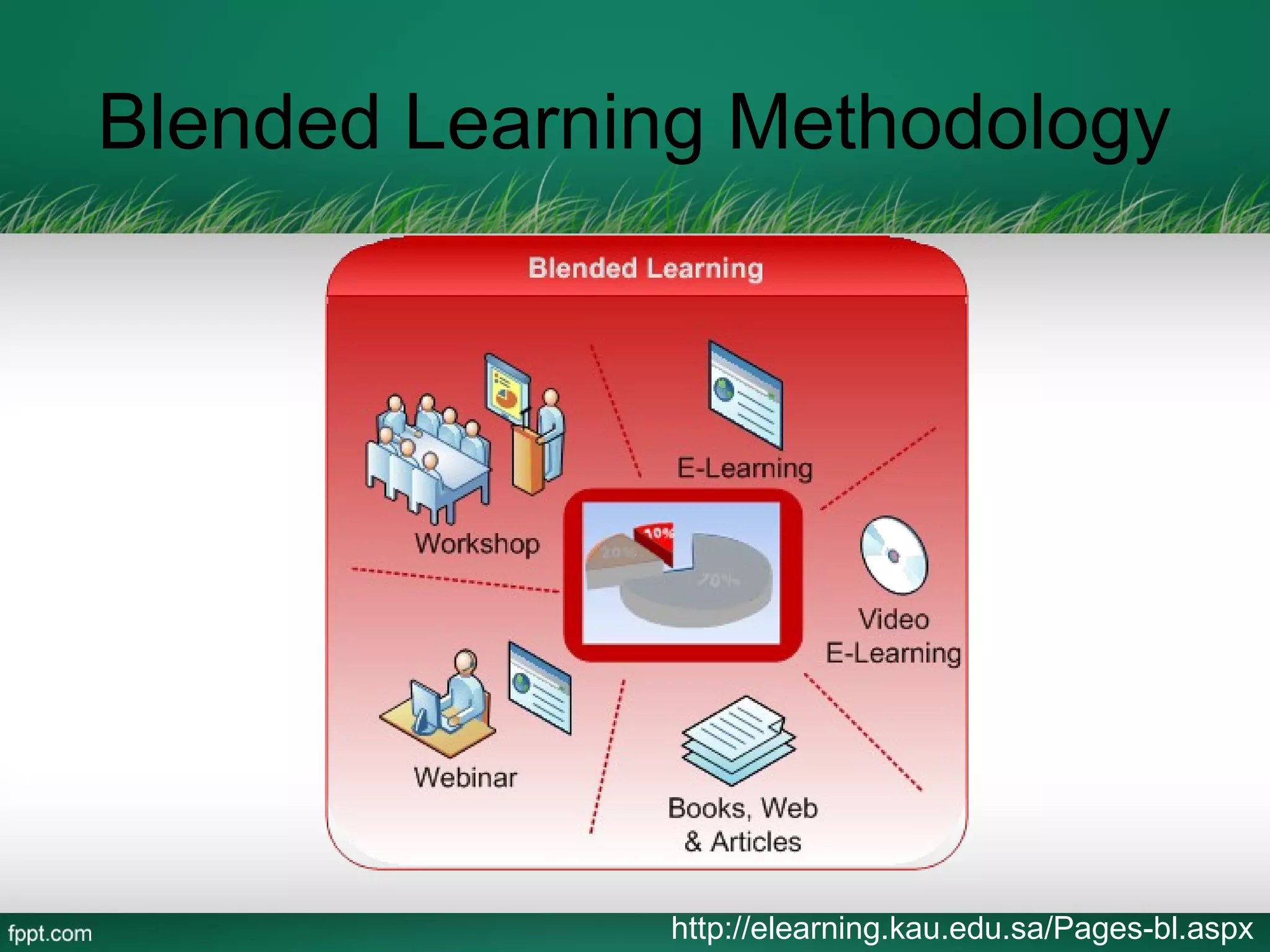
Blended Learning Methodology


              http://elearning.kau.edu.sa/Pages-bl.aspx
Blended learning benefit
• Increase the effectiveness of the learning
  process.
• Reducing the cost and time required to
  learn.
• Increasing learner satisfaction about the
  learning process.
• Increase the number of student.
• Increase the motivation to the learning
  process through the use of multimedia
Why AIT conduct blended
           learning?
• AIT has a long history on graduate training
  programs
• AIT has an excellent number of faculties
  with international standard
• AIT has an excellent IT facility
Blended learning benefit
• Provide the three choices for our learners
  (F2F,Online,Blended).
• It works to improve educational outcomes.
• Blended learning allows us to make the
  most of technology to achieve specific
  educational goals.
• Blended Learning can utilize learning and
  work .
Environmental Engineering
          Geology (EEG)
• EEG combines the contents of both
  environmental geology and engineering geology,
  the course is to equip students with an
  understanding of how geology interacts with
  major Environmental problems and issues facing
  people and society, and also provide a balanced
  and comprehensive understanding of the
  methods and approaches that are useful in
  dealing with the great variety of geologic
  conditions encountered in engineering works.
EEG Course Output
• Understand on the formation of soil/rock
• Understand on the distribution of natural
  resource and geohazards
• Understand on the interacts between
  geology and environment
EEG Course Output
• Consult on decision making concerning
  the use of water, minerals, energy
  resources, and our response to and
  preparedness for natural hazards.
• Plan and design for site investigation with
  optimum solution
• Groundwater modeling and design for
  land subsidence analysis
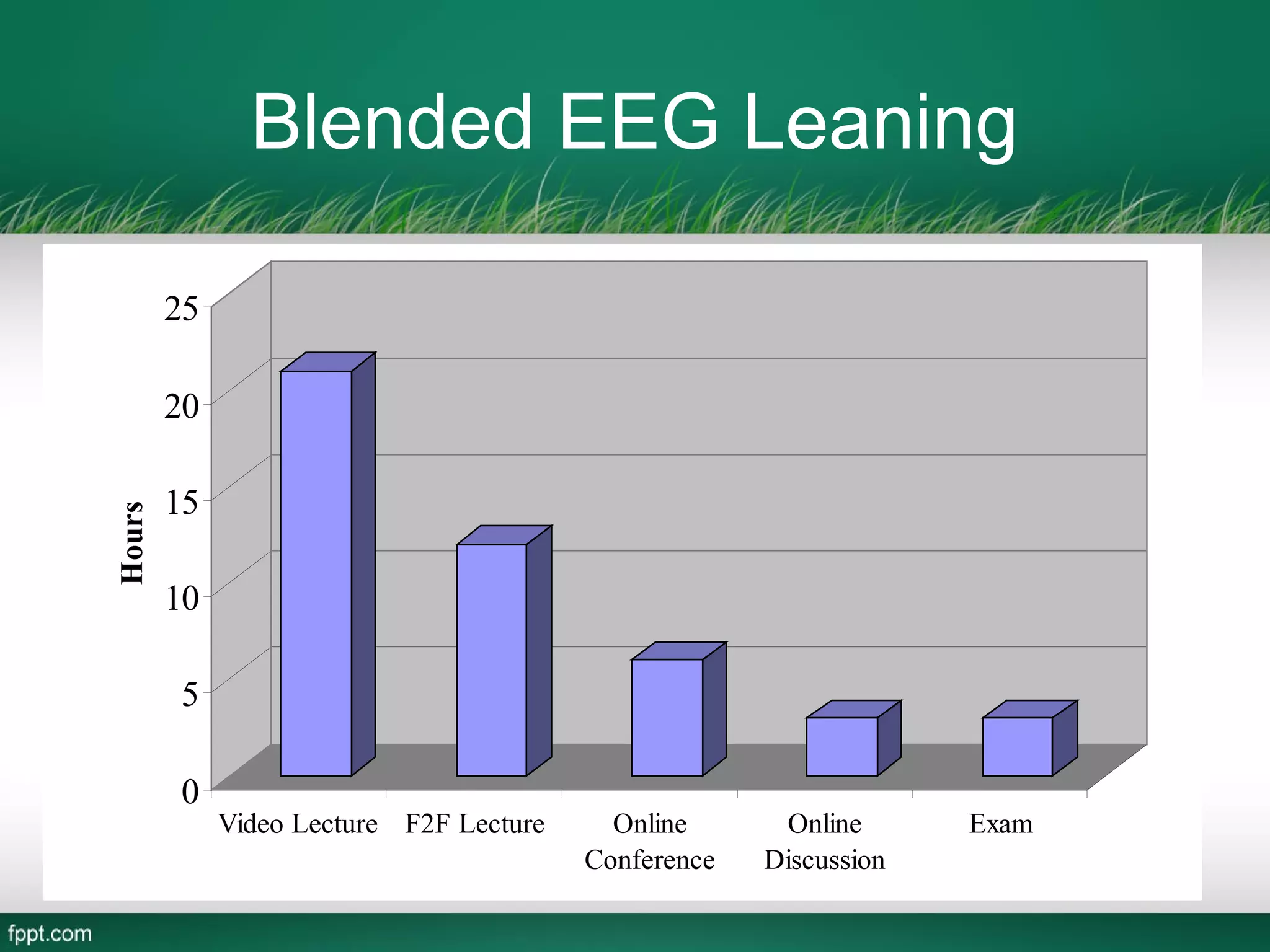
Blended EEG Leaning

        25

        20

        15
Hours


        10

        5

        0
             Video Lecture F2F Lecture     Online      Online      Exam
                                         Conference   Discussion
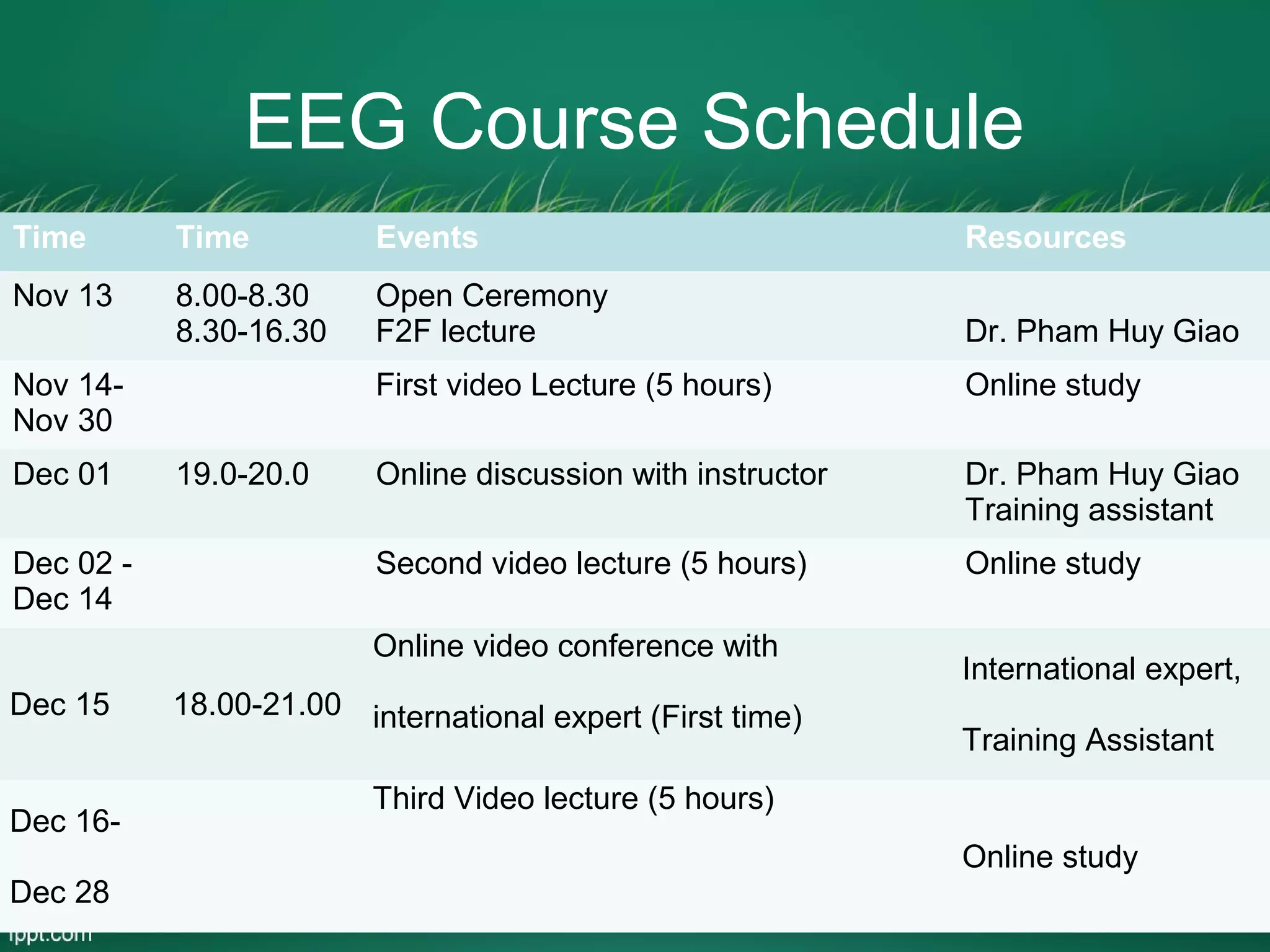
EEG Course Schedule
Time       Time          Events                              Resources
Nov 13     8.00-8.30     Open Ceremony
           8.30-16.30    F2F lecture                         Dr. Pham Huy Giao
Nov 14-                  First video Lecture (5 hours)       Online study
Nov 30
Dec 01     19.0-20.0     Online discussion with instructor   Dr. Pham Huy Giao
                                                             Training assistant
Dec 02 -                 Second video lecture (5 hours)      Online study
Dec 14
                         Online video conference with
                                                             International expert,
Dec 15     18.00-21.00 international expert (First time)
                                                             Training Assistant
                         Third Video lecture (5 hours)
Dec 16-
                                                             Online study
Dec 28
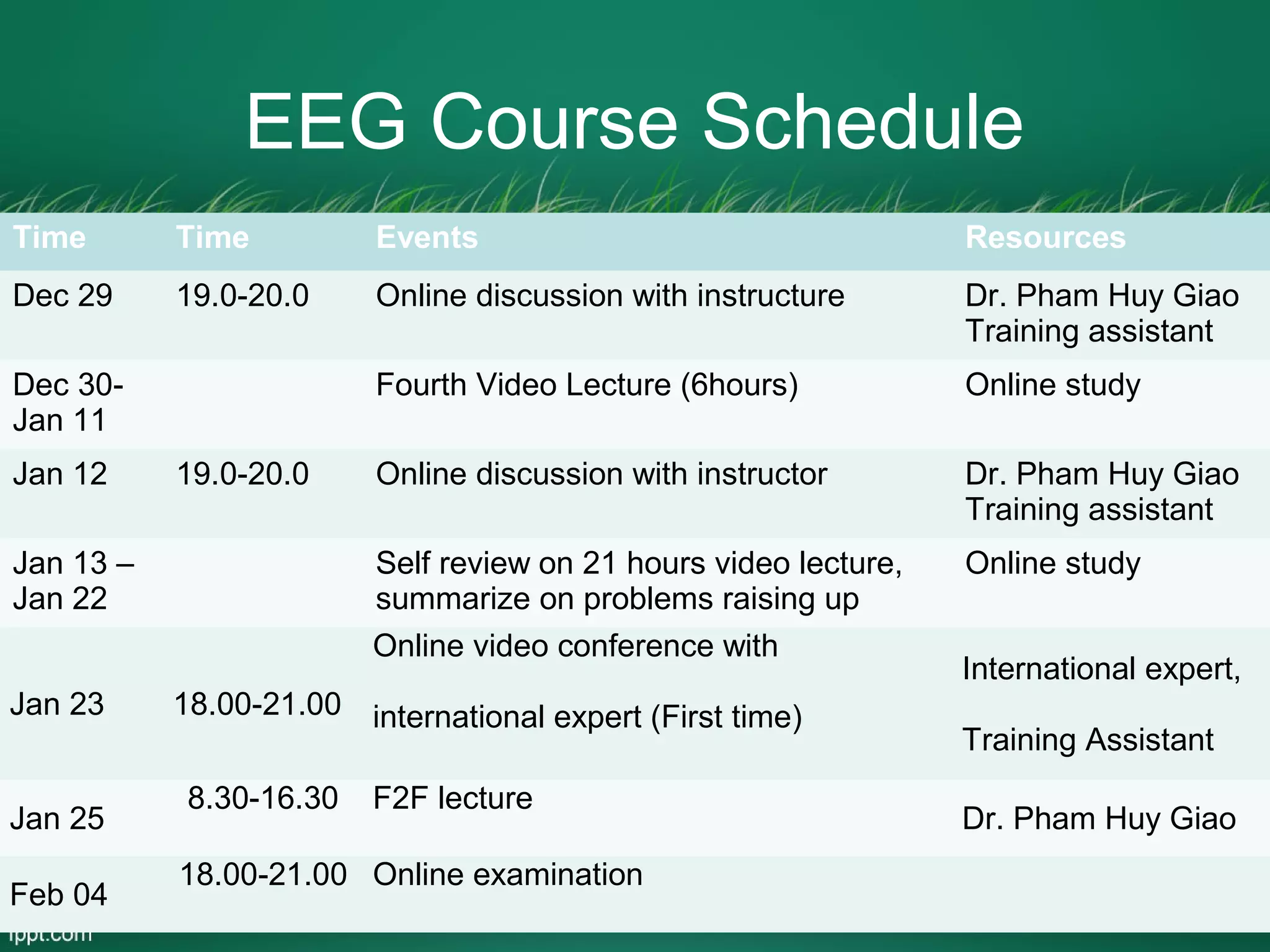
EEG Course Schedule
Time       Time          Events                                   Resources
Dec 29     19.0-20.0     Online discussion with instructure       Dr. Pham Huy Giao
                                                                  Training assistant
Dec 30-                  Fourth Video Lecture (6hours)            Online study
Jan 11
Jan 12     19.0-20.0     Online discussion with instructor        Dr. Pham Huy Giao
                                                                  Training assistant
Jan 13 –                 Self review on 21 hours video lecture,   Online study
Jan 22                   summarize on problems raising up
                         Online video conference with
                                                                  International expert,
Jan 23     18.00-21.00 international expert (First time)
                                                                  Training Assistant
            8.30-16.30   F2F lecture
Jan 25                                                            Dr. Pham Huy Giao
           18.00-21.00 Online examination
Feb 04
Thank you for your attentions

BLENDED LEARNING FOR A MASTER COURSE ON ENGINEERING AND ENVIRONMENTAL GEOLOGY

  • 1.
    BLENDED LEARNING FORA MASTER COURSE ON ENGINEERING AND ENVIRONMENTAL GEOLOGY Doan Huy Hien, PhD Asian Institute of Technology in Vietnam
  • 2.
    Outlines • Traditional trainingmodel • Elearning model • Blended traning model • Environmental Engineering Geology Course • Course schedule
  • 3.
    Traditionally Learning Model http://psyc208.wordpress.com/common-problems/
  • 4.
    Advantages of TraditionallyLearning Model • Closely interact between lecturer and trainers • Respond immediately to an individual student’s question • Conduct secure assessments • Simultaneously view common materials. • Give individualized assignments
  • 5.
    Problem of TraditionallyLearning Model • Balancing between friends and school • Awareness • Self management • Planning • Lack of interest in materials • Trying to cram • Not knowing the expectation of the course • Not enough time • Not remembering things http://psyc208.wordpress.com/common-problems/
  • 6.
    Problem of TraditionallyLearning Model Make the learners inactive
  • 7.
  • 8.
    Elearning model Is generallydefined as any form of learning that utilizes a network for delivery, interaction, or facilitation .
  • 9.
    Elearning Mission Elearning is the future schooling for providing: education for all and increasing potential of information telecommunication technology (ITC) to meet different educational objectives
  • 10.
    Elearning Objectives • Expandsopportunity of education • Expands quality of learning. • Increases delivery of learning. • Improves efficiency of teaching.
  • 11.
    Future of Elearning •Nobody has the exact answer • Graduates will be exposed to new information in one year than their grandparents in a lifetime. • Memorizing facts will have lower value, than utilizing information for decision-making.
  • 12.
    Future of Elearning,cont’d • Multi-career. • Change of career. • Lifelong learning. • Just-in-Time (JIT) learning. • Career development: learning by the corporate • Telecommuting learning: distance
  • 13.
    Traditional vs. Elearning TraditionalLearning Elearning Teacher Centered Student Centered Single Media Multimedia Isolated Work Collaborative Work Information Delivery Information Exchange Factual-based Skills-based learning Learning Bricks & Board Technology-enabled learning Push approach Pull approach
  • 14.
    Potential Elearning: Pros •Newopportunities to •Customized and flexible maximize learning potentials learning •No commuting time or travel •No constraints of cost geographical location •Learning while working •Learning at her/his own pace •Just-In-Time (JIT) learning •Learning to fit busy schedule •Re-tooling for the •No campus space is unemployed required •Probably less costly •Greater learning resources available
  • 15.
    Potential Elearning: Cons •Instructorsneed to be •Needs of students for effective equipment and service providers •Hard for instructors to move •Academic integrity of online traditional content online students •Time consuming for •Lack face-to-face interaction individualized feedback •Technical training of •Lack of regulations of learners learning practices and quality assurance •Effectiveness of •Lack of e-learning culture assessments
  • 16.
    Potential Elearning: Cons •Equityof access to learners •E-learning must be of different backgrounds integrated into the mainstream accreditation and quality assurance – guidance, design delivery and assessment •Requires new skills and •Lack of policies of responsibility from learners intellectual property rights to protect e-learning content authors •Content developers have to •Lack of social interactive be trained in instructional aspects of campus and design, learning theory classrooms
  • 17.
    Blended Learning Model “… the single greatest unrecognised trend in higher education today” (Young, 2002, President of Penn State University).  “Blended learning the thoughtful integration of face-to-face and Elearning experiences. The basic principle is that face-to-face oral communication and written communication are optimally integrated such that the strengths of each are blended into a unique learning experience…” (Garrison & Vaughan, 2007 p.5) Calls for a change in ‘culture’ of teaching.
  • 18.
    Blended Learning Methodology http://elearning.kau.edu.sa/Pages-bl.aspx
  • 19.
    Blended learning benefit •Increase the effectiveness of the learning process. • Reducing the cost and time required to learn. • Increasing learner satisfaction about the learning process. • Increase the number of student. • Increase the motivation to the learning process through the use of multimedia
  • 20.
    Why AIT conductblended learning? • AIT has a long history on graduate training programs • AIT has an excellent number of faculties with international standard • AIT has an excellent IT facility
  • 21.
    Blended learning benefit •Provide the three choices for our learners (F2F,Online,Blended). • It works to improve educational outcomes. • Blended learning allows us to make the most of technology to achieve specific educational goals. • Blended Learning can utilize learning and work .
  • 22.
    Environmental Engineering Geology (EEG) • EEG combines the contents of both environmental geology and engineering geology, the course is to equip students with an understanding of how geology interacts with major Environmental problems and issues facing people and society, and also provide a balanced and comprehensive understanding of the methods and approaches that are useful in dealing with the great variety of geologic conditions encountered in engineering works.
  • 23.
    EEG Course Output •Understand on the formation of soil/rock • Understand on the distribution of natural resource and geohazards • Understand on the interacts between geology and environment
  • 24.
    EEG Course Output •Consult on decision making concerning the use of water, minerals, energy resources, and our response to and preparedness for natural hazards. • Plan and design for site investigation with optimum solution • Groundwater modeling and design for land subsidence analysis
  • 25.
    Blended EEG Leaning 25 20 15 Hours 10 5 0 Video Lecture F2F Lecture Online Online Exam Conference Discussion
  • 26.
    EEG Course Schedule Time Time Events Resources Nov 13 8.00-8.30 Open Ceremony 8.30-16.30 F2F lecture Dr. Pham Huy Giao Nov 14- First video Lecture (5 hours) Online study Nov 30 Dec 01 19.0-20.0 Online discussion with instructor Dr. Pham Huy Giao Training assistant Dec 02 - Second video lecture (5 hours) Online study Dec 14 Online video conference with International expert, Dec 15 18.00-21.00 international expert (First time) Training Assistant Third Video lecture (5 hours) Dec 16- Online study Dec 28
  • 27.
    EEG Course Schedule Time Time Events Resources Dec 29 19.0-20.0 Online discussion with instructure Dr. Pham Huy Giao Training assistant Dec 30- Fourth Video Lecture (6hours) Online study Jan 11 Jan 12 19.0-20.0 Online discussion with instructor Dr. Pham Huy Giao Training assistant Jan 13 – Self review on 21 hours video lecture, Online study Jan 22 summarize on problems raising up Online video conference with International expert, Jan 23 18.00-21.00 international expert (First time) Training Assistant 8.30-16.30 F2F lecture Jan 25 Dr. Pham Huy Giao 18.00-21.00 Online examination Feb 04
  • 28.
    Thank you foryour attentions