Segla Kossivi
Educational
Technology
Walden University
Modern
Education
            Learning
            Environ                 Mobile
             ment                  Learning
                       Intercon
 Flexible               nected
                                    Better
                                   Looking

                       Intuitive

            Network
              ed

  Global
Need: Problem Giving Rise to The Innovation


    Research Organization: Apple, Inc.


              Development


            Commercialization


       Innovation-Decision Process


                 S-Curve
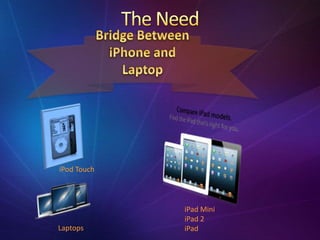
iPod Touch


             iPad Mini
             iPad 2
Laptops      iPad
.

Key Innovator: Steve Jobs
The Product


Product Innovation Time Line


     Steve Jobs announced the iPads in 2010
IPad
Get Started
SK
Creative Conferences
Invitation Cards
Conferences
Advertisements
Mails
Blogs
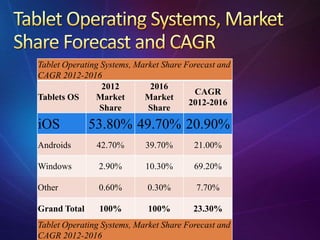
Tablet Operating Systems, Market Share Forecast and
CAGR 2012-2016
                 2012        2016
                                         CAGR
Tablets OS     Market       Market
                                        2012-2016
                Share        Share

iOS           53.80% 49.70% 20.90%
Androids       42.70%       39.70%       21.00%

Windows         2.90%       10.30%       69.20%

Other           0.60%        0.30%        7.70%

Grand Total     100%         100%        23.30%
Tablet Operating Systems, Market Share Forecast and
CAGR 2012-2016
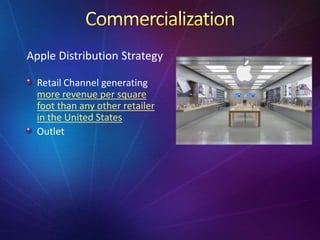
Apple Distribution Strategy

  Retail Channel generating
  more revenue per square
  foot than any other retailer
  in the United States
  Outlet
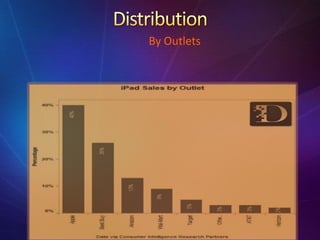
By Outlets
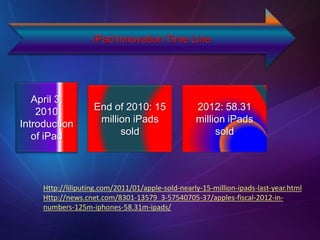
iPad Innovation Time Line


   April 3,
    2010            End of 2010: 15                2012: 58.31
Introduction         million iPads                 million iPads
   of iPad                sold                          sold


     Http://liliputing.com/2011/01/apple-sold-nearly-15-million-ipads-last-year.html
     Http://news.cnet.com/8301-13579_3-57540705-37/apples-fiscal-2012-in-
     numbers-125m-iphones-58.31m-ipads/
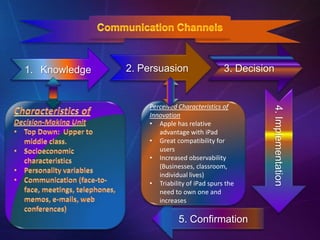
1. Knowledge   2. Persuasion                 3. Decision


                   Perceived Characteristics of


                                                       4. Implementation
                   Innovation
                   • Apple has relative
                      advantage with iPad
                   • Great compatibility for
                      users
                   • Increased observability
                      (Businesses, classroom,
                      individual lives)
                   • Triability of iPad spurs the
                      need to own one and
                      increases

                             5. Confirmation
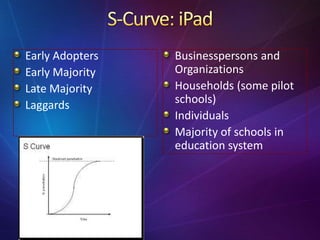
Early Adopters   Businesspersons and
Early Majority   Organizations
Late Majority    Households (some pilot
Laggards         schools)
                 Individuals
                 Majority of schools in
                 education system
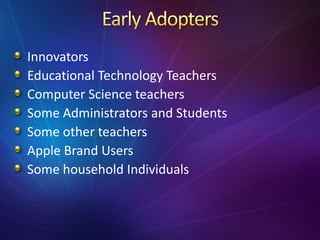
Innovators
Educational Technology Teachers
Computer Science teachers
Some Administrators and Students
Some other teachers
Apple Brand Users
Some household Individuals
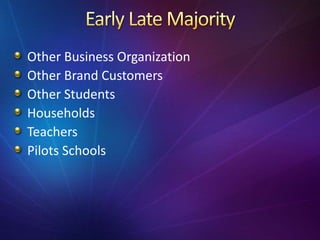
Other Business Organization
Other Brand Customers
Other Students
Households
Teachers
Pilots Schools
Other Administrators
Other Teachers with Lack of Technology Skills
Others

Tablet storyboard

Editor's Notes

  • #3 Welcome to the modern learning environment, which, due to the advanced technology of the millennial era, is global, mobile, flexible, networked, virtual, interconnected, better looking, smarter, more collaborative, intuitive, than thetraditional educational system, 
  • #4 In this presentation, I will go through the need that gives rise to the innovation of iPad tablet, the research problem, product development, commercialization, innovation-decision process, and S-curve.
  • #5 The need to bridge the gap between laptops and iPhones gave birth to iPads. The iPad tablets became a second source of renaissance for Apple (Hopkins, 2012). Jobs, a keynote speaker, advertiser, and a marketer was able to convince the manufacturers and gain worldwide market, with advanced technologies (Murphy, 2011) in iPhones, iPods, and iPads, which enabled Apple to gain its market shares. During the iPad introduction, Jobs updated the App Store, which provided mostly free apps, through iTunes, which runs on both Apple and Windows-based operating systems. Using the company’s website for posting key points of his message, Steve Jobs reached out to a global audience (Hopkins, 2012).
  • #6 The Apple co-founder, a thinker, inventor, and innovator Steve Jobs introduced iPad, in 2010, only to die a year later.
  • #7 The need to bridge the gap between laptops and iPhones gave birth to iPads. The iPad tablets became a second source of renaissance for Apple (Hopkins, 2012). Jobs, a keynote speaker, advertiser, and a marketer was able to convince the manufacturers and gain worldwide market, with advanced technologies (Murphy, 2011) in iPhones, iPods, and iPads, which enabled Apple to gain its market shares. During the iPad introduction, Jobs updated the App Store, which provided mostly free apps, through iTunes, which runs on both Apple and Windows-based operating systems. Using the company’s website for posting key points of his message, Steve Jobs reached out to a global audience (Hopkins, 2012).
  • #8 The need to bridge the gap between laptops and iPhones gave birth to iPads. The iPad tablets became a second source of renaissance for Apple (Hopkins, 2012). Jobs, a keynote speaker, advertiser, and a marketer was able to convince the manufacturers and gain worldwide market, with advanced technologies (Murphy, 2011) in iPhones, iPods, and iPads, which enabled Apple to gain its market shares. During the iPad introduction, Jobs updated the App Store, which provided mostly free apps, through iTunes, which runs on both Apple and Windows-based operating systems. Using the company’s website for posting key points of his message, Steve Jobs reached out to a global audience (Hopkins, 2012).
  • #9 The iPad tablets became a second source of renaissance for Apple (Hopkins, 2012). Jobs, a keynote speaker, advertiser, and a marketer was able to convince the manufacturers and gain worldwide market, with advanced technologies (Murphy, 2011) in iPhones, iPods, and iPads,
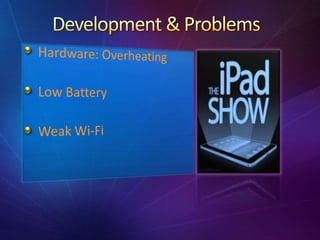
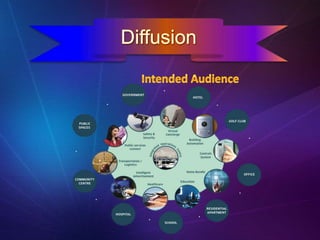
  • #10 From the development phase, Apple encountered some hardware and technological problems such as weak Wi-Fi, overheating, and low battery. These problems would lead to the introduction of iPad2 and later on mini-iPads. Existing and new customers Apple owners, government, business organizations, scholars, educational institutions, learners of all ages constitute the target market.
  • #11 Oct. 3. And earlier this year, the largest retailer in the U.S., Walmart, indicated it hopes to sell the iPad by the end of 2010.Expansion of the iPad to more retail outlets is expected to increase Apple's sales of the device significantly. Expanded distribution channels, along with international rollout and increased supply, were cited as positives on Thursday by Piper Jaffray, which believes Apple will sell 21 million units in 2011.
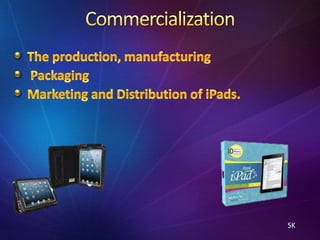
  • #14 Any one who owns iPads would testify that Apple has a sense of packaging, marketing, and distribution. Apple adopts a push-pull marketing strategy of iPads to enable the company to lead over Samsung, Motorola, Toshiba, Lenovo, and Acer. The iPad has set the standards for other devices, which the competitors manufacture (Fredette, 2012). Graziano (2012) provided data for the market share of the various competitors (table 1).
  • #15 Apple used creative conferences invitation cards, that make customers excited about the product would present in the conference. The second step is the conferences it self, making the product touch people feelings by using emotional phrases for every feature of the product, and link it to people’s every day use. The third step is after the conference with the advertisements that also touch the people senses with impressive show of the product features and a special music that makes the consumer focus on the advertisement.
  • #16 Initial price getting lower with further innovation in the product, with the introduction of iPad 2, iPad with retina display, and iPad miniªhttps://www.apple.com/ipad/compare/
  • #18 Apple’s stores are among the most successful brick-and-mortar shops around, generating more revenue per square foot than any other retailer in the United StatesBetween December of 2011 and August of 2012, the Consumer Intelligence Research Partners (CIRP).surveyed 1,227 U.S. consumers who purchased an iPhone, iPad, or Mac, and found that while Apple Stores sold by far the most Macs and iPads during the period, they didn’t sell nearly as many iPhones as the company’s retail partners.40 percent of the iPads purchased by the survey sample during December 2011 and August 2012.