
SYNCHRONOUS AND 
ASYNCHRONOUS RESET 
12/11/2014 ANINDRA 1
WHY RESET IS USED..? 
 Reset is used to initialize the hardware design of 
a system and to make system to known state from 
unknown state. 
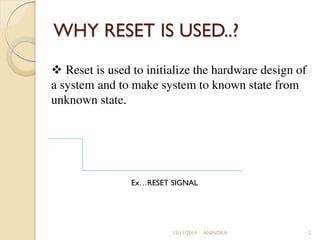
Ex…RESET SIGNAL 
12/11/2014 ANINDRA 2
TYPES OF RESETS…. 
12/11/2014 ANINDRA 3 
 Reset is of two types :- 
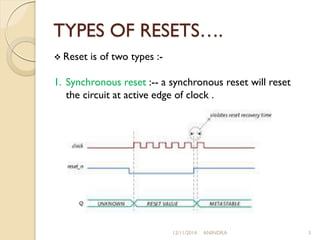
1. Synchronous reset :-- a synchronous reset will reset 
the circuit at active edge of clock .
ADVANTAGES OF 
SYNCHRONOUS RESET…. 
 Gives a completely synchronous circuit 
 Provides filtering for the reset signal, So circuit will 
not be affected by glitches. 
 Will meet reset recovery time, as the deassertion will 
happen within 1 clock cycle 
12/11/2014 ANINDRA 4
DISADVANTAGES… 
 Reset needs to be stretched, if it is not long 
enough to be seen at the active clock edge. 
 Requires presence of clock to reset the circuit. 
 Asynchronous reset may be required if there are 
12/11/2014 ANINDRA 5 
internal tri state buffers.
DISADVANTAGES…. 
12/11/2014 ANINDRA 6 
 It is slow. 
 Synthesis will not be able to easily differentiate reset 
from other signals. So this has to be taken care while 
doing synthesis. Otherwise it may lead to timing 
issues. 
 If there are gated clocks for power saving, this type of 
reset won’t be suitable.
ASYNCHRONOUS RESET…. 
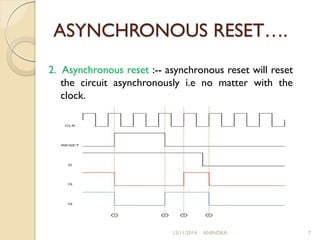
2. Asynchronous reset :-- asynchronous reset will reset 
the circuit asynchronously i.e no matter with the 
clock. 
12/11/2014 ANINDRA 7
ASYNCHRONOUS RESET 
ADVANTAGES …. 
 Reset gets the highest priority. 
12/11/2014 ANINDRA 8 
 It is fast. 
 Does not require presence of clock to reset the circuit.
DIADVANTAGES… 
 Reset line is sensitive to glitches. 
 May have metastability issues 
12/11/2014 ANINDRA 9
THANK YOU 
12/11/2014 
10 
ANINDRA

Synchronous and asynchronous reset

  • 1.
    SYNCHRONOUS AND ASYNCHRONOUSRESET 12/11/2014 ANINDRA 1
  • 2.
    WHY RESET ISUSED..?  Reset is used to initialize the hardware design of a system and to make system to known state from unknown state. Ex…RESET SIGNAL 12/11/2014 ANINDRA 2
  • 3.
    TYPES OF RESETS…. 12/11/2014 ANINDRA 3  Reset is of two types :- 1. Synchronous reset :-- a synchronous reset will reset the circuit at active edge of clock .
  • 4.
    ADVANTAGES OF SYNCHRONOUSRESET….  Gives a completely synchronous circuit  Provides filtering for the reset signal, So circuit will not be affected by glitches.  Will meet reset recovery time, as the deassertion will happen within 1 clock cycle 12/11/2014 ANINDRA 4
  • 5.
    DISADVANTAGES…  Resetneeds to be stretched, if it is not long enough to be seen at the active clock edge.  Requires presence of clock to reset the circuit.  Asynchronous reset may be required if there are 12/11/2014 ANINDRA 5 internal tri state buffers.
  • 6.
    DISADVANTAGES…. 12/11/2014 ANINDRA6  It is slow.  Synthesis will not be able to easily differentiate reset from other signals. So this has to be taken care while doing synthesis. Otherwise it may lead to timing issues.  If there are gated clocks for power saving, this type of reset won’t be suitable.
  • 7.
    ASYNCHRONOUS RESET…. 2.Asynchronous reset :-- asynchronous reset will reset the circuit asynchronously i.e no matter with the clock. 12/11/2014 ANINDRA 7
  • 8.
    ASYNCHRONOUS RESET ADVANTAGES….  Reset gets the highest priority. 12/11/2014 ANINDRA 8  It is fast.  Does not require presence of clock to reset the circuit.
  • 9.
    DIADVANTAGES…  Resetline is sensitive to glitches.  May have metastability issues 12/11/2014 ANINDRA 9
  • 10.