Strong Cryptography in PHP

by Enrico Zimuel (enrico@zend.com)

Senior Software Engineer
Zend Framework Core Team
Zend Technologies Ltd


Dutch PHP Conference, 21th May 2011

                                      © All rights reserved. Zend Technologies, Inc.
About me
           ●   Software Engineer since 1996
           ●   Enjoying PHP since 1999
           ●   PHP Engineer at Zend Technologies,
                 in the Zend Framework Team
           ●   Author of two books on security and
                 cryptography (in italian)
           ●   B.Sc. (Hons) in Computer Science and
                Economics
           ●   Blog on Programming in PHP:
                 http://www.zimuel.it/blog


                 © All rights reserved. Zend Technologies, Inc.
Strong cryptography


  Strong cryptography is the usage of
cryptographic systems or components that
     are considered highly resistant to
           cryptanalytic attacks


              © All rights reserved. Zend Technologies, Inc.
A metric of security?
●   How we can say that an encryption algorithm
    is considered highly resistant to cryptanalytic
    attacks?
●   It's difficult to answer to this question. We
    don't have a simple metric of security.
●   We have to consider:
       ▶   Brute forcing attacks
       ▶   Theoretical attacks
       ▶   Implementation attacks


                      © All rights reserved. Zend Technologies, Inc.
A metric of security? (2)
●   Brute forcing attacks
       ▶   Space key is 2n, where n is the byte size of
             the key. If n=128, K= 3,4 * 1038
●   Theoretical attacks
       ▶   Break the encryption with mathematical
             attacks.
       ▶   Reduce the space key, for AES 256bit, an
             attack can reduce K to 299.5
●   Implementation attacks
       ▶   Based on the implementation

                       © All rights reserved. Zend Technologies, Inc.
Is DES still secure?
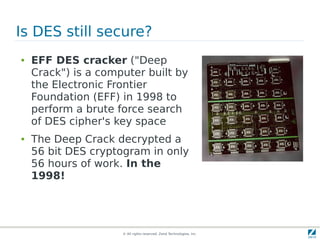
●   EFF DES cracker ("Deep
    Crack") is a computer built by
    the Electronic Frontier
    Foundation (EFF) in 1998 to
    perform a brute force search
    of DES cipher's key space
●   The Deep Crack decrypted a
    56 bit DES cryptogram in only
    56 hours of work. In the
    1998!


                     © All rights reserved. Zend Technologies, Inc.
Examples of strong cryptography
●   Strong:
       ▶   PGP, OpenPGP, GnuPG
       ▶   AES, Blowfish, Twofish
       ▶   RSA (key ≥ 2048 bit)
●   Not strong:
       ▶   DES
       ▶   WEP (Wired Equivalent Privacy)
       ▶   SSL 40 bit, international version
       ▶   All the classic ciphers (Enigma, ROT13, Vigenère,
              etc)


                         © All rights reserved. Zend Technologies, Inc.
Not only encryption
●   Strong cryptography is not only related to
    encryption.
●   It can also be used to describe hashing and
    unique identifier
●   In this usage, the term means difficult to
    guess


                    © All rights reserved. Zend Technologies, Inc.
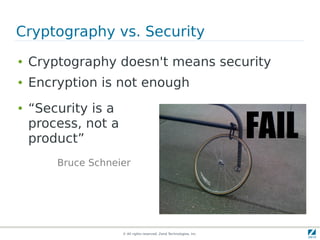
Cryptography vs. Security
●   Cryptography doesn't means security
●   Encryption is not enough
●   “Security is a
    process, not a
    product”
        Bruce Schneier


                     © All rights reserved. Zend Technologies, Inc.
Complexity vs. Security


●   There are no complex
    systems that are secure.
●   “Complexity is the wrost
    enemy of security, and it
    always comes in the form of
    features or options”

       N. Ferguson, B. Schneier

                             © All rights reserved. Zend Technologies, Inc.
Cryptography in PHP


      © All rights reserved. Zend Technologies, Inc.
Cryptography in PHP
●   crypt()
●   Mcrypt
●   Hash
●   OpenSSL


              © All rights reserved. Zend Technologies, Inc.
crypt()
 ●   One-way string hashing
 ●   Support strong cryptography
        ▶   bcrypt, sha-256, sha-512
 ●   PHP 5.3.0 – bcrypt support
 ●   PHP 5.3.2 – sha-256/512


                      © All rights reserved. Zend Technologies, Inc.
Mcrypt
●   Mcrypt is an interface to the mcrypt library,
    which supports a wide variety of block
    algorithms
●   It support the following encryption algorithms:
       ▶   3DES, ARCFOUR, BLOWFISH, CAST, DES,
             ENIGMA, GOST, IDEA (non-free),
             LOKI97, MARS, PANAMA, RIJNDAEL, RC2,
             RC4, RC6, SAFER, SERPENT, SKIPJACK,
             TEAN, TWOFISH, WAKE, XTEA


                    © All rights reserved. Zend Technologies, Inc.
Hash
●   The Hash extension requires no external libraries
    and is enabled by default as of PHP 5.1.2.
●   This extension replace the old mhash extension
●   With this extension you can generate hash values
    or HMAC (Hash-based Message Authentication
    Code)
●   Supported hash algorithms: MD4, MD5, SHA1,
    SHA256, SHA384, SHA512, RIPEMD, RIPEMD,
    WHIRLPOOL, GOST, TIGER, HAVAL, etc


                    © All rights reserved. Zend Technologies, Inc.
OpenSSL
●   The OpenSSL extension uses the functions of the
    OpenSSL project for generation and verification of
    signatures and for sealing (encrypting) and
    opening (decrypting) data
●   You can use OpenSSL to protect data using public
    key cryptography with the RSA algorithm.


                    © All rights reserved. Zend Technologies, Inc.
Use standard algorithms

                                                 ● AES (RIJNDAEL), FIST 197
                                                   standard since 2001
                                                 ● BLOWFISH

                                                 ● TWOFISH

                                                 ● SHA-256, 384, 512

                                                 ● RSA


             © All rights reserved. Zend Technologies, Inc.
Examples and
Best practices


   © All rights reserved. Zend Technologies, Inc.
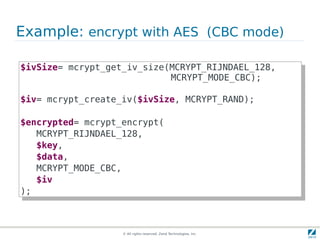
Example: encrypt with AES (CBC mode)

$ivSize= mcrypt_get_iv_size(MCRYPT_RIJNDAEL_128,
 $ivSize= mcrypt_get_iv_size(MCRYPT_RIJNDAEL_128,
                             MCRYPT_MODE_CBC);
                              MCRYPT_MODE_CBC);

$iv= mcrypt_create_iv($ivSize, MCRYPT_RAND);
 $iv= mcrypt_create_iv($ivSize, MCRYPT_RAND);

$encrypted= mcrypt_encrypt(
 $encrypted= mcrypt_encrypt(
    MCRYPT_RIJNDAEL_128,
     MCRYPT_RIJNDAEL_128,
    $key,
     $key,
    $data,
     $data,
    MCRYPT_MODE_CBC,
     MCRYPT_MODE_CBC,
    $iv
     $iv
);
 );


                   © All rights reserved. Zend Technologies, Inc.
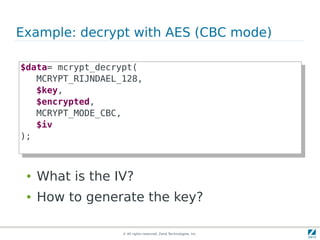
Example: decrypt with AES (CBC mode)

$data= mcrypt_decrypt(
 $data= mcrypt_decrypt(
    MCRYPT_RIJNDAEL_128,
     MCRYPT_RIJNDAEL_128,
    $key,
     $key,
    $encrypted,
     $encrypted,
    MCRYPT_MODE_CBC,
     MCRYPT_MODE_CBC,
    $iv
     $iv
);
 );


 ●   What is the IV?
 ●   How to generate the key?

                    © All rights reserved. Zend Technologies, Inc.
Initialization vector (IV)

 ●   In cryptography, an Initialization
     Vector (IV) is a fixed-size input to a
     cryptographic primitive that is typically
     required to be random or pseudorandom
 ●   The IV is not a secret, you can send it
     in plaintext
 ●   Usually IV is stored before the encrypted
     message


                  © All rights reserved. Zend Technologies, Inc.
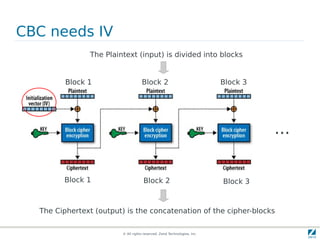
CBC needs IV
               The Plaintext (input) is divided into blocks


         Block 1                    Block 2                               Block 3


                                                                                    ...


        Block 1                      Block 2                              Block 3


  The Ciphertext (output) is the concatenation of the cipher-blocks

                         © All rights reserved. Zend Technologies, Inc.
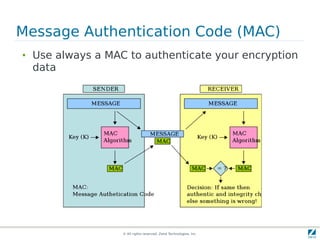
Message Authentication Code (MAC)
●
    Use always a MAC to authenticate your encryption
    data


                    © All rights reserved. Zend Technologies, Inc.
Hash-based MAC (HMAC) in PHP
●   In PHP we can generate an HMAC using the
    hash_hmac() function:

    hash_hmac($algo, $msg, $key);

    $algo is the hash algorithm to use (i.e. sha256)
    $msg is the message
    $key is the secret for the HMAC
●   Combining with encryption:
       ▶   Encrypt and after HMAC of the encrypted
             message
       ▶   HMAC of the message and after encryption

                      © All rights reserved. Zend Technologies, Inc.
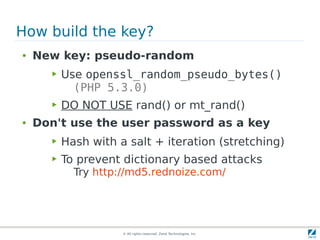
How build the key?
●   New key: pseudo-random
      ▶   Use openssl_random_pseudo_bytes()
            (PHP 5.3.0)
      ▶   DO NOT USE rand() or mt_rand()
●   Don't use the user password as a key
      ▶   Hash with a salt + iteration (stretching)
      ▶   To prevent dictionary based attacks
            Try http://md5.rednoize.com/


                     © All rights reserved. Zend Technologies, Inc.
Pseudo random key

function pseudoRandomKey($size) {{
 function pseudoRandomKey($size)
     if(function_exists('openssl_random_pseudo_bytes')) {{
      if(function_exists('openssl_random_pseudo_bytes'))
        $rnd == openssl_random_pseudo_bytes($size, $strong);
         $rnd    openssl_random_pseudo_bytes($size, $strong);
        if($strong === TRUE)
         if($strong === TRUE)
          return $rnd;
           return $rnd;
     }}
     $sha=''; $rnd='';
      $sha=''; $rnd='';
     for ($i=0;$i<$size;$i++) {{
      for ($i=0;$i<$size;$i++)
        $sha= hash('sha256',$sha.mt_rand());
         $sha= hash('sha256',$sha.mt_rand());
        $char= mt_rand(0,62);
         $char= mt_rand(0,62);
        $rnd.= chr(hexdec($sha[$char].$sha[$char+1]));
         $rnd.= chr(hexdec($sha[$char].$sha[$char+1]));
     }}
     return $rnd;
      return $rnd;
}}


                        © All rights reserved. Zend Technologies, Inc.
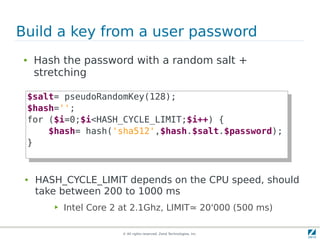
Build a key from a user password
●    Hash the password with a random salt +
     stretching

    $salt= pseudoRandomKey(128);
     $salt= pseudoRandomKey(128);
    $hash='';
     $hash='';
    for ($i=0;$i<HASH_CYCLE_LIMIT;$i++) {
     for ($i=0;$i<HASH_CYCLE_LIMIT;$i++) {
        $hash= hash('sha512',$hash.$salt.$password);
         $hash= hash('sha512',$hash.$salt.$password);
    }}


 ●   HASH_CYCLE_LIMIT depends on the CPU speed, should
     take between 200 to 1000 ms
         ▶   Intel Core 2 at 2.1Ghz, LIMIT≃ 20'000 (500 ms)

                          © All rights reserved. Zend Technologies, Inc.
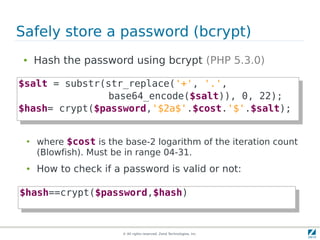
Safely store a password (bcrypt)
 ●   Hash the password using bcrypt (PHP 5.3.0)

$salt = substr(str_replace('+', '.',
 $salt = substr(str_replace('+', '.',
                base64_encode($salt)), 0, 22);
                 base64_encode($salt)), 0, 22);
$hash= crypt($password,'$2a$'.$cost.'$'.$salt);
 $hash= crypt($password,'$2a$'.$cost.'$'.$salt);

 ●
     where $cost is the base-2 logarithm of the iteration count
     (Blowfish). Must be in range 04-31.
 ●   How to check if a password is valid or not:

$hash==crypt($password,$hash)
 $hash==crypt($password,$hash)


                        © All rights reserved. Zend Technologies, Inc.
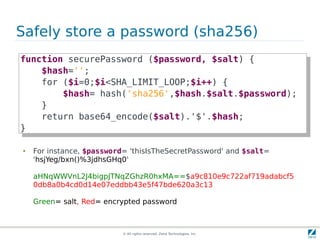
Safely store a password (sha256)
function securePassword ($password, $salt) {
 function securePassword ($password, $salt) {
    $hash='';
     $hash='';
    for ($i=0;$i<SHA_LIMIT_LOOP;$i++) {
     for ($i=0;$i<SHA_LIMIT_LOOP;$i++) {
        $hash= hash('sha256',$hash.$salt.$password);
         $hash= hash('sha256',$hash.$salt.$password);
    }}
    return base64_encode($salt).'$'.$hash;
     return base64_encode($salt).'$'.$hash;
}}
●   For instance, $password= 'thisIsTheSecretPassword' and $salt=
    'hsjYeg/bxn()%3jdhsGHq0'

    aHNqWWVnL2J4bigpJTNqZGhzR0hxMA==$a9c810e9c722af719adabcf5
    0db8a0b4cd0d14e07eddbb43e5f47bde620a3c13

    Green= salt, Red= encrypted password


                           © All rights reserved. Zend Technologies, Inc.
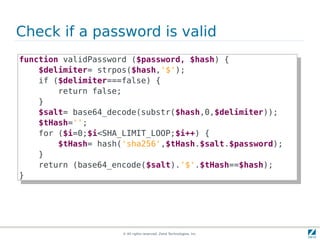
Check if a password is valid
function validPassword ($password, $hash) {{
 function validPassword ($password, $hash)
    $delimiter= strpos($hash,'$');
     $delimiter= strpos($hash,'$');
    if ($delimiter===false) {{
     if ($delimiter===false)
        return false;
         return false;
    }}
    $salt= base64_decode(substr($hash,0,$delimiter));
     $salt= base64_decode(substr($hash,0,$delimiter));
    $tHash='';
     $tHash='';
    for ($i=0;$i<SHA_LIMIT_LOOP;$i++) {{
     for ($i=0;$i<SHA_LIMIT_LOOP;$i++)
        $tHash= hash('sha256',$tHash.$salt.$password);
         $tHash= hash('sha256',$tHash.$salt.$password);
    }}
    return (base64_encode($salt).'$'.$tHash==$hash);
     return (base64_encode($salt).'$'.$tHash==$hash);
}}


                     © All rights reserved. Zend Technologies, Inc.
Generate public and private keys

$privateKey = openssl_pkey_new(array(
 $privateKey = openssl_pkey_new(array(
   'private_key_bits' => 2048,
     'private_key_bits' => 2048,
   'private_key_type' => OPENSSL_KEYTYPE_RSA
     'private_key_type' => OPENSSL_KEYTYPE_RSA
));
 ));

openssl_pkey_export_to_file($privateKey,,
 openssl_pkey_export_to_file($privateKey
'/path/to/privatekey', $passphrase);
 '/path/to/privatekey', $passphrase);

$keyDetails = openssl_pkey_get_details($privateKey);
 $keyDetails = openssl_pkey_get_details($privateKey);
file_put_contents('/path/to/publickey',
 file_put_contents('/path/to/publickey',
$keyDetails['key']);
 $keyDetails['key']);


                   © All rights reserved. Zend Technologies, Inc.
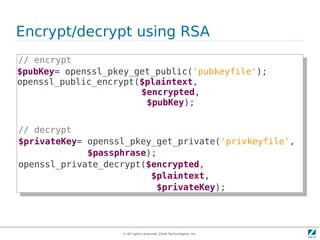
Encrypt/decrypt using RSA
// encrypt
 // encrypt
$pubKey= openssl_pkey_get_public('pubkeyfile');
 $pubKey= openssl_pkey_get_public('pubkeyfile');
openssl_public_encrypt($plaintext,
 openssl_public_encrypt($plaintext,
                        $encrypted,
                         $encrypted,
                         $pubKey);
                          $pubKey);

// decrypt
 // decrypt
$privateKey= openssl_pkey_get_private('privkeyfile',
 $privateKey= openssl_pkey_get_private('privkeyfile',
             $passphrase);
              $passphrase);
openssl_private_decrypt($encrypted,
 openssl_private_decrypt($encrypted,
                         $plaintext,
                          $plaintext,
                          $privateKey);
                           $privateKey);


                   © All rights reserved. Zend Technologies, Inc.
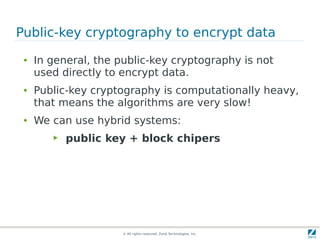
Public-key cryptography to encrypt data
 ●   In general, the public-key cryptography is not
     used directly to encrypt data.
 ●   Public-key cryptography is computationally heavy,
     that means the algorithms are very slow!
 ●   We can use hybrid systems:
        ▶   public key + block chipers


                      © All rights reserved. Zend Technologies, Inc.
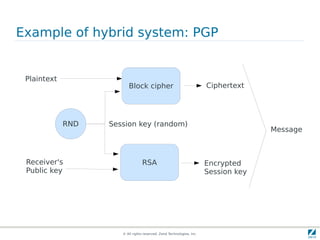
Example of hybrid system: PGP


 Plaintext
                         Block cipher                                  Ciphertext


             RND   Session key (random)
                                                                                     Message


 Receiver's                       RSA                                  Encrypted
 Public key                                                            Session key


                      © All rights reserved. Zend Technologies, Inc.
Some resources (books and papers)
●   N.Ferguson, B.Schneier, and T. Kohno, “Cryptography
      Engineering” John Wiley & Sons, 2010
●   N. Ferguson, B.Schneier, “Pratical Cryptography” Wiley,
      2003
●   C. Snyder, M.Southwell, “Pro PHP Security”, Apress, 2005
●   Chris Chiflett, “Essential PHP Security”, O'Reilly, 2006
●   Norman D. Jorstad, Landgrave T. Smith, Jr. “Cryptographic
      Algorithm Metrics”, Institute for Defense Analyses, 1997
●   Z. Benenson, U. Kühn, S.Lucks, “Cryptographic Attack
       Metrics” Dependability Metrics 2005


                         © All rights reserved. Zend Technologies, Inc.
Some resources (web)
●   PHP Cryptography Extensions,
      http://www.php.net/manual/en/refs.crypto.php
●   crypt(), http://nl.php.net/manual/en/function.crypt.php
●   Cracking MD5 and SHA-1, http://md5.rednoize.com/
●   A Guide to Cryptography in PHP,
      http://www.devx.com/webdev/Article/37821
●   How To Safely Store A Password,
      http://codahale.com/how-to-safely-store-a-password/
●   Zimuel's blog, Strong Cryptography in PHP
●   Zimuel's blog, Encrypt Session data in PHP


                        © All rights reserved. Zend Technologies, Inc.
Thank you!
●    Twitter:
          ▶   @ezimuel
●   Blog:
          ▶   http://www.zimuel.it/blog
●   GitHub:
          ▶   https://github.com/ezimuel


    © Copyright of the pictures used in this presentation:
    • TotalFail.blogspot.com

    • Windows Azure: Building a Secure Backup System

    • Borja Sotomayor “Globus Toolkit 4 Programmer's Tutorial”


                             © All rights reserved. Zend Technologies, Inc.
Questions?


             © All rights reserved. Zend Technologies, Inc.

Strong cryptography in PHP

  • 1.
    Strong Cryptography inPHP by Enrico Zimuel (enrico@zend.com) Senior Software Engineer Zend Framework Core Team Zend Technologies Ltd Dutch PHP Conference, 21th May 2011 © All rights reserved. Zend Technologies, Inc.
  • 2.
    About me ● Software Engineer since 1996 ● Enjoying PHP since 1999 ● PHP Engineer at Zend Technologies, in the Zend Framework Team ● Author of two books on security and cryptography (in italian) ● B.Sc. (Hons) in Computer Science and Economics ● Blog on Programming in PHP: http://www.zimuel.it/blog © All rights reserved. Zend Technologies, Inc.
  • 3.
    Strong cryptography Strong cryptography is the usage of cryptographic systems or components that are considered highly resistant to cryptanalytic attacks © All rights reserved. Zend Technologies, Inc.
  • 4.
    A metric ofsecurity? ● How we can say that an encryption algorithm is considered highly resistant to cryptanalytic attacks? ● It's difficult to answer to this question. We don't have a simple metric of security. ● We have to consider: ▶ Brute forcing attacks ▶ Theoretical attacks ▶ Implementation attacks © All rights reserved. Zend Technologies, Inc.
  • 5.
    A metric ofsecurity? (2) ● Brute forcing attacks ▶ Space key is 2n, where n is the byte size of the key. If n=128, K= 3,4 * 1038 ● Theoretical attacks ▶ Break the encryption with mathematical attacks. ▶ Reduce the space key, for AES 256bit, an attack can reduce K to 299.5 ● Implementation attacks ▶ Based on the implementation © All rights reserved. Zend Technologies, Inc.
  • 6.
    Is DES stillsecure? ● EFF DES cracker ("Deep Crack") is a computer built by the Electronic Frontier Foundation (EFF) in 1998 to perform a brute force search of DES cipher's key space ● The Deep Crack decrypted a 56 bit DES cryptogram in only 56 hours of work. In the 1998! © All rights reserved. Zend Technologies, Inc.
  • 7.
    Examples of strongcryptography ● Strong: ▶ PGP, OpenPGP, GnuPG ▶ AES, Blowfish, Twofish ▶ RSA (key ≥ 2048 bit) ● Not strong: ▶ DES ▶ WEP (Wired Equivalent Privacy) ▶ SSL 40 bit, international version ▶ All the classic ciphers (Enigma, ROT13, Vigenère, etc) © All rights reserved. Zend Technologies, Inc.
  • 8.
    Not only encryption ● Strong cryptography is not only related to encryption. ● It can also be used to describe hashing and unique identifier ● In this usage, the term means difficult to guess © All rights reserved. Zend Technologies, Inc.
  • 9.
    Cryptography vs. Security ● Cryptography doesn't means security ● Encryption is not enough ● “Security is a process, not a product” Bruce Schneier © All rights reserved. Zend Technologies, Inc.
  • 10.
    Complexity vs. Security ● There are no complex systems that are secure. ● “Complexity is the wrost enemy of security, and it always comes in the form of features or options” N. Ferguson, B. Schneier © All rights reserved. Zend Technologies, Inc.
  • 11.
    Cryptography in PHP © All rights reserved. Zend Technologies, Inc.
  • 12.
    Cryptography in PHP ● crypt() ● Mcrypt ● Hash ● OpenSSL © All rights reserved. Zend Technologies, Inc.
  • 13.
    crypt() ● One-way string hashing ● Support strong cryptography ▶ bcrypt, sha-256, sha-512 ● PHP 5.3.0 – bcrypt support ● PHP 5.3.2 – sha-256/512 © All rights reserved. Zend Technologies, Inc.
  • 14.
    Mcrypt ● Mcrypt is an interface to the mcrypt library, which supports a wide variety of block algorithms ● It support the following encryption algorithms: ▶ 3DES, ARCFOUR, BLOWFISH, CAST, DES, ENIGMA, GOST, IDEA (non-free), LOKI97, MARS, PANAMA, RIJNDAEL, RC2, RC4, RC6, SAFER, SERPENT, SKIPJACK, TEAN, TWOFISH, WAKE, XTEA © All rights reserved. Zend Technologies, Inc.
  • 15.
    Hash ● The Hash extension requires no external libraries and is enabled by default as of PHP 5.1.2. ● This extension replace the old mhash extension ● With this extension you can generate hash values or HMAC (Hash-based Message Authentication Code) ● Supported hash algorithms: MD4, MD5, SHA1, SHA256, SHA384, SHA512, RIPEMD, RIPEMD, WHIRLPOOL, GOST, TIGER, HAVAL, etc © All rights reserved. Zend Technologies, Inc.
  • 16.
    OpenSSL ● The OpenSSL extension uses the functions of the OpenSSL project for generation and verification of signatures and for sealing (encrypting) and opening (decrypting) data ● You can use OpenSSL to protect data using public key cryptography with the RSA algorithm. © All rights reserved. Zend Technologies, Inc.
  • 17.
    Use standard algorithms ● AES (RIJNDAEL), FIST 197 standard since 2001 ● BLOWFISH ● TWOFISH ● SHA-256, 384, 512 ● RSA © All rights reserved. Zend Technologies, Inc.
  • 18.
    Examples and Best practices © All rights reserved. Zend Technologies, Inc.
  • 19.
    Example: encrypt withAES (CBC mode) $ivSize= mcrypt_get_iv_size(MCRYPT_RIJNDAEL_128, $ivSize= mcrypt_get_iv_size(MCRYPT_RIJNDAEL_128, MCRYPT_MODE_CBC); MCRYPT_MODE_CBC); $iv= mcrypt_create_iv($ivSize, MCRYPT_RAND); $iv= mcrypt_create_iv($ivSize, MCRYPT_RAND); $encrypted= mcrypt_encrypt( $encrypted= mcrypt_encrypt( MCRYPT_RIJNDAEL_128, MCRYPT_RIJNDAEL_128, $key, $key, $data, $data, MCRYPT_MODE_CBC, MCRYPT_MODE_CBC, $iv $iv ); ); © All rights reserved. Zend Technologies, Inc.
  • 20.
    Example: decrypt withAES (CBC mode) $data= mcrypt_decrypt( $data= mcrypt_decrypt( MCRYPT_RIJNDAEL_128, MCRYPT_RIJNDAEL_128, $key, $key, $encrypted, $encrypted, MCRYPT_MODE_CBC, MCRYPT_MODE_CBC, $iv $iv ); ); ● What is the IV? ● How to generate the key? © All rights reserved. Zend Technologies, Inc.
  • 21.
    Initialization vector (IV) ● In cryptography, an Initialization Vector (IV) is a fixed-size input to a cryptographic primitive that is typically required to be random or pseudorandom ● The IV is not a secret, you can send it in plaintext ● Usually IV is stored before the encrypted message © All rights reserved. Zend Technologies, Inc.
  • 22.
    CBC needs IV The Plaintext (input) is divided into blocks Block 1 Block 2 Block 3 ... Block 1 Block 2 Block 3 The Ciphertext (output) is the concatenation of the cipher-blocks © All rights reserved. Zend Technologies, Inc.
  • 23.
    Message Authentication Code(MAC) ● Use always a MAC to authenticate your encryption data © All rights reserved. Zend Technologies, Inc.
  • 24.
    Hash-based MAC (HMAC)in PHP ● In PHP we can generate an HMAC using the hash_hmac() function: hash_hmac($algo, $msg, $key); $algo is the hash algorithm to use (i.e. sha256) $msg is the message $key is the secret for the HMAC ● Combining with encryption: ▶ Encrypt and after HMAC of the encrypted message ▶ HMAC of the message and after encryption © All rights reserved. Zend Technologies, Inc.
  • 25.
    How build thekey? ● New key: pseudo-random ▶ Use openssl_random_pseudo_bytes() (PHP 5.3.0) ▶ DO NOT USE rand() or mt_rand() ● Don't use the user password as a key ▶ Hash with a salt + iteration (stretching) ▶ To prevent dictionary based attacks Try http://md5.rednoize.com/ © All rights reserved. Zend Technologies, Inc.
  • 26.
    Pseudo random key functionpseudoRandomKey($size) {{ function pseudoRandomKey($size) if(function_exists('openssl_random_pseudo_bytes')) {{ if(function_exists('openssl_random_pseudo_bytes')) $rnd == openssl_random_pseudo_bytes($size, $strong); $rnd openssl_random_pseudo_bytes($size, $strong); if($strong === TRUE) if($strong === TRUE) return $rnd; return $rnd; }} $sha=''; $rnd=''; $sha=''; $rnd=''; for ($i=0;$i<$size;$i++) {{ for ($i=0;$i<$size;$i++) $sha= hash('sha256',$sha.mt_rand()); $sha= hash('sha256',$sha.mt_rand()); $char= mt_rand(0,62); $char= mt_rand(0,62); $rnd.= chr(hexdec($sha[$char].$sha[$char+1])); $rnd.= chr(hexdec($sha[$char].$sha[$char+1])); }} return $rnd; return $rnd; }} © All rights reserved. Zend Technologies, Inc.
  • 27.
    Build a keyfrom a user password ● Hash the password with a random salt + stretching $salt= pseudoRandomKey(128); $salt= pseudoRandomKey(128); $hash=''; $hash=''; for ($i=0;$i<HASH_CYCLE_LIMIT;$i++) { for ($i=0;$i<HASH_CYCLE_LIMIT;$i++) { $hash= hash('sha512',$hash.$salt.$password); $hash= hash('sha512',$hash.$salt.$password); }} ● HASH_CYCLE_LIMIT depends on the CPU speed, should take between 200 to 1000 ms ▶ Intel Core 2 at 2.1Ghz, LIMIT≃ 20'000 (500 ms) © All rights reserved. Zend Technologies, Inc.
  • 28.
    Safely store apassword (bcrypt) ● Hash the password using bcrypt (PHP 5.3.0) $salt = substr(str_replace('+', '.', $salt = substr(str_replace('+', '.', base64_encode($salt)), 0, 22); base64_encode($salt)), 0, 22); $hash= crypt($password,'$2a$'.$cost.'$'.$salt); $hash= crypt($password,'$2a$'.$cost.'$'.$salt); ● where $cost is the base-2 logarithm of the iteration count (Blowfish). Must be in range 04-31. ● How to check if a password is valid or not: $hash==crypt($password,$hash) $hash==crypt($password,$hash) © All rights reserved. Zend Technologies, Inc.
  • 29.
    Safely store apassword (sha256) function securePassword ($password, $salt) { function securePassword ($password, $salt) { $hash=''; $hash=''; for ($i=0;$i<SHA_LIMIT_LOOP;$i++) { for ($i=0;$i<SHA_LIMIT_LOOP;$i++) { $hash= hash('sha256',$hash.$salt.$password); $hash= hash('sha256',$hash.$salt.$password); }} return base64_encode($salt).'$'.$hash; return base64_encode($salt).'$'.$hash; }} ● For instance, $password= 'thisIsTheSecretPassword' and $salt= 'hsjYeg/bxn()%3jdhsGHq0' aHNqWWVnL2J4bigpJTNqZGhzR0hxMA==$a9c810e9c722af719adabcf5 0db8a0b4cd0d14e07eddbb43e5f47bde620a3c13 Green= salt, Red= encrypted password © All rights reserved. Zend Technologies, Inc.
  • 30.
    Check if apassword is valid function validPassword ($password, $hash) {{ function validPassword ($password, $hash) $delimiter= strpos($hash,'$'); $delimiter= strpos($hash,'$'); if ($delimiter===false) {{ if ($delimiter===false) return false; return false; }} $salt= base64_decode(substr($hash,0,$delimiter)); $salt= base64_decode(substr($hash,0,$delimiter)); $tHash=''; $tHash=''; for ($i=0;$i<SHA_LIMIT_LOOP;$i++) {{ for ($i=0;$i<SHA_LIMIT_LOOP;$i++) $tHash= hash('sha256',$tHash.$salt.$password); $tHash= hash('sha256',$tHash.$salt.$password); }} return (base64_encode($salt).'$'.$tHash==$hash); return (base64_encode($salt).'$'.$tHash==$hash); }} © All rights reserved. Zend Technologies, Inc.
  • 31.
    Generate public andprivate keys $privateKey = openssl_pkey_new(array( $privateKey = openssl_pkey_new(array( 'private_key_bits' => 2048, 'private_key_bits' => 2048, 'private_key_type' => OPENSSL_KEYTYPE_RSA 'private_key_type' => OPENSSL_KEYTYPE_RSA )); )); openssl_pkey_export_to_file($privateKey,, openssl_pkey_export_to_file($privateKey '/path/to/privatekey', $passphrase); '/path/to/privatekey', $passphrase); $keyDetails = openssl_pkey_get_details($privateKey); $keyDetails = openssl_pkey_get_details($privateKey); file_put_contents('/path/to/publickey', file_put_contents('/path/to/publickey', $keyDetails['key']); $keyDetails['key']); © All rights reserved. Zend Technologies, Inc.
  • 32.
    Encrypt/decrypt using RSA //encrypt // encrypt $pubKey= openssl_pkey_get_public('pubkeyfile'); $pubKey= openssl_pkey_get_public('pubkeyfile'); openssl_public_encrypt($plaintext, openssl_public_encrypt($plaintext, $encrypted, $encrypted, $pubKey); $pubKey); // decrypt // decrypt $privateKey= openssl_pkey_get_private('privkeyfile', $privateKey= openssl_pkey_get_private('privkeyfile', $passphrase); $passphrase); openssl_private_decrypt($encrypted, openssl_private_decrypt($encrypted, $plaintext, $plaintext, $privateKey); $privateKey); © All rights reserved. Zend Technologies, Inc.
  • 33.
    Public-key cryptography toencrypt data ● In general, the public-key cryptography is not used directly to encrypt data. ● Public-key cryptography is computationally heavy, that means the algorithms are very slow! ● We can use hybrid systems: ▶ public key + block chipers © All rights reserved. Zend Technologies, Inc.
  • 34.
    Example of hybridsystem: PGP Plaintext Block cipher Ciphertext RND Session key (random) Message Receiver's RSA Encrypted Public key Session key © All rights reserved. Zend Technologies, Inc.
  • 35.
    Some resources (booksand papers) ● N.Ferguson, B.Schneier, and T. Kohno, “Cryptography Engineering” John Wiley & Sons, 2010 ● N. Ferguson, B.Schneier, “Pratical Cryptography” Wiley, 2003 ● C. Snyder, M.Southwell, “Pro PHP Security”, Apress, 2005 ● Chris Chiflett, “Essential PHP Security”, O'Reilly, 2006 ● Norman D. Jorstad, Landgrave T. Smith, Jr. “Cryptographic Algorithm Metrics”, Institute for Defense Analyses, 1997 ● Z. Benenson, U. Kühn, S.Lucks, “Cryptographic Attack Metrics” Dependability Metrics 2005 © All rights reserved. Zend Technologies, Inc.
  • 36.
    Some resources (web) ● PHP Cryptography Extensions, http://www.php.net/manual/en/refs.crypto.php ● crypt(), http://nl.php.net/manual/en/function.crypt.php ● Cracking MD5 and SHA-1, http://md5.rednoize.com/ ● A Guide to Cryptography in PHP, http://www.devx.com/webdev/Article/37821 ● How To Safely Store A Password, http://codahale.com/how-to-safely-store-a-password/ ● Zimuel's blog, Strong Cryptography in PHP ● Zimuel's blog, Encrypt Session data in PHP © All rights reserved. Zend Technologies, Inc.
  • 37.
    Thank you! ● Twitter: ▶ @ezimuel ● Blog: ▶ http://www.zimuel.it/blog ● GitHub: ▶ https://github.com/ezimuel © Copyright of the pictures used in this presentation: • TotalFail.blogspot.com • Windows Azure: Building a Secure Backup System • Borja Sotomayor “Globus Toolkit 4 Programmer's Tutorial” © All rights reserved. Zend Technologies, Inc.
  • 38.
    Questions? © All rights reserved. Zend Technologies, Inc.