RSA
Cryptosystem
Presented By:
Anurag Admuthe (2253009)
Yash Adashetty (2103028)
Under The Guidance Of : Prof. G. G. Shingan
Index :
 Introduction to Cryptography
 Features of cryptography
 RSA Algorithm
 RSA and DRSA
 Algorithm for generating the keys
 Encryption & Decryption
 Example
 Advantages and Disadvantages
 References
Introduction:
● Cryptography:
 In digital Communication, Security is implemented using cryptography. Cryptography
is a technique of converting message into ciphertext for hiding confidential data.
 There are two types of cryptography:
1)Symmetric key cryptography
2)Asymmetric key cryptography
 In 1971, Diffie Hellman key exchange program was introduced for Asymmetric key
cryptography.
 RSA Algorithm was one of the first algorithms implemented in Asymmetric key
cryptography.
Features of cryptography :
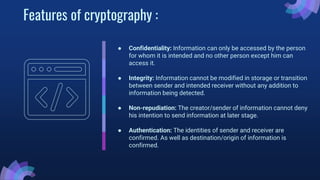
● Confidentiality: Information can only be accessed by the person
for whom it is intended and no other person except him can
access it.
● Integrity: Information cannot be modified in storage or transition
between sender and intended receiver without any addition to
information being detected.
● Non-repudiation: The creator/sender of information cannot deny
his intention to send information at later stage.
● Authentication: The identities of sender and receiver are
confirmed. As well as destination/origin of information is
confirmed.
● The RSA algorithm is an asymmetric cryptography algorithm; this means that it uses
a public key and a private key (i.e. two different, mathematically linked keys). As their
names suggest, a public key is shared publicly, while a private key is secret and must
not be shared with anyone.
● The RSA algorithm is named after those who invented it in 1978: Ron Rivest, Adi
Shamir, and Leonard Adleman.
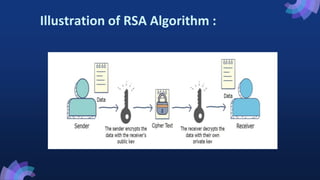
● The following illustration highlights how asymmetric cryptography works:
RSA (Rivest-Shamir-Adleman) Algorithm :
Illustration of RSA Algorithm :
RSA and Dependent RSA(DRSA) :
 DRSA is a variant of RSA, which overcomes the semantic security
problem of data-leak in RSA.
 This process of cryptography contains 3 phases,
1. Key Generation
2. Encryption
3. Decryption
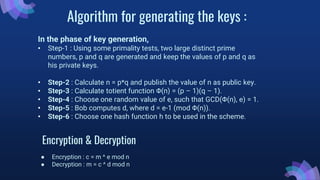
Algorithm for generating the keys :
In the phase of key generation,
• Step-1 : Using some primality tests, two large distinct prime
numbers, p and q are generated and keep the values of p and q as
his private keys.
• Step-2 : Calculate n = p*q and publish the value of n as public key.
• Step-3 : Calculate totient function Φ(n) = (p – 1)(q – 1).
• Step-4 : Choose one random value of e, such that GCD(Φ(n), e) = 1.
• Step-5 : Bob computes d, where d = e-1 (mod Φ(n)).
• Step-6 : Choose one hash function h to be used in the scheme.
Encryption & Decryption
● Encryption : c = m ^ e mod n
● Decryption : m = c ^ d mod n
Example :
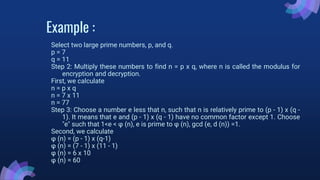
Select two large prime numbers, p, and q.
p = 7
q = 11
Step 2: Multiply these numbers to find n = p x q, where n is called the modulus for
encryption and decryption.
First, we calculate
n = p x q
n = 7 x 11
n = 77
Step 3: Choose a number e less that n, such that n is relatively prime to (p - 1) x (q -
1). It means that e and (p - 1) x (q - 1) have no common factor except 1. Choose
"e" such that 1<e < φ (n), e is prime to φ (n), gcd (e, d (n)) =1.
Second, we calculate
φ (n) = (p - 1) x (q-1)
φ (n) = (7 - 1) x (11 - 1)
φ (n) = 6 x 10
φ (n) = 60
Example :
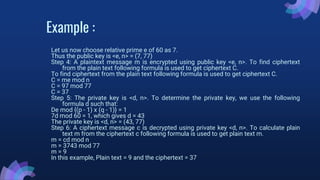
Let us now choose relative prime e of 60 as 7.
Thus the public key is <e, n> = (7, 77)
Step 4: A plaintext message m is encrypted using public key <e, n>. To find ciphertext
from the plain text following formula is used to get ciphertext C.
To find ciphertext from the plain text following formula is used to get ciphertext C.
C = me mod n
C = 97 mod 77
C = 37
Step 5: The private key is <d, n>. To determine the private key, we use the following
formula d such that:
De mod {(p - 1) x (q - 1)} = 1
7d mod 60 = 1, which gives d = 43
The private key is <d, n> = (43, 77)
Step 6: A ciphertext message c is decrypted using private key <d, n>. To calculate plain
text m from the ciphertext c following formula is used to get plain text m.
m = cd mod n
m = 3743 mod 77
m = 9
In this example, Plain text = 9 and the ciphertext = 37
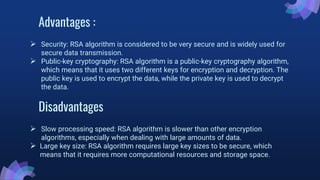
Advantages :
 Security: RSA algorithm is considered to be very secure and is widely used for
secure data transmission.
 Public-key cryptography: RSA algorithm is a public-key cryptography algorithm,
which means that it uses two different keys for encryption and decryption. The
public key is used to encrypt the data, while the private key is used to decrypt
the data.
Disadvantages
 Slow processing speed: RSA algorithm is slower than other encryption
algorithms, especially when dealing with large amounts of data.
 Large key size: RSA algorithm requires large key sizes to be secure, which
means that it requires more computational resources and storage space.
Reference :
On Using The First Variant of Dependent RSA Encryption Scheme
to Secure Text: A Tutorial
by : D Rachmawati and M A Budiman 2020
Rivest Shamir Adleman Algorithm and its variant : DRSA.pptx

Rivest Shamir Adleman Algorithm and its variant : DRSA.pptx

  • 1.
    RSA Cryptosystem Presented By: Anurag Admuthe(2253009) Yash Adashetty (2103028) Under The Guidance Of : Prof. G. G. Shingan
  • 2.
    Index :  Introductionto Cryptography  Features of cryptography  RSA Algorithm  RSA and DRSA  Algorithm for generating the keys  Encryption & Decryption  Example  Advantages and Disadvantages  References
  • 3.
    Introduction: ● Cryptography:  Indigital Communication, Security is implemented using cryptography. Cryptography is a technique of converting message into ciphertext for hiding confidential data.  There are two types of cryptography: 1)Symmetric key cryptography 2)Asymmetric key cryptography  In 1971, Diffie Hellman key exchange program was introduced for Asymmetric key cryptography.  RSA Algorithm was one of the first algorithms implemented in Asymmetric key cryptography.
  • 4.
    Features of cryptography: ● Confidentiality: Information can only be accessed by the person for whom it is intended and no other person except him can access it. ● Integrity: Information cannot be modified in storage or transition between sender and intended receiver without any addition to information being detected. ● Non-repudiation: The creator/sender of information cannot deny his intention to send information at later stage. ● Authentication: The identities of sender and receiver are confirmed. As well as destination/origin of information is confirmed.
  • 5.
    ● The RSAalgorithm is an asymmetric cryptography algorithm; this means that it uses a public key and a private key (i.e. two different, mathematically linked keys). As their names suggest, a public key is shared publicly, while a private key is secret and must not be shared with anyone. ● The RSA algorithm is named after those who invented it in 1978: Ron Rivest, Adi Shamir, and Leonard Adleman. ● The following illustration highlights how asymmetric cryptography works: RSA (Rivest-Shamir-Adleman) Algorithm :
  • 6.
  • 7.
    RSA and DependentRSA(DRSA) :  DRSA is a variant of RSA, which overcomes the semantic security problem of data-leak in RSA.  This process of cryptography contains 3 phases, 1. Key Generation 2. Encryption 3. Decryption
  • 8.
    Algorithm for generatingthe keys : In the phase of key generation, • Step-1 : Using some primality tests, two large distinct prime numbers, p and q are generated and keep the values of p and q as his private keys. • Step-2 : Calculate n = p*q and publish the value of n as public key. • Step-3 : Calculate totient function Φ(n) = (p – 1)(q – 1). • Step-4 : Choose one random value of e, such that GCD(Φ(n), e) = 1. • Step-5 : Bob computes d, where d = e-1 (mod Φ(n)). • Step-6 : Choose one hash function h to be used in the scheme. Encryption & Decryption ● Encryption : c = m ^ e mod n ● Decryption : m = c ^ d mod n
  • 9.
    Example : Select twolarge prime numbers, p, and q. p = 7 q = 11 Step 2: Multiply these numbers to find n = p x q, where n is called the modulus for encryption and decryption. First, we calculate n = p x q n = 7 x 11 n = 77 Step 3: Choose a number e less that n, such that n is relatively prime to (p - 1) x (q - 1). It means that e and (p - 1) x (q - 1) have no common factor except 1. Choose "e" such that 1<e < φ (n), e is prime to φ (n), gcd (e, d (n)) =1. Second, we calculate φ (n) = (p - 1) x (q-1) φ (n) = (7 - 1) x (11 - 1) φ (n) = 6 x 10 φ (n) = 60
  • 10.
    Example : Let usnow choose relative prime e of 60 as 7. Thus the public key is <e, n> = (7, 77) Step 4: A plaintext message m is encrypted using public key <e, n>. To find ciphertext from the plain text following formula is used to get ciphertext C. To find ciphertext from the plain text following formula is used to get ciphertext C. C = me mod n C = 97 mod 77 C = 37 Step 5: The private key is <d, n>. To determine the private key, we use the following formula d such that: De mod {(p - 1) x (q - 1)} = 1 7d mod 60 = 1, which gives d = 43 The private key is <d, n> = (43, 77) Step 6: A ciphertext message c is decrypted using private key <d, n>. To calculate plain text m from the ciphertext c following formula is used to get plain text m. m = cd mod n m = 3743 mod 77 m = 9 In this example, Plain text = 9 and the ciphertext = 37
  • 11.
    Advantages :  Security:RSA algorithm is considered to be very secure and is widely used for secure data transmission.  Public-key cryptography: RSA algorithm is a public-key cryptography algorithm, which means that it uses two different keys for encryption and decryption. The public key is used to encrypt the data, while the private key is used to decrypt the data. Disadvantages  Slow processing speed: RSA algorithm is slower than other encryption algorithms, especially when dealing with large amounts of data.  Large key size: RSA algorithm requires large key sizes to be secure, which means that it requires more computational resources and storage space.
  • 12.
    Reference : On UsingThe First Variant of Dependent RSA Encryption Scheme to Secure Text: A Tutorial by : D Rachmawati and M A Budiman 2020